belt TOYOTA 4RUNNER 1998 User Guide
[x] Cancel search | Manufacturer: TOYOTA, Model Year: 1998, Model line: 4RUNNER, Model: TOYOTA 4RUNNER 1998Pages: 350, PDF Size: 2.25 MB
Page 47 of 350
4RUNNER (1998)
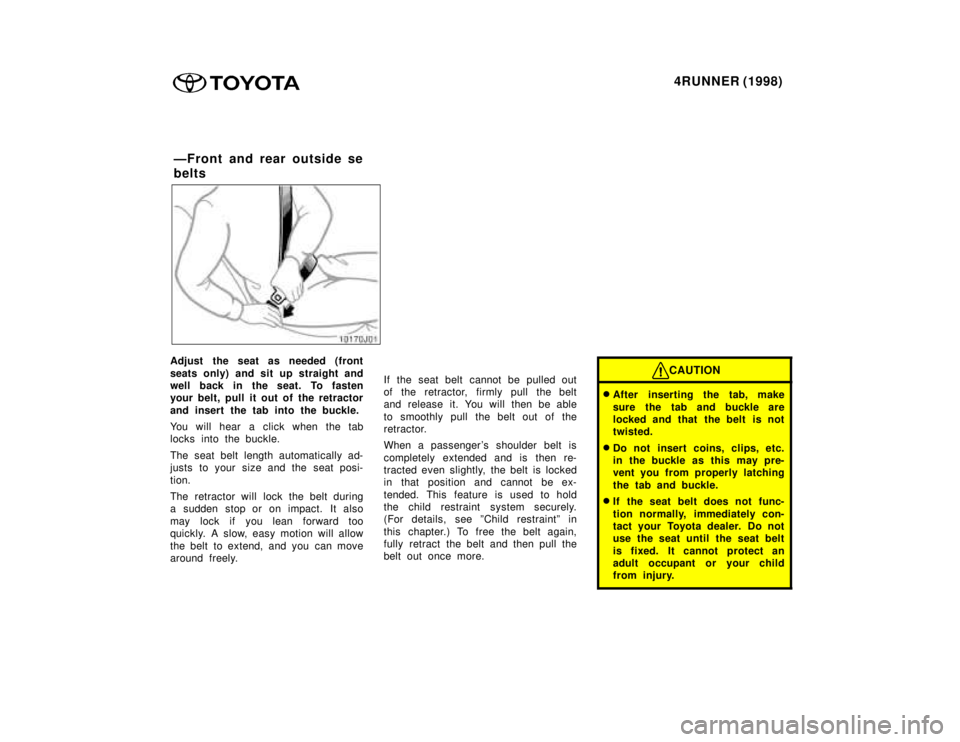
Adjust the seat as needed (front
seats only) and sit up straight and
well back in the seat. To fasten
your belt, pull it out of the retractor
and insert the tab into the buckle.
You will hear a click when the tab
locks into the buckle.
The seat belt length automatically ad-
justs to your size and the seat posi-
tion.
The retractor will lock the belt during
a sudden stop or on impact. It also
may lock if you lean forward too
quickly. A slow, easy motion will allow
the belt to extend, and you can move
around freely. If the seat belt cannot be pulled out
of the retractor, firmly pull the belt
and release it. You will then be able
to smoothly pull the belt out of the
retractor.
When a passenger 's shoulder belt is
completely extended and is then re-
tracted even slightly, the belt is locked
in that position and cannot be ex-
tended. This feature is used to hold
the child restraint system securely.
(For details, see ºChild restraintº in
this chapter.) To free the belt again,
fully retract the belt and then pull the
belt out once more.CAUTION
After inserting the tab, make
sure the tab and buckle are
locked and that the belt is not
twisted.
Do not insert coins, clips, etc.
in the buckle as this may pre-
vent you from properly latching
the tab and buckle.
If the seat belt does not func-
tion normally, immediately con-
tact your Toyota dealer. Do not
use the seat until the seat belt
is fixed. It cannot protect an
adult occupant or your child
from injury.
ÐFront and rear outside se
belts
Page 48 of 350
4RUNNER (1998)
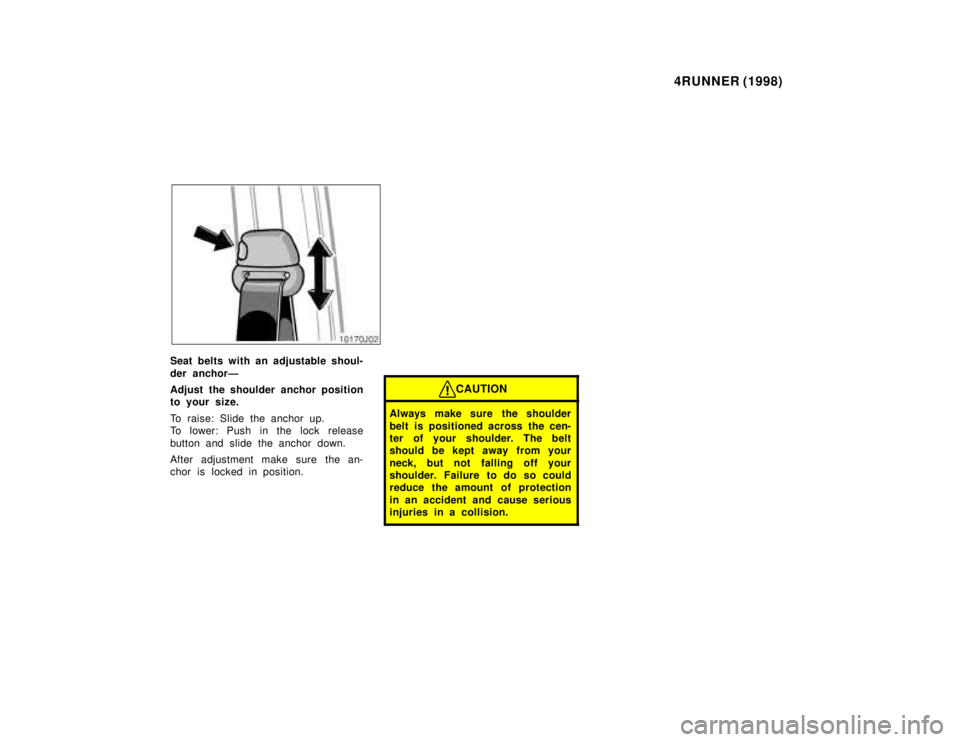
Seat belts with an adjustable shoul-
der anchorÐ
Adjust the shoulder anchor position
to your size.
To raise: Slide the anchor up.
To lower: Push in the lock release
button and slide the anchor down.
After adjustment make sure the an-
chor is locked in position.
CAUTION
Always make sure the shoulder
belt is positioned across the cen-
ter of your shoulder. The belt
should be kept away from your
neck, but not fa lling off your
shoulder. Failure to do so could
reduce the amount of protection
in an accident and cause serious
injuries in a collision.
Page 49 of 350
4RUNNER (1998)
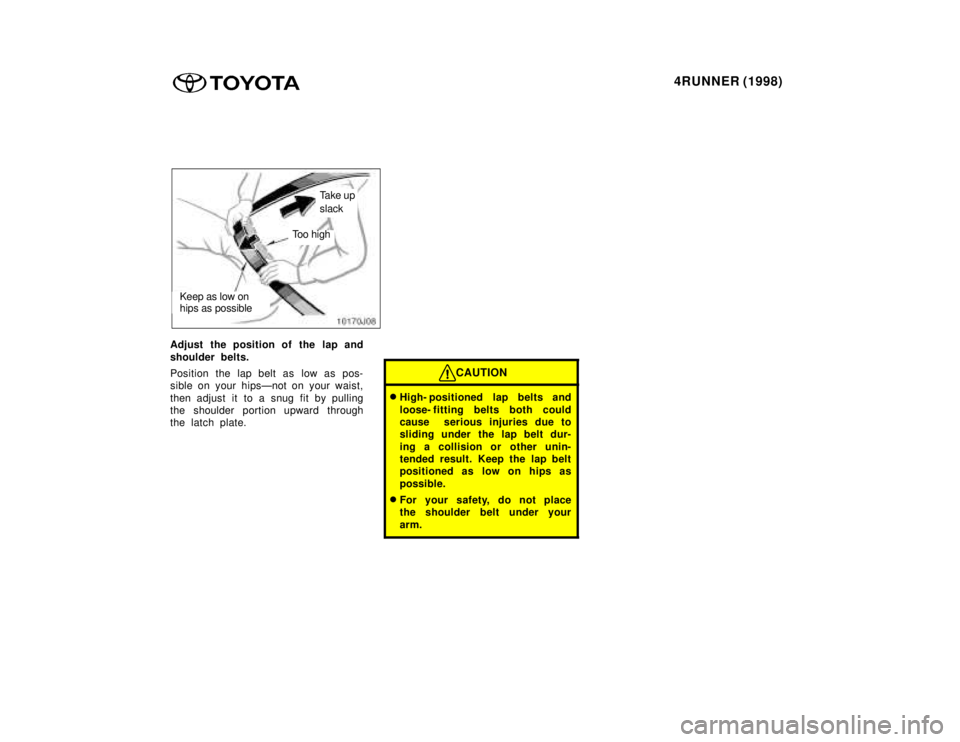
Take up slack
Too high
Keep as low on hips as possible
Adjust the position of the lap and
shoulder belts.
Position the lap belt as low as pos-
sible on your hipsÐnot on your waist,
then adjust it to a snug fit by pulling
the shoulder portion upward through
the latch plate.
CAUTION
High- positioned lap belts and
loose- fitting belts both could
cause serious injuries due to
sliding under the lap belt dur-
ing a collision or other unin-
tended result. Keep the lap belt
positioned as low on hips as
possible.
For your safety, do not place
the shoulder belt under your
arm.
Page 50 of 350
4RUNNER (1998)
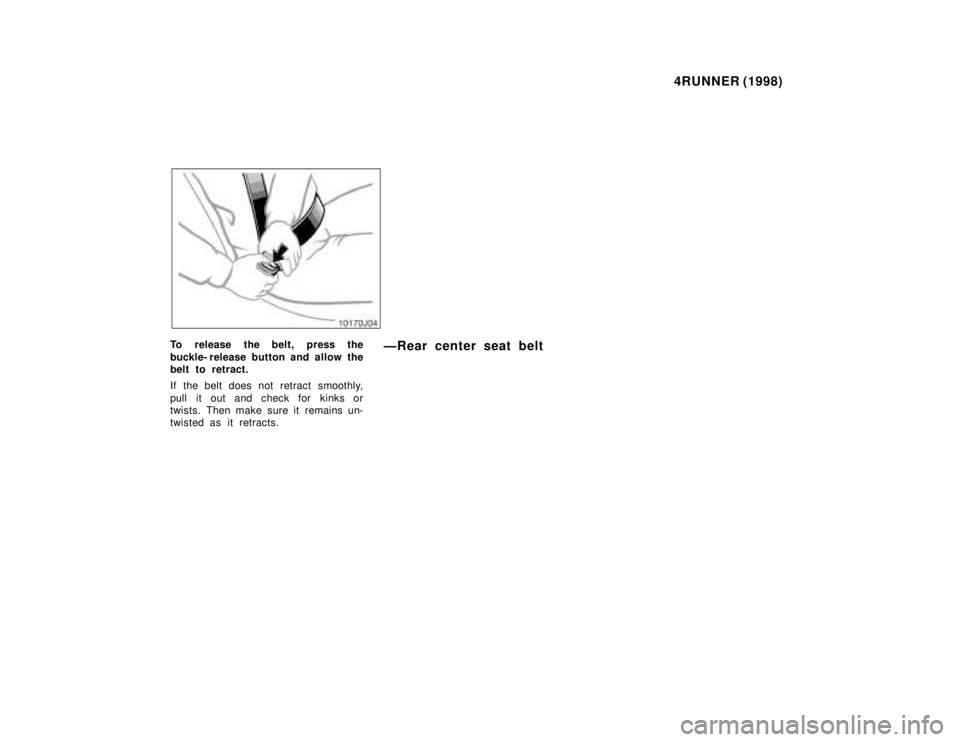
To release the belt, press the
buckle- release button and allow the
belt to retract.
If the belt does not retract smoothly,
pull it out and check for kinks or
twists. Then make sure it remains un-
twisted as it retracts. ÐRear center seat belt
Page 51 of 350
4RUNNER (1998)
Lengthen
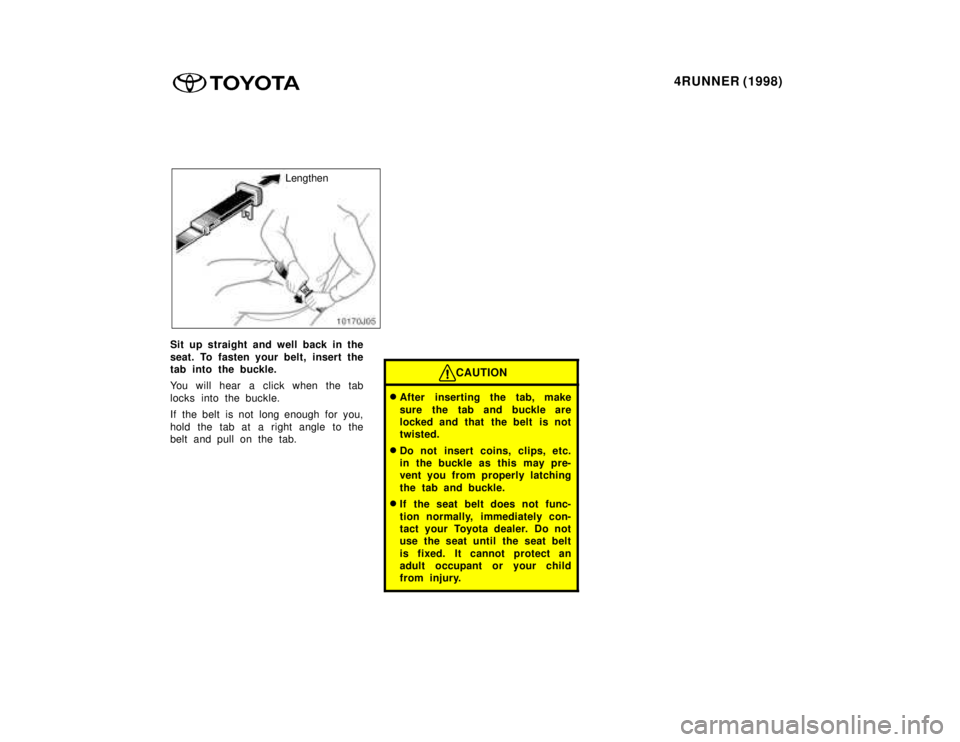
Sit up straight and well back in the
seat. To fasten your belt, insert the
tab into the buckle.
You will hear a click when the tab
locks into the buckle.
If the belt is not long enough for you,
hold the tab at a right angle to the
belt and pull on the tab.
CAUTION
After inserting the tab, make
sure the tab and buckle are
locked and that the belt is not
twisted.
Do not insert coins, clips, etc.
in the buckle as this may pre-
vent you from properly latching
the tab and buckle.
If the seat belt does not func-
tion normally, immediately con-
tact your Toyota dealer. Do not
use the seat until the seat belt
is fixed. It cannot protect an
adult occupant or your child
from injury.
Page 52 of 350
4RUNNER (1998)
Too high
Adjust to a snug fit
Keep as low on hips as possible
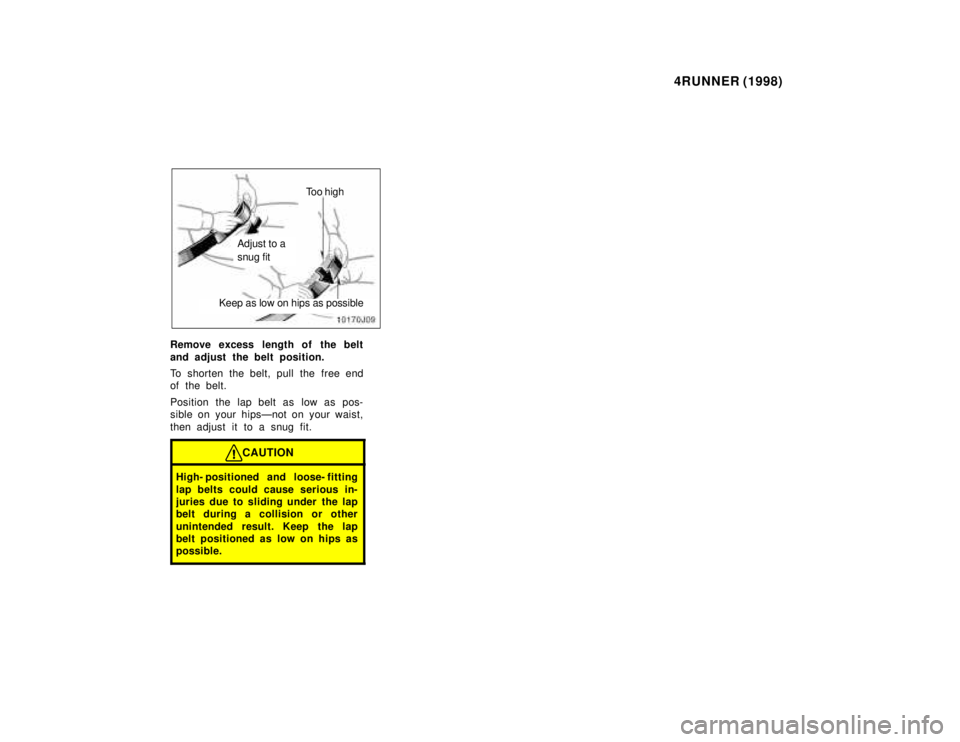
Remove excess length of the belt
and adjust the belt position.
To shorten the belt, pull the free end
of the belt.
Position the lap belt as low as pos-
sible on your hipsÐnot on your waist,
then adjust it to a snug fit.
CAUTION
High- positioned and loose- fitting
lap belts could cause serious in-
juries due to sliding under the lap
belt during a collision or other
unintended result. Keep the lap
belt positioned as low on hips as
possible.
Page 53 of 350
4RUNNER (1998)
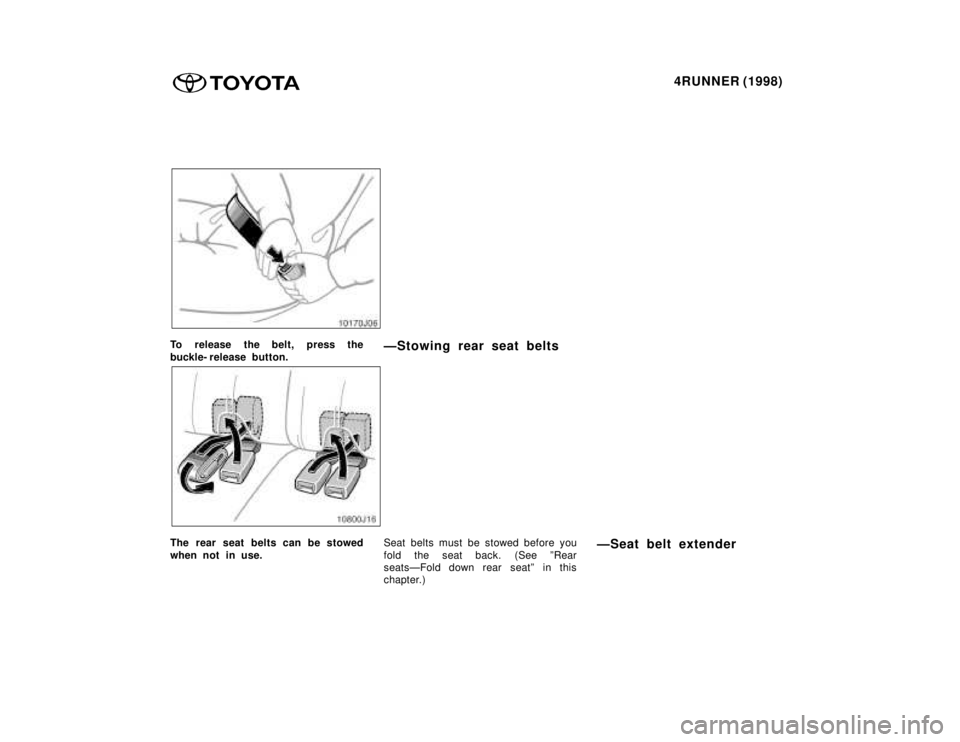
To release the belt, press the
buckle- release button. ÐStowing rear seat belts
The rear seat belts can be stowed
when not in use.Seat belts must be stowed before you
fold the seat back. (See ºRear
seatsÐFold down rear seatº in this
chapter.)ÐSeat belt extender
Page 54 of 350
4RUNNER (1998)
If your seat belt cannot be fastened
securely because it is not long enough,
a personalized seat belt extender is
available from your Toyota dealer free
of charge.
Please contact your local Toyota deal-
er so that the dealer can order the
proper required length for the extend-
er. Bring the heaviest coat you expect
to wear for proper measurement and
selection of length. Additional ordering
information is available at your Toyota
dealer.
CAUTION
When using the seat belt extend-
er, observe the following. Failure
to follow these instructions could
result in less effectiveness of the
seat belt restraint system in case
of vehicle accident, increasing the
chance of personal injury. Never use the seat belt extend-
er if you can fasten the seat
belt without it.
Remember that the extender
provided for you may not be
safe when used on a different
vehicle, or for another person
or at a different seating posi-
tion than the one originally in-
tended for.
3SRS driver and front
passenger airbags
Page 55 of 350
4RUNNER (1998)
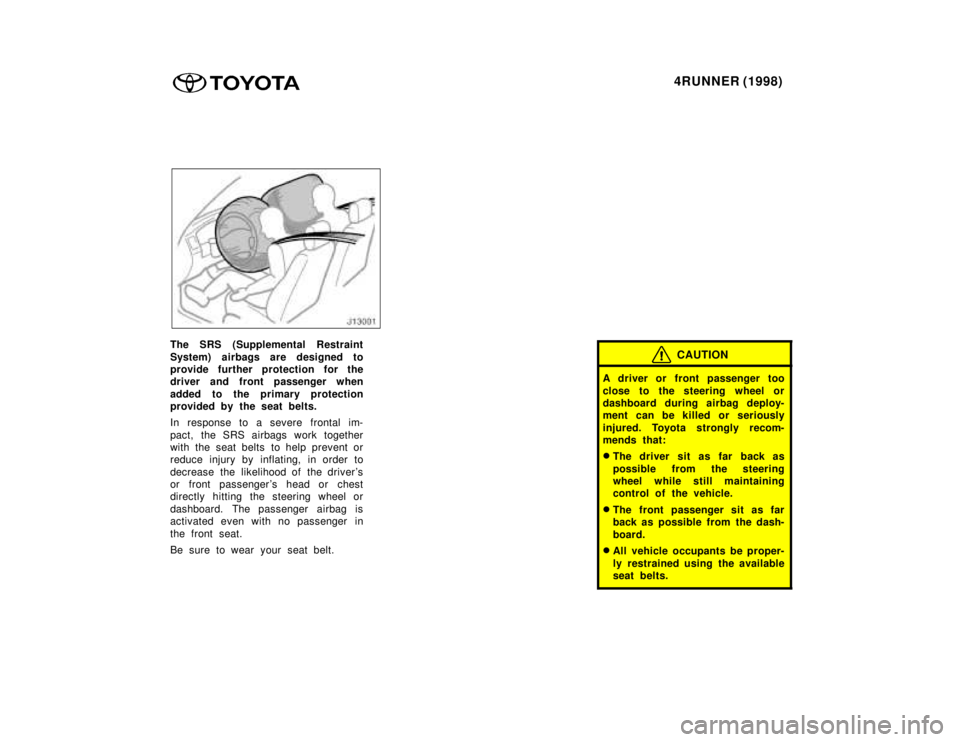
The SRS (Supplemental Restraint
System) airbags are designed to
provide further protection for the
driver and front passenger when
added to the primary protection
provided by the seat belts.
In response to a severe frontal im-
pact, the SRS airbags work together
with the seat belts to help prevent or
reduce injury by inflating, in order to
decrease the likelihood of the driver 's
or front passenger 's head or chest
directly hitting the steering wheel or
dashboard. The passenger airbag is
activated even with no passenger in
the front seat.
Be sure to wear your seat belt.CAUTION
A driver or front passenger too
close to the steering wheel or
dashboard during airbag deploy-
ment can be killed or seriously
injured. Toyota strongly recom-
mends that: The driver sit as far back as
possible from the steering
wheel while still maintaining
control of the vehicle.
The front passenger sit as far
back as possible from the dash-
board.
All vehicle occupants be proper-
ly restrained using the available
seat belts.
Page 57 of 350
4RUNNER (1998)
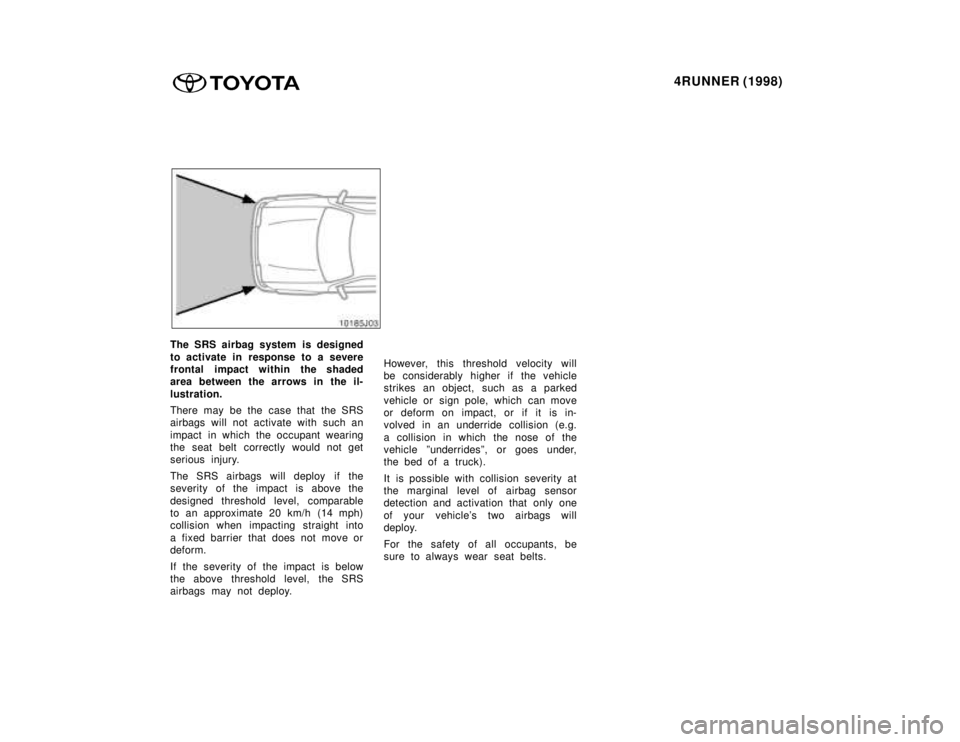
The SRS airbag system is designed
to activate in response to a severe
frontal impact within the shaded
area between the arrows in the il-
lustration.
There may be the case that the SRS
airbags will not activate with such an
impact in which the occupant wearing
the seat belt correctly would not get
serious injury.
The SRS airbags will deploy if the
severity of the impact is above the
designed threshold level, comparable
to an approximate 20 km/h (14 mph)
collision when impacting straight into
a fixed barrier that does not move or
deform.
If the severity of the impact is below
the above threshold level, the SRS
airbags may not deploy. However, this threshold velocity will
be considerably higher if the vehicle
strikes an object, such as a parked
vehicle or sign pole, which can move
or deform on impact, or if it is in-
volved in an underride collision (e.g.
a collision in which the nose of the
vehicle ºunderridesº, or goes under,
the bed of a truck).
It is possible with collision severity at
the marginal level of airbag sensor
detection and activation that only one
of your vehicle's two airbags will
deploy.
For the safety of all occupants, be
sure to always wear seat belts.