light TOYOTA 4RUNNER 1998 Manual PDF
[x] Cancel search | Manufacturer: TOYOTA, Model Year: 1998, Model line: 4RUNNER, Model: TOYOTA 4RUNNER 1998Pages: 350, PDF Size: 2.25 MB
Page 255 of 350
4RUNNER (1998)
(b) Starting a flooded engine
If the engine will not start, your
engine may be flooded because of
repeated cranking.
If this happens, turn the key to
ºSTARTº with the accelerator pedal
held down. Keep the key and acceler-
ator pedal so for 15 seconds and re-
lease them. Then try starting the en-
gine with your foot off the accelerator
pedal.
If the engine does not start after 15
seconds of cranking, release the key,
wait a few minutes and try again.
If the engine still will not start, it
needs adjustment or repair. Call a
Toyota dealer or qualified repair shop
for assistance.
NOTICE
Do not crank for more than 30 seconds at a time. This may over-heat the starter and wiring sys-tems.
(c) Jump starting
To avoid serious personal injury
and damage to your vehicle which
might result from battery explosion,
acid burns, electrical burns, or dam-
aged electronic components, these
instructions must be followed pre-
cisely.
If you are unsure about how to follow
this procedure, we strongly recom-
mend that you seek the help of a
competent mechanic or towing service.
CAUTION
Batteries contain sulfuric acid
which is poisonous and corro-
sive. Wear protective safety
glasses when jump starting, and
avoid spilling acid on your skin, clothing, or vehicle.
If you should accidentally get
acid on yourself or in your
eyes, remove any contaminated
clothing and flush the affected
area with water immediately.
Then get immediate medical
attention. If possible, continue
to apply water with a sponge or
cloth while en route to the med-
ical office.
The gas normally produced by
a battery will explode if a flame
or spark is brought near. Use
only standardized jumper cables
and do not smoke or light a
match while jump starting.
NOTICE
The battery used for boosting
must be 12 V. Do not jump startunless you are sure that thebooster battery is correct.
Page 256 of 350

4RUNNER (1998)
JUMP STARTING PROCEDURE
1. If the booster battery is installed in another vehicle, make sure the ve-
hicles are not touching. Turn off all
unnecessary lights and accesso-
ries.
2. If required, remove all the vent plugs from the booster and dis-
charged batteries. Lay a cloth over
the open vents on the batteries.
(This helps reduce the explosion
hazard, personal injuries and
burns.)
3. If the engine in the vehicle with the booster battery is not running, start
it and let it run for a few minutes.
During jump starting run the engine
at about 2000 rpm with the accel-
erator pedal lightly depressed.
Page 260 of 350
4RUNNER (1998)
CAUTION
When making the connections, to
avoid serious injury, do not lean
over the battery or accidentally
let the jumper cables or clamps
touch anything except the correct
battery terminals or the ground.
5. Start your engine in the normal
way. After starting, run it at about
2000 rpm for several minutes with
the accelerator pedal lightly de-
pressed.
6. Carefully disconnect the cables in the exact reverse order: the nega-
tive cable and then the positive
cable.
7. Carefully dispose of the battery cover clothsÐthey may now con-
tain sulfuric acid.
8. If removed, replace all the battery vent plugs.
If the cause of your battery discharg-
ing is not apparent (for example,
lights left on), you should have it
checked. If your engine stalls while driving...
1. Reduce your speed gradually, keep- ing a straight line. Move cautiously
off the road to a safe place.
2. Turn on your emergency flashers.
3. Try starting the engine again.
If the engine will not start, see ºIf
your vehicle will not startº.
CAUTION
If the engine is not running, the
power assist for the brakes and
steering will not work so steering
and braking will be much harder
than usual.
If your vehicle overheats
If your engine coolant temperature
gauge indicates overheating, if you
experience a loss of power, or if
you hear a loud knocking or ping-
ing noise, the engine has probably
overheated. You should follow this
procedure... 1. Pull safely off the road, stop the vehicle and turn on your emergen-
cy flashers. Put the transmission in
ºPº (automatic) or neutral (manual)
and apply the parking brake. Turn
off the air conditioning if it is being
used.
2. If coolant or steam is boiling out of the radiator or reservoir, stop the
engine. Wait until the steam sub-
sides before opening the hood. If
there is no coolant boiling over or
steam, leave the engine running.
CAUTION
To help avoid personal injury,
keep the hood closed until there
is no steam. Escaping steam or
coolant is a sign of very high
pressure.
If your engine stalls while
driving
Page 261 of 350
4RUNNER (1998)
3. Visually check to see if the engine drive belt (fan belt) is broken or
loose. Look for obvious coolant
leaks from the radiator, hoses, and
under the vehicle. However, note
that water draining from the air
conditioning is normal if it has
been used.
CAUTION
When the engine is running, keep
hands and clothing away from the
moving fan and engine drive
belts.
4. If the engine drive belt is brokenor the coolant is leaking, stop the
engine immediately. Call a Toyota
dealer for assistance.
5. If the engine drive belt is O.K. and there are no obvious leaks, you
may help the engine cool down
more quickly by running it at about
1500 rpm for a few minutes with
the accelerator pedal lightly de-
pressed.
6. Check the coolant reservoir. If it is dry, add coolant to the reservoir
while the engine is running. Fill it
about half full.
CAUTION
Do not attempt to remove the ra-
diator cap when the engine and
radiator are hot. Serious injury
could result from scalding hot
fluid and steam blown out under
pressure.
7. After the engine coolant tempera-ture has cooled to normal, again
check the coolant level in the res-
ervoir. If necessary, bring it up to
half full again. Serious coolant loss
indicates a leak in the system. You
should have it checked as soon as
possible at your Toyota dealer. If you have a flat tireÐ
1. Reduce your speed gradually, keep- ing a straight line. Move cautiously
off the road to a safe place well
away from the traffic. Avoid stop-
ping on the center divider of a
highway. Park on a level spot with
firm ground.
2. Stop the engine and turn on your emergency flashers.
3. Firmly set the parking brake and put the transmission in ºPº (auto-
matic) or reverse (manual).
4. Have everyone get out of the ve- hicle on the side away from traffic.
5. Read the following instructions thoroughly.
CAUTION
When jacking, be sure to observe
the following to reduce the possi-
bility of personal injury: Follow jacking instructions.
Do not start or run the engine
while your vehicle is supported
by the jack.
Page 289 of 350
4RUNNER (1998)
Cleaning the interior
CAUTION
Do not wash the vehicle floor
with water, or allow water to get
onto the floor when cleaning the
vehicle interior or exterior. Water
may get into audio components
or other electrical components
above or under the floor carpet
(or mat) and cause a malfunction;
and it may cause body corrosion.
Vinyl interior
The vinyl upholstery may be easily
cleaned with a mild soap or deter-
gent and water.
First vacuum over the upholstery to
remove loose dirt. Then, using a
sponge or soft cloth, apply the soap
solution to the vinyl. After allowing it
to soak in for a few minutes to loosen
the dirt, remove the dirt and wipe off
the soap with a clean damp cloth. If
all the dirt does not come off, repeat
the procedure. Commercial foaming-
type vinyl cleaners are also available
which work well. Follow the manufac-
turer's instructions.
NOTICE
Do not use solvent, thinner, gaso- line or window cleaner on the in-terior.
Carpets
Use a good foam- type shampoo to
clean the carpets.
Begin by vacuuming thoroughly to re-
move as much dirt as possible. Sever-
al types of foam cleaners are avail-
able; some are in aerosol cans and
others are powders or liquids which
you mix with water to produce a foam.
To shampoo the carpets, use a
sponge or brush to apply the foam.
Rub in overlapping circles.
Do not apply waterÐthe best results
are obtained by keeping the carpet as
dry as possible. Read the shampoo
instructions and follow them closely.
Seat belts
The seat belts may be cleaned with
mild soap and water or with luke-
warm water.
Use a cloth or sponge. As you are
cleaning, check the belts for exces-
sive wear, fraying, or cuts.
NOTICE
Do not use dye or bleach on the
beltsÐit may weaken them.
Windows
The windows may be cleaned with
any household window cleaner.
NOTICE
When cleaning the inside of thewindows, be careful not toscratch or damage the heaterwires on the rear window.
Air conditioning control panel, car
audio, instrument panel, console
panel, and switches
Use a soft damp cloth for cleaning.
Soak a clean soft cloth in water or
lukewarm water then lightly wipe off
any dirt.
Page 290 of 350

4RUNNER (1998)
NOTICE
Do not use organic substances
(solvents, kerosene, alcohol,gasoline, etc.) or alkaline or acidic solutions. These chemi-
cals can cause discoloring,staining or peeling of the sur-face.
If you use cleaners or polishingagents, make sure their ingredi- ents do not include the sub-
stances mentioned above.
If you use a liquid car freshen-er, do not apill the liquid ontothe vehicle's interior surfaces. It may contain the ingredients
mentioned above. Immediatelyclean any spill using the meth-
od mentioned above.
Leather Interior
The leather upholstery may be
cleaned with neutral detergent for
wool.
Remove dirt using a soft cloth damp-
ened with 5% solution of neutral de-
tergent for wool. Then thoroughly wipe
off all traces of detergent with a clean
damp cloth. After cleaning or whenever any part of
the leather gets wet, dry with a soft
clean cloth. Allow the leather to dry
in a ventilated shaded area.
NOTICE
If a stain should fail to come
out with a neutral detergent, ap-ply a cleaner that does not con-tain an organic solvent.
Never use organic substances
such as benzine, alcohol orgasoline, or alkaline or acid
solutions for cleaning the leath-er as these could cause discol-oring.
Use of a nylon brush or synthe-tic fiber cloth, etc. may scratch
the fine grained surface of theleather.
Mildew may develop on soiledleather upholstery. Be especially
careful to avoid oil spots. Try
to keep your upholstery alwaysclean.
Long exposure to direct sun-
light may cause the leather sur-face to harden and shrink. Keepyour vehicle in a shaded area,
especially in the summer.
The interior of your vehicle isapt to heat up on hot summer
days, so avoid placing on the upholstery items made of vinyl
or plastic or containing wax asthese tend to stick to leatherwhen warm
.
Improper cleaning of the leather upholstery could result in dis-coloration or staining.
If you have any questions about the
cleaning of your Toyota, your local
Toyota dealer will be pleased to
answer them.
Page 294 of 350

4RUNNER (1998)
Tire surface and wheel nuts
Check the tires carefully for cuts,
damage or excessive wear. See Chap-
ter 7- 2 for additional information.
When checking the tires, make sure
no nuts are missing, and check the
nuts for looseness. Tighten them if
necessary.
Tire rotation
Rotate the tires every 12000 km (7500
miles). See Chapter 7- 2 for additional
information.
Fluid leaks
Check underneath for leaking fuel, oil,
water or other fluid after the vehicle
has been parked for a while. If you
smell fuel fumes or notice any leak,
have the cause found and corrected
immediately.
Doors and engine hood
Check that all doors including back
door operate smoothly and all latches
lock securely. Make sure the engine
hood secondary latch secures the
hood from opening when the primary
latch is released. INSIDE THE VEHICLE
Items listed below should be
checked regularly, e.g. while per-
forming periodic services, cleaning
the vehicle, etc.
Lights
Make sure the headlights, stop lights,
tail lights, turn signal lights, and other
lights are all working. Check headlight
aim.
Service reminder indicators and
warning buzzers
Check that all service reminder indica-
tors and warning buzzers function
properly.
Steering wheel
Check that it has the specified free-
play. Be alert for changes in steering
condition, such as hard steering or
strange noise.
Seats
Check that all seat controls such as
seat adjusters, seatback recliner, etc.
operate smoothly and that all latches
lock securely in any position. Check
that the head restraint move up and
down smoothly and that the locks hold
securely in any latched position. For
folding- down rear seatbacks, swing- up
rear seat cushions and detachable
temporary third seat, check that the
latches lock securely.Seat belts
Check that the seat belt system such
as buckles, retractors and anchors op-
erate properly and smoothly. Make
sure the belt webbing is not cut,
frayed, worn or damaged.
Accelerator pedal
Check the pedal for smooth operation
and uneven pedal effort or catching.
Clutch pedal
Check the pedal for smooth operation.
Brake pedal
Check the pedal for smooth operation
and that the pedal has the proper
clearance. Check the brake booster
function.
Brakes
At a safe place, check that the brakes
do not pull to one side when applied.
Parking brake
Check that the lever has the proper
travel and that, on a safe incline, your
vehicle is held securely with only the
parking brake applied.
Page 305 of 350

4RUNNER (1998)
Parts and tools
Here is a list of parts and tools you
will need on performing do- it- yourself
maintenance. Remember all Toyota
parts are designed in metric sizes, so
your tools must be metric.
Checking the engine oil level
Parts (if level is low): Engine oil API grade SH, ºEnergy-
Conserving IIº or SJ, ºEnergy-
Conservingº multigrade or ILSAC
multigrade having viscosity proper
for your climate
Tools: Rag or paper towel
Funnel (only for adding oil)
Checking the engine coolant level
Parts (if level is low): Ethylene- glycol antifreeze
Demineralized or distilled water
Tools: Funnel (only for adding coolant)
Checking brake fluid
Parts (if level is low): SAE J1703 or FMVSS No. 116
DOT 3 brake fluid
Tools: Rag or paper towel
Funnel (only for adding fluid) Checking power steering fluid
Parts (if level is low):
Automatic transmission fluid DEXRON II or III
Tools: Rag or paper towel
Funnel (only for adding fluid)
Checking battery condition
Tools: Warm water
Baking soda
Grease
Conventional wrench (for terminal
clamp bolts)
Checking and replacing fuses
Parts (if replacement is necessary): Fuse with same amperage rating
as original
Tools: Conventional wrench (for instrument
lower panel nut)
Adding washer fluid
Parts: Water
Washer fluid containing antifreeze
(for winter use)
Tools: Funnel Replacing light bulbs
Parts:
Bulb with same number and watt-
age rating as original (See charts
in ºReplacing light bulbsº in Chap-
ter 7- 3.)
Tools: Screwdriver
Page 308 of 350
4RUNNER (1998)
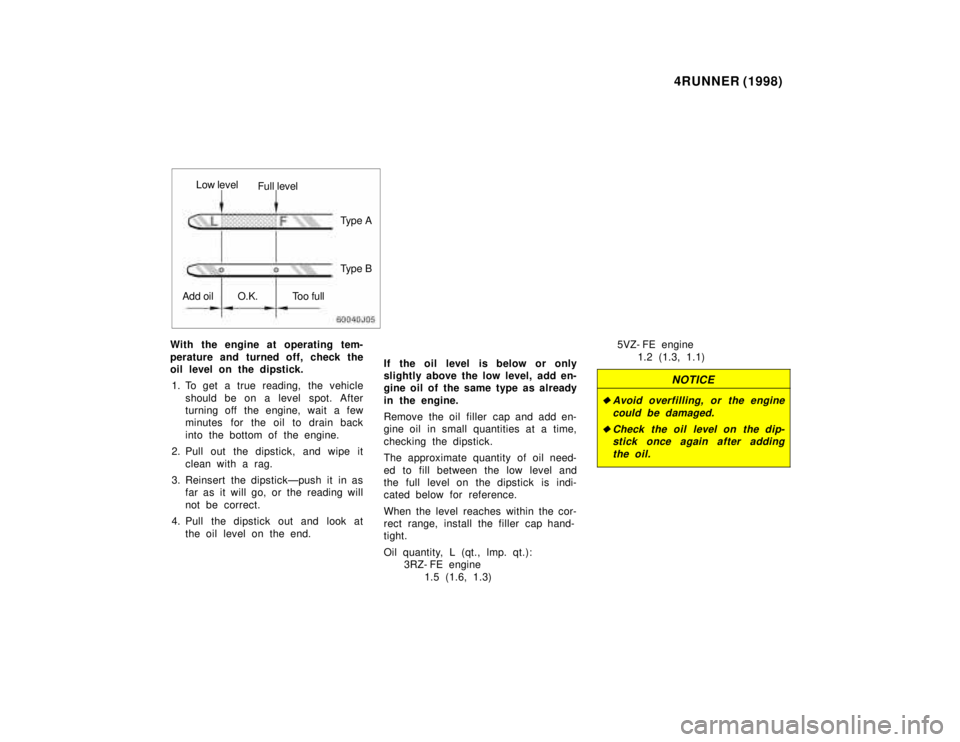
Low level
Full level
Type A
Type B
Add oil O.K. Too full
With the engine at operating tem-
perature and turned off, check the
oil level on the dipstick. 1. To get a true reading, the vehicle should be on a level spot. After
turning off the engine, wait a few
minutes for the oil to drain back
into the bottom of the engine.
2. Pull out the dipstick, and wipe it clean with a rag.
3. Reinsert the dipstickÐpush it in as far as it will go, or the reading will
not be correct.
4. Pull the dipstick out and look at the oil level on the end. If the oil level is below or only
slightly above the low level, add en-
gine oil of the same type as already
in the engine.
Remove the oil filler cap and add en-
gine oil in small quantities at a time,
checking the dipstick.
The approximate quantity of oil need-
ed to fill between the low level and
the full level on the dipstick is indi-
cated below for reference.
When the level reaches within the cor-
rect range, install the f
iller cap hand-
tight.
Oil quantity, L (qt., lmp. qt.): 3RZ- FE engine
1.5 (1.6, 1.3) 5VZ- FE engine
1.2 (1.3, 1.1)
NOTICE
Avoid overfilling, or the engine
could be damaged.
Check the oil level on the dip-stick once again after adding
the oil.
Page 312 of 350
4RUNNER (1998)
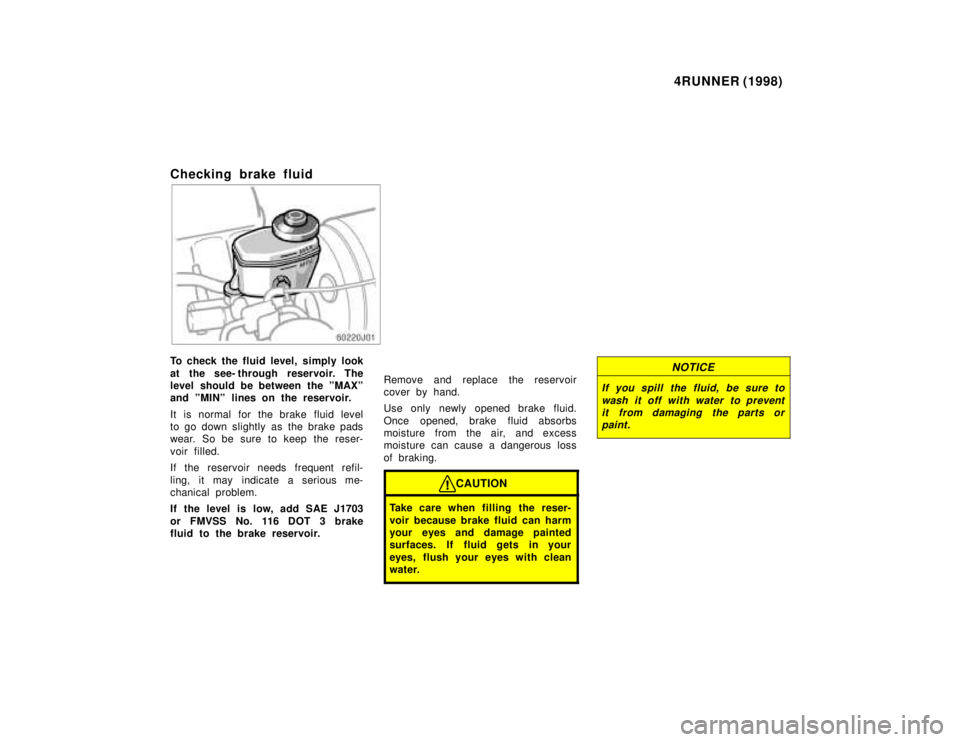
Checking brake fluid
To check the fluid level, simply look
at the see- through reservoir. The
level should be between the ºMAXº
and ºMINº lines on the reservoir.
It is normal for the brake fluid level
to go down slightly as the brake pads
wear. So be sure to keep the reser-
voir filled.
If the reservoir needs frequent refil-
ling, it may indicate a serious me-
chanical problem.
If the level is low, add SAE J1703
or FMVSS No. 116 DOT 3 brake
fluid to the brake reservoir. Remove and replace the reservoir
cover by hand.
Use only newly opened brake fluid.
Once opened, brake fluid absorbs
moisture from the air, and excess
moisture can cause a dangerous loss
of braking.
CAUTION
Take care when filling the r
eser-
voir because brake fluid can harm
your eyes and damage painted
surfaces. If fluid gets in your
eyes, flush your eyes with clean
water.
NOTICE
If you spill the fluid, be sure to
wash it off with water to preventit from damaging the parts orpaint.