engine TOYOTA 4RUNNER 2009 N280 / 5.G Workshop Manual
[x] Cancel search | Manufacturer: TOYOTA, Model Year: 2009, Model line: 4RUNNER, Model: TOYOTA 4RUNNER 2009 N280 / 5.GPages: 520, PDF Size: 10.74 MB
Page 187 of 520
187
2-4. Using other
driving systems
2
When driving
■Operating tips
The system will operate when the shift lever is in a position other than P.
However, to make effective use of the system it is recommended that the
shift lever be shifted to 2 or L.
■ The system will not operate when
The four-wheel drive control switch is in the H2 or H4 position.
■ The downhill assist control indicator flashes when
●The shift lever is in N.
● The four-wheel drive control switch is in the H2 or H4 position.
■ If the brake system overheats
The system will cease operation and a buzzer will sound to alert the driver.
Stop the vehicle in a safe place. (Ther e is no problem with continuing normal
driving.)
■ System malfunction
●The downhill assist control indicator does not come on when the engine
switch is turned to the ON position.
● The downhill assist control indicator does not come on when the DAC
switch is pressed.
In the above cases have your vehicle checked by your Toyota dealer.
CAUTION
■Do not rely excessively on the downhill assist control system
It may not be able to maintain a low speed over road surfaces on which slid-
ing can easily occur, such as extremely steep slopes or icy or muddy roads.
Page 190 of 520
190 2-4. Using other driving systems
To disable TRAC, AUTO LSD and/or VSC (2WD models and H2
mode on Multi-mode 4WD models)
If the vehicle gets stuck in fresh snow or mud, TRAC or VSC may
reduce power from the engine to the wheels. You may need to turn
the system off to enable you to rock the vehicle in order to free it.
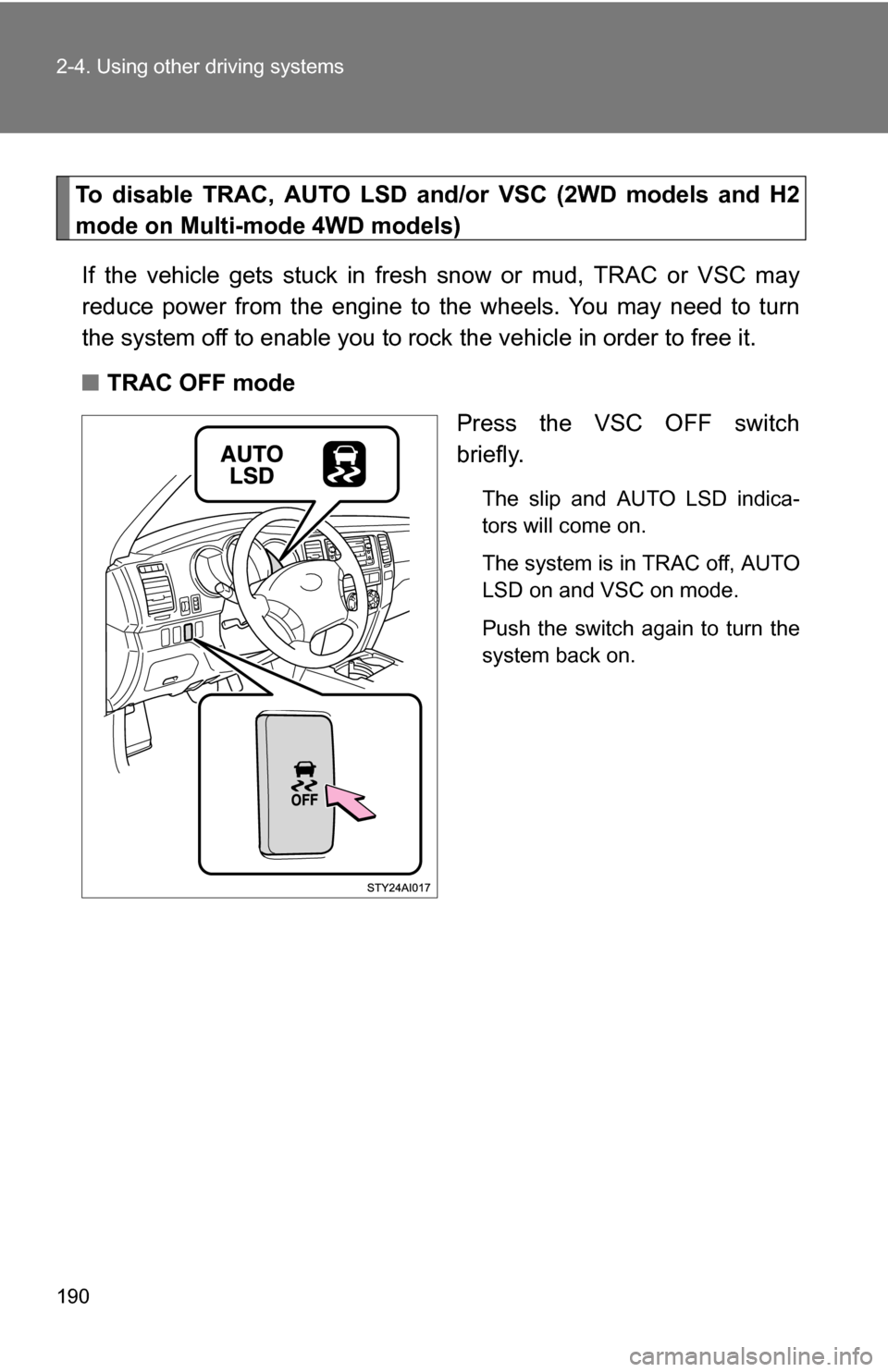
■ TRAC OFF mode
Press the VSC OFF switch
briefly.
The slip and AUTO LSD indica-
tors will come on.
The system is in TRAC off, AUTO
LSD on and VSC on mode.
Push the switch again to turn the
system back on.
Page 192 of 520
192 2-4. Using other driving systems
To disable TRAC and/or VSC (H4 mode on 4WD models)If the vehicle gets stuck in fresh snow or mud, TRAC or VSC may
reduce power from the engine to the wheels. You may need to turn
the system off to enable you to rock the vehicle in order to free it.
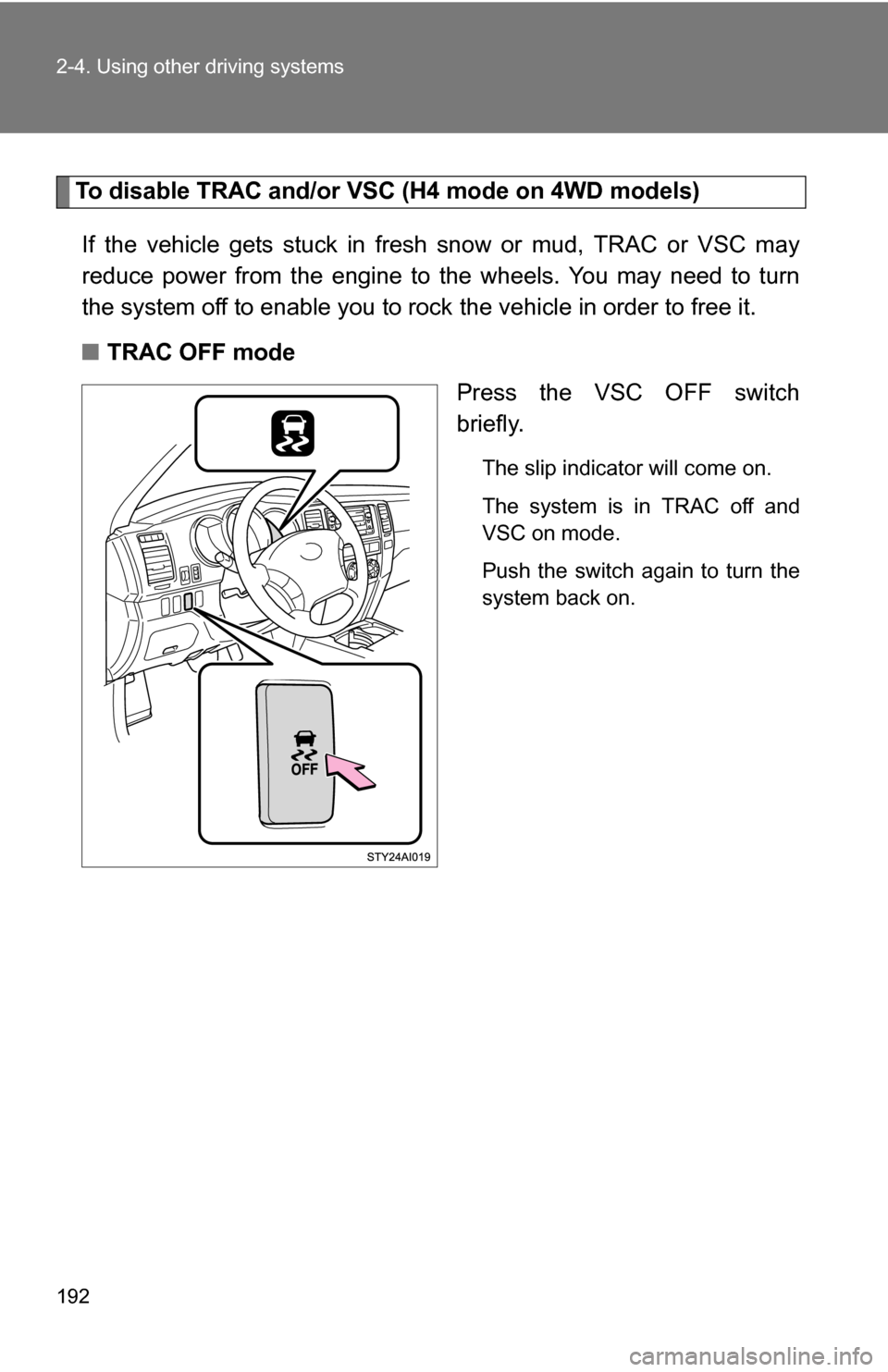
■ TRAC OFF mode
Press the VSC OFF switch
briefly.
The slip indicator will come on.
The system is in TRAC off and
VSC on mode.
Push the switch again to turn the
system back on.
Page 194 of 520
194 2-4. Using other driving systems
To disable TRAC (four-wheel drive control switch is in H4 mode
and center differential lock is locked on 4WD models)
If the vehicle gets stuck in fresh snow or mud, TRAC may reduce
power from the engine to the wheels. You may need to turn the sys-
tem off to enable you to rock the vehicle in order to free it.
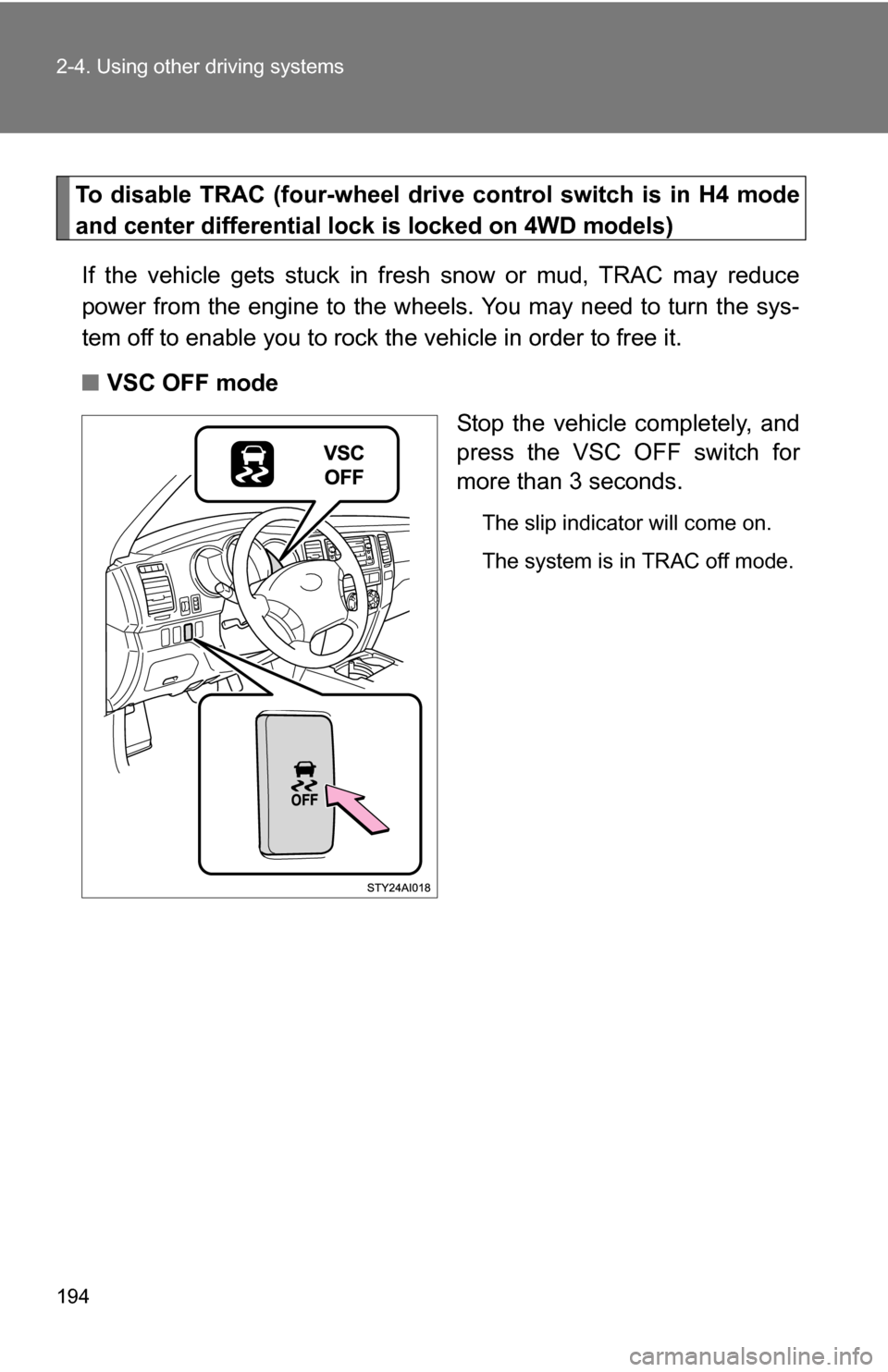
■ VSC OFF mode
Stop the vehicle completely, and
press the VSC OFF switch for
more than 3 seconds.
The slip indicator will come on.
The system is in TRAC off mode.
Page 195 of 520
195
2-4. Using other
driving systems
2
When driving
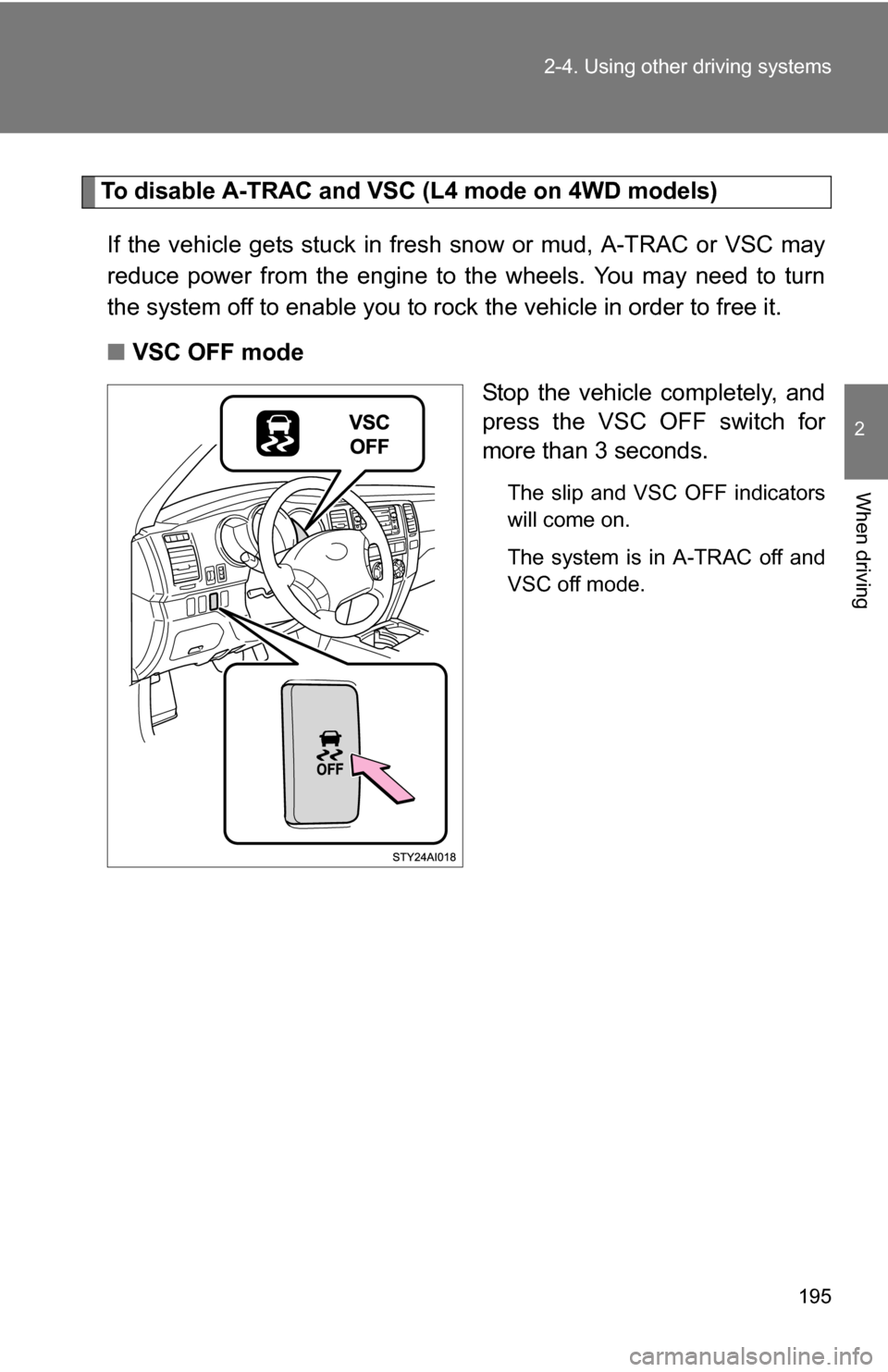
To disable A-TRAC and VSC (L4 mode on 4WD models)
If the vehicle gets stuck in fresh snow or mud, A-TRAC or VSC may
reduce power from the engine to the wheels. You may need to turn
the system off to enable you to rock the vehicle in order to free it.
■ VSC OFF mode
Stop the vehicle completely, and
press the VSC OFF switch for
more than 3 seconds.
The slip and VSC OFF indicators
will come on.
The system is in A-TRAC off and
VSC off mode.
Page 196 of 520
196 2-4. Using other driving systems
■Sounds and vibrations caused by the ABS, TRAC, A-TRAC, VSC and
brake assist system
● A sound may be heard from the engine compartment when the engine is
started or just after the vehicle begins to move. This sound does not indi-
cate that a malfunction has occurred in any of these systems.
● Any of the following conditions may occur when the above systems are
operating. None of these indicates that a malfunction has occurred.
• Vibrations may be felt through the vehicle body and steering.
• A motor sound may be heard after the vehicle comes to a stop.
• The brake pedal may pulsate slightly after the ABS is activated.
• The brake pedal may move down slightly after the ABS is activated.
■ If the brake system overheats
TRAC will cease operation and a buzzer will sound to alert the driver. Stop
the vehicle in a safe place. (There is no problem with continuing normal driv-
ing.)
Page 202 of 520
202 2-5. Driving information
NOTICE
■To prevent the water damage
●Take all necessary safety measures to ensure that water damage to the
engine or other components does not occur.
● Water entering the engine air intake will cause severe engine damage.
● Water entering the automatic transmission will cause deterioration in shift
quality, locking up of your transmission accompanied by vibration, and ulti-
mately damage.
● Water can wash the grease from wheel bearings, causing rusting and pre-
mature failure, and may also enter the differentials, transmission and
transfer case, reducing the gear oil’s lubricating qualities.
■ When you drive through water
If driving through water, such as when crossing shallow streams, first check
the depth of the water and the bottom of the river bed for firmness. Drive
slowly and avoid deep water.
■ Inspection after off-road driving
●Sand and mud that has accumulate d in brake drums and around brake
discs may affect braking efficiency and may damage brake system compo-
nents.
● Always perform a maintenance inspection after each day of off-road driv-
ing that has taken you through rough terrain, sand, mud, or water. For
scheduled maintenance information, refer to the “Scheduled Maintenance
Guide” or “Owner’s Manual Supplement”.
Page 211 of 520
211
2-5. Driving information
2
When driving
Vehicle load limits
Vehicle load limits include total load capacity, seating capacity,
towing capacity and cargo capacity.
■Total load capacity:
Without third seats — 950 lb. (431 kg)
With third seats — 1050 lb. (477 kg)
Total load capacity means the combined weight of occupants,
cargo and luggage.
■ Seating capacity:
Without third seats — 5 occupants (Front 2, Rear 3)
With third seats — 7 occupants (Front 2, Rear 5)
Seating capacity means the ma ximum number of occupants
whose estimated average weight is 150 lb. (68 kg) per per-
son.
Even if the number of occupants are within the seating capac-
ity, do not exceed the total load capacity.
■ Towing capacity:
For weight carrying hitch
5000 lb. (2268 kg)
For weight distributing hitch
(4.7 L V8 [2UZ-FE] engine only)
2WD models — 7300 lb. (3311 kg)
4WD models — 7000 lb. (3175 kg)
Towing capacity means the maximum gross trailer weight
(trailer weight plus its cargo weight) that your vehicle is able to
tow.
■ Cargo capacity
Cargo capacity may increase or decrease depending on the
weight and the number of occupants.
Page 213 of 520
213
2-5. Driving information
2
When driving
Winter driving tips
Carry out the necessary preparations and inspections before driving
the vehicle in winter. Always drive the vehicle in a manner appropri-
ate to the prevailing weather conditions.
■ Pre-winter preparations
●Use fluids that are appropriate to the prevailing outside tem-
peratures.
• Engine oil
• Engine coolant
• Washer fluid
● Have a service technician inspect the level and specific grav-
ity of battery electrolyte.
● Have the vehicle fitted with four snow tires or purchase a set
of tire chains for the rear tires.
Ensure that all tires are the same size and brand, and that chains
match the size of the tires.
■Before driving the vehicle
Perform the following according to the driving conditions.
●Do not try to forcibly open a window, scrape an outside rear
view mirror surface or move a wiper or outside rear view mir-
ror that is frozen. Pour warm water over the frozen area to
melt the ice. Wipe away the water immediately to prevent it
from freezing.
● To ensure proper operation of th e climate control system fan,
remove any snow that has accumulated on the air inlet vents
in front of the windshield.
● Remove any ice that has accumu lated on the vehicle chassis.
● Periodically check for and remove any excess ice or snow
that may have accumulated in the wheel well or on the
brakes.
Page 216 of 520
216
2-5. Driving information
Trailer towing
Weight limitsConfirm that the gross trailer weight, gross combination weight, gross
vehicle weight, gross axle weight and trailer tongue load are all within
the limits.
■ Towing capacity
For weight carrying hitch
5000 lb. (2268 kg)
For weight distributing hitch
(4.7 L V8 [2UZ-FE] engine only)
2WD models — 7300 lb. (3311 kg)
4WD models — 7000 lb. (3175 kg)
● The gross trailer weight must never exceed towing capacity
described above.
Your vehicle is designed primarily as a passenger-and-load carrying
vehicle. Towing a trailer will have an adverse effect on handling, per-
formance, braking, durability, and fu el consumption. For your safety
and the safety of others , do not overload the vehicle or trailer.
To tow a trailer safely, use extreme care and drive the vehicle in
accordance with the trailer’s char acteristics and operating condi-
tions.
The vehicle stability and braking performance are affected by trailer
stability, brake setting and performance, and the hitch.
Toyota warranties do not apply to damage or malfunction caused by
towing a trailer for commercial purposes.
Contact your Toyota dealer for fu rther information about additional
requirements such as a towing kits, etc.