coolant TOYOTA 4RUNNER 2023 User Guide
[x] Cancel search | Manufacturer: TOYOTA, Model Year: 2023, Model line: 4RUNNER, Model: TOYOTA 4RUNNER 2023Pages: 608, PDF Size: 11.8 MB
Page 475 of 608
4757-2. Steps to take in an emergency
7
When trouble arises
4RUNNER (U)
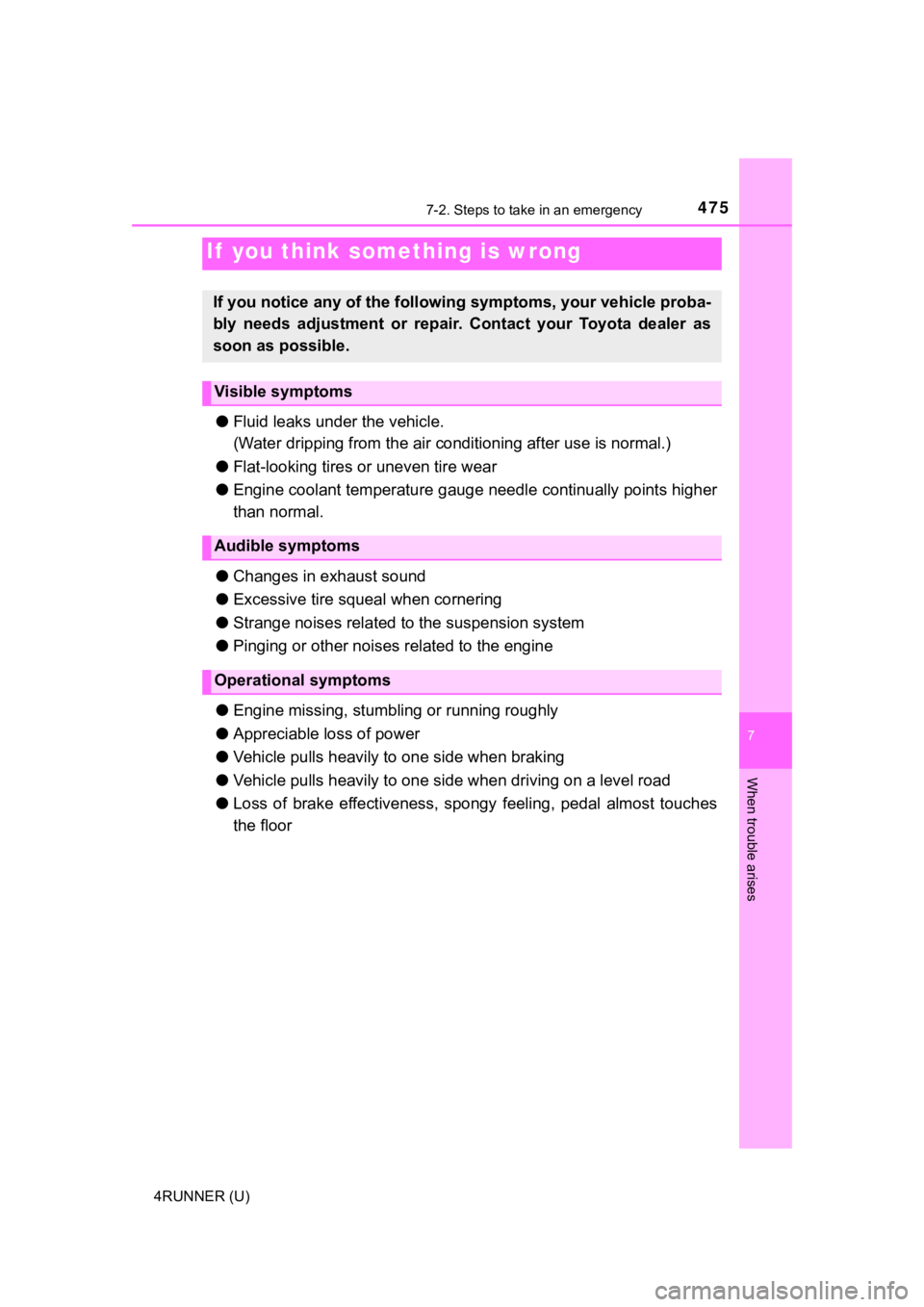
●Fluid leaks un der the vehicle.
(Water dripping from the air conditioning a fter use is normal.)
● Flat-looking tires or uneven tire wear
● Engine coolant temperature gauge needle continually points high er
than normal.
● Changes in exhaust sound
● Excessive tire squeal when cornering
● Strange noises related to the suspension system
● Pinging or other noises related to the engine
● Engine missing, stumb ling or running roughly
● Appreciable loss of power
● Vehicle pulls heavily to one side when braking
● Vehicle pulls heavily to one s ide when driving on a level road
● Loss of brake effectiveness, spongy feeling, pedal almost touch es
the floor
If you think something is wrong
If you notice any of the followi ng symptoms, your vehicle proba -
bly needs adjustment or repair. Contact your Toyota dealer as
soon as possible.
Visible symptoms
Audible symptoms
Operational symptoms
Page 477 of 608
4777-2. Steps to take in an emergency
7
When trouble arises
4RUNNER (U)
If a warning light turns on or a war ning
buzzer sounds
Calmly perform the following actions if any of the warning ligh ts
comes on or flashes. If a light comes on or flashes, but then
goes off, this does not necessarily indicate a malfunction in the
system. However, if this continues to occur, have the vehicle
inspected by your Toyota dealer.
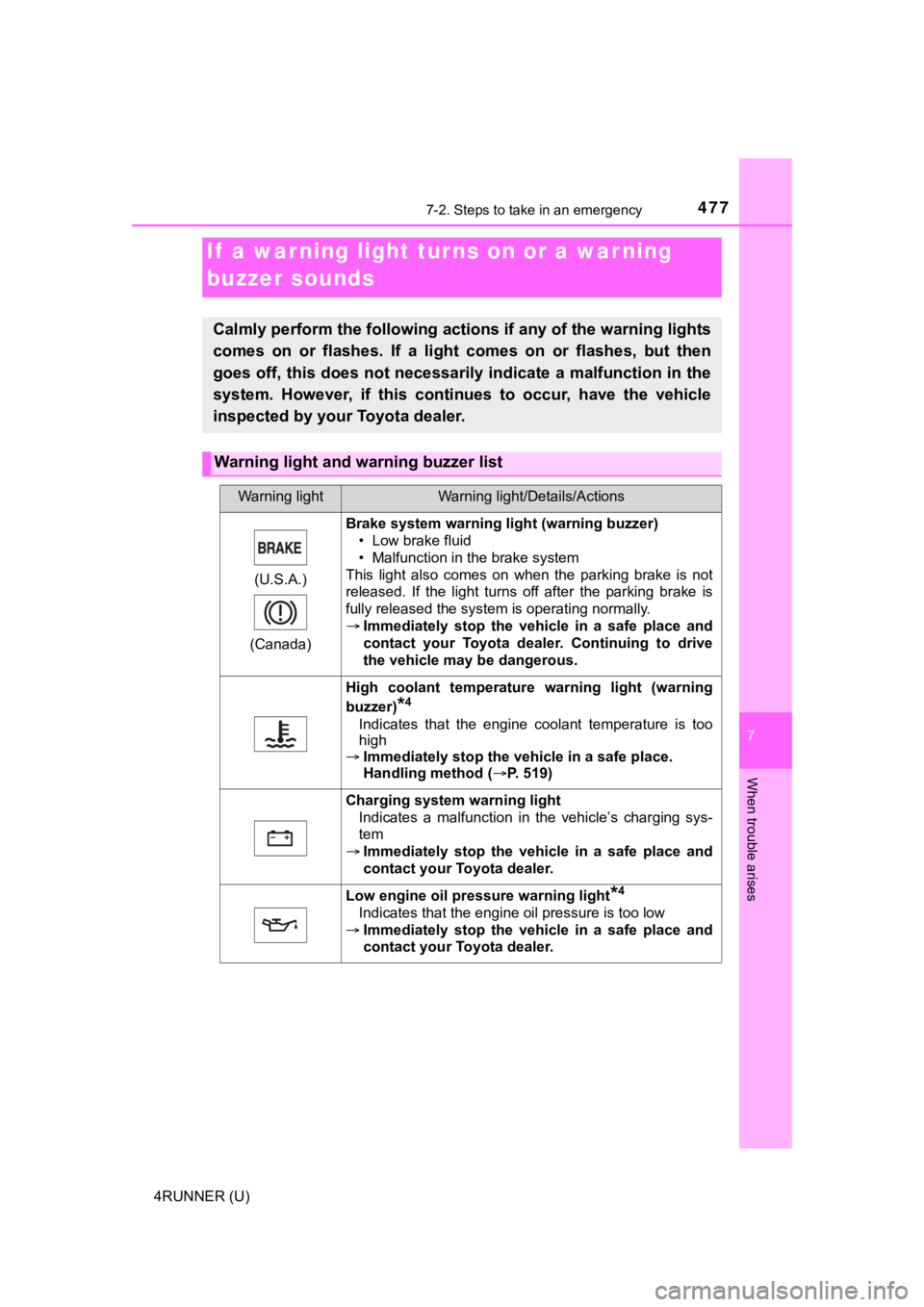
Warning light and w arning buzzer list
Warning lightWarning light/Details/Actions
(U.S.A.)
(Canada)
Brake system warning li ght (warning buzzer)
• Low brake fluid
• Malfunction in the brake system
This light also comes on when the parking brake is not
released. If the light turns off after the parking brake is
fully released the system is operating normally.
Immediately stop the vehicle in a safe place and
contact your Toyota dealer. Continuing to drive
the vehicle may be dangerous.
High coolant temperature warning light (warning
buzzer)
*4
Indicates that the engine coolant temperature is too
high
Immediately stop the vehicle in a safe place.
Handling method ( P. 519)
Charging system warning light
Indicates a malfunction in the vehicle’s charging sys-
tem
Immediately stop the vehicle in a safe place and
contact your Toyota dealer.
Low engine oil pressure warning light*4
Indicates that the engine oil pressure is too low
Immediately stop the vehicle in a safe place and
contact your Toyota dealer.
Page 490 of 608
4907-2. Steps to take in an emergency
4RUNNER (U)
■Warning messages
The warning messages explained below may differ from the actual messages
according to operation conditions and vehicle specifications.
■ System warning lights
The master warning light does not come on or flash in the following cases.
Instead, a separate system warning light will come on along wit h a message
or image shown on the multi-information display.
● Malfunction in the ABS
The ABS warning light comes on. ( P. 478)
● Indicates that the PCS (Pre-Collision System) is not currently functional
The PCS warning light comes on or flashes. ( P. 481)
● Malfunction in the tire pressure warning system
The tire pressure warning light comes on. ( P. 481)
■ If a message instructing to refer to the Owner’s Manual is disp layed
● If the following message is shown, there may be a malfunction.
Immediately stop the vehicle in a safe place and contact your T oyota dealer.
Continuing to drive the vehicle may be dangerous.
• “Braking Power Low Stop in a Safe Place See Owner’s Manual”
• “Oil Pressure Low Stop in a Safe Place See Owner’s Manual”
● If “Engine Coolant Temp High Stop in a Safe Place See Owner’s M anual” is
displayed, follow the instructions accordingly. ( P. 519)
● If “Front Camera Unavailable See Owner’s Manual” is displayed, follow the
instructions accordingly. ( P. 237, 488)
● If the following message is shown, there may be a malfunction.
Immediately have the vehicle inspected by your Toyota dealer.
• “Smart Key System Malfunction See Owner’s Manual”
■ If “High transmission fluid temperature” is shown, it indicates that the
automatic transmission fluid temperature is too high.
Immediately stop the vehicle in a safe place, shift the shift l ever to P and wait
until the warning message and light go off. If the warning message and light
go off, you may start the vehicle again. If the warning message and light do
not go off, contact your Toyota dealer.
Page 519 of 608
5197-2. Steps to take in an emergency
7
When trouble arises
4RUNNER (U)
●The needle of the engine coolant temperature gauge ( P. 8 8 )
enters the red zone o r a loss of engine power is experienced.
(For example, the vehicle speed does not increase.)
● Steam comes out f rom under the hood.
Stop the vehicle in a safe place and turn off the air condition ing sys-
tem, and then stop the engine.
If you see steam:
Carefully lift the hood after the steam subsides.
If you do not see steam:
Carefully lift the hood.
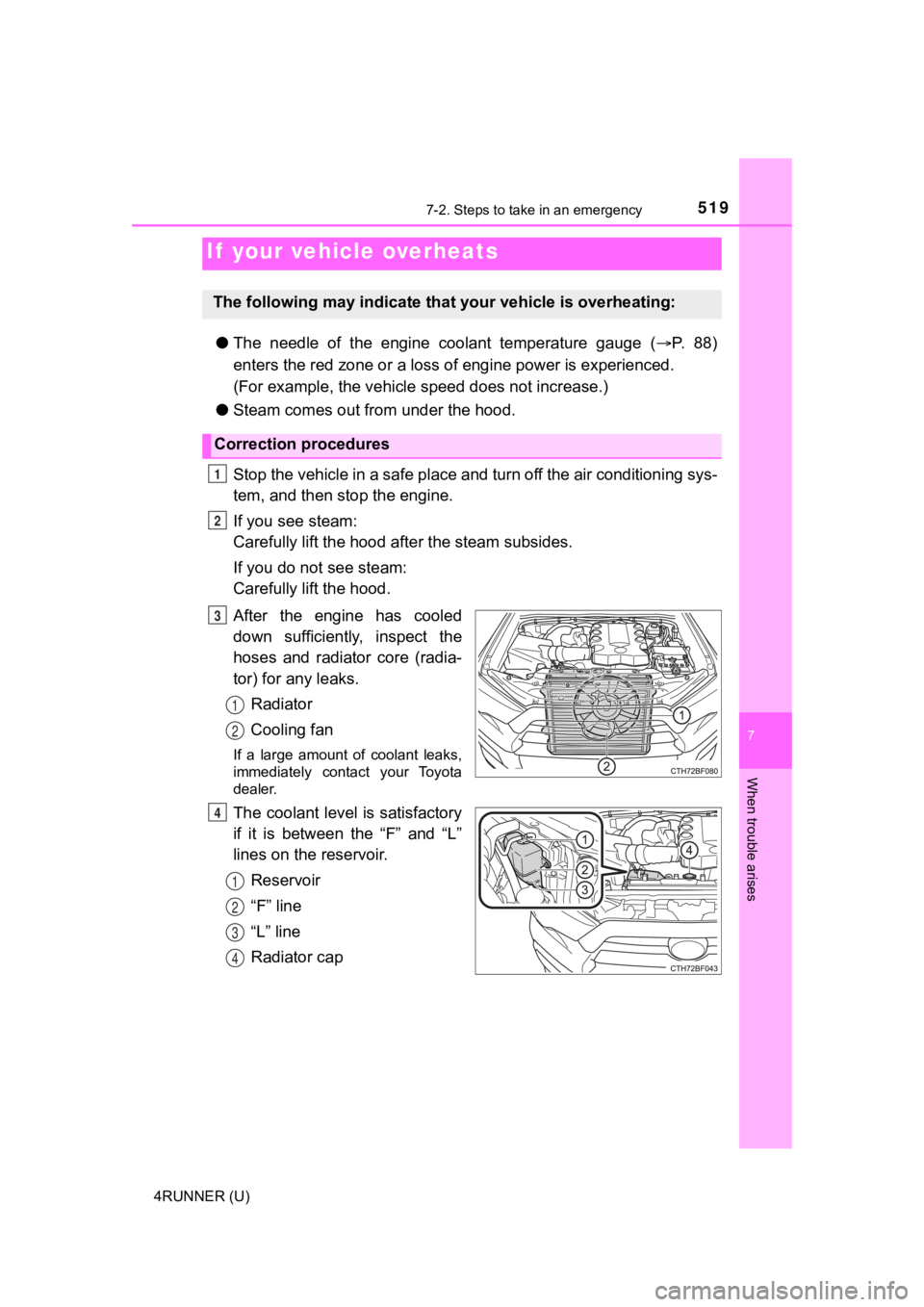
After the engine has cooled
down sufficiently, inspect the
hoses and radiator core (radia-
tor) for any leaks. Radiator
Cooling fan
If a large amount of coolant leaks,
immediately contact your Toyota
dealer.
The coolant level is satisfactory
if it is between the “F” and “L”
lines on the reservoir.Reservoir
“F” line
“L” line
Radiator cap
If your vehicle overheats
The following may indicate that your vehicle is overheating:
Correction procedures
1
2
3
1
2
4
1
2
3
4
Page 520 of 608
5207-2. Steps to take in an emergency
4RUNNER (U)
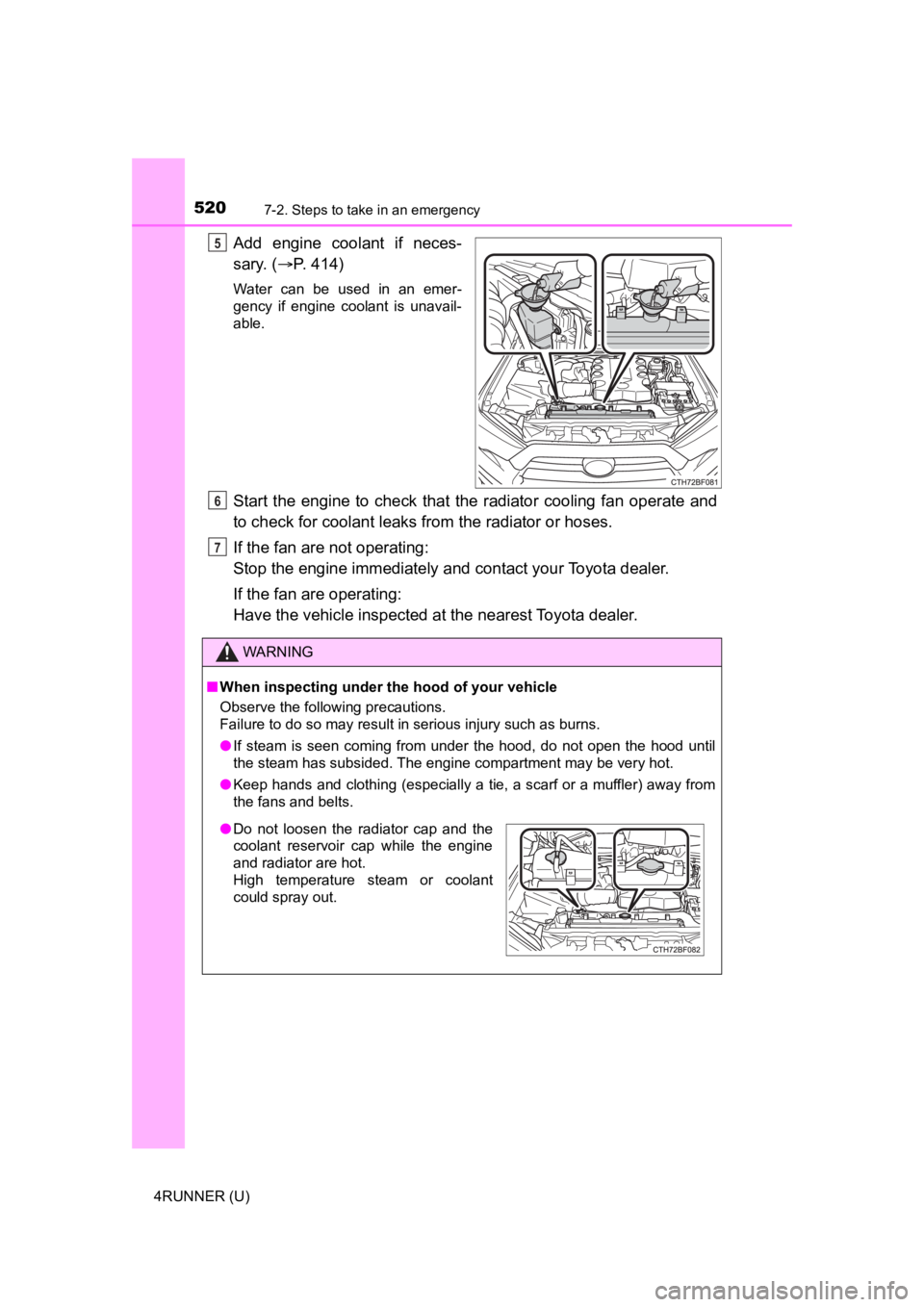
Add engine coolant if neces-
sary. (P. 414)
Water can be used in an emer-
gency if engine coolant is unavail-
able.
Start the engine to check that the radiator cooling fan operate and
to check for coolant leaks from the radiator or hoses.
If the fan are not operating:
Stop the engine immediately and contact your Toyota dealer.
If the fan are operating:
Have the vehicle inspected at the neare st Toyota dealer.
5
WARNING
■When inspecting under the hood of your vehicle
Observe the following precautions.
Failure to do so may result in serious injury such as burns.
● If steam is seen coming from under the hood, do not open the ho od until
the steam has subsided. The engine compartment may be very hot.
● Keep hands and clothing (especially a tie, a scarf or a muffler) away from
the fans and belts.
6
7
●Do not loosen the radiator cap and the
coolant reservoir cap while the engine
and radiator are hot.
High temperature steam or coolant
could spray out.
Page 521 of 608
5217-2. Steps to take in an emergency
7
When trouble arises
4RUNNER (U)
NOTICE
■When adding engine coolant
Wait until the engine has cooled down before adding engine cool ant.
When adding coolant, do so slowly. Adding cool coolant to a hot engine too
quickly can cause damage to the engine.
■ To prevent damage to the cooling system
Observe the following precautions:
● Avoid contaminating the coolant with foreign matter (such as sand or dust
etc.).
● Do not use any coolant additives.
Page 528 of 608
5288-1. Specifications
4RUNNER (U)
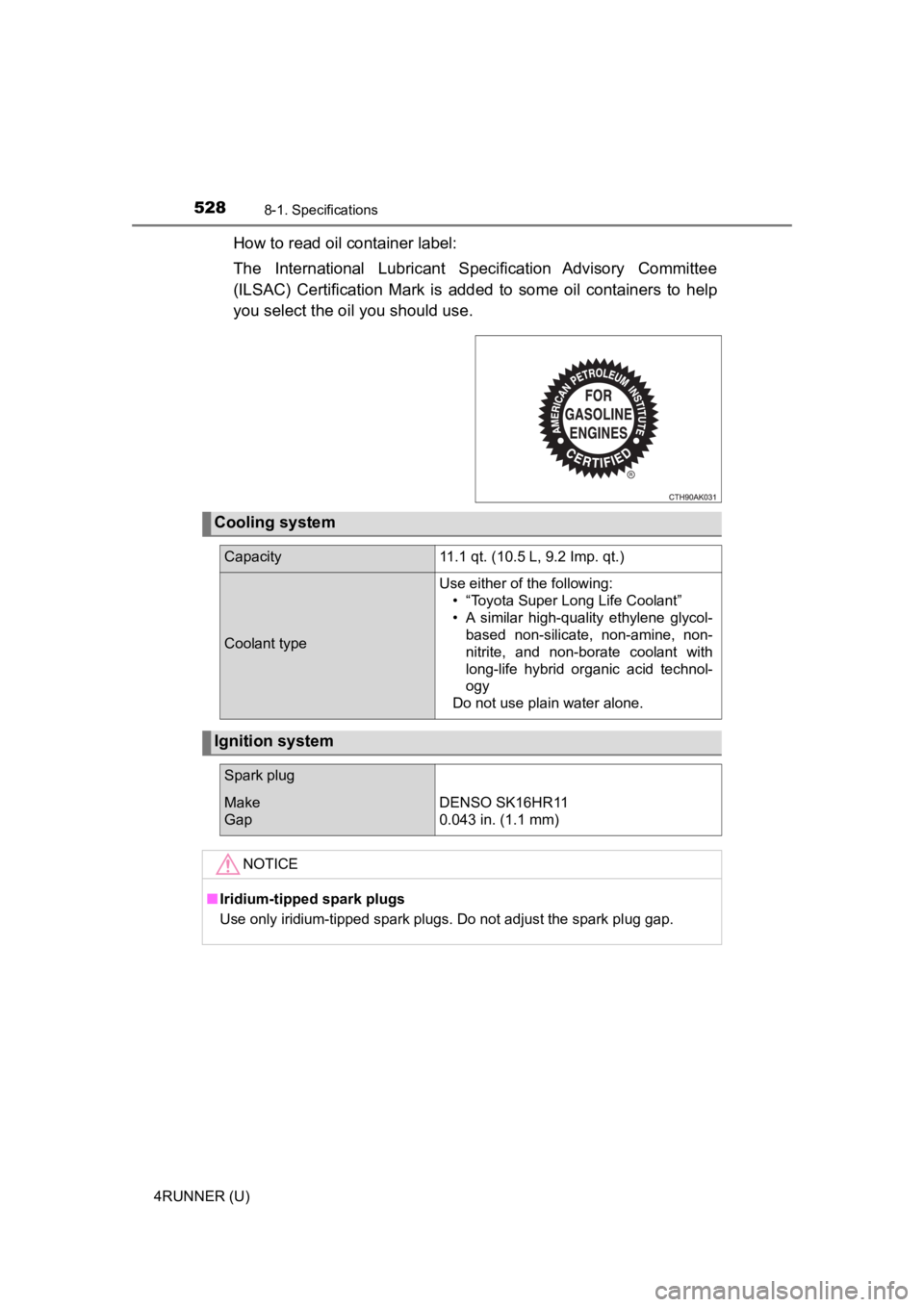
How to read oil container label:
The International Lubricant Specification Advisory Committee
(ILSAC) Certification Mark is added to some oil containers to help
you select the oil you should use.
Cooling system
Capacity11.1 qt. (10.5 L, 9.2 Imp. qt.)
Coolant type
Use either of the following:
• “Toyota Super Long Life Coolant”
• A similar high-quality ethylene glycol-based non-silicate, non-amine, non-
nitrite, and non-borate coolant with
long-life hybrid organic acid technol-
ogy
Do not use plain water alone.
Ignition system
Spark plug
Make
GapDENSO SK16HR11
0.043 in. (1.1 mm)
NOTICE
■ Iridium-tipped spark plugs
Use only iridium-tipped spark plugs. Do not adjust the spark pl ug gap.
Page 543 of 608
5438-1. Specifications
8
Vehicle specifications
4RUNNER (U)
Glossary of tire terminology
Tire related termMeaning
Cold tire inflation pres-
sure
Tire pressure when the vehicle has been
parked for three hours or more, or has not
been driven more than 1 mile or 1.5 km under
that condition
Maximum inflation
pressureThe maximum cold inflated pressure to which
a tire may be inflated, shown on the sidewall
of the tire
Recommended infla-
tion pressureCold tire inflation pressure recommended by a
manufacturer
Accessory weight
The combined weight (in excess of those stan-
dard items which may be replaced) of auto-
matic transmission, power steering, power
brakes, power windows, power seats, radio
and heater, to the extent that these items are
available as factory-installed equipment
(whether installed or not)
Curb weight
The weight of a motor vehicle with standard
equipment, including the maximum capacity of
fuel, oil and coolant, and if so equipped, air
conditioning and additional weight optional
engine
Maximum loaded vehi-
cle weight
The sum of:
(a) Curb weight
(b) Accessory weight
(c) Vehicle capacity weight
(d) Production options weight
Normal occupant
weight150 lb. (68 kg) times the number of occupants
specified in the second column of Table 1
*
that follows
Occupant distributionDistribution of occupants in a vehicle as speci-
fied in the third column of Table 1
* below
Page 585 of 608
585Alphabetical index
4RUNNER (U)
Driving ...................................... 166Break-in tips .......................... 168
Correct driving posture ........... 30
Driving assist systems .......... 322
Off-road precautions ............. 335
Procedures ........................... 166
Winter drive tips .................... 331
Dynamic radar cruise
control .................................... 257
Eco Driving Indicator ................ 98
EDR (Event data recorder) ........ 10
Electronic key .......................... 102 Battery-saving function ......... 116
If the electronic key does not operate properly ................. 512
Replacing the battery ............ 447
Emergency, in case of
If the electronic key does not operate
properly .............................. 512
If the engine will not start ...... 509
If the vehicle battery is discharged .......................... 515
If the warning buzzer sounds ................................ 477
If the warning light turns on ....................................... 477
If a warning message is displayed......................... 488
If the vehicle is submerged
or water on the road is
rising ................................... 468
If you cannot operate
back door opener ............... 511 If you have a flat tire ............. 493
If you think something
is wrong .............................. 475
If your vehicle becomes stuck ................................... 522
If your vehicle has to be stopped in an emergency ... 467
If your vehicle needs
to be towed......................... 469
If your vehicle overheats....... 519
Emergency flashers ................ 466
Engine
ACCESSORY mode ............. 200
Compartment ........................ 413
Engine switch ....................... 199
Hood ..................................... 412
How to start the engine......... 199
Identification number ............ 525
If the engine will not start ...... 509
Ignition switch (engine switch) ................... 199
Overheating .......................... 519
Engine coolant......................... 417
Capacity................................ 528
Checking............................... 417
Preparing and checking before winter ...................... 331
Engine coolant temperature gauge ....................................... 88
Engine immobilizer system ...... 78
Engine oil ................................. 415
Capacity................................ 527
Checking............................... 415
Preparing and checking before winter ...................... 331
Engine switch .......................... 199
Event data recorder (EDR)........ 10
E