Headlight TOYOTA 86 2019 User Guide
[x] Cancel search | Manufacturer: TOYOTA, Model Year: 2019, Model line: 86, Model: TOYOTA 86 2019Pages: 532, PDF Size: 6.89 MB
Page 225 of 532
2252-3. Operating the light s and windshield wipers
2
When driving ■ Headlight control sensor
■ Automatic light off system
Vehicles without a smart key system
The light switch is in , the headlights and tail lights turn of f 30 sec-
onds after a door is opened and closed if the engine switch is turned off.
(The lights turn off immediately if on the key is pressed after all the
doors are locked.)
To turn the lights on again, turn the engine switch to “ON” pos ition, or turn
the light switch off and then back to
or .
Vehicles with a smart key system
The light switch is in , the headlights and tail lights turn of f 30 sec-
onds after a door is opened and closed if the “ENGINE START STO P”
switch is turned off. (The lights turn off immediately if on t he key is
pressed after all the doors are locked.)
To turn the lights on again, turn the “ENGINE START STOP” switc h to IGNI-
TION ON mode, or turn the light switch off and then back to
or
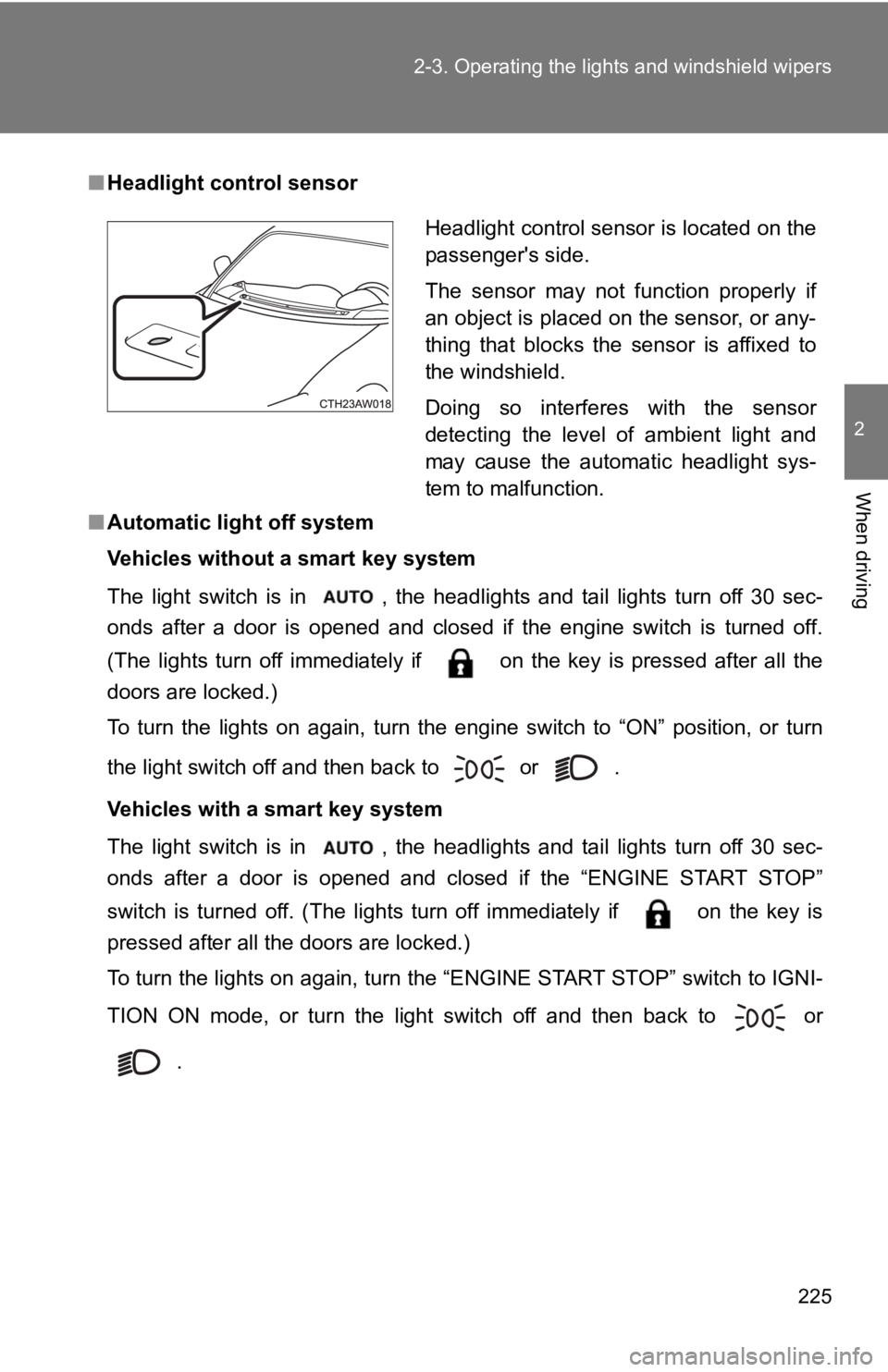
. Headlight control sensor is located on the
passenger's side.
The sensor may not function properly if
an object is placed on the sensor, or any-
thing that blocks the sensor is affixed to
the windshield.
Doing so interferes with the sensor
detecting the level of ambient light and
may cause the automatic headlight sys-
tem to malfunction.
Page 226 of 532
2262-3. Operating the lights and windshield wipers
■ Light reminder buzzer
Vehicles without a smart key system
A buzzer sounds when the engine switch is turned to “LOCK” position and
the driver's door is opened with the key removed from the engin e switch
while the lights are turned on.
Vehicles with a smart key system
A buzzer sounds when the “ENGINE START STOP” switch is turned o ff and
the driver's door is opened while the lights are turned on.
■ Automatic headlight leveling system
The level of the headlights is automatically adjusted according to the number
of passengers and the loading condition of the vehicle to ensure that the
headlights do not interfere with other road users.
■ Battery-saving function
In the following conditions, the headlights and the other remai ning lights will
go off automatically after 20 minutes in order to prevent the v ehicle battery
from being discharged:
● The headlights and/or tail lights are on.
● The key is removed from the engine switch (vehicles without a s mart key
system) or the “ENGINE START STOP” switch is turned off (vehicl es with
a smart key system).
● The light switch is in or .
This function will be canceled in any of the following situations:
● When the engine switch is turned to the “ON” position (vehicles without a
smart key system) or the “ENGINE START STOP” switch is turned t o
IGNITION ON mode (vehicles with a smart key system)
● When the light switch is operated
● When the door is opened or closed
■ Customization that can be conf igured at your Toyota dealer
Settings of the light sensor sensitivity can be changed.
(Customizable features P. 487)
Page 228 of 532
2282-3. Operating the lights and windshield wipers
Fog light switch
■ Fog lights can be used when
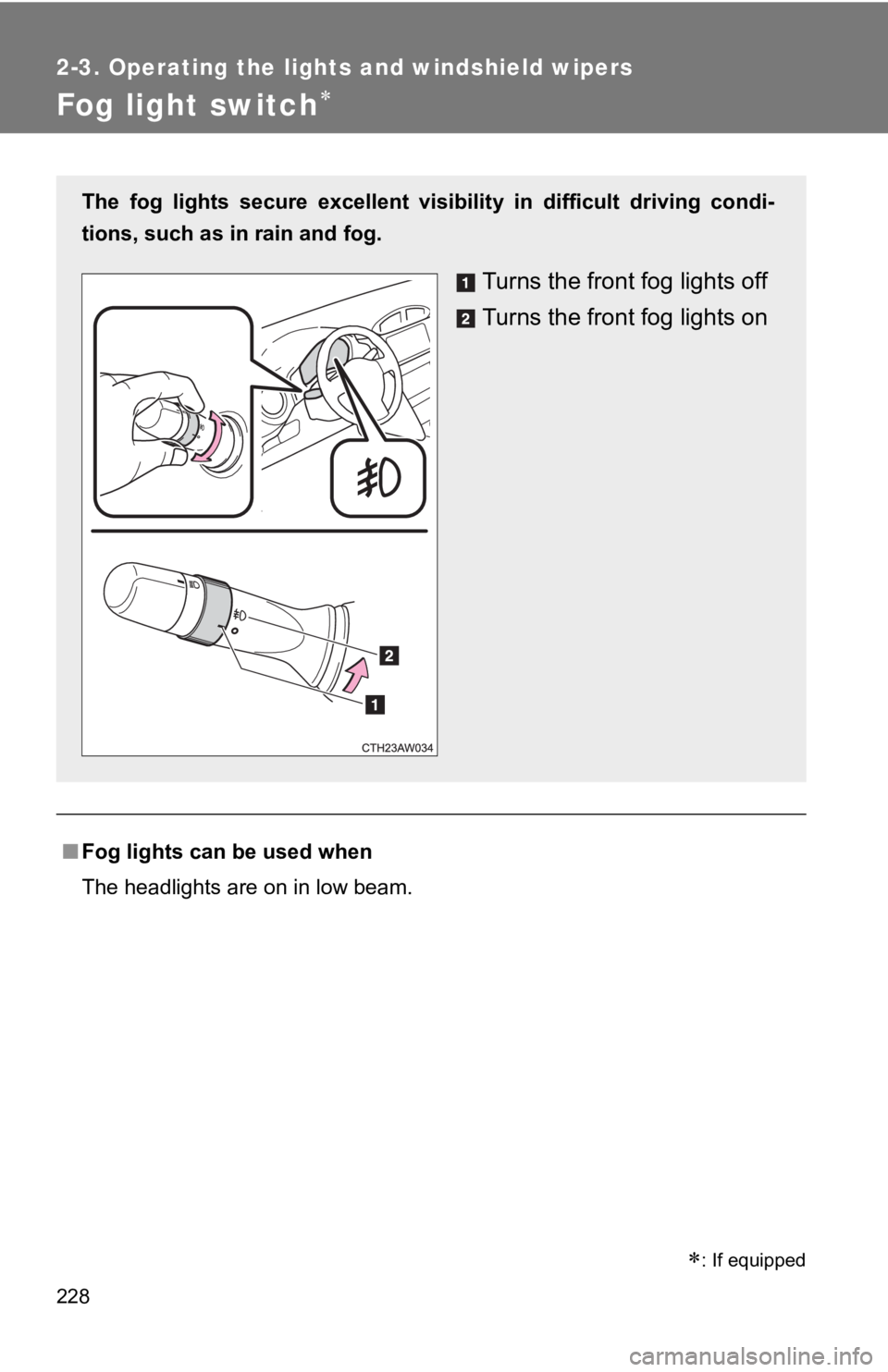
The headlights are on in low beam.The fog lights secure excellent vis ibility in difficult driving condi-
tions, such as in rain and fog.
Turns the front fog lights off
Turns the front fog lights on
: If equipped
Page 241 of 532
2412-4. Using other driving systems
2
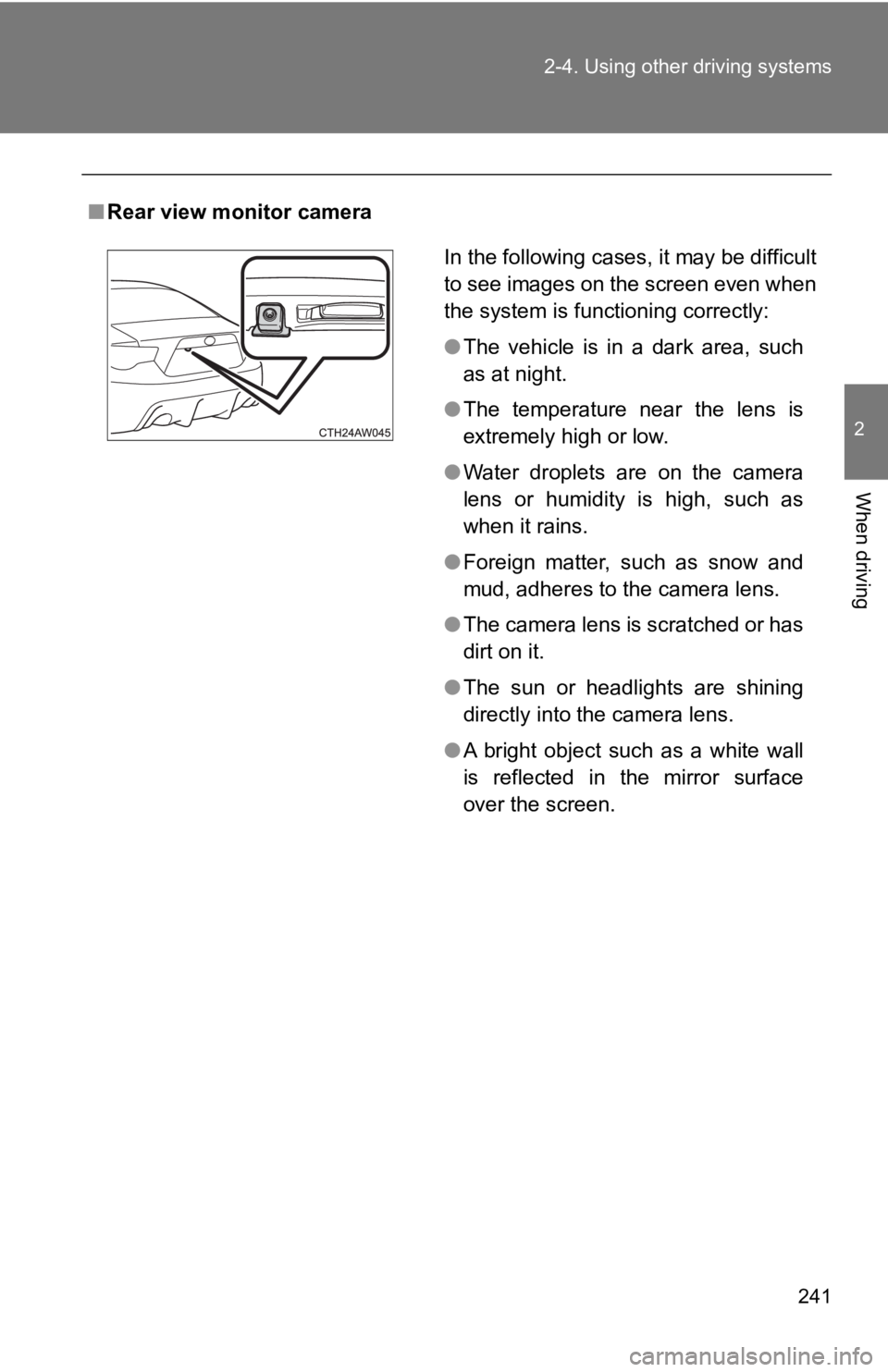
When driving ■ Rear view monitor camera
In the following cases, it may be difficult
to see images on the screen even when
the system is functioning correctly:
● The vehicle is in a dark area, such
as at night.
● The temperature near the lens is
extremely high or low.
● Water droplets are on the camera
lens or humidity is high, such as
when it rains.
● Foreign matter, such as snow and
mud, adheres to the camera lens.
● The camera lens is scratched or has
dirt on it.
● The sun or headlights are shining
directly into the camera lens.
● A bright object such as a white wall
is reflected in the mirror surface
over the screen.
Page 372 of 532
3724-3. Do-it-yourself maintenance
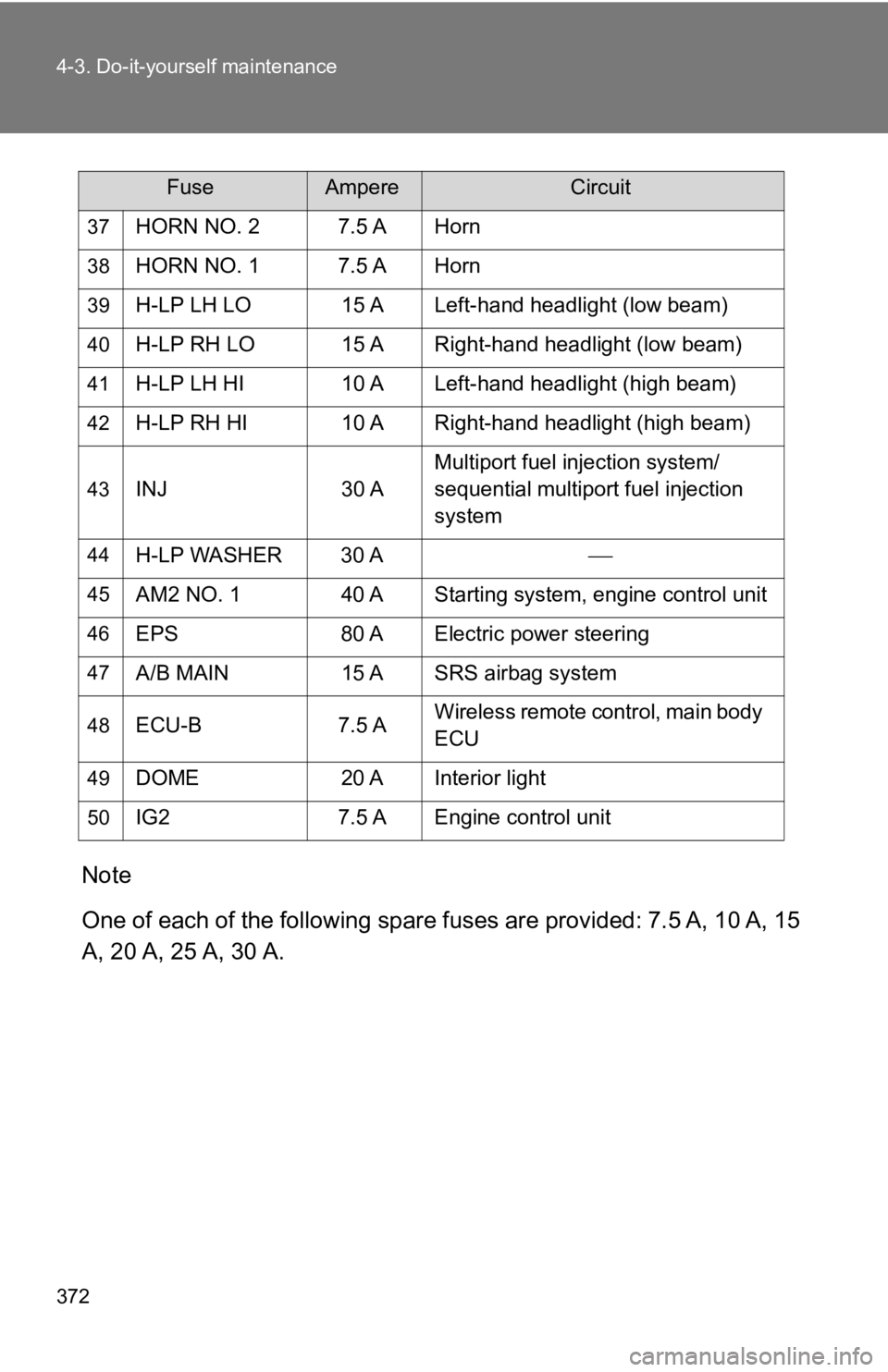
Note
One of each of the following spare fuses are provided: 7.5 A, 10 A, 15
A, 20 A, 25 A, 30 A. 37
HORN NO. 2 7.5 A Horn38
HORN NO. 1 7.5 A Horn39
H-LP LH LO 15 A Left-hand headlight (low beam)40
H-LP RH LO 15 A Right-hand headlight (low beam)41
H-LP LH HI 10 A Left-hand headlight (high beam)42
H-LP RH HI 10 A Right-hand headlight (high beam)
43
INJ 30 A Multiport fuel injection system/
sequential multiport fuel injection
system44
H-LP WASHER 30 A
45
AM2 NO. 1 40 A Starting system, engine control unit
46
EPS 80 A Electric power steering
47
A/B MAIN 15 A SRS airbag system
48
ECU-B 7.5 A Wireless remote control, main body
ECU
49
DOME 20 A Interior light
50
IG2 7.5 A Engine control unitFuse Ampere Circuit
Page 379 of 532
3794-3. Do-it-yourself maintenance
4
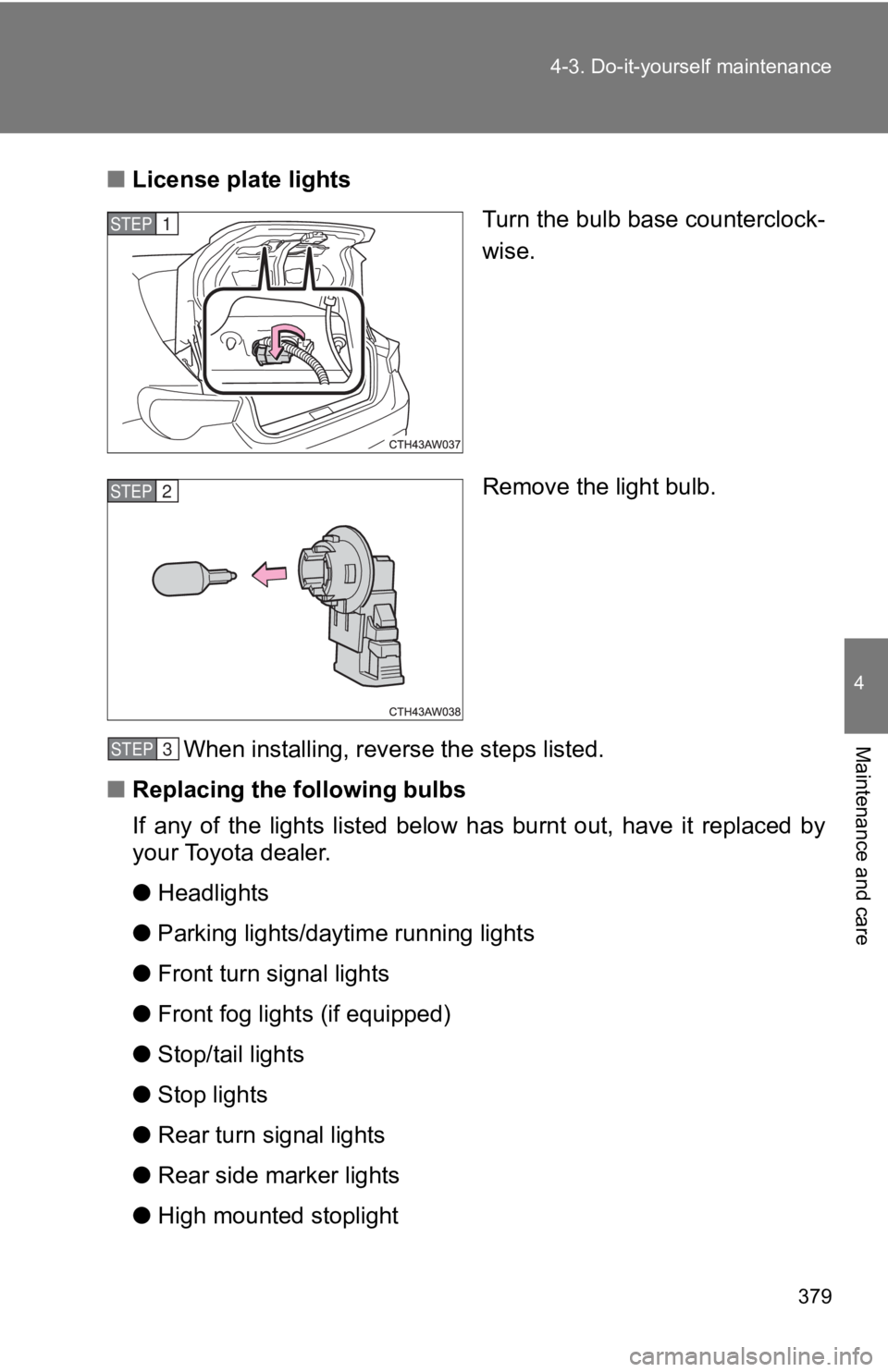
Maintenance and care ■ License pl ate lights
Turn the bulb base counterclock-
wise.
Remove the light bulb.
When installing, reverse the steps listed.
■ Replacing the following bulbs
If any of the lights listed belo w has burnt out, have it replac ed by
your Toyota dealer.
● Headlights
● Parking lights/dayti me running lights
● Front turn signal lights
● Front fog lights (if equipped)
● Stop/tail lights
● Stop lights
● Rear turn signal lights
● Rear side ma rker lights
● High mounted stoplight STEP 1
STEP 2
STEP 3
Page 380 of 532
3804-3. Do-it-yourself maintenance
■ Condensation build-up on the inside of the lens
Temporary condensation build-up on the inside of the light lens does not
indicate a malfunction. Contact your Toyota dealer for more inf ormation in
the following situations:
● Large drops of water are built up on the inside of the lens.
● Water has built up inside the light.
■ LED light bulbs
The headlights, parking lights/daytime running lights, front tu rn signal lights,
front fog lights (if equipped), stop/tail lights, stop lights, rear turn signal lights,
rear side marker lights and high mounted stoplight consist of a number of
LEDs. If any of the LEDs burn out, take your vehicle to your Toyota dealer to
have the light replaced.
■ When replacing light bulbs
Toyota recommends that you use genuine Toyota products designed for this
vehicle.
Because certain bulbs are connected to circuits designed to pre vent over-
load, non-genuine parts or parts not designed for this vehicle may be unus-
able.
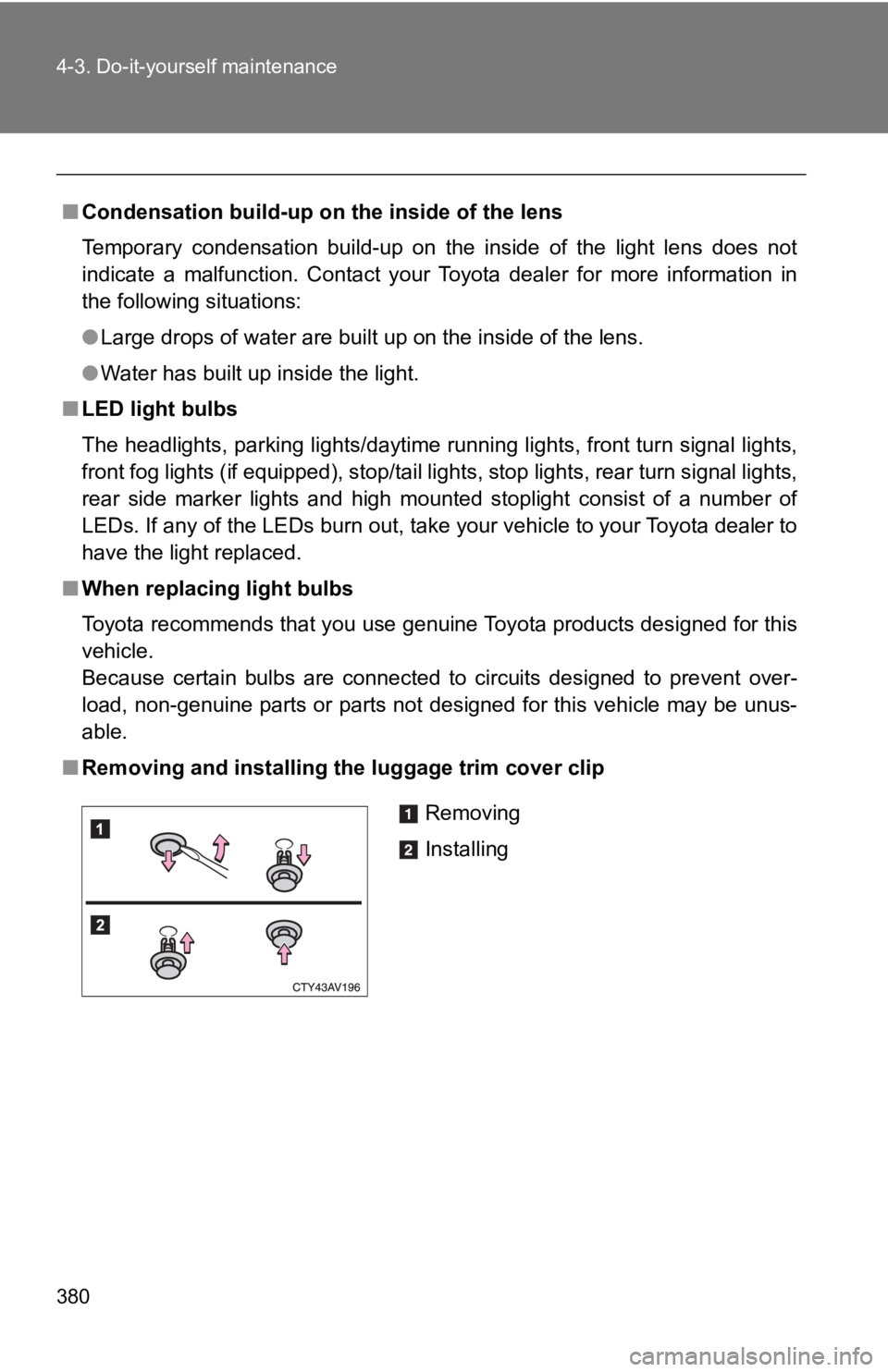
■ Removing and installing the luggage trim cover clip
Removing
Installing
Page 397 of 532
5
When trouble arises
3975-2. Steps to take in an emergency
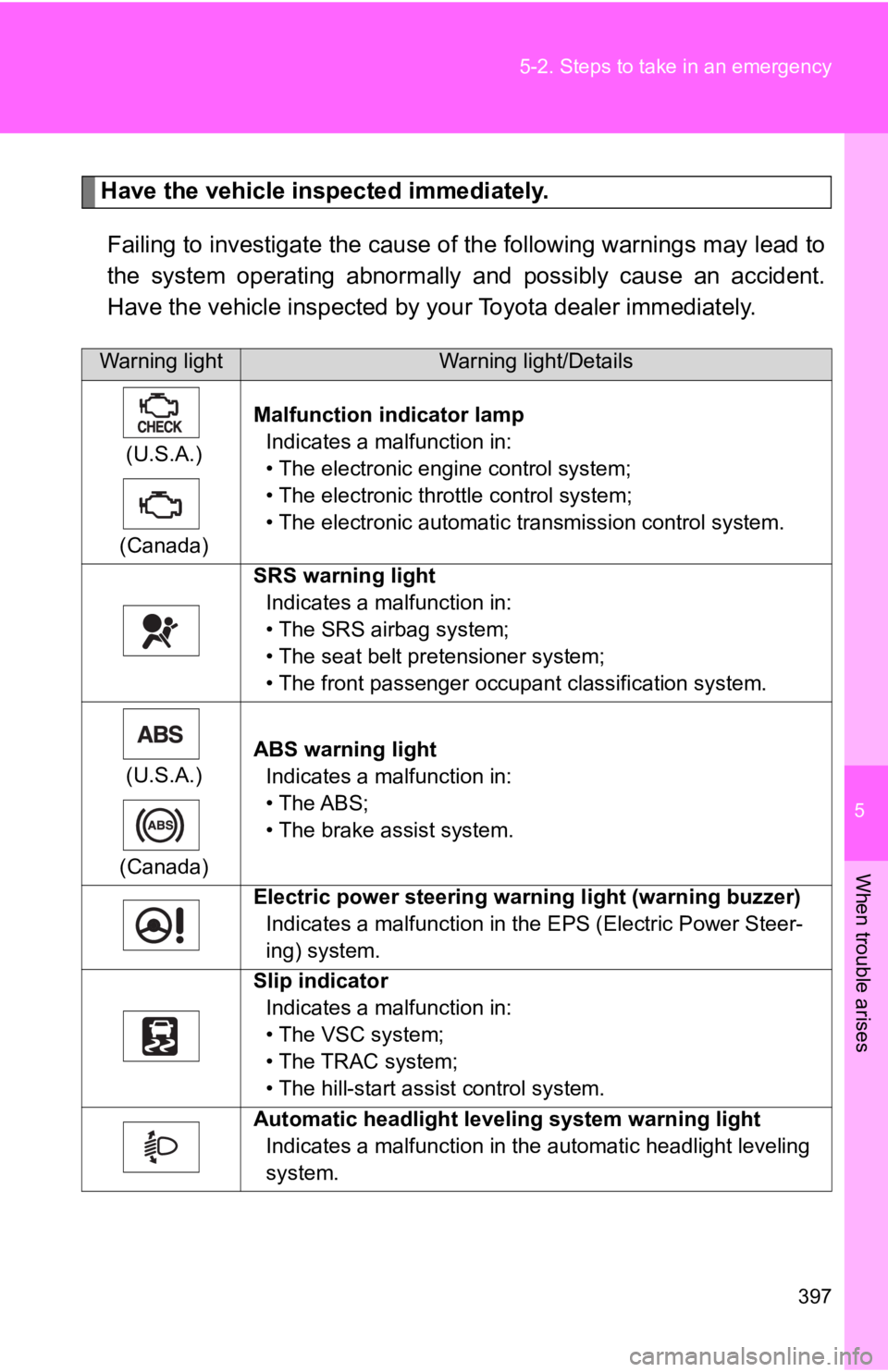
Have the vehicle ins pected immediately.
Failing to investigate the cause of the following warnings may lead to
the system operating abnormally and possibly cause an accident.
Have the vehicle ins pected by your Toyota dealer immediately.Warning light Warning light/Details
(U.S.A.)
(Canada) Malfunction indicator lamp
Indicates a malfunction in:
• The electronic engine control system;
• The electronic throttle control system;
• The electronic automatic transmission control system.
SRS warning light
Indicates a malfunction in:
• The SRS airbag system;
• The seat belt pretensioner system;
• The front passenger occupant classification system.
(U.S.A.)
(Canada) ABS warning light
Indicates a malfunction in:
• The ABS;
• The brake assist system.
Electric power steering warning light (warning buzzer)
Indicates a malfunction in the EPS (Electric Power Steer-
ing) system.
Slip indicator
Indicates a malfunction in:
• The VSC system;
• The TRAC system;
• The hill-start assist control system.
Automatic headlight leveling system warning light
Indicates a malfunction in the automatic headlight leveling
system.
Page 435 of 532
5
When trouble arises
4355-2. Steps to take in an emergency
If the engine will not star t If the engine will not start even t hough correct starting proce dures
are being followed ( P. 166, 175), consider each of the following
points.
■ The engine will not start even when the starter motor oper-
ates normally.
One of the following may be the cause of the problem.
● There may not be sufficient fuel in the vehicle’s tank.
Refuel the vehicle.
● The engine may be flooded.
Try to restart the engine once more following correct starting
procedures. ( P. 166, 175)
● There may be a malfunction in t he engine immobilizer system.
( P. 7 9 )
■ The starter motor turns over slowly, the interior lights and
headlights are dim, or the horn does not sound or sounds at
a low volume.
One of the following may be the cause of the problem.
● The battery may be discharged. ( P. 444)
● The battery terminal connections may be loose or corroded.
■ The starter motor does not turn over. (vehicles with a smart
key system)
The engine starting system may be malfunctioning due to an
electrical problem such as an open circuit or a blown fuse. How -
ever, an interim measure is a vailable to start the engine.
( P. 4 3 6 )
Page 436 of 532
4365-2. Steps to take in an emergency
Emergency start function (vehicles with a smart key system)
When the engine does not start, the following steps can be used as
an interim measure to start the engine if the “ENGINE START STO P”
switch is functioning normally:
Vehicles with an auto matic transmission
Set the parking brake.
Put the shift lever in P.
Set the “ENGINE START STOP” switch to ACCESSORY
mode.
Press and hold the “ENGINE START STOP” switch about 15
seconds while depressing the brake pedal firmly.
Even if the engine can be started using the above steps, the sy stem
may be malfunctioning. Have the vehicle checked by your Toyota
dealer.■ The starter motor does not turn over, the interior lights and
headlights do not turn on, o r the horn does not sound.
One of the following may be the cause of the problem.
● One or both of the battery ter minals may be disconnected.
● The battery may be discharged. ( P. 444)
● There may be a malfunction in the steering lock system. (vehi-
cles with a smart key system) Contact your Toyota dealer if the problem cannot be repaired, o r if
repair procedures are unknown.
STEP 1
STEP 2
STEP 3
STEP 4