light TOYOTA 86 2019 User Guide
[x] Cancel search | Manufacturer: TOYOTA, Model Year: 2019, Model line: 86, Model: TOYOTA 86 2019Pages: 532, PDF Size: 6.89 MB
Page 45 of 532

451-2. Opening, closing and locking the doors and trunk
1
Before driving ■ Window open/close function linked to door operation
In order to make opening and closing the doors easier, complete ly closed
windows are linked to door operations. Therefore, when a door is opened, its
window opens slightly. When a door is closed, its window closes completely.
However, if the battery has discharged or is disconnected, this function will
not operate. ( P. 448)
■ If the smart key system has been deactivated in a customized se tting
(vehicles with a smart key system)
Use the wireless remote control or mechanical key. ( P. 38, 440)
WARNING■ To prevent an accident
Observe the following precautions while driving the vehicle.
Failure to do so may result in a door opening and an occupant f alling out,
resulting in death or serious injury.
● Always use a seat belt.
● Always lock both side doors.
● Ensure that both side doors are properly closed.
● Do not pull the inside handle of the doors while driving.
The doors may be opened and the passengers are thrown out of th e vehi-
cle and it may result in serious injury or death.
Page 48 of 532
481-2. Opening, closing and locking the doors and trunk
■ Trunk light
The trunk light turns on when the trunk is opened.
■ Function to prevent the trunk be ing locked with the electronic key
inside (vehicles with a smart key system)
● When all doors are being locked, closing the trunk lid with the electronic
key left inside the trunk will sound an alarm.
In this case, the trunk lid can be opened using the entry funct ion.
● Even when the spare electronic key is put in the trunk with all the doors
locked, the key confinement prevention function can be activate d so the
trunk can be opened. In order to prevent theft, take all electr onic keys
with you when leaving the vehicle.
● Even when the electronic key is put in the trunk with all the d oors are
locked, the key may not be detected depending on the places and the
surrounding radio wave conditions. In this case, the key confinement pre-
vention function cannot be activated, causing the doors to lock when the
trunk is closed. Make sure to check where the key is before clo sing the
trunk.
● The key confinement prevention function cannot be activated if any one
of the doors is unlocked. In this case, open the trunk using th e trunk
opener.
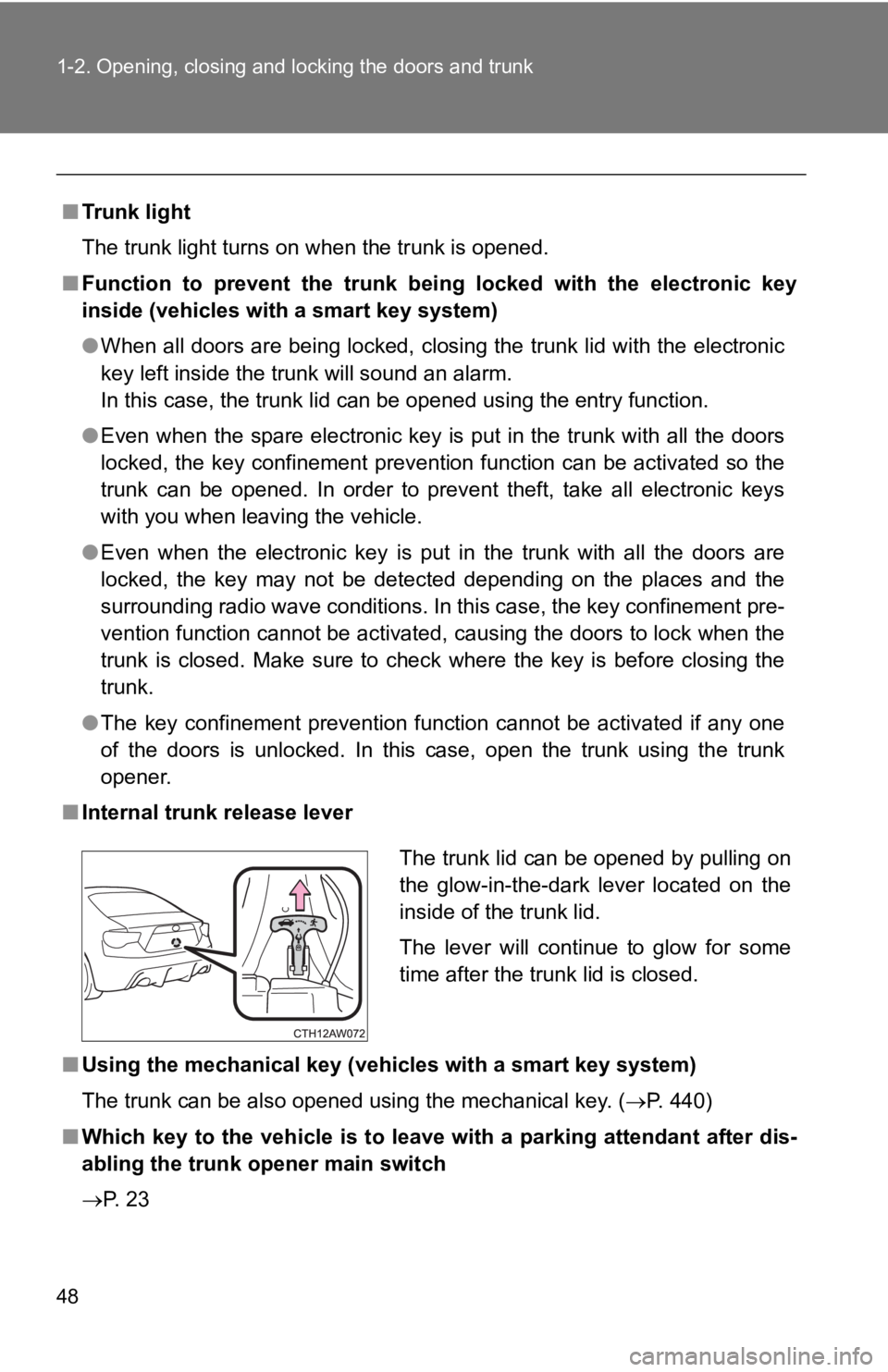
■ Internal trunk release lever
■ Using the mechanical key (vehicles with a smart key system)
The trunk can be also opened using the mechanical key. ( P. 440)
■ Which key to the vehicle is to leave with a parking attendant a fter dis-
abling the trunk opener main switch
P. 23 The trunk lid can be opened by pulling on
the glow-in-the-dark lever located on the
inside of the trunk lid.
The lever will continue to glow for some
time after the trunk lid is closed.
Page 51 of 532
511-2. Opening, closing and locking the doors and trunk
1
Before driving WARNING
● Do not attach any accessories other than genuine Toyota parts t o the trunk
lid. Such additional weight on the trunk lid may cause the lid to suddenly
shut again after it is opened.
■ Trunk lid damper stays
Do not pull on or disassemble the trunk lid damper stays, or di spose of them
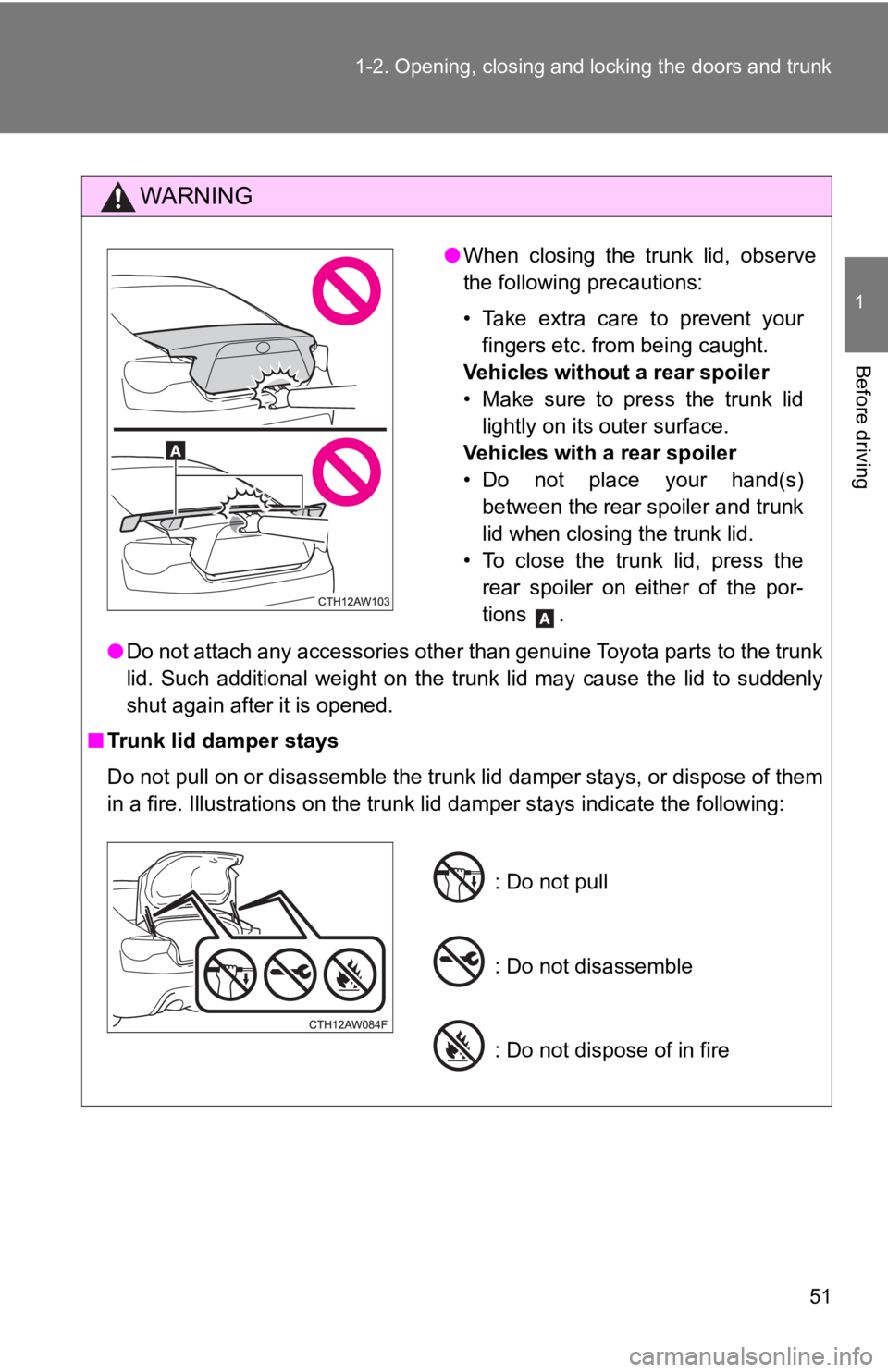
in a fire. Illustrations on the trunk lid damper stays indicate the following:● When closing the trunk lid, observe
the following precautions:
• Take extra care to prevent your
fingers etc. from being caught.
Vehicles without a rear spoiler
• Make sure to press the trunk lid
lightly on its outer surface.
Vehicles with a rear spoiler
• Do not place your hand(s)
between the rear spoiler and trunk
lid when closing the trunk lid.
• To close the trunk lid, press the
rear spoiler on either of the por-
tions .
: Do not pull
: Do not disassemble
: Do not dispose of in fire
Page 57 of 532
571-3. Adjustable components (s eats, mirrors, steering wheel)
1
Before driving WARNING■ When folding the rear seatbacks down
Observe the following precautions. Failure to do so may result in death or
serious injury.
● Do not fold the seatbacks down while driving.
● Stop the vehicle on level ground, set the parking brake and shi ft the shift
lever to P (automatic transmission) or N (manual transmission).
● Do not allow anyone to sit on a folded seatback or in the trunk while driv-
ing.
● Do not allow children to enter the trunk.
■ After returning the rear seatback to the upright position
Observe the following precautions. Failure to do so may result in death or
serious injury.
● Check that the seat belts are not twisted or caught in the seat back.
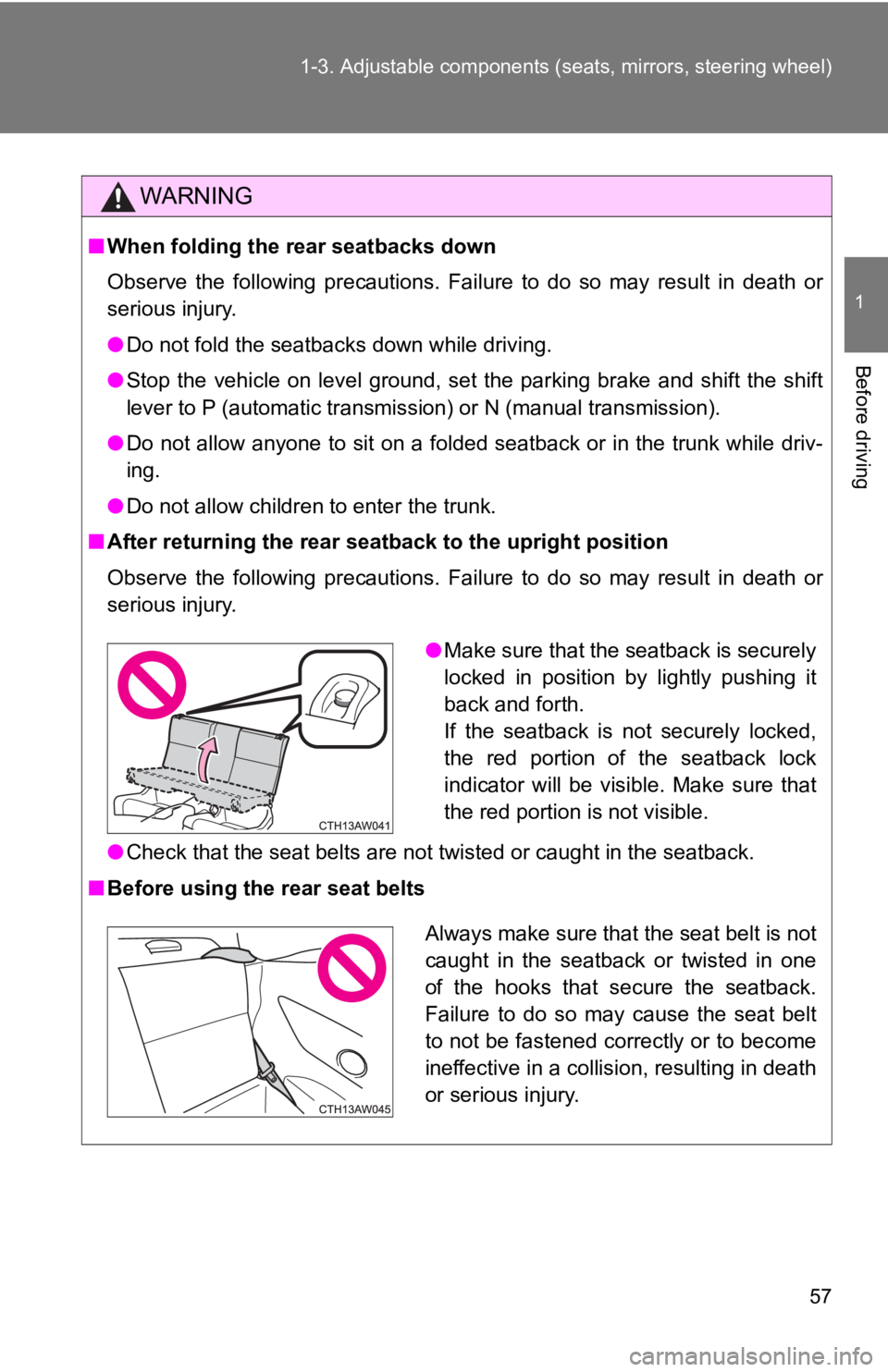
■ Before using the rear seat belts ● Make sure that the seatback is securely
locked in position by lightly pushing it
back and forth.
If the seatback is not securely locked,
the red portion of the seatback lock
indicator will be visible. Make sure that
the red portion is not visible.
Always make sure that the seat belt is not
caught in the seatback or twisted in one
of the hooks that secure the seatback.
Failure to do so may cause the seat belt
to not be fastened correctly or to become
ineffective in a collision, resulting in death
or serious injury.
Page 62 of 532

621-3. Adjustable components (s eats, mirrors, steering wheel)
■ Emergency locking retractor (ELR)
The retractor will lock the belt during a sudden stop or on imp act. It may also
lock if you lean forward too quickly. A slow, easy motion will allow the belt to
extend so that you can move around fully.
■ Automatic locking retractor (ALR)
When a passenger's shoulder belt is completely extended and the n
retracted even slightly, the belt is locked in that position and cannot be
extended. This feature is used to hold the child restraint syst em (CRS) firmly.
To free the belt again, fully retract the belt and then pull th e belt out once
more. ( P. 141)
■ Child seat belt usage
The seat belts of your vehicle are principally designed for persons of adult
size.
● Use a child restraint system appropriate for the child, until the child
becomes large enough to properly w ear the vehicle's seat belt.
( P. 137)
● When the child becomes large enough to properly wear the vehicl e's seat
belt, follow the instructions on P. 60 regarding seat belt usag e.
■ Seat belt pretensioners
● Seatbelt pretensioners are not designed to activate in a rear i mpact or
minor frontal or side impact.
● The following four components operate simultaneously when the v ehicle
is involved in a rollover accident.
• Seat belt pretensioner for driver
• Seat belt pretensioner for front passenger
• SRS curtain shield airbag for driver’s seat side
• SRS curtain shield airbag for front passenger’s seat side
Page 65 of 532

651-3. Adjustable components (s eats, mirrors, steering wheel)
1
Before driving WARNING■ People with a medical condition
Obtain medical advice and wear the seat belt in the proper way.
■ When children are in the vehicle
Do not allow children to play with the seat belt. If the seat b elt becomes
twisted around a child’s neck, it may lead to choking or other serious injuries
that could result in death.
If this occurs and the buckle cannot be unfastened, scissors should be used
to cut the belt.
■ Seat belt pretensioners
If the pretensioner has activated, the SRS warning light will c ome on. In that
case, the seat belt cannot be used again and must be replaced a t your
Toyota dealer.
Page 68 of 532
681-3. Adjustable components (seats, mirrors, steering wheel)
Anti-glare inside rear view mirror ■ Automatic anti-glare function
Responding to the level of brightness of the headlights of vehicles behind,
the reflected light is automatically reduced. When the shift le ver is shifted to
R and a rear view image is displayed on the rear view monitor, the automatic
anti-glare function will be disabled.
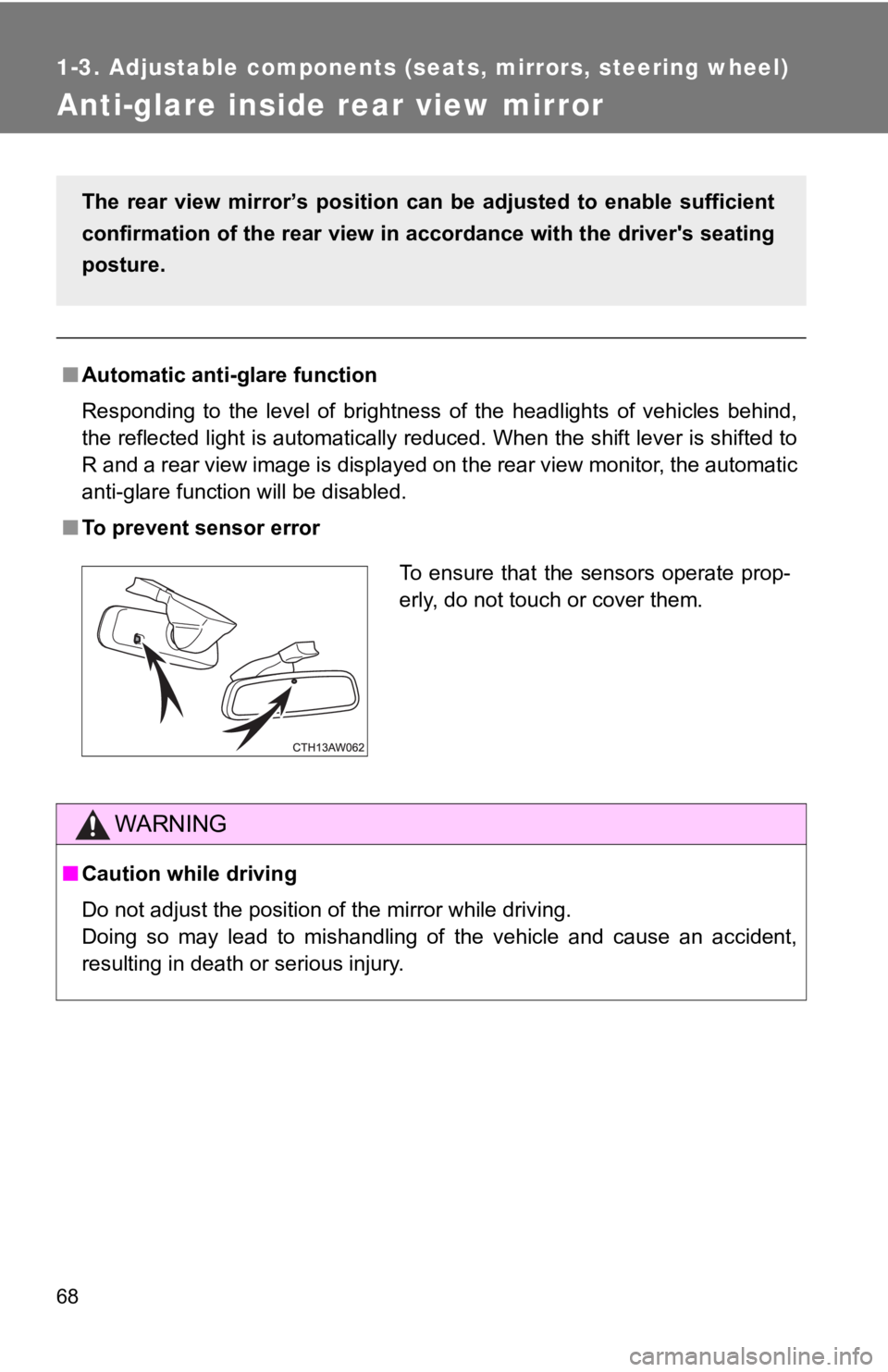
■ To prevent sensor error
WARNING■ Caution while driving
Do not adjust the position of the mirror while driving.
Doing so may lead to mishandling of the vehicle and cause an ac cident,
resulting in death or serious injury.The rear view mirror’s position can be adjusted to enable suffi cient
confirmation of the rear view in accordance with the driver's s eating
posture.
To ensure that the sensors operate prop-
erly, do not touch or cover them.
Page 73 of 532
731-4. Opening and closing the windows
1
Before driving ■ The power windows can be operated when
Vehicles without a smart key system
The engine switch is in the “ON” position.
Vehicles with a smart key system
The “ENGINE START STOP” switch is in IGNITION ON mode.
■ Operating the power windows after turning the engine off
Vehicles without a smart key system
The power windows can be operated for approximately 45 seconds even
after the engine switch is turned to the “ACC” or “LOCK” positi on. They can-
not, however, be operated once either door is opened.
Vehicles with a smart key system
The power windows can be operated for approximately 45 seconds even
after the “ENGINE START STOP” sw itch is turned to ACCESSORY mod e or
turned off. They cannot, however, be operated once either door is opened.
■ Jam protection function
If an object becomes caught between the window and the body, wi ndow
travel is stopped and the window is opened slightly.
■ When the power window does not close normally
If the jam protection function is operating abnormally and a window cannot
be closed, close all the doors and perform the following operat ions using the
power window switch on the relevant door.
Vehicles without a smart key system: After stopping the vehicle , the
engine switch is turned to the “ON” position.
Vehicles with a smart key system: After stopping the vehicle, t he
“ENGINE START STOP” switch is turned to IGNITION ON mode.
Hold the power window switch in the one-touch closing position two
consecutive times.
Hold the power window switch in the one-touch closing position
once again and continue holding for 1 second or more after the win-
dow closes completely.
If you push the power window switch to the opening position whi le the win-
dow is moving, start again from the beginning. If the window continues to
close but then re-open slightly even after performing the above procedure
correctly, have the vehicle inspected by your Toyota dealer. STEP 1
STEP 2
STEP 3
Page 76 of 532
761-5. Refueling
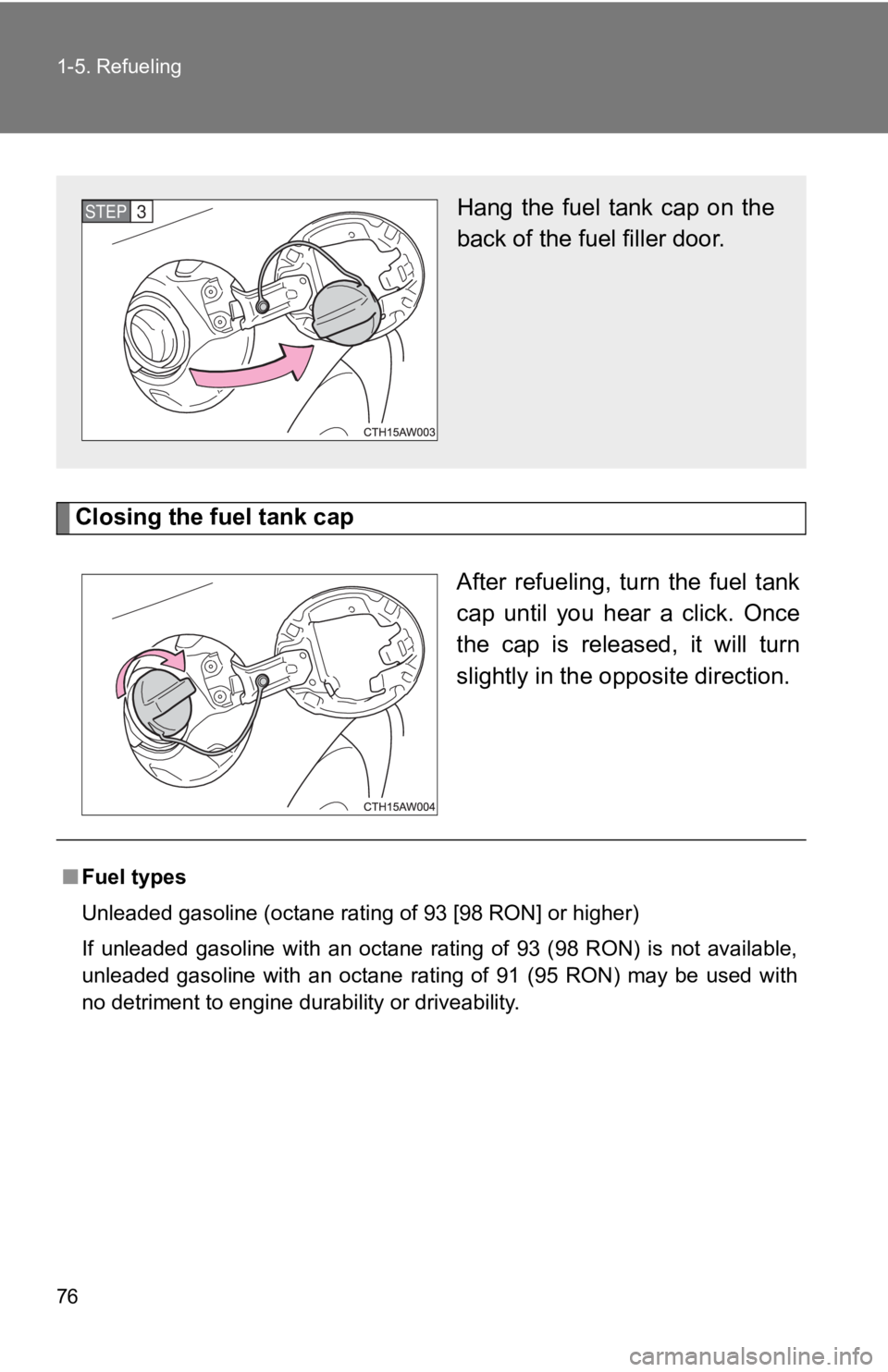
Closing the fuel tank cap
After refueling, turn the fuel tank
cap until you hear a click. Once
the cap is released, it will turn
slightly in the o pposite direction.Hang the fuel tank cap on the
back of the fuel filler door.STEP 3
■ Fuel types
Unleaded gasoline (octane rating of 93 [98 RON] or higher)
If unleaded gasoline with an octane rating of 93 (98 RON) is no t available,
unleaded gasoline with an octane rating of 91 (95 RON) may be u sed with
no detriment to engine durability or driveability.
Page 78 of 532
781-5. Refueling
WARNING■ When refueling
Observe the following precautions to prevent fuel overflowing f rom the fuel
tank:
● Securely insert the fuel nozzle into the fuel filler neck
● Stop filling the tank after the fuel nozzle automatically click s off
● Do not top off the fuel tank
● Observe other precautions that are posted at the service statio n.
● Turn the cap to the right until it clicks to ensure that it is fully tightened. If
the cap is not securely tightened, fuel spillage could occur in the event of
an accident, creating a fire hazard.
■ When replacing the fuel cap
Do not use anything but a genuine Toyota fuel tank cap designed for your
vehicle. Doing so may cause a fire or other incident which may result in
death or serious injury.
NOTICE■ Refueling
● Do not spill fuel during refueling.
Doing so may damage the vehicle, such as causing the emission c ontrol
system to operate abnormally or damaging fuel system components or the
vehicle's painted surface.
● Never add any cleaning agents to the fuel tank. The addition of a cleaning
agent may cause damage to the fuel system.
● Immediately put fuel in the tank whenever the low fuel warning light illumi-
nates. Engine misfires as a result of an empty tank could cause damage to
the engine.