light TOYOTA 86 2019 Owner's Manual
[x] Cancel search | Manufacturer: TOYOTA, Model Year: 2019, Model line: 86, Model: TOYOTA 86 2019Pages: 532, PDF Size: 6.89 MB
Page 79 of 532
79 1
Before driving 1-6. Theft deterrent system
Engine immobilizer system The vehicle's keys have built-in tr ansponder chips that prevent the
engine from starting if the key has not been previously registe red in
the vehicle's on-board computer.
Never leave the keys inside the vehicle when you leave the vehi cle.
This system is designed to help prevent vehicle theft but does not
guarantee absolute security against all vehicle thefts.
Vehicles without a smart
key system
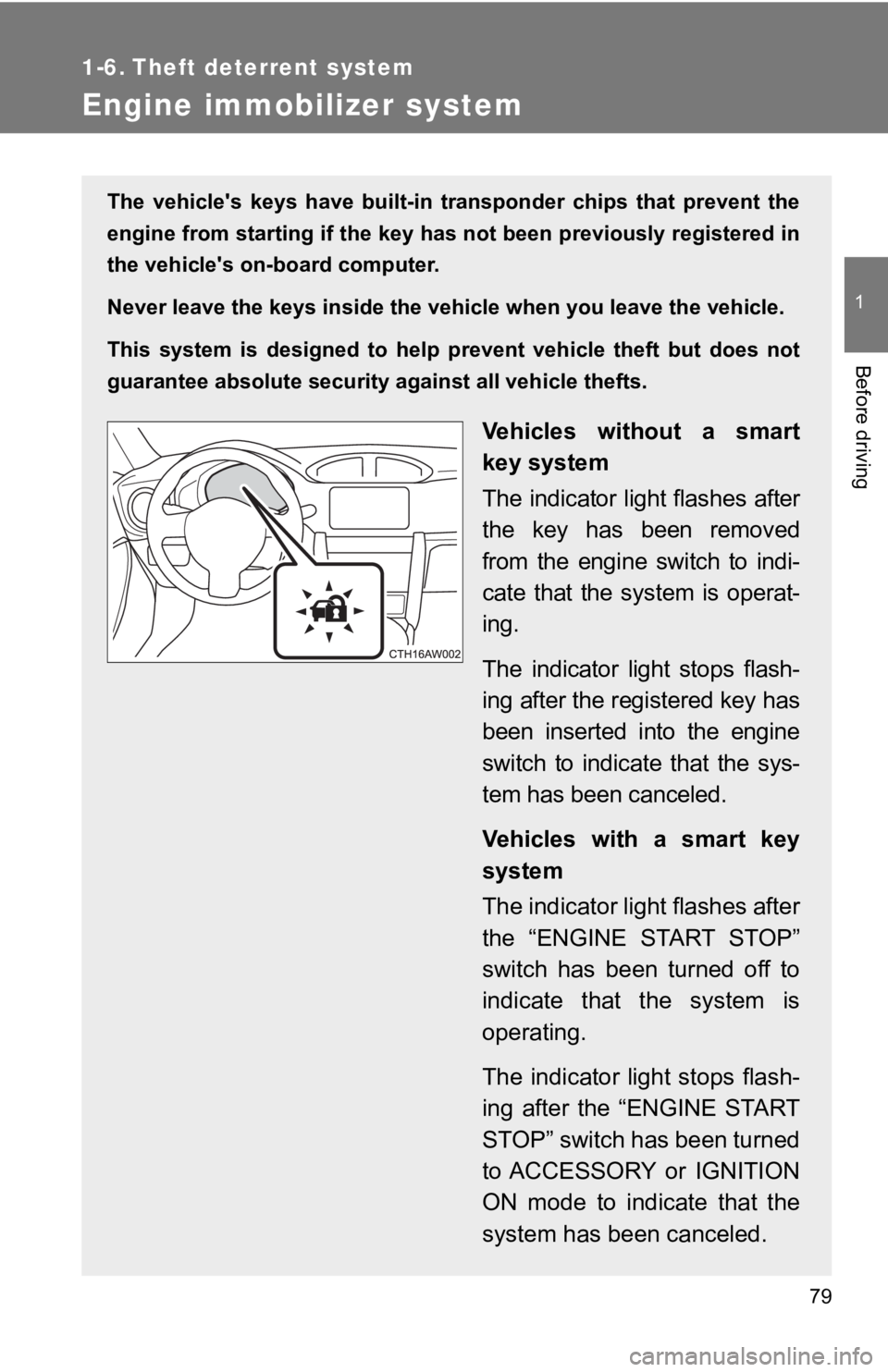
The indicator light flashes after
the key has been removed
from the engine switch to indi-
cate that the system is operat-
ing.
The indicator light stops flash-
ing after the registered key has
been inserted into the engine
switch to indicate that the sys-
tem has been canceled.
Vehicles with a smart key
system
The indicator light flashes after
the “ENGINE START STOP”
switch has been turned off to
indicate that the system is
operating.
The indicator light stops flash-
ing after the “ENGINE START
STOP” switch has been turned
to ACCESSORY or IGNITION
ON mode to indicate that the
system has been canceled.
Page 82 of 532
821-6. Theft deterrent system
Alarm
: If equippedThe alarm’s default setting is set to off. To use the alarm, pe rform the
activating the alarm system procedures.
The system sounds the alarm and flashes the lights when forcibl e
entry is detected.
■ Triggering of the alarm
The alarm is triggered when a locked door or the trunk is
unlocked or opened in any way ot her than using the entry func-
tion or wireless remote cont rol while the alarm is set.
■ Setting the alarm system
Close the doors and/or trunk an d perform one of the following:
● Lock the doors using the entry function.
● Lock the doors using the wi reless remote control.
● Lock the doors from the outsi de without using a key.
( P. 4 4 )
The system will be set auto-
matically after 30 seconds or
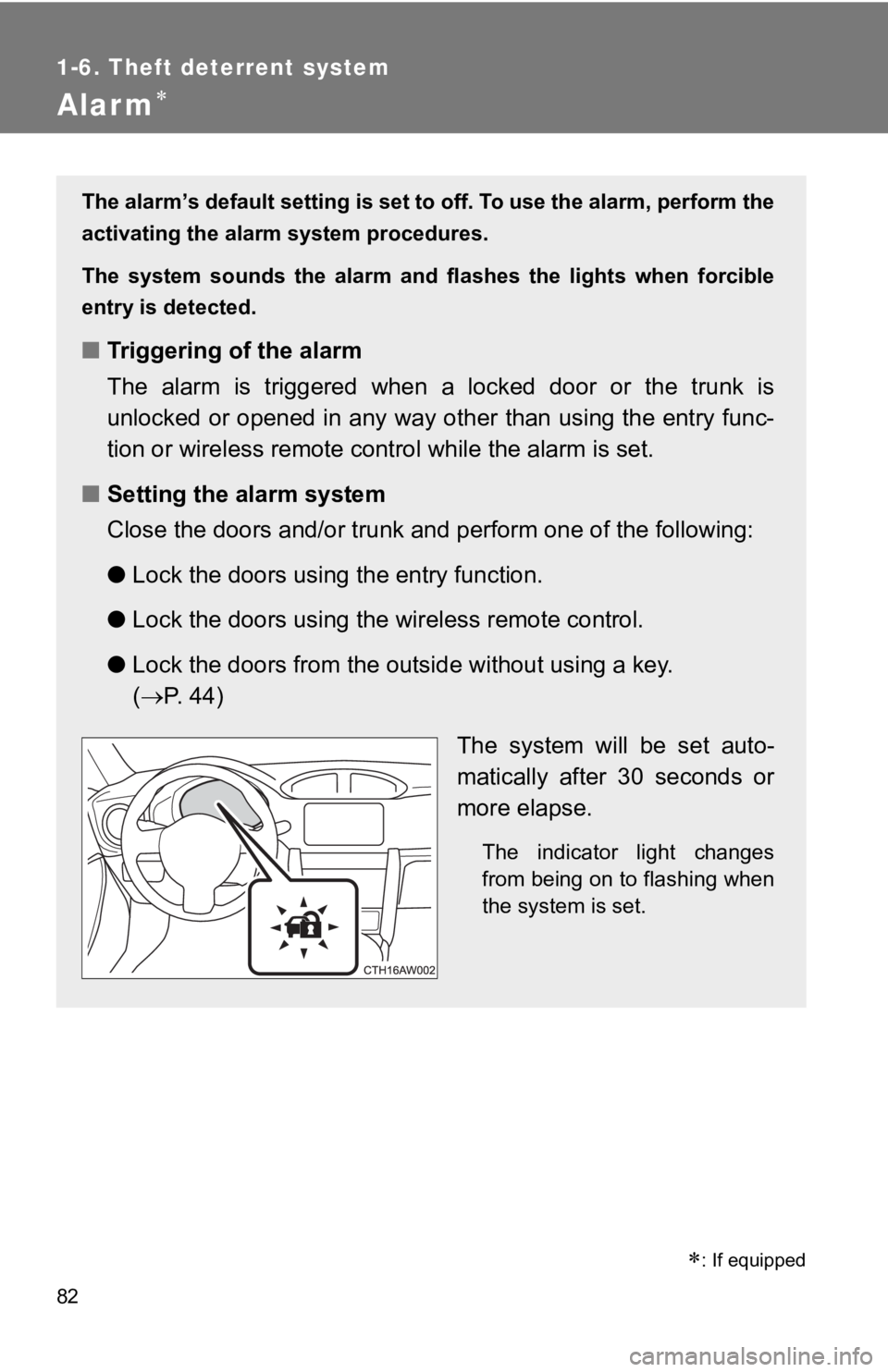
more elapse. The indicator light changes
from being on to flashing when
the system is set.
Page 92 of 532

921-7. Safety information
WARNING■ SRS airbag
● Put children aged 12 and under in the
rear seat properly restrained at all
times. The SRS airbag deploys with
considerable speed and force and can
injure or even kill children, especially if
they are 12 years of age and under and
are not restrained or improperly
restrained. Because children are lighter
and weaker than adults, their risk of
being injured from deployment is
greater.
For that reason, we strongly recom-
mend that ALL children (including those
in child seats and those that have out-
grown child restraint devices) sit in the
REAR seat properly restrained at all
times in a child restraint device or in a
seat belt, whichever is appropriate for
the child's age, height and weight.
Secure ALL types of child restraint
devices (including forward facing child
seats) in the REAR seats at all times.
According to accident statistics, chil-
dren are safer when properly restrained
in the rear seating positions than in the
front seating positions.
For instructions and precautions con-
cerning the child restraint system, refer
to “Child restraint systems”. ( P. 137)
Page 94 of 532
941-7. Safety information
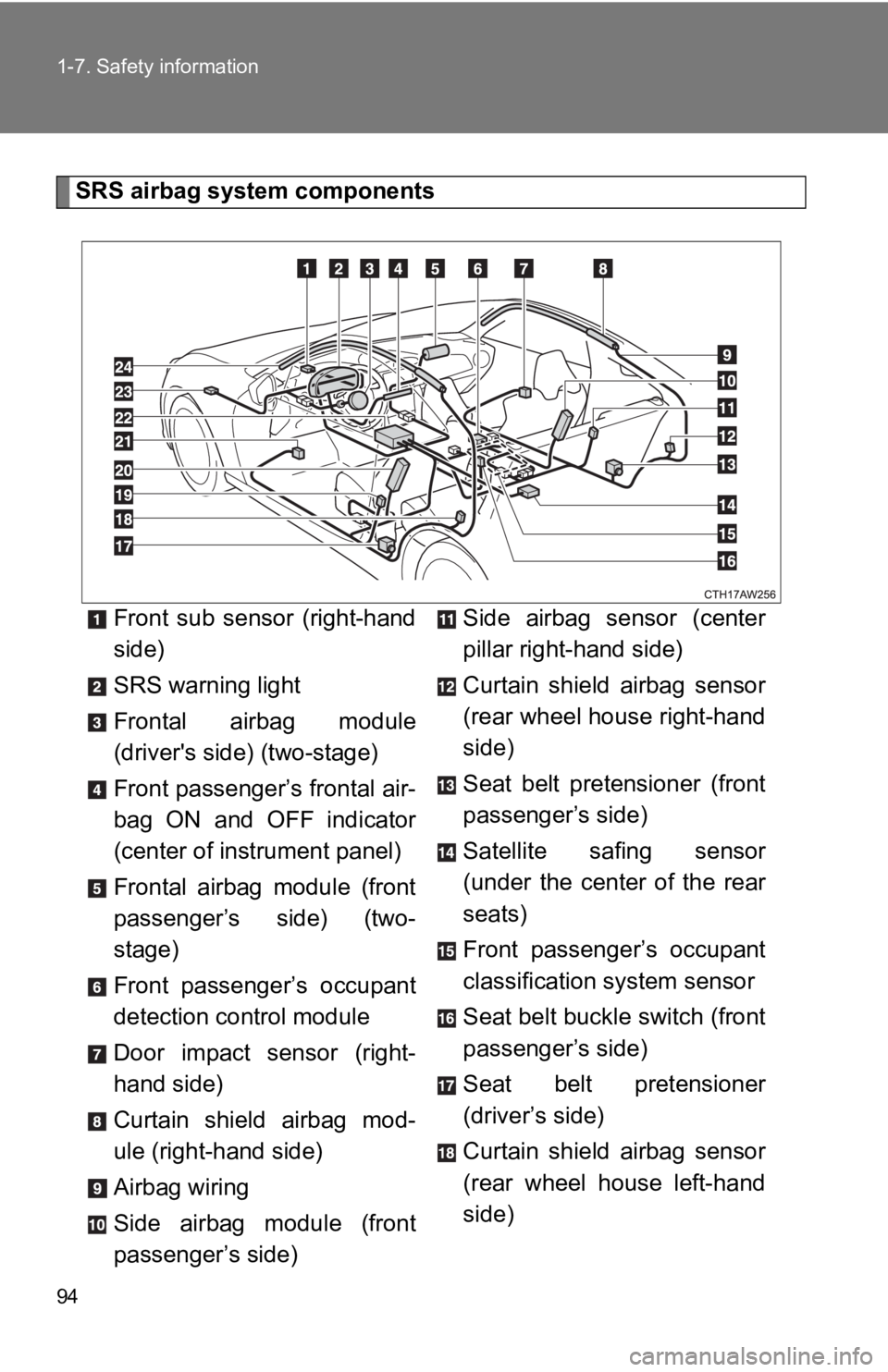
SRS airbag system components
Front sub sensor (right-hand
side)
SRS warning light
Frontal airbag module
(driver's side) (two-stage)
Front passenger’s frontal air-
bag ON and OFF indicator
(center of instrument panel)
Frontal airbag module (front
passenger’s side) (two-
stage)
Front passenger’s occupant
detection control module
Door impact sensor (right-
hand side)
Curtain shield airbag mod-
ule (right-hand side)
Airbag wiring
Side airbag module (front
passenger’s side) Side airbag sensor (center
pillar right-hand side)
Curtain shield airbag sensor
(rear wheel house right-hand
side)
Seat belt pretensioner (front
passenger’s side)
Satellite safing sensor
(under the center of the rear
seats)
Front passenger’s occupant
classification system sensor
Seat belt buckle switch (front
passenger’s side)
Seat belt pretensioner
(driver’s side)
Curtain shield airbag sensor
(rear wheel house left-hand
side)
Page 95 of 532

951-7. Safety information
1
Before driving
Your vehicle is equipped with ADVANCED AIRBAGS designed based
on US motor vehicle safety standards (FMVSS208). The airbag sys -
tem controls airbag deployment power for the driver and front p as-
senger. The front passenger's air bag system consists of the fro nt
passenger occupant detec tion control module etc.
The main SRS airbag system components are shown above. The
SRS airbag system is controlled by the airbag control module. T he
airbag control module cons ists of an airbag sensor.
In certain types of severe front or side impacts, the SRS airba g sys-
tem triggers the airbag inflators. A chemical reaction in the inflators
quickly fills the airbags with non- toxic gas to help restrain t he motion
of the occupants. Side airbag sensor (center
pillar left-hand side)
Side airbag module (driver’s
side)
Door impact sensor (left-
hand side) Airbag control module
(including impact sensors
and rollover sensors)
Front sub sensor (left-hand
side)
Curtain shield airbag mod-
ule (left-hand side)
■ If the SRS airbags deploy (inflate)
● Slight abrasions, burns, bruisi ng etc., may be sustained from S RS air-
bags, due to the extremely high speed deployment (inflation) by hot
gases.
● A loud noise and white powder will be emitted.
● Parts of the airbag module (steering wheel hub, airbag cover an d inflator)
as well as the front seats, parts of the front and rear pillars , and roof side
rails, may be hot for several minutes. The airbag itself may al so be hot.
● The windshield may crack.
Page 97 of 532

971-7. Safety information
1
Before driving ■ Driver’s SRS frontal airbag
The driver’s SRS frontal airbag uses a dual stage inflator. The inflator oper-
ates in different ways depending on the severity of impact.
Have the system inspected by your Toyota dealer immediately if the SRS
warning light illuminates.
NOTE
The driver’s SRS side airbag and SRS curtain shield airbag are not con-
trolled by the Toyota advanced frontal airbag system.
■ Front passenger’s SRS frontal airbag
The front passenger’s SRS frontal airbag uses a dual stage infl ator. The
inflator operates in different ways depending on the severity of impact.
The occupant classification system sensor is installed under th e seat uphol-
stery and monitors the physique and posture of the front passen ger. Using
this information, the occupant classification system determines whether the
front passenger’s SRS frontal airbag should be deployed or not.
The occupant classification system may not inflate the front passenger’s
SRS frontal airbag even when the driver’s SRS frontal airbag de ploys. This
is normal. In this case, although the front passenger’s SRS fro ntal airbag
does not operate, the front passenger’s seat belt pretensioner operates with
the driver’s seat belt pretensioner. For details about the seat belt preten-
sioner, refer to “Seat belt pretensioners”. ( P. 61)
Observe the following precautions. Failure to do so may prevent the Toyota
advanced frontal airbag system from functioning correctly or ca use the sys-
tem to fail.
● Do not apply any strong impact to the front passenger’s seat.
● Do not spill liquid on the front passenger’s seat. If liquid is spilled, wipe it
off immediately.
● Do not remove or disassemble the front passenger’s seat.
● Do not install any accessory (such as an audio amplifier) other than a
genuine Toyota accessory under the front passenger’s seat.
● Do not place anything (shoes, umbrella, etc.) under the front p assenger’s
seat.
● Do not place a magnet near the seat belt buckle.
Page 98 of 532

981-7. Safety information
If the seat belt buckle switch and/or front passenger’s occupan t classification
system have failed, the SRS warning light will illuminate. Have the system
inspected by your Toyota dealer immediately if the SRS warning light illumi-
nates.
If your vehicle has sustained impact, this may affect the proper function of
the Toyota advanced frontal airbag system. Have your vehicle in spected at
your Toyota dealer. Do not use the front passenger’s seat while driving the
vehicle to your Toyota dealer.
NOTE
The front passenger’s SRS side airbag and SRS curtain shield ai rbag are
not controlled by the Toyota advanced frontal airbag system.
■ Passenger’s frontal airba g ON and OFF indicators
P. 128
■ Occupant classification system
The occupant classification system sensor is installed under th e seat uphol-
stery and monitors the physique and posture of the front passen ger. Using
this information, the occupant classification system determines whether the
front passenger’s SRS frontal airbag should be deployed or not.
If the front passenger’s seat cushion is wet, this may adversel y affect the
ability of the system to determine deployment. If the seat cush ion is wet, the
front passenger should stop sitting on the front passenger’s se at. Wipe off
liquid from the seat immediately, let the seat dry naturally an d then check the
SRS warning light as follows.
● If the SRS warning light illuminates, keep the seat dry until t he warning
light turns off. If the SRS warning light stays on even when th e seat has
dried, do not allow anyone to sit on the front passenger’s seat and have
the system checked by your Toyota dealer.
● If the SRS warning light does not illuminate, check that the fr ont passen-
ger’s frontal airbag ON and OFF indicators work properly. If th e indicators
do not work properly, do not allow anyone to sit on the front p assenger’s
seat and have the system checked by your Toyota dealer.
Page 121 of 532

1211-7. Safety information
1
Before driving WARNING■ SRS airbag precautions
● The SRS driver airbag deploys with considerable force, and can cause
death or serious injury especially if the driver is very close to the airbag.
The National Highway Traffic Safety Administration (“NHTSA”) ad vises:
Since the risk zone for the driver’s airbag is the first 2 - 3 in. (50 - 75 mm)
of inflation, placing yourself 10 in. (250 mm) from your driver airbag pro-
vides you with a clear margin of safety. This distance is measu red from the
center of the steering wheel to your breastbone. If you sit les s than 10 in.
(250 mm) away now, you can change your driving position in seve ral
ways:
• Move your seat to the rear as far as you can while still reaching the
pedals comfortably.
• Slightly recline the back of the seat. Although vehicle design s vary,
many drivers can achieve the 10 in. (250 mm) distance, even wit h the
driver seat all the way forward, simply by reclining the back o f the seat
somewhat. If reclining the back of your seat makes it hard to s ee the
road, raise yourself by using a firm, non-slippery cushion, or raise the
seat if your vehicle has that feature.
• If your steering wheel is adjustable, tilt it downward. This p oints the air-
bag toward your chest instead of your head and neck.
The seat should be adjusted as recommended by NHTSA above, whil e
still maintaining control of the foot pedals, steering wheel, a nd your view of
the instrument panel controls.
● The SRS front passenger airbag al so deploys with considerable f orce, and
can cause death or serious injury especially if the front passe nger is very
close to the airbag. The front passenger seat should be as far from the air-
bag as possible with the seatback adjusted, so the front passen ger sits
upright.
● Improperly seated and/or restrained infants and children can be killed or
seriously injured by a deploying airbag. An infant or child who is too small
to use a seat belt should be properly secured using a child res traint sys-
tem. Toyota strongly recommends that all infants and children be placed in
the rear seats of the vehicle and properly restrained. The rear seats are
safer for infants and children than the front passenger seat. ( P. 137)
Page 125 of 532
1251-7. Safety information
1
Before driving SRS airbag system monitors
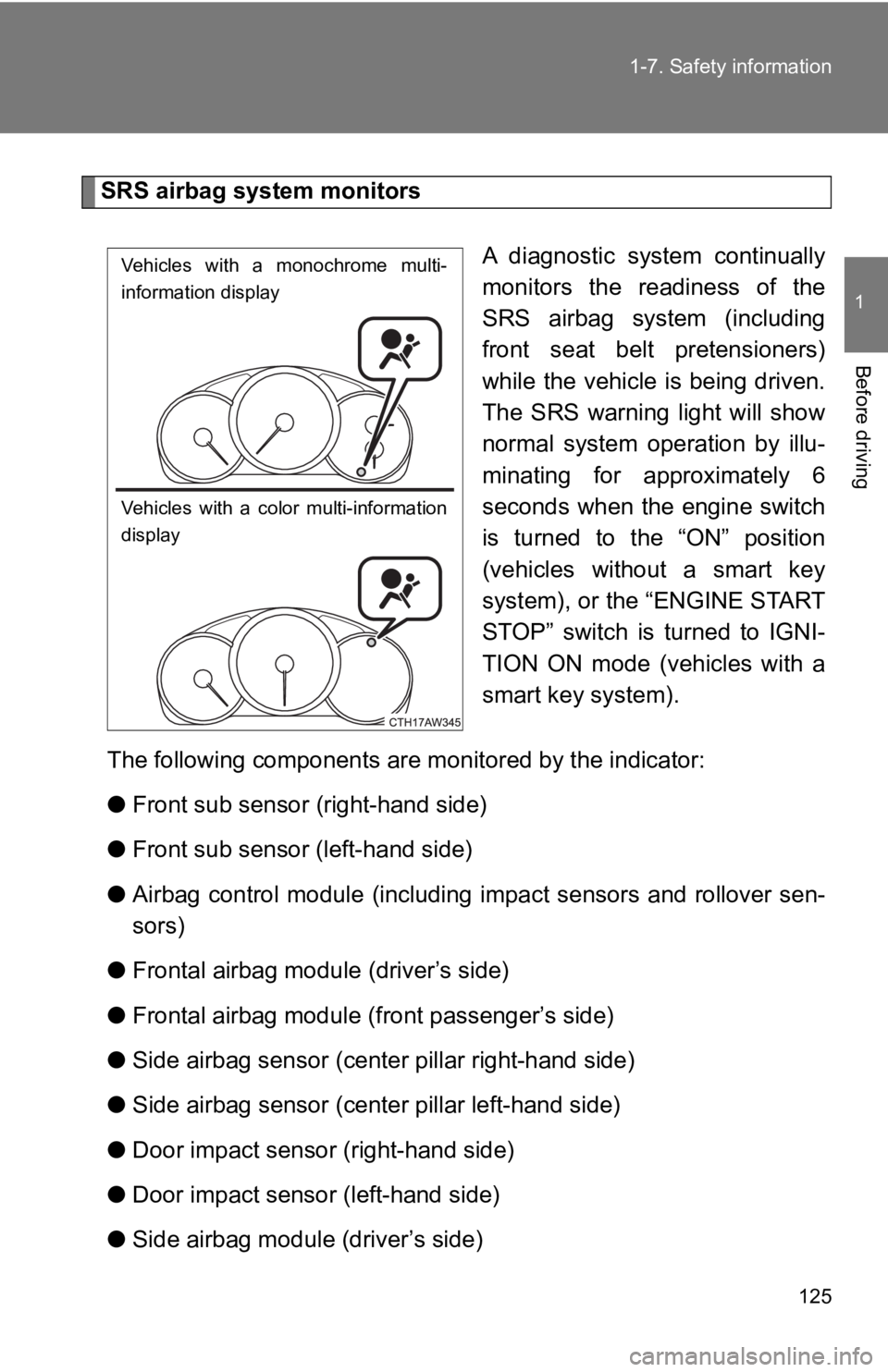
A diagnostic system continually
monitors the readiness of the
SRS airbag system (including
front seat belt pretensioners)
while the vehicle is being driven.
The SRS warning light will show
normal system operation by illu-
minating for approximately 6
seconds when the engine switch
is turned to the “ON” position
(vehicles without a smart key
system), or the “ENGINE START
STOP” switch is turned to IGNI-
TION ON mode (vehicles with a
smart key system).
The following components are mo nitored by the indicator:
● Front sub sensor (right-hand side)
● Front sub sensor (left-hand side)
● Airbag control module (including impact sensors and rollover se n-
sors)
● Frontal airbag modu le (driver’s side)
● Frontal airbag module ( front passenger’s side)
● Side airbag sensor (center pillar right-hand side)
● Side airbag sensor (center pillar left-hand side)
● Door impact sensor (right-hand side)
● Door impact sensor (left-hand side)
● Side airbag module (driver’s side) Vehicles with a monochrome multi-
information display
Vehicles with a color multi-information
display
Page 127 of 532

1271-7. Safety information
1
Before driving WARNING■ SRS warning light
If the warning light exhibits any of the following conditions, there may be a
malfunction in the seat belt pretensioners, SRS airbag system a nd/or front
passenger occupant classification system. Immediately take your vehicle to
your nearest Toyota dealer to have the system checked. Unless c hecked
and properly repaired, the seat belt pretensioners, SRS airbag and/or front
passenger occupant classification system will not operate prope rly in the
event of a collision, which may increase the risk of death or s erious injury.
● Flashing or flickering of the warning light
● No illumination of the warning light when the engine switch is first turned to
the “ON” position (vehicles without a smart key system), or the “ENGINE
START STOP” switch is turned to IGNITION ON mode (vehicles with a
smart key system).
● Continuous illumination of the warning light
● Illumination of the warning light while driving