tow TOYOTA AURIS 2015 (in English) User Guide
[x] Cancel search | Manufacturer: TOYOTA, Model Year: 2015, Model line: AURIS, Model: TOYOTA AURIS 2015Pages: 632, PDF Size: 17.65 MB
Page 158 of 632
1583-3. Adjusting the seats
Auris Touring Sports_EE (OM12G98E)
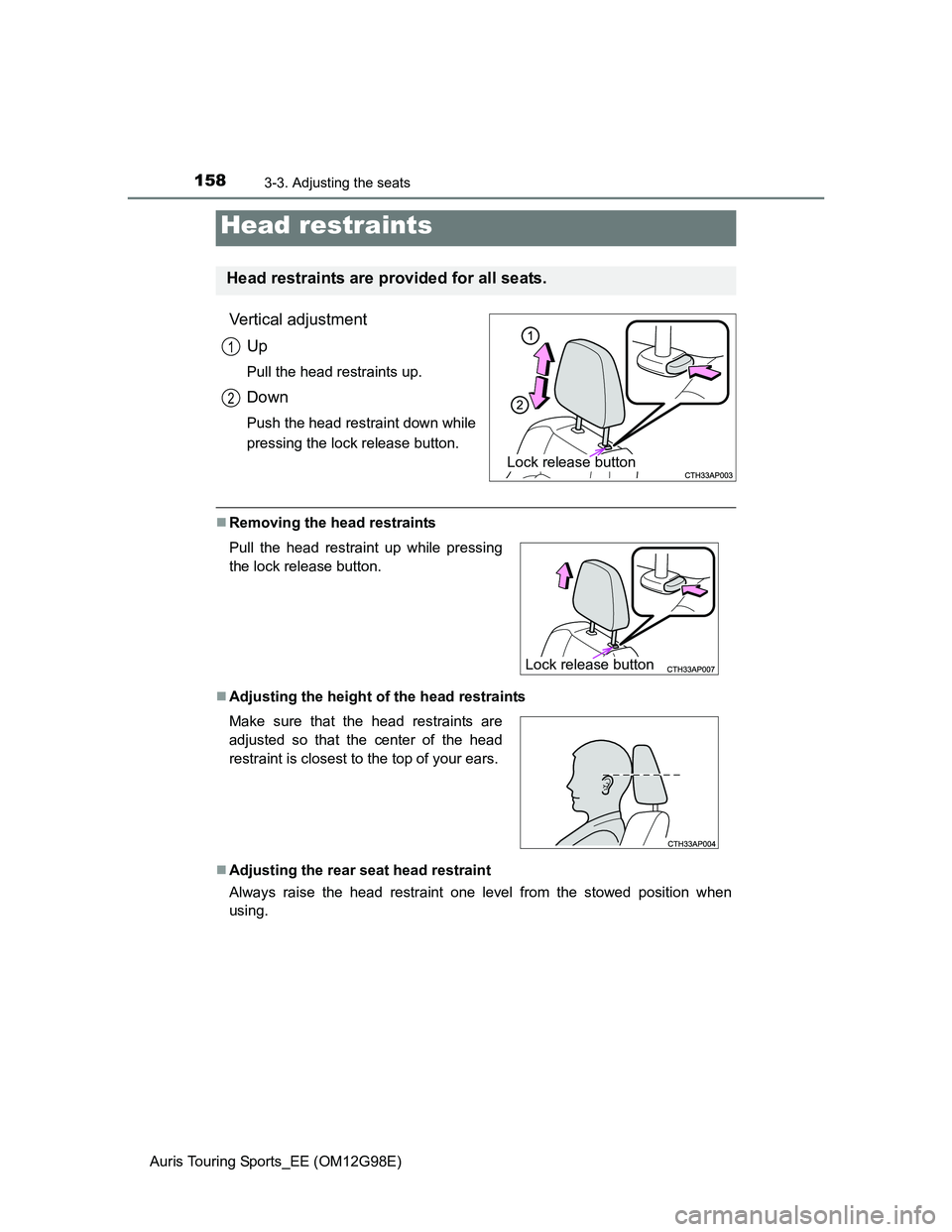
Vertical adjustment
Up
Pull the head restraints up.
Down
Push the head restraint down while
pressing the lock release button.
Removing the head restraints
Adjusting the height of the head restraints
Adjusting the rear seat head restraint
Always raise the head restraint one level from the stowed position when
using.
Head restraints
Head restraints are provided for all seats.
Lock release button
1
2
Pull the head restraint up while pressing
the lock release button.
Make sure that the head restraints are
adjusted so that the center of the head
restraint is closest to the top of your ears.
Lock release button
Page 165 of 632
1653-4. Adjusting the steering wheel and mirrors
Auris Touring Sports_EE (OM12G98E)
3
Operation of each component
Mirror angle can be adjusted when
Vehicles without a smart entry & start system
The engine switch is in the “ACC” or “ON” position.
Vehicles with a smart entry & start system
The engine switch is in ACCESSORY or IGNITION ON mode.
When the mirrors are fogged up
The outside rear view mirrors can be cleared using the mirror defoggers. Turn
on the rear window defogger to turn on the outside rear view mirror defog-
gers. (P. 314)
Using automatic mode in cold weather (if equipped)
When automatic mode is used in cold weather, the door mirror could freeze
up and automatic stowing and return may not be possible. In this event,
remove any ice and snow from the door mirror, then either operate the mirror
using manual mode or move the mirror by hand.
CAUTION
Important points while driving
Observe the following precautions while driving.
Failure to do so may result in loss of control of the vehicle and cause an
accident, resulting in death or serious injury.
Do not adjust the mirrors while driving.
Do not drive with the mirrors folded.
Both the driver and passenger side mirrors must be extended and properly
adjusted before driving.
When a mirror is moving
To avoid personal injury and mirror malfunction, be careful not to get your
hand caught by the moving mirror.
When the mirror defoggers are operating
Do not touch the rear view mirror surfaces, as they can become very hot
and burn you.
Page 171 of 632
171
4Driving
Auris Touring Sports_EE (OM12G98E)4-1. Before driving
Driving the vehicle ............. 172
Cargo and luggage ............ 183
Trailer towing ..................... 186
4-2. Driving procedures
Engine (ignition) switch
(vehicles without a
smart entry & start
system) ............................ 195
Engine (ignition) switch
(vehicles with a smart
entry & start system)........ 199
Multidrive ........................... 209
Manual transmission.......... 214
Turn signal lever ................ 217
Parking brake .................... 218
Horn ................................... 219
4-3. Operating the lights
and wipers
Headlight switch ................ 220
Automatic High Beam ........ 226
Fog light switch .................. 230
Windshield wipers and
washer ............................. 232
Rear window wiper and
washer ............................. 2364-4. Refueling
Opening the fuel tank
cap ................................... 238
4-5. Using the driving
support systems
Cruise control..................... 242
Speed limiter ...................... 247
Toyota parking
assist-sensor ................... 250
Simple-IPA
(Simple-Intelligent
Parking Assist)................. 256
Stop & Start system ........... 270
Driving assist systems ....... 276
Hill-start assist control........ 281
Diesel particulate filter
system ............................. 283
4-6. Driving tips
Winter driving tips .............. 285
Page 175 of 632
1754-1. Before driving
Auris Touring Sports_EE (OM12G98E)
4
Driving
Breaking in your new Toyota
To extend the life of the vehicle, observing the following precautions is recom-
mended:
For the first 300 km (186 miles):
Avoid sudden stops.
For the first 800 km (500 miles):
Do not tow a trailer.
For the first 1000 km (621 miles):
• Do not drive at extremely high speeds.
• Avoid sudden acceleration.
• Do not drive continuously in low gears.
• Do not drive at a constant speed for extended periods.
Operating your vehicle in a foreign country
Comply with the relevant vehicle registration laws and confirm the availability
of the correct fuel. (P. 590)
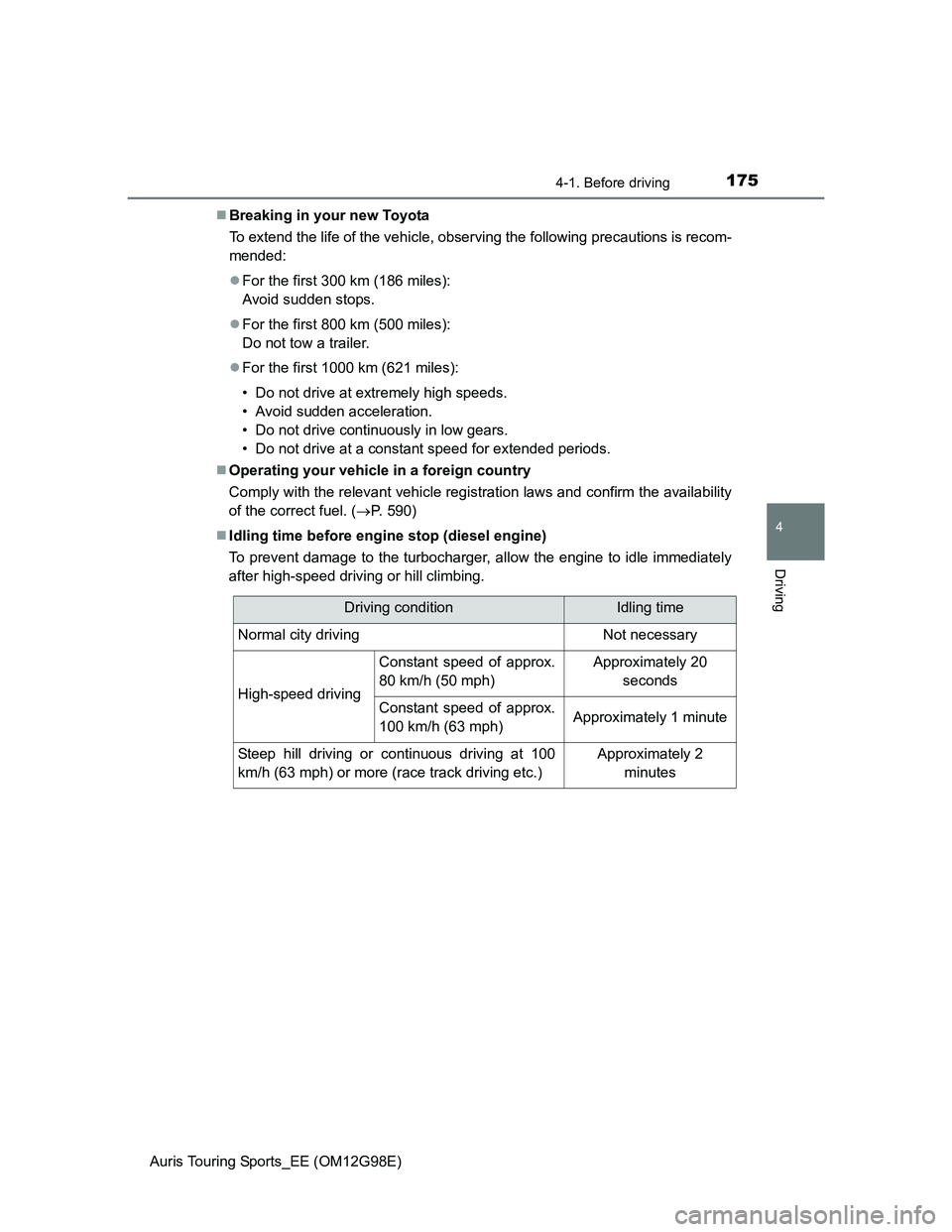
Idling time before engine stop (diesel engine)
To prevent damage to the turbocharger, allow the engine to idle immediately
after high-speed driving or hill climbing.
Driving conditionIdling time
Normal city driving Not necessary
High-speed driving
Constant speed of approx.
80 km/h (50 mph)Approximately 20
seconds
Constant speed of approx.
100 km/h (63 mph)Approximately 1 minute
Steep hill driving or continuous driving at 100
km/h (63 mph) or more (race track driving etc.)Approximately 2
minutes
Page 183 of 632
1834-1. Before driving
Auris Touring Sports_EE (OM12G98E)
4
Driving
Cargo and luggage
Take notice of the following information about storage precau-
tions, cargo capacity and load:
CAUTION
Things that must not be carried in the luggage compartment
The following things may cause a fire if loaded in the luggage compartment:
Receptacles containing gasoline
Aerosol cans
Storage precautions
Observe the following precautions.
Failure to do so may prevent the pedals from being depressed properly,
may block the driver’s vision, or may result in items hitting the driver or pas-
sengers, possibly causing an accident.
Stow cargo and luggage in the luggage compartment whenever possible.
Do not stack cargo and luggage in the luggage compartment higher than
the seatbacks.
Do not place cargo or luggage in or on the following locations.
• At the feet of the driver
• On the front passenger or rear seats (when stacking items)
• On the luggage cover
• On the instrument panel
• On the dashboard
Secure all items in the occupant compartment.
When you fold down the rear seats, long items should not be placed
directly behind the front seats.
Never allow anyone to ride in the luggage compartment. It is not designed
for passengers. They should ride in their seats with their seat belts prop-
erly fastened.
Page 186 of 632
1864-1. Before driving
Auris Touring Sports_EE (OM12G98E)
Weight limits
Check the allowable towing capacity, gross vehicle mass, maximum
permissible axle capacity, and permissible drawbar load before tow-
ing. (P. 584)
Towing hitch/bracket
Toyota recommends the use of the Toyota hitch/bracket for your
vehicle. Other products of a suitable nature and comparable quality
may also be used.
Trailer towing
Your vehicle is designed primarily as a passenger carrying vehi-
cle. Towing a trailer will have an adverse effect on handling, per-
formance, braking, durability, and fuel consumption. Your safety
and satisfaction depend on the proper use of correct equipment
and cautious driving habits. For your safety and the safety of
others, do not overload the vehicle or trailer.
To tow a trailer safely, use extreme care and drive the vehicle in
accordance with the trailer’s characteristics and operating con-
ditions.
Toyota warranties do not apply to damage or malfunction
caused by towing a trailer for commercial purposes.
Ask your local authorized Toyota dealer or repairer, or another
duly qualified and equipped professional for further details
before towing, as there are additional legal requirements in
some countries.
Page 187 of 632
1874-1. Before driving
Auris Touring Sports_EE (OM12G98E)
4
Driving
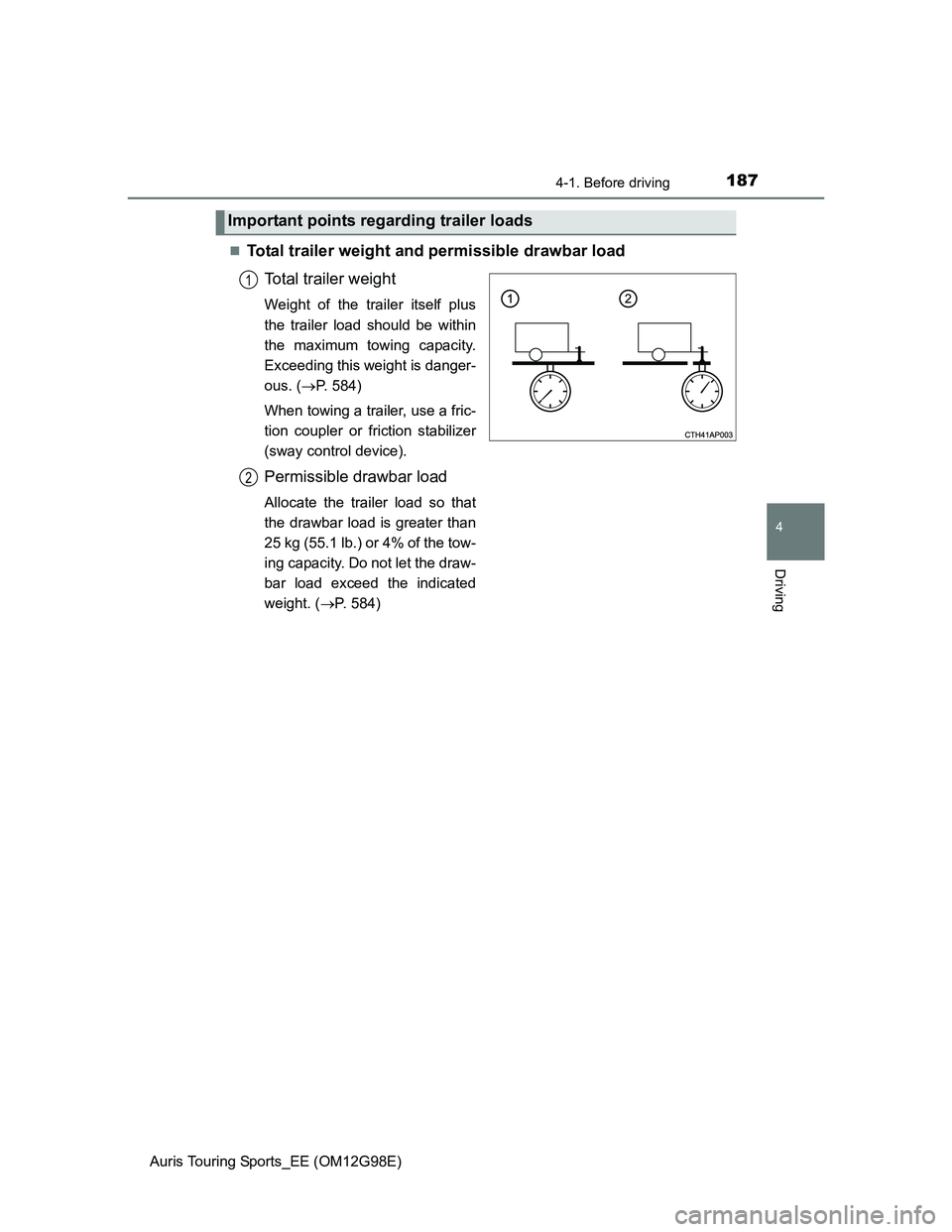
Total trailer weight and permissible drawbar load
Total trailer weight
Weight of the trailer itself plus
the trailer load should be within
the maximum towing capacity.
Exceeding this weight is danger-
ous. (P. 584)
When towing a trailer, use a fric-
tion coupler or friction stabilizer
(sway control device).
Permissible drawbar load
Allocate the trailer load so that
the drawbar load is greater than
25 kg (55.1 lb.) or 4% of the tow-
ing capacity. Do not let the draw-
bar load exceed the indicated
weight. (P. 584)
Important points regarding trailer loads
1
2
Page 188 of 632
1884-1. Before driving
Auris Touring Sports_EE (OM12G98E)
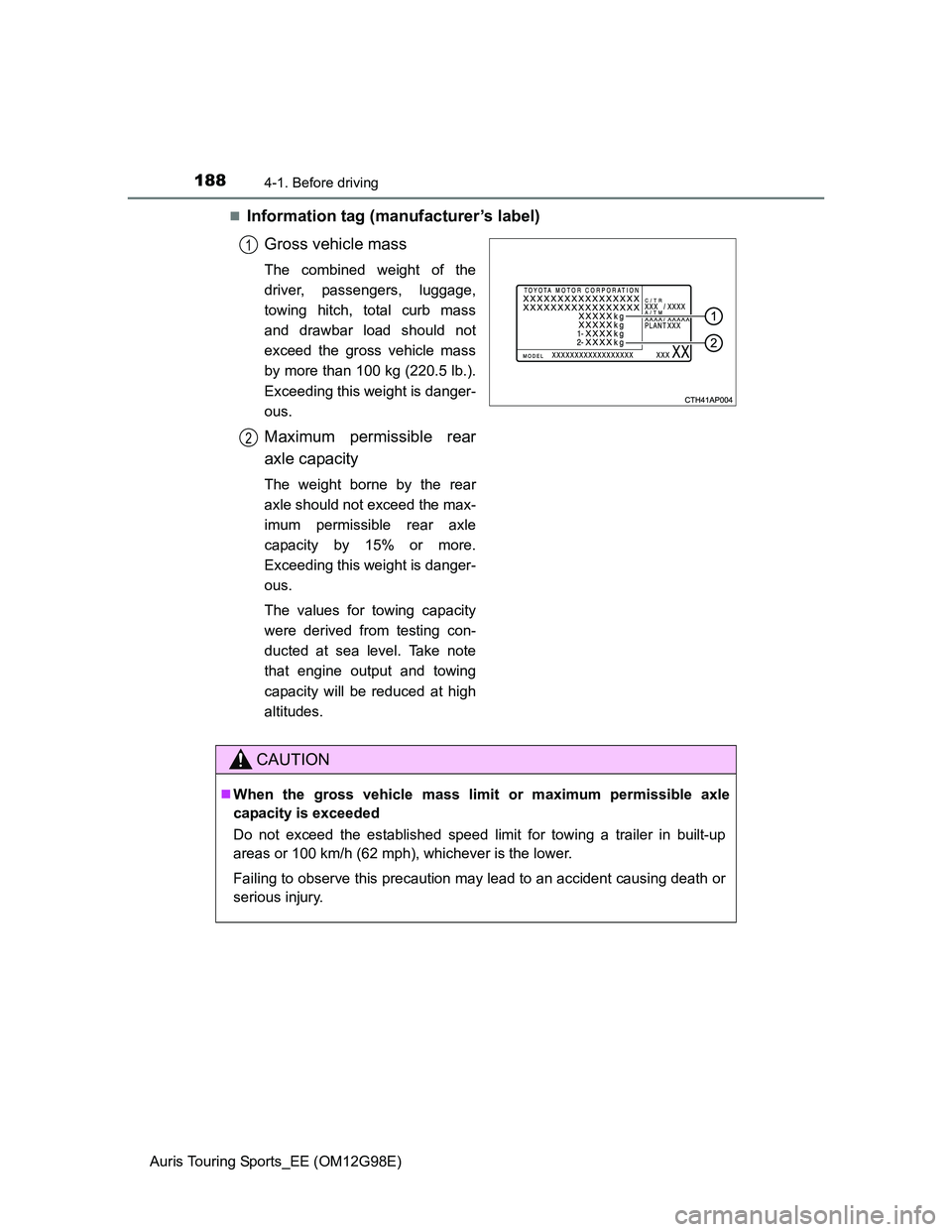
Information tag (manufacturer’s label)
Gross vehicle mass
The combined weight of the
driver, passengers, luggage,
towing hitch, total curb mass
and drawbar load should not
exceed the gross vehicle mass
by more than 100 kg (220.5 lb.).
Exceeding this weight is danger-
ous.
Maximum permissible rear
axle capacity
The weight borne by the rear
axle should not exceed the max-
imum permissible rear axle
capacity by 15% or more.
Exceeding this weight is danger-
ous.
The values for towing capacity
were derived from testing con-
ducted at sea level. Take note
that engine output and towing
capacity will be reduced at high
altitudes.
1
2
CAUTION
When the gross vehicle mass limit or maximum permissible axle
capacity is exceeded
Do not exceed the established speed limit for towing a trailer in built-up
areas or 100 km/h (62 mph), whichever is the lower.
Failing to observe this precaution may lead to an accident causing death or
serious injury.
Page 189 of 632
1894-1. Before driving
Auris Touring Sports_EE (OM12G98E)
4
Driving
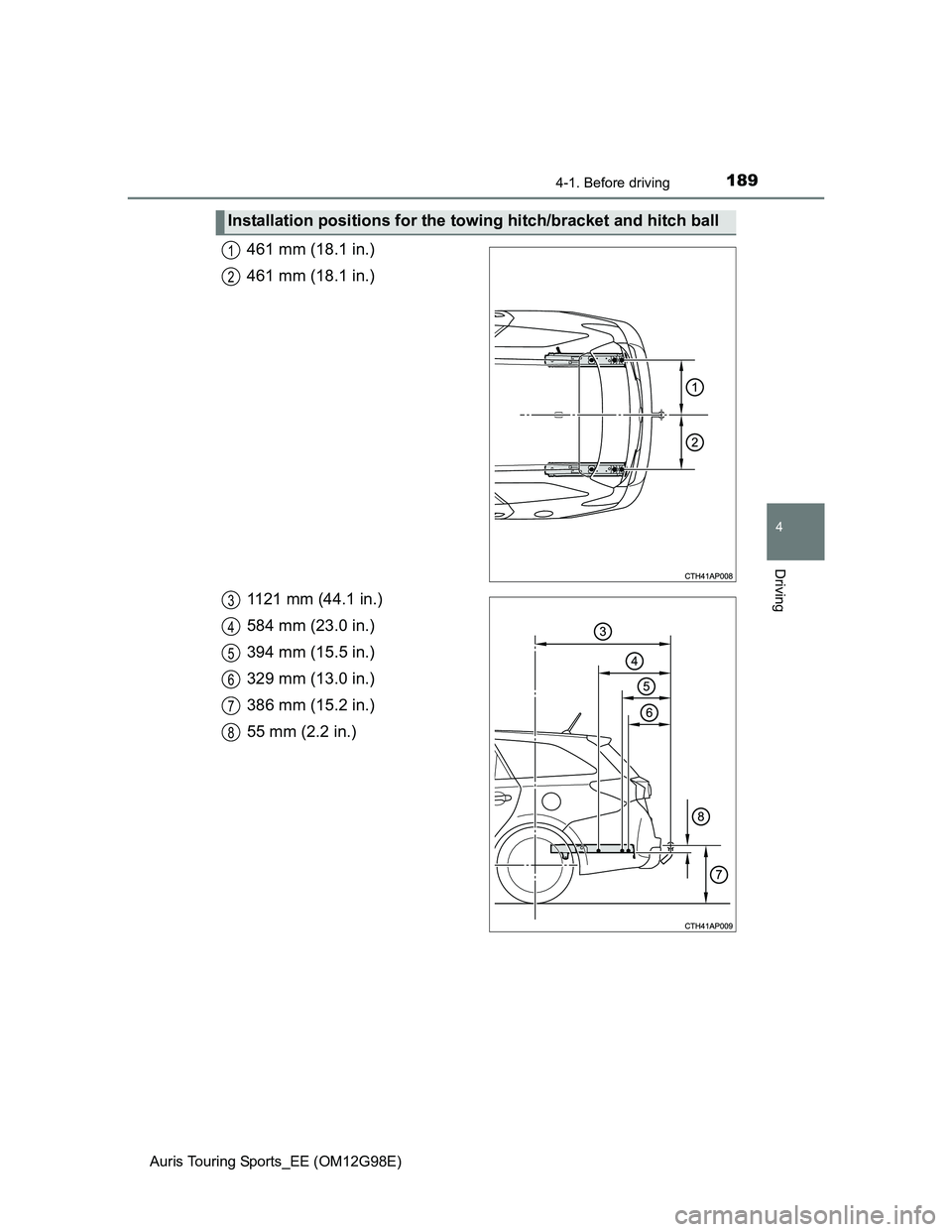
461 mm (18.1 in.)
461 mm (18.1 in.)
1121 mm (44.1 in.)
584 mm (23.0 in.)
394 mm (15.5 in.)
329 mm (13.0 in.)
386 mm (15.2 in.)
55 mm (2.2 in.)
Installation positions for the towing hitch/bracket and hitch ball
1
2
3
4
5
6
7
8
Page 190 of 632
1904-1. Before driving
Auris Touring Sports_EE (OM12G98E)
Tire information
Increase the tire inflation pressure to 20.0 kPa (0.2 kgf/cm
2 or bar, 3 psi)
greater than the recommended value when towing. (P. 599)
Increase the air pressure of the trailer tires in accordance with the total
trailer weight and according to the values recommended by the manufac-
turer of your trailer.
Trailer lights
Please consult at any authorized dealer or repairer, or another duly qualified
and equipped professional when installing trailer lights, as incorrect installa-
tion may cause damage to the vehicle’s lights. Please take care to comply
with your state’s laws when installing trailer lights.
Break-in schedule
Toyota recommends that vehicles fitted with new power train components
should not be used for towing trailers for the first 800 km (500 miles).
Safety checks before towing
Check that the maximum load limit for the towing hitch/bracket and hitch ball
is not exceeded. Bear in mind that the coupling weight of the trailer will add
to the load exerted on the vehicle. Also make sure that the total load exerted
on the vehicle is within the range of the weight limits. (P. 187)
Ensure that the trailer load is secure.
Supplementary outside rear view mirrors should be added to the vehicle if
the traffic behind cannot be clearly seen with standard mirrors. Adjust the
extending arms of these mirrors on both sides of the vehicle so that they
always provide maximum visibility of the road behind.
Maintenance
Maintenance must be performed more frequently when using the vehicle for
towing due to the greater weight burden placed on the vehicle compared to
normal driving.
Retighten all bolts securing the hitching ball and bracket after towing for
approximately 1000 km (600 miles).