tow TOYOTA AURIS 2015 (in English) Owner's Guide
[x] Cancel search | Manufacturer: TOYOTA, Model Year: 2015, Model line: AURIS, Model: TOYOTA AURIS 2015Pages: 632, PDF Size: 17.65 MB
Page 254 of 632
2544-5. Using the driving support systems
Auris Touring Sports_EE (OM12G98E)
Sensor detection information
Certain vehicle conditions and the surrounding environment may affect the
ability of the sensor to correctly detect obstacles. Particular instances where
this may occur are listed below.
• There is dirt, snow or ice on the sensor.
• A sensor is frozen.
• A sensor is covered in any way.
• The vehicle is leaning considerably to one side.
• On an extremely bumpy road, on an incline, on gravel, or on grass.
• The vicinity of the vehicle is noisy due to vehicle horns, motorcycle
engines, air brakes of large vehicles, or other loud noises producing ultra-
sonic waves.
• There is another vehicle equipped with parking assist sensors in the
vicinity.
• A sensor is coated with a sheet of spray or heavy rain.
• The vehicle is equipped with a fender pole or wireless antenna.
• Towing eyelet is installed.
• A bumper or sensor receives a strong impact.
• The vehicle is approaching a tall or curved curb.
• In harsh sunlight or intense cold weather.
• A non-genuine Toyota suspension (lowered suspension etc.) is installed.
In addition to the examples above, there are instances in which, because of
their shapes, signs and other objects may be judged by the sensor to be
closer than they are.
The shape of the obstacle may prevent the sensor from detecting it. Pay
particular attention to the following obstacles:
• Wires, fences, ropes, etc.
• Cotton, snow and other materials that absorb sound waves
• Sharply-angled objects
• Low obstacles
• Tall obstacles with upper sections projecting outwards in the direction of
your vehicle
If a message is displayed
P. 507
Page 268 of 632
2684-5. Using the driving support systems
Auris Touring Sports_EE (OM12G98E)
CAUTION
Conditions in which the use of Simple-IPA is prohibited
Do not use Simple-IPA under the following conditions.
Doing so may cause improper operation and lead to an unexpected acci-
dent.
On sharp bends or slopes.
On slippery or icy roads, or in snow.
On uneven road surfaces such as gravel.
During bad weather such as heavy rain, fog, snow, or a sandstorm.
When the tires are extremely worn or tire pressure is low.
When the vehicle has improper wheel alignment due to tires having
received a strong impact such as bumping against a curb.
When the compact spare tire (if equipped) or snow chains are installed.
When the tires slid while attempting to park.
When fallen leaves or snow is in a parking space.
When items such as a towing bracket, trailer, bicycle carrier, etc. are
installed on the rear of the vehicle.
When a vehicle of which the front/rear end is above the detection area,
such as a truck, bus or vehicle with a towing bracket, trailer, bicycle carrier,
etc., is parked at the front or rear of the parking space.
If the front bumper has been damaged.
If the sensor is covered by the front bumper cover, etc.
If a vehicle or obstacle is not in a suitable position at the front or rear of the
parking space.
Automatic steering precautions
As the steering wheel moves automatically in the parking assist function, be
aware of the following point.
Keep clothing such as neckties, scarves and long sleeves away from the
steering wheel, as they may become entangled. Also, keep children away
from the steering wheel.
If you have long fingernails, be careful not to injure yourself when the
steering wheel moves.
Page 366 of 632
3665-4. Using the storage features
Auris Touring Sports_EE (OM12G98E)
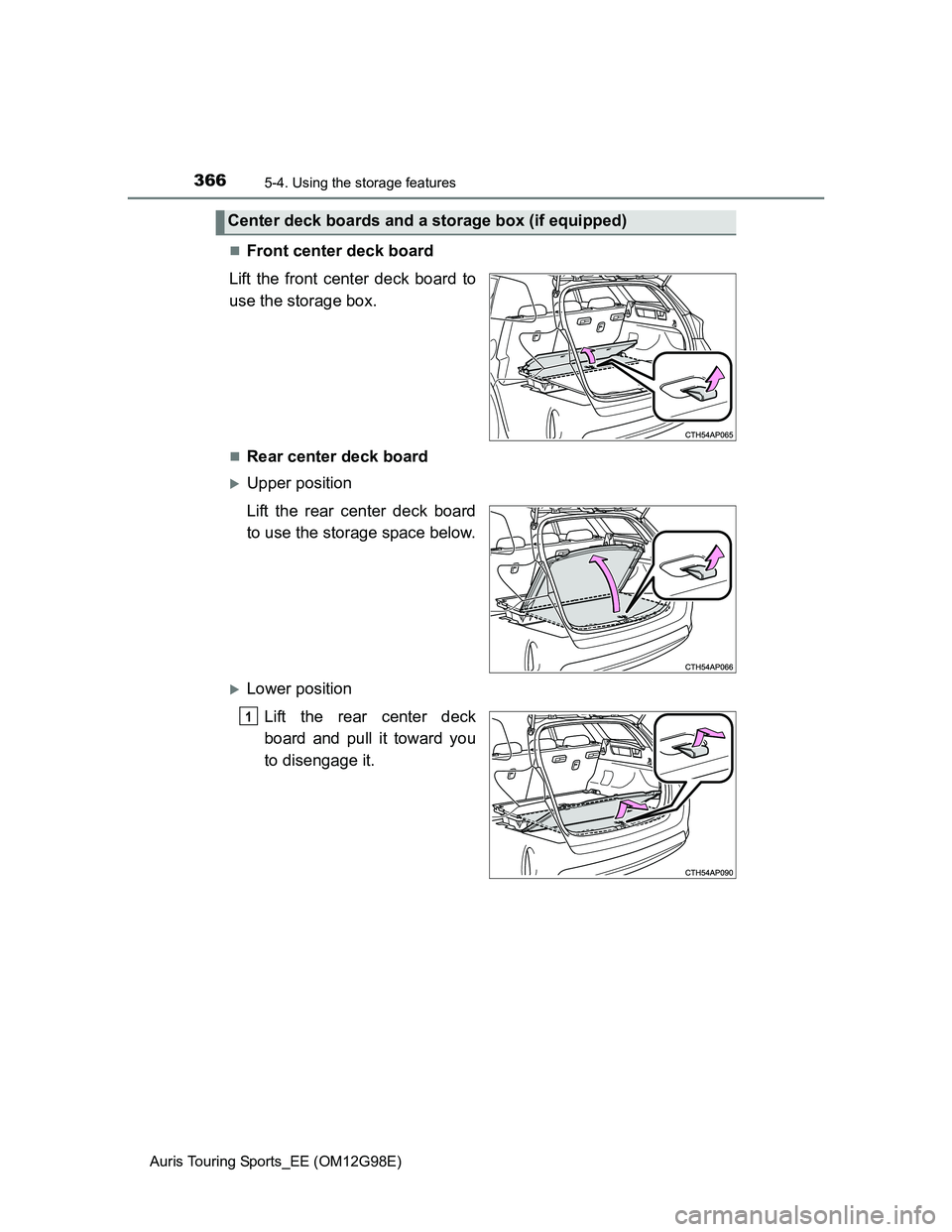
Front center deck board
Lift the front center deck board to
use the storage box.
Rear center deck board
Upper position
Lift the rear center deck board
to use the storage space below.
Lower position
Lift the rear center deck
board and pull it toward you
to disengage it.
Center deck boards and a storage box (if equipped)
1
Page 367 of 632
3675-4. Using the storage features
Auris Touring Sports_EE (OM12G98E)
5
Interior features
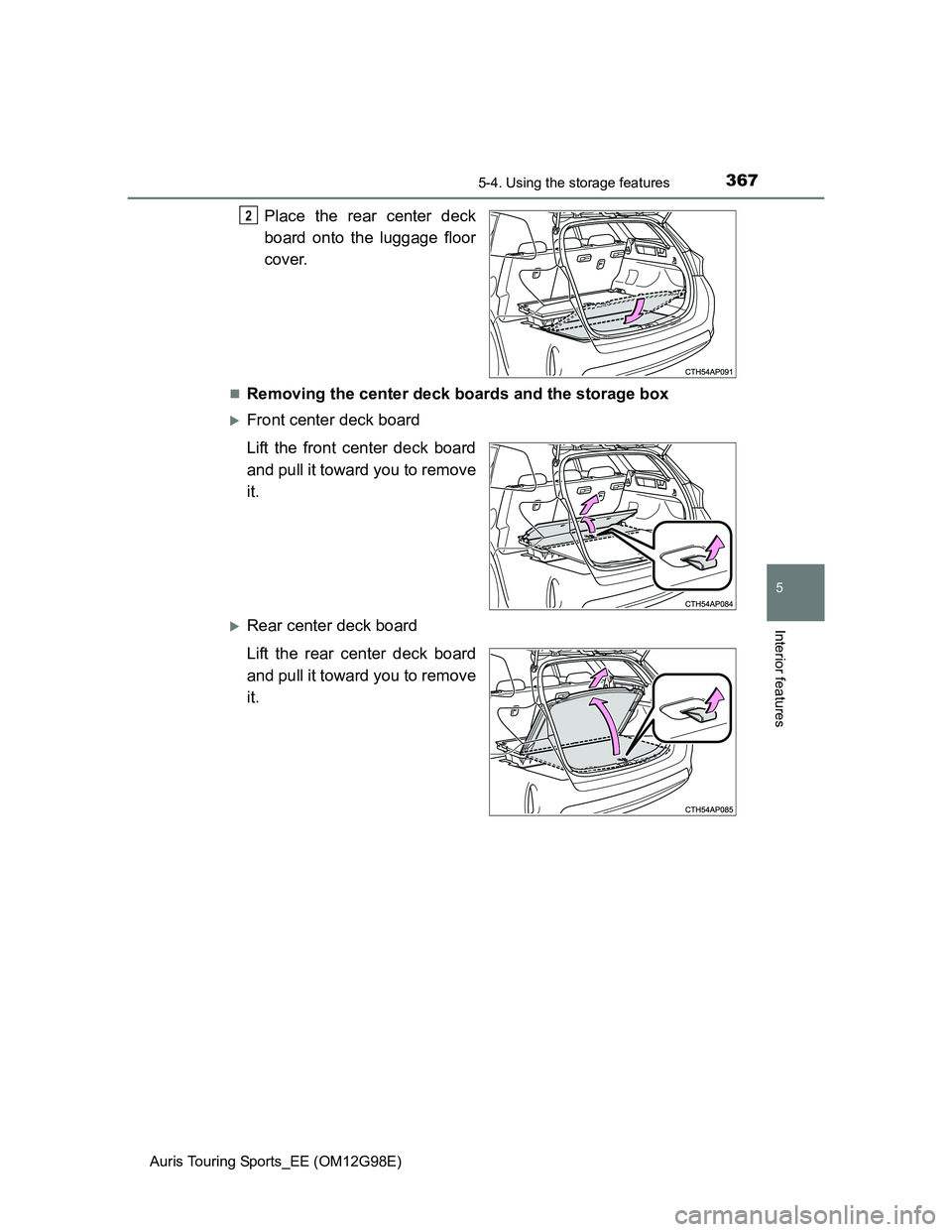
Place the rear center deck
board onto the luggage floor
cover.
Removing the center deck boards and the storage box
Front center deck board
Lift the front center deck board
and pull it toward you to remove
it.
Rear center deck board
Lift the rear center deck board
and pull it toward you to remove
it.
2
Page 368 of 632
3685-4. Using the storage features
Auris Touring Sports_EE (OM12G98E)
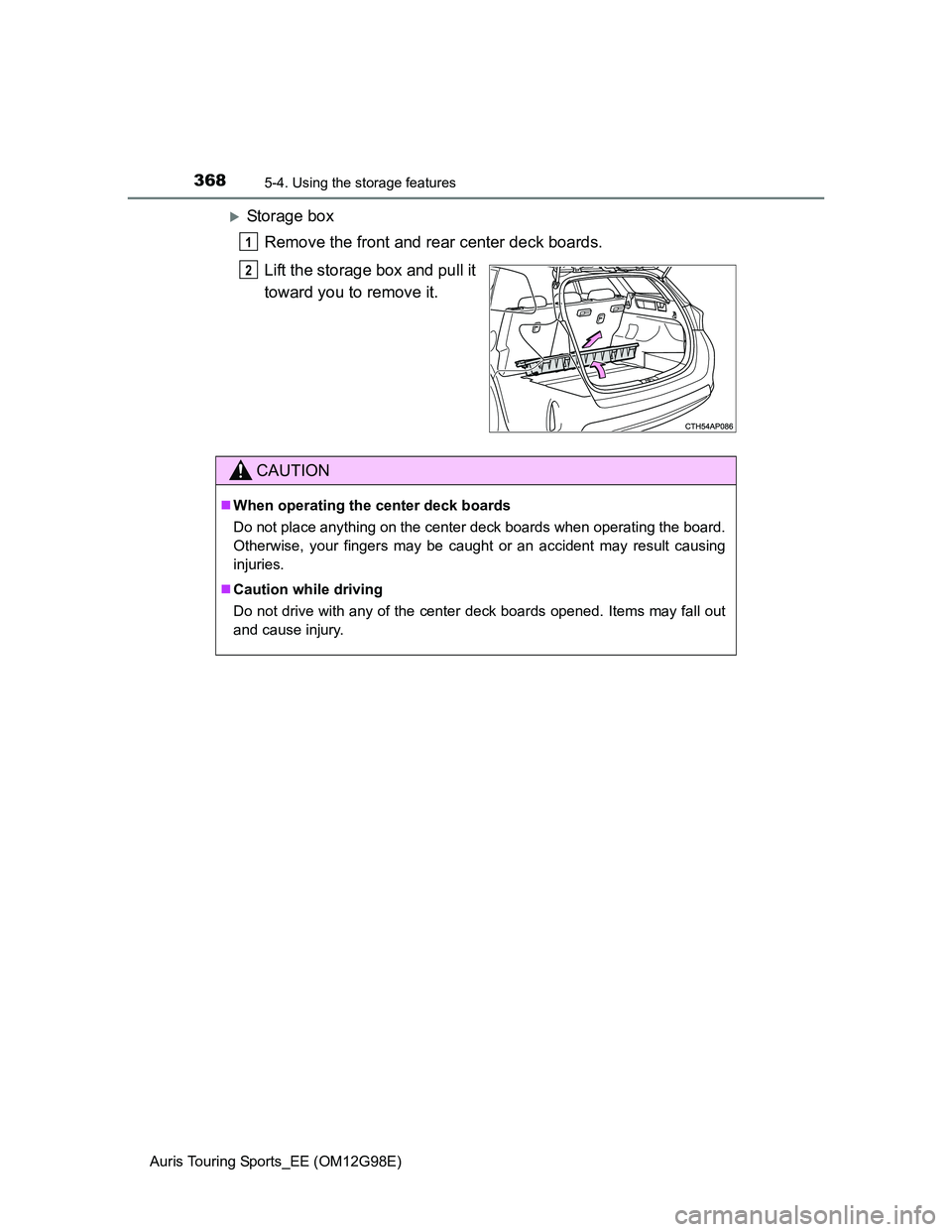
Storage box
Remove the front and rear center deck boards.
Lift the storage box and pull it
toward you to remove it.
1
2
CAUTION
When operating the center deck boards
Do not place anything on the center deck boards when operating the board.
Otherwise, your fingers may be caught or an accident may result causing
injuries.
Caution while driving
Do not drive with any of the center deck boards opened. Items may fall out
and cause injury.
Page 371 of 632
3715-4. Using the storage features
Auris Touring Sports_EE (OM12G98E)
5
Interior features
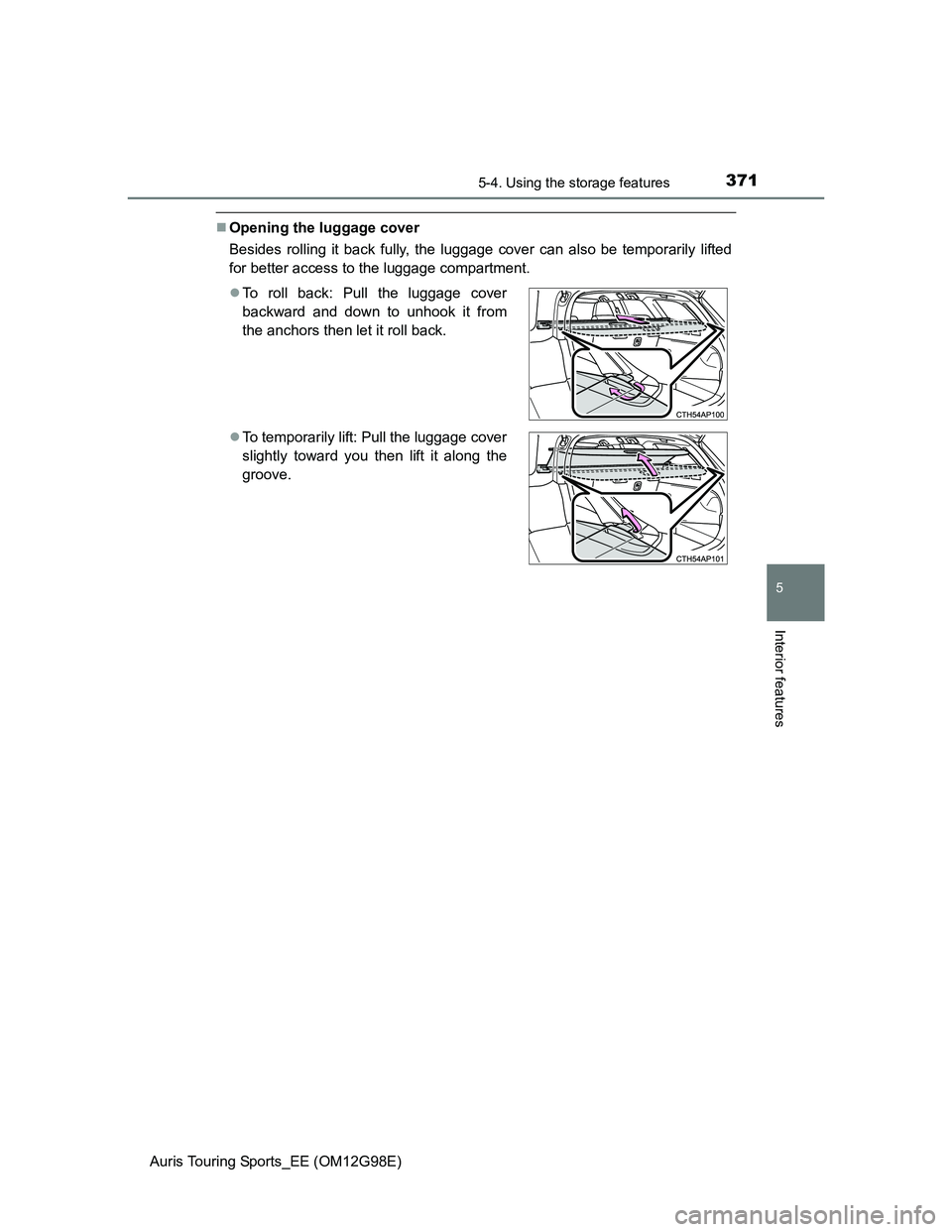
Opening the luggage cover
Besides rolling it back fully, the luggage cover can also be temporarily lifted
for better access to the luggage compartment.
To roll back: Pull the luggage cover
backward and down to unhook it from
the anchors then let it roll back.
To temporarily lift: Pull the luggage cover
slightly toward you then lift it along the
groove.
Page 402 of 632
402
Auris Touring Sports_EE (OM12G98E)
6-3. Do-it-yourself maintenance
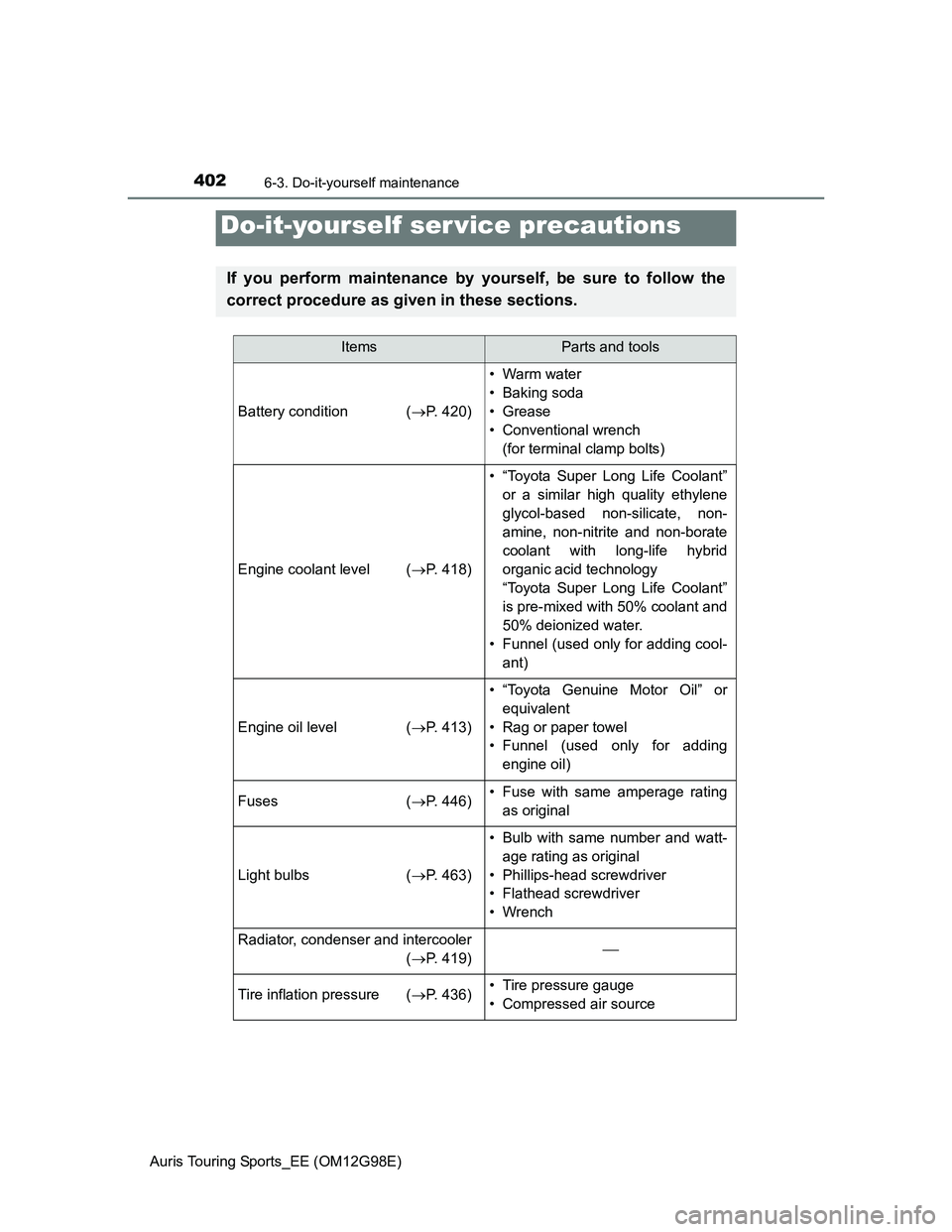
Do-it-yourself ser vice precautions
If you perform maintenance by yourself, be sure to follow the
correct procedure as given in these sections.
ItemsParts and tools
Battery condition (P. 420)
•Warm water
• Baking soda
• Grease
• Conventional wrench
(for terminal clamp bolts)
Engine coolant level (P. 418)
• “Toyota Super Long Life Coolant”
or a similar high quality ethylene
glycol-based non-silicate, non-
amine, non-nitrite and non-borate
coolant with long-life hybrid
organic acid technology
“Toyota Super Long Life Coolant”
is pre-mixed with 50% coolant and
50% deionized water.
• Funnel (used only for adding cool-
ant)
Engine oil level (P. 413)
• “Toyota Genuine Motor Oil” or
equivalent
• Rag or paper towel
• Funnel (used only for adding
engine oil)
Fuses (P. 446)• Fuse with same amperage rating
as original
Light bulbs (P. 463)
• Bulb with same number and watt-
age rating as original
• Phillips-head screwdriver
• Flathead screwdriver
•Wrench
Radiator, condenser and intercooler
(P. 419)
Tire inflation pressure (P. 436)• Tire pressure gauge
• Compressed air source
Page 414 of 632
4146-3. Do-it-yourself maintenance
Auris Touring Sports_EE (OM12G98E)
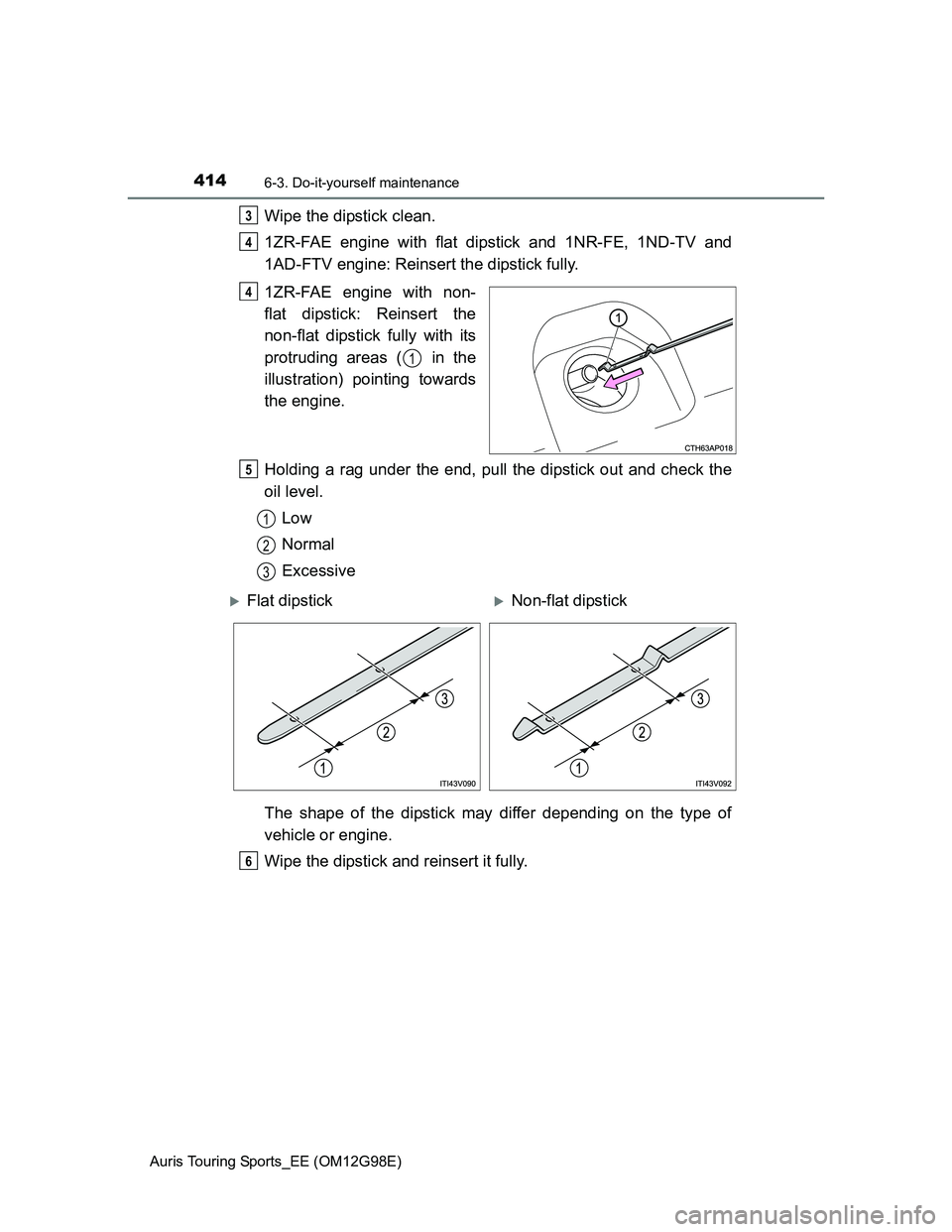
Wipe the dipstick clean.
1ZR-FAE engine with flat dipstick and 1NR-FE, 1ND-TV and
1AD-FTV engine: Reinsert the dipstick fully.
1ZR-FAE engine with non-
flat dipstick: Reinsert the
non-flat dipstick fully with its
protruding areas ( in the
illustration) pointing towards
the engine.
Holding a rag under the end, pull the dipstick out and check the
oil level.
Low
Normal
Excessive
The shape of the dipstick may differ depending on the type of
vehicle or engine.
Wipe the dipstick and reinsert it fully.3
4
4
1
5
1
2
3
Flat dipstickNon-flat dipstick
6
Page 416 of 632
4166-3. Do-it-yourself maintenance
Auris Touring Sports_EE (OM12G98E)
When adding engine oil (1ND-TV engine only)
Do not overfill the engine. Use the dipstick to ensure that the oil level does not
exceed the full mark. If exceeded, the oil level will have to be adjusted to
below the full mark.
Engine oil consumption
A certain amount of engine oil will be consumed while driving. In the following
situations, oil consumption may increase, and engine oil may need to be
refilled in between oil maintenance intervals.
When the engine is new, for example directly after purchasing the vehicle or
after replacing the engine
If low quality oil or oil of an inappropriate viscosity is used
When driving at high engine speeds or with a heavy load, when towing, or
when driving while accelerating or decelerating frequently
When leaving the engine idling for a long time, or when driving frequently
through heavy traffic
After changing the engine oil (diesel engine only)
The engine oil maintenance data should be reset. Perform the following pro-
cedures:
Switch the display to the trip meter “A” when the engine is running.
(P. 90, 95)
Turn the engine switch off.
Vehicles without a smart entry & start system:
While pressing the display change button (P. 90, 95), turn the engine
switch to the “ON” position (do not start the engine because reset mode will
be canceled). Continue to press and hold the button until the trip meter dis-
plays “000000”.
Vehicles with a smart entry & start system:
While pressing the display change button (P. 90, 95), turn the engine
switch to the IGNITION ON mode (do not start the engine because other-
wise the reset mode will be canceled). Continue to press and hold the but-
ton until the trip meter displays “000000”.
1
2
3
Page 430 of 632
4306-3. Do-it-yourself maintenance
Auris Touring Sports_EE (OM12G98E)Situations in which the tire pressure warning system may not operate
properly (vehicles with a tire pressure warning system)
In the following cases, the tire pressure warning system may not operate
properly.
• If non-genuine Toyota wheels are used.
• A tire has been replaced with a tire that is not an OE (Original Equipment)
tire.
• A tire has been replaced with a tire that is not of the specified size.
• Tire chains etc. are equipped.
• Lock nuts are equipped.
• An auxiliary-supported run-flat tire is equipped.
• If a window tint that affects the radio wave signals is installed.
• If there is a lot of snow or ice on the vehicle, particularly around the
wheels or wheel housings.
• If the tire inflation pressure is extremely higher than the specified level.
• If tires not equipped with tire pressure warning valves and transmitters
are used.
• If the ID code on the tire pressure warning valves and transmitters is not
registered in the tire pressure warning computer.
Performance may be affected in the following situations.
• Near a TV tower, electric power plant, gas station, radio station, large dis-
play, airport or other facility that generates strong radio waves or electri-
cal noise.
• When carrying a portable radio, cellular phone, cordless phone or other
wireless communication device.
When the vehicle is parked, the time taken for the warning to start or go off
could be extended.
When tire inflation pressure declines rapidly for example when a tire has
burst, the warning may not function.