engine TOYOTA AURIS HYBRID 2016 User Guide
[x] Cancel search | Manufacturer: TOYOTA, Model Year: 2016, Model line: AURIS HYBRID, Model: TOYOTA AURIS HYBRID 2016Pages: 592, PDF Size: 16.67 MB
Page 192 of 592
1924-1. Before driving
UK AURIS_HV_HB_EE (OM12K47E)■
Operating your vehicle in a foreign country
Comply with the relevant vehicle registration laws and confirm the availability
of the correct fuel. ( →P. 554)
■ Brake actuator
The brake actuator uses brake fluid pr essurized by the pump to power-assist
the brakes. If the brake actuator fails during driving, the brake system warn-
ing light comes on and the buzzer sounds intermittently. In this case, the
brakes may not work properly. If they do not work well, depress the brake
pedal firmly. If the brake system warning light comes on, immediately stop
your vehicle and contact any authorized Toyota dealer or repairer, or another
duly qualified and equipped professional.
In the following conditions, you may hear a sound in the engine compartment.
This is not a malfunction.
● The driver’s door is opened with the hybrid system turned off.
● The brake pedal is depressed with the hybrid system turned off.
● After the hybrid system is turned on.
● The brake pedal is depressed repeatedly with the hybrid system turned on.
● After the hybrid system is turned off.
The brake pedal may be hard to depress or the brake pedal stroke may be
short before turning the hybrid system on. This is not a malfunction.
■ When braking the vehicle
When applying brakes, you may hear a sound coming from the motor gener-
ator.
However, this does not indicate any trouble.
Page 193 of 592
1934-1. Before driving
UK AURIS_HV_HB_EE (OM12K47E)
4
Driving
WARNING
Observe the following precautions.
Failure to do so may result in death or serious injury.
■ When starting the vehicle
Always keep your foot on the brake pedal while stopped with the “READY”
indicator is illuminated. This prevents the vehicle from creeping.
■ When driving the vehicle
●Do not drive if you are unfamiliar with the location of the brake and accel-
erator pedals to avoid depressing the wrong pedal.
• Accidentally depressing the accelerator pedal instead of the brake
pedal will result in sudden acceleration that may lead to an accident.
• When backing up, you may twist your body around, leading to a diffi- culty in operating the pedals. Make sure to operate the pedals properly.
• Make sure to keep a correct driving posture even when moving the vehicle only slightly. This allows you to depress the brake and accelera-
tor pedals properly.
• Depress the brake pedal using your right foot. Depressing the brake pedal using your left foot may delay response in an emergency, result-
ing in an accident.
● The driver should pay attention to pedestrians when the vehicle is pow-
ered only by the electric motor (traction motor). As there is no engine
noise, the pedestrians may misjudge the vehicle’s movement.
● Do not drive the vehicle over or st op the vehicle near flammable materials.
The exhaust system and exhaust gases can be extremely hot. These hot
parts may cause a fire if there is any flammable material nearby.
Page 194 of 592
1944-1. Before driving
UK AURIS_HV_HB_EE (OM12K47E)
WARNING
Observe the following precautions.
Failure to do so may result in death or serious injury.
■ When driving the vehicle
●During normal driving, do not turn off the hybrid system. Turning the hybrid
system off while driving will not cause loss of steering or braking control,
but the power assist to these systems will be lost. This will make it more
difficult to steer and brake, so you should pull over and stop the vehicle as
soon as it is safe to do so.
However, in the event of an emergency, such as if it becomes impossible
to stop the vehicle in the normal way: →P. 483
● Use engine braking (shift position B) to maintain a safe speed when driv-
ing down a steep hill.
Using the brakes continuously may cause the brakes to overheat and lose
effectiveness. ( →P. 219)
● Do not adjust the positions of the steering wheel, the seat, or the inside or
outside rear view mirrors while driving.
Doing so may result in a loss of vehicle control.
● Always check that all passengers’ arms, heads or other parts of their body
are not outside the vehicle.
Page 195 of 592
1954-1. Before driving
UK AURIS_HV_HB_EE (OM12K47E)
4
Driving
WARNING
Observe the following precautions.
Failure to do so may result in death or serious injury.
■ When driving on slippery road surfaces
●Sudden braking, acceleration and steering may cause tire slippage and
reduce your ability to control the vehicle.
● Sudden acceleration, engine braking due to shifting, or changes in engine
speed could cause the vehicle to skid.
● After driving through a puddle, lightly depress the brake pedal to make
sure that the brakes are functioning properly. Wet brake pads may prevent
the brakes from functioning properly. If the brakes on only one side are wet
and not functioning properly, steering control may be affected.
■ When changing the shift position
●Do not let the vehicle roll backwards while a forward driving position is
selected, or roll forward while R is selected.
Doing so result in an accident or damage to the vehicle.
● Do not shift the shift position to P while the vehicle is moving.
Doing so can damage the transmission and may result in a loss of vehicle
control.
● Do not shift the shift position to R while the vehicle is moving forward.
Doing so can damage the transmission and may result in a loss of vehicle
control.
● Do not shift the shift position to a driving position while the vehicle is mov-
ing backward.
Doing so can damage the transmission and may result in a loss of vehicle
control.
● Shifting the shift position to N while the vehicle is moving will disengage
the hybrid system. Engine braking is not available with the hybrid system
disengaged.
● Be careful not to change the shift position with the accelerator pedal
depressed.
Changing the shift position to any position other than P or N may lead to
unexpected rapid acceleration of the vehicle that may cause an accident
and result in death or serious injury.
After changing the shift position, make sure to check the current shift posi-
tion using the shift position indicator. ( →P. 219)
Page 196 of 592
1964-1. Before driving
UK AURIS_HV_HB_EE (OM12K47E)
WARNING
Observe the following precautions.
Failure to do so may result in death or serious injury.
■ If you hear a squealing or scrapi ng noise (brake pad wear indicators)
Have the brake pads checked and replaced by any authorized Toyota
dealer or repairer, or another dul y qualified and equipped professional as
soon as possible.
Rotor damage may result if the pads are not replaced when needed.
It is dangerous to drive the vehicle when the wear limits of the brake pads
and/or those of the brake discs are exceeded.
■ When the vehicle is stopped
●Do not depress the accelerator pedal unnecessarily.
If a shift position other than P or N is selected, the vehicle may accelerate
suddenly and unexpectedly, causing an accident.
● In order to prevent accidents due to the vehicle rolling away, always keep
depressing the brake pedal while stopped with the “READY” indicator is
illuminated. Apply the parking brake as necessary.
● If the vehicle is stopped on an incline, in order to prevent accidents caused
by the vehicle rolling forward or backward, always depress the brake pedal
and securely apply the parking brake as needed.
● Avoid revving or racing the engine.
Running the engine at high speed while the vehicle is stopped may cause
the exhaust system to overheat, which could result in a fire if combustible
material is nearby.
Page 199 of 592
1994-1. Before driving
UK AURIS_HV_HB_EE (OM12K47E)
4
Driving
NOTICE
■If you get a flat tire while driving
A flat or damaged tire may cause the following situations. Hold the steering
wheel firmly and gradually depress the brake pedal to slow down the vehi-
cle.
●It may be difficult to control your vehicle.
● The vehicle will make abnormal sounds or vibrations.
● The vehicle will lean abnormally.
Information on what to do in case of a flat tire ( →P. 507, 519)
■ When encountering flooded roads
Do not drive on a road that has flooded after heavy rain etc. Doing so may
cause the following serious damage to the vehicle:
●Engine stalling
● Short in electrical components
● Engine damage caused by water immersion
In the event that you drive on a flooded road and the vehicle is flooded, be
sure to have any authorized Toyota deale r or repairer, or another duly quali-
fied and equipped professional check the following:
● Brake function
● Changes in quantity and quality of engine oil, hybrid transmission fluid,
etc.
● Lubricant condition for the bearings and suspension joints (where possi-
ble), and the function of all joints, bearings, etc.
If the P position control system is damaged by flooding, it may not be possi-
ble to shift the shift position to P, or from P to other positions. When the shift
position cannot be changed from P to any other position, the front wheels
will lock, and you will be unable to to w the vehicle with the front wheels on
the ground, as the front wheels may be locked. In this case, transport the
vehicle with both front wheels or all four wheels lifted.
Page 204 of 592
2044-1. Before driving
UK AURIS_HV_HB_EE (OM12K47E)■
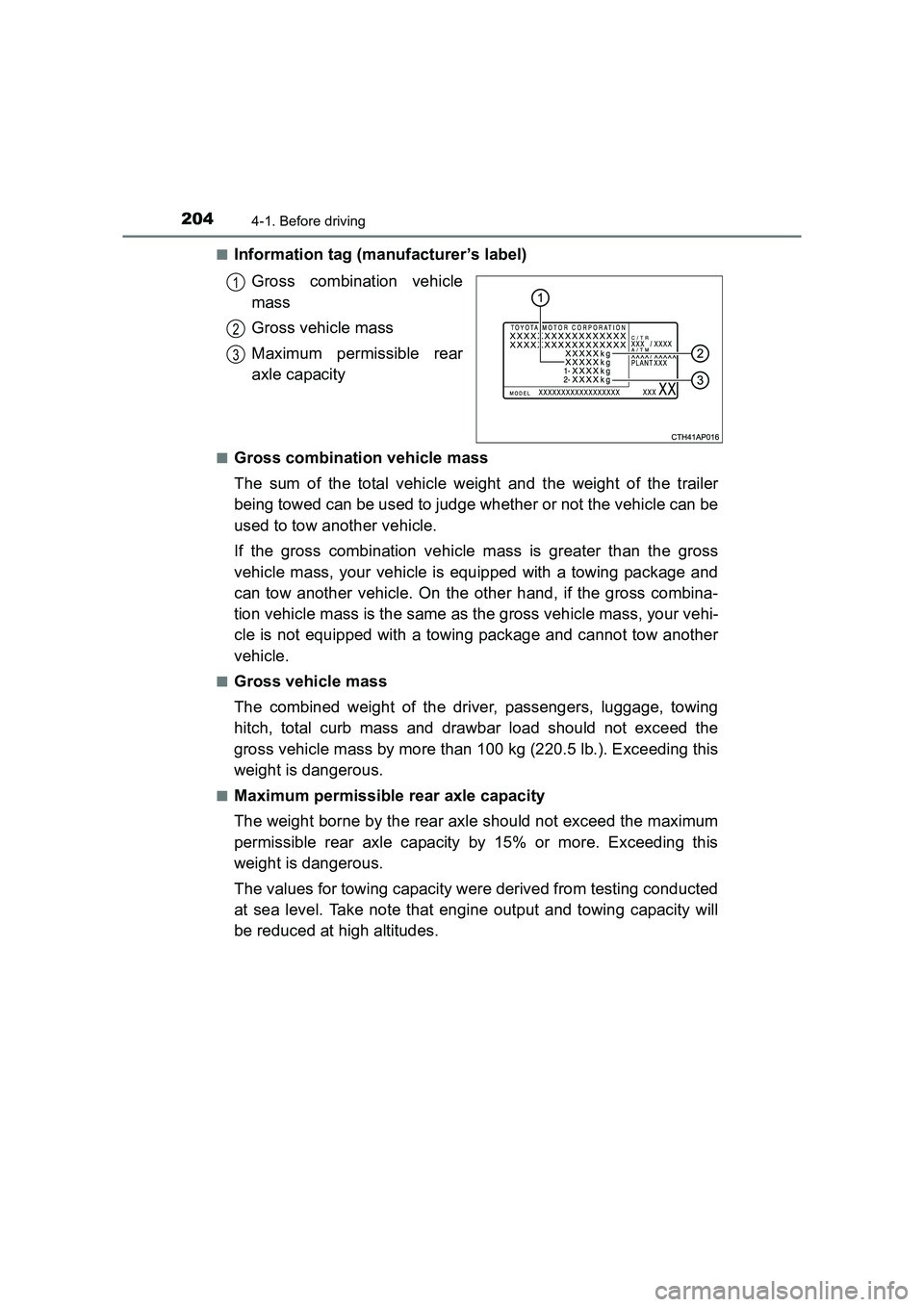
Information tag (manufacturer’s label)
Gross combination vehicle
mass
Gross vehicle mass
Maximum permissible rear
axle capacity
■Gross combination vehicle mass
The sum of the total vehicle weight and the weight of the trailer
being towed can be used to judge whether or not the vehicle can be
used to tow another vehicle.
If the gross combination vehicle mass is greater than the gross
vehicle mass, your vehicle is equipped with a towing package and
can tow another vehicle. On the other hand, if the gross combina-
tion vehicle mass is the same as the gross vehicle mass, your vehi-
cle is not equipped with a towing package and cannot tow another
vehicle.
■Gross vehicle mass
The combined weight of the driver, passengers, luggage, towing
hitch, total curb mass and drawbar load should not exceed the
gross vehicle mass by more than 100 kg (220.5 lb.). Exceeding this
weight is dangerous.
■Maximum permissible rear axle capacity
The weight borne by the rear axle should not exceed the maximum
permissible rear axle capacity by 15% or more. Exceeding this
weight is dangerous.
The values for towing capacity were derived from testing conducted
at sea level. Take note that engine output and towing capacity will
be reduced at high altitudes.
1
2
3
Page 209 of 592
2094-1. Before driving
UK AURIS_HV_HB_EE (OM12K47E)
4
Driving
■Sudden acceleration/steering input/cornering
Executing sharp turns when towing may result in the trailer colliding
with your vehicle. Decelerate well in advance when approaching
turns and take them slowly and carefully to avoid sudden braking.
■Important points regarding turning
The wheels of the trailer will travel closer to the inside of the curve
than the wheels of the vehicle. To make allowance for this, take the
turns wider than you would normally do.
■Important points regarding stability
Vehicle movement resulting from uneven road surfaces and strong
crosswinds will affect handling. The vehicle may also be rocked by
passing buses or large trucks. Frequently check behind when mov-
ing alongside such vehicles. As soon as such vehicle movement
occurs, immediately start to decelerate smoothly by slowly applying
the brakes. Always steer the vehicle straight ahead while braking.
■Passing other vehicles
Consider the total combined length of your vehicle and trailer and
ensure that the vehicle-to-vehicle distance is sufficient before exe-
cuting lane changes.
■Transmission information
To maintain engine braking efficiency and charging system perfor-
mance when using engine braking, do not use the transmission in
D. Shift the shift position to B.
■If the engine overheats
Towing a loaded trailer up a long, steep incline in temperatures
exceeding 30°C (85 °F) may result in the engine overheating. If the
engine coolant temperature gauge indicates that the engine is over-
heating, turn the air conditioning off immediately, leave the road and
stop the vehicle in a safe place. ( →P. 544)
■When parking the vehicle
Always place wheel chocks under the wheels of both the vehicle
and trailer. Firmly set the parking brake and shift the shift position to
P.
Page 210 of 592
2104-1. Before driving
UK AURIS_HV_HB_EE (OM12K47E)
WARNING
Follow all the instructions described in this section. Failure to do so could
cause an accident resulting in death or serious injury.
■ Trailer towing precautions
When towing, make sure that none of the weight limits are exceeded.
(→ P. 203)
■ Vehicle speed in towing
Observe the legal maximum speeds for trailer towing.
■ Before descending hills or long declines
Reduce speed then use the engine braking.
■ Operation of the brake pedal
Do not hold the brake pedal depressed often or for long periods of time.
Doing so may result in the brake overheating or reduce braking effects.
■ To avoid accident or injury
●Vehicles with a cruise control: Do not use cruise control when you are tow-
ing.
● Vehicles with a compact spare tire: Do not tow a trailer when the compact
spare tire is installed on your vehicle.
● Vehicles with an emergency tire puncture repair kit: Do not tow a trailer
when the tire installed is repaired with the emergency tire puncture repair
kit.
NOTICE
■ Do not directly splice trailer lights
Directly splicing trailer lights may damage your vehicle's electrical system
and cause a malfunction.
Page 217 of 592
2174-2. Driving procedures
UK AURIS_HV_HB_EE (OM12K47E)
4
Driving
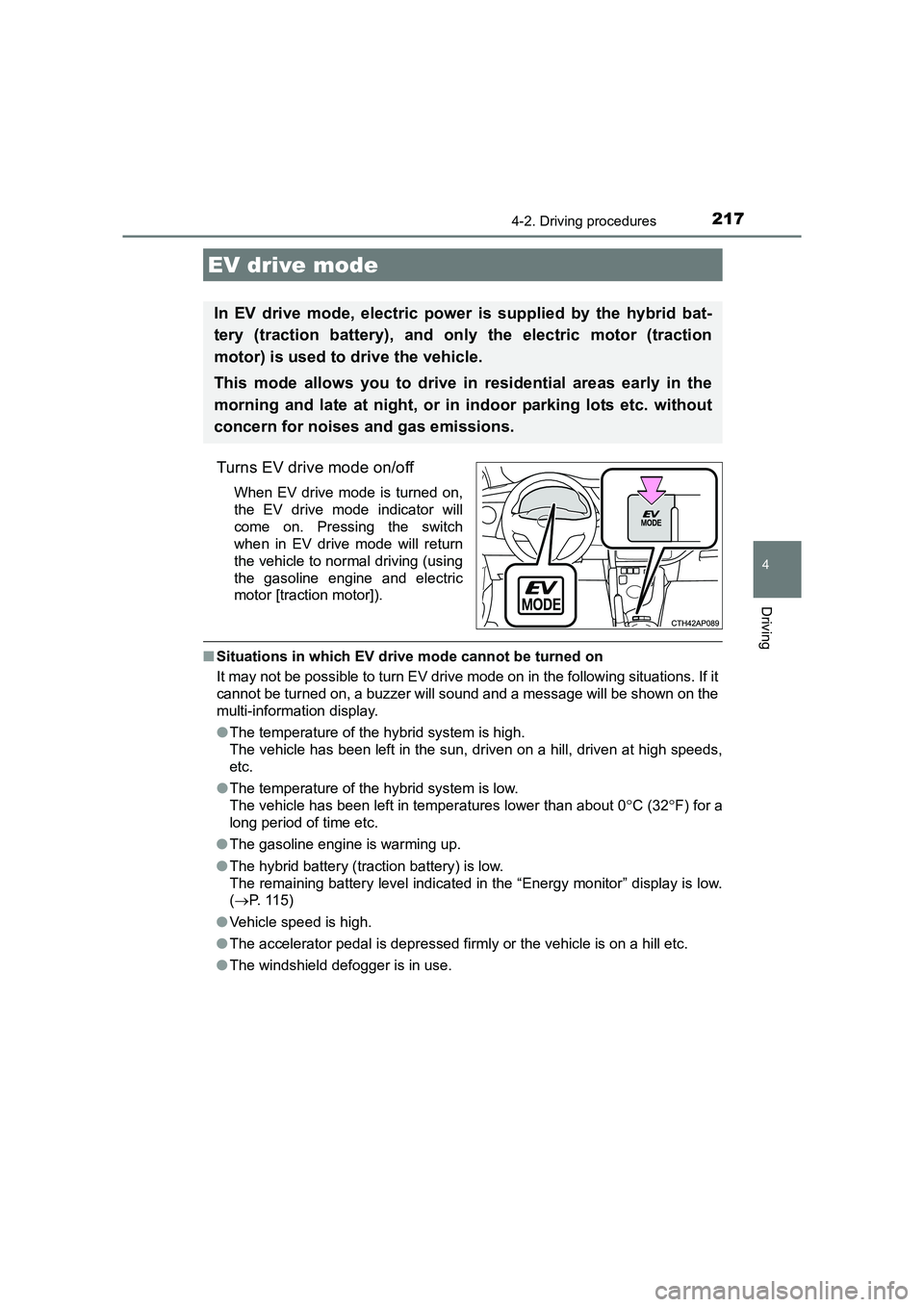
Turns EV drive mode on/off
When EV drive mode is turned on,
the EV drive mode indicator will
come on. Pressing the switch
when in EV drive mode will return
the vehicle to normal driving (using
the gasoline engine and electric
motor [traction motor]).
■Situations in which EV drive mode cannot be turned on
It may not be possible to turn EV drive mode on in the following situations. If it
cannot be turned on, a buzzer will sound and a message will be shown on the
multi-information display.
●The temperature of the hybrid system is high.
The vehicle has been left in the sun, driven on a hill, driven at high speeds,
etc.
● The temperature of the hybrid system is low.
The vehicle has been left in temperatures lower than about 0
°C (32°F) for a
long period of time etc.
● The gasoline engine is warming up.
● The hybrid battery (traction battery) is low.
The remaining battery level indicated in the “Energy monitor” display is low.
(→ P. 115)
● Vehicle speed is high.
● The accelerator pedal is depressed firmly or the vehicle is on a hill etc.
● The windshield defogger is in use.
EV drive mode
In EV drive mode, electric power is supplied by the hybrid bat-
tery (traction battery), and only the electric motor (traction
motor) is used to drive the vehicle.
This mode allows you to drive in residential areas early in the
morning and late at night, or in indoor parking lots etc. without
concern for noises and gas emissions.