check engine TOYOTA AVALON 2012 XX40 / 4.G Owner's Manual
[x] Cancel search | Manufacturer: TOYOTA, Model Year: 2012, Model line: AVALON, Model: TOYOTA AVALON 2012 XX40 / 4.GPages: 580, PDF Size: 9.33 MB
Page 385 of 580
Maintenance and care4
385
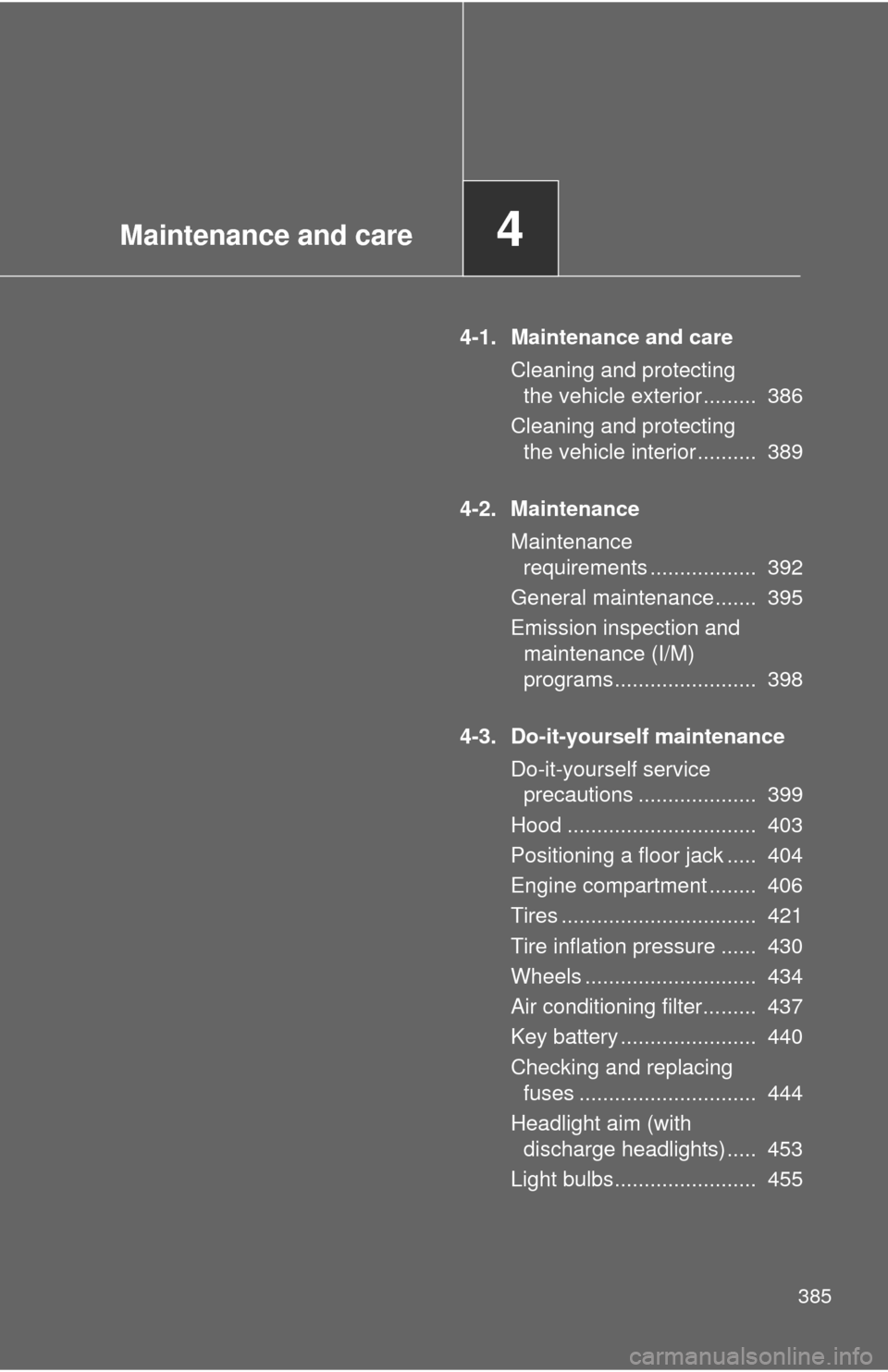
4-1. Maintenance and careCleaning and protecting the vehicle exterior ......... 386
Cleaning and protecting the vehicle interior .......... 389
4-2. Maintenance Maintenance requirements .................. 392
General maintenance....... 395
Emission inspection and maintenance (I/M)
programs........................ 398
4-3. Do-it-yourself maintenance Do-it-yourself service precautions .................... 399
Hood ................................ 403
Positioning a floor jack ..... 404
Engine compartment ........ 406
Tires ................................. 421
Tire inflation pressure ...... 430
Wheels ............................. 434
Air conditioning filter......... 437
Key battery ....................... 440
Checking and replacing fuses .............................. 444
Headlight aim (with discharge headlights) ..... 453
Light bulbs........................ 455
Page 395 of 580
395
4-2. Maintenance
4
Maintenance and care
General maintenance
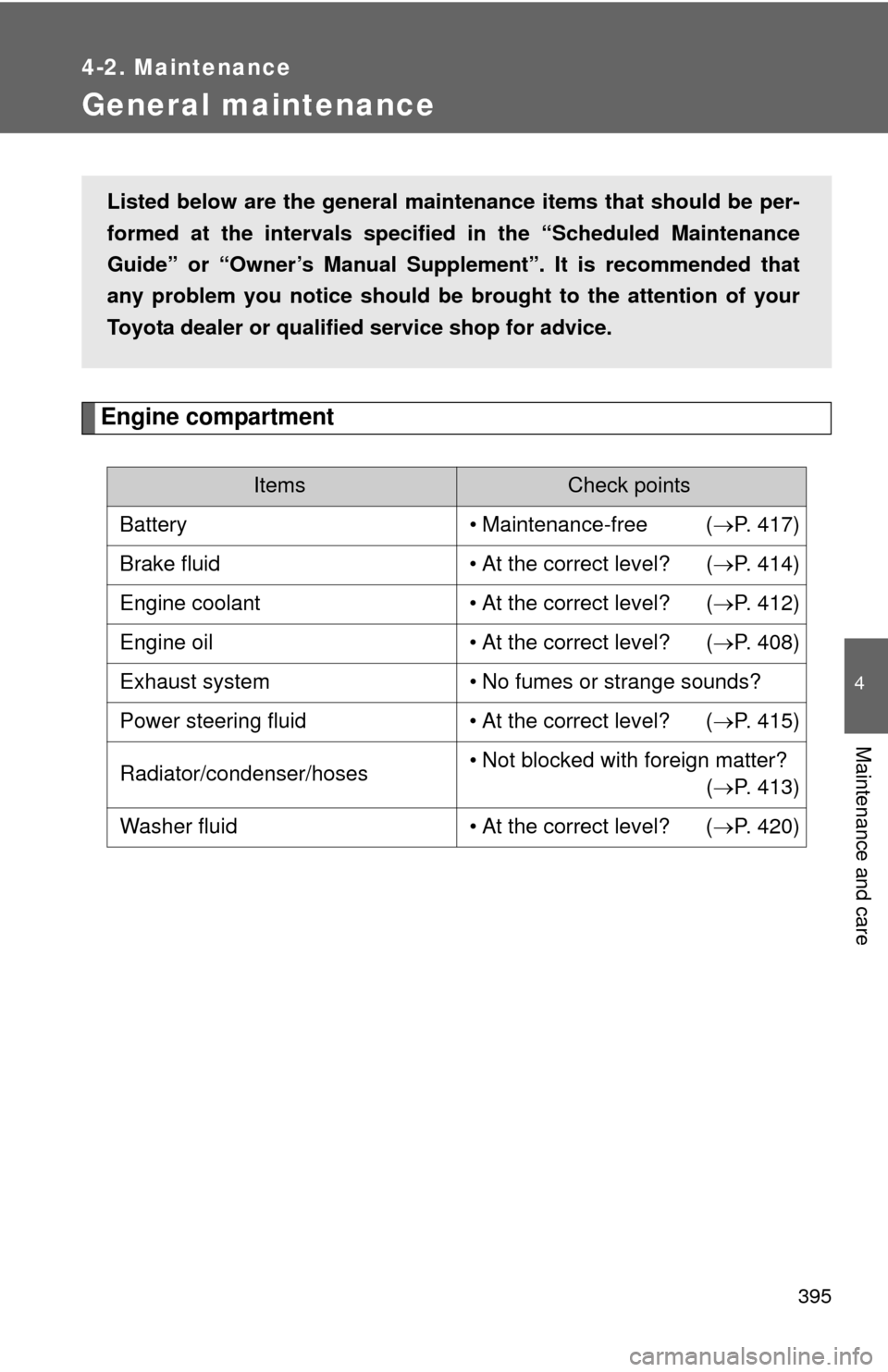
Engine compartment
ItemsCheck points
Battery • Maintenance-free ( P. 417)
Brake fluid • At the correct level? ( P. 414)
Engine coolant • At the correct level? ( P. 412)
Engine oil • At the correct level? ( P. 408)
Exhaust system • No fumes or strange sounds?
Power steering fluid • At the correct level? ( P. 415)
Radiator/condenser/hoses • Not blocked with foreign matter?
(P. 413)
Washer fluid • At the correct level? ( P. 420)
Listed below are the general maintenance items that should be per-
formed at the intervals specified in the “Scheduled Maintenance
Guide” or “Owner’s Manual Supp lement”. It is recommended that
any problem you notice should be brought to the attention of your
Toyota dealer or qualified service shop for advice.
Page 397 of 580
397
4-2. Maintenance
4
Maintenance and care
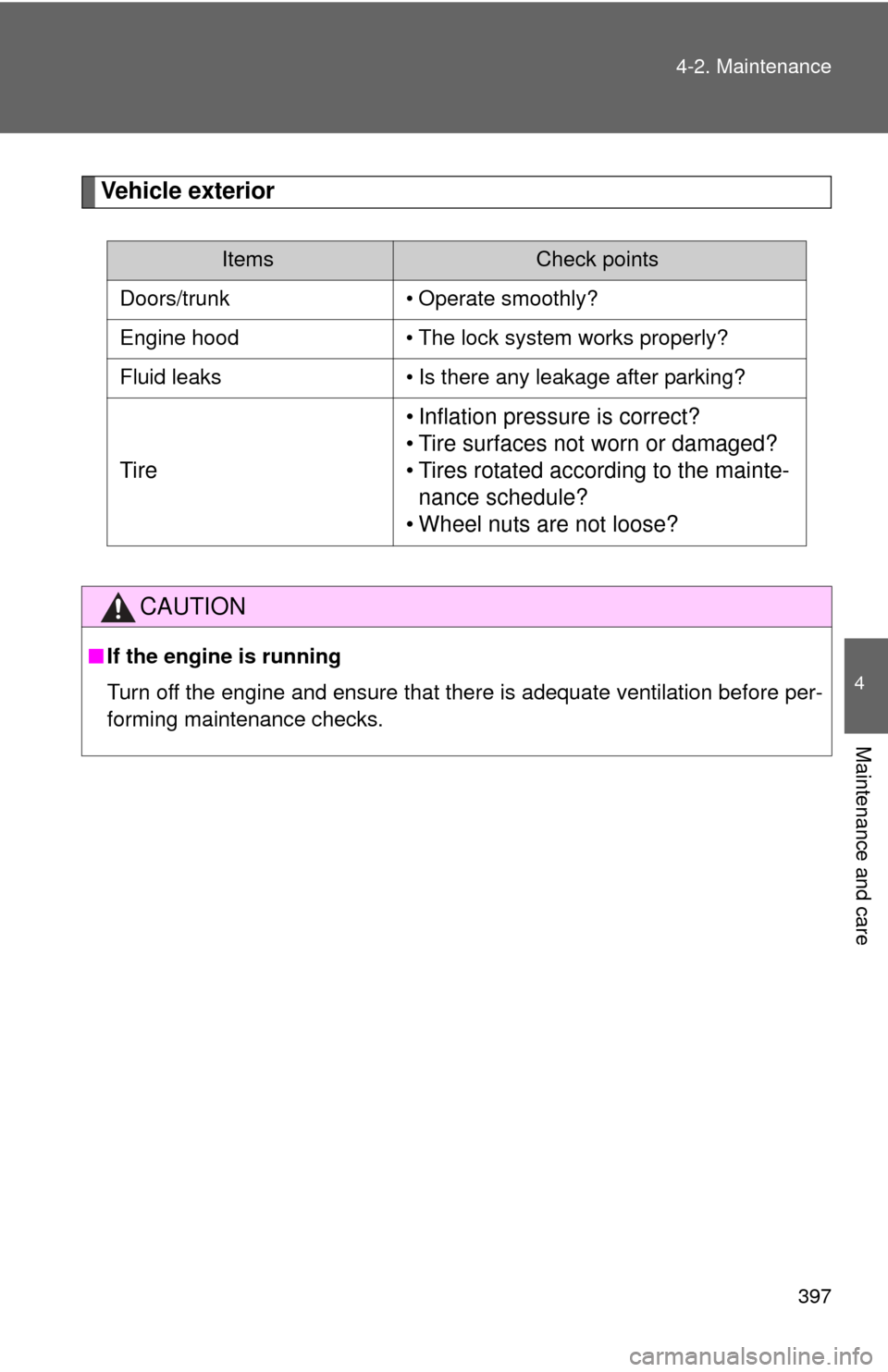
Vehicle exterior
ItemsCheck points
Doors/trunk • Operate smoothly?
Engine hood • The lock system works properly?
Fluid leaks • Is there any leakage after parking?
Tire • Inflation pressure is correct?
• Tire surfaces not worn or damaged?
• Tires rotated according to the mainte-
nance schedule?
• Wheel nuts are not loose?
CAUTION
■ If the engine is running
Turn off the engine and ensure that there is adequate ventilation before per-
forming maintenance checks.
Page 408 of 580
408 4-3. Do-it-yourself maintenance
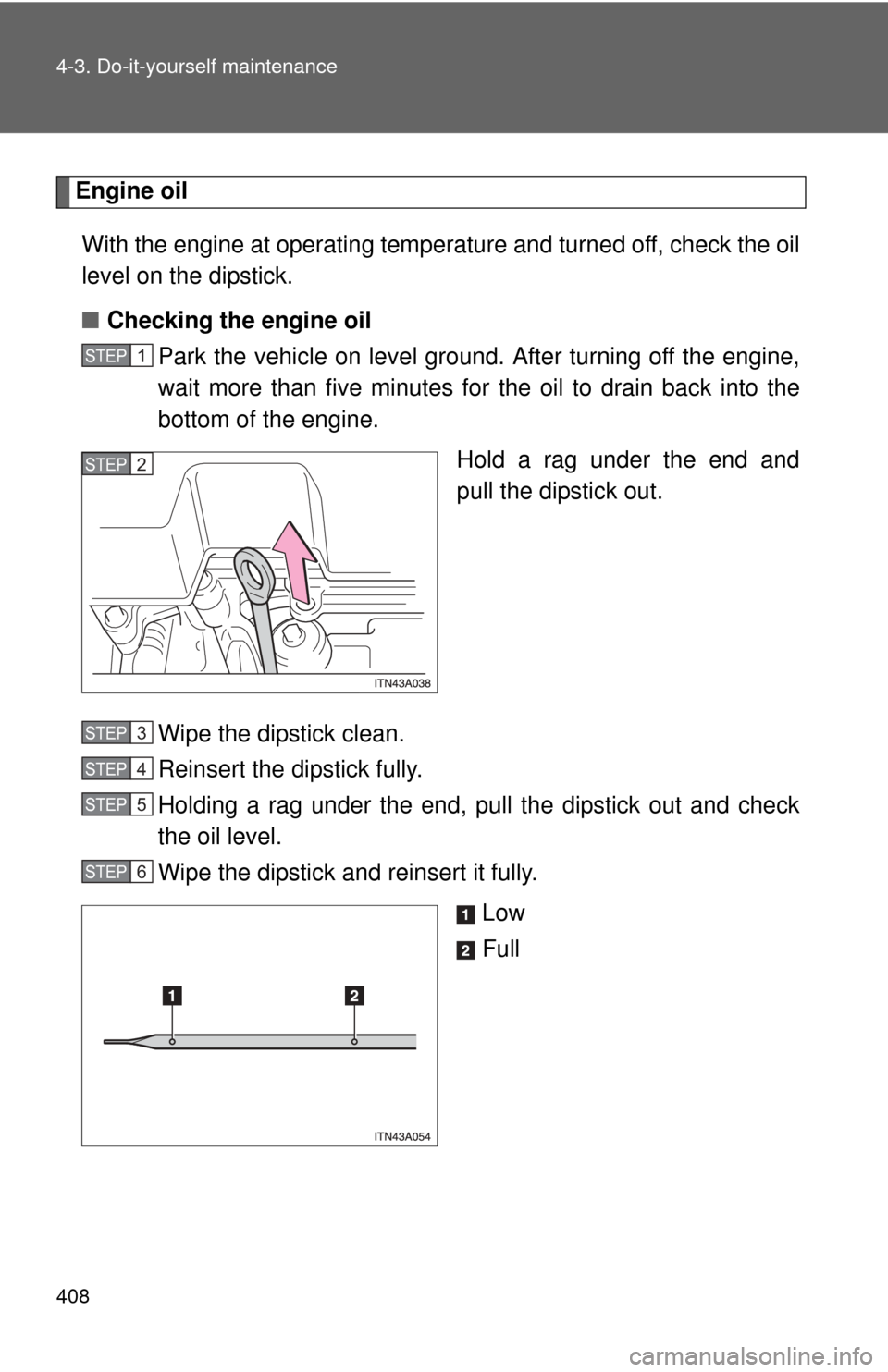
Engine oilWith the engine at operating temperature and turned off, check the oil
level on the dipstick.
■ Checking the engine oil
Park the vehicle on level gro und. After turning off the engine,
wait more than five minutes for the oil to drain back into the
bottom of the engine.
Hold a rag under the end and
pull the dipstick out.
Wipe the dipstick clean.
Reinsert the dipstick fully.
Holding a rag under the end, pull the dipstick out and check
the oil level.
Wipe the dipstick and reinsert it fully. Low
Full
STEP1
STEP2
STEP3
STEP4
STEP5
STEP6
Page 409 of 580
4
Maintenance and care
409
4-3. Do-it-yourself maintenance
■
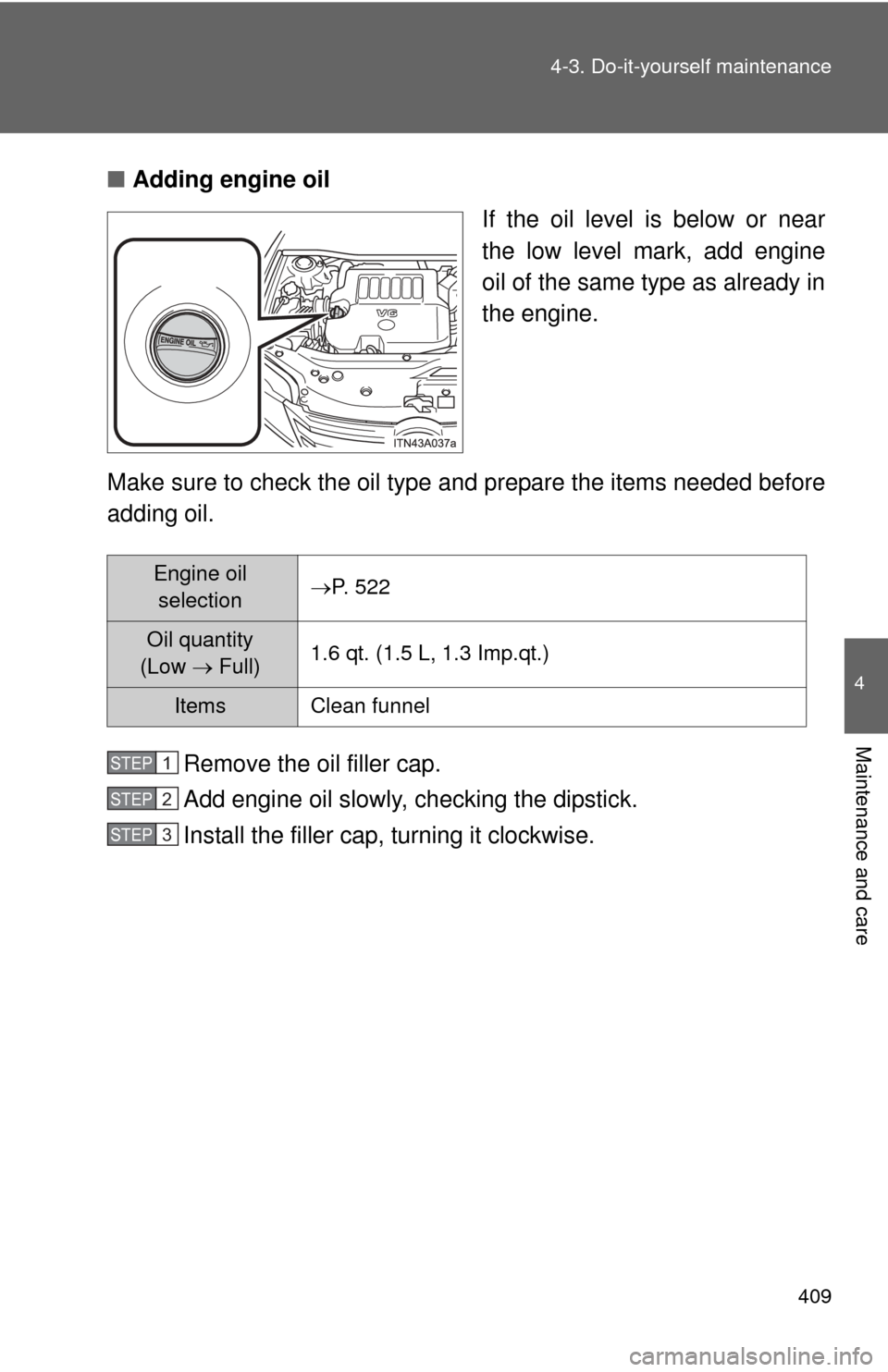
Adding engine oil
If the oil level is below or near
the low level mark, add engine
oil of the same type as already in
the engine.
Make sure to check the oil type and prepare the items needed before
adding oil.
Remove the oil filler cap.
Add engine oil slowly, checking the dipstick.
Install the filler cap, turning it clockwise.
Engine oil selectionP. 522
Oil quantity
(Low Full) 1.6 qt. (1.5 L, 1.3 Imp.qt.)
Items Clean funnel
STEP1
STEP2
STEP3
Page 411 of 580
4
Maintenance and care
411
4-3. Do-it-yourself maintenance
CAUTION
■
Used engine oil
●Used engine oil contains potentially harmful contaminants which may
cause skin disorders such as inflammation or skin cancer, so care should
be taken to avoid prolonged and repeated contact. To remove used engine
oil from your skin, wash thoroughly with soap and water.
● Dispose of used oil and filters only in a safe and acceptable manner. Do
not dispose of used oil and filters in household trash, in sewers or onto the
ground.
Call your Toyota dealer, service station or auto parts store for information
concerning recycling or disposal.
● Do not leave used engine oil within the reach of children.
NOTICE
■To prevent serious engine damage
Check the oil level on regular basis.
■ When replacing the engine oil
●Be careful not to spill engine oil on the vehicle components.
● Avoid overfilling, or the engine could be damaged.
● Check the oil level on the dipstick every time you refill the vehicle.
● Be sure the engine oil filler cap is properly tightened.
Page 412 of 580
412 4-3. Do-it-yourself maintenance
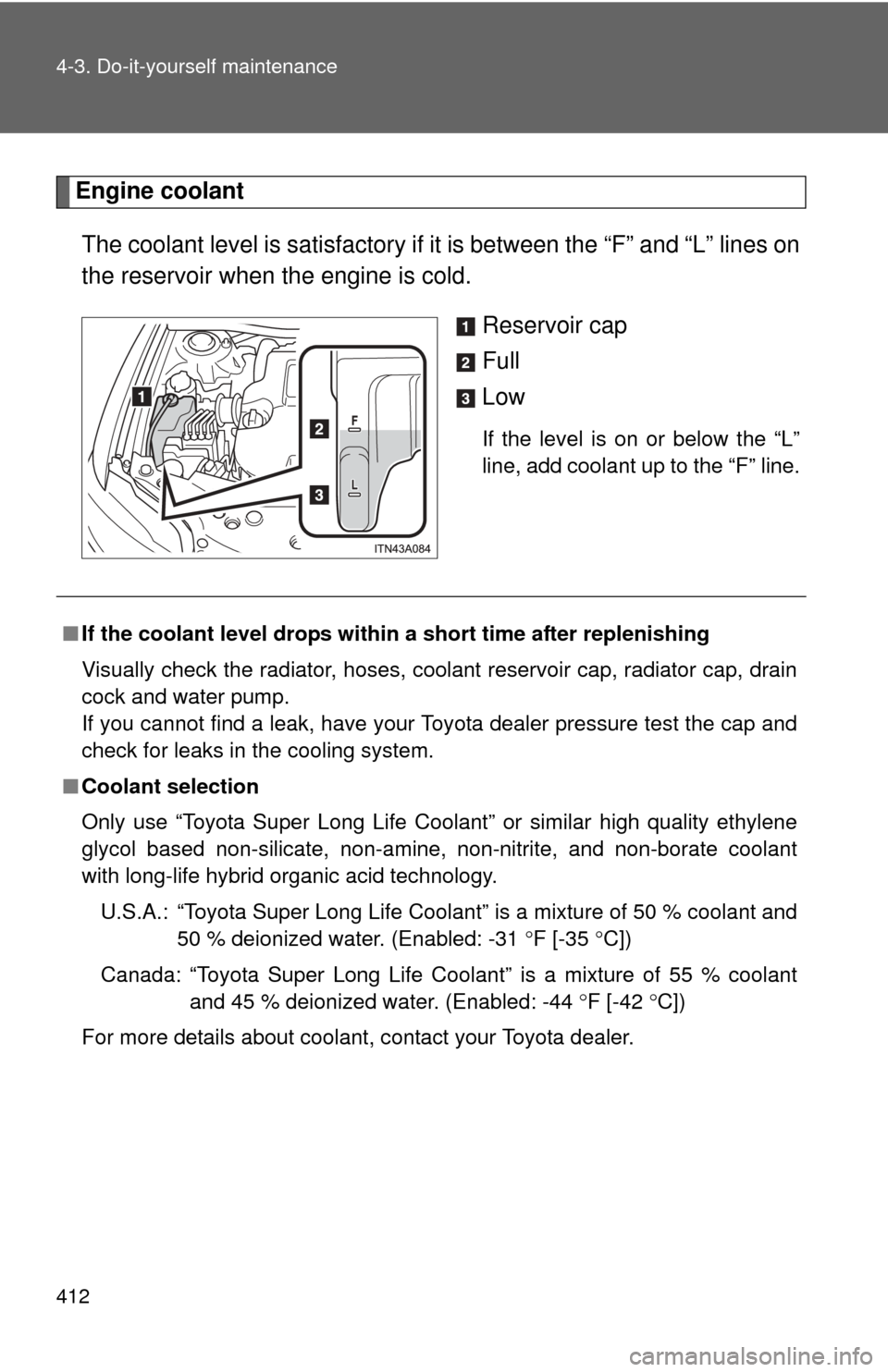
Engine coolantThe coolant level is sati sfactory if it is between the “F” and “L” lines on
the reservoir when the engine is cold.
Reservoir cap
Full
Low
If the level is on or below the “L”
line, add coolant up to the “F” line.
■If the coolant level drops within a short time after replenishing
Visually check the radiator, hoses, coolant reservoir cap, radiator cap, drain
cock and water pump.
If you cannot find a leak, have your Toyota dealer pressure test the cap and
check for leaks in the cooling system.
■ Coolant selection
Only use “Toyota Super Long Life Coolant” or similar high quality ethylene
glycol based non-silicate, non-amine, non-nitrite, and non-borate coolant
with long-life hybrid organic acid technology.
U.S.A.: “Toyota Super Long Life Coolant” is a mixture of 50 % coolant and 50 % deionized water. (Enabled: -31 F [-35 C])
Canada: “Toyota Super Long Life Coolant” is a mixture of 55 % coolant and 45 % deionized water. (Enabled: -44 F [-42 C])
For more details about coolant, contact your Toyota dealer.
Page 413 of 580
4
Maintenance and care
413
4-3. Do-it-yourself maintenance
Radiator and condenser
Check the radiator and condenser and clear any foreign objects.
If either of the above parts are extremely dirty or you are not sure of
their condition, have your vehicl e checked by your Toyota dealer.
CAUTION
■When the engine is hot
Do not remove the radiator cap.
The cooling system may be under pressure and may spray hot coolant if the
cap is removed, causing serious injuries, such as burns.
NOTICE
■When adding the coolant
Coolant is neither plain water nor stra ight antifreeze. The correct mixture of
water and anti freeze must be used to provide proper lubrication, corrosion
protection and cooling. Be sure to read the antifreeze or coolant label.
■ If you spill coolant
Be sure to wash it off with water to prevent it from damaging to parts or paint.
CAUTION
■When the engine is hot
Do not touch the radiator or condenser as they may be hot and cause seri-
ous injuries, such as burns.
Page 444 of 580
444
4-3. Do-it-yourself maintenance
Checking and replacing fuses
If any of the electrical components do not operate, a fuse may have
blown. If this happens, check and replace the fuses as necessary.
Turn the “ENGINE START STOP” switch or the engine
switch OFF.
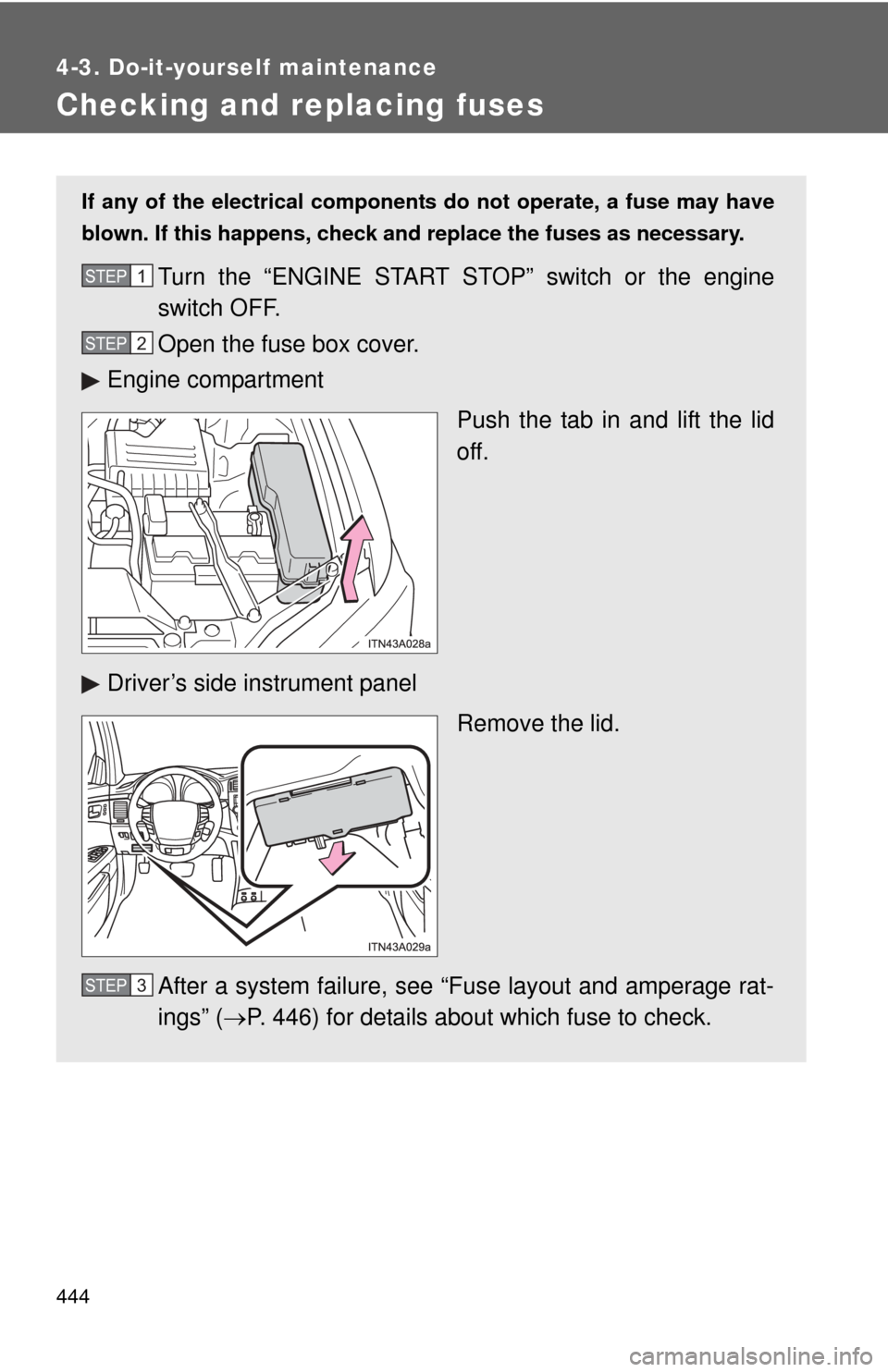
Open the fuse box cover.
Engine compartment
Push the tab in and lift the lid
off.
Driver’s side instrument panel Remove the lid.
After a system failure, see “Fuse layout and amperage rat-
ings” ( P. 446) for details about which fuse to check.STEP1
STEP2
STEP3
Page 455 of 580
455
4-3. Do-it-yourself maintenance
4
Maintenance and care
Light bulbs
You may replace the following bulbs yourself. The difficulty level of
replacement varies depending on the bulb. If necessary bulb
replacement seems difficult to perfor m, contact your Toyota dealer.
For more information about replacing other light bulbs, contact your
Toyota dealer.
■ Prepare a replacement light bulb.
Check the wattage of the light bulb being replaced. ( P. 527)
■ Remove the engine compartment cover
P. 407
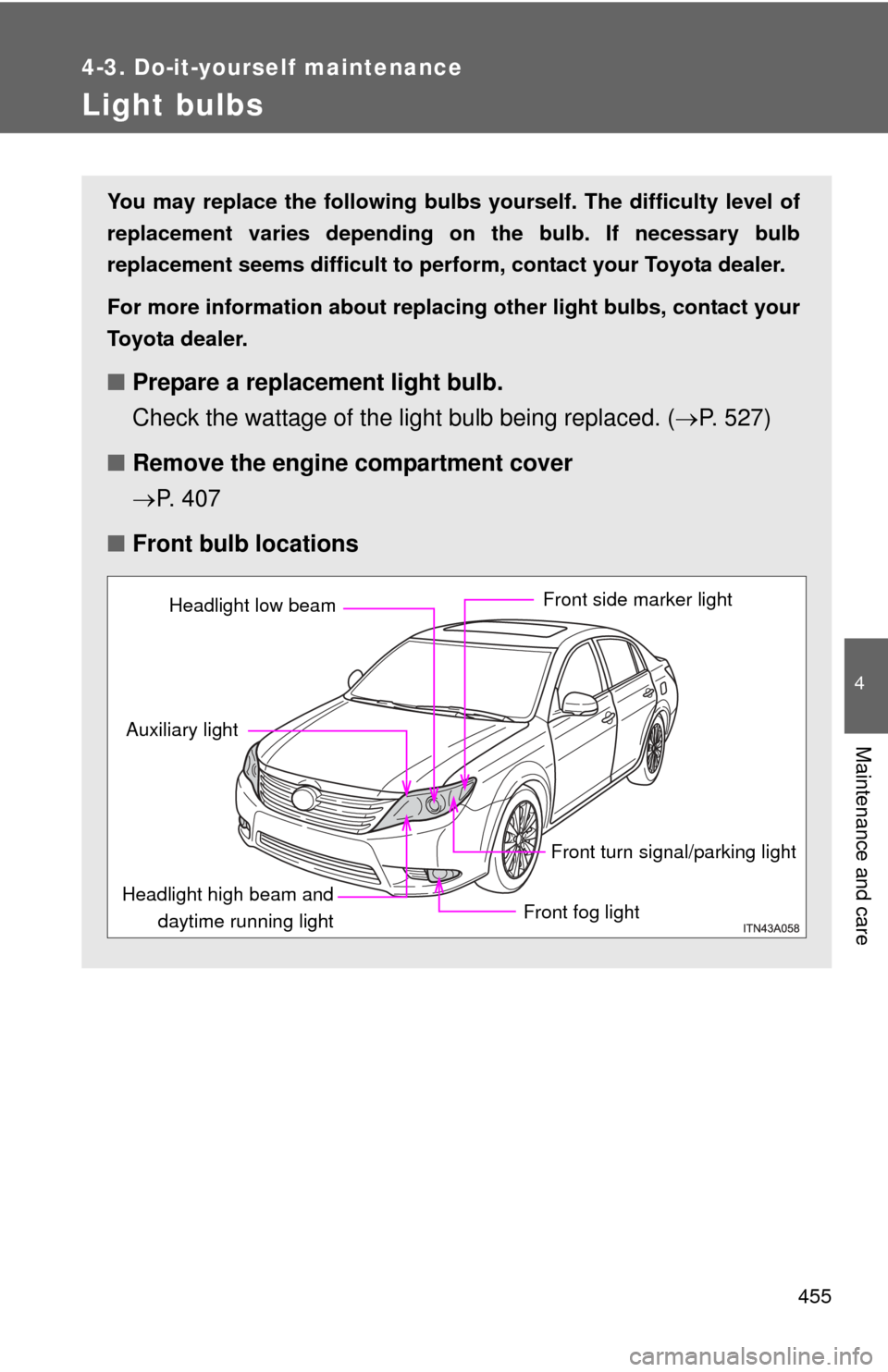
■ Front bulb locations
Front side marker light
Front turn signal/parking light
Front fog light
Headlight high beam and
daytime running light
Auxiliary light
Headlight low beam