battery TOYOTA AVALON 2019 (in English) Workshop Manual
[x] Cancel search | Manufacturer: TOYOTA, Model Year: 2019, Model line: AVALON, Model: TOYOTA AVALON 2019Pages: 536, PDF Size: 9.43 MB
Page 455 of 536
4557-2. Steps to take in an emergency
7
When trouble arises
If you have a set of jumper (or booster) cables and a second vehicle
with a 12-volt battery, you can jump start your vehicle by foll owing the
steps below.
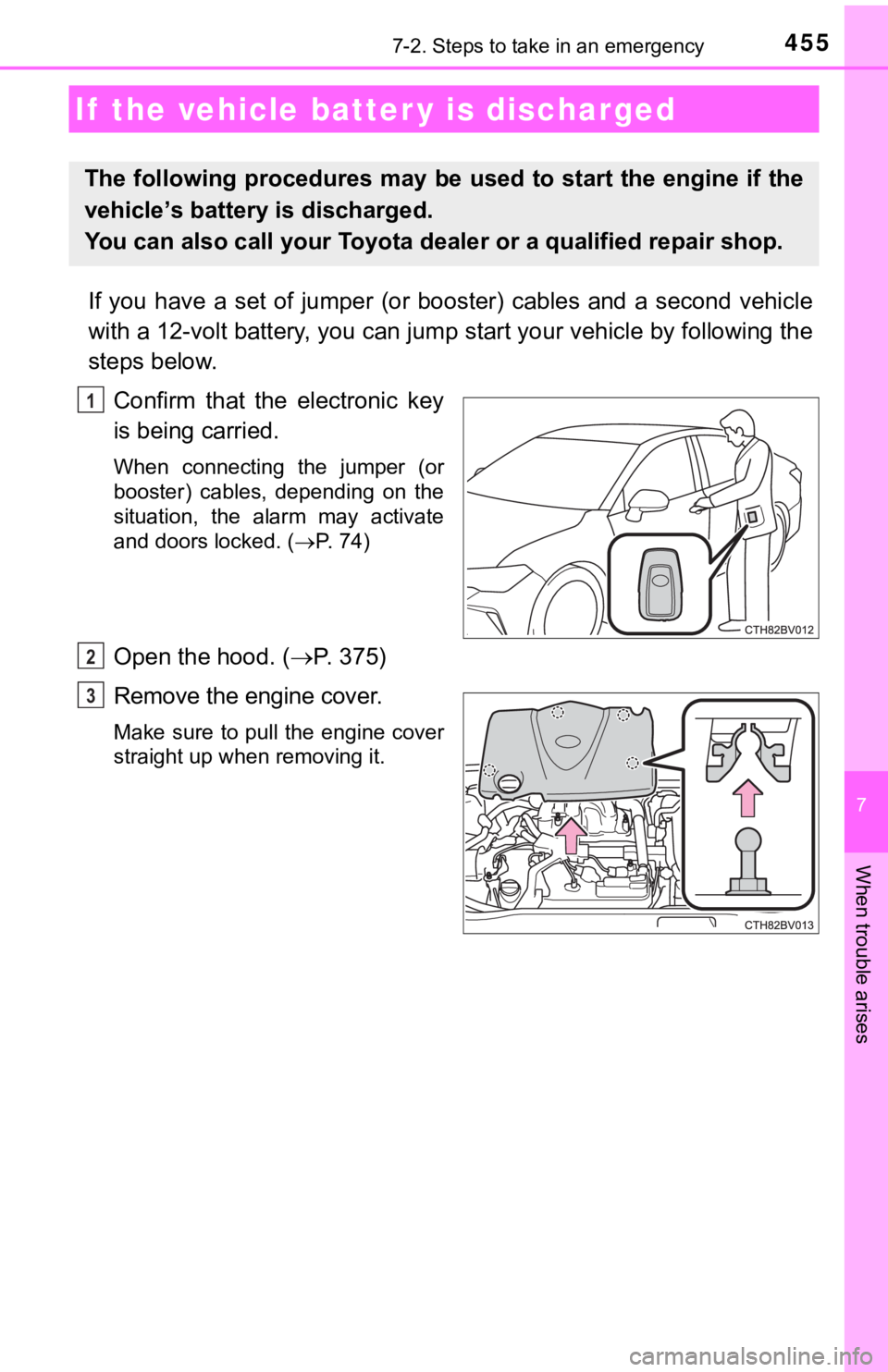
Confirm that the electronic key
is being carried.
When connecting the jumper (or
booster) cables, depending on the
situation, the alarm may activate
and doors locked. ( P. 74)
Open the hood. ( P. 375)
Remove the engine cover.
Make sure to pull the engine cover
straight up when removing it.
If the vehicle batt er y is discharged
The following procedures may be used to start the engine if the
vehicle’s battery is discharged.
You can also call your Toyota de aler or a qualified repair shop.
1
2
3
Page 456 of 536
4567-2. Steps to take in an emergency
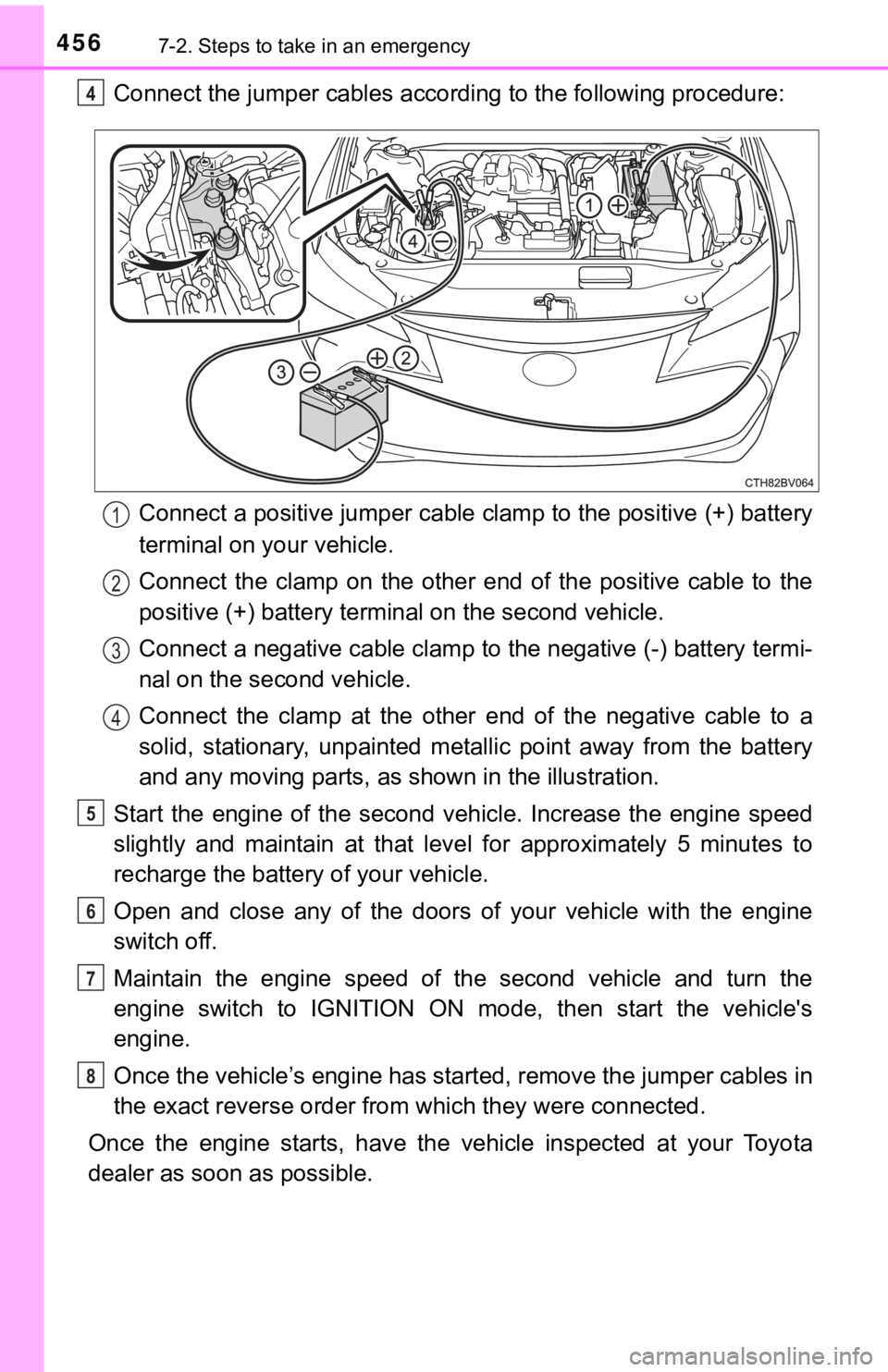
Connect the jumper cables according to the following procedure:Connect a positive jumper cable clamp to the positive (+) batte ry
terminal on your vehicle.
Connect the clamp on the other end of the positive cable to the
positive (+) battery termi nal on the second vehicle.
Connect a negative cable clamp to the negative (-) battery term i-
nal on the s econd vehicle.
Connect the clamp at the other e nd of the negative cable to a
solid, stationary, unpainted meta llic point away from the battery
and any moving parts, as shown in the illustration.
Start the engine of the second v ehicle. Increase the engine speed
slightly and maintain at that lev el for approximately 5 minutes to
recharge the batter y of your vehicle.
Open and close any of the doors of your vehicle with the engine
switch off.
Maintain the engine speed of the second vehicle and turn the
engine switch to IGNITION ON mode, then start the vehicle's
engine.
Once the vehicle’s engine has st arted, remove the jumper cables in
the exact reverse order from which they were connected.
Once the engine starts, have the vehicle inspected at your Toyota
dealer as soon as possible.4
1
2
3
4
5
6
7
8
Page 457 of 536
4577-2. Steps to take in an emergency
7
When trouble arises
■Starting the engine when t he battery is discharged
The engine cannot be started by push-starting.
■ To prevent battery discharge
●Turn off the headlights and the audio system while the engine is off.
● Turn off any unnecessary electrical components when the vehicle is running
at a low speed for an extended period, such as in heavy traffic .
■ When the battery is r emoved or discharged
● Information stored in the ECU is cleared. When the battery is d epleted, have
the vehicle inspected at your Toyota dealer.
● Some systems may require initialization. ( P. 499)
■ When removing the battery terminals
When the battery terminals are removed, the information stored in the ECU is
cleared. Before removing the battery terminals, contact your Toyota dealer.
■ Charging the battery
The electricity stored in the battery will discharge gradually even when the
vehicle is not in use, due to natural discharge and the draining effects of cer-
tain electrical appliances. If the vehicle is left for a long t ime, the battery may
discharge, and the engine may be unable to start. (The battery recharges
automatically during driving.)
■ When recharging or replacing the battery
●In some cases, it may not be possible to unlock the doors using the smart
key system when the battery is discharged. Use the wireless rem ote control
or the mechanical key to lock or unlock the doors.
● The engine may not start on the first attempt after the battery has recharged
but will start normally after the second attempt. This is not a malfunction.
● The engine switch mode is memorized by the vehicle. When the ba ttery is
reconnected, the system will return to the mode it was in befor e the battery
was discharged. Before disconnecting the battery, turn the engine switch off.
If you are unsure what mode the engine switch was in before the battery dis-
charged, be especially careful when reconnecting the battery.
■ When replacing the battery
●Use a battery that conforms to European regulations.
● Use a battery that the case size is same as the previous one (L N3), 20 hour
rate capacity (20HR) is equivalent (70Ah) or greater, and perfo rmance rating
(CCA) is equivalent (603A) or greater.
• If the sizes differ, the battery cannot be properly secured.
• If the 20 hour rate capacity is low, even if the time period w here the vehi-
cle is not used is a short time, the battery may discharge and the engine
may not be able to start.
● For details, consult your Toyota dealer.
Page 458 of 536
4587-2. Steps to take in an emergency
WARNING
■When removing the battery terminals
Always remove the negative (-) terminal first. If the positive (+) terminal con-
tacts any metal in the surrounding area when the positive (+) terminal is
removed, a spark may occur, leading to a fire in addition to el ectrical shocks
and death or serious injury.
■ Avoiding battery fires or explosions
Observe the following precautions to prevent accidentally ignit ing the flam-
mable gas that may be emitted from the battery:
● Make sure each jumper cable is connected to the correct terminal and that
it is not unintentionally in contact with any other than the in tended terminal.
● Do not allow the other end of the jumper cable connected to the “+” termi-
nal to come into contact with any other parts or metal surfaces in the area,
such as brackets or unpainted metal.
● Do not allow the + and - clamps of the jumper cables to come into contact
with each other.
● Do not smoke, use matches, cigarette lighters or allow open fla me near
the battery.
■ Battery precautions
The battery contains poisonous and corrosive acidic electrolyte , while
related parts contain lead and lead compounds. Observe the foll owing pre-
cautions when handling the battery:
● When working with the battery, always wear safety glasses and t ake care
not to allow any battery fluids (acid) to come into contact wit h skin, clothing
or the vehicle body.
● Do not lean over the battery.
● In the event that battery fluid comes into contact with the skin or eyes,
immediately wash the affected area with water and seek medical attention.
Place a wet sponge or cloth over the affected area until medica l attention
can be received.
● Always wash your hands after handling the battery support, term inals, and
other battery-related parts.
● Do not allow children near the battery.
NOTICE
■When handling jumper cables
When connecting the jumper cables, ensure that they do not beco me entan-
gled in the cooling fan or engine drive belt.
Page 471 of 536
4718-1. Specifications
8
Vehicle specifications
*: The fluid capacity is a reference quantity. If replacement is necessary, contact your Toyota dealer.
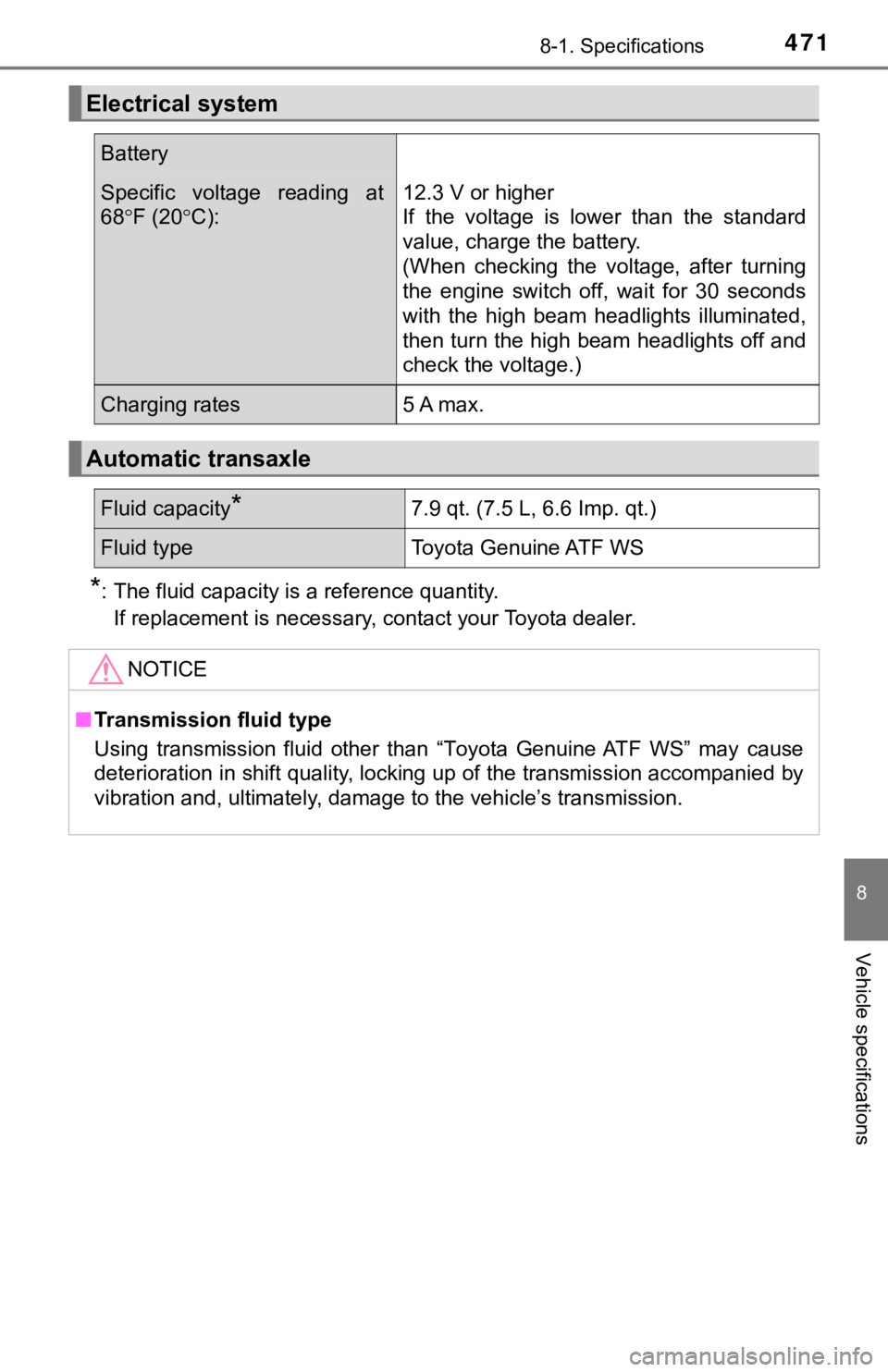
Electrical system
Battery
Specific voltage reading at
68 F (20 C):12.3 V or higher
If the voltage is lower than the standard
value, charge the battery.
(When checking the voltage, after turning
the engine switch off, wait for 30 seconds
with the high beam headlights illuminated,
then turn the high beam headlights off and
check the voltage.)
Charging rates5 A max.
Automatic transaxle
Fluid capacity*7.9 qt. (7.5 L, 6.6 Imp. qt.)
Fluid type Toyota Genuine ATF WS
NOTICE
■Transmission fluid type
Using transmission fluid other than “Toyota Genuine ATF WS” may cause
deterioration in shift quality, locking up of the transmission accompanied by
vibration and, ultimately, damage to the vehicle’s transmission .
Page 486 of 536
4868-1. Specifications
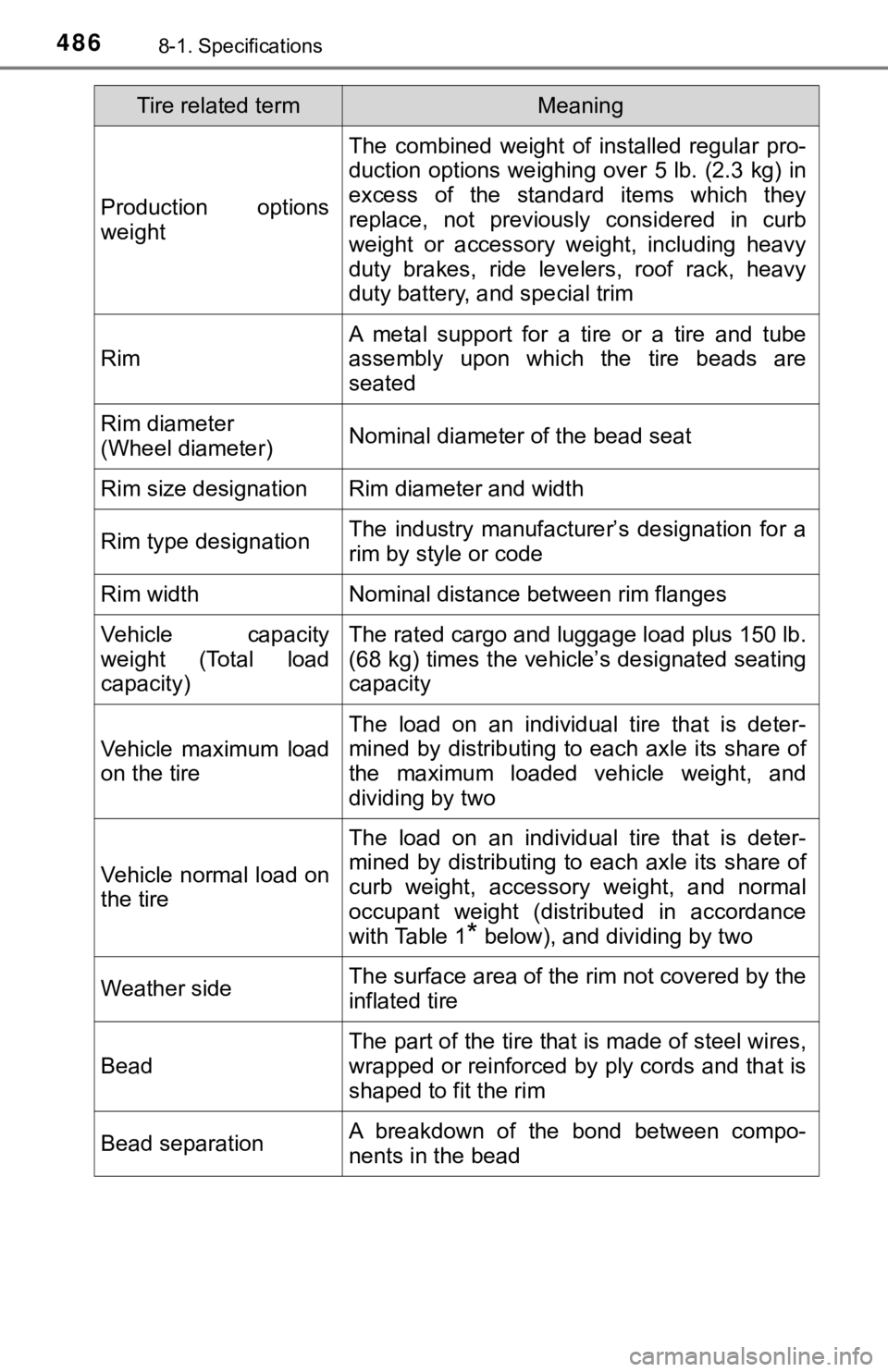
Production options
weight
The combined weight of installed regular pro-
duction options weighing over 5 lb. (2.3 kg) in
excess of the standard items which they
replace, not previously considered in curb
weight or accessory weight, including heavy
duty brakes, ride levelers, roof rack, heavy
duty battery, and special trim
Rim
A metal support for a tire or a tire and tube
assembly upon which the tire beads are
seated
Rim diameter
(Wheel diameter)Nominal diameter of the bead seat
Rim size designationRim diameter and width
Rim type designationThe industry manufacturer’s designation for a
rim by style or code
Rim widthNominal distance between rim flanges
Vehicle capacity
weight (Total load
capacity)The rated cargo and l uggage load plus 150 lb.
(68 kg) times the vehicle’s designated seating
capacity
Vehicle maximum load
on the tire
The load on an individual tire that is deter-
mined by distributing to each axle its share of
the maximum loaded vehicle weight, and
dividing by two
Vehicle normal load on
the tire
The load on an individual tire that is deter-
mined by distributing to each axle its share of
curb weight, accessory weight, and normal
occupant weight (distributed in accordance
with Table 1
* below), and dividing by two
Weather sideThe surface area of the rim not covered by the
inflated tire
Bead
The part of the tire that is made of steel wires,
wrapped or reinforced by ply cords and that is
shaped to fit the rim
Bead separationA breakdown of the bond between compo-
nents in the bead
Tire related termMeaning
Page 498 of 536
4988-2. Customization
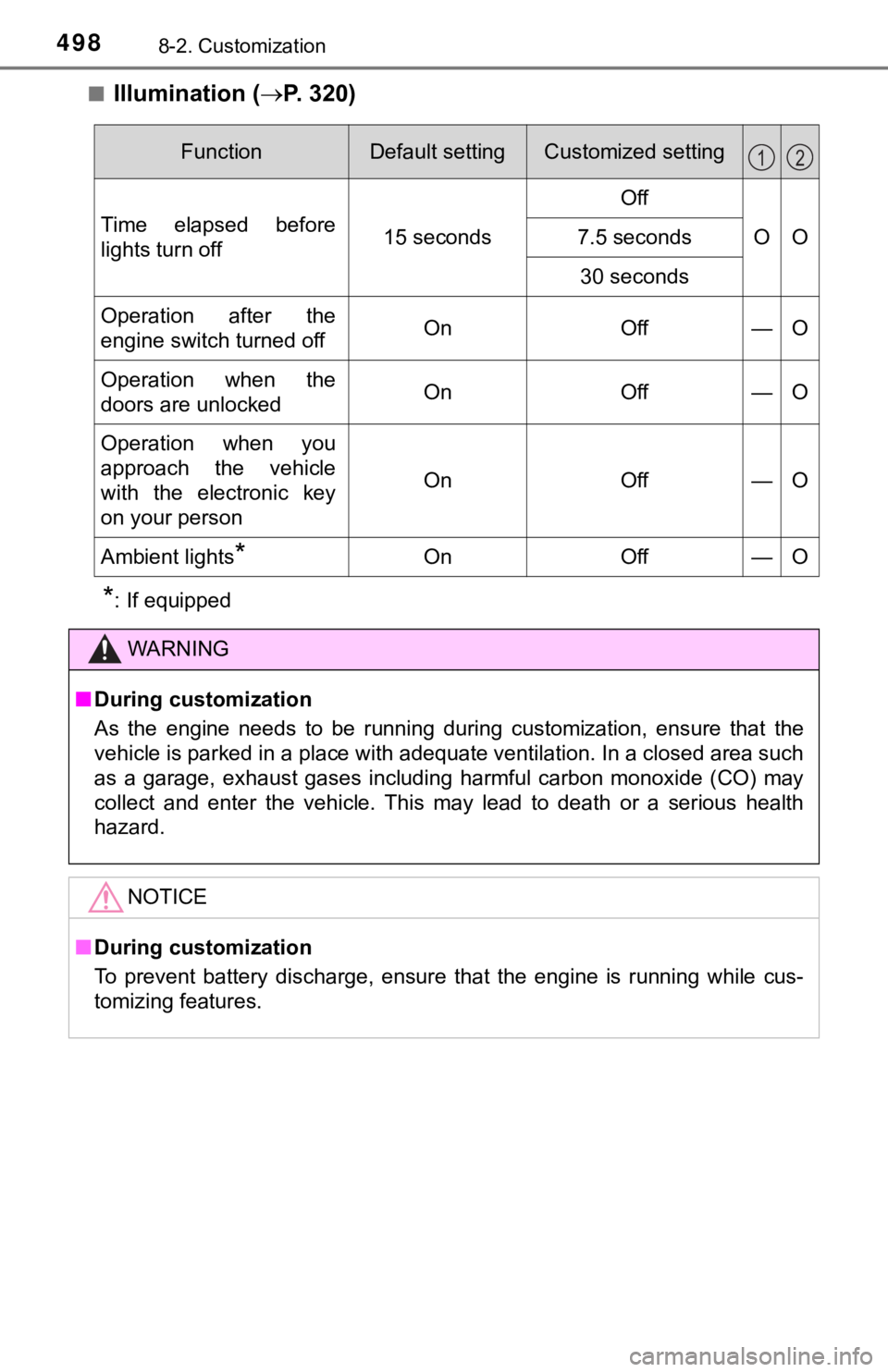
■Illumination (P. 320)
*: If equipped
FunctionDefault settingCustomized setting
Time elapsed before
lights turn off15 seconds
Off
OO7.5 seconds
30 seconds
Operation after the
engine switch turned offOnOff—O
Operation when the
doors are unlockedOnOff—O
Operation when you
approach the vehicle
with the electronic key
on your person
OnOff—O
Ambient lights*OnOff—O
12
WARNING
■During customization
As the engine needs to be running during customization, ensure that the
vehicle is parked in a place with adequate ventilation. In a closed area such
as a garage, exhaust gases including harmful carbon monoxide (CO) may
collect and enter the vehicle. This may lead to death or a serious health
hazard.
NOTICE
■ During customization
To prevent battery discharge, ensure that the engine is running while cus-
tomizing features.
Page 499 of 536
499
8
Vehicle specifications
8-3. Items to initialize
Items to initialize
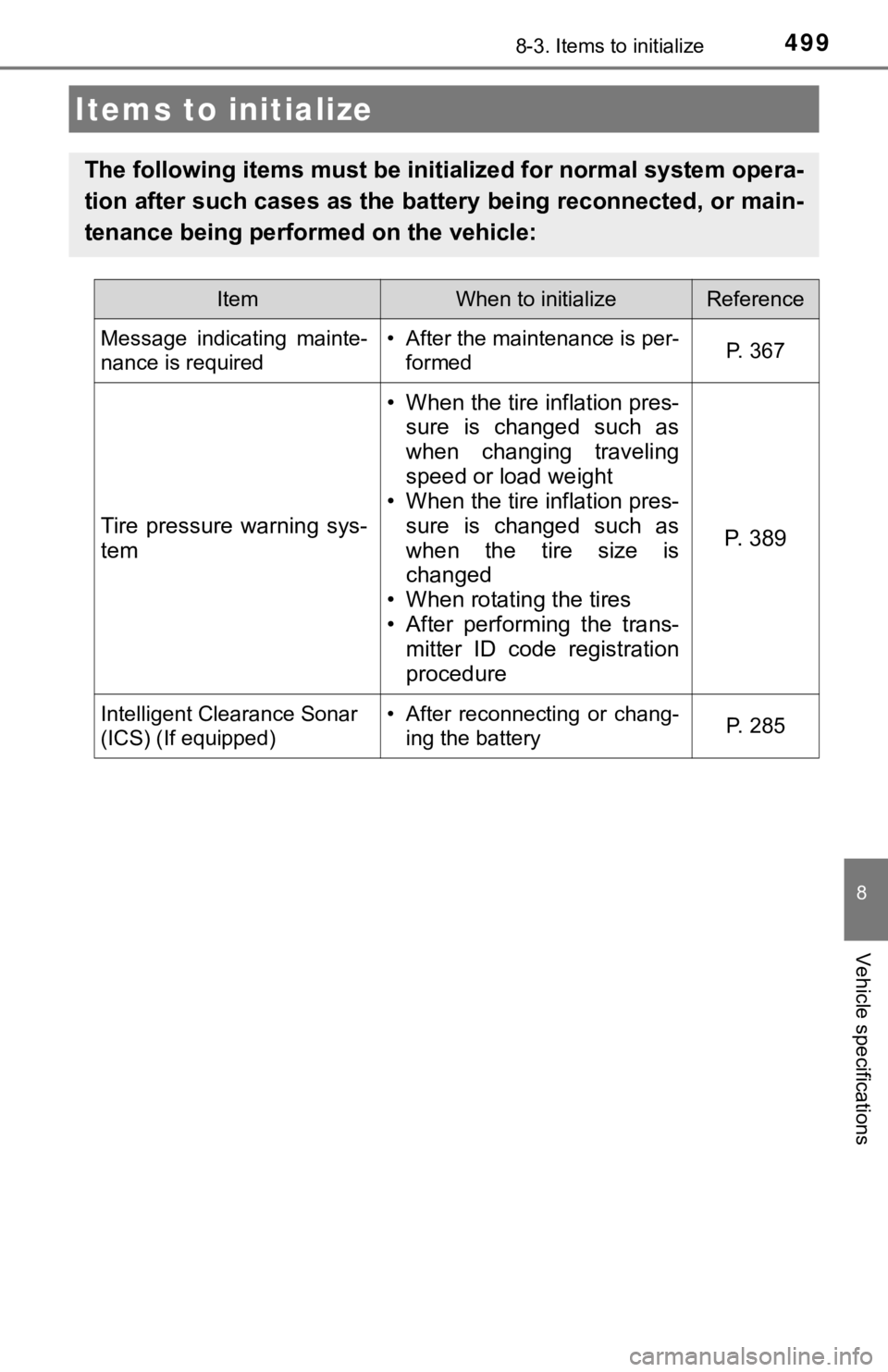
The following items must be initialized for normal system opera-
tion after such cases as the battery being reconnected, or main -
tenance being performed on the vehicle:
ItemWhen to initializeReference
Message indicating mainte-
nance is required • After the maintenance is per- formedP. 367
Tire pressure warning sys-
tem
• When the tire inflation pres-sure is changed such as
when changing traveling
speed or load weight
• When the tire inflation pres- sure is changed such as
when the tire size is
changed
• When rotating the tires
• After performing the trans- mitter ID code registration
procedure
P. 389
Intelligent Clearance Sonar
(ICS) (If equipped)• After reconnecting or chang-
ing the batteryP. 285
Page 516 of 536
516What to do if... (Troubleshooting)
What to do if... (Troubleshooting)
●If you lose your mechanical keys, new genuine mechanical keys can be
made by your Toyota dealer. ( P. 113)
●If you lose your electronic keys, the risk of vehicle theft inc reases signifi-
cantly. Contact your Toyota dealer immediately. ( P. 114)
●Is the key battery weak or depleted? (P. 408)
●Is the engine switch in IGNITION ON mode?
When locking the doors, turn the engine switch off. ( P. 175)
●Is the electronic key left inside the vehicle?
When locking the doors, make sure that you have the electronic key on
your person.
●The function may not operate properly due to the condition of t he radio
wave. ( P. 113, 127)
●Is the child-protector lock set?
The rear door cannot be opened from inside the vehicle when the lock is
set. Open the rear door from outside and then unlock the child-protector
lock. ( P. 118)
●The function to prevent the electronic key from being left insi de the trunk
will operate and you can open the trunk as usual. Take the key out from the
trunk. ( P. 122)
If you have a problem, check the following before contacting
your Toyota dealer.
The doors cannot be locked, unlocked, opened or closed
You lose your keys
The doors cannot be locked or unlocked
The rear door cannot be opened
The trunk lid is closed with the electronic key left inside
Page 517 of 536
517What to do if... (Troubleshooting)
●Did you press the engine switch while firmly depressing the brake pedal?
( P. 174)
●Is the shift lever in P? ( P. 176)
●Is the electronic key anywhere detectable inside the vehicle? ( P. 125)
●Is the steering wheel unlocked? (P. 176)
●Is the electronic key battery weak or depleted?
In this case, the engine can be started in a temporary way. ( P. 453)
●Is the battery discharged? (P. 455)
●Is the engine switch in IGNITION ON mode?
If you cannot release the shift lever by depressing the brake p edal with the
engine switch in IGNITION ON mode. ( P. 183)
●It is locked automatically to prevent theft of the vehicle. ( P. 176)
●Is the window lock switch pressed?
The power window except for the one at the driver’s seat cannot be oper-
ated if the window lock switch is pressed. ( P. 150)
●The auto power off function will be operated if the vehicle is left in ACCES-
SORY or IGNITION ON mode (the engine is not running) for a peri od of
time. ( P. 176)
If you think something is wrong
The engine does not start
The shift lever cannot be shifted from P even if you depress
the brake pedal
The steering wheel cannot be turned after the engine is
stopped
The windows do not open or close by operating the power
window switches
The engine switch is tur ned off automatically