transmission TOYOTA AVALON 2019 Owners Manual (in English)
[x] Cancel search | Manufacturer: TOYOTA, Model Year: 2019, Model line: AVALON, Model: TOYOTA AVALON 2019Pages: 536, PDF Size: 9.43 MB
Page 3 of 536

3
1
8 7 5 4
3
2
9
6
3-1. Key informationKeys .................................. 112
3-2. Opening, closing and locking the doors
Doors................................. 115
Trunk ................................. 121
Smart key system.............. 125
3-3. Adjusting the seats Front seats ........................ 132
Rear seats ......................... 134
Driving position memory ........................... 136
Head restraints .................. 141
3-4. Adjusting the steering wheel and mirrors
Steering wheel .................. 143
Inside rear view mirror....... 145
Outside rear view mirrors..................... 147
3-5. Opening and closing the windows
Power windows ................. 150
Moon roof .......................... 154 4-1. Before driving
Driving the vehicle ............. 160
Cargo and luggage ............ 168
Vehicle load limits .............. 171
Trailer towing ..................... 172
Dinghy towing .................... 173
4-2. Driving procedures Engine (ignition) switch .............................. 174
Automatic transmission .................... 179
Turn signal lever ................ 185
Parking brake .................... 186
Brake Hold ......................... 190
4-3. Operating the lights and wipers
Headlight switch ................ 192
Automatic High Beam ........ 196
Windshield wipers and washer ...................... 200
4-4. Refueling Opening the fuel tank cap ........................... 204
3Operation of each
component4Driving
Page 9 of 536

9
Your Toyota is equipped with several sophisticated computers that will record
certain data, such as:• Engine speed
• Accelerator status
• Brake status
• Vehicle speed
• Shift position
The recorded data varies according to the vehicle grade level and options
with which it is equipped. These computers do not record conver sations or
sounds, and only record images outside of the vehicle in certai n situations.
●Data Transmission
Your vehicle may transmit the data recorded in these computers to Toyota
without notification to you.
●Data usage
Toyota may use the data recorded in these computers to diagnose malfunc-
tions, conduct research and development, and improve quality.
Toyota will not disclose the recorded data to a third party exc ept:
• With the consent of the vehicle owner or with the consent of the lessee if the vehicle is leased
• In response to an official request by the police, a court of l aw or a govern-
ment agency
• For use by Toyota in a lawsuit
• For research purposes where the data is not tied to a specific vehicle or
vehicle owner
●Usage of data collected through Safety Connect (U.S. mainland o nly)
If your Toyota has Safety Connect and if you have subscribed to those ser-
vices, please refer to the Safety Connect Telematics Subscription Service
Agreement for information on data collected and its usage.
●To learn more about the vehicle data collected, used and shared by
Toyota, please visit www.toyota.com/privacyvts/
.
Vehicle data recordings
Page 159 of 536

159
4Driving
4-1. Before drivingDriving the vehicle ............. 160
Cargo and luggage ........... 168
Vehicle load limits ............. 171
Trailer towing..................... 172
Dinghy towing ................... 173
4-2. Driving procedures Engine (ignition) switch .............................. 174
Automatic transmission .................... 179
Turn signal lever................ 185
Parking brake .................... 186
Brake Hold ........................ 190
4-3. Operating the lights and wipers
Headlight switch ................ 192
Automatic High Beam ....... 196
Windshield wipers and washer ............................ 200
4-4. Refueling Opening the fuel tank cap .......................... 204 4-5. Using the driving
support systems
Toyota Safety Sense P ..... 208
PCS (Pre-Collision System) .... 216
LDA (Lane Departure Alert with steering
control) ............................ 228
Dynamic radar cruise control with full-speed
range............................... 238
BSM (Blind Spot Monitor) ........ 251
• BSM function ................ 255
• RCTA function .............. 257
Rear Camera Detection function ........................... 262
Intuitive parking assist....... 266
Intelligent Clearance Sonar (ICS) ..................... 274
Driving mode select switches .......................... 295
Driving assist systems ...... 299
4-6. Driving tips Winter driving tips ............. 305
Page 164 of 536

1644-1. Before driving
WARNING
Observe the following precautions.
Failure to do so may result in death or serious injury.
■When driving on slippery road surfaces
● Sudden braking, acceleration and steering may cause tire slippa ge and
reduce your ability to control the vehicle.
● Sudden acceleration, engine braking due to shifting, or changes in engine
speed could cause the vehicle to skid.
● After driving through a puddle, lightly depress the brake pedal to make
sure that the brakes are functioning properly. Wet brake pads m ay prevent
the brakes from functioning properly. If the brakes on only one side are wet
and not functioning properly, steering control may be affected.
■ When shifting the shift lever
● Do not let the vehicle roll backward while the shift lever is i n a driving posi-
tion, or roll forward while the shift lever is in R.
Doing so may cause the engine to stall or lead to poor brake an d steering
performance, resulting in an accident or damage to the vehicle.
● Do not shift the shift lever to P while the vehicle is moving.
Doing so can damage the transmission and may result in a loss o f vehicle
control.
● Do not shift the shift lever to R while the vehicle is moving forward.
Doing so can damage the transmission and may result in a loss o f vehicle
control.
● Do not shift the shift lever to a driving position while the ve hicle is moving
backward.
Doing so can damage the transmission and may result in a loss o f vehicle
control.
● Shifting the shift lever to N while the vehicle is moving will disengage the
engine from the transmission. Engine braking is not available w hen N is
selected.
● Be careful not to shift the shift lever with the accelerator pe dal depressed.
Shifting the shift lever to a gear other than P or N may lead to unexpected
rapid acceleration of the vehicle that may cause an accident an d result in
death or serious injury.
■ If you hear a squealing or scrap ing noise (brake pad wear limit indica-
tors)
Have the brake pads checked and replaced by your Toyota dealer as soon
as possible.
Rotor damage may result if the pads are not replaced when neede d.
It is dangerous to drive the vehicle when the wear limits of the brake pads
and/or those of the brake discs are exceeded.
Page 179 of 536
1794-2. Driving procedures
4
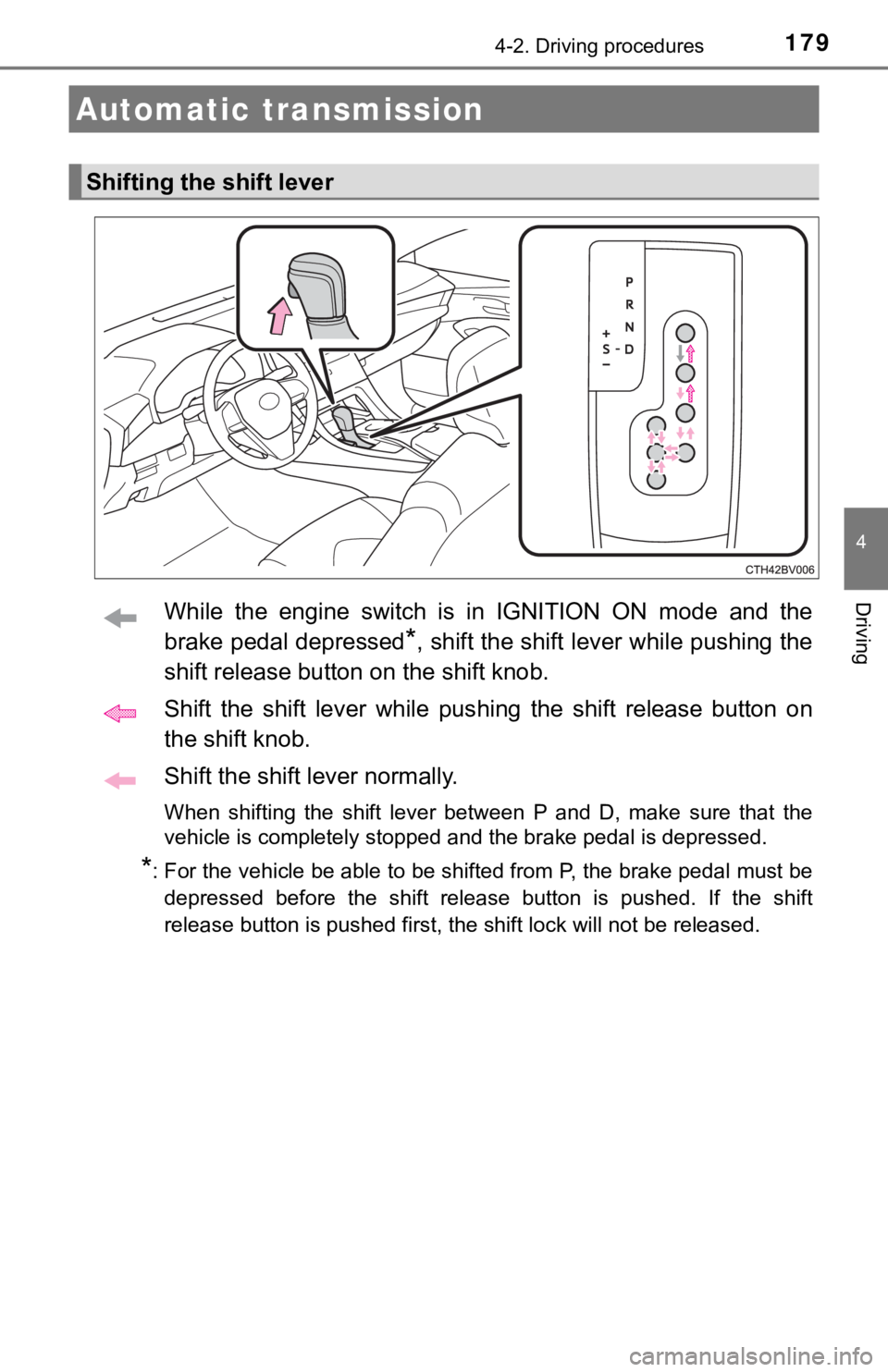
DrivingWhile the engine switch is in IGNITION ON mode and the
brake pedal depressed
*, shift the shift lever while pushing the
shift release button on the shift knob.
Shift the shift lever while pushing the shift release button on
the shift knob.
Shift the shift lever normally.
When shifting the shift lever between P and D, make sure that t he
vehicle is completely stopped and the brake pedal is depressed.
*: For the vehicle be able to be shifted from P, the brake pedal must be
depressed before the shift release button is pushed. If the shift
release button is pushed first, the shift lock will not be rele ased.
Automatic transmission
Shifting the shift lever
Page 182 of 536

1824-2. Driving procedures
■Automatic deactivation of shift range selection in the D positi on (vehi-
cles with paddle shift switches)
Shift range selection in the D position will be deactivated in the following situ-
ations:
● The “+” paddle shift switch is held down for a period of time
● When the vehicle comes to a stop
● If the accelerator pedal is depressed for more than a certain p eriod of time
● When the shift lever is shifted to a position other than D
■ S mode
●When the shift range is 7 or lower, holding the shift lever toward “+” sets the
shift range to 8.
● To prevent the engine from over-revving, upshifting may automat ically
occur.
● To protect the automatic transmission, a function is adopted that automati-
cally selects a higher shift range when the fluid temperature is high.
■ Downshift restriction warning buzzer (S mode or paddle shifting )
To help ensure safety and driving performance, downshifting ope ration may
sometimes be restricted. In some circumstances, downshifting ma y not be
possible even when the shift lever or paddle shift switches are operated. (A
buzzer will sound twice.)
■ When driving with dynamic radar cruise control with full-speed range
activated
Even when performing the following actions with the intent of e nabling engine
braking, engine braking will not activate because dynamic radar cruise con-
trol with full-speed range will not be canceled.
● While driving in D or S mode, downshifting to 7, 6, 5 or 4.
● When switching the driving mode to sport mode while driving in the D posi-
tion. (
P. 295)
■ Restraining sudden start (Drive-start Control)
P. 161
■ Shift lock system
The shift lock system is a system to prevent accidental operation of the shift
lever in starting.
The shift lever can be shifted from P only when the engine switch is in the
IGNITION ON mode the brake pedal is depressed and the shift release but-
ton is pushed.
Page 183 of 536
1834-2. Driving procedures
4
Driving
■If the shift lever cannot be shifted from P
First, check whether the brake pedal is being depressed.
If the shift lever cannot be shifted even though the brake peda l is depressed
and the shift release button is pushed, there may be a problem with the shift
lock system. Have the vehicle inspected by your Toyota dealer i mmediately.
The following steps may be used as an emergency measure to ensu re that
the shift lever can be shifted.
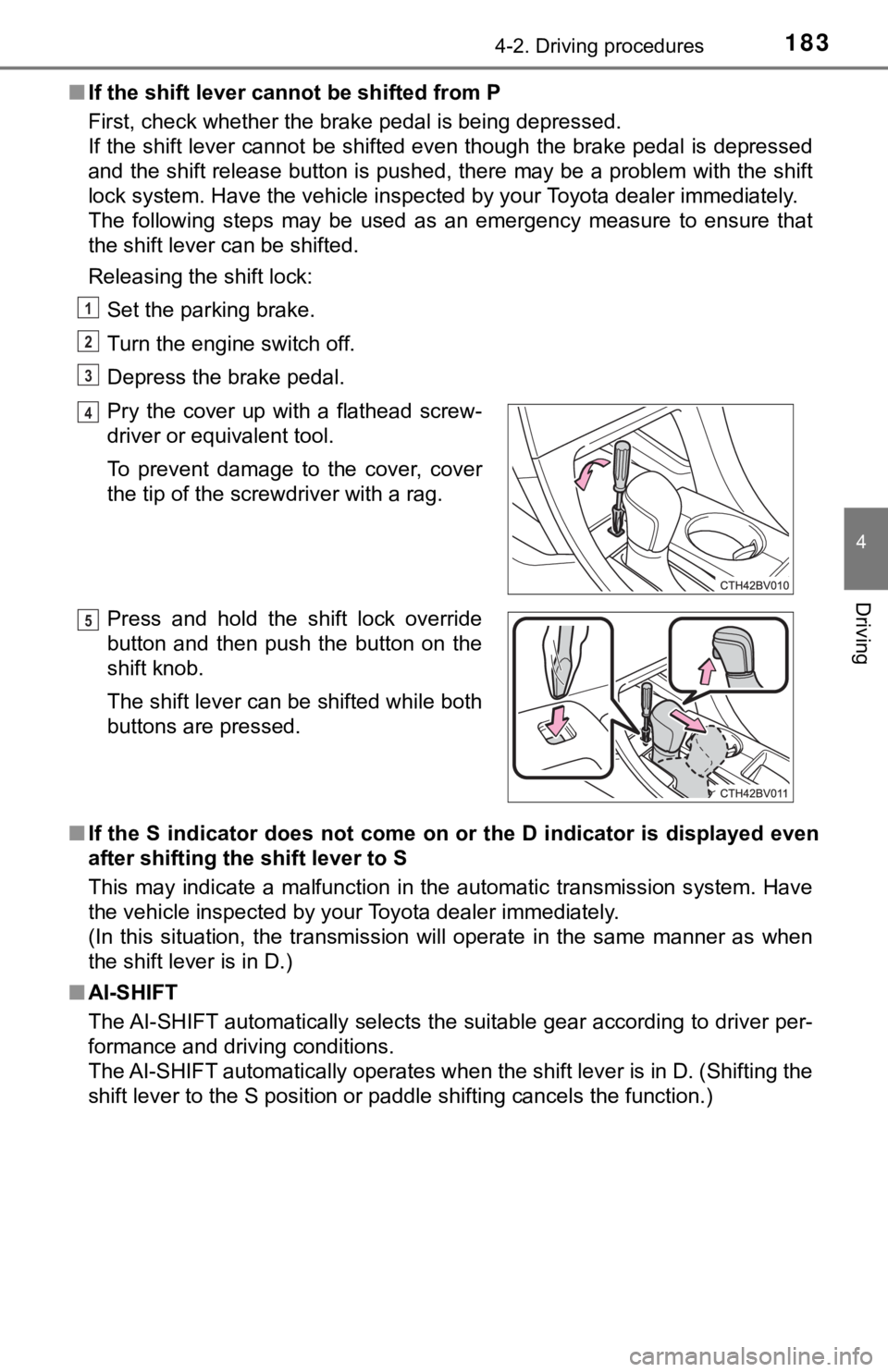
Releasing the shift lock:
Set the parking brake.
Turn the engine switch off.
Depress the brake pedal.
■ If the S indicator does not come on or the D indicator is displayed even
after shifting the shift lever to S
This may indicate a malfunction in the automatic transmission s ystem. Have
the vehicle inspected by your Toyota dealer immediately.
(In this situation, the transmission will operate in the same m anner as when
the shift lever is in D.)
■ AI-SHIFT
The AI-SHIFT automatically selects the suitable gear according to driver per-
formance and driving conditions.
The AI-SHIFT automatically operates when the shift lever is in D. (Shifting the
shift lever to the S position or paddle shifting cancels the fu nction.)
Pry the cover up with a flathead screw-
driver or equivalent tool.
To prevent damage to the cover, cover
the tip of the screwdriver with a rag.
Press and hold the shift lock override
button and then push the button on the
shift knob.
The shift lever can be shifted while both
buttons are pressed.
1
2
3
4
5
Page 297 of 536
2974-5. Using the driving support systems
4
Driving
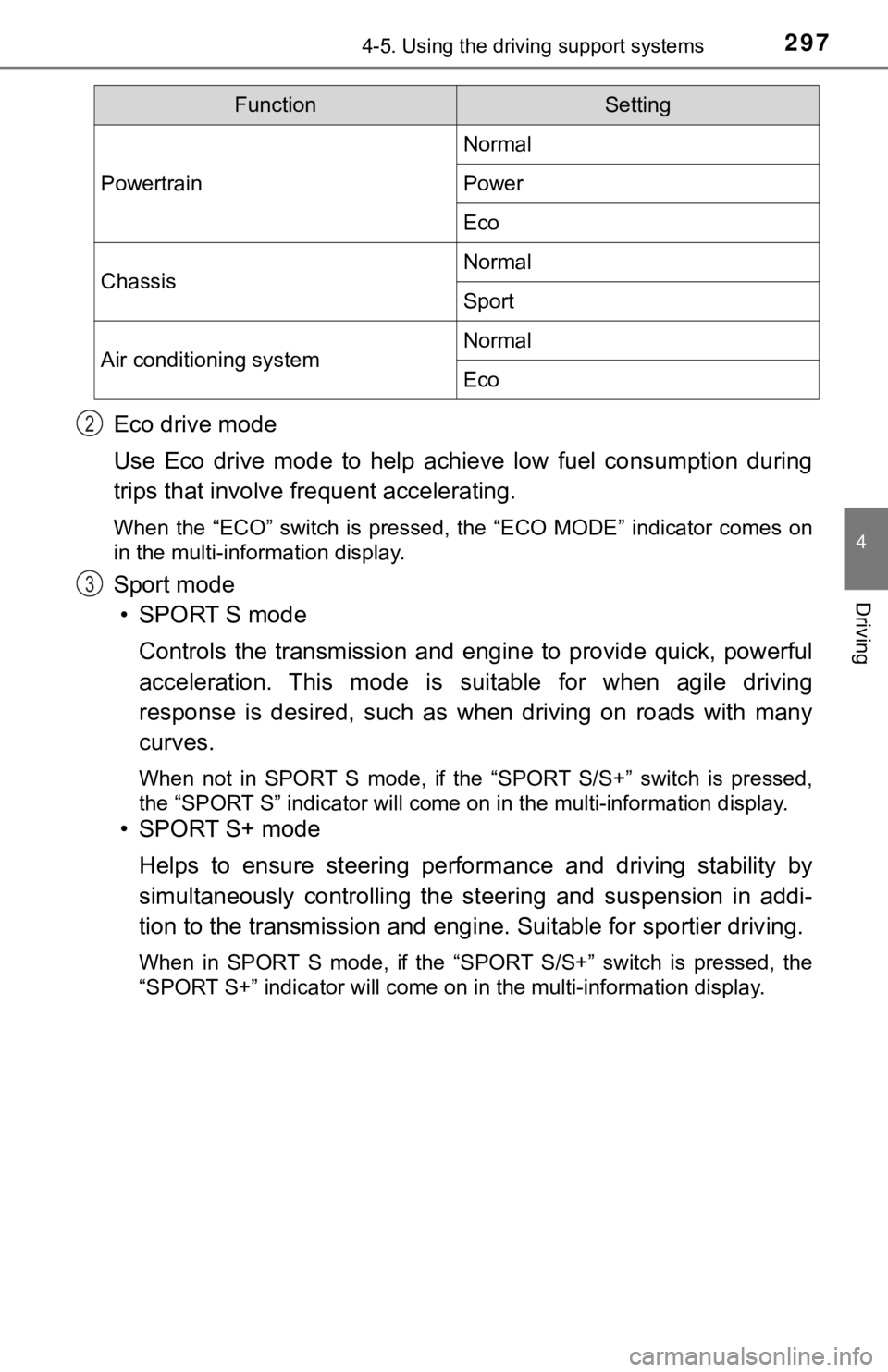
Eco drive mode
Use Eco drive mode to help achieve low fuel consumption during
trips that involve frequent accelerating.
When the “ECO” switch is pressed, the “ECO MODE” indicator comes on
in the multi-information display.
Sport mode
• SPORT S mode
Controls the transmission and eng ine to provide quick, powerful
acceleration. This mode is suitable for when agile driving
response is desired, such as when driving on roads with many
curves.
When not in SPORT S mode, if the “SPORT S/S+” switch is pressed ,
the “SPORT S” indicator will come on in the multi-information d isplay.
• SPORT S+ mode
Helps to ensure steering perfo rmance and driving stability by
simultaneously controlling the steering and suspension in addi-
tion to the transmission and engi ne. Suitable for sportier driving.
When in SPORT S mode, if the “SPORT S/S+” switch is pressed, th e
“SPORT S+” indicator will come on in the multi-information disp lay.
FunctionSetting
Powertrain
Normal
Power
Eco
ChassisNormal
Sport
Air conditioning systemNormal
Eco
2
3
Page 369 of 536
3696-2. Maintenance
6
Maintenance and care
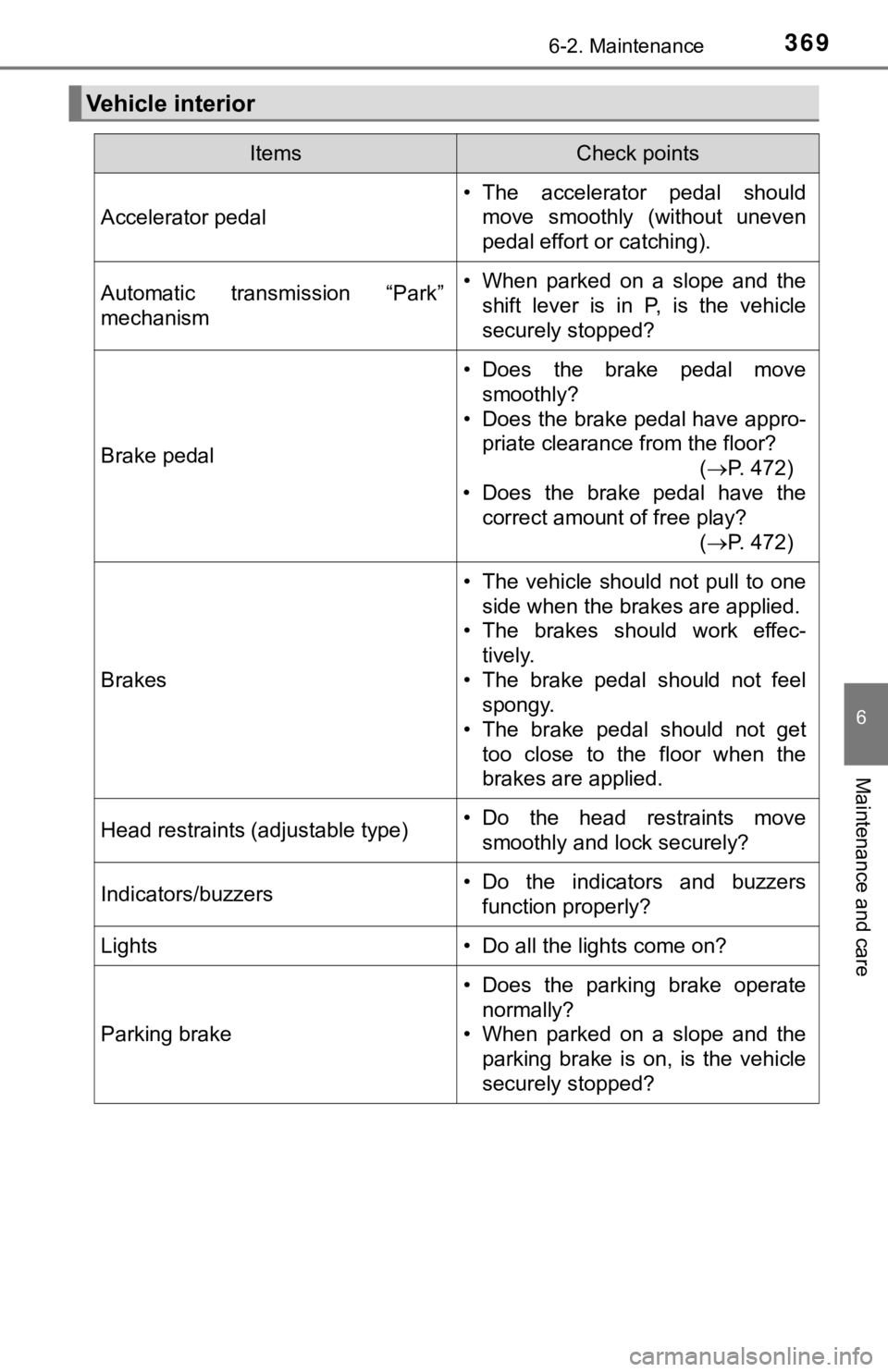
Vehicle interior
ItemsCheck points
Accelerator pedal
• The accelerator pedal shouldmove smoothly (without uneven
pedal effort or catching).
Automatic transmission “Park”
mechanism• When parked on a slope and theshift lever is in P, is the vehicle
securely stopped?
Brake pedal
• Does the brake pedal move
smoothly?
• Does the brake pedal have appro- priate clearance from the floor?
(P. 472)
• Does the brake pedal have the correct amount of free play?
(P. 472)
Brakes
• The vehicle should not pull to one
side when the brakes are applied.
• The brakes should work effec- tively.
• The brake pedal should not feel spongy.
• The brake pedal should not get
too close to the floor when the
brakes are applied.
Head restraints (adjustable type)• Do the head restraints movesmoothly and lock securely?
Indicators/buzzers• Do the indicators and buzzersfunction properly?
Lights • Do all the lights come on?
Parking brake
• Does the parking brake operate
normally?
• When parked on a slope and the parking brake is on, is the vehicle
securely stopped?
Page 418 of 536
4187-2. Steps to take in an emergency
The following may indicate a problem with your transmission. Contact
your Toyota dealer or commercial towing service before towing.
● The engine is running but t he vehicle does not move.
● The vehicle makes an abnormal sound.
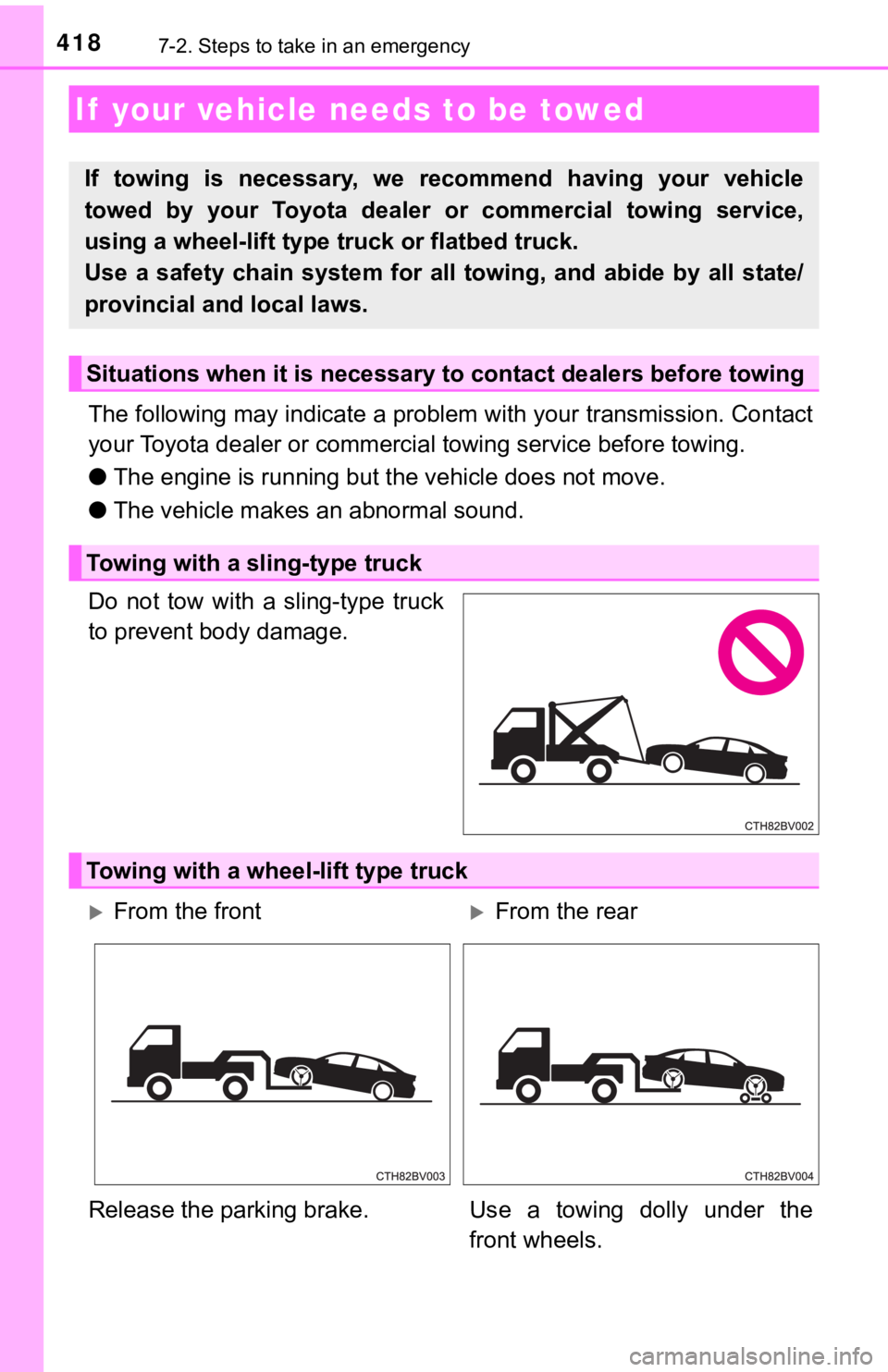
Do not tow with a sling-type truck
to prevent body damage.
If your vehicle needs to be towed
If towing is necessary, we recommend having your vehicle
towed by your Toyota dealer o r commercial towing service,
using a wheel-lift type t ruck or flatbed truck.
Use a safety chain system for all towing, and abide by all stat e/
provincial and local laws.
Situations when it is necessary to contact dealers before towing
Towing with a sling-type truck
Towing with a wheel-lift type truck
From the frontFrom the rear
Release the parking brake. Us e a towing dolly under the
front wheels.