parking brake TOYOTA AVALON 2020 (in English) Owner's Guide
[x] Cancel search | Manufacturer: TOYOTA, Model Year: 2020, Model line: AVALON, Model: TOYOTA AVALON 2020Pages: 540, PDF Size: 10.4 MB
Page 312 of 540

3124-5. Using the driving support systems
■Turning off both TRAC and VSC systems
To turn the TRAC and VSC systems off, press and hold for more than 3
seconds while the vehicle is stopped.
The VSC OFF indicator light will come on and the “Traction Cont rol Turned
Off” will be shown on the multi-information display
*.
Press again to turn the system back on.
*: Pre-collision brake assist and pre-collision braking will also be disabled. The PCS warning light will come o n and the message will be shown on the
multi-information display. ( P. 237)
■ When the message is displayed on the multi-information display show-
ing that TRAC has been disabled even if has not been pressed
TRAC is temporary deactivated. If the information continues to show, contact
your Toyota dealer.
■ Operating conditions of hill-start assist control
When the following four conditions are met, the hill-start assi st control will
operate:
● The shift lever is in a position other than P or N (when starting off forward/
backward on an upward incline)
● The vehicle is stopped
● The accelerator pedal is not depressed
● The parking brake is not engaged
■ Automatic system cancelation of hill-start assist control
The hill-start assist control will turn off in any of the follo wing situations:
● The shift lever is shifted to P or N
● The accelerator pedal is depressed
● The parking brake is engaged
● 2 seconds at maximum elapsed after the brake pedal is released
Page 315 of 540

3154-5. Using the driving support systems
4
Driving
WARNING
■Hill- start assist control does not operate effectively when
● Do not overly rely on hill-start assist control. Hill-start ass ist control may
not operate effectively on steep inclines and roads covered wit h ice.
● Unlike the parking brake, hill-st art assist control is not intended to hold the
vehicle stationary for an extended period of time. Do not attempt to use
hill-start assist control to hold the vehicle on an incline, as doing so may
lead to an accident.
■ When the TRAC/VSC is activated
The slip indicator light flashes. Always drive carefully. Reckless driving may
cause an accident. Exercise particular care when the indicator light flashes.
■ When the TRAC/VSC systems are turned off
Be especially careful and drive at a speed appropriate to the r oad condi-
tions. As these are the systems to help ensure vehicle stabilit y and driving
force, do not turn the TRAC/VSC systems off unless necessary.
■ Replacing tires
Make sure that all tires are of the specified size, brand, trea d pattern and
total load capacity. In addition, make sure that the tires are inflated to the
recommended tire inflation pressure level.
The ABS, TRAC and VSC systems will not function correctly if di fferent tires
are installed on the vehicle.
Contact your Toyota dealer for further information when replaci ng tires or
wheels.
■ Handling of tires and the suspension
Using tires with any kind of problem or modifying the suspensio n will affect
the driving assist systems, and may cause a system to malfuncti on.
■ Secondary Collision Brake
Do not rely solely upon the Secondary Collision Brake. This sys tem is
designed to help reduce the possibility of further damage due t o a second-
ary collision, however, that effect changes according to variou s conditions.
Overly relying on the system may result in death or serious inj ury.
Page 317 of 540
3174-6. Driving tips
4
Driving
Accelerate the vehicle slowly, keep a safe distance between you and
the vehicle ahead, and drive at a reduced speed suitable to roa d con-
ditions.
● Park the vehicle and move the shift lever to P without setting the
parking brake. The parking brake may freeze up, preventing it from
being released. If the vehicle is parked without setting the pa rking
brake, make sure t o block the wheels.
Failure to do so may be dangerou s because it may cause the vehi-
cle to move unexpectedly, pos sibly leading to an accident.
● If the vehicle is parked without setting the parking brake, confirm
that the shift lever c annot be moved out of P
*.
*: The shift lever will be locked if it is attempted to be shifte d from P to any
other position without depressing the brake pedal. If the shift lever can be
shifted from P, there may be a problem with the shift lock syst em. Have the
vehicle inspected by your Toyota dealer immediately.
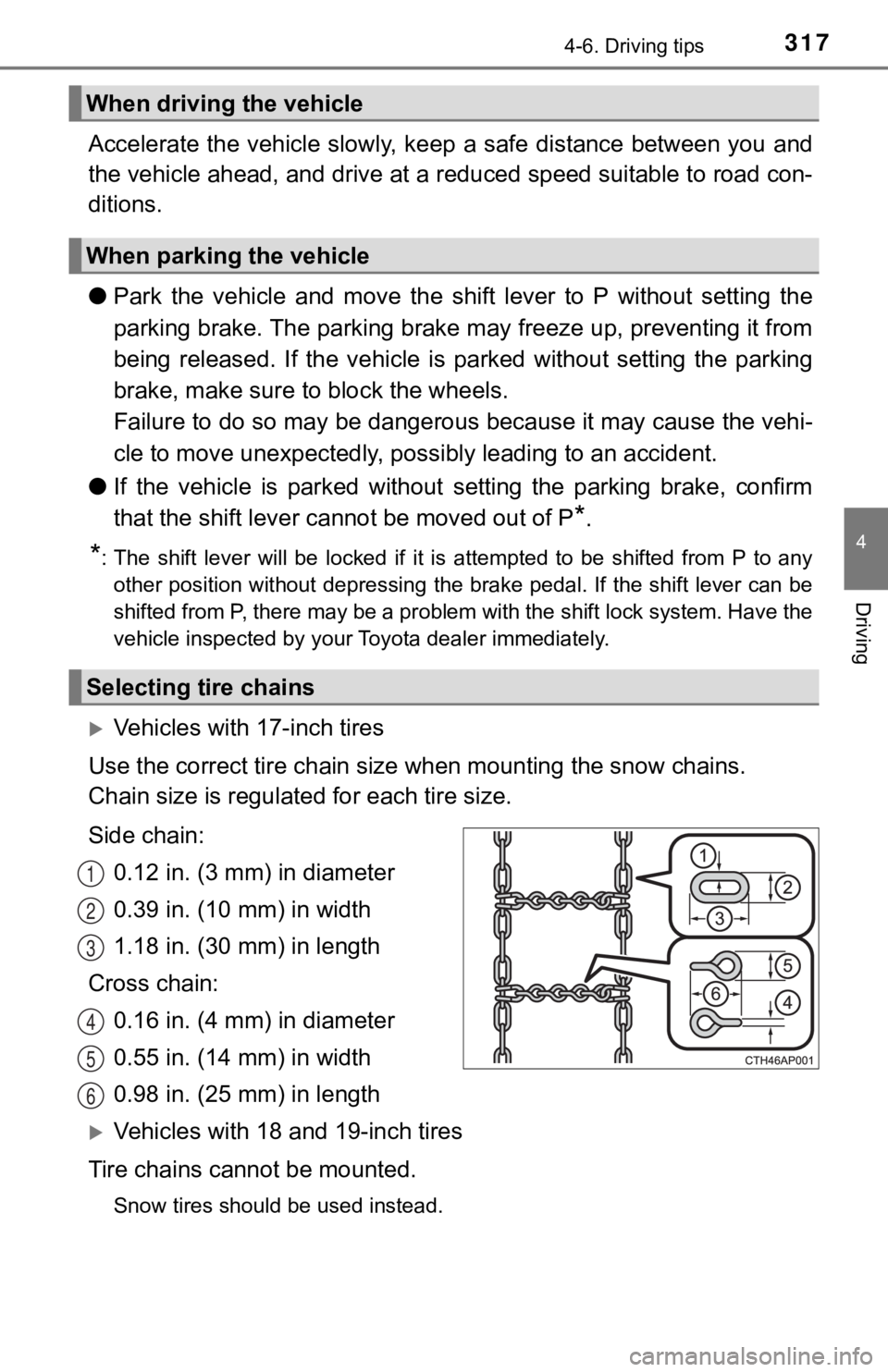
Vehicles with 17-inch tires
Use the correct tire ch ain size when mounting the snow chains.
Chain size is regulate d for each tire size.
Side chain: 0.12 in. (3 mm) in diameter
0.39 in. (10 mm) in width
1.18 in. (30 mm) in length
Cross chain: 0.16 in. (4 mm) in diameter
0.55 in. (14 mm) in width
0.98 in. (25 mm) in length
Vehicles with 18 and 19-inch tires
Tire chains cannot be mounted.
Snow tires should be used instead.
When driving the vehicle
When parking the vehicle
Selecting tire chains
1
2
3
4
5
6
Page 375 of 540
3756-2. Maintenance
6
Maintenance and care
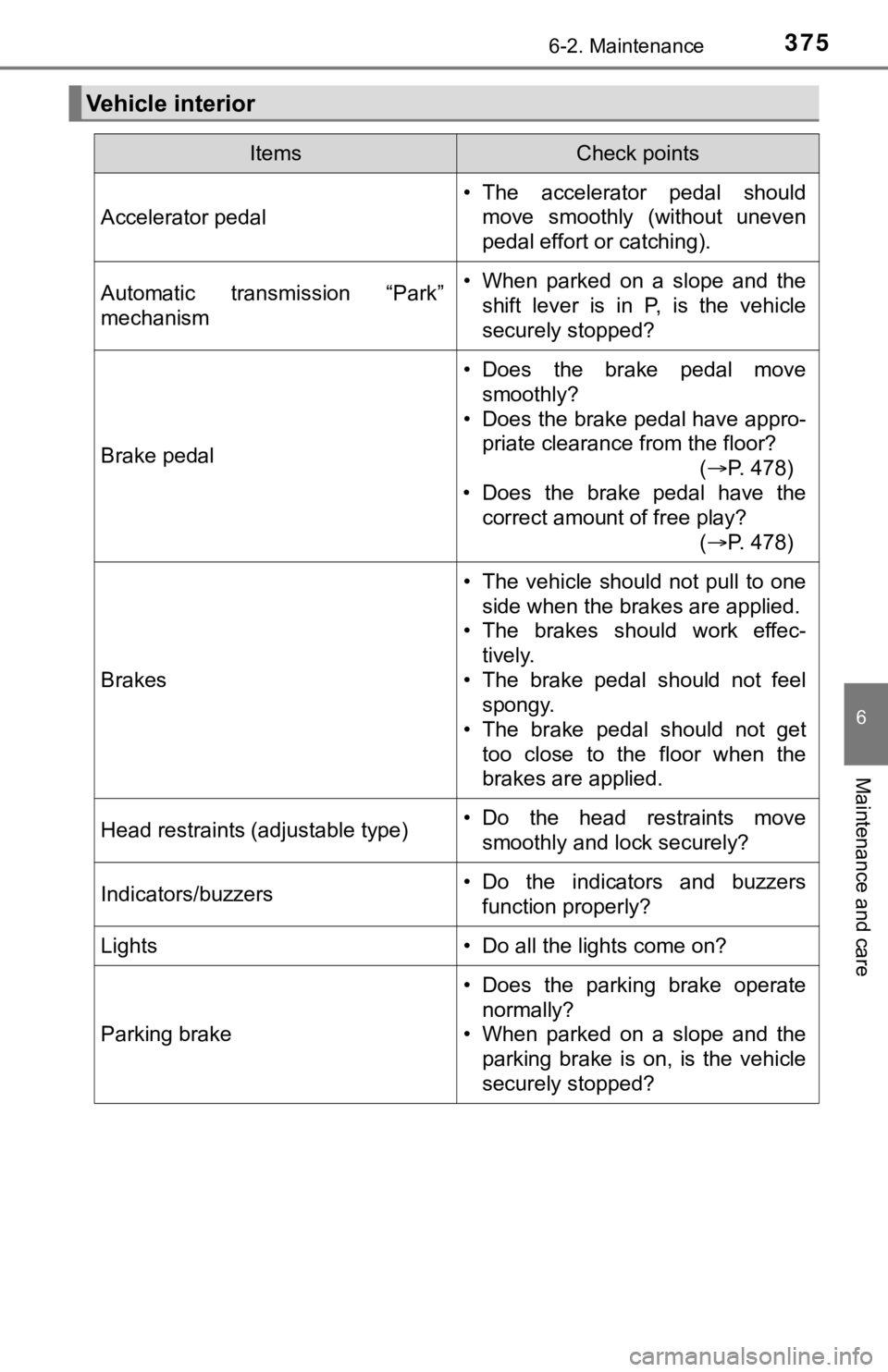
Vehicle interior
ItemsCheck points
Accelerator pedal
• The accelerator pedal shouldmove smoothly (without uneven
pedal effort or catching).
Automatic transmission “Park”
mechanism• When parked on a slope and theshift lever is in P, is the vehicle
securely stopped?
Brake pedal
• Does the brake pedal move
smoothly?
• Does the brake pedal have appro- priate clearance from the floor?
(P. 478)
• Does the brake pedal have the correct amount of free play?
(P. 478)
Brakes
• The vehicle should not pull to one
side when the brakes are applied.
• The brakes should work effec- tively.
• The brake pedal should not feel spongy.
• The brake pedal should not get
too close to the floor when the
brakes are applied.
Head restraints (adjustable type)• Do the head restraints movesmoothly and lock securely?
Indicators/buzzers• Do the indicators and buzzersfunction properly?
Lights • Do all the lights come on?
Parking brake
• Does the parking brake operate
normally?
• When parked on a slope and the parking brake is on, is the vehicle
securely stopped?
Page 425 of 540
425
7
When trouble arises
7-2. Steps to take in an emergency
The following may indicate a problem with your transmission. Contact
your Toyota dealer or commercial towing service before towing.
● The engine is running but t he vehicle does not move.
● The vehicle makes an abnormal sound.
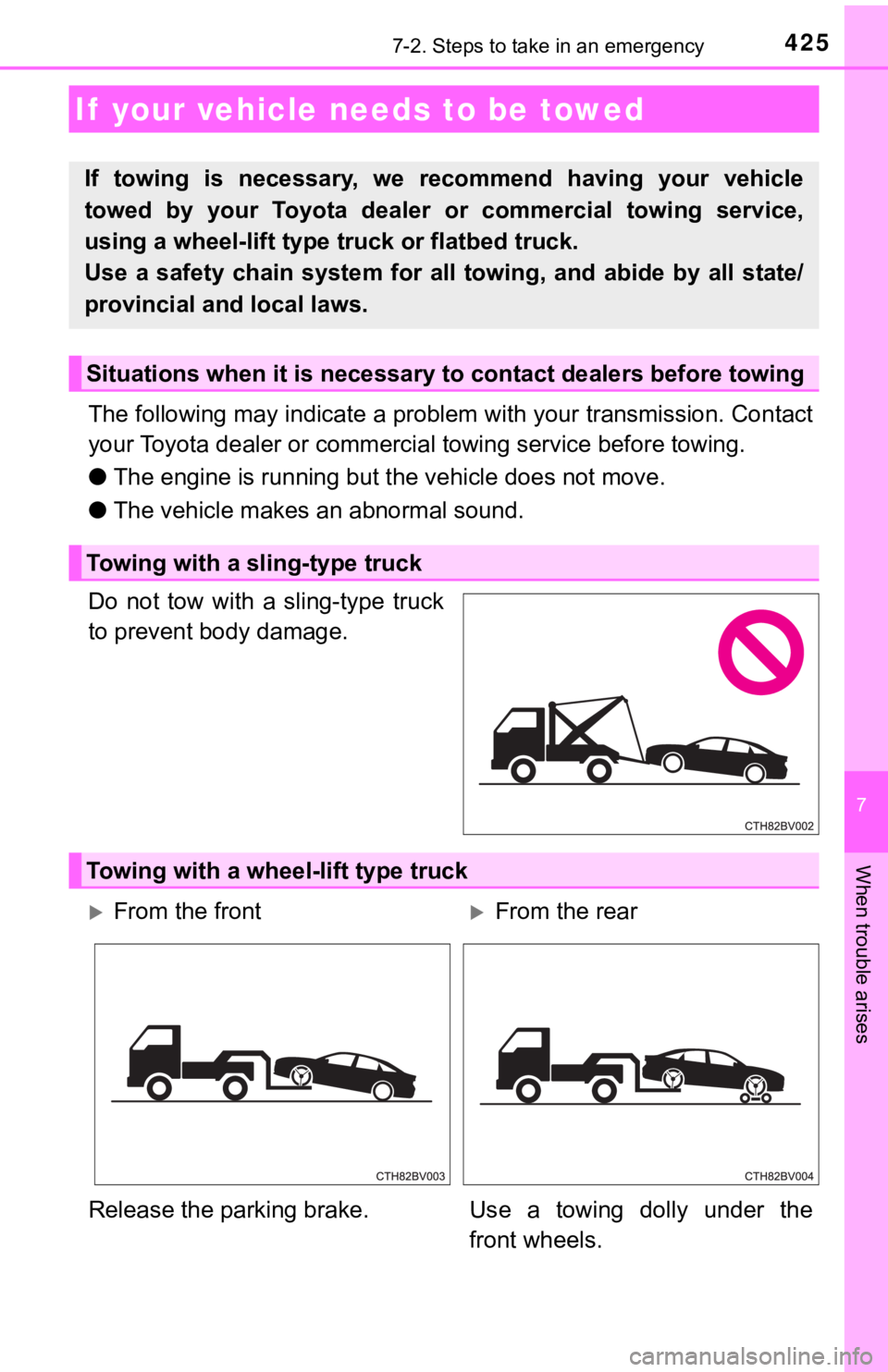
Do not tow with a sling-type truck
to prevent body damage.
If your vehicle needs to be towed
If towing is necessary, we recommend having your vehicle
towed by your Toyota dealer o r commercial towing service,
using a wheel-lift type t ruck or flatbed truck.
Use a safety chain system for all towing, and abide by all stat e/
provincial and local laws.
Situations when it is necessary to contact dealers before towing
Towing with a sling-type truck
Towing with a wheel-lift type truck
From the frontFrom the rear
Release the parking brake. Us e a towing dolly under the
front wheels.
Page 430 of 540
4307-2. Steps to take in an emergency
If a warning light turns on or a war ning
buzzer sounds
Calmly perform the following actions if any of the warning ligh ts
comes on or flashes. If a light comes on or flashes, but then
goes off, this does not necessarily indicate a malfunction in the
system. However, if this continues to occur, have the vehicle
inspected by your Toyota dealer.
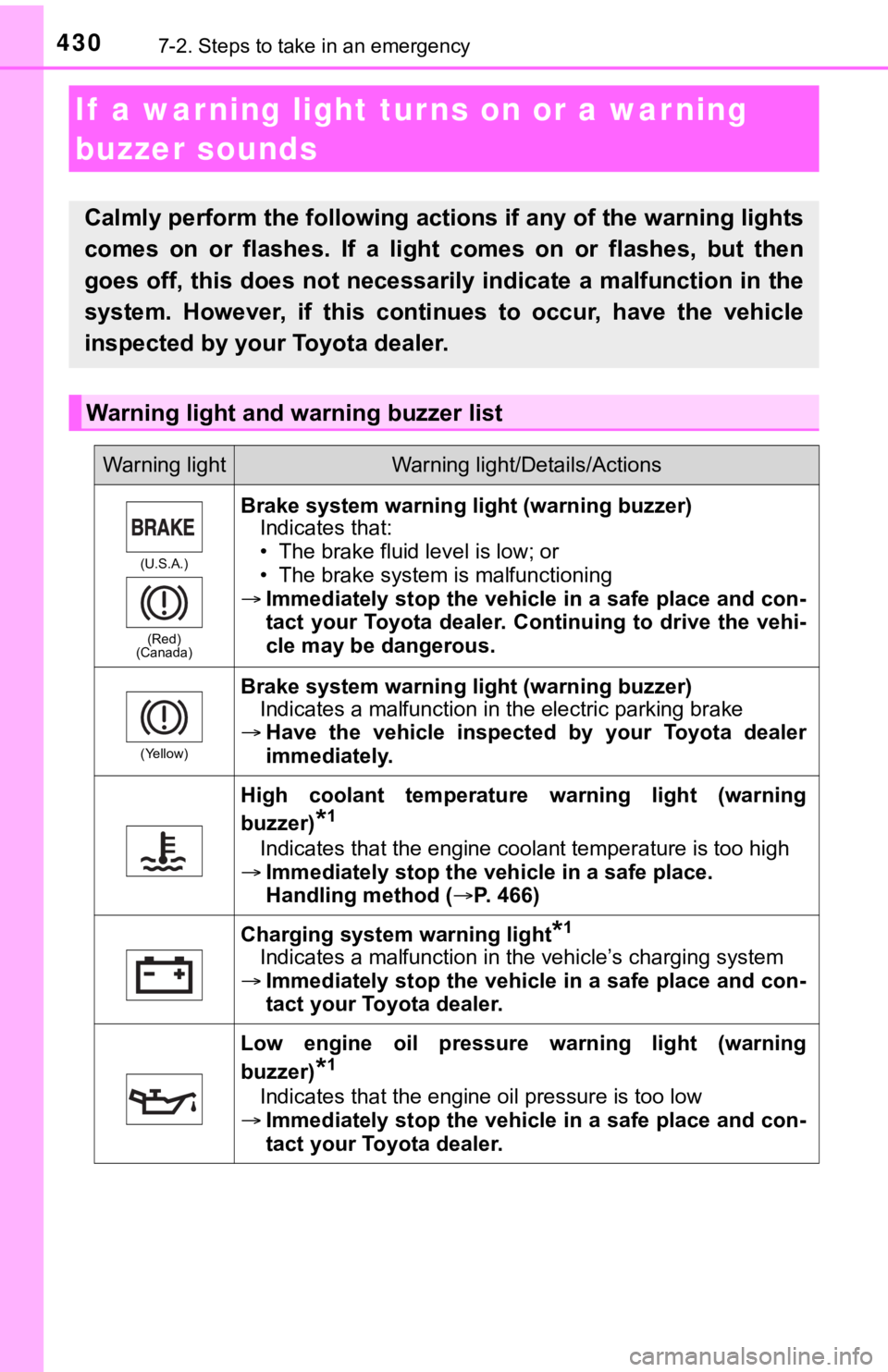
Warning light and w arning buzzer list
Warning lightWarning light/Details/Actions
(U.S.A.)
(Red)
(Canada)
Brake system warning li ght (warning buzzer)
Indicates that:
• The brake fluid level is low; or
• The brake system is malfunctioning
Immediately stop the vehicle in a safe place and con-
tact your Toyota dealer. Continuing to drive the vehi-
cle may be dangerous.
(Yellow)
Brake system warning li ght (warning buzzer)
Indicates a malfunction in the electric parking brake
Have the vehicle inspected by your Toyota dealer
immediately.
High coolant temperature warning light (warning
buzzer)
*1
Indicates that the engine coolant temperature is too high
Immediately stop the vehicle in a safe place.
Handling method ( P. 466)
Charging system warning light*1
Indicates a malfunction in the vehicle’s charging system
Immediately stop the vehicle in a safe place and con-
tact your Toyota dealer.
Low engine oil pressure warning light (warning
buzzer)
*1
Indicates that the engine oil pressure is too low
Immediately stop the vehicle in a safe place and con-
tact your Toyota dealer.
Page 432 of 540
4327-2. Steps to take in an emergency
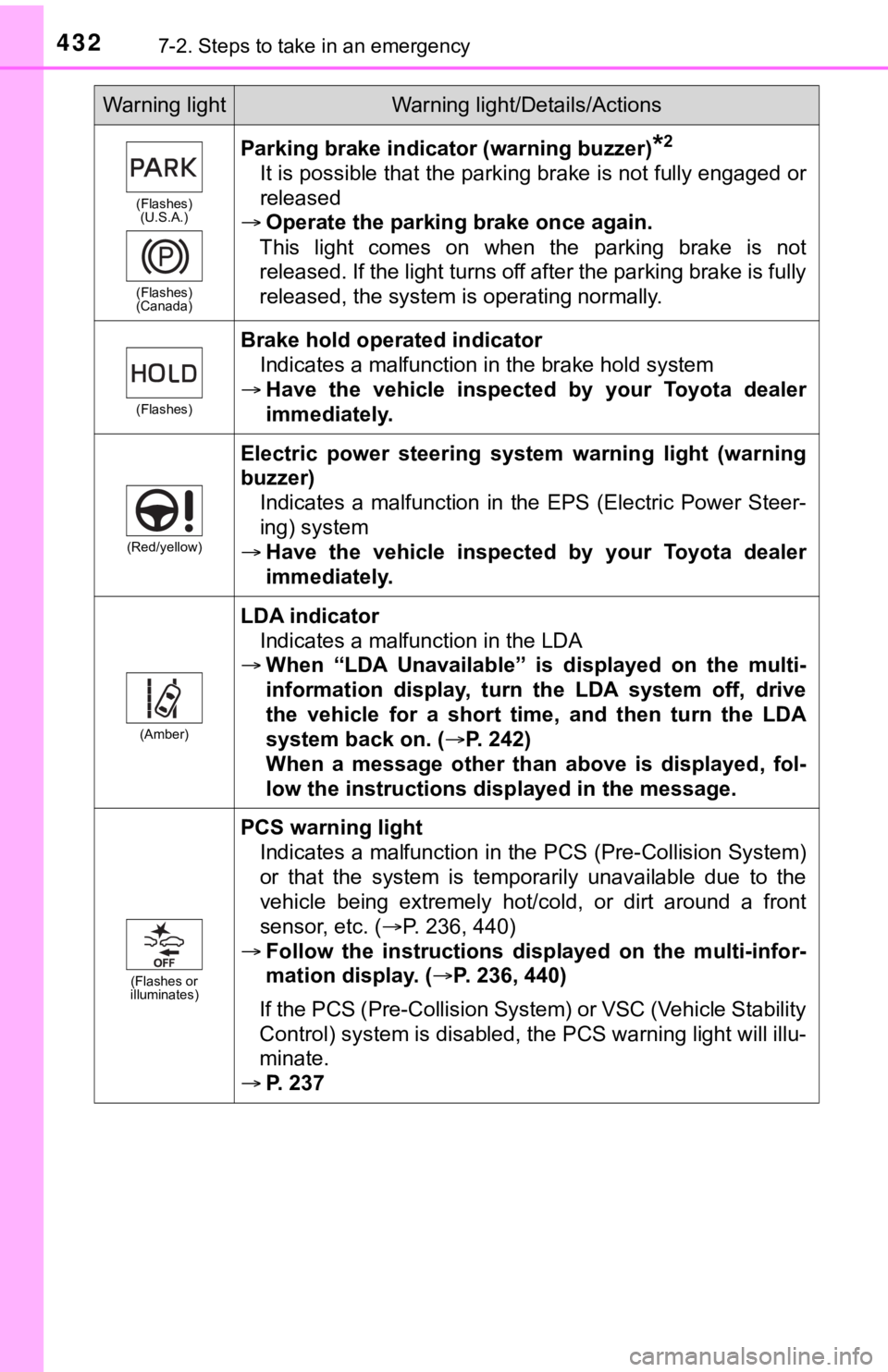
(Flashes)(U.S.A.)
(Flashes)
(Canada)
Parking brake indicator (warning buzzer)*2
It is possible that the parking brake is not fully engaged or
released
Operate the parking brake once again.
This light comes on when the parking brake is not
released. If the light turns off after the parking brake is ful ly
released, the system is operating normally.
(Flashes)
Brake hold operated indicator Indicates a malfunction in the brake hold system
Have the vehicle inspected by your Toyota dealer
immediately.
(Red/yellow)
Electric power steering system warning light (warning
buzzer)
Indicates a malfunction in the EPS (Electric Power Steer-
ing) system
Have the vehicle inspected by your Toyota dealer
immediately.
(Amber)
LDA indicator
Indicates a malfunction in the LDA
When “LDA Unavailable” is displayed on the multi-
information display, turn the LDA system off, drive
the vehicle for a short time, and then turn the LDA
system back on. ( P. 242)
When a message other than above is displayed, fol-
low the instructions displayed in the message.
(Flashes or
illuminates)
PCS warning light
Indicates a malfunction in the PCS (Pre-Collision System)
or that the system is temporarily unavailable due to the
vehicle being extremely hot/cold, or dirt around a front
sensor, etc. ( P. 236, 440)
Follow the instructions displayed on the multi-infor-
mation display. (P. 236, 440)
If the PCS (Pre-Collision System) or VSC (Vehicle Stability
Control) system is disabled, the PCS warning light will illu-
minate.
P. 237
Warning lightWarning light/Details/Actions
Page 434 of 540
4347-2. Steps to take in an emergency
*1: This light illuminates on the multi-information display.
*2: Parking brake engaged warning buzzer:A buzzer will sound if the vehicle is driven at a speed of appr oximately 3
mph (5 km/h) or more.
*3: Vehicles with 215/55R17 tires
*4: Driver’s seat belt buzzer:
The driver’s seat belt buzzer sounds to alert the driver that h is or her seat
belt is not fastened. Once the engine switch is turned to IGNIT ION ON
mode, the buzzer sounds for 6 seconds. If the vehicle reaches a speed of
12 mph (20 km/h), the buzzer sounds once. If the seat belt is s till unfas-
tened after 24 seconds, the buzzer will sound intermittently fo r 6 seconds.
Then, if the seat belt is still unfastened, the buzzer will sou nd in a different
tone for 90 more seconds.
Front passenger’s seat belt buzzer:
The front passenger’s seat belt buzzer sounds to alert the fron t passenger
that his or her seat belt is not fastened. The buzzer sounds on ce if the
vehicle reaches a speed of 12 mph (20 km/h). If the seat belt i s still unfas-
tened after 24 seconds, the buzzer will sound intermittently fo r 6 seconds.
Then, if the seat belt is still unfastened, the buzzer will sou nd in a different
tone for 90 more seconds.
*5: Rear passenger’s seat belt buzzer:
The rear passenger’s seat belt buzzer sounds to alert the rear passenger
that his or her seat belt is not fastened. The buzzer sounds on ce if the
vehicle reaches a speed of 12 mph (20 km/h). If the seat belt i s still unfas-
tened after 24 seconds, the buzzer will sound intermittently fo r 6 seconds.
Then, if the seat belt is still unfastened, the buzzer will sou nd in a different
tone for 30 more seconds.
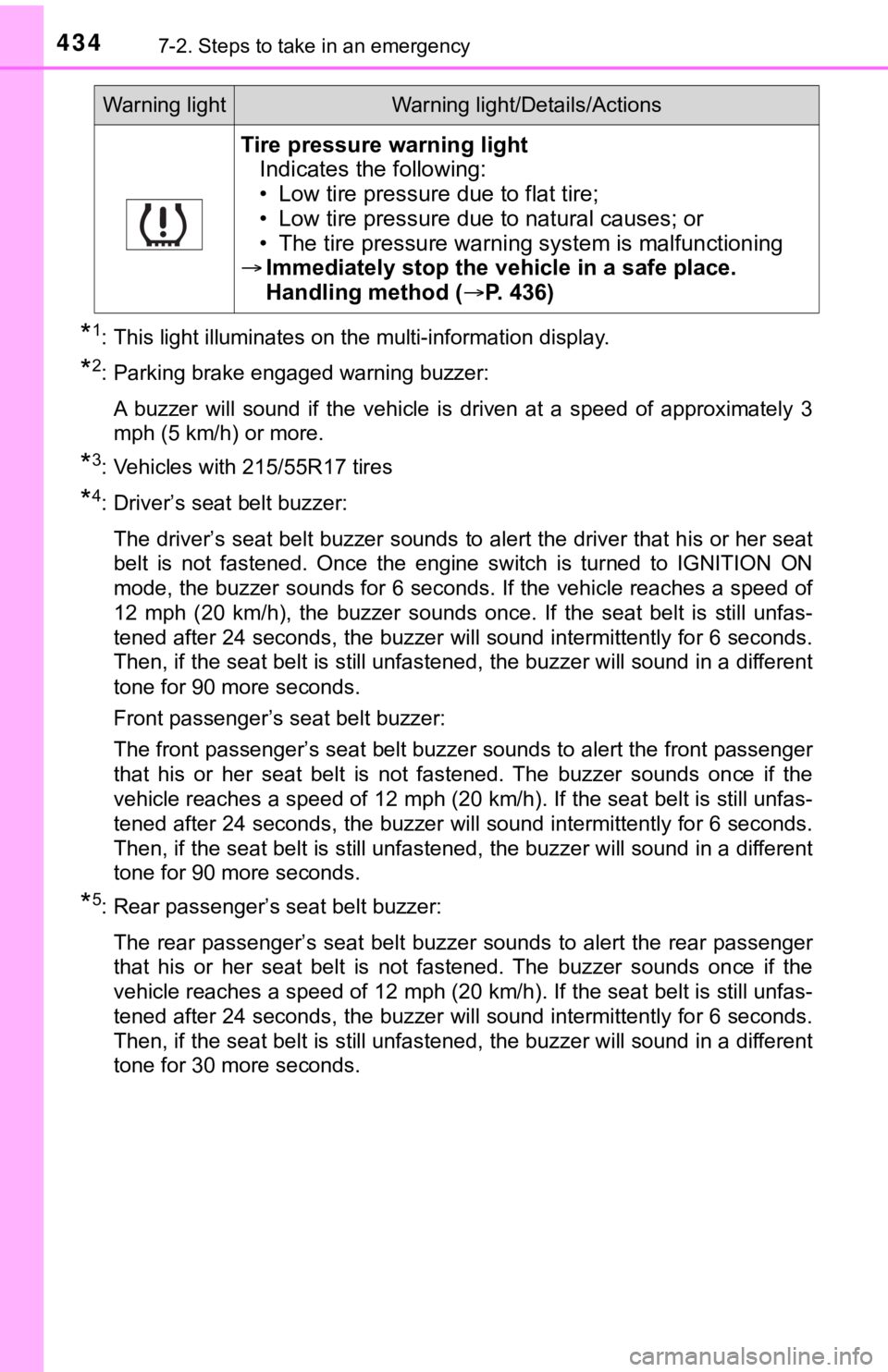
Tire pressure warning light Indicates the following:
• Low tire pressure due to flat tire;
• Low tire pressure due to natural causes; or
• The tire pressure warning system is malfunctioning
Immediately stop the veh icle in a safe place.
Handling method ( P. 4 3 6 )
Warning lightWarning light/Details/Actions
Page 445 of 540
4457-2. Steps to take in an emergency
7
When trouble arises
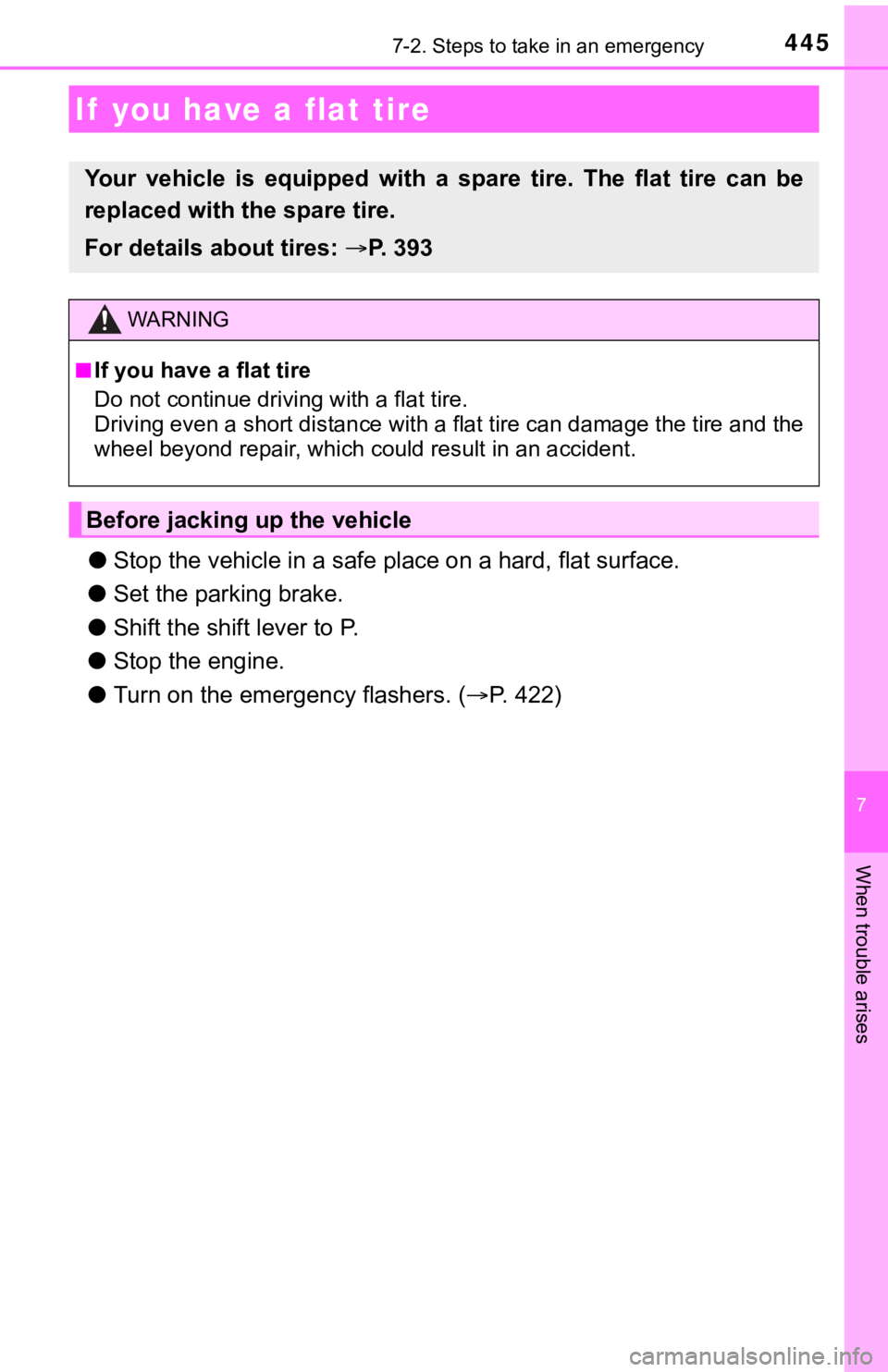
●Stop the vehicle in a safe place on a hard, flat surface.
● Set the parking brake.
● Shift the shift lever to P.
● Stop the engine.
● Turn on the emergency flashers. ( P. 422)
If you have a flat tire
Your vehicle is equipped with a spare tire. The flat tire can b e
replaced with the spare tire.
For details about tires: P. 393
WARNING
■If you have a flat tire
Do not continue driving with a flat tire.
Driving even a short distance wit h a flat tire can damage the tire and the
wheel beyond repair, which cou ld result in an accident.
Before jacking up the vehicle
Page 455 of 540

4557-2. Steps to take in an emergency
7
When trouble arises
WARNING
■When using the compact spare tire
●Remember that the compact spare tire provided is specifically
designed for use with your vehicle. Do not use your compact spare tire
on another vehicle.
●Do not use more than one compact spare tires simultaneously.
●Replace the compact spare tire with a standard tire as soon as possi-
ble.
●Avoid sudden acceleration, abrupt steering, sudden braking and shift-
ing operations that cause sudden engine braking.
■When the compact spa re tire is attached
The vehicle speed may not be co rrectly detected, and the following sys-
tems may not operate correctly:
*:If equipped
■Speed limit when using the compact spare tire
Do not drive at speeds in excess of 50 mph (80 km/h) when a com pact
spare tire is installed on the vehicle.
The compact spare tire is not designed for driving at high spee ds. Fail-
ure to observe this precaution ma y lead to an accident causing death or
serious injury.
■After using the tools and jack
Before driving, make sure all t he tools and jack are securely i n place in
their storage locatio n to reduce the possibility of personal in jury during a
collision or su dden braking.
• ABS & Brake assist
• VSC
•TRAC
• EPS
• Automatic High Beam
• Dynamic radar cruise control
with full-speed range
• LDA (Lane Departure Alert with
steering control)
• PCS (Pre-Collision System) • Tire pressure warning system
• BSM (Blind Spot Monitor)
•Intuitive parking assist*
•Intelligent Clearance Sonar
(ICS)
*
•Rear view monitor system*
• Toyota parking assist monitor
•Panoramic view monitor*
•Navigation system*