ECO mode TOYOTA AVALON 2020 (in English) Service Manual
[x] Cancel search | Manufacturer: TOYOTA, Model Year: 2020, Model line: AVALON, Model: TOYOTA AVALON 2020Pages: 540, PDF Size: 10.4 MB
Page 380 of 540
3806-3. Do-it-yourself maintenance
WARNING
The engine compartment contains many mechanisms and fluids that may
move suddenly, become hot, or become electrically energized. To avoid death
or serious injury, observe the following precautions.
■When working on the engine compartment
● Keep hands, clothing and tools away from the moving fan and eng ine
drive belt.
● Be careful not to touch the engine, radiator, exhaust manifold, etc. right
after driving as they may be hot. Oil and other fluids may also be hot.
● Do not leave anything that may burn easily, such as paper and r ags, in the
engine compartment.
● Do not smoke, cause sparks or expose an open flame to fuel or t he bat-
tery. Fuel and battery fumes are flammable.
● Be extremely cautious when working on the battery. It contains poisonous
and corrosive sulfuric acid.
■ When working near the electric cooling fan or radiator grille
Be sure the engine switch is off. With the engine switch in IGN ITION ON
mode, the electric cooling fan may automatically start to run if the air condi-
tioning is on and/or the coolant temperature is high. ( P. 388)
■ Safety glasses
Wear safety glasses to prevent flying or falling material, fluid spray, etc.
from getting in your eyes.
NOTICE
■If you remove the air cleaner filter
Driving with the air cleaner filter removed may cause excessive engine wear
due to dirt in the air.
Page 390 of 540
3906-3. Do-it-yourself maintenance
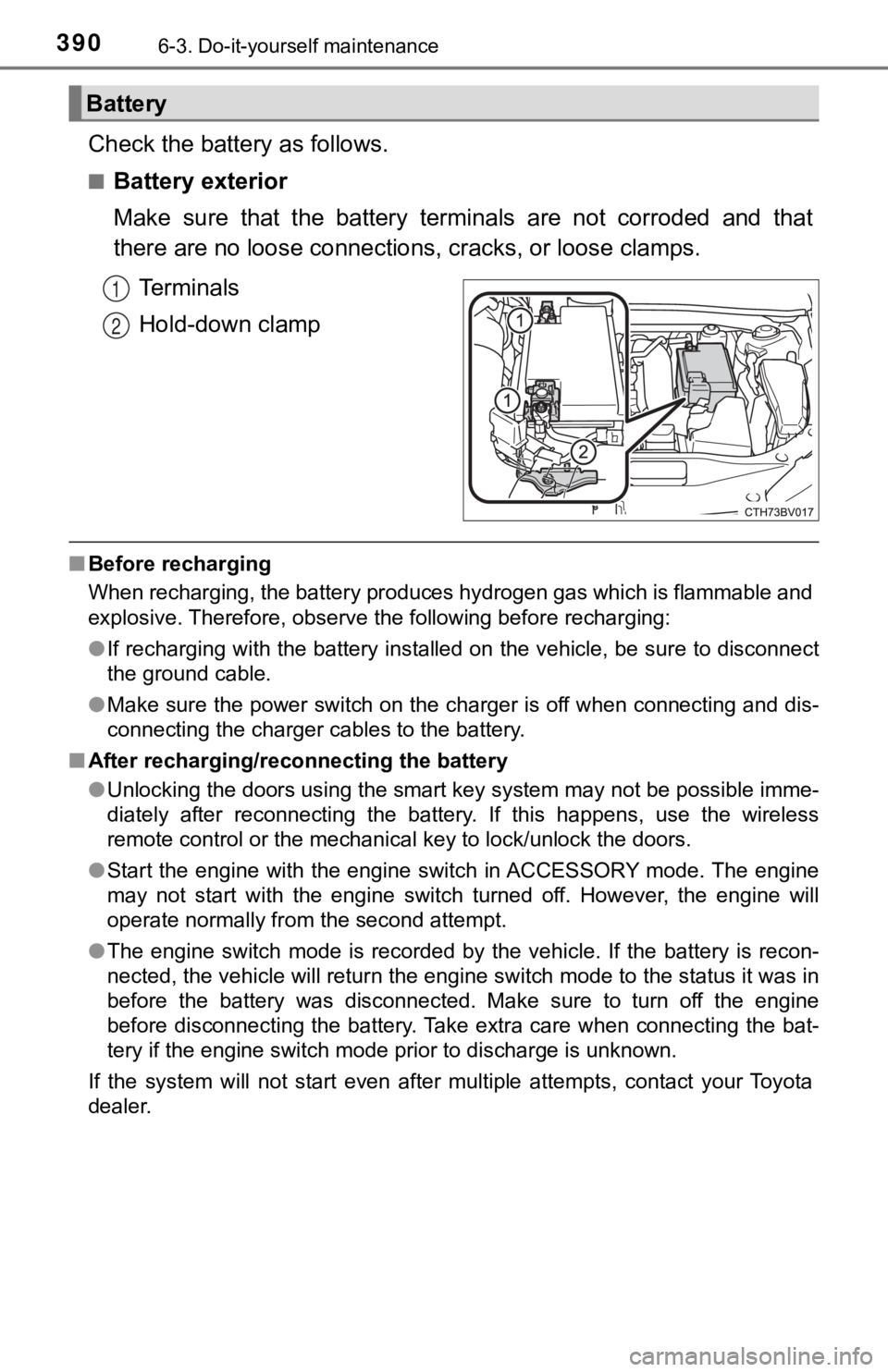
Check the battery as follows.
■Battery exterior
Make sure that the battery terminals are not corroded and that
there are no loose connections, cracks, or loose clamps.
Terminals
Hold-down clamp
■ Before recharging
When recharging, the battery produces hydrogen gas which is flammable and
explosive. Therefore, observe the following before recharging:
●If recharging with the battery installed on the vehicle, be sur e to disconnect
the ground cable.
● Make sure the power switch on the charger is off when connectin g and dis-
connecting the charger cables to the battery.
■ After recharging/reconnecting the battery
●Unlocking the doors using the smart key system may not be possi ble imme-
diately after reconnecting the battery. If this happens, use the wireless
remote control or the mechanical key to lock/unlock the doors.
● Start the engine with the engine switch in ACCESSORY mode. The engine
may not start with the engine switch turned off. However, the e ngine will
operate normally from the second attempt.
● The engine switch mode is recorded by the vehicle. If the batte ry is recon-
nected, the vehicle will return the engine switch mode to the s tatus it was in
before the battery was disconnected. Make sure to turn off the engine
before disconnecting the battery. Take extra care when connecti ng the bat-
tery if the engine switch mode prior to discharge is unknown.
If the system will not start even after multiple attempts, contact your Toyota
dealer.
Battery
1
2
Page 405 of 540
4056-3. Do-it-yourself maintenance
6
Maintenance and care
WARNING
■When inspecting or replacing tires
Observe the following precautions to prevent accidents.
Failure to do so may cause damage to parts of the drive train as well as
dangerous handling characteristics, which may lead to an accide nt
resulting in death o r serious injury.
●Do not mix tires of different ma kes, models or tread patterns.
Also, do not mix tires of re markably different treadwear.
●Do not use tire sizes other th an those recommended by Toyota.
●Do not mix differently constructed tires (radial, bias-belted o r bias-ply
tires).
●Do not mix summer, all season and snow tires.
●Do not use tires that have b een used on another vehicle.
Do not use tires if you do not kn ow how they were used previous ly.
■When initializing the tire pressure warning system
Do not initialize the tire press ure warning system without firs t adjusting
the tire inflation pressure to t he specified level. Otherwise, the tire pres-
sure warning light may not come on even if the tire inflation p ressure is
low, or it may come on when the tire inflation pressure is actu ally nor-
mal.
Page 434 of 540
4347-2. Steps to take in an emergency
*1: This light illuminates on the multi-information display.
*2: Parking brake engaged warning buzzer:A buzzer will sound if the vehicle is driven at a speed of appr oximately 3
mph (5 km/h) or more.
*3: Vehicles with 215/55R17 tires
*4: Driver’s seat belt buzzer:
The driver’s seat belt buzzer sounds to alert the driver that h is or her seat
belt is not fastened. Once the engine switch is turned to IGNIT ION ON
mode, the buzzer sounds for 6 seconds. If the vehicle reaches a speed of
12 mph (20 km/h), the buzzer sounds once. If the seat belt is s till unfas-
tened after 24 seconds, the buzzer will sound intermittently fo r 6 seconds.
Then, if the seat belt is still unfastened, the buzzer will sou nd in a different
tone for 90 more seconds.
Front passenger’s seat belt buzzer:
The front passenger’s seat belt buzzer sounds to alert the fron t passenger
that his or her seat belt is not fastened. The buzzer sounds on ce if the
vehicle reaches a speed of 12 mph (20 km/h). If the seat belt i s still unfas-
tened after 24 seconds, the buzzer will sound intermittently fo r 6 seconds.
Then, if the seat belt is still unfastened, the buzzer will sou nd in a different
tone for 90 more seconds.
*5: Rear passenger’s seat belt buzzer:
The rear passenger’s seat belt buzzer sounds to alert the rear passenger
that his or her seat belt is not fastened. The buzzer sounds on ce if the
vehicle reaches a speed of 12 mph (20 km/h). If the seat belt i s still unfas-
tened after 24 seconds, the buzzer will sound intermittently fo r 6 seconds.
Then, if the seat belt is still unfastened, the buzzer will sou nd in a different
tone for 30 more seconds.
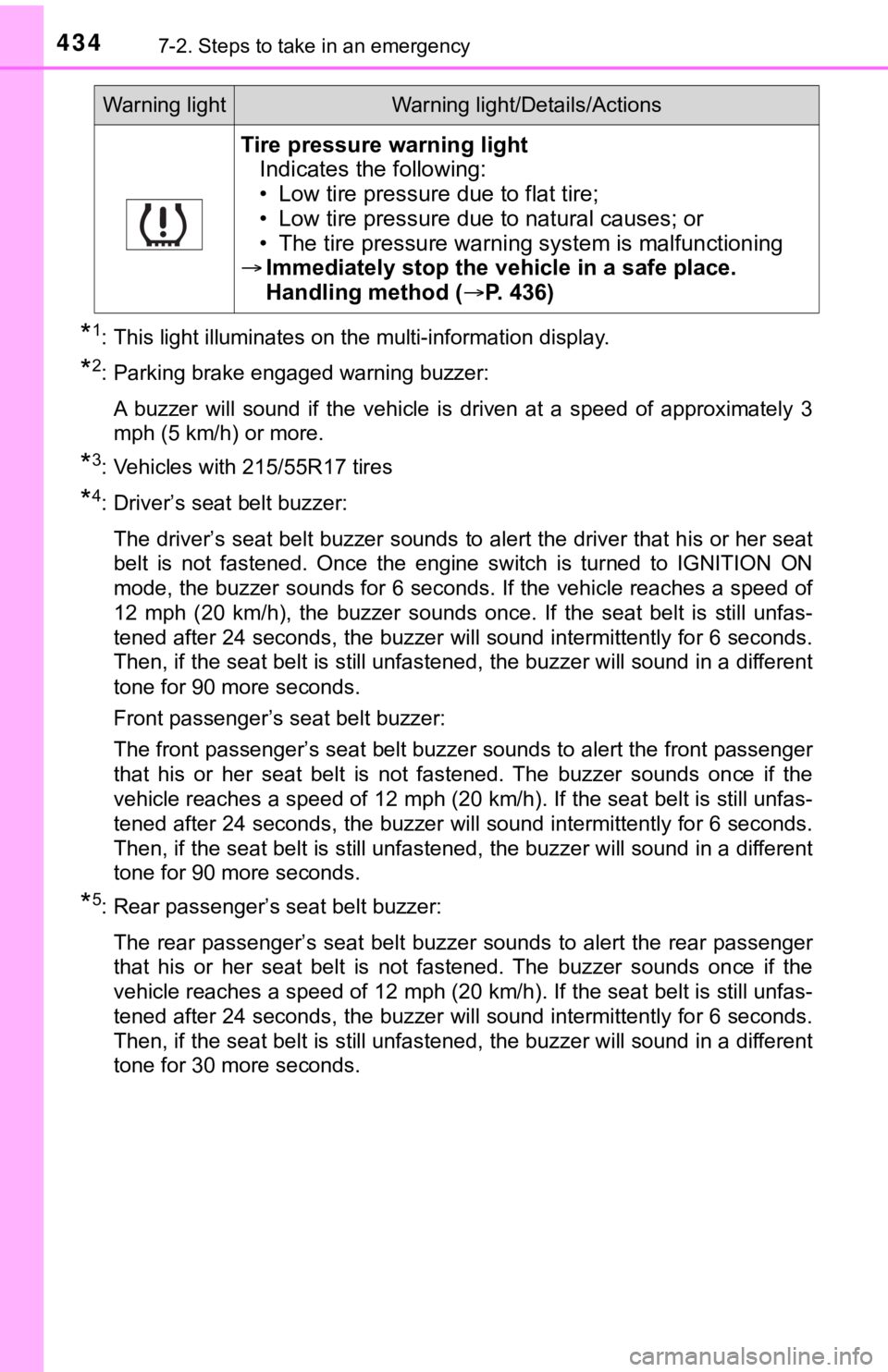
Tire pressure warning light Indicates the following:
• Low tire pressure due to flat tire;
• Low tire pressure due to natural causes; or
• The tire pressure warning system is malfunctioning
Immediately stop the veh icle in a safe place.
Handling method ( P. 4 3 6 )
Warning lightWarning light/Details/Actions
Page 458 of 540
4587-2. Steps to take in an emergency
One of the following may be the cause of the problem:
● One or both of the battery t erminals may be disconnected.
● The battery may be discharged. ( P. 462)
● There may be a malfunction i n the steering lock system.
Contact your Toyota dealer if the problem cannot be repaired, o r if repair
procedures are unknown.
When the engine does not start, the following steps can be used as an
interim measure to start the engine if the engine switch is fun ctioning
normally:
Set the parking brake.
Shift the shift lever to P.
Turn the engine switch to ACCESSORY mode.
Press and hold the engine switch for about 15 seconds while
depressing the brake pedal firmly.
Even if the engine can be start ed using the above steps, the sy stem
may be malfunctioning. Have the vehicle inspected by your Toyot a
dealer.
The starter motor does not turn over, the interior lights and h ead-
lights do not turn on, o r the horn does not sound.
Emergency start function
1
2
3
4
Page 461 of 540
4617-2. Steps to take in an emergency
7
When trouble arises
■Stopping the engine
Shift the shift lever to P and press the engine switch as you normally do when
stopping the engine.
■ Replacing the key battery
As the above procedure is a temporary measure, it is recommende d that the
electronic key battery be replaced immediately when the battery is depleted.
( P. 414)
■ Changing engine switch modes
Release the brake pedal and press the engine switch in step above.
The engine does not start and modes will be changed each time t he switch is
pressed. ( P. 185)
■ When the electronic key does not work properly
●Make sure that the smart key system has not been deactivated in the cus-
tomization setting. If it is off, turn the function on.
(Customizable features: P. 497)
● Check if battery-saving mode is set. If it is set, cancel the f unction.
( P. 136)
WARNING
■ When using the mechanical key and operating the power windows o r
moon roof
Operate the power window or moon roof after checking to make su re that
there is no possibility of any passenger having any of their body parts
caught in the window or moon roof. Also, do not allow children to operate
the mechanical key. It is possible for children and other passe ngers to get
caught in the power window or moon roof.
3
Page 463 of 540
4637-2. Steps to take in an emergency
7
When trouble arises
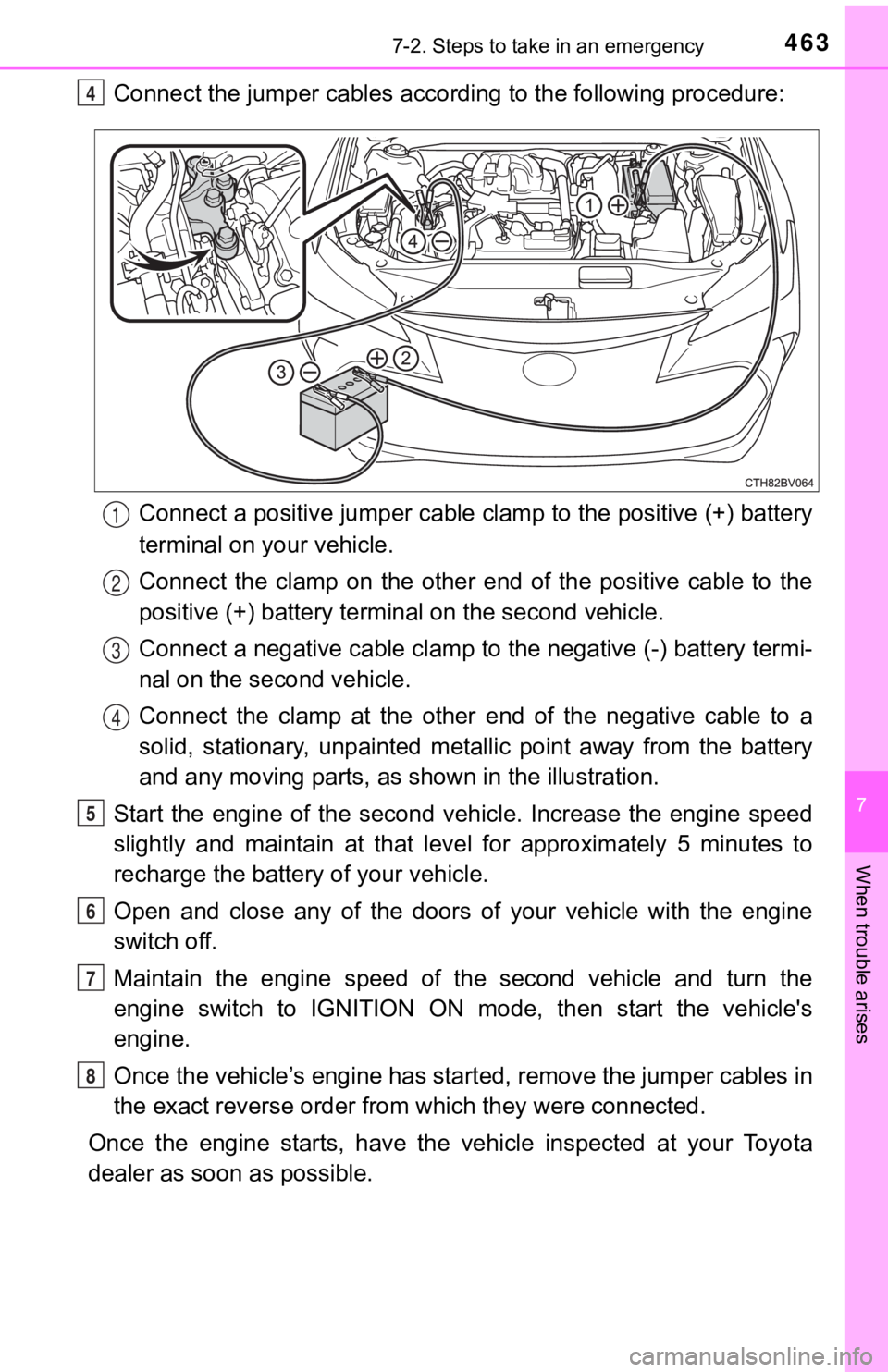
Connect the jumper cables according to the following procedure:Connect a positive jumper cable clamp to the positive (+) batte ry
terminal on your vehicle.
Connect the clamp on the other end of the positive cable to the
positive (+) battery termi nal on the second vehicle.
Connect a negative cable clamp to the negative (-) battery term i-
nal on the s econd vehicle.
Connect the clamp at the other e nd of the negative cable to a
solid, stationary, unpainted meta llic point away from the battery
and any moving parts, as shown in the illustration.
Start the engine of the second v ehicle. Increase the engine speed
slightly and maintain at that lev el for approximately 5 minutes to
recharge the batter y of your vehicle.
Open and close any of the doors of your vehicle with the engine
switch off.
Maintain the engine speed of the second vehicle and turn the
engine switch to IGNITION ON mode, then start the vehicle's
engine.
Once the vehicle’s engine has st arted, remove the jumper cables in
the exact reverse order from which they were connected.
Once the engine starts, have the vehicle inspected at your Toyota
dealer as soon as possible.4
1
2
3
4
5
6
7
8
Page 464 of 540
4647-2. Steps to take in an emergency
■Starting the engine when t he battery is discharged
The engine cannot be started by push-starting.
■ To prevent battery discharge
●Turn off the headlights and the audio system while the engine is off.
● Turn off any unnecessary electrical components when the vehicle is running
at a low speed for an extended period, such as in heavy traffic .
■ When the battery is r emoved or discharged
● Information stored in the ECU is cleared. When the battery is d epleted, have
the vehicle inspected at your Toyota dealer.
● Some systems may require initialization. ( P. 505)
■ When removing the battery terminals
When the battery terminals are removed, the information stored in the ECU is
cleared. Before removing the battery terminals, contact your Toyota dealer.
■ Charging the battery
The electricity stored in the battery will discharge gradually even when the
vehicle is not in use, due to natural discharge and the draining effects of cer-
tain electrical appliances. If the vehicle is left for a long t ime, the battery may
discharge, and the engine may be unable to start. (The battery recharges
automatically during driving.)
■ When recharging or replacing the battery
●In some cases, it may not be possible to unlock the doors using the smart
key system when the battery is discharged. Use the wireless rem ote control
or the mechanical key to lock or unlock the doors.
● The engine may not start on the first attempt after the battery has recharged
but will start normally after the second attempt. This is not a malfunction.
● The engine switch mode is memorized by the vehicle. When the ba ttery is
reconnected, the system will return to the mode it was in befor e the battery
was discharged. Before disconnecting the battery, turn the engine switch off.
If you are unsure what mode the engine switch was in before the battery dis-
charged, be especially careful when reconnecting the battery.
■ When replacing the battery
●Use a battery that conforms to European regulations.
● Use a battery that the case size is same as the previous one (L N3), 20 hour
rate capacity (20HR) is equivalent (70Ah) or greater, and perfo rmance rating
(CCA) is equivalent (603A) or greater.
• If the sizes differ, the battery cannot be properly secured.
• If the 20 hour rate capacity is low, even if the time period w here the vehi-
cle is not used is a short time, the battery may discharge and the engine
may not be able to start.
● For details, consult your Toyota dealer.
Page 503 of 540
5038-2. Customization
8
Vehicle specifications
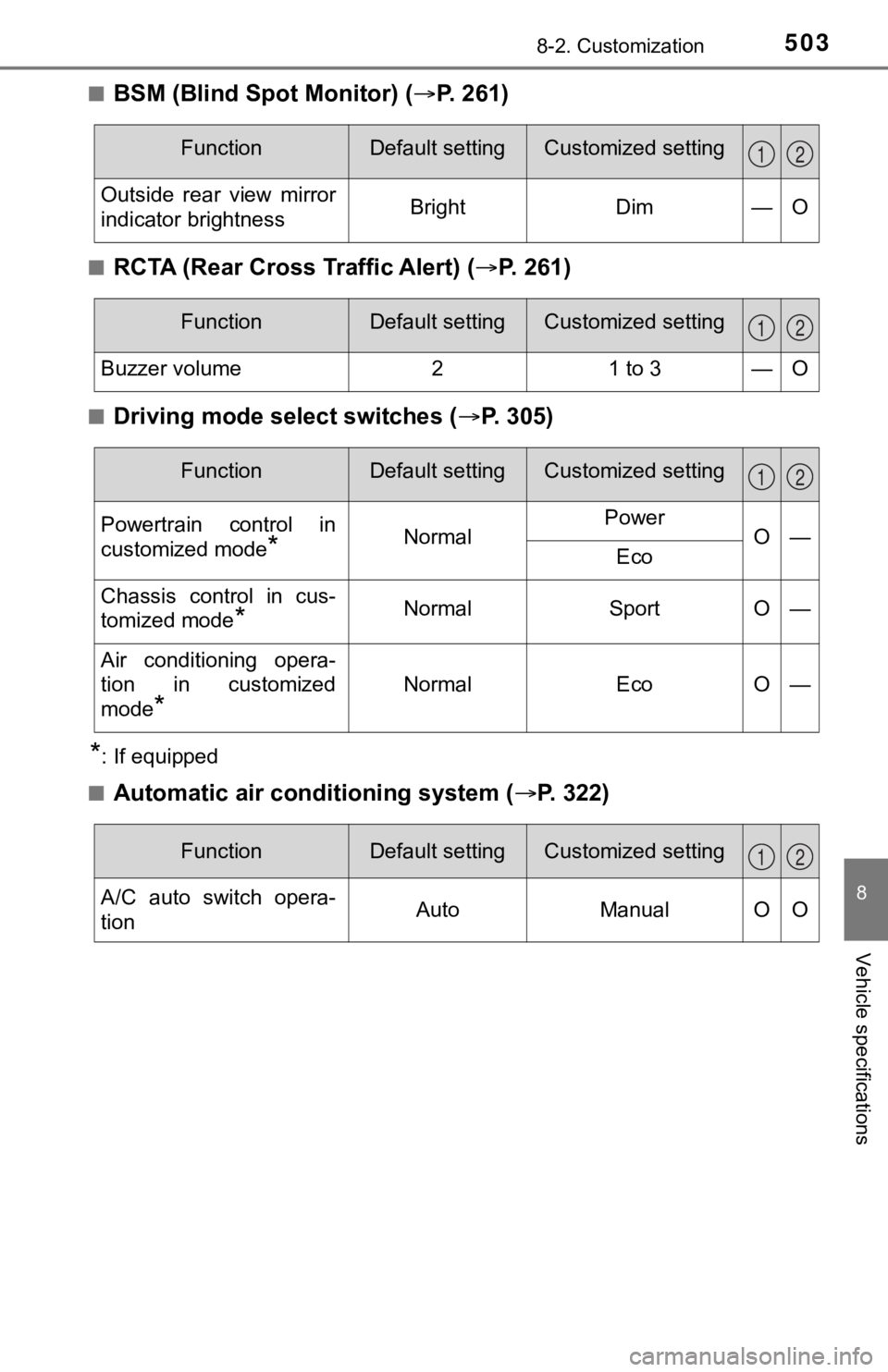
■BSM (Blind Spot Monitor) (P. 261)
■RCTA (Rear Cross Traffic Alert) ( P. 2 6 1 )
■Driving mode select switches ( P. 305)
*: If equipped
■
Automatic air c onditioning system ( P. 322)
FunctionDefault settingCustomized setting
Outside rear view mirror
indicator brightnessBrightDim—O
12
FunctionDefault settingCustomized setting
Buzzer volume21 to 3—O
12
FunctionDefault settingCustomized setting
Powertrain control in
customized mode
*NormalPowerO—Eco
Chassis control in cus-
tomized mode
*NormalSportO—
Air conditioning opera-
tion in customized
mode
*
NormalEcoO—
12
FunctionDefault settingCustomized setting
A/C auto switch opera-
tionAutoManualOO
12
Page 524 of 540
524What to do if... (Troubleshooting)
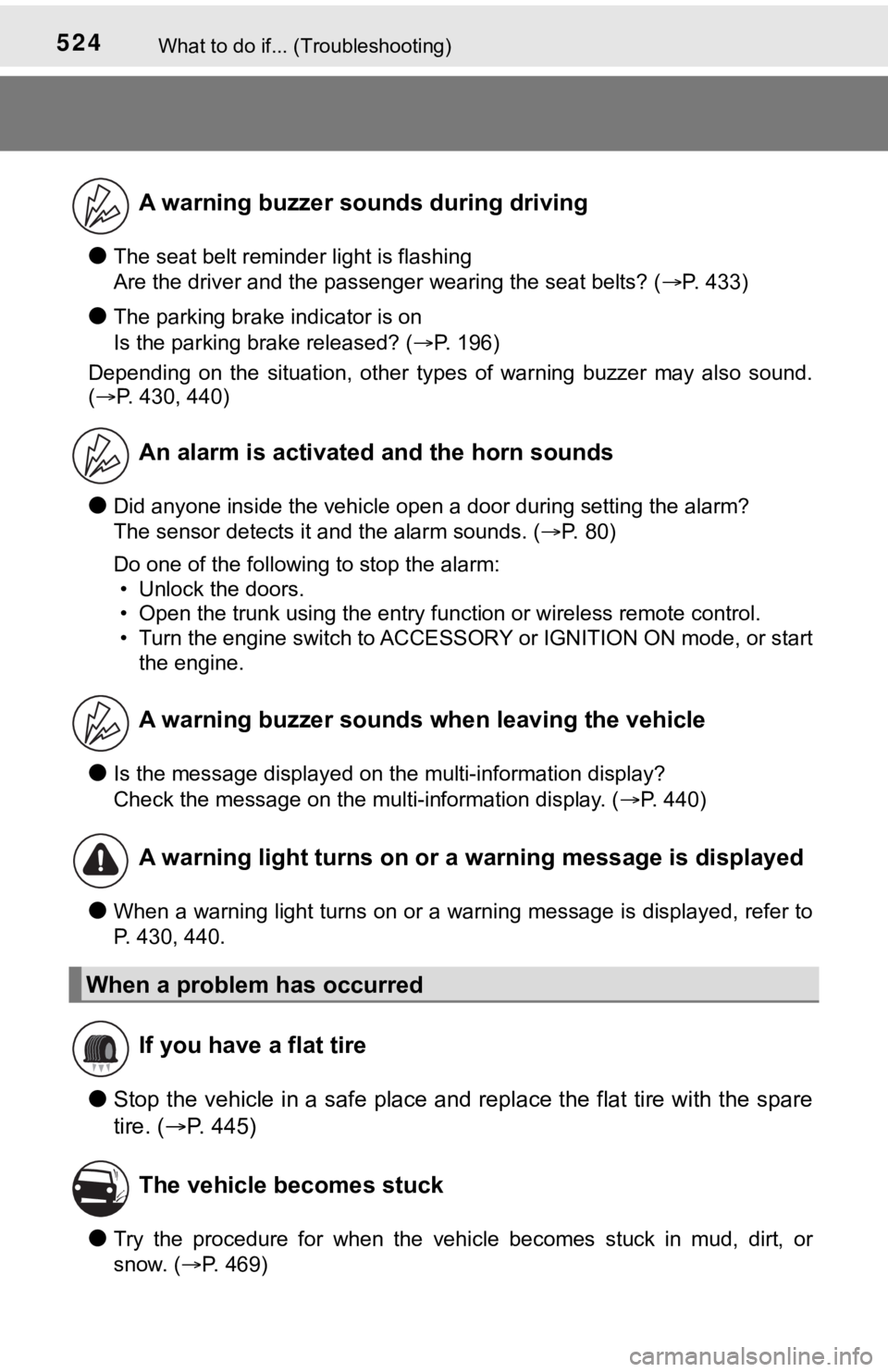
●The seat belt reminder light is flashing
Are the driver and the passenger wearing the seat belts? (P. 433)
●The parking brake indicator is on
Is the parking brake released? (P. 196)
Depending on the situation, other types of warning buzzer may also sound.
( P. 430, 440)
●Did anyone inside the vehicle open a door during setting the al arm?
The sensor detects it and the alarm sounds. ( P. 80)
Do one of the following to stop the alarm: • Unlock the doors.
• Open the trunk using the entry function or wireless remote con trol.
• Turn the engine switch to ACCESSORY or IGNITION ON mode, or st art
the engine.
●Is the message displayed on the multi-information display?
Check the message on the multi-information display. ( P. 440)
●When a warning light turns on or a warning message is displayed , refer to
P. 430, 440.
●Stop the vehicle in a safe place and replace the flat tire with the spare
tire. ( P. 445)
●Try the procedure for when the vehicle becomes stuck in mud, di rt, or
snow. ( P. 469)
A warning buzzer sounds during driving
An alarm is activated and the horn sounds
A warning buzzer sounds w hen leaving the vehicle
A warning light turns on or a warning message is displayed
When a problem has occurred If you have a flat tire
The vehicle becomes stuck