engine coolant TOYOTA AVALON 2021 (in English) User Guide
[x] Cancel search | Manufacturer: TOYOTA, Model Year: 2021, Model line: AVALON, Model: TOYOTA AVALON 2021Pages: 548, PDF Size: 13.4 MB
Page 389 of 548
3896-3. Do-it-yourself maintenance
6
Maintenance and care
Check the radiator and condenser and clear away any foreign objects.
If either of the above parts is extremely dirty or you are not sure of
their condition, have your vehicle inspected by your Toyota dealer.
WARNING
■When the engine is hot
Do not remove the engine coolant reservoir cap or the radiator cap.
The cooling system may be under pressure and may spray hot coolant if the
cap is removed, causing serious injuries, such as burns.
NOTICE
■When adding coolant
Coolant is neither plain water nor straight antifreeze. The correct mixture of
water and antifreeze must be used to provide proper lubrication, corrosion
protection and cooling. Be sure to read the antifreeze or coolant label.
■If you spill coolant
Be sure to wash it off with water to prevent it from damaging parts or paint.
Radiator and condenser
WARNING
■When the engine is hot
Do not touch the radiator or condenser as they may be hot and cause seri-
ous injuries, such as burns.
Page 432 of 548
4327-2. Steps to take in an emergency
●Fluid leaks under the vehicle.
(Water dripping from the air conditioning after use is normal.)
●Flat-looking tires or uneven tire wear
●Engine coolant temperature gauge needle continually points higher
than normal
●Changes in exhaust sound
●Excessive tire squeal when cornering
●Strange noises related to the suspension system
●Pinging or other noises related to the engine
●Engine missing, stumbling or running roughly
●Appreciable loss of power
●Vehicle pulls heavily to one side when braking
●Vehicle pulls heavily to one side when driving on a level road
●Loss of brake effectiveness, spongy feeling, pedal almost touches
the floor
If you think something is wrong
If you notice any of the following symptoms, your vehicle proba-
bly needs adjustment or repair. Contact your Toyota dealer as
soon as possible.
Visible symptoms
Audible symptoms
Operational symptoms
Page 434 of 548
4347-2. Steps to take in an emergency
If a warning light turns on or a war ning
buzzer sounds
Calmly perform the following actions if any of the warning lights
comes on or flashes. If a light comes on or flashes, but then
goes off, this does not necessarily indicate a malfunction in the
system. However, if this continues to occur, have the vehicle
inspected by your Toyota dealer.
Warning light and warning buzzer list
Warning lightWarning light/Details/Actions
(U.S.A.)
(Red)
(Canada)
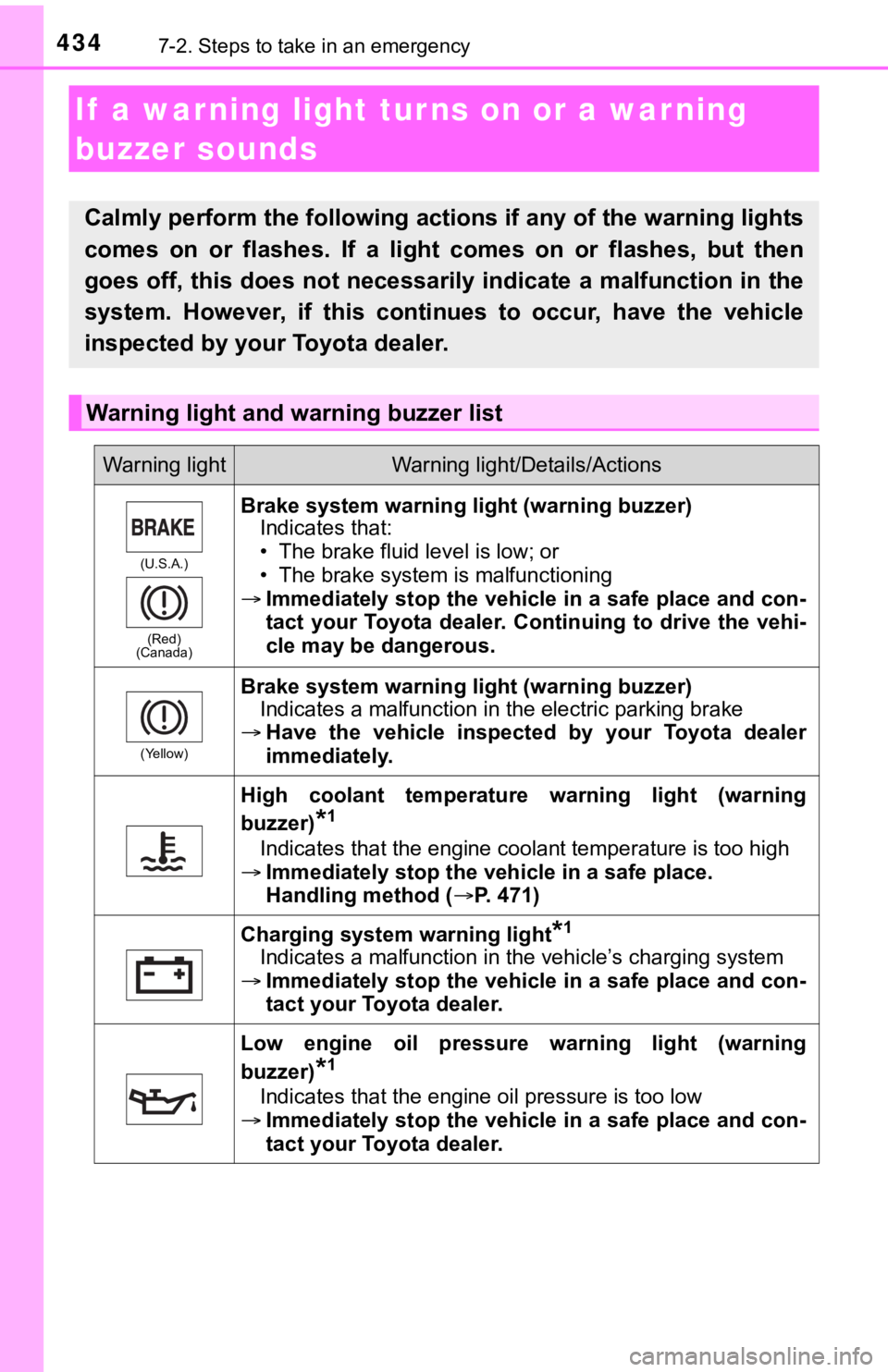
Brake system warning light (warning buzzer)
Indicates that:
• The brake fluid level is low; or
• The brake system is malfunctioning
Immediately stop the vehicle in a safe place and con-
tact your Toyota dealer. Continuing to drive the vehi-
cle may be dangerous.
(Yellow)
Brake system warning light (warning buzzer)
Indicates a malfunction in the electric parking brake
Have the vehicle inspected by your Toyota dealer
immediately.
High coolant temperature warning light (warning
buzzer)
*1
Indicates that the engine coolant temperature is too high
Immediately stop the vehicle in a safe place.
Handling method (P. 471)
Charging system warning light*1
<002c00510047004c0046004400570048005600030044000300500044004f00490058005100460057004c005200510003004c005100030057004b0048000300590048004b004c0046004f004800b6005600030046004b00440055004a004c0051004a000300
56005c0056005700480050[
Immediately stop the vehicle in a safe place and con-
tact your Toyota dealer.
Low engine oil pressure warning light (warning
buzzer)
*1
Indicates that the engine oil pressure is too low
Immediately stop the vehicle in a safe place and con-
tact your Toyota dealer.
Page 446 of 548

4467-2. Steps to take in an emergency
■Warning messages
The warning messages explained below may differ from the actual messages
<004400460046005200550047004c0051004a0003005700520003005200530048005500440057004c0052005100030046005200510047004c0057004c0052005100560003004400510047000300590048004b004c0046004f00480003005600530048004600
4c0049004c004600440057004c0052005100560011[
■System warning lights
The master warning light does not come on or flash in the following cases.
Instead, a separate system warning light will come on along with a message
shown on the multi-information display.
●Malfunction in the ABS
The ABS warning light comes on. (P. 435)
●Malfunction in the tire pressure warning system
The tire pressure warning light comes on. (P. 438)
●Remaining fuel level is low
The low fuel level warning light comes on. (P. 437)
■If a message instructing to refer to the Owner’s Manual is displayed
●If the following messages are shown, there may be a malfunction.
Immediately stop the vehicle in a safe place and contact your Toyota dealer.
Continuing to drive the vehicle may be dangerous.
• “Low Braking Power Stop in a Safe Place See Owner’s Manual”
• “Oil Pressure Low Stop in a Safe Place See Owner’s Manual”
• “Charging System Malfunction Stop in a Safe Place See Owner’s Man-
ual”
●<002c004900030057004b0048000300490052004f004f0052005a004c0051004a000300500048005600560044004a00480003004c005600030056004b0052005a0051000f00030057004b004800550048000300500044005c00030045004800030044000300
500044004f00490058005100460057004c005200510011[
Immediately have the vehicle inspected by your Toyota dealer.
• “Smart Key System Malfunction See Owner’s Manual”
●If “Engine Coolant Temp High Stop in a Safe Place See Owner’s Manual” is
displayed, follow the instructions accordingly. (P. 471)
■If “Shift to P Before Exiting Vehicle” is shown
Message is displayed when the driver’s door is opened without turning the
engine switch off with the shift lever in any position other than P.
Shift the shift lever to P.
■If “Auto Power Off to Conserve Battery” is displayed
Power was turned off due to the automatic power off function.
Next time when starting the engine, increase the engine speed slightly and
maintain that level for approximately 5 minutes to recharge the battery.
Page 471 of 548
4717-2. Steps to take in an emergency
7
When trouble arises
Stop the vehicle in a safe place and turn off the air conditioning sys-
tem, and then stop the engine.
If you see steam:
Carefully lift the hood after the steam subsides.
If you do not see steam:
Carefully lift the hood.
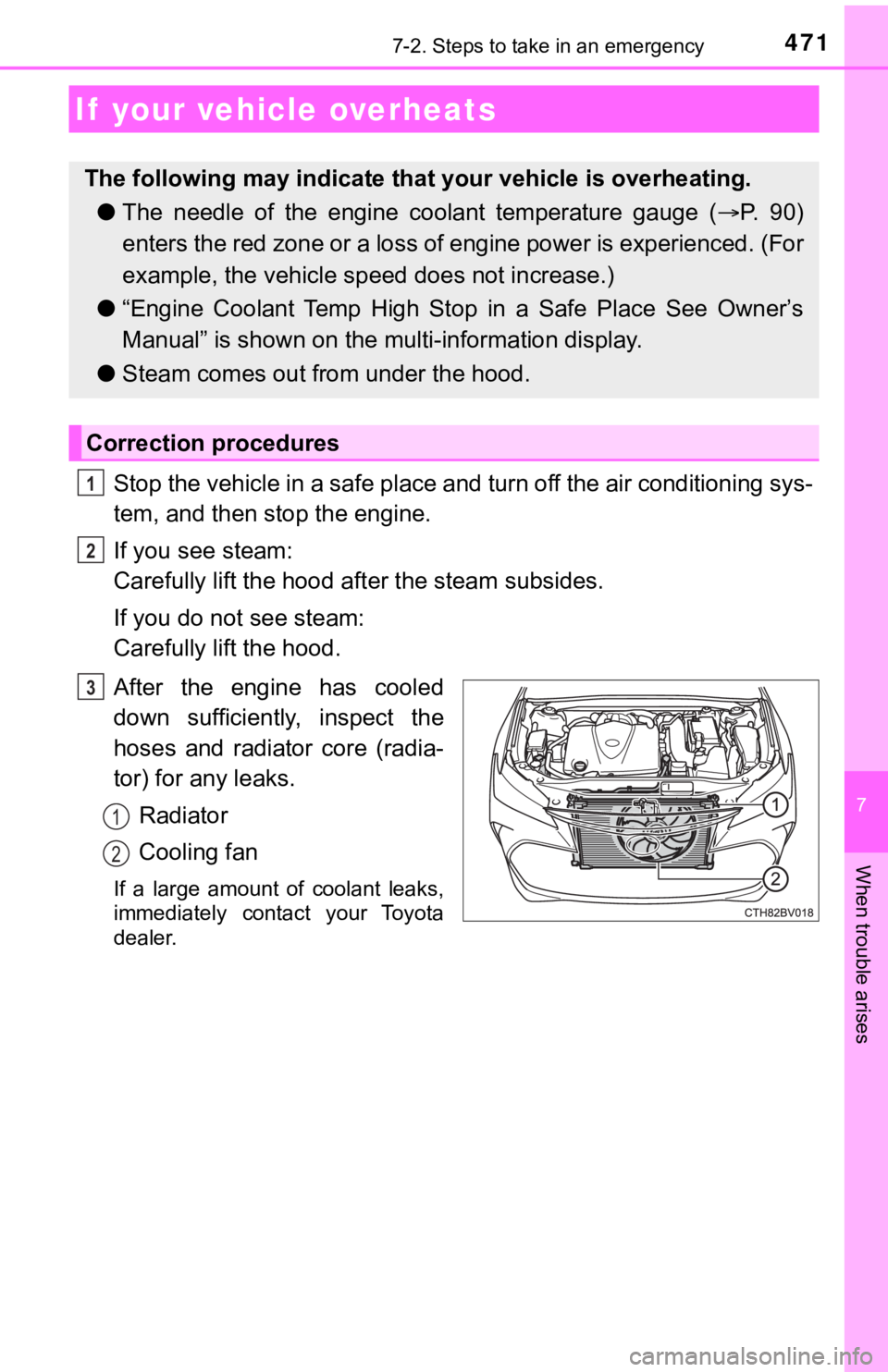
After the engine has cooled
down sufficiently, inspect the
hoses and radiator core (radia-
tor) for any leaks.
Radiator
Cooling fan
If a large amount of coolant leaks,
immediately contact your Toyota
dealer.
If your vehicle overheats
The following may indicate that your vehicle is overheating.
●The needle of the engine coolant temperature gauge (P. 90)
enters the red zone or a loss of engine power is experienced. (For
example, the vehicle speed does not increase.)
●“Engine Coolant Temp High Stop in a Safe Place See Owner’s
Manual” is shown on the multi-information display.
●Steam comes out from under the hood.
Correction procedures
1
2
3
1
2
Page 472 of 548
4727-2. Steps to take in an emergency
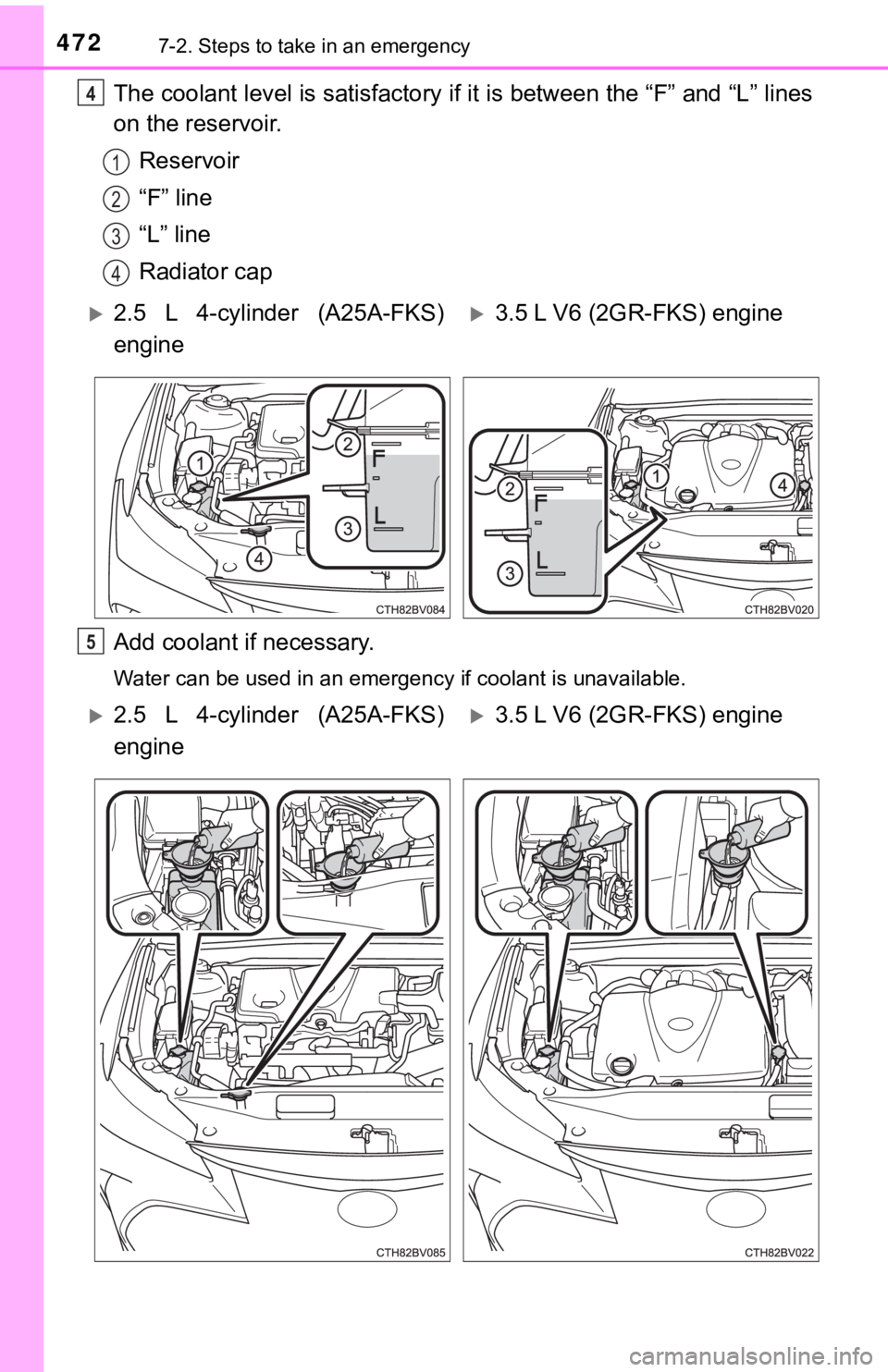
The coolant level is satisfactory if it is between the “F” and “L” lines
on the reservoir.
Reservoir
“F” line
“L” line
Radiator cap
Add coolant if necessary.
Water can be used in an emergency if coolant is unavailable.
4
1
2
3
4
2.5 L 4-cylinder (A25A-FKS)
engine3.5 L V6 (2GR-FKS) engine
5
2.5 L 4-cylinder (A25A-FKS)
engine3.5 L V6 (2GR-FKS) engine
Page 473 of 548
4737-2. Steps to take in an emergency
7
When trouble arises
Start the engine and turn the air conditioning system on to check
that the radiator cooling fan operates and to check for coolant leaks
from the radiator or hoses.
The fan operates when the air conditioning system is turned on immedi-
ately after a cold start. Confirm that the fan is operating by checking the fan
sound and air flow. If it is difficult to check these, turn the air conditioning
system on and off repeatedly. (The fan may not operate in freezing tem-
peratures.)
If the fan is not operating:
Stop the engine immediately and contact your Toyota dealer.
If the fan is operating:
Have the vehicle inspected at the nearest Toyota dealer.
WARNING
■To prevent an accident or injury when inspecting under the hood of
your vehicle
Observe the following precautions.
<00290044004c004f005800550048000300570052000300470052000300560052000300500044005c00030055004800560058004f00570003004c00510003005600480055004c0052005800560003004c0051004d00580055005c0003005600580046004b00
03004400560003004500580055005100560011[
●If steam is seen coming from under the hood, do not open the hood until
the steam has subsided. The engine compartment may be very hot.
●Keep hands and clothing (especially a tie, a scarf or a muffler) away from
the fan and belts. Failure to do so may cause the hands or clothing to be
caught, resulting in serious injury.
●Do not loosen the radiator cap and the coolant reservoir cap while the
engine and radiator are hot.
High temperature steam or coolant could spray out.
NOTICE
■When adding engine coolant
Wait until the engine has cooled down before adding engine coolant.
When adding coolant, do so slowly. Adding cool coolant to a hot engine too
quickly can cause damage to the engine.
■To prevent damage to the cooling system
Observe the following precautions:
●Avoid contaminating the coolant with foreign matter (such as sand or dust
etc.).
●Do not use any coolant additives.
6
7
Page 483 of 548
4838-1. Specifications
8
Vehicle specifications
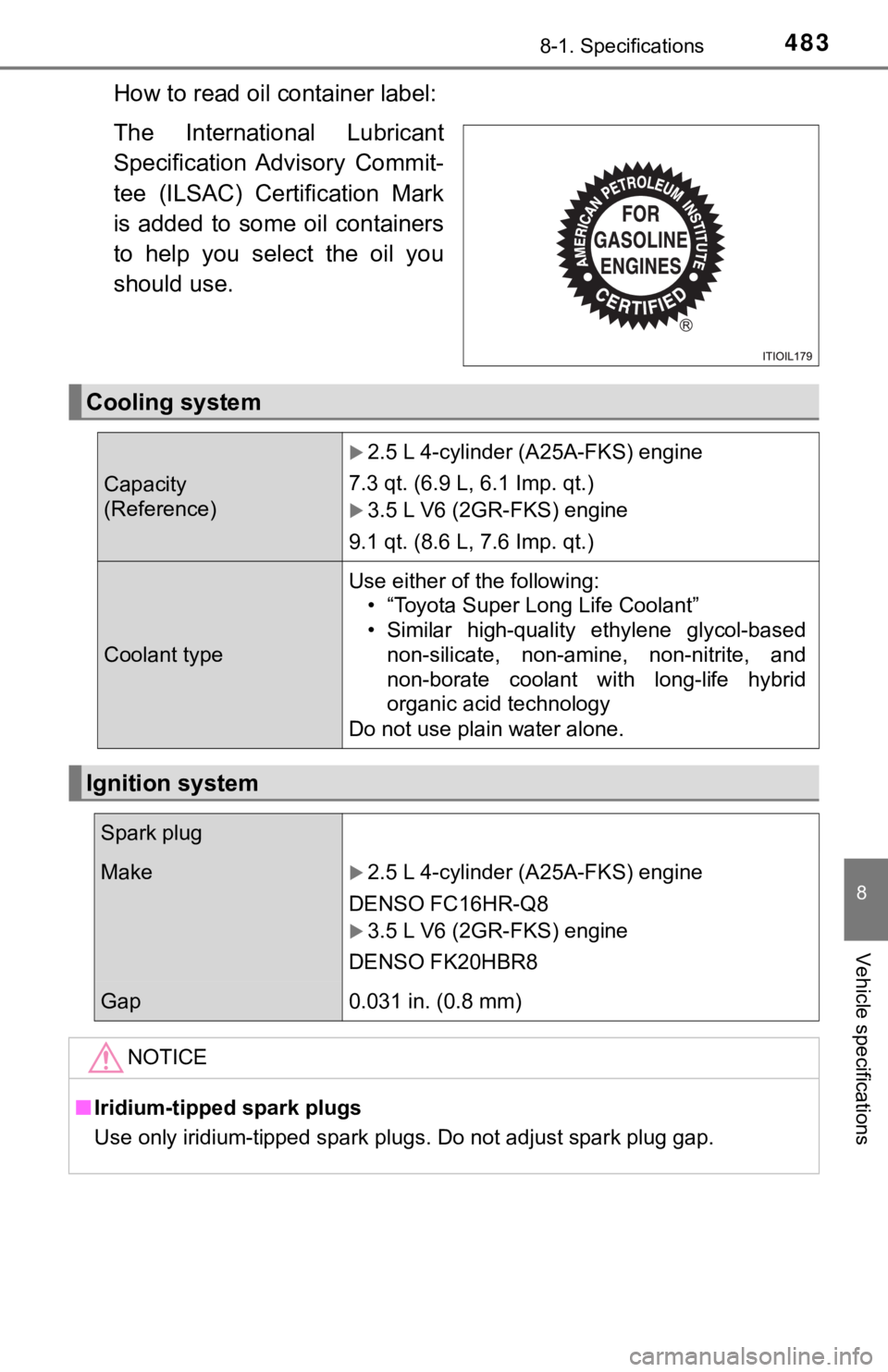
How to read oil container label:
The International Lubricant
Specification Advisory Commit-
tee (ILSAC) Certification Mark
is added to some oil containers
to help you select the oil you
should use.
Cooling system
Capacity
(Reference)
2.5 L 4-cylinder (A25A-FKS) engine
7.3 qt. (6.9 L, 6.1 Imp. qt.)
3.5 L V6 (2GR-FKS) engine
9.1 qt. (8.6 L, 7.6 Imp. qt.)
Coolant typeUse either of the following:
• “Toyota Super Long Life Coolant”
• Similar high-quality ethylene glycol-based
non-silicate, non-amine, non-nitrite, and
non-borate coolant with long-life hybrid
organic acid technology
Do not use plain water alone.
Ignition system
Spark plug
Make2.5 L 4-cylinder (A25A-FKS) engine
DENSO FC16HR-Q8
3.5 L V6 (2GR-FKS) engine
DENSO FK20HBR8
Gap0.031 in. (0.8 mm)
NOTICE
■Iridium-tipped spark plugs
<003800560048000300520051004f005c0003004c0055004c0047004c0058005000100057004c005300530048004700030056005300440055004e00030053004f0058004a005600110003002700520003005100520057000300440047004d00580056005700
030056005300440055004e00030053004f0058004a0003004a[ap.
Page 499 of 548
4998-1. Specifications
8
Vehicle specifications
Glossary of tire terminology
Tire related termMeaning
Cold tire inflation pres-
sure
Tire pressure when the vehicle has been
parked for three hours or more, or has not
been driven more than 1 mile or 1.5 km under
that condition
Maximum inflation
pressureThe maximum cold inflated pressure to which
a tire may be inflated, shown on the sidewall
of the tire
Recommended infla-
tion pressureCold tire inflation pressure recommended by a
manufacturer
Accessory weight
The combined weight (in excess of those stan-
dard items which may be replaced) of auto-
matic transmission, power steering, power
brakes, power windows, power seats, radio
and heater, to the extent that these items are
available as factory-installed equipment
(whether installed or not)
Curb weight
The weight of a motor vehicle with standard
equipment, including the maximum capacity of
fuel, oil and coolant, and if so equipped, air
conditioning and additional weight optional
engine
Maximum loaded vehi-
cle weight
The sum of:
(a) Curb weight
(b) Accessory weight
(c) Vehicle capacity weight
(d) Production options weight
Normal occupant
weight150 lb. (68 kg) times the number of occupants
specified in the second column of Table 1
*
that follows
Occupant distributionDistribution of occupants in a vehicle as speci-
fied in the third column of Table 1
* below
Page 535 of 548
535Alphabetical index
Child safety ................................ 55
Airbag precautions .................. 39
Battery precautions ....... 392, 470
Child restraint system ............. 56
How your child should wear
the seat belt .......................... 32
Installing child restraints ......... 60
Moon roof precautions .......... 167
Power window lock switch .... 160
Power window precautions ... 163
Rear door child-protectors .... 128
Removed electronic key
battery precautions ............. 416
Seat belt extender
precautions ........................... 35
Seat belt precautions .............. 34
Seat heater precautions........ 329
Trunk precautions ................. 133
Child-protectors....................... 128
Cleaning ........................... 366, 369
Exterior ................................. 366
Interior................................... 369
Seat belts .............................. 370
Wheels and wheel
ornaments .......................... 367
Coat hooks ............................... 356
Condenser ................................ 389
Connected Services
*
Console box ............................. 336
Consumption
screen............................... 97, 116
Coolant
Capacity ................................ 483
Checking ............................... 388
Preparing and checking
before winter....................... 317
Cooling system ........................ 388
Engine overheating ............... 471
Cornering lights ....................... 203
Cruise control
Dynamic radar cruise control
with full-speed range .......... 247Cup holders ............................. 338
Curtain shield airbags............... 37
Customizable features ............ 505
Customized mode ................... 305
Daytime running light
system.................................... 204
Defogger
Outside rear view mirrors ..... 324
Rear window ......................... 324
Windshield ............................ 324
Dimensions .............................. 478
Dinghy towing.......................... 183
Display
Dynamic radar cruise control
with full-speed range .......... 247
LDA (Lane Departure Alert
with steering control) .......... 242
Multi-information display ......... 93
Warning messages ............... 444
Do-it-yourself maintenance .... 379
Door courtesy lights
Location ................................ 332
Wattage ................................ 488
Door lock
Doors .................................... 125
Smart key system ................. 125
Wireless remote control ........ 125
Doors ........................................ 125
Automatic door locking
and unlocking systems ....... 128
Door lock .............................. 127
Outside rear view mirrors ..... 157
Rear door child-protector ...... 128
Side doors ............................ 125
Side windows........................ 160
Drive-Start Control .................. 171
Driver’s seat belt
reminder light ........................ 438
D
*: Refer to the “NAVIGATION AND MULTIMEDIA SYSTEM
OWNER’S MANUAL”.