service TOYOTA AVALON 2021 (in English) User Guide
[x] Cancel search | Manufacturer: TOYOTA, Model Year: 2021, Model line: AVALON, Model: TOYOTA AVALON 2021Pages: 548, PDF Size: 13.4 MB
Page 317 of 548
317
4
Driving
4-6. Driving tips
●Use fluids that are appropriate to the prevailing outside tempera-
tures.
• Engine oil
• Engine coolant
• Washer fluid
●Have a service technician inspect the condition of the battery.
●Have the vehicle fitted with four snow tires or purchase a set of tire
chains for the front tires.
*
Ensure that all tires are the same size and brand, and that chains match
the size of the tires.
*: Tire chains cannot be mounted on vehicles with 18 and 19-inch tires.
Perform the following according to the driving conditions:
●Do not try to forcibly open a window or move a wiper that is frozen.
Pour warm water over the frozen area to melt the ice. Wipe away
the water immediately to prevent it from freezing.
●To ensure proper operation of the climate control system fan,
remove any snow that has accumulated on the air inlet vents in
front of the windshield.
●Check for and remove any excess ice or snow that may have accu-
mulated on the exterior lights, vehicle’s roof, chassis, around the
tires or on the brakes.
●Remove any snow or mud from the bottom of your shoes before
getting in the vehicle.
Winter driving tips
Carry out the necessary preparations and inspections before
driving the vehicle in winter. Always drive the vehicle in a man-
ner appropriate to the prevailing weather conditions.
Preparation for winter
Before driving the vehicle
Page 327 of 548
3275-1. Using the air conditioning system and defogger
5
Interior features
■Air conditioning filter
P. 413
■Air conditioning system refrigerant
●The meaning of each symbol on the label are as follows:
■Customization
Some functions can be customized. (P. 5 1 1 ) ●A label regarding the refrigerant of the
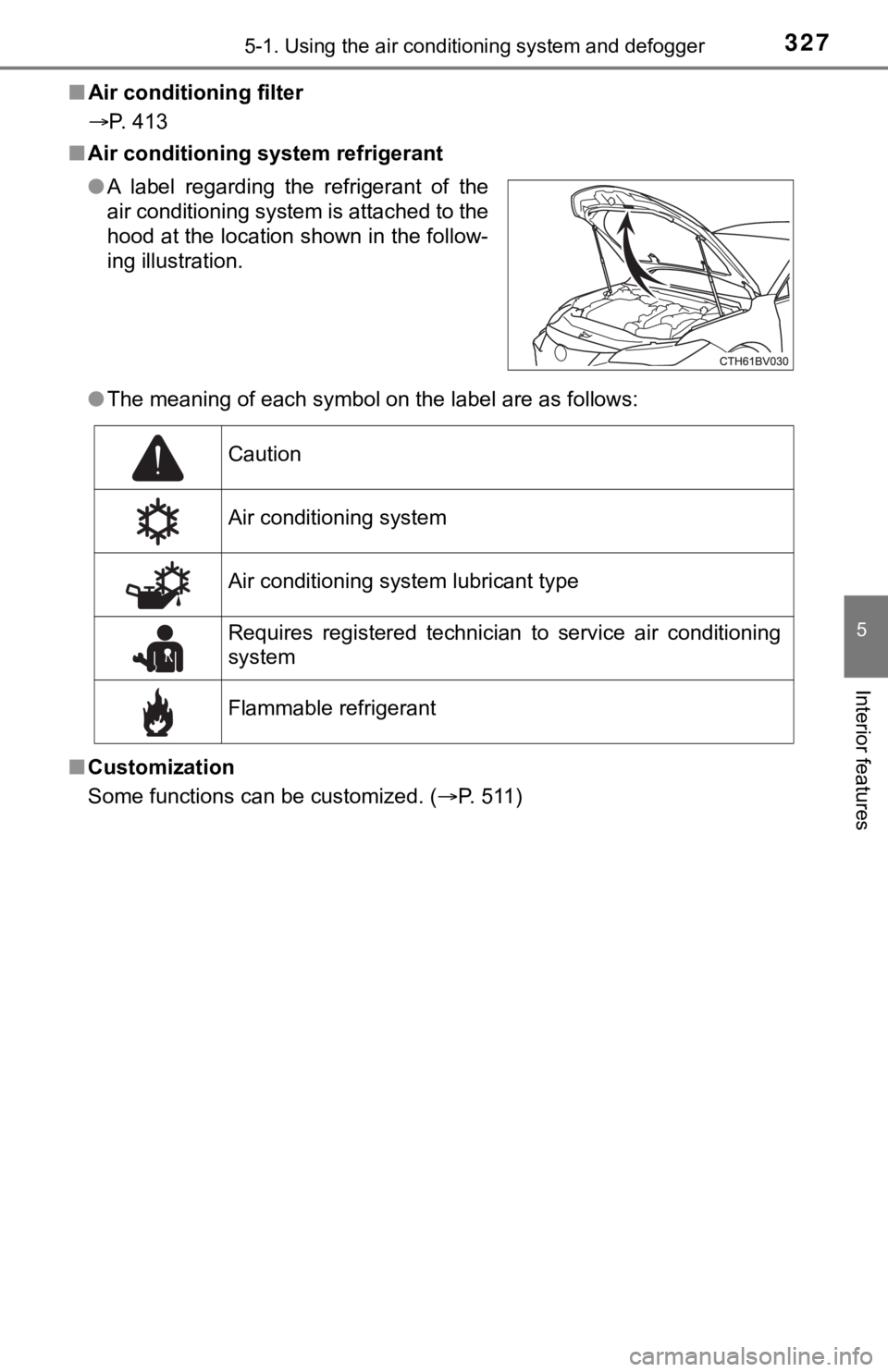
air conditioning system is attached to the
hood at the location shown in the follow-
ing illustration.
Caution
Air conditioning system
Air conditioning system lubricant type
Requires registered technician to service air conditioning
system
Flammable refrigerant
Page 365 of 548

365
6Maintenance and care
6-1. Maintenance and care
Cleaning and protecting
the vehicle exterior .......... 366
Cleaning and protecting
the vehicle interior ........... 369
6-2. Maintenance
Maintenance
requirements ................... 372
General maintenance........ 374
Emission inspection and
maintenance (I/M)
programs......................... 378
6-3. Do-it-yourself
maintenance
Do-it-yourself service
precautions ..................... 379
Hood ................................. 381
Positioning a floor jack ...... 382
Engine compartment ......... 383
Tires .................................. 394
Tire inflation pressure ....... 408
Wheels .............................. 411
Air conditioning filter.......... 413
Electronic key battery........ 415
Checking and replacing
fuses ............................... 418
Light bulbs......................... 421
Page 373 of 548
3736-2. Maintenance
6
Maintenance and care
■Repair and replacement
It is recommended that genuine Toyota parts be used for repairs to ensure
performance of each system. If non-Toyota parts are used in replacement or if
a repair shop other than a Toyota dealer performs repairs, confirm the war-
ranty coverage.
■<003500480056004800570057004c0051004a00030057004b0048000300500048005600560044004a00480003004c00510047004c004600440057004c0051004a000300500044004c005100570048005100440051004600480003004c005600030055004800
540058004c005500480047[
After the required maintenance is performed according to the maintenance
schedule, please reset the message.
To reset the message, perform the following procedure:
Select on the multi-information display using the meter control switches
on the steering wheel. (P. 100)
Select and then press and hold .
Select “Scheduled Maintenance” and then press .
Select “Yes” and then press .
A message will be displayed on the multi-information display when the
reset procedure has been completed.
■Allow inspection and repairs to be performed by a Toyota dealer
●Toyota technicians are well-trained specialists and are kept up to date with
the latest service information. They are well informed about the operations
of all systems on your vehicle.
●Keep a copy of the repair order. It proves that the maintenance that has
been performed is under warranty coverage. If any problem should arise
while your vehicle is under warranty, your Toyota dealer will promptly take
care of it.
WARNING
■If your vehicle is not properly maintained
Improper maintenance could result in serious damage to the vehicle and
possible death or serious injury.
■Important health and safety information
●Engine exhaust, some of its constituents, and a wide variety of automobile
components contain or emit chemicals known to the State of California to
cause cancer and birth defects and other reproductive harm. Work in a
well ventilated area.
●Oils, fuels and fluids contained in vehicles as well as waste produced by
component wear contain or emit chemicals known to the State of
California to cause cancer and birth defects or other reproductive harm.
Avoid exposure and wash any affected area immediately.
●Battery posts, terminals and related accessories contain lead and lead
compounds which are known to cause brain damage. Wash your hands
after handling. (P. 391)
1
2
3
4
5
Page 374 of 548
3746-2. Maintenance
General maintenance
Listed below are the general maintenance items that should be
performed at the intervals specified in the “Owner’s Warranty
Information Booklet” or “Owner’s Manual Supplement/Sched-
uled Maintenance Guide”. It is recommended that any problem
you notice should be brought to the attention of your Toyota
dealer or qualified service shop for advice.
Engine compartment
ItemsCheck points
BatteryCheck the connections. (P. 391)
Brake fluidIs the brake fluid at the correct
level? (P. 390)
Engine coolantIs the engine coolant at the correct
level? (P. 388)
Engine oilIs the engine oil at the correct level?
(P. 385)
Exhaust systemThere should not be any fumes or
strange sounds.
Radiator/condenser
The radiator and condenser should
be free from foreign objects.
(P. 389)
Washer fluidIs there sufficient washer fluid?
(P. 393)
Page 378 of 548
3786-2. Maintenance
The OBD system determines that a problem exists somewhere in the
emission control system. Your vehicle may not pass the I/M test and
may need to be repaired. Contact your Toyota dealer to service the
vehicle.
●When the battery is disconnected or discharged
Readiness codes that are set during ordinary driving are erased.
Also, depending on your driving habits, the readiness codes may
not be completely set.
●When the fuel tank cap is loose
The malfunction indicator lamp comes on indicating a temporary
malfunction and your vehicle may not pass the I/M test.
The error code in the OBD system will not be cleared unless the vehi-
cle is driven 40 or more times.
Contact your Toyota dealer to prepare the vehicle for re-testing.
Emission inspection and maintenance (I/M)
programs
Some states have vehicle emission inspection programs which
include OBD (On Board Diagnostics) checks. The OBD system
monitors the operation of the emission control system.
If the malfunction indicator lamp comes on
Your vehicle may not pass the I/M test in the following situations:
When the malfunction indicator lamp still remains on after sev-
eral driving trips
If your vehicle does not pass the I/M test
Page 387 of 548
3876-3. Do-it-yourself maintenance
6
Maintenance and care
WARNING
■Used engine oil
●Used engine oil contains potentially harmful contaminants which may
cause skin disorders such as inflammation and skin cancer, so care
should be taken to avoid prolonged and repeated contact. To remove used
engine oil from your skin, wash thoroughly with soap and water.
●Dispose of used oil and filters only in a safe and acceptable manner. Do
not dispose of used oil and filters in household trash, in sewers or onto the
ground.
Call your Toyota dealer, service station or auto parts store for information
concerning recycling or disposal.
●Do not leave used engine oil within the reach of children.
NOTICE
■To prevent serious engine damage
Check the oil level on a regular basis.
■When replacing the engine oil
●Be careful not to spill engine oil on the vehicle components.
●Avoid overfilling, or the engine could be damaged.
●Check the oil level on the dipstick every time you refill the vehicle.
●Be sure the engine oil filler cap is properly tightened.
■If oil is spilled on the engine cover
To prevent the engine cover from being damaged, remove any engine oil
from the engine cover as soon as possible using a neutral detergent.
Do not use an organic solvent such as brake cleaner.
Page 407 of 548
4076-3. Do-it-yourself maintenance
6
Maintenance and care
NOTICE
■Repairing or replacing tires, wheels, tire pressure warning valve
and transmitters and tire valve caps
●When removing or fitting the wheels, tires or the tire pressure warning
valve and transmitters, contact your Toyota dealer as the tire pressure
warning valve and transmitters may be damaged if not handled cor-
rectly.
●Make sure to install the tire valve caps. If the tire valve caps are not
installed, water may enter the valves of the tire pressure warning valve
and transmitters and the valves may become stuck.
●When replacing tire valve caps, do not use tire valve caps other than
those specified. The cap may become stuck.
■To avoid damage to the tire pressure warning valve and transmit-
ters
When a tire is repaired with liquid sealants, the tire pressure warning
valve and transmitter may not operate properly. If a liquid sealant is
used, contact your Toyota dealer or other qualified service shop as soon
as possible. Make sure to replace the tire pressure warning valve and
transmitter when replacing the tire. (P. 3 9 6 )
■Driving on rough roads
Take particular care when driving on roads with loose surfaces or pot-
holes.
These conditions may cause losses in tire inflation pressure, reducing
the cushioning ability of the tires. In addition, driving on rough roads
may cause damage to the tires themselves, as well as the vehicle’s
wheels and body.
■Low profile tires (vehicles with 18 or 19-inch wheels)
Low profile tires may cause greater damage than usual to the tire wheel
when sustaining impact from the road surface. Therefore, pay attention
to the following:
●Be sure to use proper tire inflation pressure. If tires are under-inflated,
they may be damaged more severely.
●Avoid potholes, uneven pavement, curbs and other road hazards. Fail-
ure to do so may lead to severe tire and wheel damage.
■If tire inflation pressure of each tire becomes low while driving
Do not continue driving, or your tires and/or wheels may be ruined.
Page 412 of 548
4126-3. Do-it-yourself maintenance
WARNING
■When replacing wheels
●Do not use wheels that are a different size from those recommended in
the Owner’s Manual, as this may result in a loss of handling control.
●Never use an inner tube in a leaking wheel which is designed for a
tubeless tire. Doing so may result in an accident, causing death or seri-
ous injury.
■When installing the wheel nuts
●Be sure to install the wheel nuts with the tapered ends facing inward.
(P. 457) Installing the nuts with the tapered ends facing outward can
cause the wheel to break and eventually cause the wheel to come off
while driving, which could lead to an accident resulting in death or seri-
ous injury.
●Never use oil or grease on the wheel bolts or wheel nuts.
Oil and grease may cause the wheel nuts to be excessively tightened,
leading to bolt or disc wheel damage. In addition, the oil or grease can
cause the wheel nuts to loosen and the wheel may fall off, causing an
accident and resulting in death or serious injury. Remove any oil or
grease from the wheel bolts or wheel nuts.
NOTICE
■Replacing tire pressure warning valve and transmitters
●Because tire repair or replacement may affect the tire pressure warn-
ing valve and transmitters, make sure to have tires serviced by your
Toyota dealer or other qualified service shop. In addition, make sure to
purchase your tire pressure warning valve and transmitters at your
Toyota dealer.
●Ensure that only genuine Toyota wheels are used on your vehicle.
Tire pressure warning valve and transmitters may not work properly
with non-genuine wheels.
Page 427 of 548
427
7
When trouble arises
7-2. Steps to take in an emergency
If your vehicle needs to be towed
If towing is necessary, we recommend having your vehicle
towed by your Toyota dealer or commercial towing service,
using a wheel-lift type truck or flatbed truck.
Use a safety chain system for all towing, and abide by all state/
provincial and local laws.
2WD models: If towing your vehicle with a wheel-lift type truck
from the front, the vehicle's rear wheels and axles must be in
good conditions. (P. 428, 430)
If they are damaged, use a towing dolly or flatbed truck.
AWD models: If towing your vehicle with a wheel-lift type truck,
use a towing dolly. (P. 428, 430)