remote start TOYOTA AVALON 2021 Owners Manual (in English)
[x] Cancel search | Manufacturer: TOYOTA, Model Year: 2021, Model line: AVALON, Model: TOYOTA AVALON 2021Pages: 548, PDF Size: 13.4 MB
Page 12 of 548
12
The SRS airbag and seat belt pretensioner devices in your Toyota contain
explosive chemicals. If the vehicle is scrapped with the airbags and seat belt
pretensioners left as they are, this may cause an accident such as fire. Be
sure to have the systems of the SRS airbag and seat belt pretensioner
removed and disposed of by a qualified service shop or by your Toyota dealer
before you scrap your vehicle.
Special handling may apply, See www.dtsc.ca.gov/hazardouswaste/perchlorate.
Your vehicle has components that may contain perchlorate. These compo-
nents may include airbag, seat belt pretensioners, and wireless remote con-
trol batteries.
Scrapping of your Toyota
Perchlorate Material
WARNING
■General precautions while driving
Driving under the influence: Never drive your vehicle when under the influ-
ence of alcohol or drugs that have impaired your ability to operate your vehi-
cle. Alcohol and certain drugs delay reaction time, impair judgment and
reduce coordination, which could lead to an accident that could result in
death or serious injury.
Defensive driving: Always drive defensively. Anticipate mistakes that other
drivers or pedestrians might make and be ready to avoid accidents.
Driver distraction: Always give your full attention to driving. Anything that
distracts the driver, such as adjusting controls, talking on a cellular phone or
reading can result in a collision with resulting death or serious injury to you,
your occupants or others.
■General precaution regarding children’s safety
Never leave children unattended in the vehicle, and never allow children to
have or use the key.
Children may be able to start the vehicle or shift the vehicle into neutral.
There is also a danger that children may injure themselves by playing with
the windows, the moon roof, or other features of the vehicle. In addition,
heat build-up or extremely cold temperatures inside the vehicle can be fatal
to children.
Page 80 of 548
801-3. Theft deterrent system
The alarm uses light and sound to give an alert when an intrusion is
detected.
The alarm is triggered in the following situations when the alarm is
set:
●A locked door is unlocked or opened in any way other than using
the entry function, wireless remote control or mechanical key. (The
doors will lock again automatically.)
●The trunk is opened in any way other than using the entry function
or wireless remote control.
●The hood is opened.
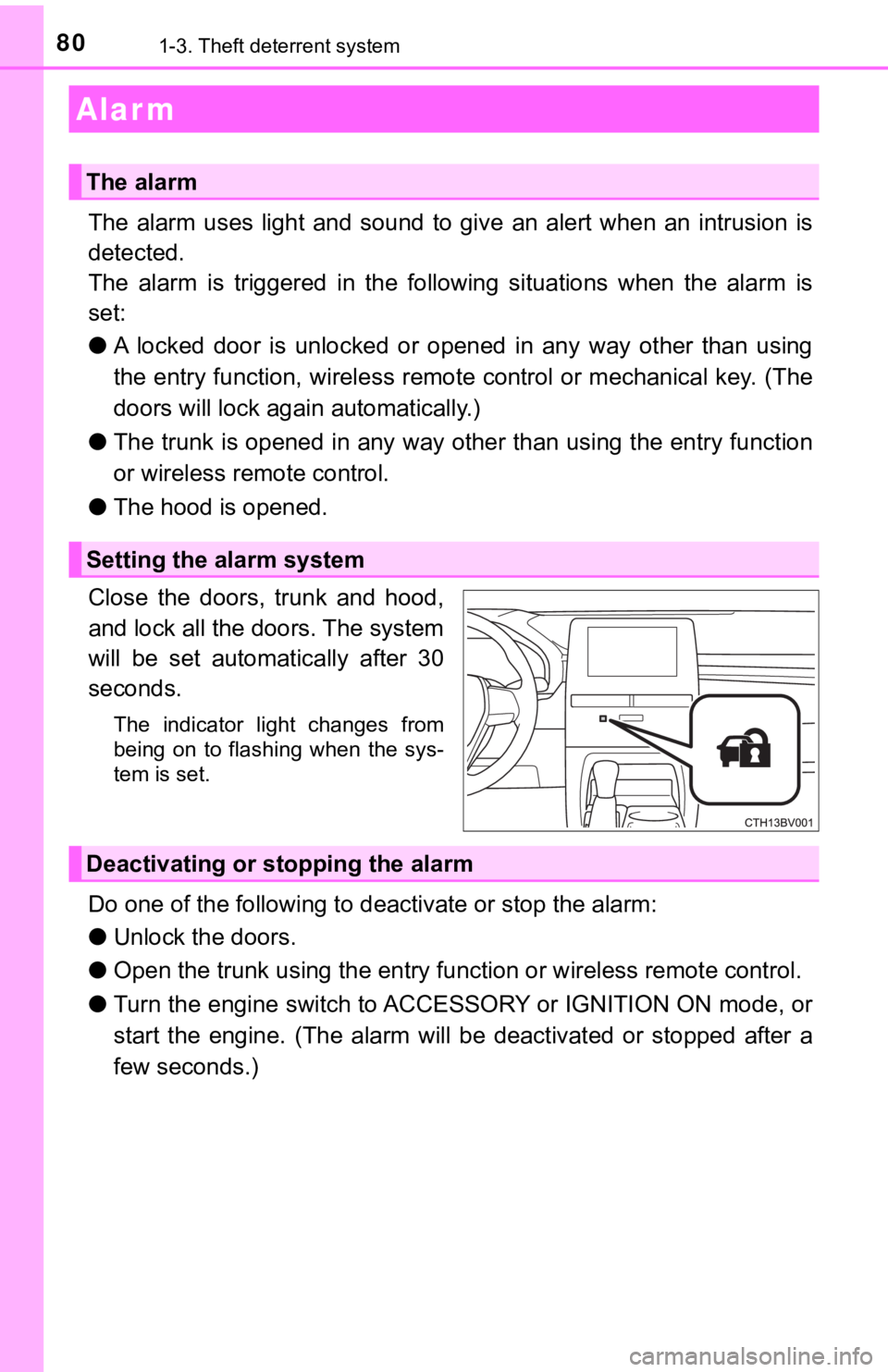
Close the doors, trunk and hood,
and lock all the doors. The system
will be set automatically after 30
seconds.
The indicator light changes from
being on to flashing when the sys-
tem is set.
Do one of the following to deactivate or stop the alarm:
●Unlock the doors.
●Open the trunk using the entry function or wireless remote control.
●Turn the engine switch to ACCESSORY or IGNITION ON mode, or
start the engine. (The alarm will be deactivated or stopped after a
few seconds.)
Alar m
The alarm
Setting the alarm system
Deactivating or stopping the alarm
Page 138 of 548

1383-2. Opening, closing and locking the doors
■Note for the entry function
●Even when the electronic key is within the effective range (detection areas),
the system may not operate properly in the following cases:
• The electronic key is too close to the window or outside door handle, near
the ground, or in a high place when the doors are locked or unlocked.
• The electronic key is near the ground or in a high place, or too close to
the rear bumper center when the trunk is opened.
• The electronic key is on the instrument panel, rear package tray or floor,
or in the door pockets or glove box when the engine is started or engine
switch modes are changed.
●Do not leave the electronic key on top of the instrument panel or near the
door pockets when exiting the vehicle. Depending on the radio wave recep-
tion conditions, it may be detected by the antenna outside the cabin and the
door will become lockable from the outside, possibly trapping the electronic
key inside the vehicle.
●As long as the electronic key is within the effective range, the doors may be
locked or unlocked by anyone. However, only the doors detecting the elec-
tronic key can be used to unlock the vehicle.
●Even if the electronic key is not inside the vehicle, it may be possible to start
the engine if the electronic key is near the window.
●The doors may unlock or lock if a large amount of water splashes on the
door handle, such as in the rain or in a car wash, when the electronic key is
within the effective range. (The doors will automatically be locked after
approximately 60 seconds if the doors are not opened and closed.)
●If the wireless remote control is used to lock the doors when the electronic
key is near the vehicle, there is a possibility that the door may not be
unlocked by the entry function. (Use the wireless remote control to unlock
the doors.)
●Touching the door lock sensor while wearing gloves may delay or prevent
lock operation. Remove the gloves and touch the lock sensor again.
●When the lock operation is performed using the lock sensor, recognition sig-
nals will be shown up to two consecutive times. After this, no recognition
signals will be given.
*
●If the door handle becomes wet while the electronic key is within the effec-
tive range, the door may lock and unlock repeatedly. In this case, follow the
<00490052004f004f0052005a004c0051004a00030046005200550055004800460057004c00520051000300530055005200460048004700580055004800560003005700520003005a00440056004b00030057004b0048000300590048004b004c0046004f00
48001d[
• Place the electronic key in a location 6 ft. (2 m) or more away from the
vehicle. (Take care to ensure that the key is not stolen.)
• Set the electronic key to battery-saving mode to disable the smart key
system. (P. 137)
●If the electronic key is inside the vehicle and a door handle becomes wet
during a car wash, a message may be shown on the multi-information dis-
play and a buzzer will sound outside the vehicle. To turn off the alarm, lock
all the doors.
Page 139 of 548

1393-2. Opening, closing and locking the doors
3
Operation of each component
●The lock sensor may not work properly if it comes into contact with ice,
snow, mud, etc. Clean the lock sensor and attempt to operate it again.
●A sudden approach to the effective range or door handle may prevent the
doors from being unlocked. In this case, return the door handle to the origi-
nal position and check that the doors unlock before pulling the door handle
again.
●If there is another electronic key in the detection area, it may take slightly
longer to unlock the doors after the door handle is gripped.
●Fingernails may scrape against the door during operation of the door han-
dle. Be careful not to injure fingernails or damage the surface of the door.
*: This setting can be customized at your Toyota dealer.
■When the vehicle is not driven for extended periods
●To prevent theft of the vehicle, do not leave the electronic key within 6 ft. (2
m) of the vehicle.
●The smart key system can be deactivated in advance. (P. 505)
●Setting the electronic key to battery-saving mode helps to reduce key bat-
tery depletion. (P. 137)
■To operate the system properly
Make sure to carry the electronic key when operating the system. Do not get
the electronic key too close to the vehicle when operating the system from the
outside of the vehicle.
Depending on the position and holding condition of the electronic key, the key
may not be detected correctly and the system may not operate properly. (The
alarm may go off accidentally, or the door lock prevention function may not
operate.)
■If the smart key system does not operate properly
●Locking and unlocking the doors and opening the trunk: Use the mechanical
key. (P. 463)
●Starting the engine: P. 464
■Customization
Some functions can be customized. (P. 505)
■If the smart key system has been deactivated in a customized setting
●Locking and unlocking the doors and opening the trunk:
Use the wireless remote control or mechanical key. (P. 125, 131, 463)
●Starting the engine and changing engine switch modes: P. 464
●Stopping the engine: P. 184
Page 391 of 548
3916-3. Do-it-yourself maintenance
6
Maintenance and care
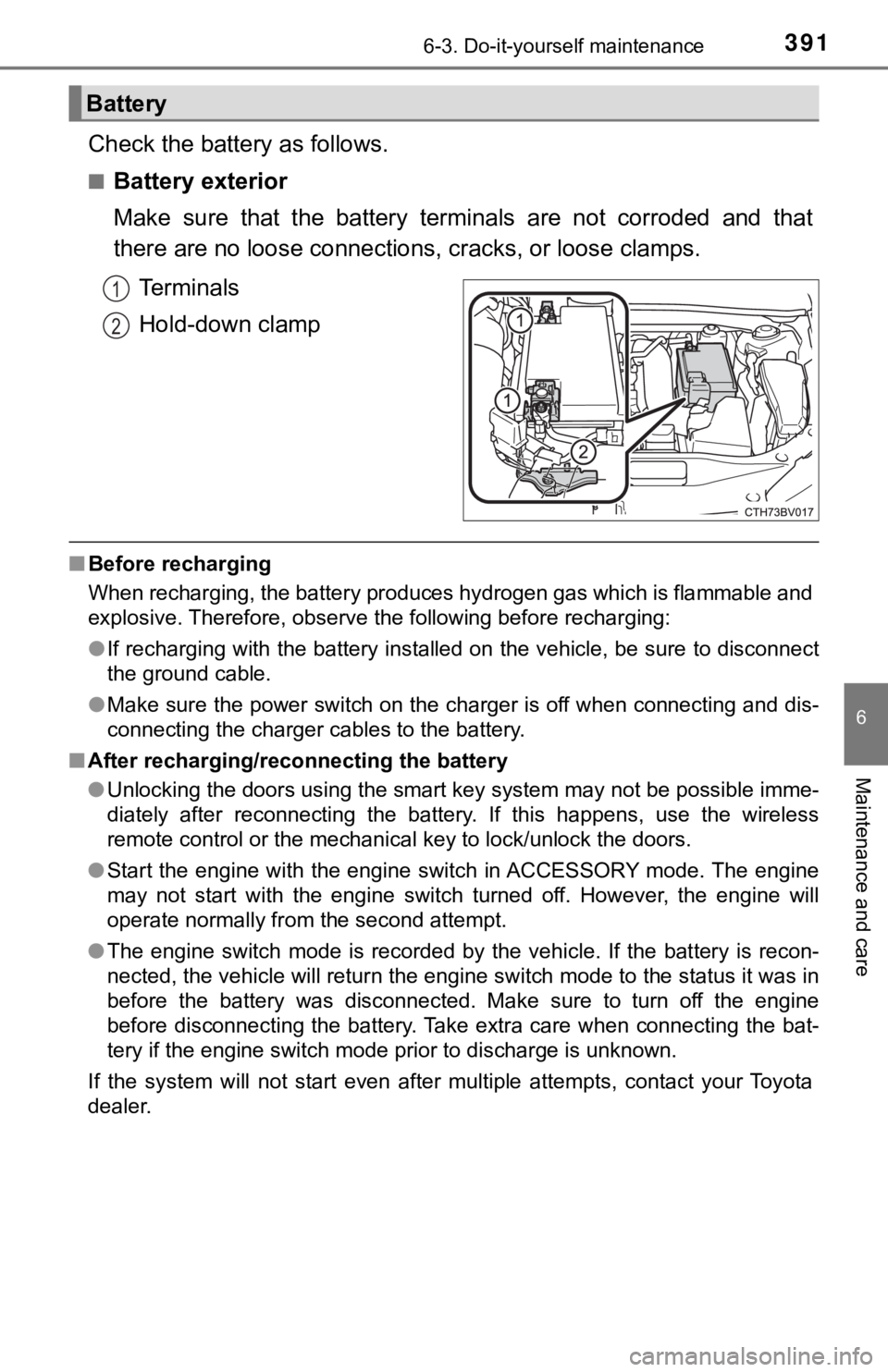
Check the battery as follows.
■Battery exterior
Make sure that the battery terminals are not corroded and that
there are no loose connections, cracks, or loose clamps.
Terminals
Hold-down clamp
■Before recharging
When recharging, the battery produces hydrogen gas which is flammable and
explosive. Therefore, observe the following before recharging:
●If recharging with the battery installed on the vehicle, be sure to disconnect
the ground cable.
●Make sure the power switch on the charger is off when connecting and dis-
connecting the charger cables to the battery.
■After recharging/reconnecting the battery
●Unlocking the doors using the smart key system may not be possible imme-
diately after reconnecting the battery. If this happens, use the wireless
remote control or the mechanical key to lock/unlock the doors.
●Start the engine with the engine switch in ACCESSORY mode. The engine
may not start with the engine switch turned off. However, the engine will
operate normally from the second attempt.
●The engine switch mode is recorded by the vehicle. If the battery is recon-
nected, the vehicle will return the engine switch mode to the status it was in
before the battery was disconnected. Make sure to turn off the engine
before disconnecting the battery. Take extra care when connecting the bat-
tery if the engine switch mode prior to discharge is unknown.
If the system will not start even after multiple attempts, contact your Toyota
dealer.
Battery
1
2
Page 463 of 548
4637-2. Steps to take in an emergency
7
When trouble arises
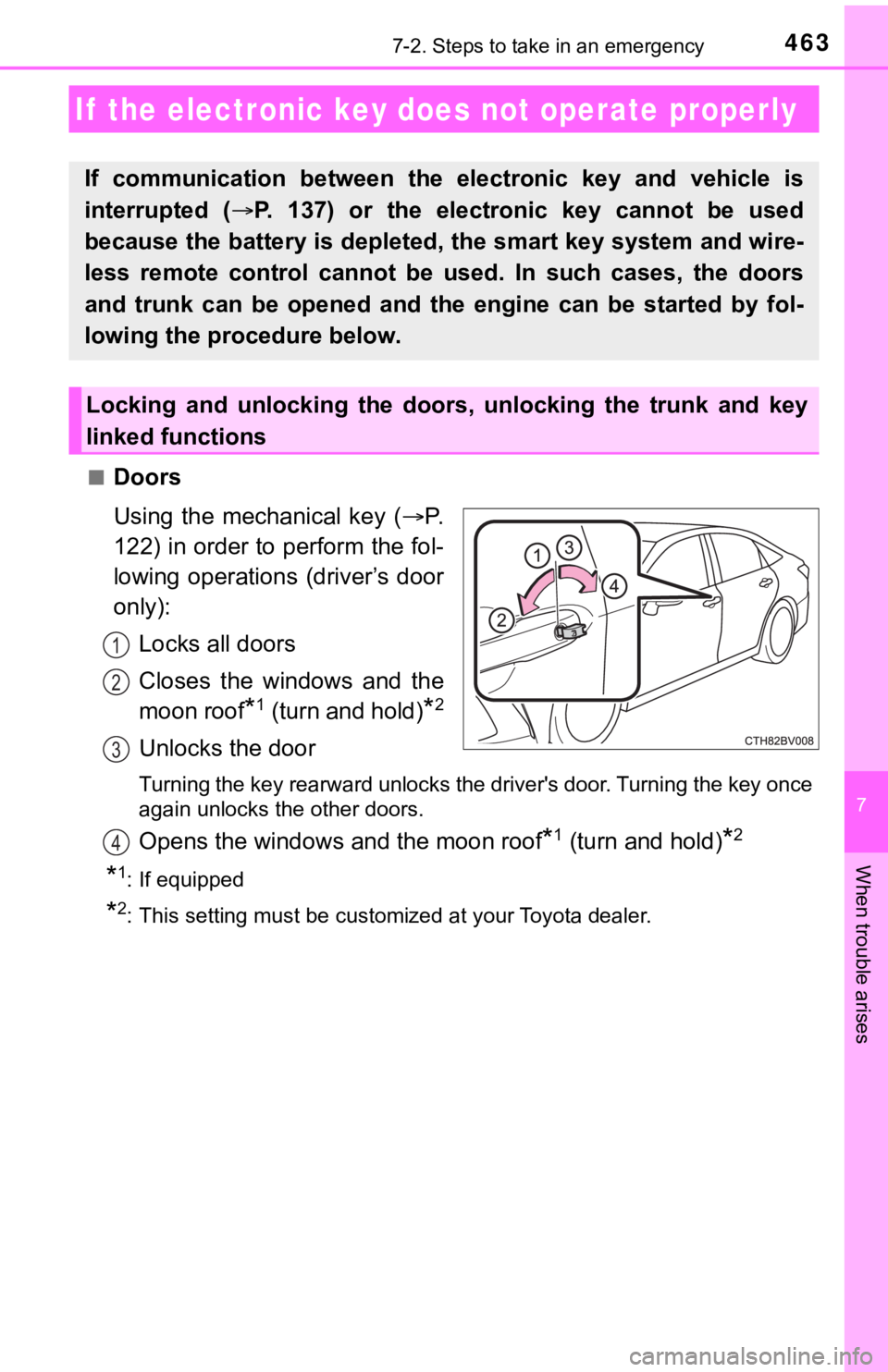
■Doors
Using the mechanical key (P.
122) in order to perform the fol-
lowing operations (driver’s door
only):
Locks all doors
Closes the windows and the
moon roof
*1 (turn and hold)*2
Unlocks the door
Turning the key rearward unlocks the driver's door. Turning the key once
again unlocks the other doors.
Opens the windows and the moon roof*1 (turn and hold)*2
*1: If equipped
*2: This setting must be customized at your Toyota dealer.
If the electronic key does not operate properly
If communication between the electronic key and vehicle is
interrupted (P. 137) or the electronic key cannot be used
because the battery is depleted, the smart key system and wire-
less remote control cannot be used. In such cases, the doors
and trunk can be opened and the engine can be started by fol-
lowing the procedure below.
Locking and unlocking the doors, unlocking the trunk and key
linked functions
1
2
3
4
Page 469 of 548

4697-2. Steps to take in an emergency
7
When trouble arises
■Starting the engine when the battery is discharged
The engine cannot be started by push-starting.
■To prevent battery discharge
●Turn off the headlights and the audio system while the engine is off.
●Turn off any unnecessary electrical components when the vehicle is running
at a low speed for an extended period, such as in heavy traffic.
■When the battery is removed or discharged
●Information stored in the ECU is cleared. When the battery is depleted, have
the vehicle inspected at your Toyota dealer.
●Some systems may require initialization. (P. 513)
■When removing the battery terminals
When the battery terminals are removed, the information stored in the ECU is
cleared. Before removing the battery terminals, contact your Toyota dealer.
■Charging the battery
The electricity stored in the battery will discharge gradually even when the
vehicle is not in use, due to natural discharge and the draining effects of cer-
tain electrical appliances. If the vehicle is left for a long time, the battery may
discharge, and the engine may be unable to start. (The battery recharges
automatically during driving.)
■When recharging or replacing the battery
●In some cases, it may not be possible to unlock the doors using the smart
key system when the battery is discharged. Use the wireless remote control
or the mechanical key to lock or unlock the doors.
●The engine may not start on the first attempt after the battery has recharged
but will start normally after the second attempt. This is not a malfunction.
●The engine switch mode is memorized by the vehicle. When the battery is
reconnected, the system will return to the mode it was in before the battery
was discharged. Before disconnecting the battery, turn the engine switch off.
If you are unsure what mode the engine switch was in before the battery dis-
charged, be especially careful when reconnecting the battery.
■When replacing the battery
●Use a battery that conforms to European regulations.
●Use a battery that the case size is same as the previous one (LN3), 20 hour
rate capacity (20HR) is equivalent (70Ah) or greater, and performance rating
(CCA) is equivalent (603A) or greater.
• If the sizes differ, the battery cannot be properly secured.
• If the 20 hour rate capacity is low, even if the time period where the vehi-
cle is not used is a short time, the battery may discharge and the engine
may not be able to start.
●For details, consult your Toyota dealer.
Page 532 of 548
532What to do if... (Troubleshooting)
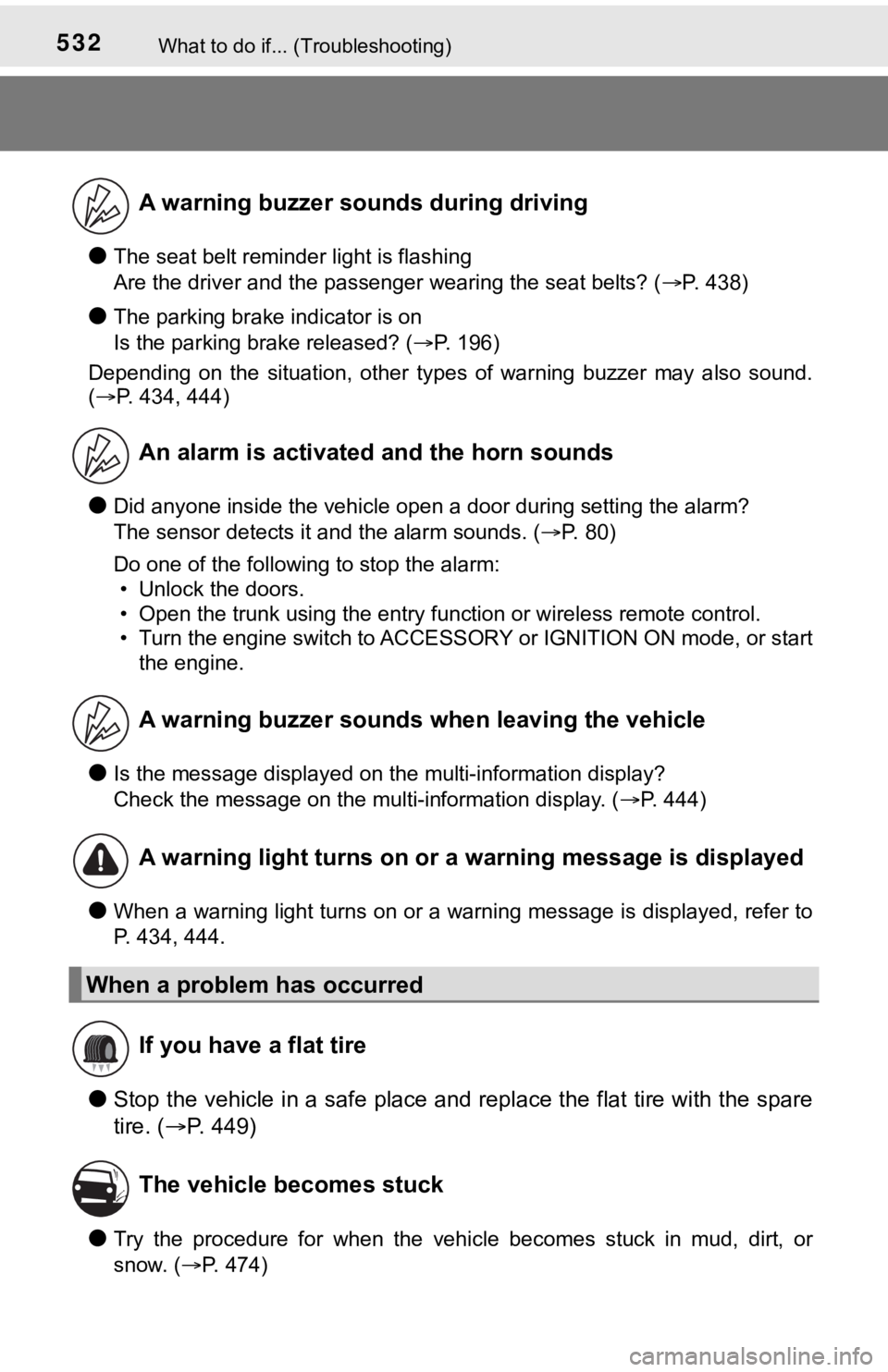
●The seat belt reminder light is flashing
Are the driver and the passenger wearing the seat belts? (P. 438)
●The parking brake indicator is on
Is the parking brake released? (P. 196)
Depending on the situation, other types of warning buzzer may also sound.
(P. 434, 444)
●Did anyone inside the vehicle open a door during setting the alarm?
The sensor detects it and the alarm sounds. (P. 80)
Do one of the following to stop the alarm:
• Unlock the doors.
• Open the trunk using the entry function or wireless remote control.
• Turn the engine switch to ACCESSORY or IGNITION ON mode, or start
the engine.
●Is the message displayed on the multi-information display?
Check the message on the multi-information display. (P. 444)
●When a warning light turns on or a warning message is displayed, refer to
P. 434, 444.
●Stop the vehicle in a safe place and replace the flat tire with the spare
tire. (P. 449)
●Try the procedure for when the vehicle becomes stuck in mud, dirt, or
snow. (P. 474)
A warning buzzer sounds during driving
An alarm is activated and the horn sounds
A warning buzzer sounds when leaving the vehicle
A warning light turns on or a warning message is displayed
When a problem has occurred
If you have a flat tire
The vehicle becomes stuck
Page 535 of 548
535Alphabetical index
Child safety ................................ 55
Airbag precautions .................. 39
Battery precautions ....... 392, 470
Child restraint system ............. 56
How your child should wear
the seat belt .......................... 32
Installing child restraints ......... 60
Moon roof precautions .......... 167
Power window lock switch .... 160
Power window precautions ... 163
Rear door child-protectors .... 128
Removed electronic key
battery precautions ............. 416
Seat belt extender
precautions ........................... 35
Seat belt precautions .............. 34
Seat heater precautions........ 329
Trunk precautions ................. 133
Child-protectors....................... 128
Cleaning ........................... 366, 369
Exterior ................................. 366
Interior................................... 369
Seat belts .............................. 370
Wheels and wheel
ornaments .......................... 367
Coat hooks ............................... 356
Condenser ................................ 389
Connected Services
*
Console box ............................. 336
Consumption
screen............................... 97, 116
Coolant
Capacity ................................ 483
Checking ............................... 388
Preparing and checking
before winter....................... 317
Cooling system ........................ 388
Engine overheating ............... 471
Cornering lights ....................... 203
Cruise control
Dynamic radar cruise control
with full-speed range .......... 247Cup holders ............................. 338
Curtain shield airbags............... 37
Customizable features ............ 505
Customized mode ................... 305
Daytime running light
system.................................... 204
Defogger
Outside rear view mirrors ..... 324
Rear window ......................... 324
Windshield ............................ 324
Dimensions .............................. 478
Dinghy towing.......................... 183
Display
Dynamic radar cruise control
with full-speed range .......... 247
LDA (Lane Departure Alert
with steering control) .......... 242
Multi-information display ......... 93
Warning messages ............... 444
Do-it-yourself maintenance .... 379
Door courtesy lights
Location ................................ 332
Wattage ................................ 488
Door lock
Doors .................................... 125
Smart key system ................. 125
Wireless remote control ........ 125
Doors ........................................ 125
Automatic door locking
and unlocking systems ....... 128
Door lock .............................. 127
Outside rear view mirrors ..... 157
Rear door child-protector ...... 128
Side doors ............................ 125
Side windows........................ 160
Drive-Start Control .................. 171
Driver’s seat belt
reminder light ........................ 438
D
*: Refer to the “NAVIGATION AND MULTIMEDIA SYSTEM
OWNER’S MANUAL”.