fuel TOYOTA AVALON HYBRID 2020 (in English) Service Manual
[x] Cancel search | Manufacturer: TOYOTA, Model Year: 2020, Model line: AVALON HYBRID, Model: TOYOTA AVALON HYBRID 2020Pages: 560, PDF Size: 11.03 MB
Page 400 of 560
4006-3. Do-it-yourself maintenance
Tire inflation
pressure
( P. 427)• Tire pressure gauge
• Compressed air source
Washer fluid
( P. 410)• Water or washer fluid containing antifreeze (for win-
ter use)
• Funnel (used only for adding water or washer fluid)
WARNING
The engine compartment contains many mechanisms and fluids that may
move suddenly, become hot, or become electrically energized. To avoid death
or serious injury, observe the following precautions.
■ When working on the engine compartment
● Make sure that the “ACCESSORY” or “IGNITION ON” on the multi-in for-
mation display and the “READY” indicator are both off.
● Keep hands, clothing and tools away from the moving fan and eng ine
drive belt.
● Be careful not to touch the engine, power control unit, radiator, exhaust
manifold, etc. right after driving as they may be hot. Oil and other fluids
may also be hot.
● Do not leave anything that may burn easily, such as paper and r ags, in the
engine compartment.
● Do not smoke, cause sparks or expose an open flame to fuel. Fuel fumes
are flammable.
■ When working near the electric cooling fan or radiator grille
Be sure the power switch is off.
With the power switch in ON mode, the electric cooling fan may automati-
cally start to run if the air conditioning is on and/or the coo lant temperature
is high. ( P. 408)
■ Safety glasses
Wear safety glasses to prevent flying or falling material, fluid spray, etc.
from getting in your eyes.
NOTICE
■If you remove the air cleaner filter
Driving with the air cleaner filter removed may cause excessive engine wear
due to dirt in the air.
ItemsParts and tools
Page 428 of 560
4286-3. Do-it-yourself maintenance
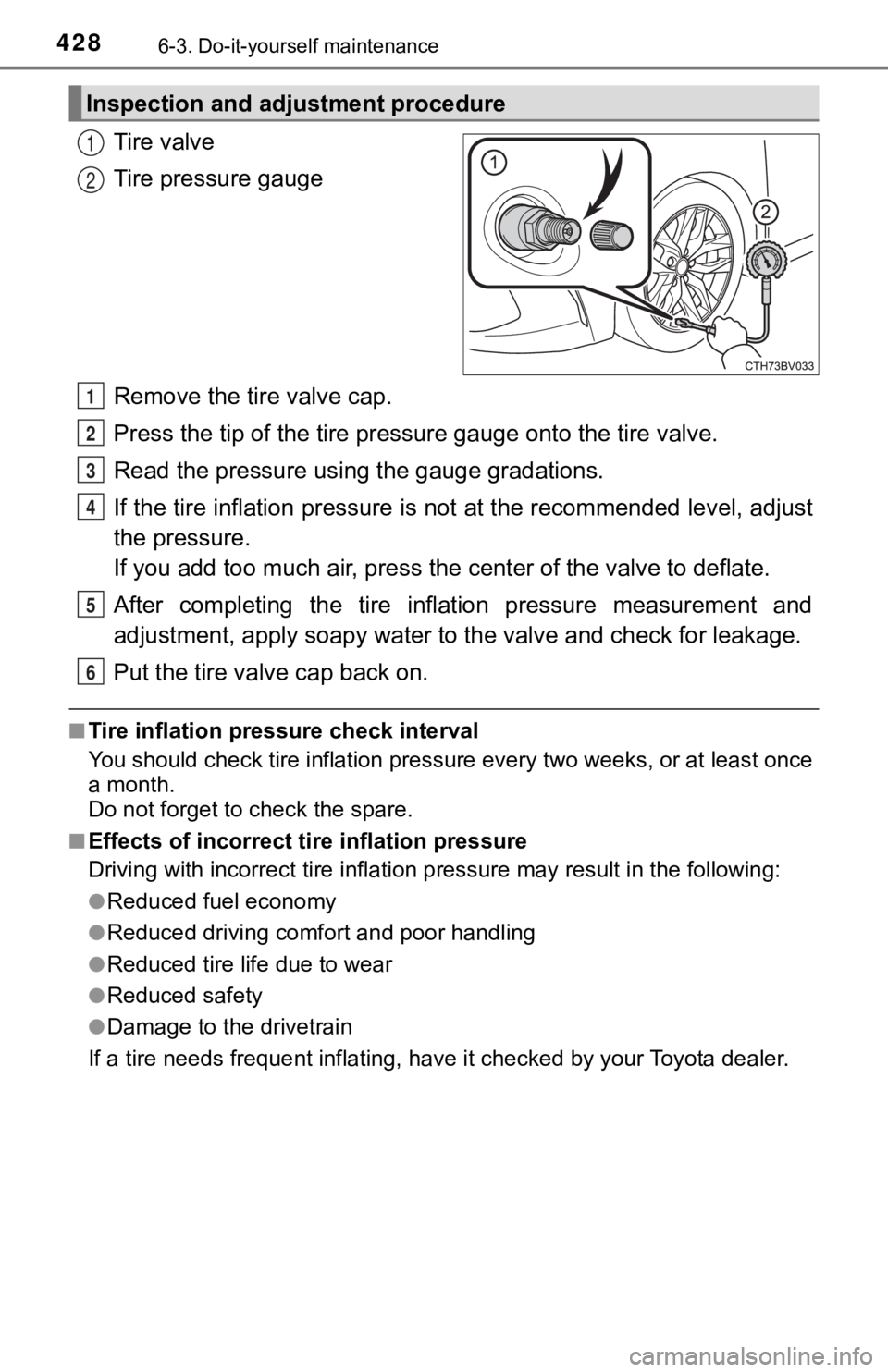
Tire valve
Tire pressure gauge
Remove the tire valve cap.
Press the tip of the tire pressure gauge onto the tire valve.
Read the pressure using the gauge gradations.
If the tire inflation pressure is not at the recommended level, adjust
the pressure.
If you add too much air, press the center of the valve to defla te.
After completing the tire inflation pressure measurement and
adjustment, apply soapy water to the valve and check for leakage.
Put the tire valve cap back on.
■Tire inflation pressure check interval
You should check tire inflation p ressure every two weeks, or at least once
a month.
Do not forget to check the spare.
■Effects of incorrect tire inflation pressure
Driving with incorrec t tire inflation pressure may result in th e following:
●Reduced fuel economy
●Reduced driving comfort and poor handling
●Reduced tire life due to wear
●Reduced safety
●Damage to the drivetrain
If a tire needs frequent inflating , have it checked by your Toyota dealer.
Inspection and adjustment procedure
1
2
1
2
3
4
5
6
Page 434 of 560
4346-3. Do-it-yourself maintenance
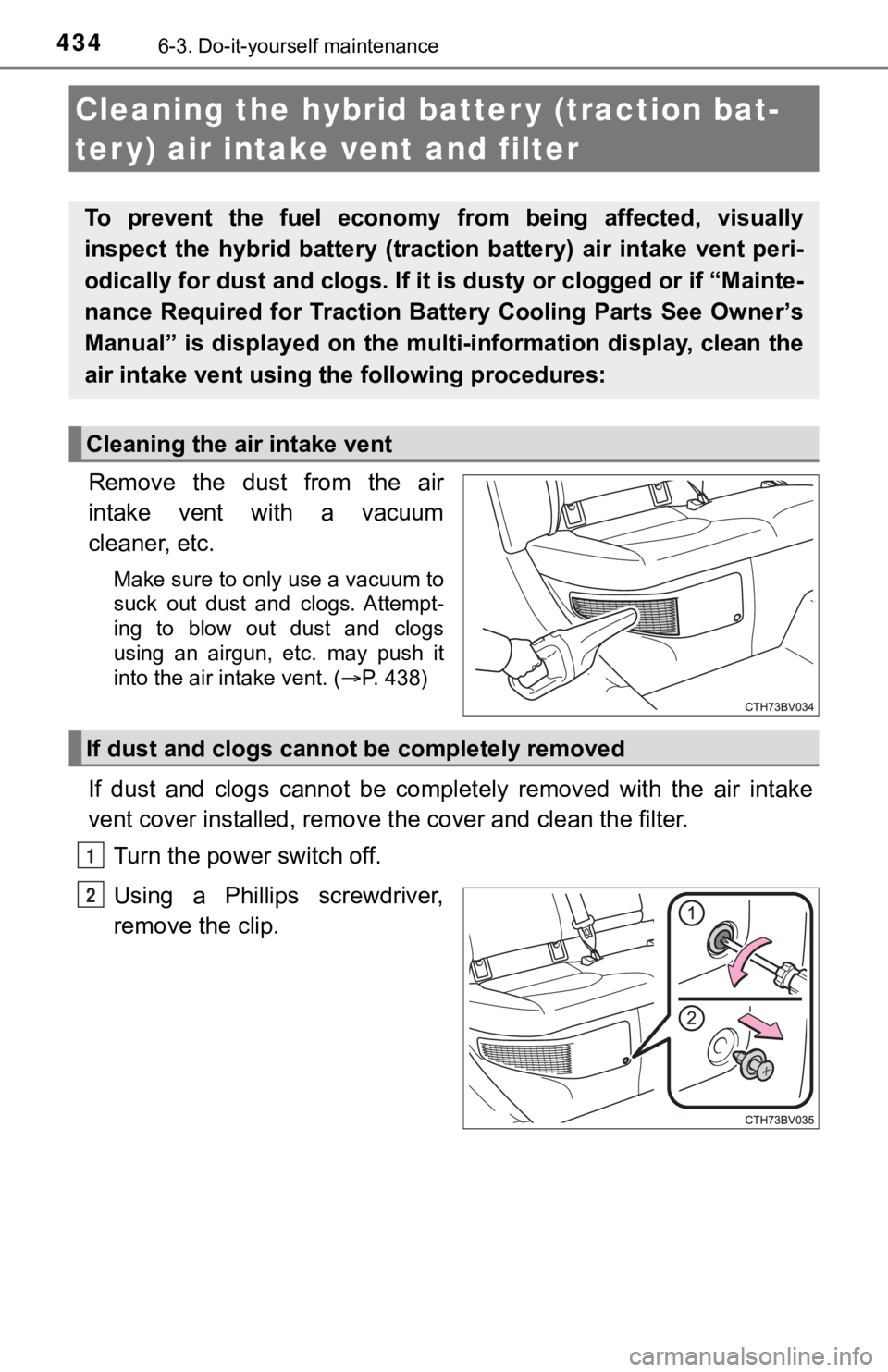
Remove the dust from the air
intake vent with a vacuum
cleaner, etc.
Make sure to only use a vacuum to
suck out dust and clogs. Attempt-
ing to blow out dust and clogs
using an airgun, etc. may push it
into the air intake vent. (P. 4 3 8 )
If dust and clogs cannot be completely removed with the air int ake
vent cover installed, remove t he cover and clean the filter.
Turn the power switch off.
Using a Phillips screwdriver,
remove the clip.
Cleaning the hybrid batter y (traction bat-
ter y) air intake vent and filter
To prevent the fuel economy from being affected, visually
inspect the hybrid battery (traction battery) air intake vent p eri-
odically for dust and clogs. If i t is dusty or clogged or if “Mainte-
nance Required for Traction Battery Cooling Parts See Owner’s
Manual” is displayed on the multi-information display, clean the
air intake vent using the following procedures:
Cleaning the air intake vent
If dust and clogs cannot be completely removed
1
2
Page 437 of 560
4376-3. Do-it-yourself maintenance
6
Maintenance and care
■Scheduled maintenance of the air intake vent is necessary when
In some situations such as when the vehicle is used frequently or in heavy
traffic or dusty areas, the air intake vent may need to be clea ned more regu-
larly. For details, refer to “Schedule maintenance guide” or “O wner’s Manual
Supplement”.
■ Cleaning the air intake vent
●Dust in the air intake vent may interfere with the cooling of t he hybrid battery
(traction battery). If charging/discharging of the hybrid batte ry (traction bat-
tery) becomes limited, the distance that the vehicle can be dri ven using the
electric motor (traction motor) may be reduced and the fuel eco nomy may
be reduced.
● Improper handling of the air intake vent cover and filter may result in dam-
age to them. If you have any concerns about cleaning the filter , contact your
Toyota dealer.
■ If “Maintenance Required for Traction Battery Cooling Parts See Owner’s
Manual” is displayed on the multi-information display
● If this warning message is displayed on the multi-information d isplay,
remove the air intake vent cover and clean the filter. ( P. 434)
● After cleaning the air intake vent, start the hybrid system and check that the
warning message is no longer displayed.
It may take approximately 20 minutes after the hybrid system is started until
the warning message disappears. If the warning message does not disap-
pear, have the vehicle inspected by your Toyota dealer.
WARNING
■When cleaning the air intake vent
● Do not use water or other liquids to clean the air intake vent. If water is
applied to the hybrid battery (traction battery) or other components, a mal-
function or fire may occur.
● Before cleaning the air intake vent, make sure to turn the power switch off
to stop the hybrid system.
■
When removing the air intake vent cover
Do not touch the service plug located near the air intake vent. ( P. 82)
Page 456 of 560
4567-2. Steps to take in an emergency
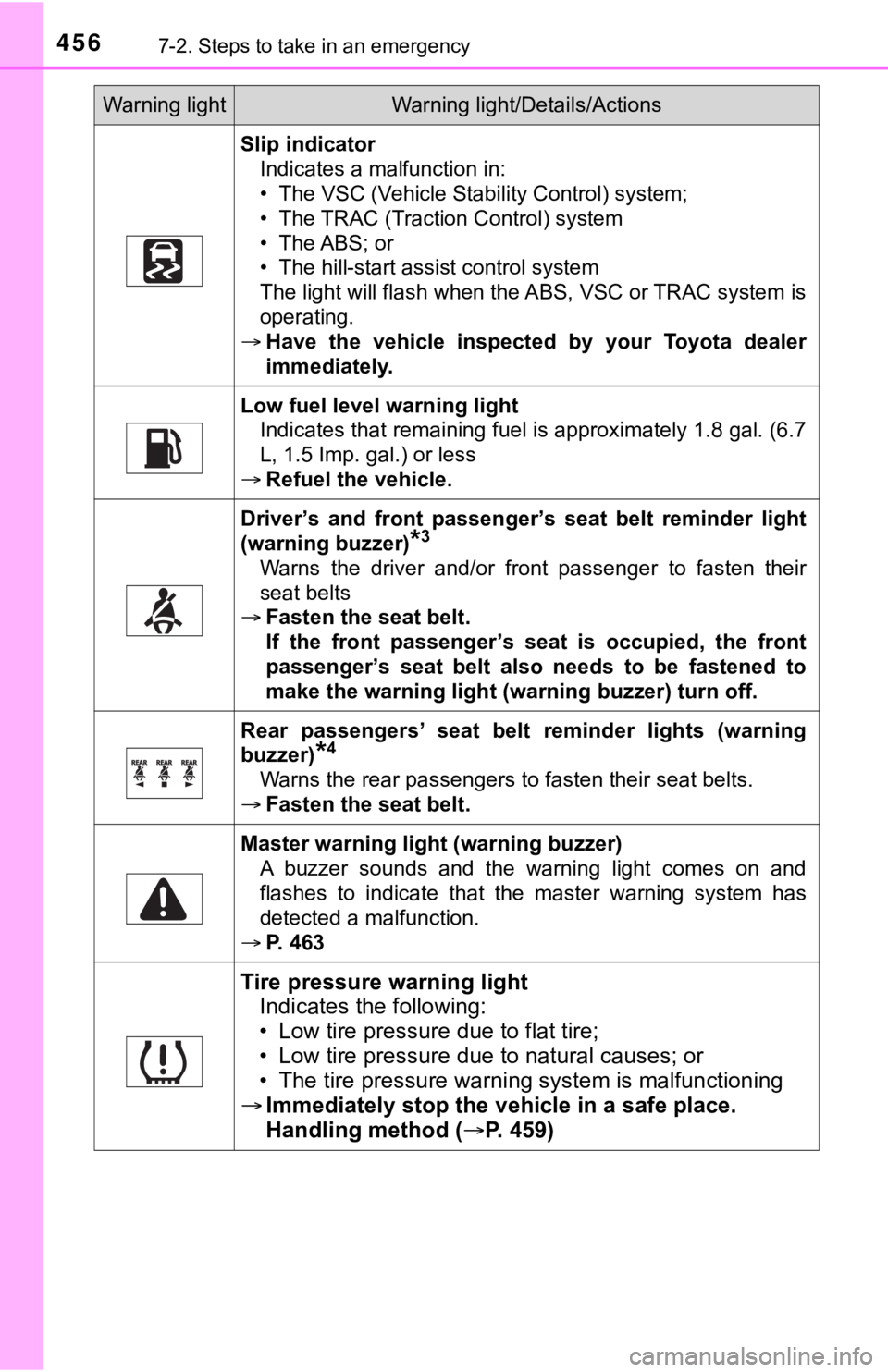
Slip indicatorIndicates a malfunction in:
• The VSC (Vehicle Stability Control) system;
• The TRAC (Traction Control) system
• The ABS; or
• The hill-start assist control system
The light will flash when the ABS, VSC or TRAC system is
operating.
Have the vehicle inspected by your Toyota dealer
immediately.
Low fuel level warning light
Indicates that remaining fuel is approximately 1.8 gal. (6.7
L, 1.5 Imp. gal.) or less
Refuel the vehicle.
Driver’s and front passenger’ s seat belt reminder light
(warning buzzer)
*3
Warns the driver and/or front passenger to fasten their
seat belts
Fasten the seat belt.
If the front passenger’s seat is occupied, the front
passenger’s seat belt also needs to be fastened to
make the warning light (warning buzzer) turn off.
Rear passengers’ seat belt reminder lights (warning
buzzer)
*4
Warns the rear passengers to fasten their seat belts.
Fasten the seat belt.
Master warning light (warning buzzer)
A buzzer sounds and the warning light comes on and
flashes to indicate that the master warning system has
detected a malfunction.
P. 463
Tire pressure warning light
Indicates the following:
• Low tire pressure due to flat tire;
• Low tire pressure due to natural causes; or
• The tire pressure warning system is malfunctioning
Immediately stop the veh icle in a safe place.
Handling method ( P. 4 5 9 )
Warning lightWarning light/Details/Actions
Page 458 of 560

4587-2. Steps to take in an emergency
■SRS warning light
This warning light system monitors the airbag sensor assembly, front impact
sensors, side impact sensors (front door), side impact sensors (front), side
impact sensors (rear), driver’s seat position sensor, driver’s seat belt buckle
switch, front passenger occupant classification system (ECU and sensors),
“AIR BAG ON” indicator light, “A IR BAG OFF” indicator light, seat belt preten-
sioners, airbags, interconnecting wiring and power sources. (P. 36)
■ Front passenger detection sensor, seat belt reminder and warnin g
buzzer
● If luggage is placed on the front passenger seat, the front pas senger detec-
tion sensor may cause the warning light to flash and the warnin g buzzer to
sound even if a passenger is not sitting in the seat.
● If a cushion is placed on the seat, the sensor may not detect a passenger,
and the warning light may not operate properly.
■ If the malfunction indicator lamp comes on while driving
First check the following:
●Is the fuel tank empty?
If it is, fill the fuel tank immediately.
● Is the fuel tank cap loose?
If it is, tighten it securely.
The light will go off after several driving trips.
If the light does not go off even after several trips, contact your Toyota dealer
as soon as possible.
■ Electric power steering system w arning light (warning buzzer)
When the 12-volt battery charge becomes insufficient or the vol tage tempo-
rarily drops, the electric power steering system warning light may come on
and the warning buzzer may sound.
Page 461 of 560

4617-2. Steps to take in an emergency
7
When trouble arises
WARNING
■Maintenance of the tires
Each tire, including the spare (if provided), should be checked monthly
when cold and inflated to the inflation pressure recommended by the
vehicle manufacturer on the vehicle placard or tire inflation p ressure
label (tire and load information label). (If your vehicle has t ires of a dif-
ferent size than the size indica ted on the vehicle placard or tire inflation
pressure label [tire and load information label], you should de termine
the proper tire inflation p ressure for those tires.)
As an added safety feature, your vehicle has been equipped with a tire
pressure monitoring system (TPMS -tire pressure warning system) that
illuminates a low tire pressure telltale (tire pressure warning light) when
one or more of your tires is significantly under-inflated. Acco rdingly,
when the low tire pressure telltale (tire pressure warning ligh t) illumi-
nates, you should stop and check your tires as soon as possible , and
inflate them to the proper pressure. Driving on a significantly under-
inflated tire causes the tire to overheat and can lead to tire failure.
Under-inflation also reduces fuel efficiency and tire tread lif e, and may
affect the vehicle’s handl ing and stopping ability.
Please note that the TPMS (tire pressure warning system) is not a sub-
stitute for proper tire maintena nce, and it is the driver’s responsibility to
maintain correct tire pressure, even if under-inflation has not reached
the level to trigger illumination of the TPMS low tire pressure telltale (tire
pressure warning light).
Your vehicle has also been equipped with a TPMS (tire pressure warn-
ing system) malfunction indicato r to indicate when the system is not
operating properly. The TPMS (tire pressure warning system) mal func-
tion indicator is combined with the low tire pressure telltale (tire pressure
warning light). When the system detects a malfunction, the tell tale will
flash for approximately one mi nute and then remain continuously illumi-
nated. This sequence will continue upon subsequent vehicle star t-ups
as long as the malfunction exists . When the malfunction indicator is illu-
minated, the system may not be able to detect or signal low tir e pres-
sure as intended.
TPMS (tire pressure warning system) malfunctions may occur for a vari-
ety of reasons, including the installation of replacement or al ternate tires
or wheels on the vehicle that prevent the TPMS (tire pressure w arning
system) from functioning properly. Always check the TPMS (tire pres-
sure warning system) malfunction telltale after replacing one or more
tires or wheels on your vehicle to ensure that the replacement or alter-
nate tires and wheels allow the TPMS (tire pressure warning sys tem) to
continue to function properly.
Page 465 of 560

4657-2. Steps to take in an emergency
7
When trouble arises
■Warning messages
The warning messages explained below may differ from the actual messages
according to operation conditions and vehicle specifications.
■ System warning lights
The master warning light does not come on or flash in the following cases.
Instead, a separate system warning light will come on along wit h a message
shown on the multi-information display.
● Malfunction in the ABS
The ABS warning light comes on. ( P. 454)
● Malfunction in the brake system
The brake system warning light (yellow) comes on. ( P. 453)
● Malfunction in the tire pressure warning system
The tire pressure warning light comes on. ( P. 456)
● Remaining fuel level is low
The low fuel level warning light comes on. ( P. 456)
■ If a message instructing to refer to the Owner’s Manual is disp layed
● If the following messages are shown, there may be a malfunction .
Immediately stop the vehicle in a safe place and contact your T oyota dealer.
Continuing to drive the vehicle may be dangerous.
• “Low Braking Power Stop in a Safe Place See Owner’s Manual”
• “Oil Pressure Low Stop in a Safe Place See Owner’s Manual”
• “Charging System Malfunction Stop in a Safe Place See Owner’s Man-
ual”
● If the following message is shown, there may be a malfunction.
Immediately have the vehicle inspected by your Toyota dealer.
• “Hybrid System Malfunction”
• “Check Engine”
• “Hybrid Battery System Malfunction”
• “Accelerator System Malfunction”
• “Smart Key System Malfunction”
● If “Engine Coolant Temp High Stop in a Safe Place See Owner’s Manual” is
displayed, follow the instructions accordingly. ( P. 492)
● If “Maintenance Required for Traction Battery Cooling Parts See Owner’s
Manual” is displayed, follow the instructions accordingly. ( P. 434)
Page 480 of 560
4807-2. Steps to take in an emergency
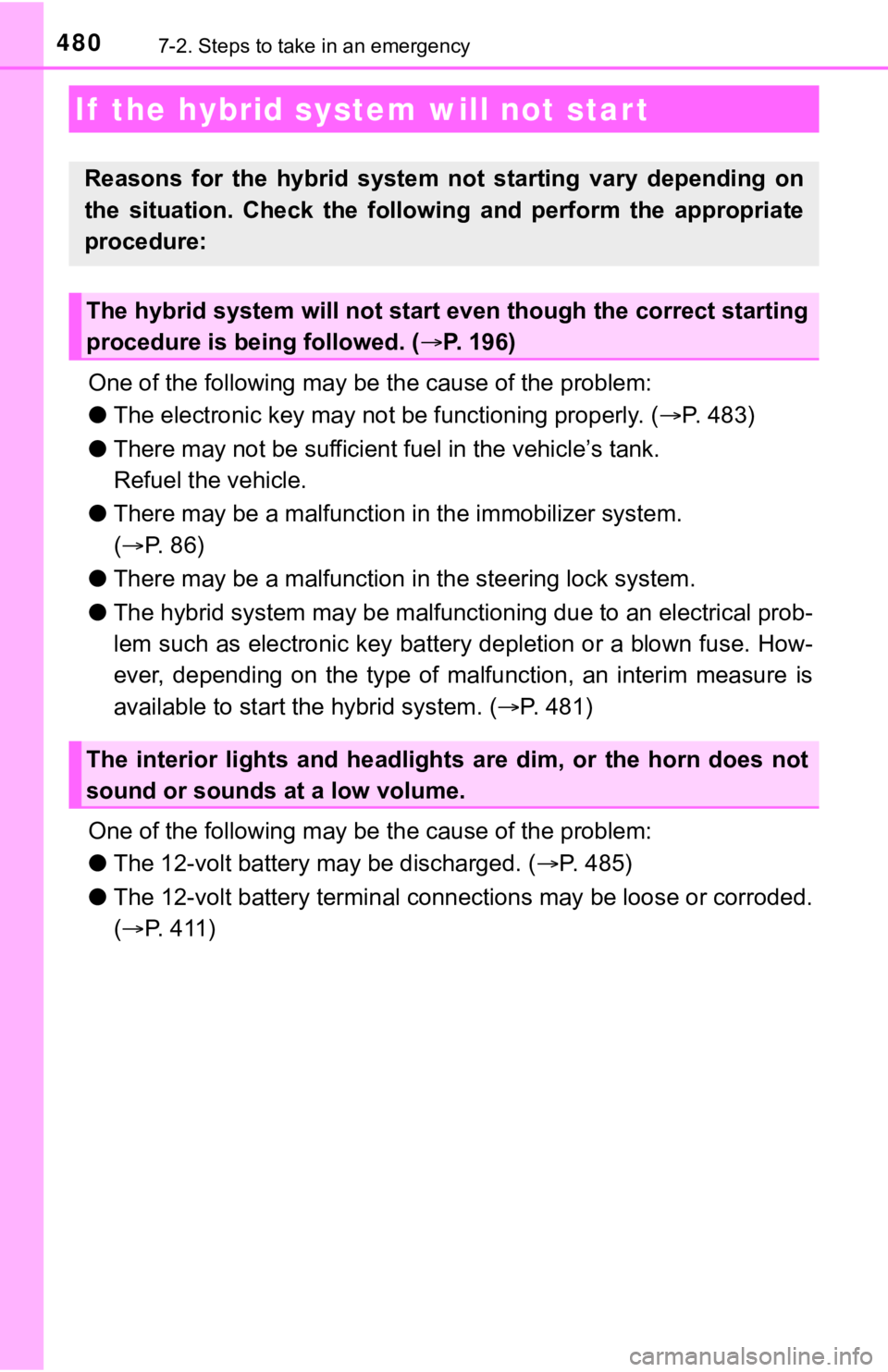
One of the following may be the cause of the problem:
● The electronic key may not be functioning properly. (P. 483)
● There may not be sufficient f uel in the vehicle’s tank.
Refuel the vehicle.
● There may be a mal function in the immobilizer system.
( P. 86)
● There may be a malfunction i n the steering lock system.
● The hybrid system may be malfunc tioning due to an electrical prob-
lem such as electronic key battery depletion or a blown fuse. H ow-
ever, depending on the type of malfunction, an interim measure is
available to start the hybrid system. ( P. 481)
One of the following may be the cause of the problem:
● The 12-volt battery may be discharged. ( P. 485)
● The 12-volt battery terminal conn ections may be loose or corroded.
( P. 411)
If the hybrid system will not start
Reasons for the hybrid system not starting vary depending on
the situation. Check the followi ng and perform the appropriate
procedure:
The hybrid system will not start even though the correct starting
procedure is being followed. ( P. 1 9 6 )
The interior lights and headlights are dim, or the horn does no t
sound or sounds at a low volume.
Page 499 of 560

499
8Vehicle specifications
8-1. SpecificationsMaintenance data (fuel, oil level, etc.) .......... 500
Fuel information ................ 508
Tire information ................. 511
8-2. Customization Customizable features ...... 524
8-3. Items to initialize Items to initialize ............... 533