belt TOYOTA AYGO 2013 (in English) Owner's Manual
[x] Cancel search | Manufacturer: TOYOTA, Model Year: 2013, Model line: AYGO, Model: TOYOTA AYGO 2013Pages: 372, PDF Size: 14.28 MB
Page 92 of 372
92
1-7. Safety information
AYGO_WE_99G80E
Child restraint systems
Points to remember
Studies have shown that installing a child restraint on a rear seat is
much safer than installing one on the front passenger seat.
Choose a child restraint system that suits your vehicle and is
appropriate to the age and size of the child.
For installation details, follow the instructions provided with the
child restraint system.
General installation instructions are provided in this manual.
(P. 103)
If child restraint system regulations exist in the country where you
reside, please contact any authorized Toyota dealer or repairer, or
another duly qualified and equipped professional for the child
restraint system installation.
Toyota recommends that you use a child restraint system which
conforms to the regulation ECE No.44.
Types of child restraints
Child restraint systems are classified into the following 5 groups
according to the regulation ECE No.44:
Group 0: Up to 10 kg (22 lb.) (0 - 9 months)
Group 0
+: Up to 13 kg (28 lb.) (0 - 2 years)
Group I: 9 to 18 kg (20 to 39 lb.) (9 months - 4 years)
Group II: 15 to 25 kg (34 to 55 lb.) (4 years - 7 years)
Group III: 22 to 36 kg (49 to 79 lb.) (6 years - 12 years)
In this owner’s manual, the following 3 types of popular child restraint
systems that can be secured with the seat belts are explained:
Toyota strongly urges the use of child restraint systems.
Page 100 of 372
100 1-7. Safety information
AYGO_WE_99G80E
When installing the child restraint system on the front passenger seat
Selecting an appropriate child restraint system
Use a child restraint system appropriate for the child until the child
becomes large enough to properly wear the vehicle’s seat belt.
If the child is too large for a child restraint system, sit the child on a rear
seat and use the vehicle’s seat belt. (P. 59)
CAUTION
Using a child restraint system
The use of a child restraint system not suitable for the vehicle may not prop-
erly secure the infant or child. It may result in death or serious injury (in the
event of sudden braking or an accident).
Child restraint precautions
For effective protection in automobile accidents and sudden stops, a child
must be properly restrained, using a seat belt or child restraint system
depending on the age and size of the child. Holding a child in your arms is
not a substitute for a child restraint system. In an accident, the child can be
crushed against the windshield, or between you and the vehicle’s interior.
Toyota strongly urges the use of a proper child restraint system that con-
forms to the size of the child, installed on the rear seat. According to acci-
dent statistics, the child is safer when properly restrained in the rear seat
than in the front seat.
Never use a rear-facing child restraint system on the front passenger seat
when the airbag manual on-off switch is on. (P. 90)
In the event of an accident, the force of the rapid inflation of the front pas-
senger airbag can cause death or serious injury to the child.
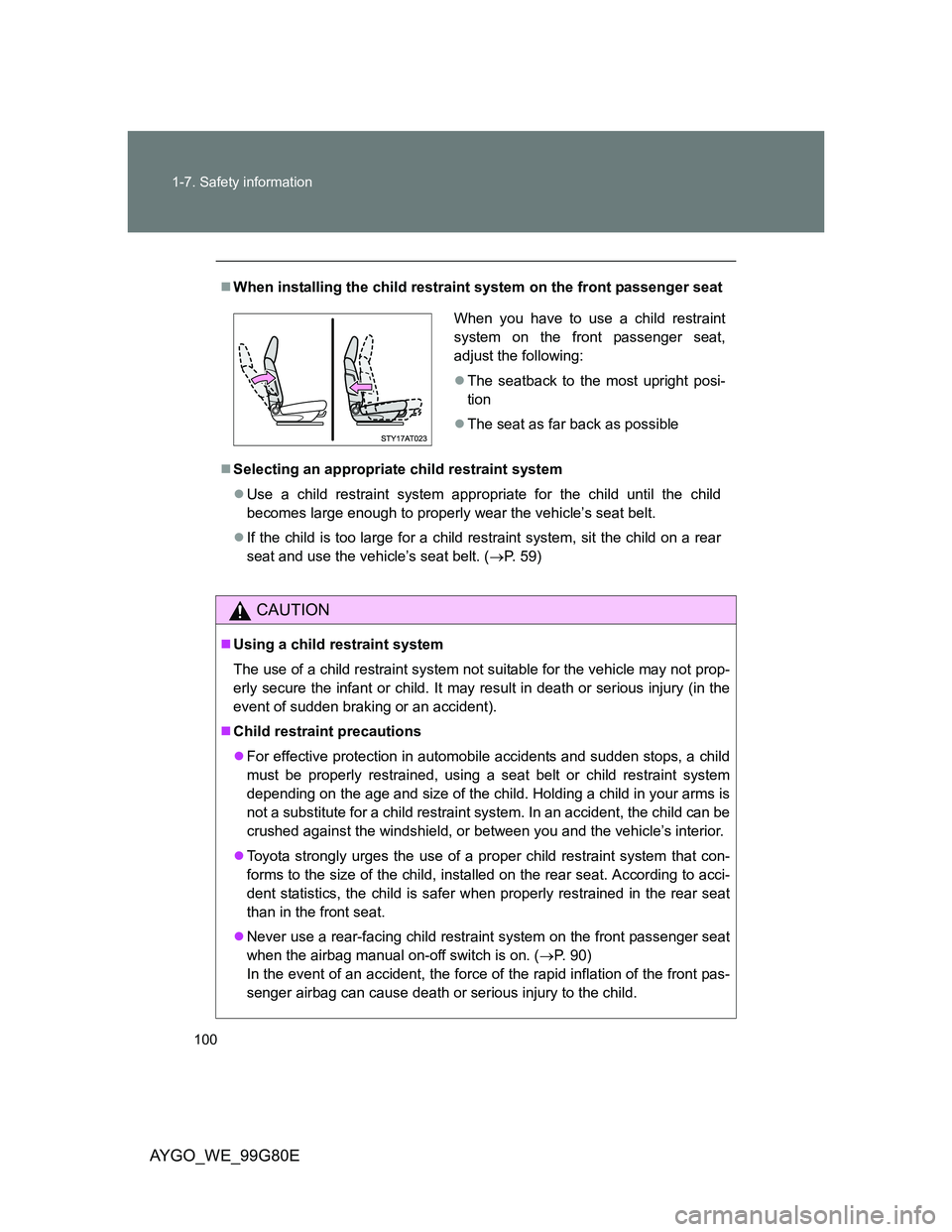
When you have to use a child restraint
system on the front passenger seat,
adjust the following:
The seatback to the most upright posi-
tion
The seat as far back as possible
Page 101 of 372
101 1-7. Safety information
1
Before driving
AYGO_WE_99G80E
CAUTION
Child restraint precautions
A forward-facing child restraint system may be installed on the front pas-
senger seat only when it is unavoidable. A child restraint system that
requires a top tether strap should not be used in the front passenger seat
since there is no top tether strap anchor for the front passenger seat.
Adjust the seatback as upright as possible and always move the seat as
far back as possible because the front passenger airbag could inflate with
considerable speed and force. Otherwise, the child may be killed or seri-
ously injured.
On vehicles with SRS side airbags, do not allow the child to lean his/her
head or any part of his/her body against the door or the area of the seat
from which the side airbags deploy even if the child is seated in the child
restraint system. It is dangerous if the side airbags inflate, and the impact
could cause death or serious injury to the child.
On vehicles with SRS side and curtain shield airbags, do not allow the
child to lean his/her head or any part of his/her body against the door or
the area of the seat, front and rear pillars or roof side rails from which the
SRS side airbags or SRS curtain shield airbags deploy even if the child is
seated in the child restraint system. It is dangerous if the SRS side airbags
and SRS curtain shield airbags inflate, and the impact could cause death
or serious injury to the child.
Make sure you have complied with all installation instructions provided by
the child restraint manufacturer and that the system is properly secured. If
it is not secured properly, it may cause death or serious injury to the child
in the event of a sudden stop, sudden swerve or an accident.
When children are in the vehicle
Do not allow children to play with the seat belt. If the seat belt becomes
twisted around a child’s neck, it may lead to choking or other serious injuries
that could result in death.
If this occurs and the buckle cannot be unfastened, scissors should be used
to cut the belt.
Page 103 of 372
103
1
1-7. Safety information
Before driving
AYGO_WE_99G80E
Installing child restraints
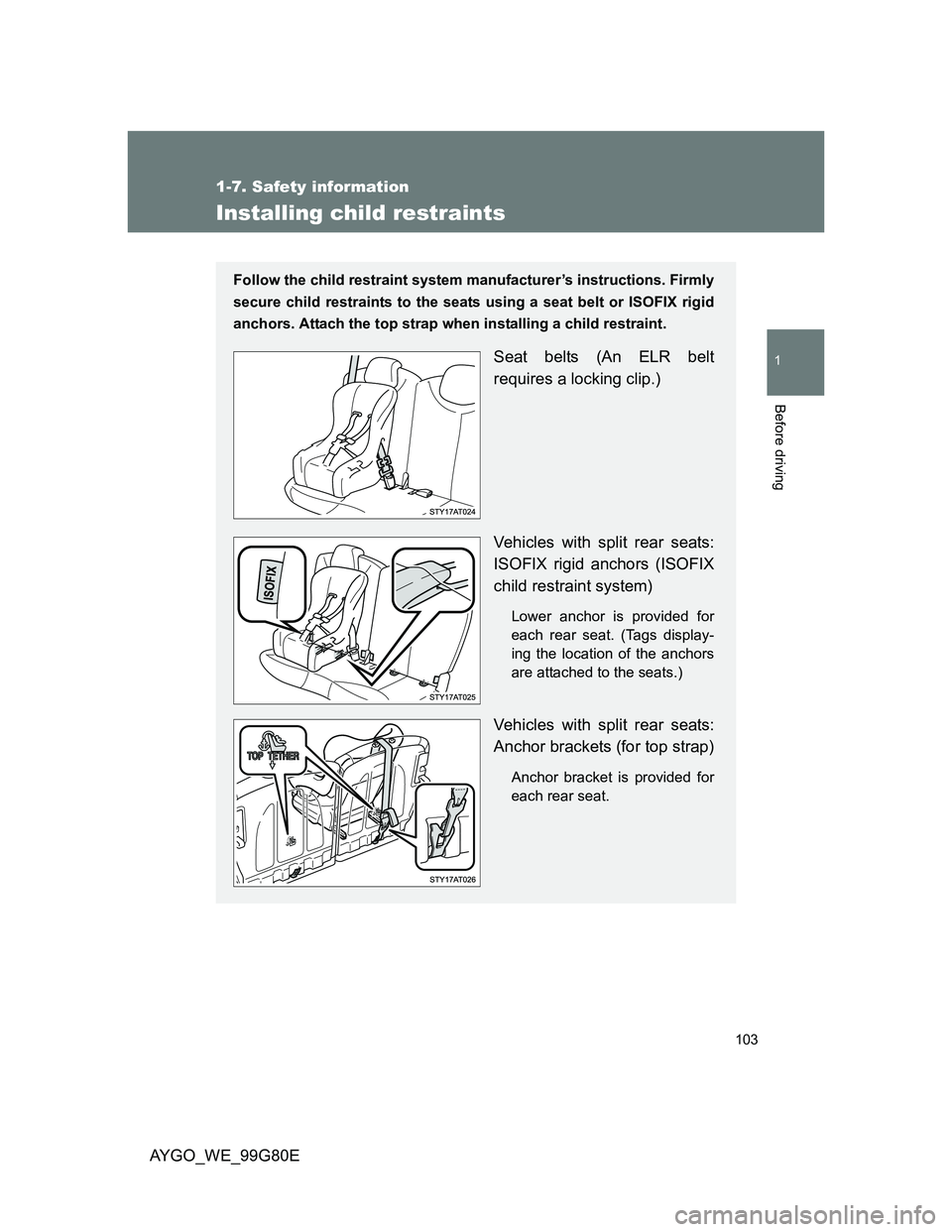
Follow the child restraint system manufacturer’s instructions. Firmly
secure child restraints to the seats using a seat belt or ISOFIX rigid
anchors. Attach the top strap when installing a child restraint.
Seat belts (An ELR belt
requires a locking clip.)
Vehicles with split rear seats:
ISOFIX rigid anchors (ISOFIX
child restraint system)
Lower anchor is provided for
each rear seat. (Tags display-
ing the location of the anchors
are attached to the seats.)
Vehicles with split rear seats:
Anchor brackets (for top strap)
Anchor bracket is provided for
each rear seat.
Page 104 of 372
104 1-7. Safety information
AYGO_WE_99G80E
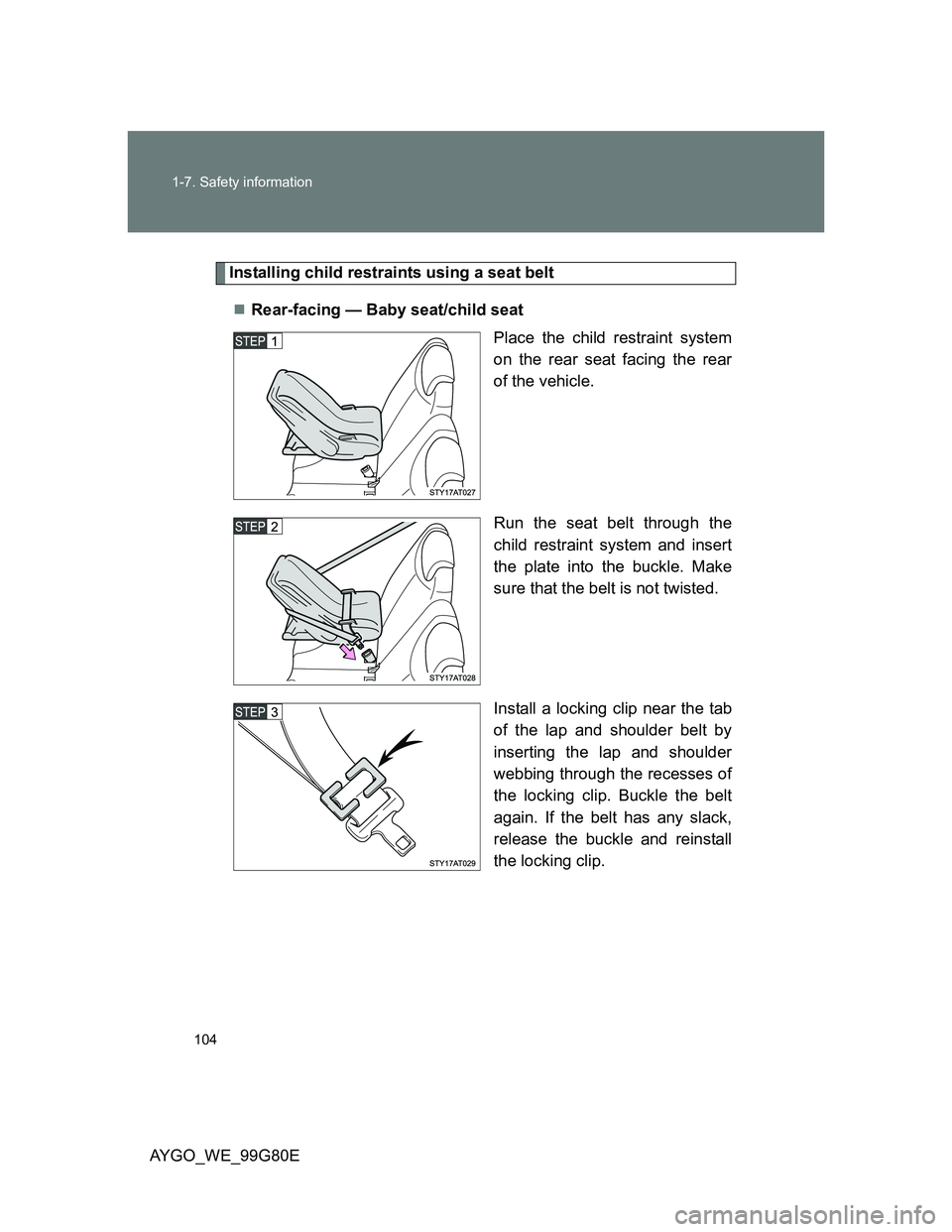
Installing child restraints using a seat belt
Rear-facing — Baby seat/child seat
Place the child restraint system
on the rear seat facing the rear
of the vehicle.
Run the seat belt through the
child restraint system and insert
the plate into the buckle. Make
sure that the belt is not twisted.
Install a locking clip near the tab
of the lap and shoulder belt by
inserting the lap and shoulder
webbing through the recesses of
the locking clip. Buckle the belt
again. If the belt has any slack,
release the buckle and reinstall
the locking clip.
Page 105 of 372
105 1-7. Safety information
1
Before driving
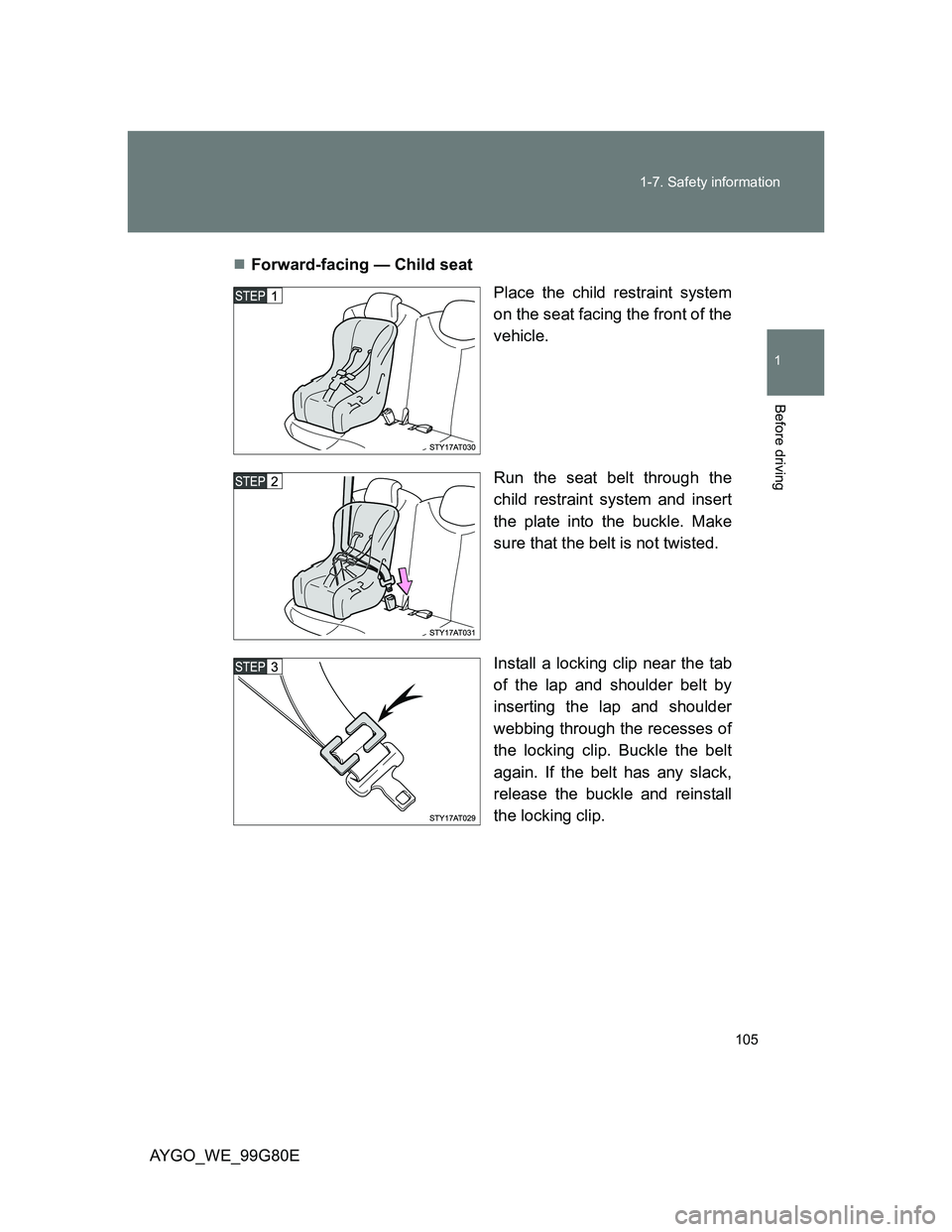
AYGO_WE_99G80EForward-facing — Child seat
Place the child restraint system
on the seat facing the front of the
vehicle.
Run the seat belt through the
child restraint system and insert
the plate into the buckle. Make
sure that the belt is not twisted.
Install a locking clip near the tab
of the lap and shoulder belt by
inserting the lap and shoulder
webbing through the recesses of
the locking clip. Buckle the belt
again. If the belt has any slack,
release the buckle and reinstall
the locking clip.
Page 106 of 372
106 1-7. Safety information
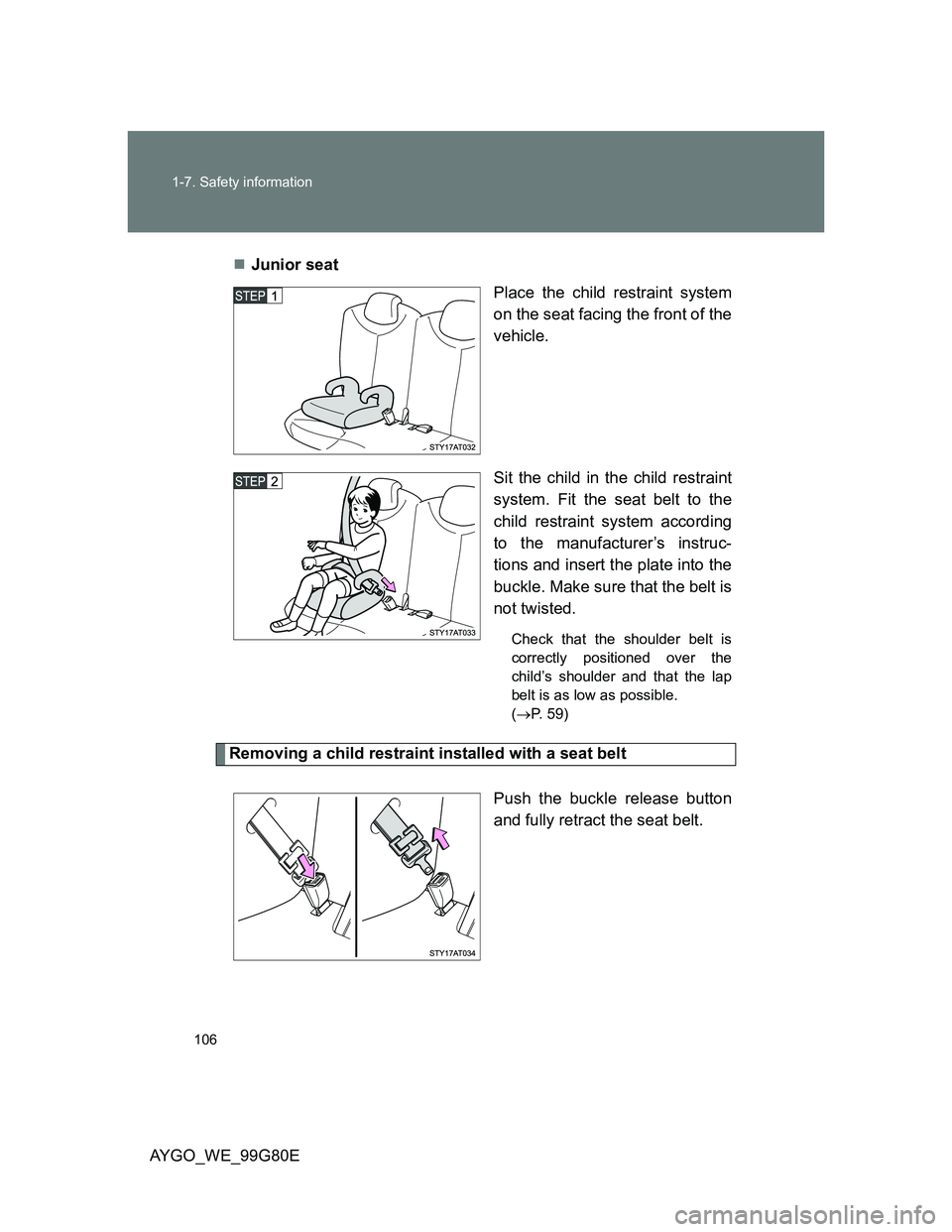
AYGO_WE_99G80EJunior seat
Place the child restraint system
on the seat facing the front of the
vehicle.
Sit the child in the child restraint
system. Fit the seat belt to the
child restraint system according
to the manufacturer’s instruc-
tions and insert the plate into the
buckle. Make sure that the belt is
not twisted.
Check that the shoulder belt is
correctly positioned over the
child’s shoulder and that the lap
belt is as low as possible.
(P. 59)
Removing a child restraint installed with a seat belt
Push the buckle release button
and fully retract the seat belt.
Page 107 of 372
107 1-7. Safety information
1
Before driving
AYGO_WE_99G80E
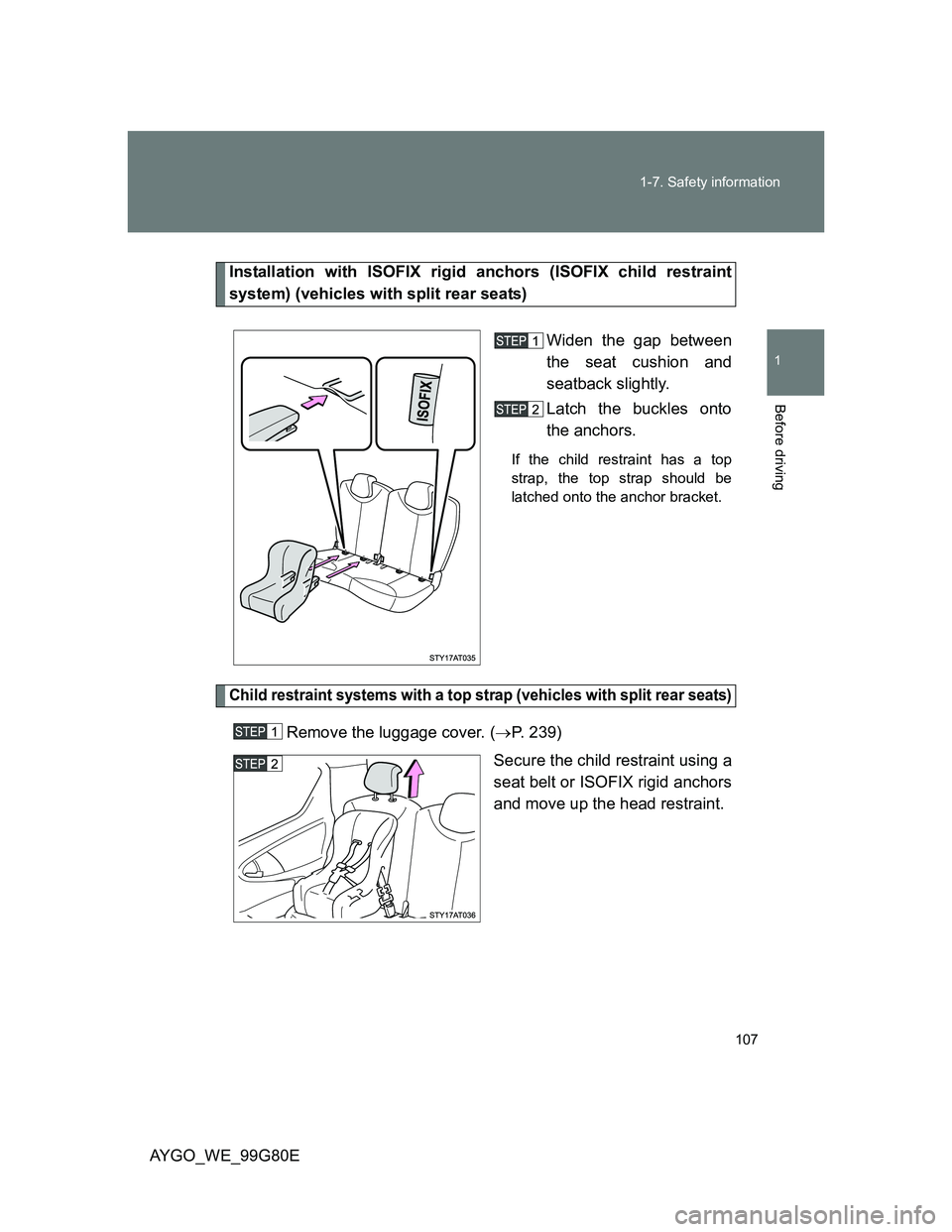
Installation with ISOFIX rigid anchors (ISOFIX child restraint
system) (vehicles with split rear seats)
Widen the gap between
the seat cushion and
seatback slightly.
Latch the buckles onto
the anchors.
If the child restraint has a top
strap, the top strap should be
latched onto the anchor bracket.
Child restraint systems with a top strap (vehicles with split rear seats)
Remove the luggage cover. (P. 239)
Secure the child restraint using a
seat belt or ISOFIX rigid anchors
and move up the head restraint.
Page 111 of 372
111 1-7. Safety information
1
Before driving
AYGO_WE_99G80E
CAUTION
When installing a child restraint system
If child restraint system regulations exist in the country where you reside,
please contact any authorized Toyota dealer or repairer, or another duly
qualified and equipped professional for the child restraint system installa-
tion.
When a junior seat is installed, always ensure that the shoulder belt is
positioned across the center of the child’s shoulder. The belt should be
kept away from the child’s neck, but not so that it could fall off the child’s
shoulder. Failure to do so may result in death or serious injury in the event
of sudden braking, sudden swerving or an accident.
Ensure that the belt and plate are securely locked and the seat belt is not
twisted.
Shake the child restraint system left and right, and forward and backward
to ensure that it has been securely installed.
Follow all installation instructions provided by the child restraint system
manufacturer.
To correctly attach a child restraint system to the anchors (vehicles
with split rear seats)
When using the ISOFIX rigid anchors, be sure that there are no foreign
objects around the anchors and that the seat belt is not caught behind the
child restraint system. Make sure the child restraint system is securely
attached, or it may cause death or serious injury to the child or other passen-
gers in the event of a sudden stop, sudden swerve or accident.
Page 158 of 372
158 2-5. Driving information
AYGO_WE_99G80E
CAUTION
Secure all items in the occupant compartment, as they may shift and injure
someone in the event of an accident or sudden braking.
Vehicles with a rear seat: When you fold down the rear seats, long items
should not be place directly behind the front seats.
Never allow anyone to ride in the luggage compartment. It is not designed
for passengers. They should ride in their seats with their seat belts prop-
erly fastened. Otherwise, they are much more likely to suffer death or seri-
ous bodily injury, in the event of sudden braking or an accident.
Load and distribution
Do not overload your vehicle.
Do not apply loads unevenly.
Improper loading may cause deterioration of steering or braking control
which may cause death or serious injury.