belt TOYOTA AYGO 2013 (in English) Owner's Guide
[x] Cancel search | Manufacturer: TOYOTA, Model Year: 2013, Model line: AYGO, Model: TOYOTA AYGO 2013Pages: 372, PDF Size: 14.28 MB
Page 246 of 372
246 4-1. Maintenance and care
AYGO_WE_99G80E
Caring for leather areas
Toyota recommends cleaning the interior of the vehicle at least twice a year
to maintain the quality of the vehicle’s interior.
Shampooing the carpets
There are several commercial foaming-type cleaners available. Use a
sponge or brush to apply the foam. Rub in overlapping circles. Do not use
water. Wipe dirty surfaces and let them dry. Excellent results are obtained by
keeping the carpet as dry as possible.
Seat belts
Clean with mild soap and lukewarm water using a cloth or sponge. Also
check the belts periodically for excessive wear, fraying or cuts.
CAUTION
Water in the vehicle
Do not splash or spill liquid in the vehicle.
Doing so may cause electrical components etc. to malfunction or catch
fire.
Do not get any of the SRS components or wiring in the vehicle interior wet.
(P. 80)
An electrical malfunction may cause the airbags to deploy or not function
properly, resulting in death or serious injury.
Cleaning the interior (especially instrument panel)
Do not use polish wax or polish cleaner. The instrument panel may reflect off
the windshield, obstructing the driver’s view and leading to an accident,
resulting in death or serious injury.
Page 252 of 372
252 4-3. Do-it-yourself maintenance
AYGO_WE_99G80E
CAUTION
The engine compartment contains many mechanisms and fluids that may
move suddenly, become hot, or become electrically energized. To avoid death
or serious injury, observe the following precautions:
When working on the engine compartment:
Keep hands, clothing and tools away from the moving fan and engine
drive belt.
Be careful not to touch the engine, radiator, exhaust manifold, etc. right
after driving as they may be hot. Oil and other fluids may also be hot.
Do not leave anything that may burn easily, such as paper and rags, in the
engine compartment.
Do not smoke, cause sparks or expose an open flame to fuel or the bat-
tery. Fuel and battery fumes are flammable.
Be extremely cautious when working on the battery. It contains poisonous
and corrosive sulfuric acid.
Take care because brake fluid can harm your hands or eyes and damage
painted surfaces. If fluid gets on your hands or in your eyes, flush the
affected area with clean water immediately.
If you still experience discomfort, consult a doctor.
ItemsParts and tools
Tire inflation pressure (P. 275)• Tire pressure gauge
• Compressed air source
Washer fluid (P. 269)• Water or washer fluid containing
antifreeze (for winter use)
• Funnel (used only for adding
water or washer fluid)
Page 273 of 372
273 4-3. Do-it-yourself maintenance
4
Maintenance and care
AYGO_WE_99G80E
When to replace your vehicle’s tires
Tires should be replaced if:
You have tire damage such as cuts, splits, cracks deep enough to
expose the fabric, and bulges indicating internal damage
A tire goes flat repeatedly or cannot be properly repaired due to the size
or location of a cut or other damage
If you are not sure, consult with any authorized Toyota dealer or repairer, or
another duly qualified and equipped professional.
Tire life
Any tire over 6 years old must be checked by a qualified technician even if it
has seldom or never been used or damage is not obvious.
If the tread on snow tires wears down below 4 mm (0.16 in.)
The effectiveness of the tires as snow tires is lost.
CAUTION
When inspecting or replacing tires
Observe the following precautions to prevent accidents.
Failure to do so may cause damage to parts of the drive train as well as dan-
gerous handling characteristics, which may lead to an accident resulting in
death or serious injury.
Do not mix tires of different makes, models or tread patterns.
Also, do not mix tires of remarkably different treadwear.
Do not use tire sizes other than those recommended by Toyota.
Do not mix differently constructed tires (radial, bias-belted or bias-ply
tires).
Do not mix summer, all season and snow tires.
Do not use tires that have been used on another vehicle.
Do not use tires if you do not know how they were used previously.
Page 315 of 372
5
315 5-2. Steps to take in an emergency
When trouble arises
AYGO_WE_99G80E
Have the vehicle inspected immediately.
Failure to investigate the cause of the following warnings may lead to
the system operating abnormally and possibly cause an accident.
Have the vehicle inspected by any authorized Toyota dealer or
repairer, or another duly qualified and equipped professional immedi-
ately.
To prevent the clutch from overheating
Do not use the accelerator pedal or starting assist system to hold the
vehicle on a hill.
On an uphill incline, observe the following whenever possible:
• Maintain a safe distance from the vehicle ahead and avoid unneces-
sary starting off and stopping.
• Avoid using E mode on an uphill slope. This will help to avoid unneces-
sary gear changes.
Warning lightWarning light/Details
Malfunction indicator lamp
Indicates a malfunction in:
• The electronic engine control system;
• The electronic throttle control system;
• The electronic multi-mode manual transmission control
system (if equipped); or
• The emission control system.
(Flashes)SRS warning light
Indicates a malfunction in:
• The SRS airbag system; or
• The seat belt pretensioner system.
ABS warning light
Indicates a malfunction in:
• The ABS; or
• The brake assist system (vehicles with VSC system).
Electric power steering warning light (if equipped)
Indicates a malfunction in the EPS system.
Page 316 of 372
316 5-2. Steps to take in an emergency
AYGO_WE_99G80E
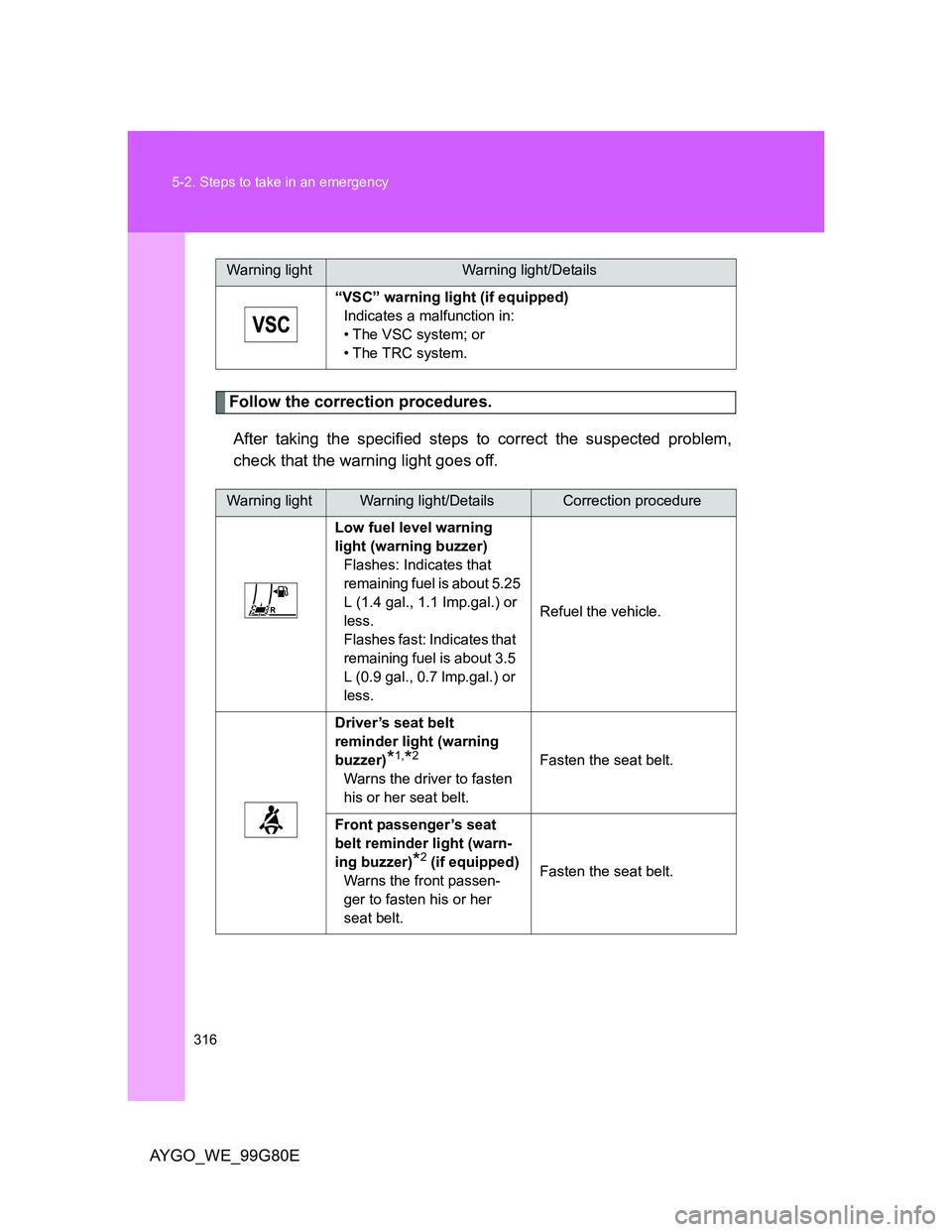
Follow the correction procedures.
After taking the specified steps to correct the suspected problem,
check that the warning light goes off.
“VSC” warning light (if equipped)
Indicates a malfunction in:
• The VSC system; or
• The TRC system.
Warning lightWarning light/DetailsCorrection procedure
Low fuel level warning
light (warning buzzer)
Flashes: Indicates that
remaining fuel is about 5.25
L (1.4 gal., 1.1 Imp.gal.) or
less.
Flashes fast: Indicates that
remaining fuel is about 3.5
L (0.9 gal., 0.7 lmp.gal.) or
less.Refuel the vehicle.
Driver’s seat belt
reminder light (warning
buzzer)
*1,*2
Warns the driver to fasten
his or her seat belt.Fasten the seat belt.
Front passenger’s seat
belt reminder light (warn-
ing buzzer)
*2 (if equipped)
Warns the front passen-
ger to fasten his or her
seat belt.Fasten the seat belt.
Warning lightWarning light/Details
Page 317 of 372
5
317 5-2. Steps to take in an emergency
When trouble arises
AYGO_WE_99G80E
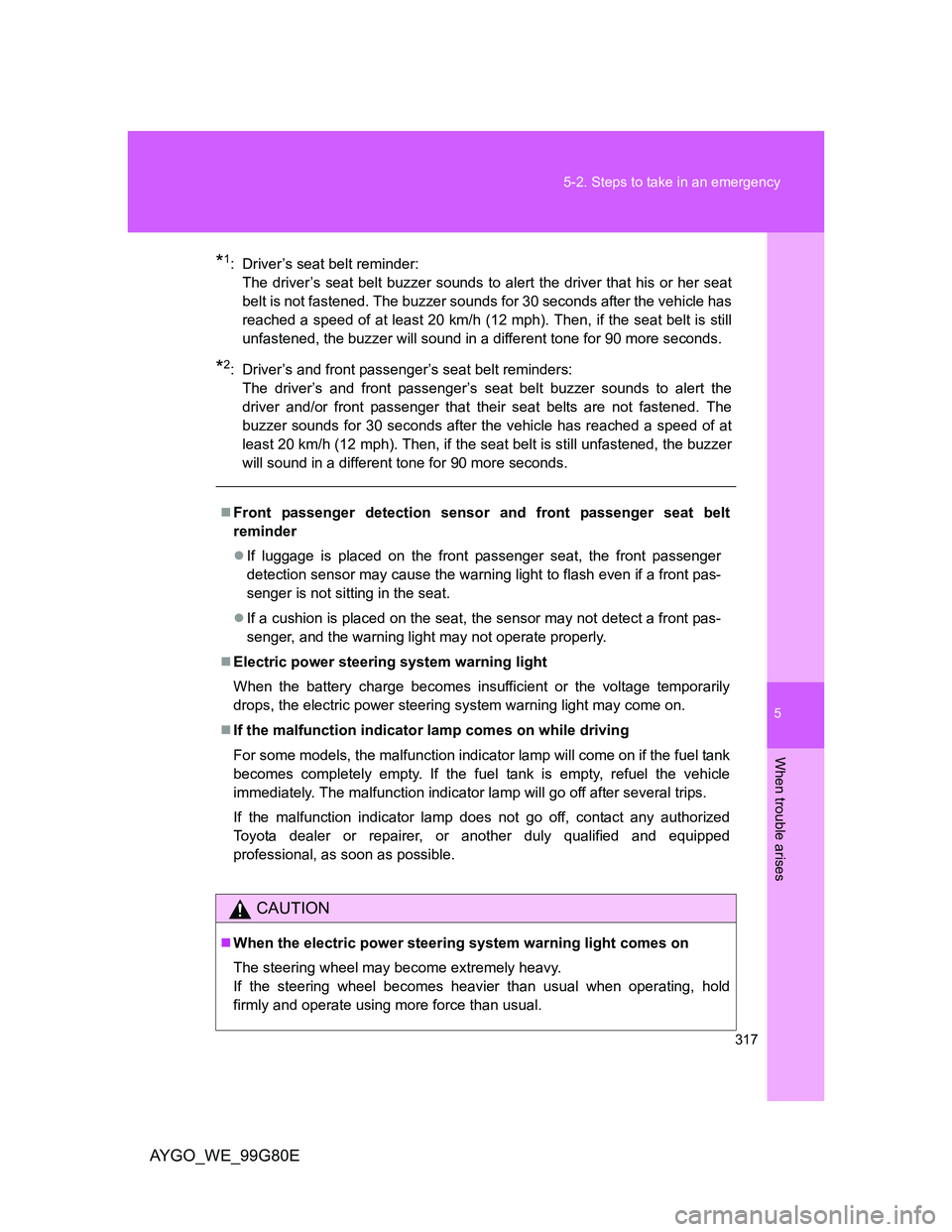
*1: Driver’s seat belt reminder:
The driver’s seat belt buzzer sounds to alert the driver that his or her seat
belt is not fastened. The buzzer sounds for 30 seconds after the vehicle has
reached a speed of at least 20 km/h (12 mph). Then, if the seat belt is still
unfastened, the buzzer will sound in a different tone for 90 more seconds.
*2: Driver’s and front passenger’s seat belt reminders:
The driver’s and front passenger’s seat belt buzzer sounds to alert the
driver and/or front passenger that their seat belts are not fastened. The
buzzer sounds for 30 seconds after the vehicle has reached a speed of at
least 20 km/h (12 mph). Then, if the seat belt is still unfastened, the buzzer
will sound in a different tone for 90 more seconds.
Front passenger detection sensor and front passenger seat belt
reminder
If luggage is placed on the front passenger seat, the front passenger
detection sensor may cause the warning light to flash even if a front pas-
senger is not sitting in the seat.
If a cushion is placed on the seat, the sensor may not detect a front pas-
senger, and the warning light may not operate properly.
Electric power steering system warning light
When the battery charge becomes insufficient or the voltage temporarily
drops, the electric power steering system warning light may come on.
If the malfunction indicator lamp comes on while driving
For some models, the malfunction indicator lamp will come on if the fuel tank
becomes completely empty. If the fuel tank is empty, refuel the vehicle
immediately. The malfunction indicator lamp will go off after several trips.
If the malfunction indicator lamp does not go off, contact any authorized
Toyota dealer or repairer, or another duly qualified and equipped
professional, as soon as possible.
CAUTION
When the electric power steering system warning light comes on
The steering wheel may become extremely heavy.
If the steering wheel becomes heavier than usual when operating, hold
firmly and operate using more force than usual.
Page 335 of 372
5
335 5-2. Steps to take in an emergency
When trouble arises
AYGO_WE_99G80E
NOTICE
When handling jumper cables
When connecting the jumper cables, ensure that they do not become entan-
gled in the cooling fan or belt.
Page 338 of 372
338 5-2. Steps to take in an emergency
AYGO_WE_99G80E
CAUTION
To prevent an accident or injury when inspecting under the hood of
your vehicle
If steam is seen coming from under the hood, do not open the hood until
the steam has subsided. The engine compartment may be very hot, caus-
ing serious injuries such as burns.
Keep hands and clothing (especially a tie, a scarf or a muffler) away from
the fan and belts. Failure to do so may cause the hands or clothing to be
caught, resulting in serious injury.
Do not loosen the radiator cap and the coolant reservoir cap while the
engine and radiator are hot.
Serious injury, such as burns, may result from hot coolant and steam
released under pressure.
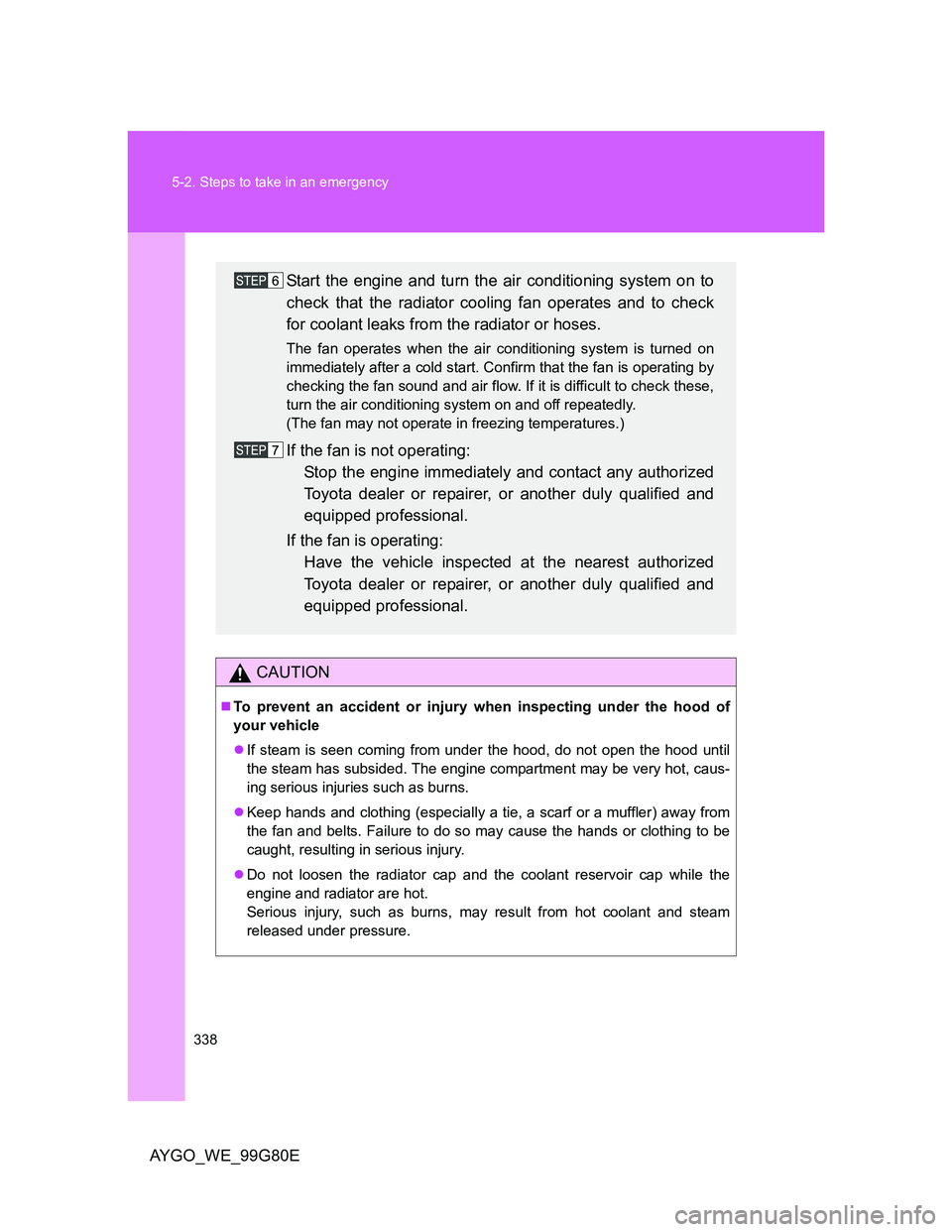
Start the engine and turn the air conditioning system on to
check that the radiator cooling fan operates and to check
for coolant leaks from the radiator or hoses.
The fan operates when the air conditioning system is turned on
immediately after a cold start. Confirm that the fan is operating by
checking the fan sound and air flow. If it is difficult to check these,
turn the air conditioning system on and off repeatedly.
(The fan may not operate in freezing temperatures.)
If the fan is not operating:
Stop the engine immediately and contact any authorized
Toyota dealer or repairer, or another duly qualified and
equipped professional.
If the fan is operating:
Have the vehicle inspected at the nearest authorized
Toyota dealer or repairer, or another duly qualified and
equipped professional.
Page 348 of 372
348 6-1. Specifications
AYGO_WE_99G80E
Engine
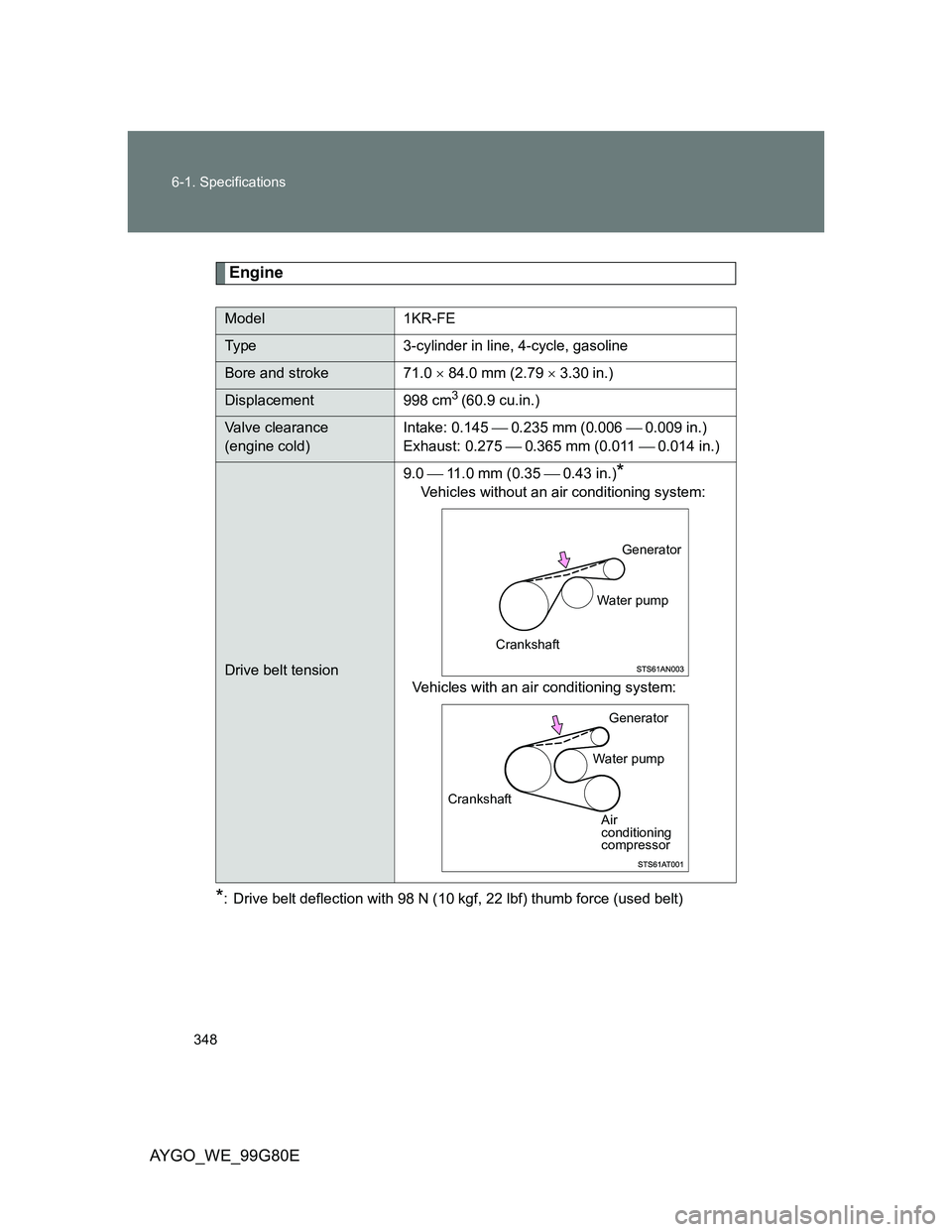
*: Drive belt deflection with 98 N (10 kgf, 22 lbf) thumb force (used belt)
Model 1KR-FE
Type 3-cylinder in line, 4-cycle, gasoline
Bore and stroke 71.0 84.0 mm (2.79 3.30 in.)
Displacement 998 cm3 (60.9 cu.in.)
Valve clearance
(engine cold)Intake: 0.145 0.235 mm (0.006 0.009 in.)
Exhaust:
0.275 0.365 mm (0.011 0.014 in.)
Drive belt tension9.0 11.0 mm (0.35 0.43 in.)
*
Vehicles without an air conditioning system:
Vehicles with an air conditioning system:
Generator
Water pump
Crankshaft
CrankshaftWater pumpGenerator
Air
conditioning
compressor
Page 362 of 372
362 Alphabetical index
AYGO_WE_99G80E
Back door ................................... 48
Back-up lights
Replacing light bulbs ............. 292
Wattage................................. 356
Battery
Checking ............................... 266
If the vehicle battery is
discharged .......................... 332
Preparing and checking
before winter ....................... 159
Bluetooth
® audio ..................... 209
Bluetooth® phone .................... 212
Brake
Parking brake ........................ 137
Brake assist.............................. 154
Break-in tips ............................. 117
Care
Exterior.................................. 242
Interior ................................... 245
Seat belts .............................. 246
CD player .......................... 181, 196
Chains ....................................... 159
Child-protectors ......................... 46
Child restraint system
Baby seats, definition .............. 92
Baby seats, installation ......... 103
Child seats, definition .............. 92
Child seats, installation ......... 103
Installing CRS with ISOFIX
rigid anchor ......................... 107
Installing CRS with seat
belts .................................... 104
Installing CRS with top
straps .................................. 107
Junior seats, definition ............ 92
Junior seats, installation........ 103Child safety
Airbag precautions .................. 85
Battery precautions ....... 268, 334
Child-protectors ...................... 46
Child restraint system ............. 92
How your child should wear
the seat belt .......................... 60
Installing child restraints ....... 103
Power window precautions ..... 66
Removed key battery
precautions ......................... 281
Seat belt precautions .............. 61
Cleaning
Exterior ................................. 242
Interior................................... 245
Seat belts .............................. 246
Clock ......................................... 233
Condenser ................................ 266
Cooling system
Engine overheating ............... 336
Cup holders.............................. 230
Curtain shield airbags ............... 79
B
C