ignition TOYOTA AYGO 2017 (in English) User Guide
[x] Cancel search | Manufacturer: TOYOTA, Model Year: 2017, Model line: AYGO, Model: TOYOTA AYGO 2017Pages: 480, PDF Size: 40.72 MB
Page 155 of 480
155
4
4-2. Driving procedures
Driving
AYGO_OM_Europe_OM99Q24E
Engine (ignition) switch (vehicles without a
smart entry & start system)
Multi-mode manual transmission
Check that the parking brake is set.
Firmly depress the brake pedal, turn the engine switch to the “ON”
position and shift the shift lever to N. ( P. 163)
Turn the engine switch to the “START” position to start the engine.
Manual transmission
Check that the parking brake is set.
Check that the shift lever is set in N. ( P. 168)
Firmly depress the clutch pedal.
Turn the engine switch to the “START” position to start the engine.
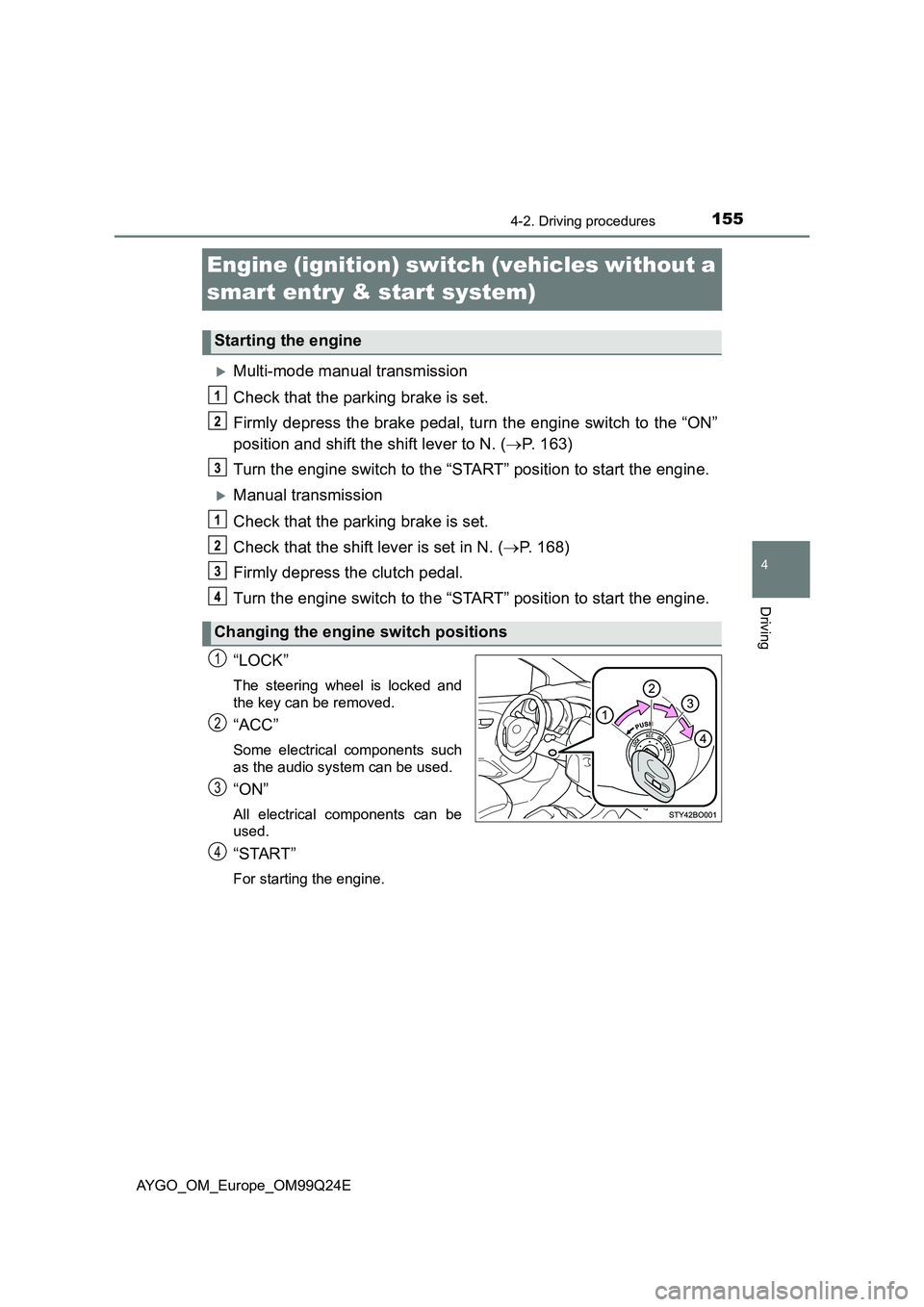
“LOCK”
The steering wheel is locked and
the key can be removed.
“ACC”
Some electrical components such
as the audio system can be used.
“ON”
All electrical components can be
used.
“START”
For starting the engine.
Starting the engine
Changing the engine switch positions
1
2
3
4
Page 158 of 480
1584-2. Driving procedures
AYGO_OM_Europe_OM99Q24E
Engine (ignition) switch (vehicles with a
smart entry & start system)
Multi-mode manual transmission
Check that the parking brake is set.
Firmly depress the brake pedal, press the engine switch once and
shift the shift lever to N. ( P. 163)
The smart entry & start system indicator light (green) will turn on. If the
indicator light does not turn on, the engine cannot be started.
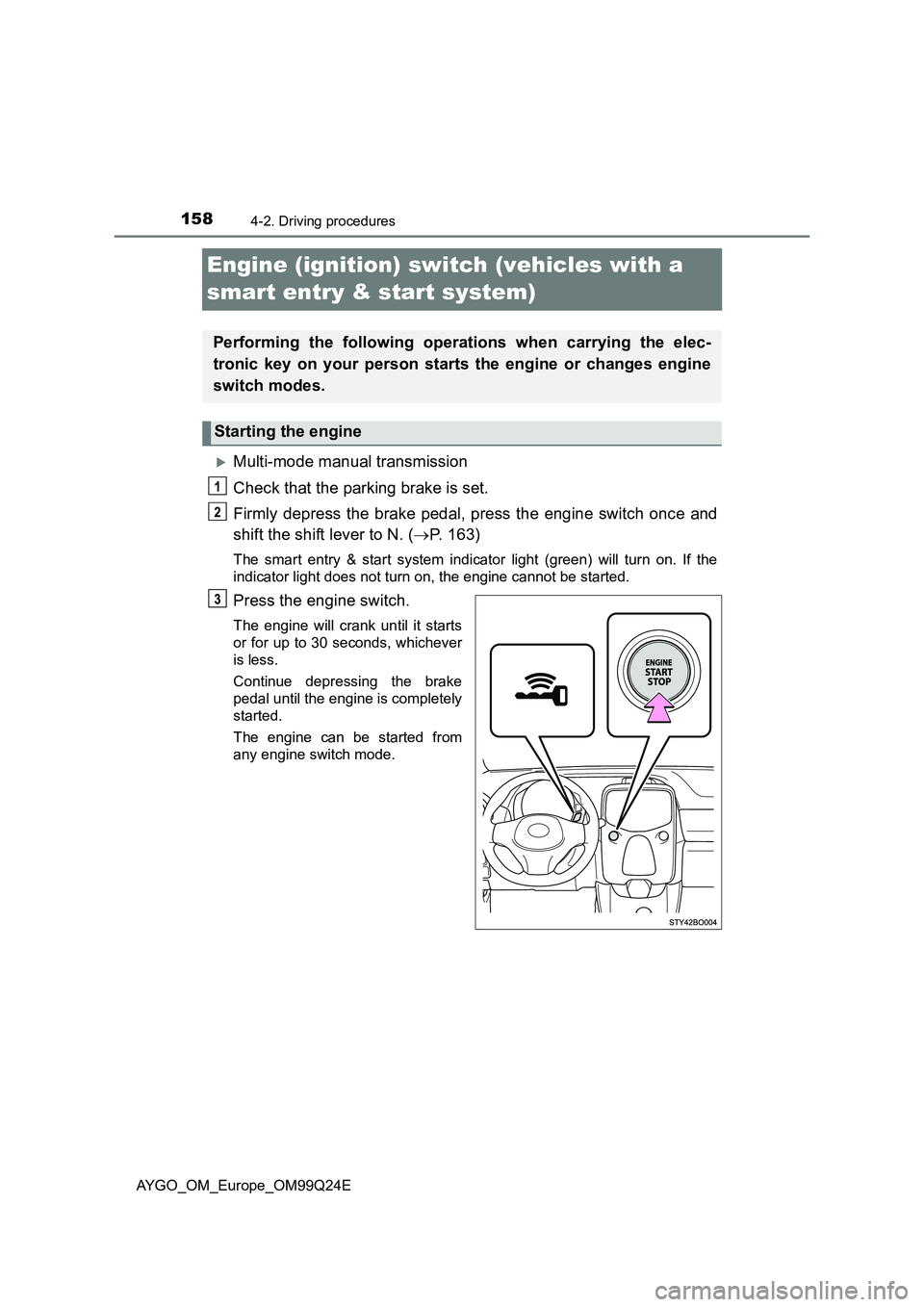
Press the engine switch.
The engine will crank until it starts
or for up to 30 seconds, whichever
is less.
Continue depressing the brake
pedal until the engine is completely
started.
The engine can be started from
any engine switch mode.
Performing the following operations when carrying the elec-
tronic key on your person starts the engine or changes engine
switch modes.
Starting the engine
Page 160 of 480
1604-2. Driving procedures
AYGO_OM_Europe_OM99Q24E
Modes can be changed by pressing the engine switch with the brake
pedal (multi-mode manual transmission) or clutch pedal (manual
transmission) released. (The mode changes each time the switch is
pressed.)
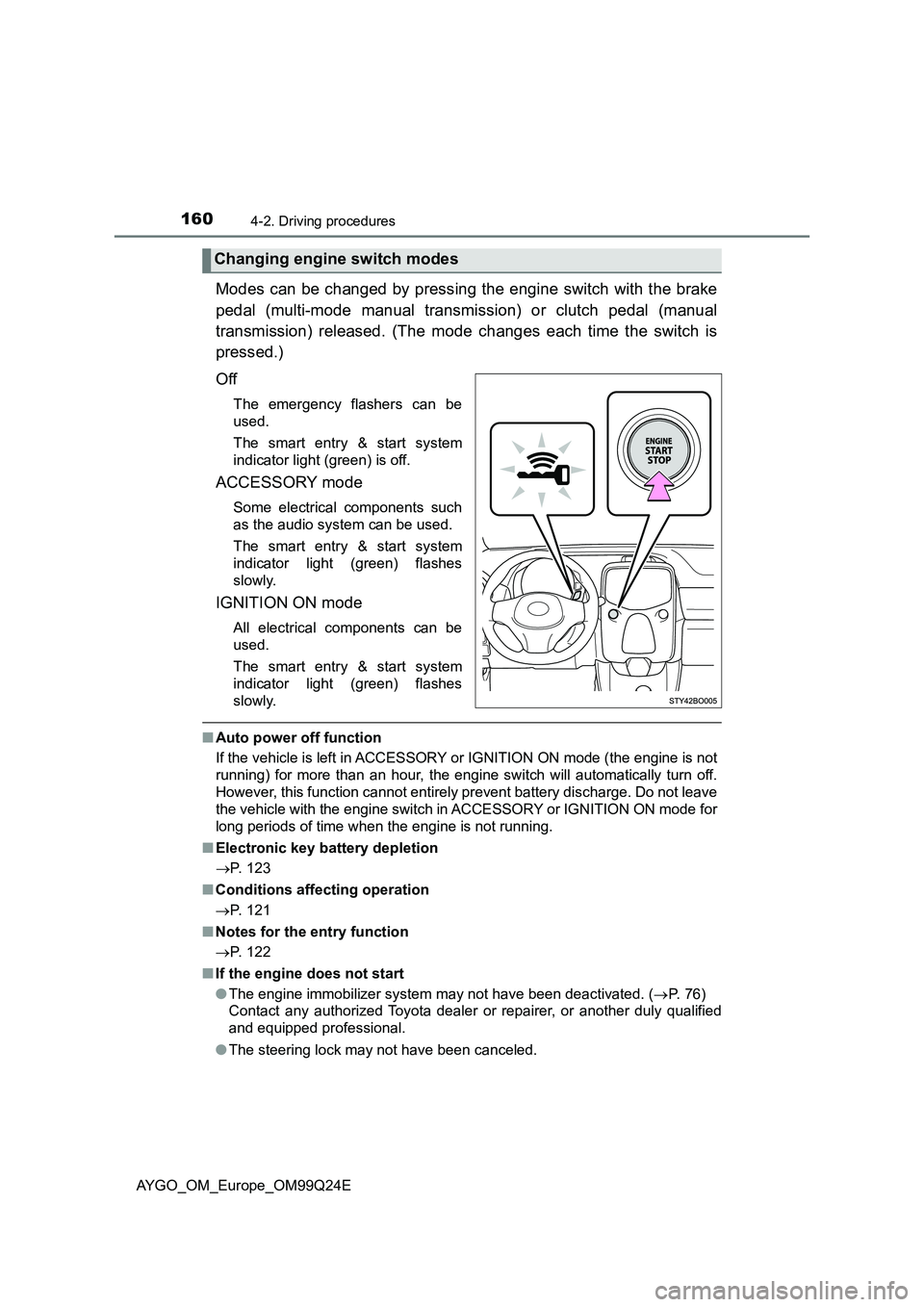
Off
The emergency flashers can be
used.
The smart entry & start system
indicator light (green) is off.
ACCESSORY mode
Some electrical components such
as the audio system can be used.
The smart entry & start system
indicator light (green) flashes
slowly.
IGNITION ON mode
All electrical components can be
used.
The smart entry & start system
indicator light (green) flashes
slowly.
■ Auto power off function
If the vehicle is left in ACCESSORY or IGNITION ON mode (the engine is not
running) for more than an hour, the engine switch will automatically turn off.
However, this function cannot entirely prevent battery discharge. Do not leave
the vehicle with the engine switch in ACCESSORY or IGNITION ON mode for
long periods of time when the engine is not running.
■ Electronic key battery depletion
P. 123
■ Conditions affecting operation
P. 121
■ Notes for the entry function
P. 122
■ If the engine does not start
● The engine immobilizer system may not have been deactivated. (P. 7 6 )
Contact any authorized Toyota dealer or repairer, or another duly qualified
and equipped professional.
● The steering lock may not have been canceled.
Changing engine switch modes
Page 162 of 480
1624-2. Driving procedures
AYGO_OM_Europe_OM99Q24E
WARNING
■When starting the engine
Always start the engine while sitting in the driver’s seat. Do not depress the
accelerator pedal while starting the engine under any circumstances.
Doing so may cause an accident resulting in death or serious injury.
■ Caution while driving
If engine failure occurs while the vehicle is moving, do not lock or open the
doors until the vehicle reaches a safe and complete stop. Activation of the
steering lock in this circumstance may lead to an accident, resulting in
death or serious injury.
■ Stopping the engine in an emergency
If you want to stop the engine in an emergency while driving the vehicle,
press and hold the engine switch for more than 2 seconds, or press it briefly
3 times or more in succession. ( P. 379)
However, do not touch the engine switch while driving except in an emer-
gency. Turning the engine off while driving will not cause loss of steering or
braking control, but the power assist to these systems will be lost. This will
make it more difficult to steer and brake, so you should pull over and stop
the vehicle as soon as it is safe to do so.
NOTICE
■ To prevent battery discharge
● Do not leave the engine switch in ACCESSORY or IGNITION ON mode
for long periods of time without the engine running.
● If the smart entry & start system indicator light (green) is illuminated, the
engine switch is not off. When exiting the vehicle, always check that the
engine switch is off.
■ When starting the engine
● Do not race a cold engine.
● If the engine becomes difficult to start or stalls frequently, have your vehi-
cle checked immediately.
■ Symptoms indicating a malfunction with the engine switch
If the engine switch seems to be operating somewhat differently than usual,
such as the switch sticking slightly, there may be a malfunction. Contact any
authorized Toyota dealer or repairer, or another duly qualified and equipped
professional immediately.
Page 166 of 480
1664-2. Driving procedures
AYGO_OM_Europe_OM99Q24E
■ If the shift lever cannot be shifted
● With the shift lever in N
Depress the brake pedal to shift the shift lever. If the shift lever cannot be
shifted with your foot on the brake, there may be a problem with the shift
lock system. ( P. 428)
● With the shift lever in a position other than N
P. 428
■ If the driver’s door is opened when the shift lever is in a position other
than N and the engine is running
A buzzer will sound. Close the driver’s door.
■ If the parking brake is set when the shift lever is in a position other than
N with engine running
● When the driver’s door is opened
A buzzer will sound and the gear position will automatically change to N in
10 seconds.
● When the driver’s door is closed
A buzzer will sound and the gear position will automatically change to N in
90 seconds.
■ If the M indicator does not come on even after shifting the shift lever to M
This may indicate a malfunction in the multi-mode manual transmission sys-
tem. Have the vehicle inspected by any authorized Toyota dealer or repairer,
or another duly qualified and equipped professional immediately.
(In this situation, the vehicle will operate as if the shift lever is in E.)
■ If the N indicator is flashing
● When shifting the shift lever:
Shift the shift lever to N. Wait a few seconds and shift the shift lever to the
desired position.
● When the engine is turned off:
Vehicles without a smart entry & start system:
Turn the engine switch to the “ON” position and shift the shift lever to N, and
then to the desired position.
Vehicles with a smart entry & start system:
Turn the engine switch to IGNITION ON mode and shift the shift lever to N,
and then to the desired position.
If the indicator still blinks after the above operations, shift the shift lever to N
and start the engine. Then, shift the shift lever to the desired position.
■ If the N indicator is flashing and the warning buzzer is beeping
Shift the shift lever to N, and then to E, M or R.
Page 170 of 480
1704-2. Driving procedures
AYGO_OM_Europe_OM99Q24E
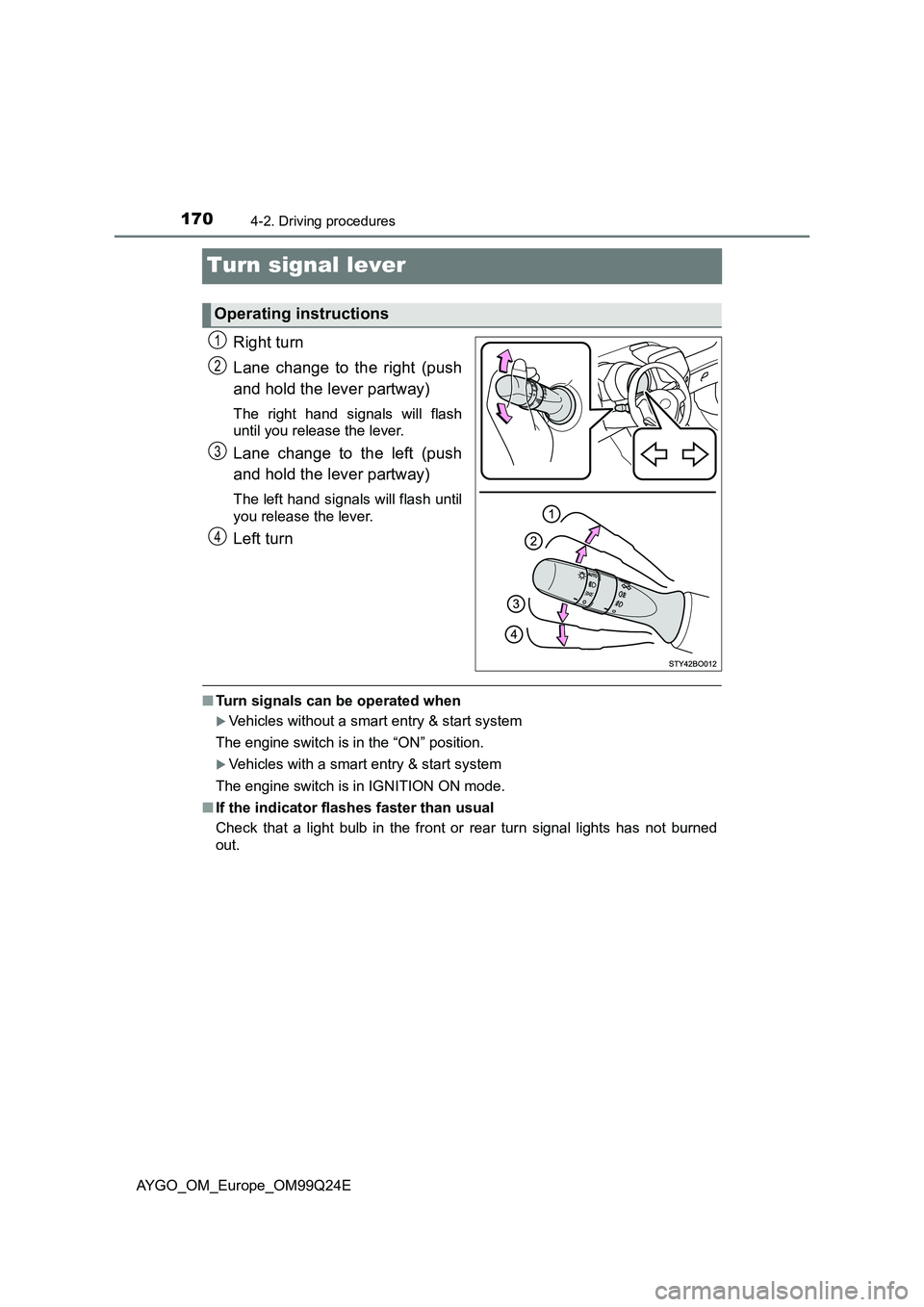
Turn signal lever
Right turn
Lane change to the right (push
and hold the lever partway)
The right hand signals will flash
until you release the lever.
Lane change to the left (push
and hold the lever partway)
The left hand signals will flash until
you release the lever.
Left turn
■ Turn signals can be operated when
Vehicles without a smart entry & start system
The engine switch is in the “ON” position.
Vehicles with a smart entry & start system
The engine switch is in IGNITION ON mode.
■ If the indicator flashes faster than usual
Check that a light bulb in the front or rear turn signal lights has not burned
out.
Operating instructions
1
2
3
4
Page 175 of 480
1754-3. Operating the lights and wipers
4
Driving
AYGO_OM_Europe_OM99Q24E
■ Light reminder buzzer
Vehicles without a smart entry & start system
A buzzer sounds when the engine switch is turned to the “LOCK” position, the
driver’s door is opened while the lights are turned on.
Vehicles with a smart entry & start system
A buzzer sounds when the engine switch is turned off and the driver’s door is
opened while the lights are turned on.
■ Battery-saving function (if equipped)
In the following conditions, the remaining lights will go off automatically after
20 minutes in order to prevent the vehicle battery from being discharged:
● The headlights and/or tail lights are on.
● Vehicles without a smart entry & start system: The engine switch is turned to
the “ACC” position or turned off.
Vehicles with a smart entry & start system: The engine switch is turned to
ACCESSORY mode or turned off.
● The light switch is in or .
This function will be canceled in any of the following situations:
● Vehicles without a smart entry & start system: When the engine switch is
turned to the “ON” position.
Vehicles with a smart entry & start system: When the engine switch is turned
to IGNITION ON mode.
● When the light switch is operated.
● When a door is opened or closed.
NOTICE
■To prevent battery discharge
Do not leave the lights on longer than necessary when the engine is not
running.
Page 179 of 480
1794-3. Operating the lights and wipers
4
Driving
AYGO_OM_Europe_OM99Q24E
■The windshield wiper and washer can be operated when
Vehicles without a smart entry & start system
The engine switch is in the “ON” position.
Vehicles with a smart entry & start system
The engine switch is in IGNITION ON mode.
■ If no windshield washer fluid sprays
Check that the washer nozzles are not blocked, if there is washer fluid in the
windshield washer fluid reservoir.
WARNING
■ Caution regarding the use of washer fluid
When it is cold, do not use the washer fluid until the windshield becomes
warm. The fluid may freeze on the windshield and cause low visibility. This
may lead to an accident, resulting in death or serious injury.
NOTICE
■ When the windshield is dry
Do not use the wiper, as they may damage the windshield.
■ When the washer fluid tank is empty
Do not operate the switch continually as the washer fluid pump may over-
heat.
■ To prevent battery discharge
Do not leave the wiper on longer than necessary when the engine is off.
Page 180 of 480
1804-3. Operating the lights and wipers
AYGO_OM_Europe_OM99Q24E
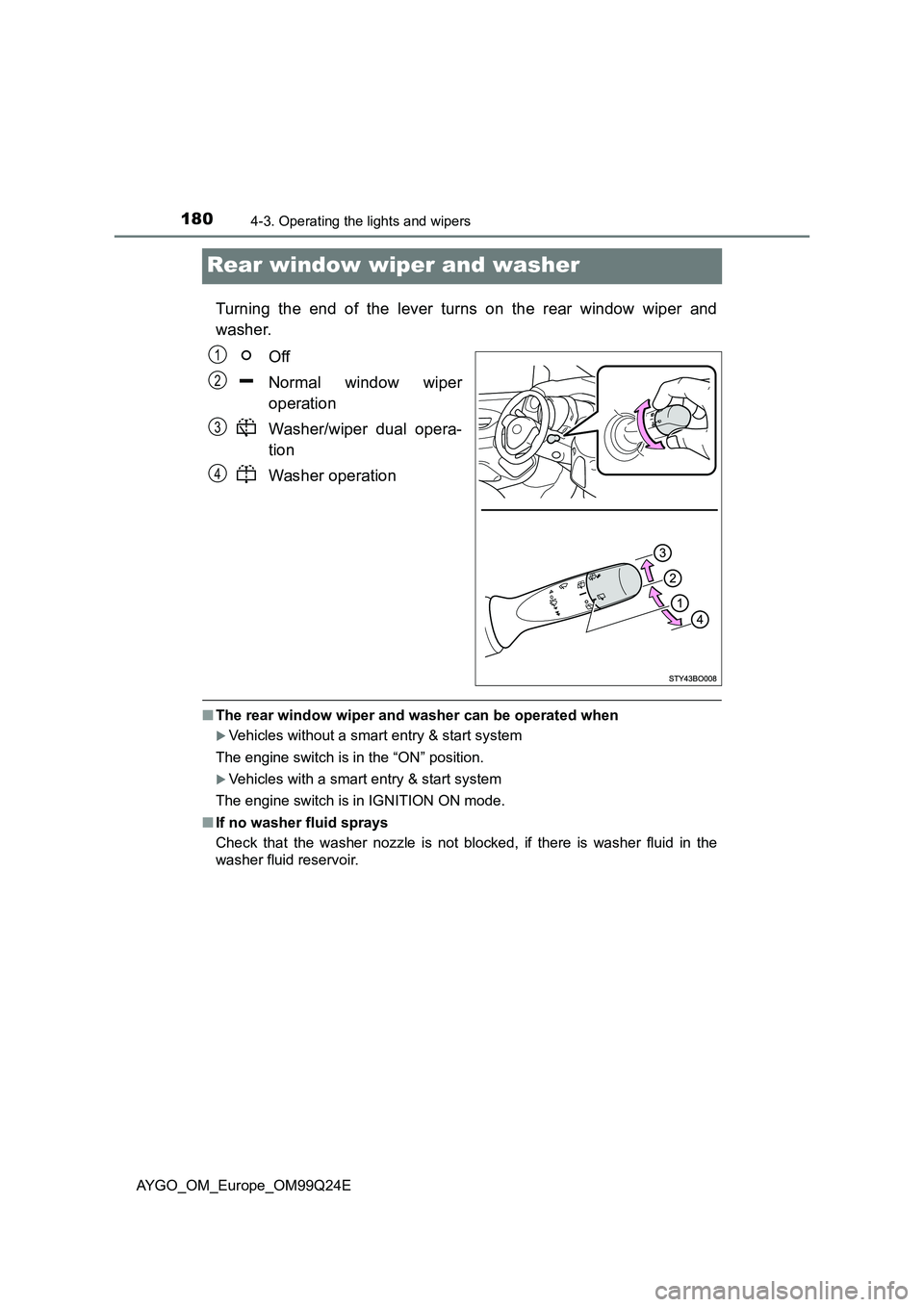
Rear window wiper and washer
Turning the end of the lever turns on the rear window wiper and
washer.
Off
Normal window wiper
operation
Washer/wiper dual opera-
tion
Washer operation
■ The rear window wiper and washer can be operated when
Vehicles without a smart entry & start system
The engine switch is in the “ON” position.
Vehicles with a smart entry & start system
The engine switch is in IGNITION ON mode.
■ If no washer fluid sprays
Check that the washer nozzle is not blocked, if there is washer fluid in the
washer fluid reservoir.
1
2
3
4
Page 183 of 480
1834-4. Refueling
4
Driving
AYGO_OM_Europe_OM99Q24E
WARNING
■When refueling the vehicle
Observe the following precautions while refueling the vehicle. Failure to do
so may result in death or serious injury.
● After exiting the vehicle and before opening the fuel door, touch an
unpainted metal surface to discharge any stat ic electricity. It is important to
discharge static electricity before re fueling because sparks resulting from
static electricity can cause fuel vapors to ignite while refueling.
● Always hold the grips on the fuel tank cap and turn it slowly to remove it.
A whooshing sound may be heard when the fuel tank cap is loosened.
Wait until the sound cannot be heard before fully removing the cap. In hot
weather, pressurized fuel may spray out the filler neck and cause injury.
● Do not allow anyone that has not discharged static electricity from their
body to come close to an open fuel tank.
● Do not inhale vaporized fuel.
Fuel contains substances that are harmful if inhaled.
● Do not smoke while refueling the vehicle.
Doing so may cause the fuel to ignite and cause a fire.
● Do not return to the vehicle or touch any person or object that is statically
charged.
This may cause static electricity to build up, resulting in a possible ignition
hazard.
■ When refueling
Observe the following precautions to pr event fuel overflowing from the fuel
tank:
● Securely insert the fuel nozzle into the fuel filler neck.
● Stop filling the tank after the fuel nozzle automatically clicks off.
● Do not top off the fuel tank.
NOTICE
■Refueling
Do not spill fuel during refueling.
Doing so may damage the vehicle, such as causing the emission control
system to operate abnormally or damaging fuel system components or the
vehicle’s painted surface.