tow TOYOTA AYGO 2019 (in English) User Guide
[x] Cancel search | Manufacturer: TOYOTA, Model Year: 2019, Model line: AYGO, Model: TOYOTA AYGO 2019Pages: 504, PDF Size: 67.32 MB
Page 154 of 504
1543-3. Adjusting the seats
AYGO_OM_Europe_OM99R19E
Rear seats
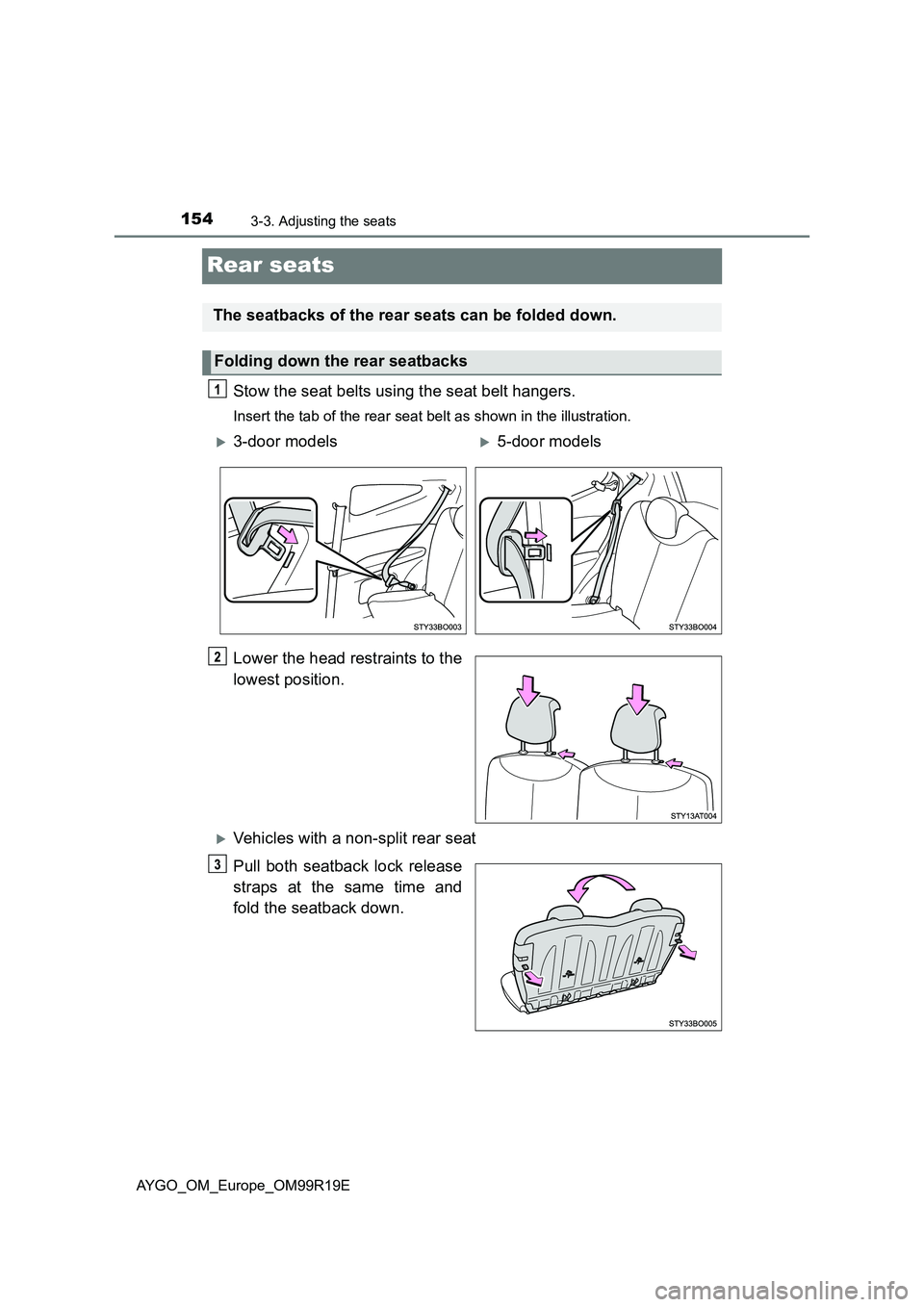
Stow the seat belts using the seat belt hangers.
Insert the tab of the rear seat belt as shown in the illustration.
Lower the head restraints to the
lowest position.
Vehicles with a non-split rear seat
Pull both seatback lock release
straps at the same time and
fold the seatback down.
The seatbacks of the rear seats can be folded down.
Folding down the rear seatbacks
3-door models5-door models
Page 155 of 504
1553-3. Adjusting the seats
3
Operation of each component
AYGO_OM_Europe_OM99R19E
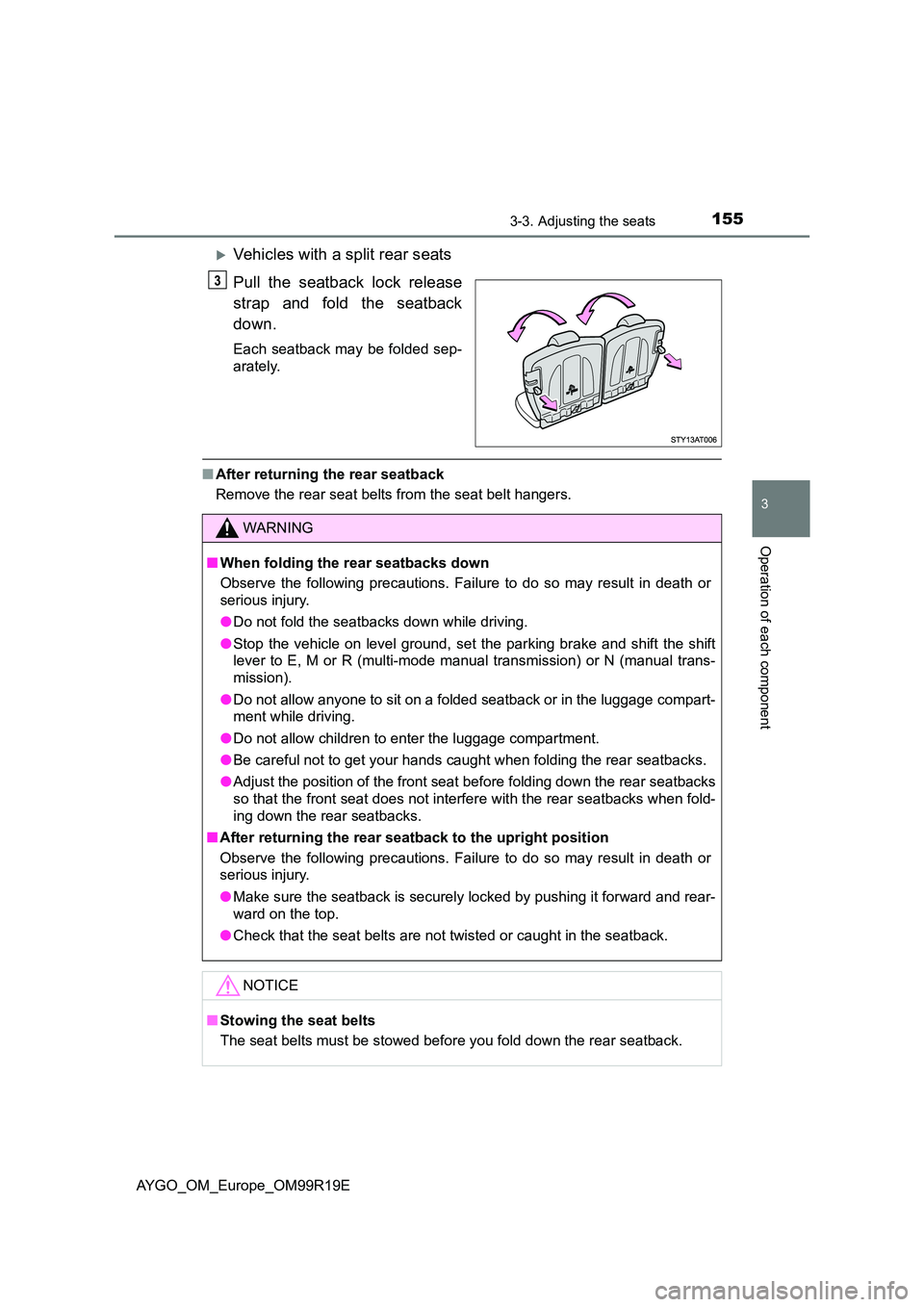
Vehicles with a split rear seats
Pull the seatback lock release
strap and fold the seatback
down.
Each seatback may be folded sep-
arately.
■ After returning the rear seatback
Remove the rear seat belts from the seat belt hangers.
WARNING
■ When folding the rear seatbacks down
Observe the following precautions. Failure to do so may result in death or
serious injury.
● Do not fold the seatbacks down while driving.
● Stop the vehicle on level ground, set the parking brake and shift the shift
lever to E, M or R (multi-mode manual transmission) or N (manual trans-
mission).
● Do not allow anyone to sit on a folded seatback or in the luggage compart-
ment while driving.
● Do not allow children to enter the luggage compartment.
● Be careful not to get your hands caught when folding the rear seatbacks.
● Adjust the position of the front seat before folding down the rear seatbacks
so that the front seat does not interf ere with the rear seatbacks when fold-
ing down the rear seatbacks.
■ After returning the rear seatback to the upright position
Observe the following precautions. Failure to do so may result in death or
serious injury.
● Make sure the seatback is securely locked by pushing it forward and rear-
ward on the top.
● Check that the seat belts are not twisted or caught in the seatback.
NOTICE
■Stowing the seat belts
The seat belts must be stowed before you fold down the rear seatback.
Page 157 of 504
1573-3. Adjusting the seats
3
Operation of each component
AYGO_OM_Europe_OM99R19E
■ Adjusting the rear head restraints
Always raise the head restraint one level from the stowed position when
using.
■ Front head restraints
The front head restraints do not have adjusted function.
WARNING
■ Head restraint precautions
Observe the following precautions regarding the head restraints. Failure to
do so may result in death or serious injury.
● Use the head restraints designed for each respective seat.
● Adjust the head restraints to the correct position at all times.
● After adjusting the head restraints, push down on them and make sure
they are locked in position.
● Do not drive with the head restraints removed.
Page 164 of 504
1643-5. Opening, closing the windows and canvas top
AYGO_OM_Europe_OM99R19E
Rear side windows (5-door models)
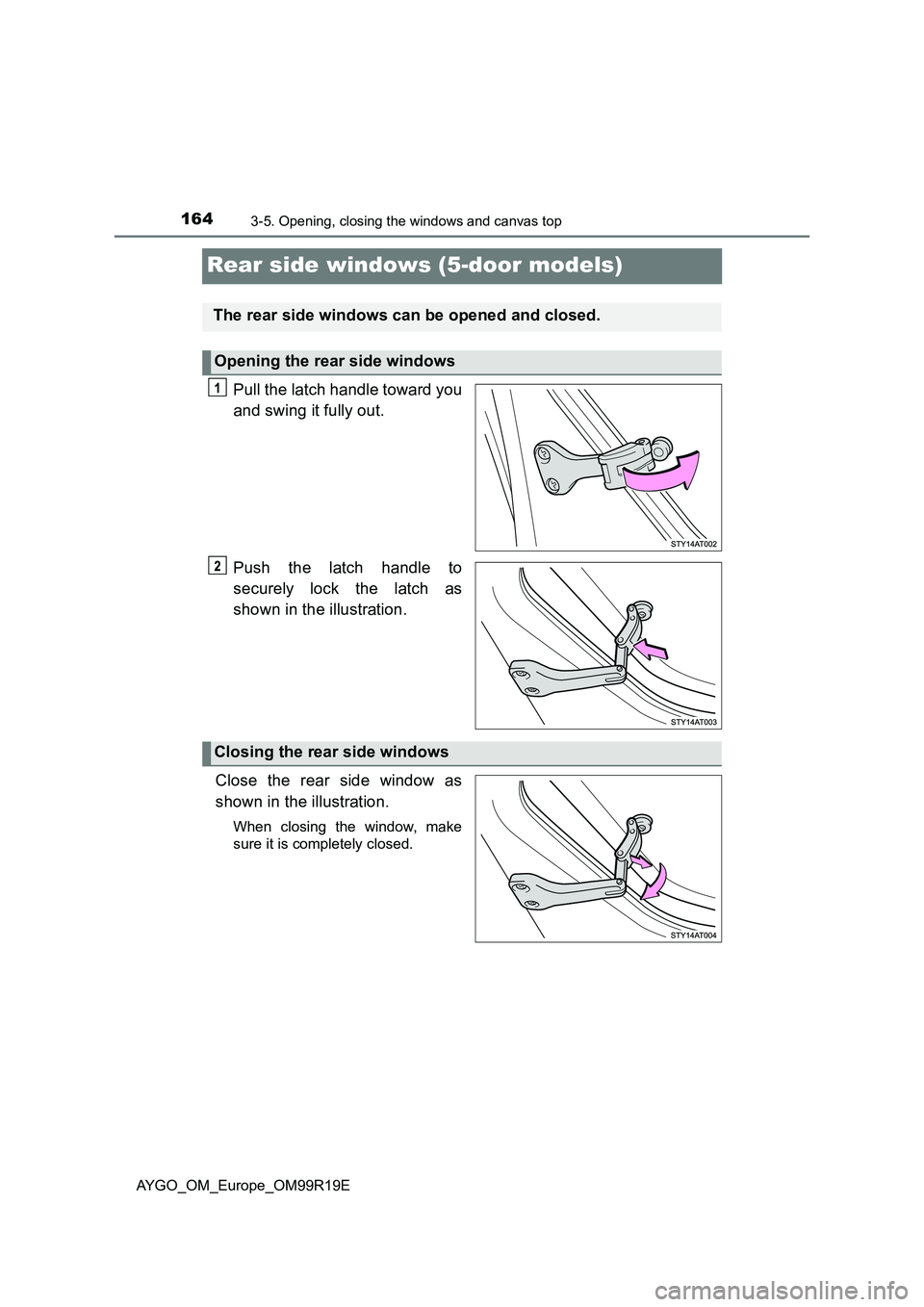
Pull the latch handle toward you
and swing it fully out.
Push the latch handle to
securely lock the latch as
shown in the illustration.
Close the rear side window as
shown in the illustration.
When closing the window, make
sure it is completely closed.
The rear side windows can be opened and closed.
Opening the rear side windows
Closing the rear side windows
Page 169 of 504
169
4Driving
AYGO_OM_Europe_OM99R19E
4-1. Before driving
Driving the vehicle ............. 170
Cargo and luggage ............ 180
Trailer towing ..................... 181
4-2. Driving procedures
Engine (ignition) switch
(vehicles without a smart
entry & start system)........ 182
Engine (ignition) switch
(vehicles with a smart
entry & start system)........ 185
Multi-mode manual
transmission .................... 190
Manual transmission.......... 195
Turn signal lever ................ 197
Parking brake .................... 198
4-3. Operating the lights
and wipers
Headlight switch................. 199
Fog light switch .................. 203
Windshield wiper
and washer ...................... 205
Rear window wiper
and washer ...................... 207
4-4. Refueling
Opening the fuel tank
cap ................................... 209
4-5. Toyota Safety Sense
Toyota Safety Sense ......... 213
PCS (Pre-Collision
system) ............................ 219
LDA (Lane Departure
Alert) ................................ 232
4-6. Using the driving support
systems
Speed limiter ...................... 237
Stop & Start system ........... 240
Driving assist systems ....... 247
4-7. Driving tips
Winter driving tips .............. 253
Page 180 of 504
1804-1. Before driving
AYGO_OM_Europe_OM99R19E
Cargo and luggage
Take notice of the following information about storage precau-
tions, cargo capacity and load.
WARNING
■ Things that must not be carried in the luggage compartment
The following things may cause a fire if loaded in the luggage compartment:
● Receptacles containing gasoline
● Aerosol cans
■ Storage precautions
Observe the following precautions.
Failure to do so may prevent t he pedals from being depressed properly,
may block the driver’s vision, or may re sult in items hitting the driver or pas-
sengers, possibly causing an accident.
● Stow cargo and luggage in the luggage compartment whenever possible.
● Do not stack anything in the luggage compartment higher than the seat-
backs.
● Do not place cargo or luggage in or on the following locations.
• At the feet of the driver
• On the front passenger or rear seats (when stacking items)
• On the luggage cover (if equipped)
• On the instrument panel
• On the dashboard
● Secure all items in the occupant compartment.
● When you fold down the rear seats, long items should not be placed
directly behind the front seats.
● Never allow anyone to ride in the luggage compartment. It is not designed
for passengers. They should ride in their seats with their seat belts prop-
erly fastened. Otherwise, they are much more likely to suffer death or seri-
ous bodily injury, in the event of sudden braking, sudden swerving or an
accident.
■ Load and distribution
● Do not overload your vehicle.
● Do not apply loads unevenly.
Improper loading may cause deterioration of steering or braking control
which may cause death or serious injury.
Page 181 of 504
181
4
4-1. Before driving
Driving
AYGO_OM_Europe_OM99R19E
Trailer towing
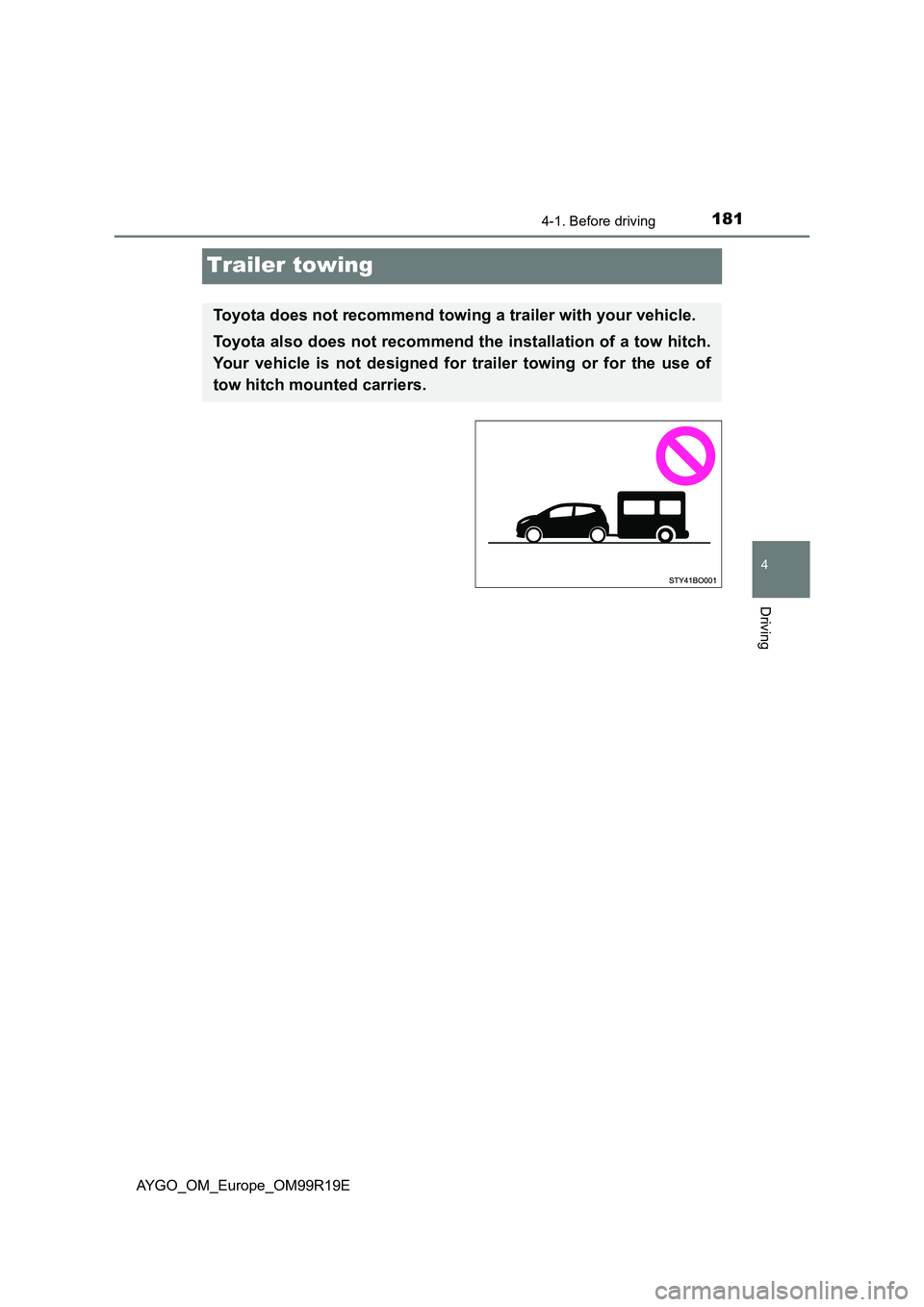
Toyota does not recommend towing a trailer with your vehicle.
Toyota also does not recommend the installation of a tow hitch.
Your vehicle is not designed for trailer towing or for the use of
tow hitch mounted carriers.
Page 200 of 504
2004-3. Operating the lights and wipers
AYGO_OM_Europe_OM99R19E
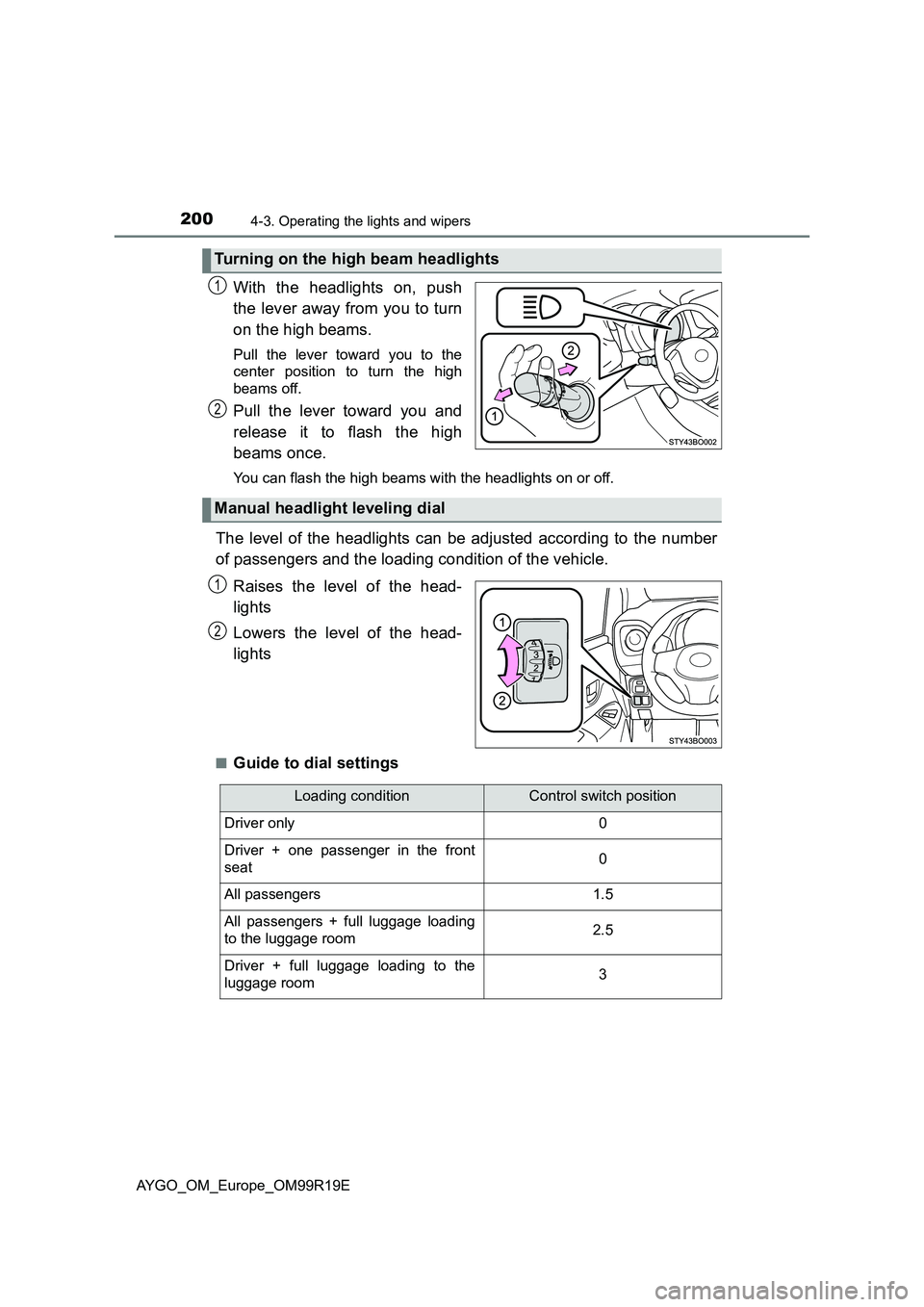
With the headlights on, push
the lever away from you to turn
on the high beams.
Pull the lever toward you to the
center position to turn the high
beams off.
Pull the lever toward you and
release it to flash the high
beams once.
You can flash the high beams wi th the headlights on or off.
The level of the headlights can be adjusted according to the number
of passengers and the loading condition of the vehicle.
Raises the level of the head-
lights
Lowers the level of the head-
lights
■Guide to dial settings
Turning on the high beam headlights
1
2
Manual headlight leveling dial
1
2
Loading conditionControl switch position
Driver only0
Driver + one passenger in the front
seat0
All passengers1.5
All passengers + full luggage loading
to the luggage room2.5
Driver + full luggage loading to the
luggage room3
Page 201 of 504
2014-3. Operating the lights and wipers
4
Driving
AYGO_OM_Europe_OM99R19E
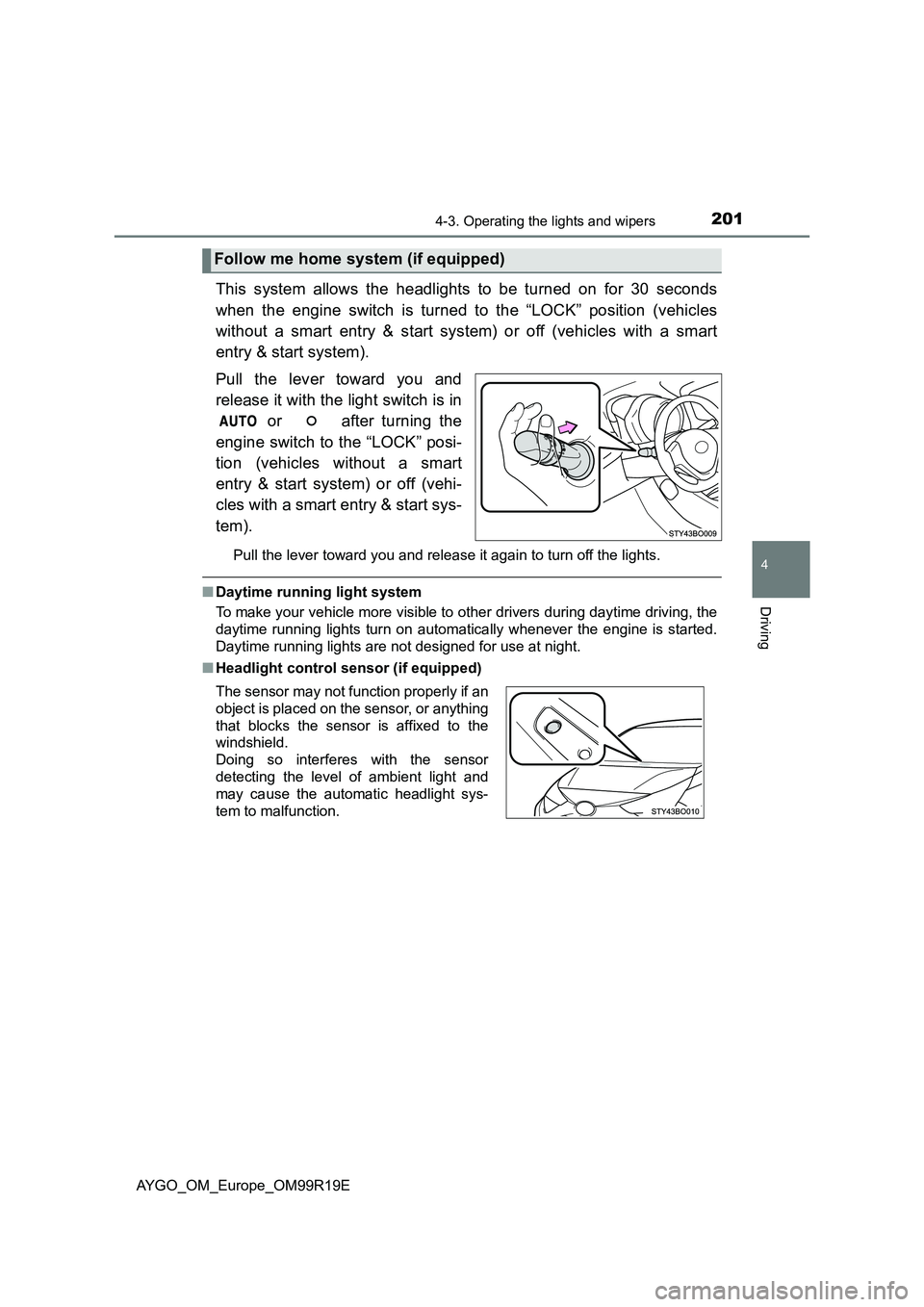
This system allows the headlights to be turned on for 30 seconds
when the engine switch is turned to the “LOCK” position (vehicles
without a smart entry & start system) or off (vehicles with a smart
entry & start system).
Pull the lever toward you and
release it with the light switch is in
or after turning the
engine switch to the “LOCK” posi-
tion (vehicles without a smart
entry & start system) or off (vehi-
cles with a smart entry & start sys-
tem).
Pull the lever toward you and release it again to turn off the lights.
■ Daytime running light system
To make your vehicle more visible to other drivers during daytime driving, the
daytime running lights turn on automatic ally whenever the engine is started.
Daytime running lights are not designed for use at night.
■ Headlight control sensor (if equipped)
Follow me home system (if equipped)
The sensor may not function properly if an
object is placed on the sensor, or anything
that blocks the sensor is affixed to the
windshield.
Doing so interferes with the sensor
detecting the level of ambient light and
may cause the automatic headlight sys-
tem to malfunction.
Page 221 of 504
2214-5. Toyota Safety Sense
4
Driving
AYGO_OM_Europe_OM99R19E
WARNING
●While driving, such as when driving through a railway crossing, the system
may determine that the possibility of a collision with an object, such as rail-
way crossing barrier, is high and operate the pre-collision braking function.
To move the vehicle in an emergency, such as if the system operates in a
railway crossing, perform the following operations and then take the nec-
essary measures to ensure your safety.
• If the vehicle has been stopped, depress the accelerator pedal.
• If the vehicle is decelerating, fully depress the accelerator pedal.
( P. 223)
• Disable the pre-collision system. ( P. 222)
■ When to disable the pre-collision system In the following situations, disable the system, as it may not operate prop-
erly, possibly leading to an accident resulting in death or serious injury:
● When the vehicle is being towed
● When your vehicle is towing another vehicle
● When transporting the vehicle via truck, boat, train or similar means of
transportation
● When the vehicle is raised on a lift with the engine running and the tires
are allowed to rotate freely
● When inspecting the vehicle using a drum tester such as a chassis dyna-
mometer or speedometer tester, or when using an on vehicle wheel bal-
ancer
● If the vehicle cannot be driven in a stable manner, such as when the vehi-
cle has been in an accident or is malfunctioning
● When the vehicle is driven in a sporty manner or off-road
● When the condition of the tires is poor and they do not perform well
( P. 372)
● When tires of a size other than specified are installed
● When tire chains are installed
● When a compact spare tire or an emergency tire puncture repair kit is used