warning light TOYOTA AYGO 2021 Service Manual
[x] Cancel search | Manufacturer: TOYOTA, Model Year: 2021, Model line: AYGO, Model: TOYOTA AYGO 2021Pages: 546, PDF Size: 81 MB
Page 282 of 546
2804-6. Using the driving support systems
AYGO_OM_Europe_OM9A012E
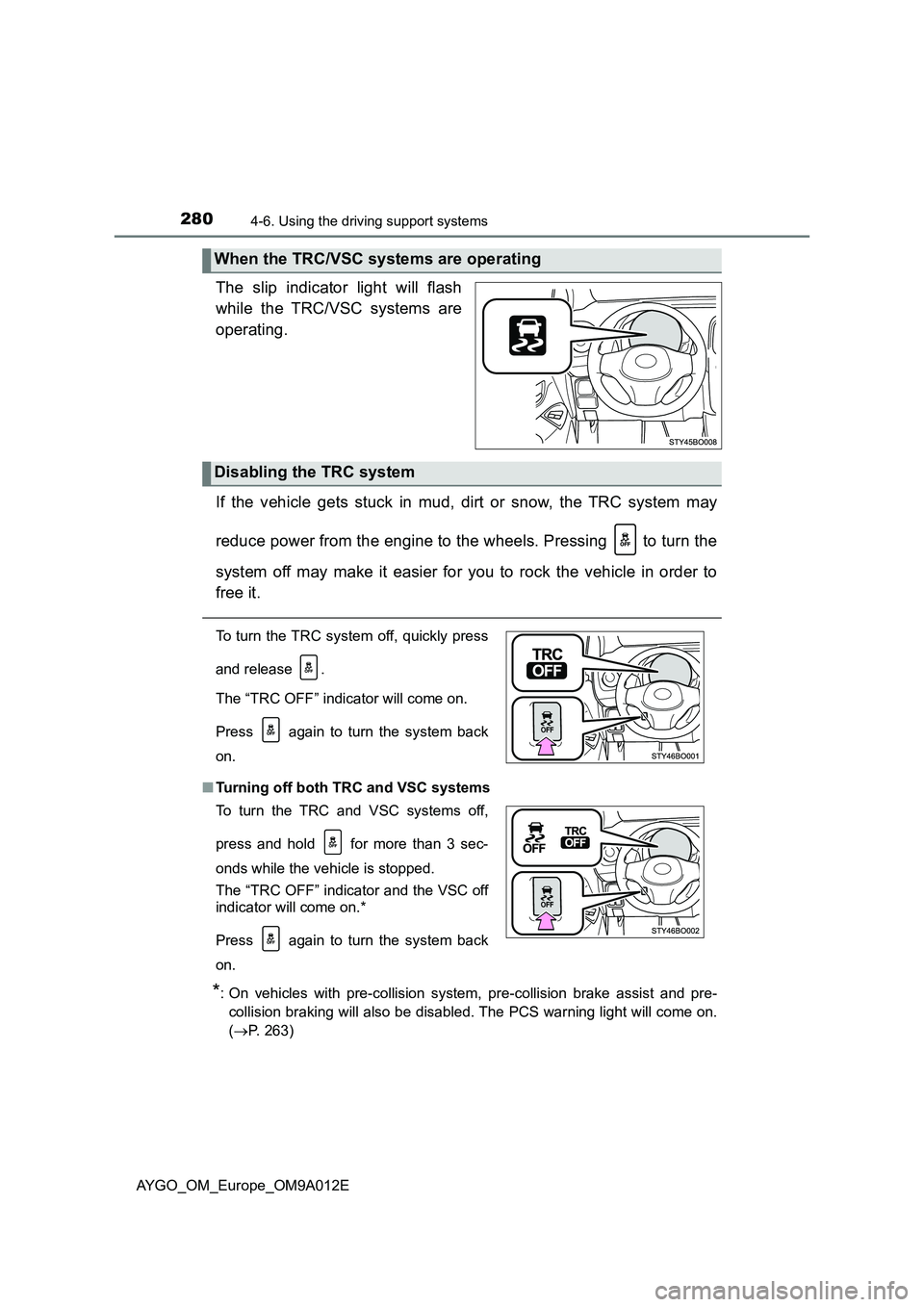
The slip indicator light will flash
while the TRC/VSC systems are
operating.
If the vehicle gets stuck in mud, dirt or snow, the TRC system may
reduce power from the engine to the wheels. Pressing to turn the
system off may make it easier for you to rock the vehicle in order to
free it.
■Turning off both TRC and VSC systems
*: On vehicles with pre-collision system, pre-collision brake assist and pre-
collision braking will also be disabled. The PCS warning light will come on.
(P. 263)
When the TRC/VSC systems are operating
Disabling the TRC system
To turn the TRC system off, quickly press
and release .
The “TRC OFF” indicator will come on.
Press again to turn the system back
on.
To turn the TRC and VSC systems off,
press and hold for more than 3 sec-
onds while the vehicle is stopped.
The “TRC OFF” indicator and the VSC off
indicator will come on.*
Press again to turn the system back
on.
Page 286 of 546
2844-6. Using the driving support systems
AYGO_OM_Europe_OM9A012E
WARNING
■When the TRC/VSC is activated
The slip indicator light flashes. Always drive carefully. Reckless driving may
cause an accident. Exercise particular care when the indicator light flashes.
■ When the TRC/VSC systems are turned off
Be especially careful and drive at a speed appropriate to the road condi-
tions. As these are the systems to help ensure vehicle stability and driving
force, do not turn the TRC/VSC systems off unless necessary.
■ Replacing tires
Make sure that all tires are of the specified size, brand, tread pattern and
total load capacity. In addition, make sure that the tires are inflated to the
recommended tire inflation pressure level.
The ABS, TRC and VSC systems will not function correctly if different tires
are installed on the vehicle.
Contact any authorized Toyota retailer or Toyota authorized repairer, or any
reliable repairer for further information when replacing tires or wheels.
■ Handling of tires and the suspension
Using tires with any kind of problem or modifying the suspension will affect
the driving assist systems, and may cause a system to malfunction.
Page 369 of 546
3676-3. Using the storage features
6
Interior features
AYGO_OM_Europe_OM9A012E
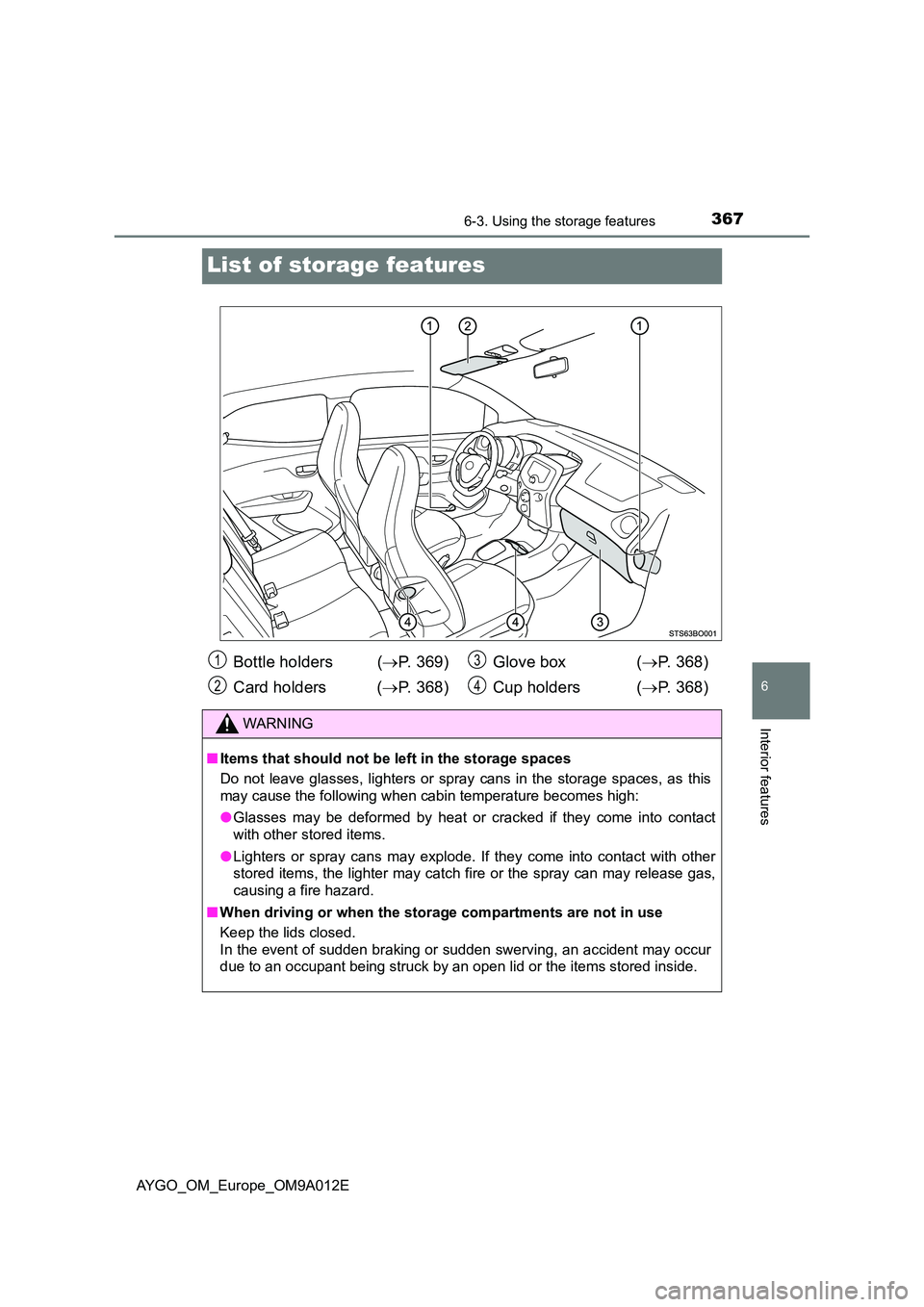
List of storage features
Bottle holders (P. 369)
Card holders ( P. 368)
Glove box ( P. 368)
Cup holders ( P. 368)
WARNING
■Items that should not be left in the storage spaces
Do not leave glasses, lighters or spray cans in the storage spaces, as this
may cause the following when cabin temperature becomes high:
● Glasses may be deformed by heat or cracked if they come into contact
with other stored items.
● Lighters or spray cans may explode. If they come into contact with other
stored items, the lighter may catch fire or the spray can may release gas,
causing a fire hazard.
■ When driving or when the storage compartments are not in use
Keep the lids closed.
In the event of sudden braking or sudden swerving, an accident may occur
due to an occupant being struck by an open lid or the items stored inside.
1
2
3
4
Page 382 of 546
3807-1. Maintenance and care
AYGO_OM_Europe_OM9A012E
WARNING
■When cleaning the windshield
Installation area of front sensor on windshield: P. 250
■ When washing the vehicle
Do not apply water to the inside of the engine compartment. Doing so may
cause the electrical components, etc., to catch fire.
■ Precautions regarding the exhaust pipe
Exhaust gases cause the exhaust pipe to become quite hot.
When washing the vehicle, be careful not to touch the pipe until it has
cooled sufficiently, as touching hot exhaust pipe can cause burns.
NOTICE
■ To prevent paint deterioration and corrosion on the body and compo-
nents (aluminum wheels, etc.)
● Wash the vehicle immediately in the following cases:
• After driving near the sea coast
• After driving on salted roads
• If coal tar or tree sap is present on the paint surface
• If dead insects, insect droppings or bird droppings are present on the
paint surface
• After driving in an area contaminated with soot, oily smoke, mine dust,
iron powder or chemical substances
• If the vehicle becomes heavily soiled with dust or mud
• If liquids such as benzene and gasoline are spilled on the paint surface
● If the paint is chipped or scratched, have it repaired immediately.
● To prevent the wheels from corroding, remove any dirt and store in a place
with low humidity when storing the wheels.
■ Cleaning the exterior lights
● Wash carefully. Do not use organic substances or scrub with a hard brush.
This may damage the surfaces of the lights.
● Do not apply wax to the surfaces of the lights.
Wax may cause damage to the lenses.
■ Antenna installation and removal precautions
● Before driving, ensure that the antenna is installed.
● When the antenna is removed, such as before entering an automatic car
wash, make sure to store it in a suitable place so as not to lose it. Also,
before driving, make sure to reinstall the antenna in its original position.
Page 403 of 546
4017-3. Do-it-yourself maintenance
7
Maintenance and care
AYGO_OM_Europe_OM9A012E
WARNING
■Chemicals in the battery
A battery contains poisonous and corrosive sulfuric acid and may produce
hydrogen gas which is flammable and explosive. To reduce the risk of death
or serious injury, take the following precautions while working on or near the
battery:
● Do not cause sparks by touching the battery terminals with tools.
● Do not smoke or light a match near the battery.
● Avoid contact with eyes, skin and clothes.
● Never inhale or swallow electrolyte.
● Wear protective safety glasses when working near the battery.
● Keep children away from the battery.
■ Where to safely charge the battery
Always charge the battery in an open area. Do not charge the battery in a
garage or closed room w here there is not sufficient ventilation.
■ How to recharge the battery
Only perform a slow charge (5 A or less). The battery may explode if
charged at a quicker rate.
■ Emergency measures regarding electrolyte
● If electrolyte gets in your eyes
Flush your eyes with clean water for at least 15 minutes and get immedi-
ate medical attention. If possible, continue to apply water with a sponge or
cloth while traveling to the nearest medical facility.
● If electrolyte gets on your skin
Wash the affected area thoroughly. If you feel pain or burning, get medical
attention immediately.
● If electrolyte gets on your clothes
It can soak through clothing on to your skin. Immediately take off the cloth-
ing and follow the procedure above if necessary.
● If you accidentally swallow electrolyte
Drink a large quantity of water or milk. Get emergency medical attention
immediately.
NOTICE
■ When recharging the battery
Never recharge the battery while the engine is running. Also, be sure all
accessories are turned off.
Page 408 of 546
4067-3. Do-it-yourself maintenance
AYGO_OM_Europe_OM9A012E■
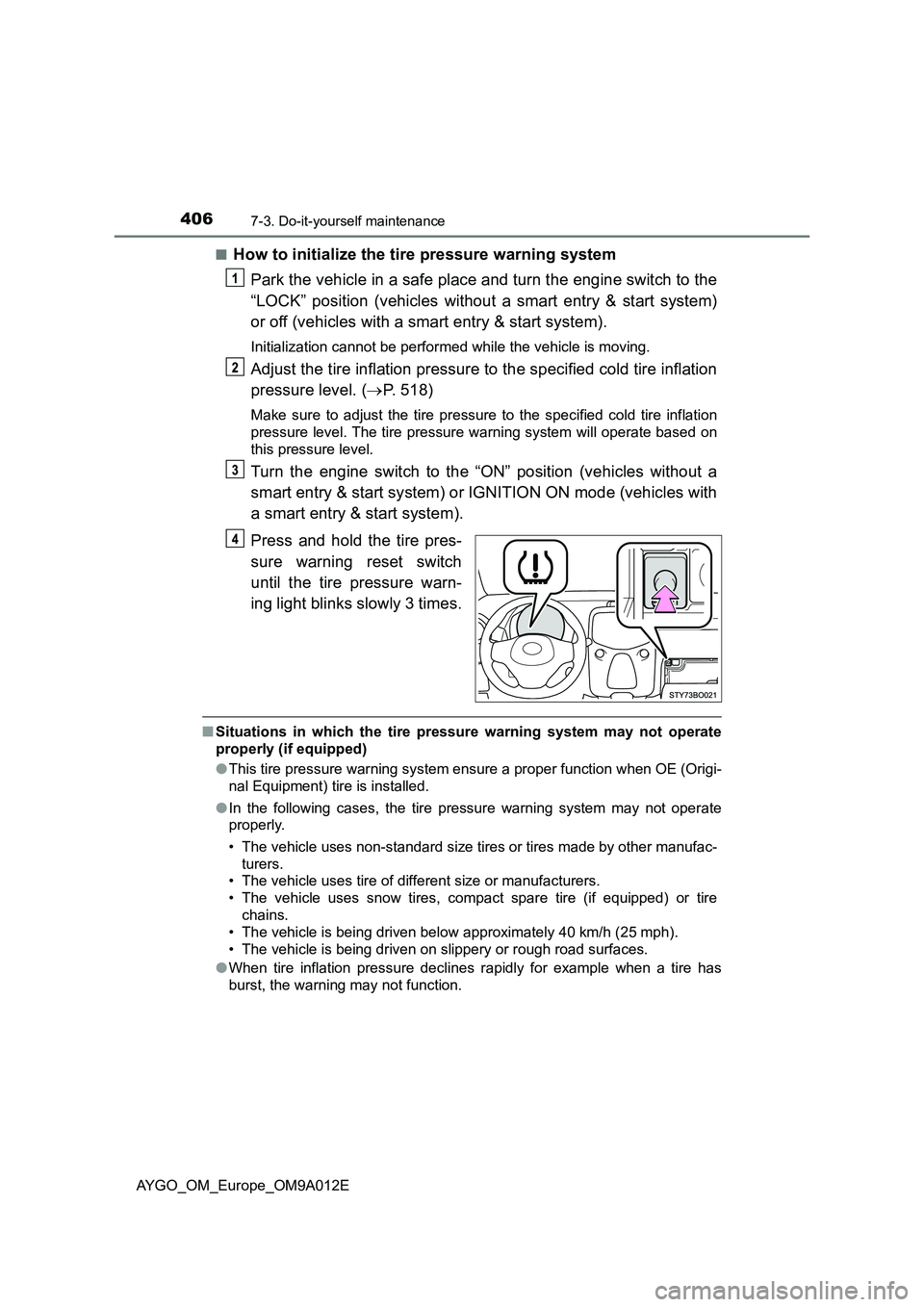
How to initialize the tire pressure warning system
Park the vehicle in a safe place and turn the engine switch to the
“LOCK” position (vehicles without a smart entry & start system)
or off (vehicles with a smart entry & start system).
Initialization cannot be performed while the vehicle is moving.
Adjust the tire inflation pressure to the specified cold tire inflation
pressure level. (P. 518)
Make sure to adjust the tire pressure to the specified cold tire inflation
pressure level. The tire pressure warning system will operate based on
this pressure level.
Turn the engine switch to the “ON” position (vehicles without a
smart entry & start system) or IGNITION ON mode (vehicles with
a smart entry & start system).
Press and hold the tire pres-
sure warning reset switch
until the tire pressure warn-
ing light blinks slowly 3 times.
■Situations in which the tire pressure warning system may not operate
properly (if equipped)
●This tire pressure warning system ensure a proper function when OE (Origi-
nal Equipment) tire is installed.
●In the following cases, the tire pressure warning system may not operate
properly.
• The vehicle uses non-standard size tires or tires made by other manufac-
turers.
• The vehicle uses tire of different size or manufacturers.
• The vehicle uses snow tires, compact spare tire (if equipped) or tire
chains.
• The vehicle is being driven below approximately 40 km/h (25 mph).
• The vehicle is being driven on slippery or rough road surfaces.
●When tire inflation pressure declines rapidly for example when a tire has
burst, the warning may not function.
Page 409 of 546
4077-3. Do-it-yourself maintenance
7
Maintenance and care
AYGO_OM_Europe_OM9A012E
WARNING
■When inspecting or replacing tires
Observe the following precautions to prevent accidents.
Failure to do so may cause damage to parts of the drive train as well as
dangerous handling characteristics, which may lead to an accident resulting
in death or serious injury.
● Do not mix tires of different makes, models or tread patterns.
Also, do not mix tires of remarkably different treadwear.
● Do not use tire sizes other than those recommended by Toyota.
● Do not mix differently constructed tires (radial, bias-belted or bias-ply
tires).
● Do not mix summer, all season and snow tires.
● Do not use tires that have been used on another vehicle.
Do not use tires if you do not know how they were used previously.
● Vehicles with a compact spare tire: Do not tow if your vehicle has a com-
pact spare tire installed.
● Vehicles with an emergency tire puncture repair kit: Do not tow anything if
a tire that has been repaired using the emergency tire puncture repair kit is
installed. The load on the tire may cause unexpected damage to the tire.
■ When initializing the tire pressure warning system (if equipped)
Do not operate the tire pressure warning reset switch without first adjusting
the tire inflation pressure to the specified level. Otherwise, the tire pressure
warning light may not come on even if the tire inflation pressure is low, or it
may come on when the tire inflation pressure is actually normal.
Page 410 of 546
4087-3. Do-it-yourself maintenance
AYGO_OM_Europe_OM9A012E
WARNING
■Maintenance of the tires (vehicles with the tire pressure warning sys-
tem)
Each tire, including the spare (if provided), should be checked monthly
when cold and inflated to the inflation pressure recommended by the vehi-
cle manufacturer on the vehicle placard or tire inflation pressure label (tire
and load information label). (If your vehicle has tires of a different size than
the size indicated on the vehicle placard or tire inflation pressure label [tire
and load information label], you should determine the proper tire inflation
pressure for those tires.)
As an added safety feature, your vehicle has been equipped with a tire
pressure monitoring system (TPMS-tire pressure warning system) that illu-
minates a low tire pressure telltale (tire pressure warning light) when one or
more of your tires is significantly under-inflated. Accordingly, when the low
tire pressure telltale (tire pressure warning light) illuminates, you should
stop and check your tires as soon as possible, and inflate them to the
proper pressure. Driving on a significantly under-inflated tire causes the tire
to overheat and can lead to tire failure. Under-inflation also reduces fuel effi-
ciency and tire tread life, and may affect the vehicle’s handling and stopping
ability.
Please note that the TPMS (tire pressure warning system) is not a substi-
tute for proper tire maintenance, and it is the driver’s responsibility to main-
tain correct tire pressure, even if under-inflation has not reached the level to
trigger illumination of the TPMS low tire pressure telltale (tire pressure
warning light).
Your vehicle has also been equipped with a TPMS (tire pressure warning
system) malfunction indicator to indicate when the system is not operating
properly. The TPMS (tire pressure warning system) malfunction indicator is
combined with the low tire pressure telltale (tire pressure warning light).
When the system detects a malfunction, the telltale will flash for approxi-
mately one minute and then remain continuously illuminated. This
sequence will continue upon subsequent vehicle start-ups as long as the
malfunction exists. When the malfunction indicator is illuminated, the sys-
tem may not be able to detect or signal low tire pressure as intended.
TPMS (tire pressure warning system) malfunctions may occur for a variety
of reasons, including the installation of replacement or alternate tires or
wheels on the vehicle that prevent the TPMS (tire pressure warning system)
from functioning properly. Always check the TPMS (tire pressure warning
system) malfunction telltale after replacing one or more tires or wheels on
your vehicle to ensure that the repl acement or alternate tires and wheels
allow the TPMS (tire pressure warning system) to continue to function prop-
erly.
Page 427 of 546
4257-3. Do-it-yourself maintenance
7
Maintenance and care
AYGO_OM_Europe_OM9A012E
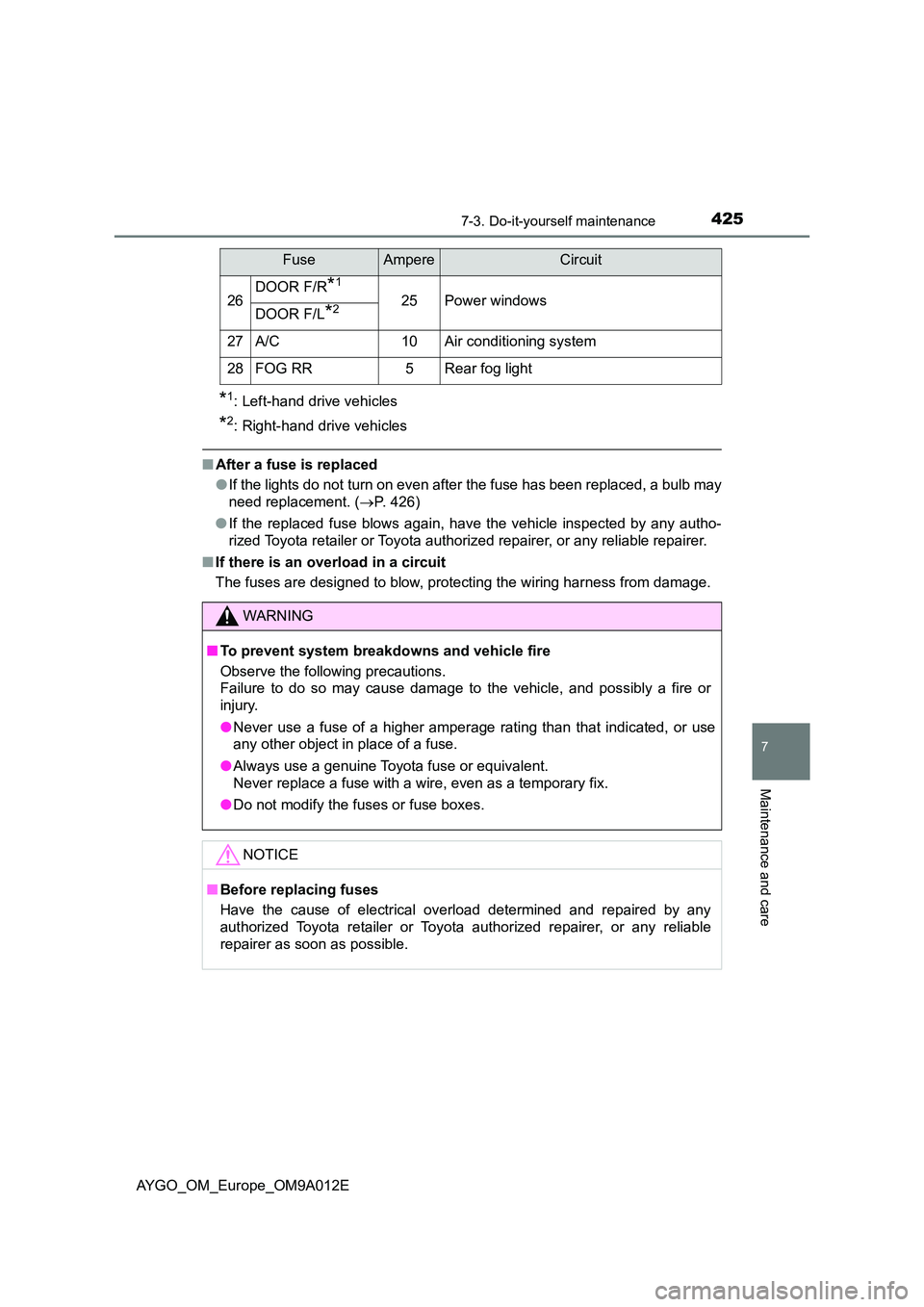
*1: Left-hand drive vehicles
*2: Right-hand drive vehicles
■After a fuse is replaced
● If the lights do not turn on even after the fuse has been replaced, a bulb may
need replacement. ( P. 426)
● If the replaced fuse blows again, have the vehicle inspected by any autho-
rized Toyota retailer or Toyota authorized repairer, or any reliable repairer.
■ If there is an overload in a circuit
The fuses are designed to blow, protecting the wiring harness from damage.
26DOOR F/R*1
25Power windowsDOOR F/L*2
27A/C10Air conditioning system
28FOG RR5Rear fog light
WARNING
■ To prevent system breakdowns and vehicle fire
Observe the following precautions.
Failure to do so may cause damage to the vehicle, and possibly a fire or
injury.
● Never use a fuse of a higher amperage rating than that indicated, or use
any other object in place of a fuse.
● Always use a genuine Toyota fuse or equivalent.
Never replace a fuse with a wire, even as a temporary fix.
● Do not modify the fuses or fuse boxes.
NOTICE
■Before replacing fuses
Have the cause of electrical overload determined and repaired by any
authorized Toyota retailer or Toyota authorized repairer, or any reliable
repairer as soon as possible.
FuseAmpereCircuit
Page 438 of 546
4367-3. Do-it-yourself maintenance
AYGO_OM_Europe_OM9A012E
■LED Lights
The front position lights, daytime running lights and tail lights consist of a
number of LEDs. If any of the LEDs burn out, take your vehicle to any autho-
rized Toyota retailer or Toyota author ized repairer, or any reliable repairer to
have the light replaced.
■ Condensation build-up on the inside of the lens
Temporary condensation build-up on the inside of the headlight lens does not
indicate a malfunction. Contact any authorized Toyota retailer or Toyota
authorized repairer, or any reliable repairer for more information in the follow-
ing situations:
● Large drops of water have built up on the inside of the lens.
● Water has built up inside the headlight.
WARNING
■Replacing light bulbs
● Turn off the lights. Do not attempt to replace the bulb immediately after
turning off the lights.
The bulbs become very hot and may cause burns.
● Do not touch the glass portion of the light bulb with bare hands. When it is
unavoidable to hold the glass portion, use and hold with a clean dry cloth
to avoid getting moisture and oils on the bulb.
Also, if the bulb is scratched or dropped, it may blow out or crack.
● Fully install light bulbs and any parts used to secure them. Failure to do so
may result in heat damage, fire, or water entering the headlight unit. This
may damage the headlights or cause condensation to build up on the lens.
■ To prevent damage or fire
● Make sure bulbs are fully seated and locked.
● Check the wattage of the bulb before installing to prevent heat damage.