engine TOYOTA C-HR 2018 1.G Owners Manual
[x] Cancel search | Manufacturer: TOYOTA, Model Year: 2018, Model line: C-HR, Model: TOYOTA C-HR 2018 1.GPages: 516, PDF Size: 9.32 MB
Page 441 of 516
4417-2. Steps to take in an emergency
7
When trouble arises
C-HR_OM_USA_OM10526U
Vehicles without a smart key system:
Maintain the engine speed of the second vehicle and turn the
engine switch to the “ON” position, then start the vehicle’s engine.
Vehicles with a smart key system:
Maintain the engine speed of the second vehicle and turn the
engine switch to IGNITION ON mode, then start the vehicle’s
engine.
Once the vehicle’s engine has started, remove the jumper cables in
the exact reverse order from which they were connected.
To install the engine cover, conduct the removal procedure in
reverse. After installing, check that the fixed pins are inserted
securely.
Once the engine starts, have the v ehicle inspected at your Toyota
dealer as soon as possible.
■ Starting the engine when the battery is discharged
The engine cannot be started by push-starting.
■ To prevent battery discharge
●Turn off the headlights and the air conditioning system while the engine is
stopped.
● Turn off any unnecessary electrical components when the vehicle is running
at a low speed for an extended period, such as in heavy traffic.
■ Charging the battery
The electricity stored in the battery will discharge gradually even when the
vehicle is not in use, due to natural discharge and the draining effects of cer-
tain electrical appliances. If the vehicle is left for a long time, the battery may
discharge, and the engine may be unable to start. (The battery recharges
automatically during driving.)
■ When exchanging the battery
●Use a battery that conforms to European regulations.
● Use a battery that the case size is same as the previous one (LN2), 20 hour
rate capacity (20HR) is equivalent ( 60Ah) or greater, and performance rating
(CCA) is equivalent (520A) or greater.
• If the sizes differ, the battery cannot be properly secured.
• If the 20 hour rate capacity is low, even if the time period where the vehi- cle is not used is a short time, the battery may discharge and the engine
may not be able to start.
● For details, consult your Toyota dealer.
6
7
8
Page 442 of 516
4427-2. Steps to take in an emergency
C-HR_OM_USA_OM10526U
WARNING
■Avoiding battery fires or explosions
Observe the following precautions to prevent accidentally igniting the flam-
mable gas that may be emitted from the battery:
● Make sure each jumper cable is connected to the correct terminal and that
it is not unintentionally in contact with any other than the intended terminal.
● Do not allow the other end of the jumper cable connected to the “+” termi-
nal to come into contact with any other parts or metal surfaces in the area,
such as brackets or unpainted metal.
● Do not allow the + and - clamps of the jumper cables to come into contact
with each other.
● Do not smoke, use matches, cigarette lighters or allow open flame near
the battery.
■ Battery precautions
The battery contains poisonous and corrosive acidic electrolyte, while
related parts contain lead and lead compounds. Observe the following pre-
cautions when handling the battery:
● When working with the battery, always wear safety glasses and take care
not to allow any battery fluids (acid) to come into contact with skin, clothing
or the vehicle body.
● Do not lean over the battery.
● In the event that battery fluid comes into contact with the skin or eyes,
immediately wash the affected area with water and seek medical attention.
Place a wet sponge or cloth over the affected area until medical attention
can be received.
● Always wash your hands after handling the battery support, terminals, an\
d
other battery-related parts.
● Do not allow children near the battery.
NOTICE
■When handling jumper cables
When connecting the jumper cables, ensure that they do not become entan-
gled in the cooling fan or engine drive belt.
Page 443 of 516
4437-2. Steps to take in an emergency
C-HR_OM_USA_OM10526U
7
When trouble arises
If your vehicle overheats
●The needle of the engine coolant temperature gauge ( →P. 8 6 )
enters the red zone or a loss of engine power is experienced (for
example, the vehicle speed does not increase).
● Steam comes out from under the hood.
Stop the vehicle in a safe place and turn off the air conditioning sys-
tem, and then stop the engine.
If you see steam:
Carefully lift the hood after the steam subsides.
If you do not see steam:
Carefully lift the hood.
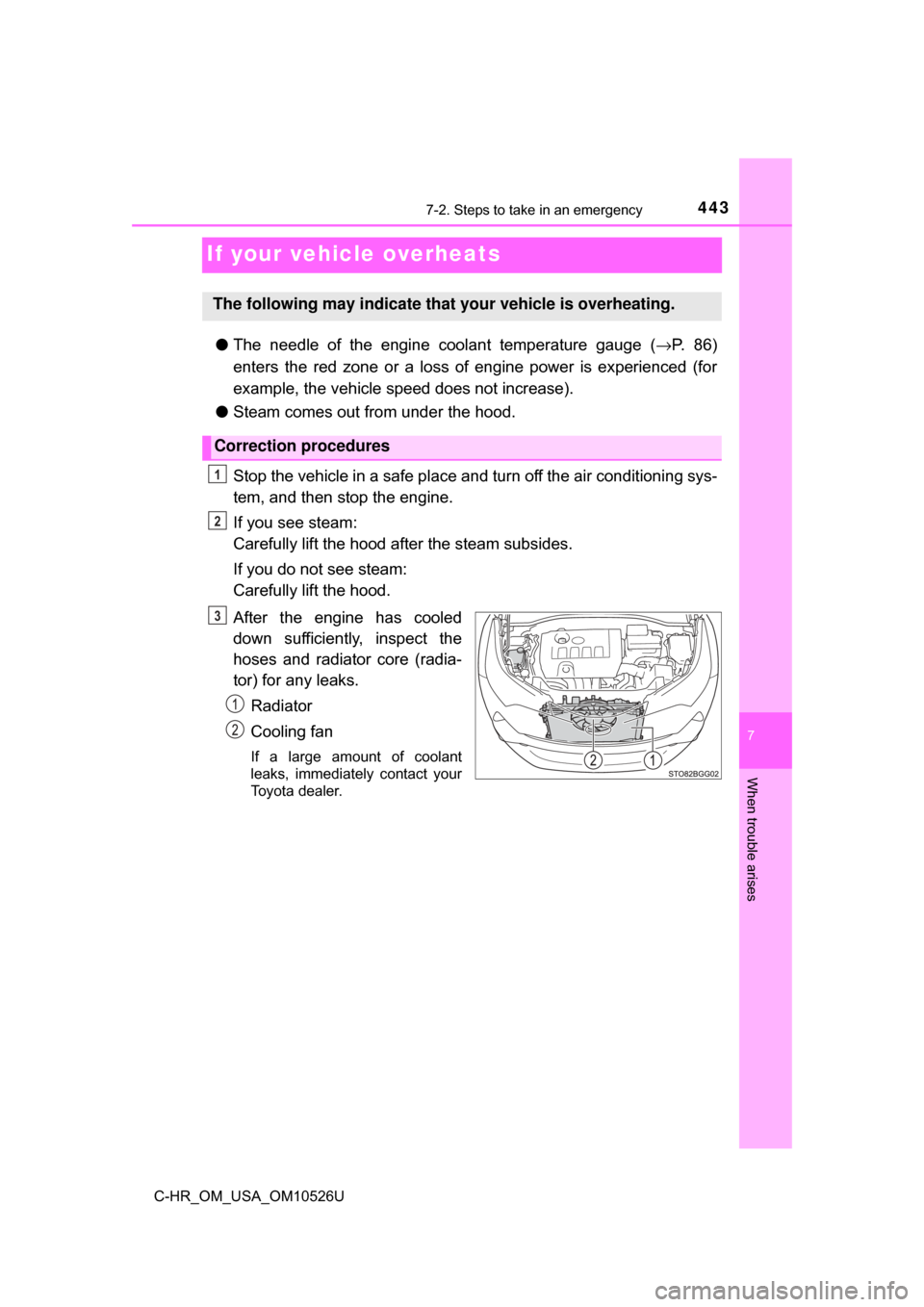
After the engine has cooled
down sufficient ly, inspect the
hoses and radiator core (radia-
tor) for any leaks.
Radiator
Cooling fan
If a large amount of coolant
leaks, immediately contact your
Toyota dealer.
The following may indicate that your vehicle is overheating.
Correction procedures
1
2
3
Page 444 of 516
4447-2. Steps to take in an emergency
C-HR_OM_USA_OM10526U
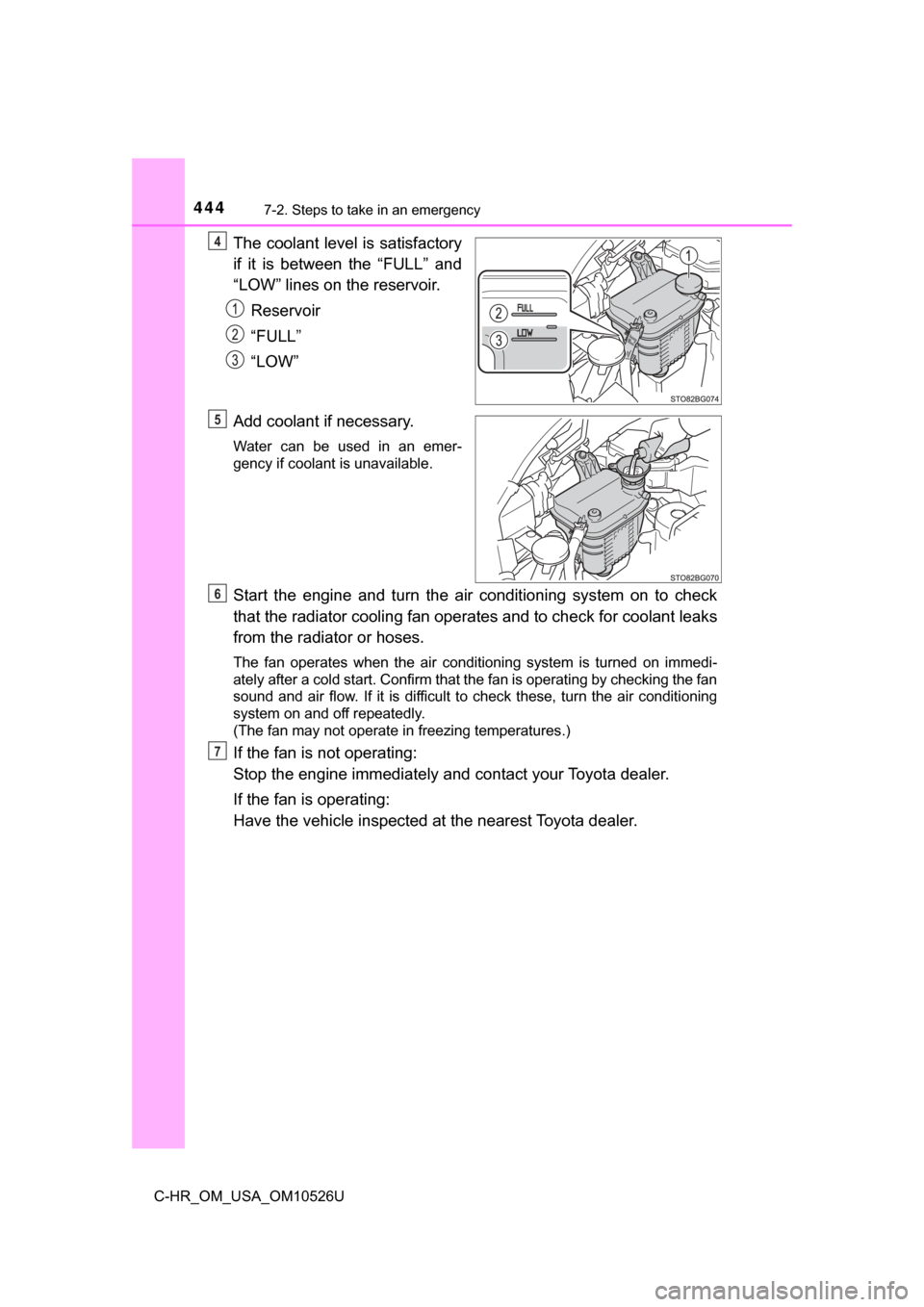
The coolant level is satisfactory
if it is between the “FULL” and
“LOW” lines on the reservoir.Reservoir
“FULL”
“LOW”
Add coolant if necessary.
Water can be used in an emer-
gency if coolant is unavailable.
Start the engine and turn the air conditioning system on to check
that the radiator cooling fan opera tes and to check for coolant leaks
from the radiator or hoses.
The fan operates when the air conditioning system is turned on immedi-
ately after a cold start. Confirm that the fan is operating by checking the fan
sound and air flow. If it is difficult to check these, turn the air conditioning
system on and off repeatedly.
(The fan may not operate in freezing temperatures.)
If the fan is not operating:
Stop the engine immediately and contact your Toyota dealer.
If the fan is operating:
Have the vehicle in spected at the nearest Toyota dealer.
4
5
6
7
Page 445 of 516
4457-2. Steps to take in an emergency
7
When trouble arises
C-HR_OM_USA_OM10526U
WARNING
■When inspecting under the hood of your vehicle
Observe the following precautions.
Failure to do so may result in serious injury such as burns.
● If steam is seen coming from under the hood, do not open the hood until
the steam has subsided. The engine compartment may be very hot.
● Keep hands and clothing (especially a tie, a scarf or a muffler) away from
the fan and belts. Failure to do so may cause the hands or clothing to be
caught, resulting in serious injury.
● Do not loosen the coolant reservoir cap while the engine and radiator are
hot.
High temperature steam or coolant could spray out.
NOTICE
■When adding coolant
Add coolant slowly after the engine has cooled down sufficiently. Adding
cool coolant to a hot engine too quickly can cause damage to the engine.
■ To prevent damage to the cooling system
Observe the following precautions:
● Avoid contaminating the coolant with foreign matter (such as sand or dust
etc.).
● Do not use any coolant additives.
Page 446 of 516
4467-2. Steps to take in an emergency
C-HR_OM_USA_OM10526U
If the vehicle becomes stuck
Stop the engine. Shift the shift lever to P, and set the parking brake.
Remove the mud, snow or sand from around the front wheels.
Place wood, stones or some othe r material under the front wheels
to help provide traction.
Restart the engine.
Shift the shift lever to D or R and release the parking brake. Then,
while exercising caution, depress the accelerator pedal.
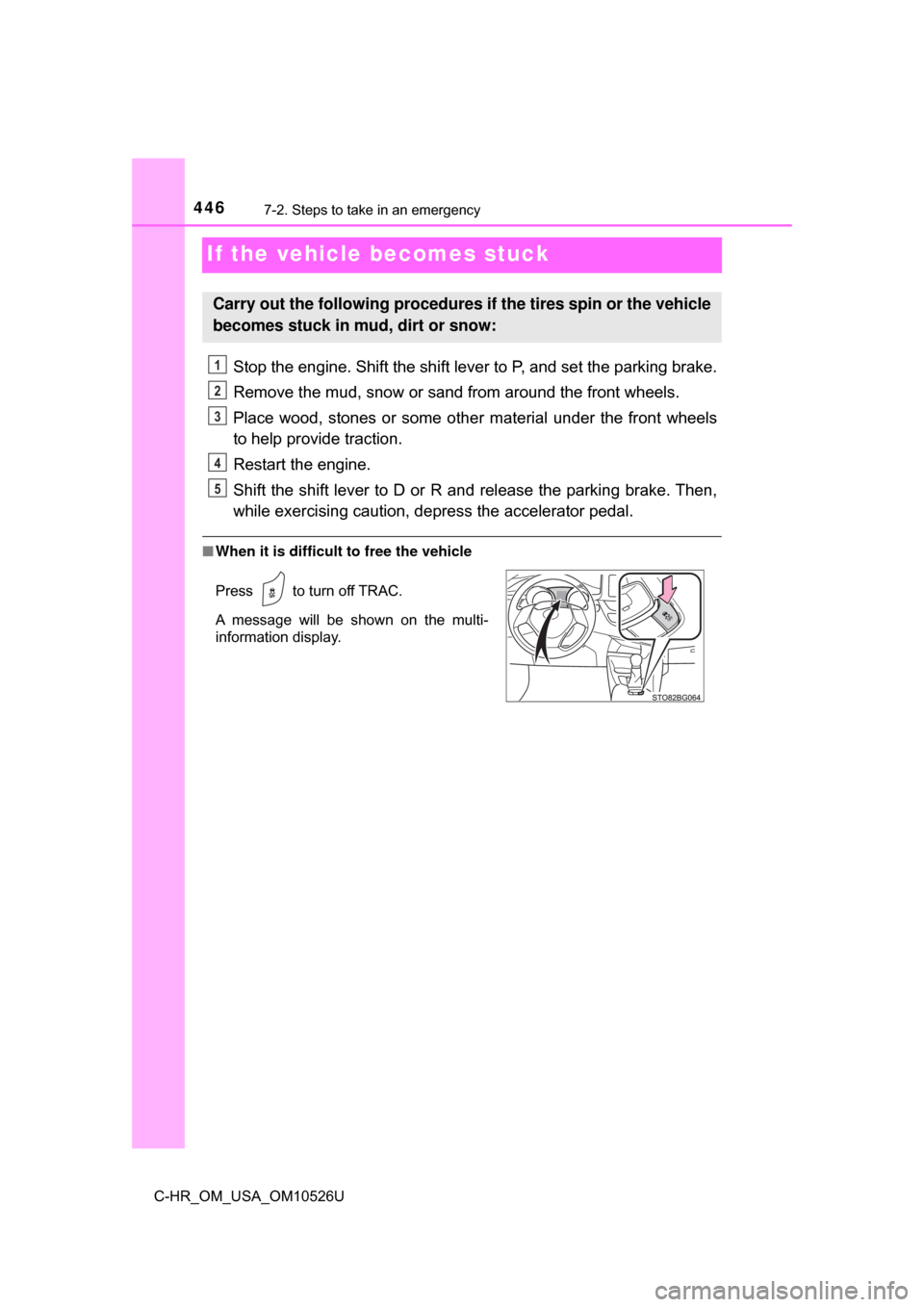
■ When it is difficult to free the vehicle
Carry out the following procedures if the tires spin or the vehicle
becomes stuck in mud, dirt or snow:
Press to turn off TRAC.
A message will be shown on the multi-
information display.
1
2
3
4
5
Page 451 of 516

4518-1. Specifications
8
Vehicle specifications
C-HR_OM_USA_OM10526U
This number is stamped under
the right-hand front seat.
This number is also on the Cer-
tification Label.
■Engine number
The engine number is stamped
on the engine block as shown.
Page 452 of 516
4528-1. Specifications
C-HR_OM_USA_OM10526U
*: The engine oil capacity is a reference quantity to be used when changingthe engine oil. Warm up and turn off the engine, wait more than 5 minutes,
and check the oil level on the dipstick.
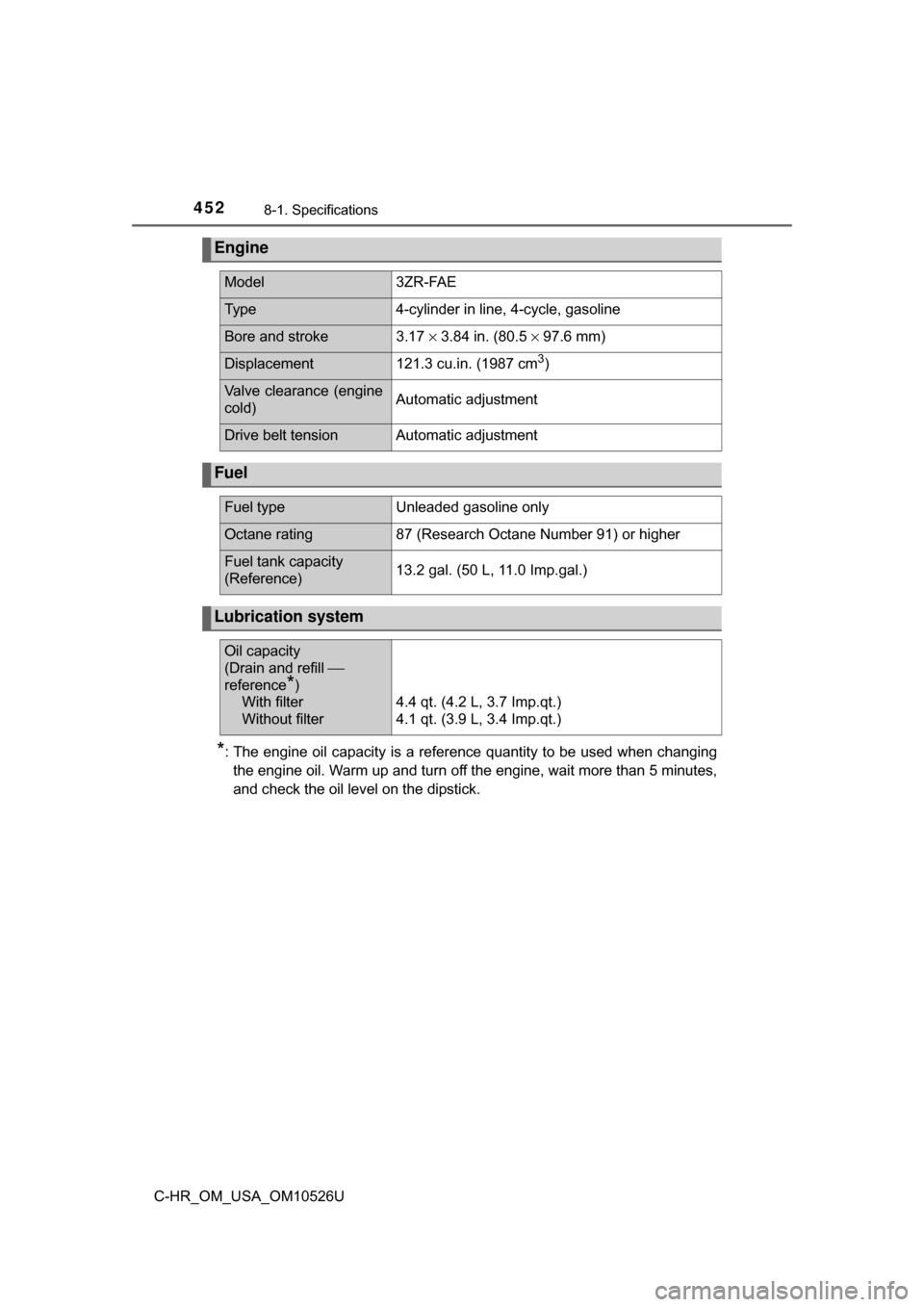
Engine
Model 3ZR-FAE
Type4-cylinder in line, 4-cycle, gasoline
Bore and stroke 3.17 × 3.84 in. (80.5 × 97.6 mm)
Displacement 121.3 cu.in. (1987 cm3)
Valve clearance (engine
cold)Automatic adjustment
Drive belt tension Automatic adjustment
Fuel
Fuel type
Unleaded gasoline only
Octane rating87 (Research Octane Number 91) or higher
Fuel tank capacity
(Reference)13.2 gal. (50 L, 11.0 Imp.gal.)
Lubrication system
Oil capacity
(Drain and refill
⎯
reference
*)
With filter
Without filter 4.4 qt. (4.2 L, 3.7 Imp.qt.)
4.1 qt. (3.9 L, 3.4 Imp.qt.)
Page 453 of 516
4538-1. Specifications
8
Vehicle specifications
C-HR_OM_USA_OM10526U■
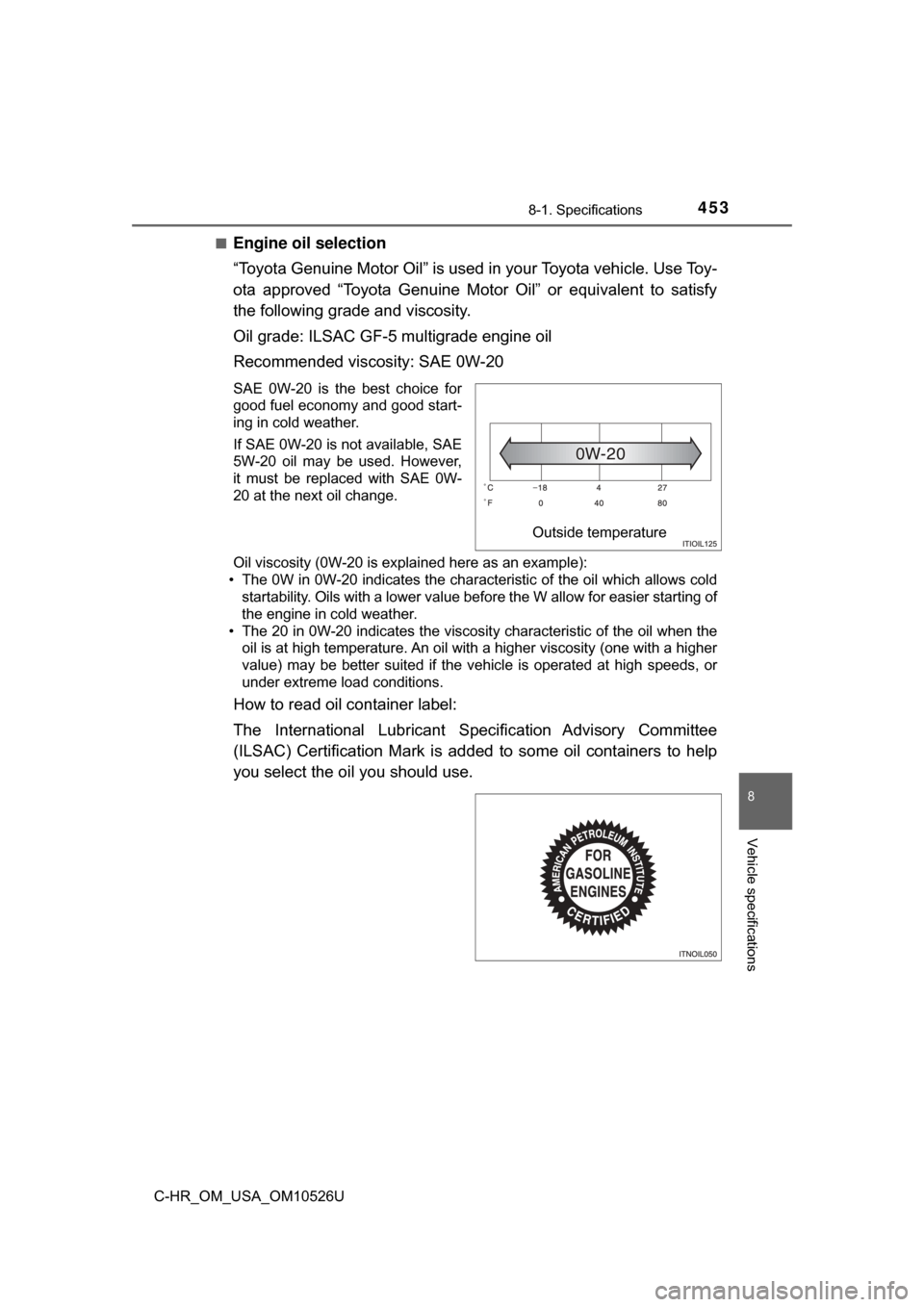
Engine oil selection
“Toyota Genuine Motor Oil” is used
in your Toyota vehicle. Use Toy-
ota approved “Toyota Genuine Motor Oil” or equivalent to satisfy
the following grade and viscosity.
Oil grade: ILSAC GF-5 multigrade engine oil
Recommended viscosity: SAE 0W-20
SAE 0W-20 is the best choice for
good fuel economy and good start-
ing in cold weather.
If SAE 0W-20 is not available, SAE
5W-20 oil may be used. However,
it must be replaced with SAE 0W-
20 at the next oil change.
Oil viscosity (0W-20 is explained here as an example):
• The 0W in 0W-20 indicates the characteristic of the oil which allows cold startability. Oils with a lower value before the W allow for easier starting of
the engine in cold weather.
• The 20 in 0W-20 indicates the viscosity characteristic of the oil when the oil is at high temperature. An oil with a higher viscosity (one with a higher
value) may be better suited if the vehicle is operated at high speeds, \
or
under extreme load conditions.
How to read oil container label:
The International Lubricant Sp ecification Advisory Committee
(ILSAC) Certification Mark is ad ded to some oil containers to help
you select the oi l you should use.
Outside temperature
Page 454 of 516
4548-1. Specifications
C-HR_OM_USA_OM10526U
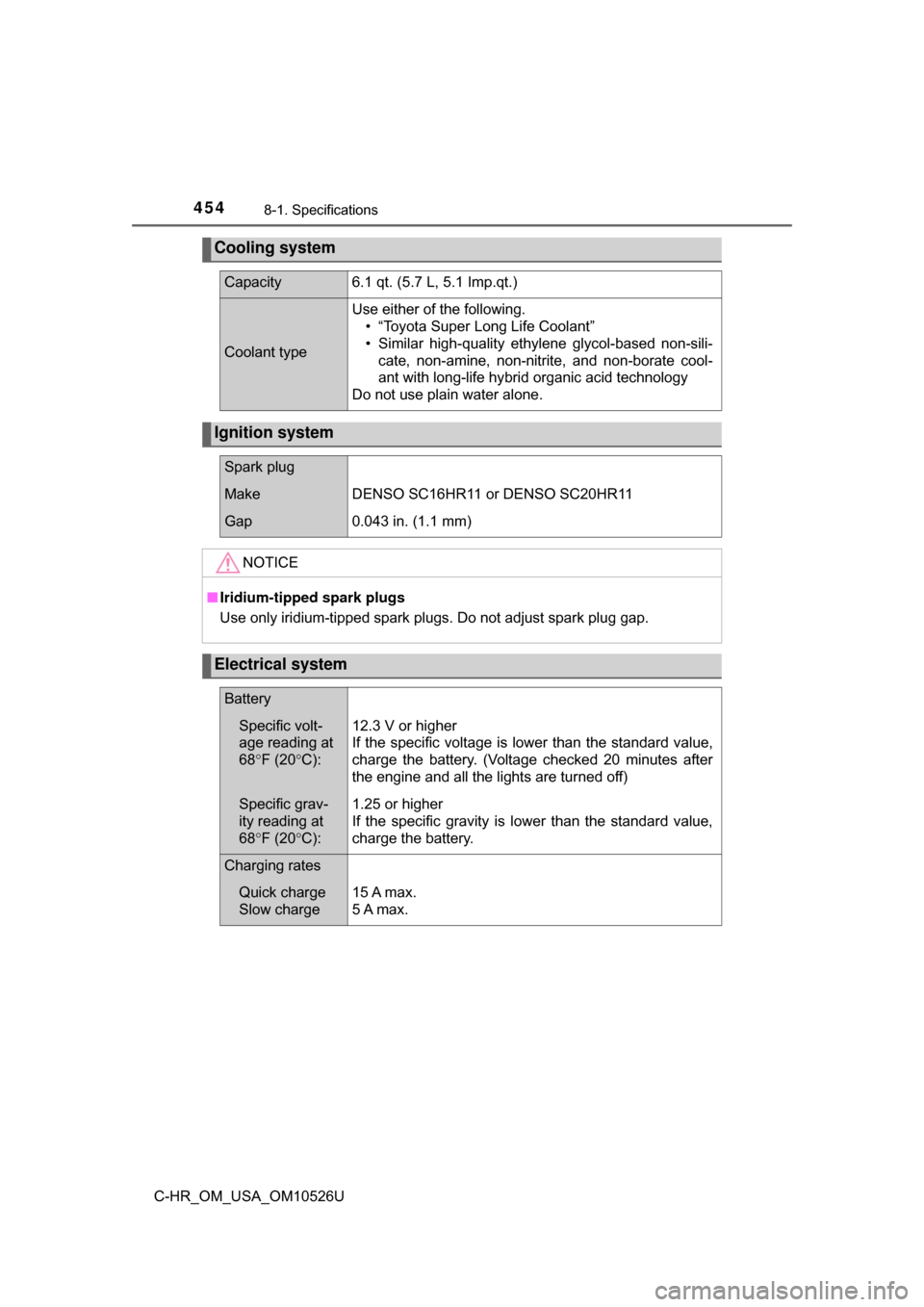
Cooling system
Capacity6.1 qt. (5.7 L, 5.1 Imp.qt.)
Coolant type
Use either of the following.• “Toyota Super Long Life Coolant”
• Similar high-quality ethylene glycol-based non-sili-cate, non-amine, non-nitrite, and non-borate cool-
ant with long-life hybrid organic acid technology
Do not use plain water alone.
Ignition system
Spark plug
MakeDENSO SC16HR11 or DENSO SC20HR11
Gap0.043 in. (1.1 mm)
NOTICE
■ Iridium-tipped spark plugs
Use only iridium-tipped spark plugs. Do not adjust spark plug gap.
Electrical system
Battery
Specific volt-
age reading at
68° F (20 °C):12.3 V or higher
If the specific voltage is lower than the standard value,
charge the battery. (Voltage checked 20 minutes after
the engine and all the lights are turned off)
Specific grav-
ity reading at
68° F (20 °C):1.25 or higher
If the specific gravity is lower than the standard value,
charge the battery.
Charging rates
Quick charge
Slow charge15 A max.
5 A max.