ESP TOYOTA C-HR 2020 Owners Manual (in English)
[x] Cancel search | Manufacturer: TOYOTA, Model Year: 2020, Model line: C-HR, Model: TOYOTA C-HR 2020Pages: 48, PDF Size: 3.81 MB
Page 12 of 48
 10
Continuously variable transmission
* The engine switch must be in the “ON” position (without Smart Ke\
y) / “IGNITION ON” mode (with Smart Key) and the brake pedal depressed to shift from P")
10
Continuously variable transmission
* The engine switch must be in the “ON” position (without Smart Ke\
y) / “IGNITION ON” mode (with Smart Key) and the brake pedal depressed to shift from Par\
k.
Shift the shift lever to “M” position from “D” position.
+: Upshifting (push and release)
-: Downshifting (pull and release)
Downshifting increases power going uphill, or provides engine braking downhill. For
best fuel economy during normal driving conditions, always drive with the sh\
ift lever
in the “D” position.
Refer to the Owner’s Manual for more details.
FEATURES & OPERATIONS
7-SPEED SPORT SEQUENTIAL SHIFTMATIC MODE (M POSITION)
M
P
R
N
D
Park*
Reverse
Neutral
Drive
“M” position
+ (M position)
- (M position)
Use the the steering wheel meter control switches to operate the MID. See
above.
Driving mode select
“NORMAL” - Suitable for city driving.
“SPORT” - Suitable for roads with many curves needing improved driving response\
.
“ECO” - Suitable for improved fuel economy and energy saving controlled air/
heating.
(1) Press steering wheel switches “
” to find and select in the MID.
(2) Press steering wheel switches “
” switches and select “Drive Mode” in the MID.
(3) Select a driving mode:
The “SPORT” and “ECO” indicators display in the Multi-Informati\
on Display (MID).
Note: Operation of the LDA system and setting adjustments continues in the same
condition regardless of Ignition cycle until changed by the driver or the system is reset.
Page 34 of 48
32
TOYOTA SAFETY SENSE™
ADJUSTING DISTANCE
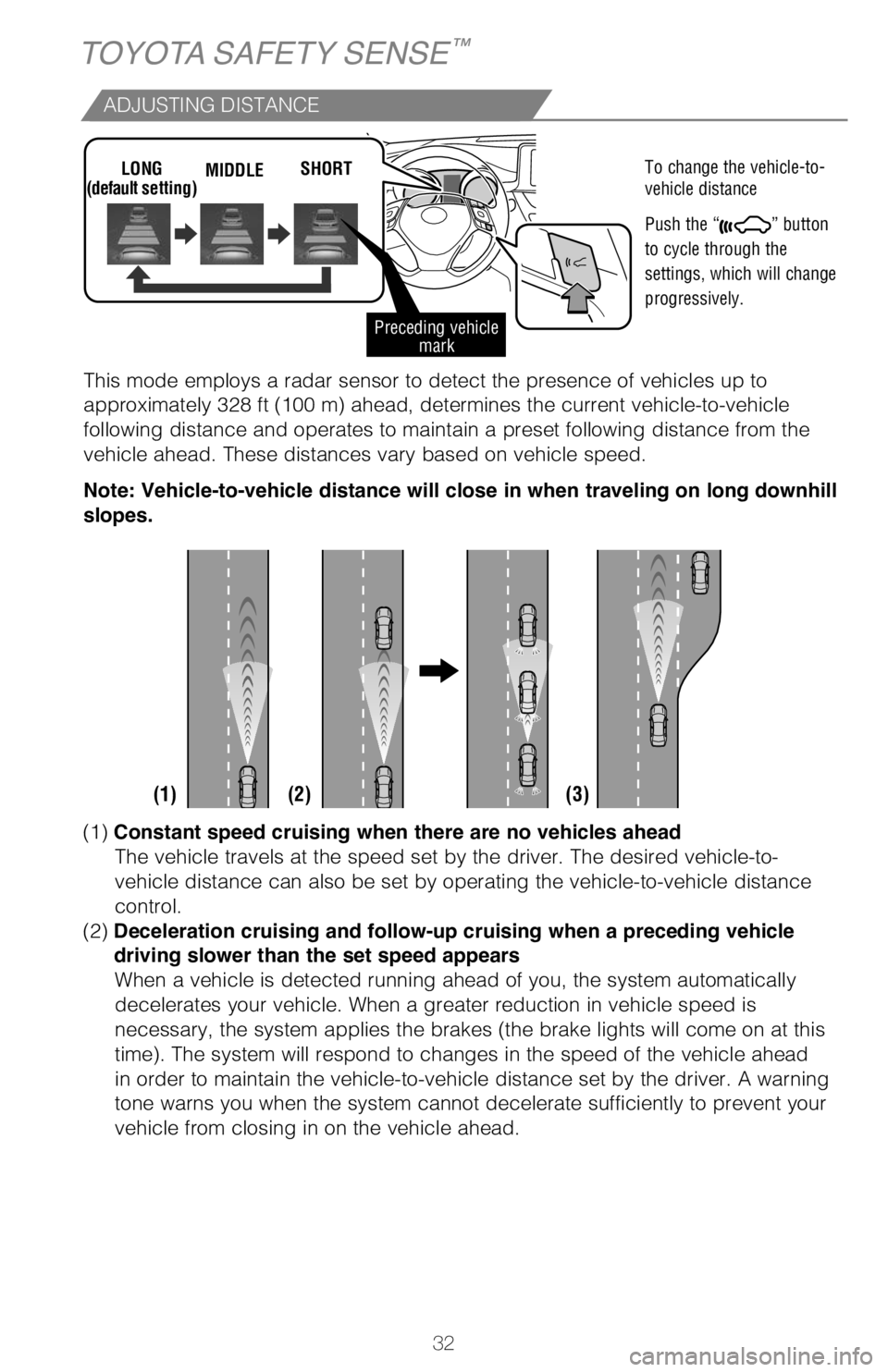
To change the vehicle-to-
vehicle distance
Push the “
” button
to cycle through the
settings, which will change
progressively.
This mode employs a radar sensor to detect the presence of vehicles up to
approximately 328 ft (100 m) ahead, determines the current vehicle-to-vehicle
following distance and operates to maintain a preset following distance from the
vehicle ahead. These distances vary based on vehicle speed.
Note: Vehicle-to-vehicle distance will close in when traveling on long downhill
slopes.
MIDDLE SHORT
(default setting) LONG
Preceding vehicle
mark
(1) Constant speed cruising when there are no vehicles ahead
The vehicle travels at the speed set by the driver. The desired vehicle-to-\
vehicle distance can also be set by operating the vehicle-to-vehicle distance
control.
(2) Deceleration cruising and follow-up cruising when a preceding vehicle
driving slower than the set speed appears
When a vehicle is detected running ahead of you, the system automatically
decelerates your vehicle. When a greater reduction in vehicle speed is
necessary, the system applies the brakes (the brake lights will come on at this
time). The system will respond to changes in the speed of the vehicle ahead
in order to maintain the vehicle-to-vehicle distance set by the driver. A \
warning
tone warns you when the system cannot decelerate sufficiently to prevent you\
r
vehicle from closing in on the vehicle ahead.
(1) (2) (3)
Page 39 of 48
37
OVERVIEW
FEATURES & OPERATIONS
TOYOTA SAFETY SENSE
SAFETY & EMERGENCY FEATURES
Safety Connect (if equipped)
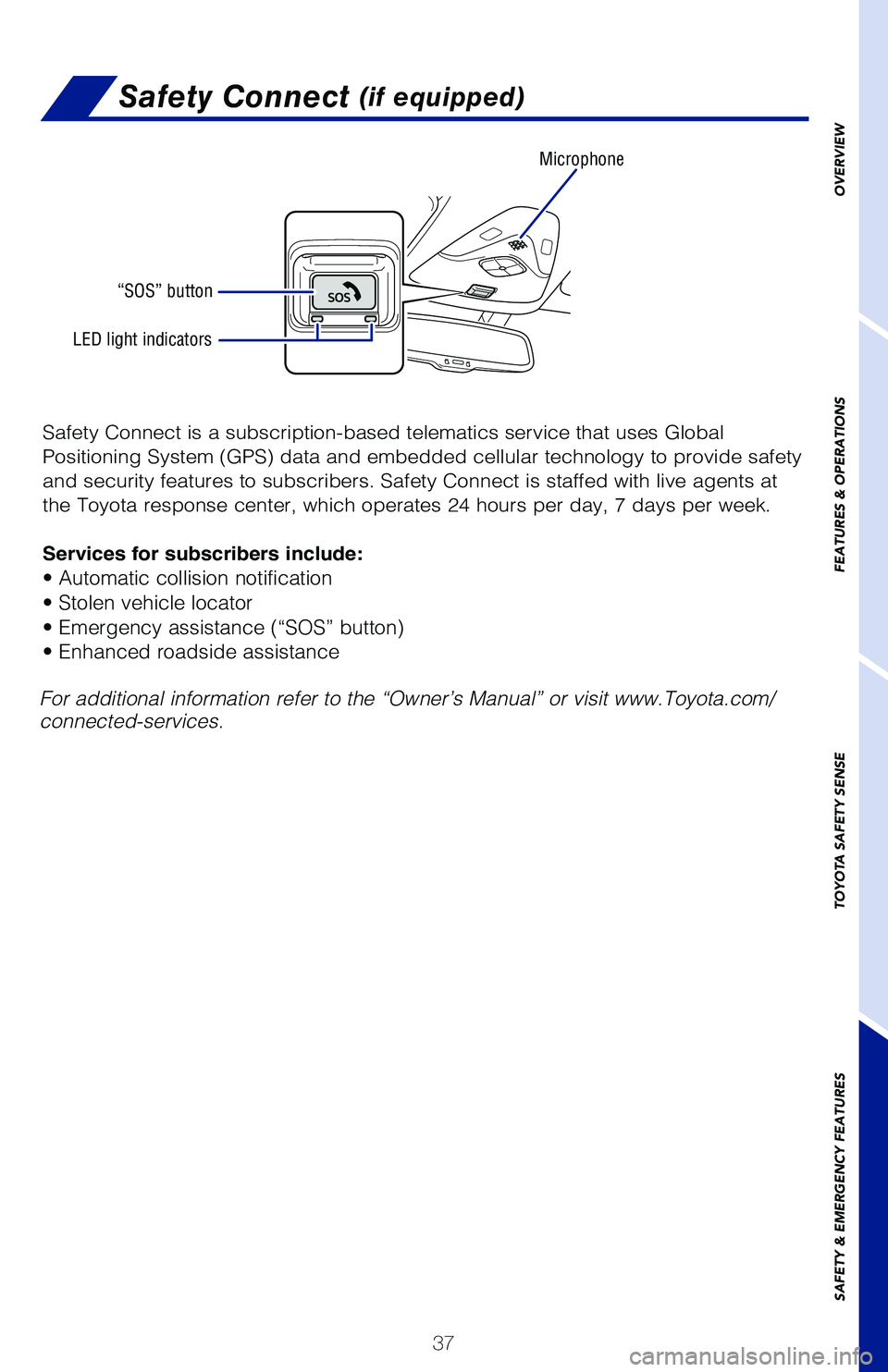
Safety Connect is a subscription-based telematics service that uses Global
Positioning System (GPS) data and embedded cellular technology to provide safety
and security features to subscribers. Safety Connect is staffed with live a\
gents at
the Toyota response center, which operates 24 hours per day, 7 days per wee\
k.
Services for subscribers include:
• Automatic collision notification
• Stolen vehicle locator
• Emergency assistance (“SOS” button)
• Enhanced roadside assistance
Microphone
LED light indicators
“SOS” button
For additional information refer to the “Owner’s Manual” or visit \
www.Toyota.com/
connected-services.
Page 41 of 48
 39
OVERVIEW
FEATURES & OPERATIONS
TOYOTA SAFETY SENSE
SAFETY & EMERGENCY FEATURES
SMART STOP TECHNOLOGY (SST)
Smart Stop Technology automatically reduces engine power when the accelerator\
and brake")
39
OVERVIEW
FEATURES & OPERATIONS
TOYOTA SAFETY SENSE
SAFETY & EMERGENCY FEATURES
SMART STOP TECHNOLOGY (SST)
Smart Stop Technology automatically reduces engine power when the accelerator\
and brake pedals are pressed simultaneously under certain conditions.
SST engages when the accelerator is depressed first and the brakes are appl\
ied
firmly for longer than one-half second at speeds greater than five miles per h\
our.
SST doesn’t engage if the brake pedal is depressed before the accelerato\
r pedal,
allowing vehicles to start on a steep hill and safely accelerate without rolling\
backward.
Star Safety System™
ANTI-LOCK BRAKE SYSTEM (ABS)
Toyota’s ABS sensors detect which wheels are locking up and limits wheel lockup
by “pulsing” each wheel’s brakes independently. Pulsing releases \
brake pressure
repeatedly for fractions of a second. This helps the tires attain the traction tha\
t
current road conditions will allow, helping you to stay in directional control.\
BRAKE ASSIST (BA)
Brake Assist is designed to detect sudden or “panic” braking, and then \
add braking
pressure to help decrease the vehicle’s stopping distance. When there’s on\
ly a split
second to react, Brake Assist can add additional brake pressure more quickly t\
han
just the driver alone can.
ELECTRONIC BRAKE FORCE DISTRIBUTION (EBD)
Toyota’s ABS technology has Electronic Brake-force Distribution (EBD) to help
maintain control and balance when braking. EBD responds to sudden stops by
redistributing brake force to enhance the braking effectiveness of all four wheels. Your vehicle comes standard with the Star Safety System
TM, which combines Anti-
lock Braking System (ABS), Brake Assist (BA), Electronic Brake-force Dis\
tribution
(EBD), Smart Stop Technology (SST), Traction Control (TRAC) and Vehicle St\
ability
Control (VSC).
Refer to the Owner’s Manual for more details and important information on limitations
to these systems.
ENHANCED VEHICLE STABILITY CONTROL (VSC)
Enhanced Vehicle Stability Control provides cooperative control of the ABS, TRAC\
,
VSC and EPS.
Enhanced VSC helps to maintain directional stability when loss of traction occur\
s
during a turn.