flat tire TOYOTA C-HR 2020 (in English) Owner's Manual
[x] Cancel search | Manufacturer: TOYOTA, Model Year: 2020, Model line: C-HR, Model: TOYOTA C-HR 2020Pages: 536, PDF Size: 11.99 MB
Page 372 of 536
3726-3. Do-it-yourself maintenance
C-HR_OM_USA_OM10634U
Tire inflation pressure
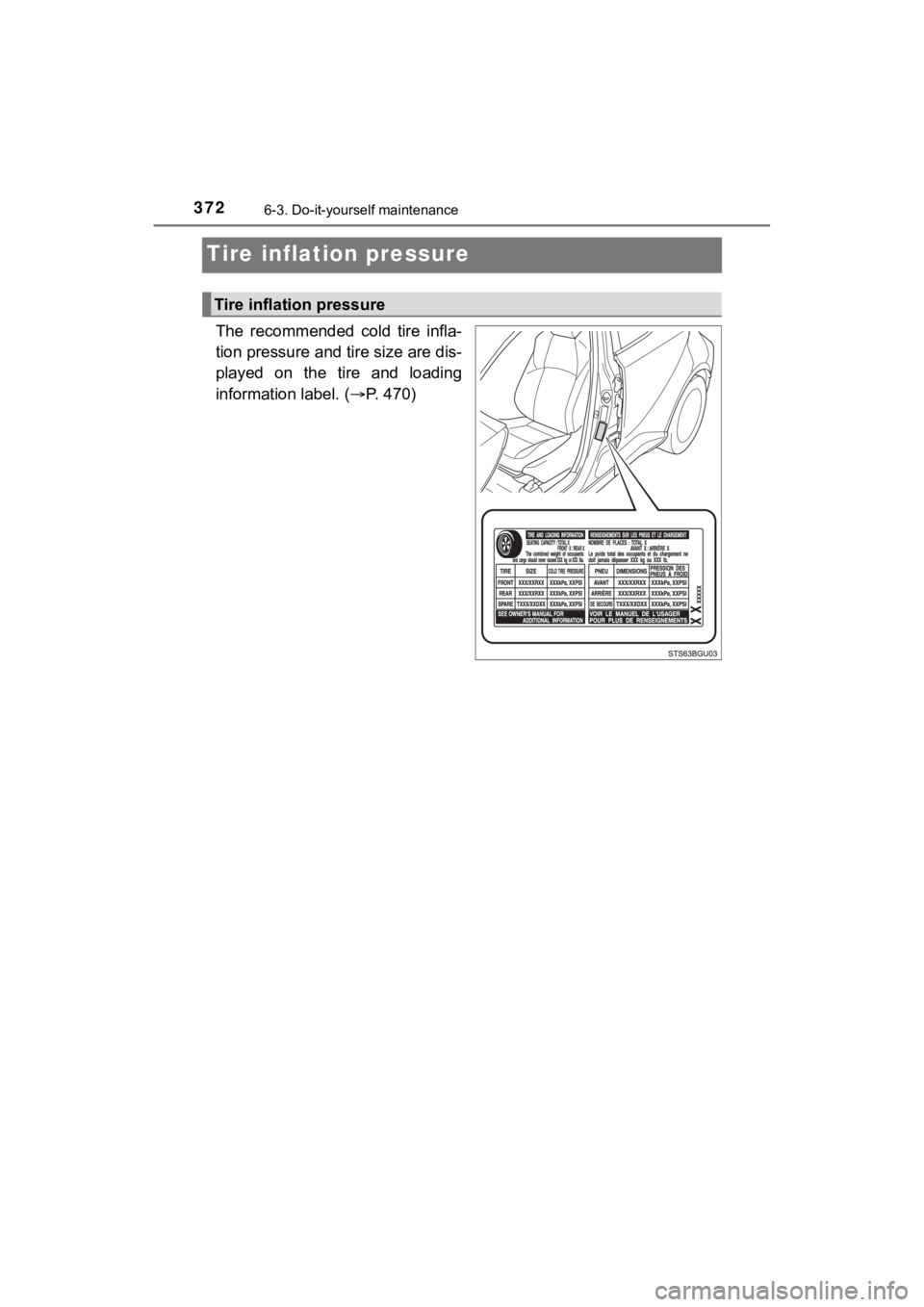
The recommended cold tire infla-
tion pressure and tire size are dis-
played on the tire and loading
information label. (P. 470)
Tire inflation pressure
Page 373 of 536
3736-3. Do-it-yourself maintenance
6
Maintenance and care
C-HR_OM_USA_OM10634U
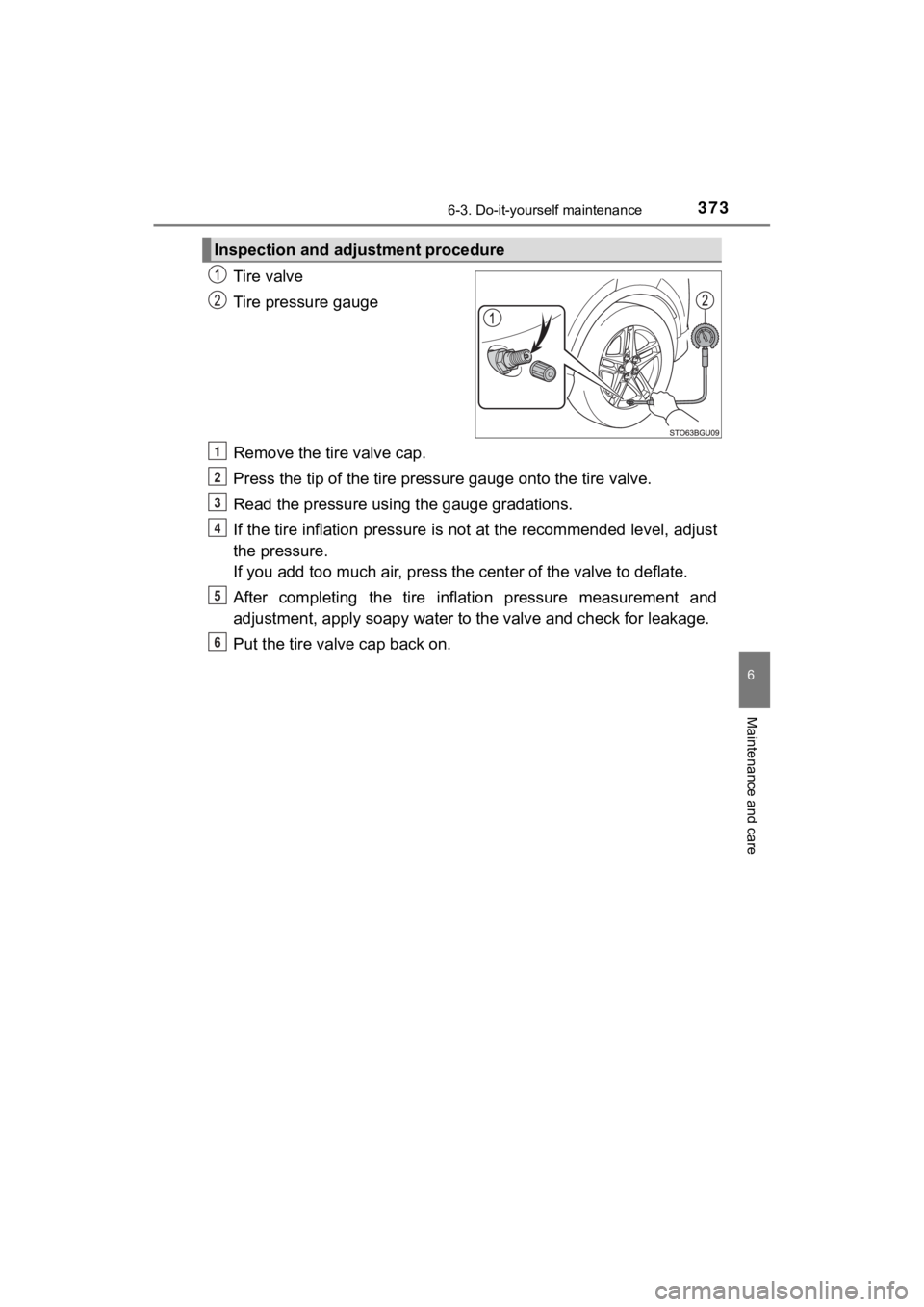
Tire valve
Tire pressure gauge
Remove the tire valve cap.
Press the tip of the tire pressure gauge onto the tire valve.
Read the pressure using the gauge gradations.
If the tire inflation pressure is not at the recommended level, adjust
the pressure.
If you add too much air, press the center of the valve to defla te.
After completing the tire inflation pressure measurement and
adjustment, apply soapy water to the valve and check for leakage.
Put the tire valve cap back on.
Inspection and adjustment procedure
1
2
3
4
5
6
Page 374 of 536

3746-3. Do-it-yourself maintenance
C-HR_OM_USA_OM10634U
■Tire inflation pressure check interval
You should check tire inflation pressure every two weeks, or at least once
a month.
Do not forget to check the spare.
■Effects of incorrect tire inflation pressure
Driving with incorrec t tire inflation pressure may result in th e following:
●Reduced fuel economy
●Reduced driving comfort and poor handling
●Reduced tire life due to wear
●Reduced safety
●Damage to the drivetrain
If a tire needs frequent inflating , have it checked by your Toyota dealer.
■Instructions for checking tire inflation pressure
When checking tire inflation p ressure, observe the following:
●Check only when the tires are cold.
If your vehicle has been parked for at least 3 hours or has not been
driven for more than 1 mile or 1.5 km, you will get an accurate cold tire
inflation pressure reading.
●Always use a tire pressure gauge.
It is difficult to judge if a tire is properly inflated based o nly on its appear-
ance.
●It is normal for the tire inflation pressure to be higher after driving as
heat is generated in the tire. Do not reduce tire inflation pre ssure after
driving.
●Never exceed the vehicle capacity weight.
Passengers and luggage weight should be placed so that the vehi cle is
balanced.
Page 375 of 536
3756-3. Do-it-yourself maintenance
6
Maintenance and care
C-HR_OM_USA_OM10634U
WARNING
■Proper inflation is critical to save tire performance
Keep your tires properly inflated.
If the tires are not properly in flated, the following conditions may occur
which could lead to an accident r esulting in death or serious injury:
●Excessive wear
●Uneven wear
●Poor handling
●Possibility of blowouts resulting from overh eated tires
●Air leaking from between tire and wheel
●Wheel deformation and/or tire damage
●Greater possibility of tire damage while driving (due to road hazards,
expansion joints, sharp ed ges in the road, etc.)
NOTICE
■When inspecting and adjusti ng tire inflation pressure
Be sure to put the tire valve caps back on.
If a valve cap is not installed , dirt or moisture may get into the valve and
cause an air leak, resulting in decreased tire inflation pressu re.
Page 376 of 536
3766-3. Do-it-yourself maintenance
C-HR_OM_USA_OM10634U
Wheels
When replacing wheels, care should be taken to ensure that they are
equivalent to those removed in load capacity, diameter, rim wid th and
inset
*.
Replacement wheels are available at your Toyota dealer.
*: Conventionally referred to as “offset”.
Toyota does not recommend using the following:
● Wheels of different sizes or types
● Used wheels
● Bent wheels that hav e been straightened
● Use only Toyota wheel nuts and wrenches designed for use with
your aluminum wheels.
● When rotating, repairing or changi ng your tires, check that the
wheel nuts are still tight afte r driving 1000 miles (1600 km).
● Be careful not to damage the aluminum wheels when using tire
chains.
● Use only Toyota genuine balance we ights or equivalent and a plas-
tic or rubber hammer when balancing your wheels.
■When replacing wheels
The wheels of your vehicle are equipped with tire pressure warn ing
valves and transmitters that allow the tire pressure warning sy stem to
provide advance warning in the event of a loss in tire inflatio n pressure.
Whenever wheels are replaced, tir e pressure warning valves and trans-
mitters must be installed. ( P. 363)
If a wheel is bent, cracked or heavily corroded, it should be
replaced. Otherwise, the tire may separate from the wheel or
cause a loss of handling control.
Wheel selection
Aluminum wheel pre cautions (if equipped)
Page 384 of 536
3846-3. Do-it-yourself maintenance
C-HR_OM_USA_OM10634U
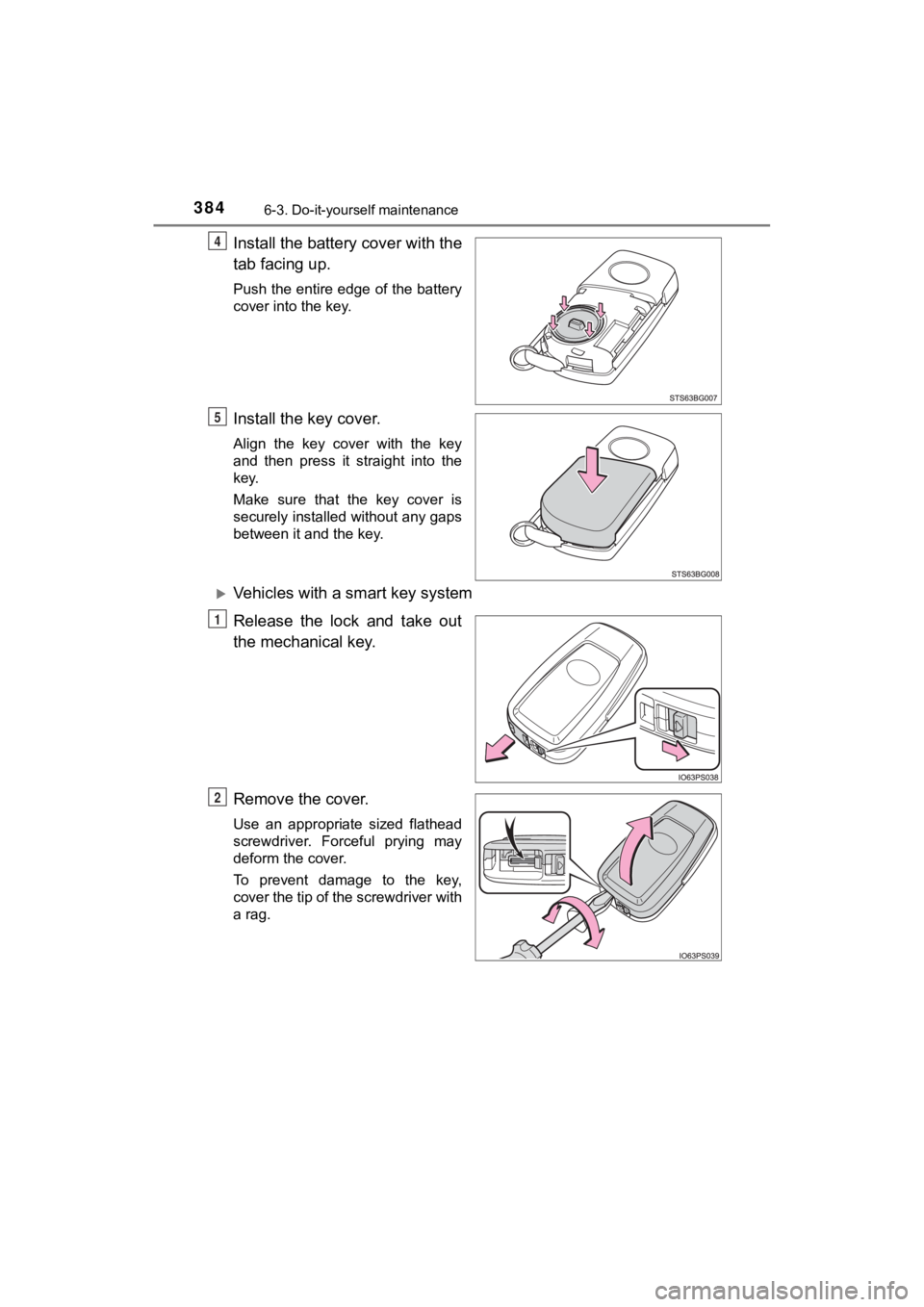
Install the battery cover with the
tab facing up.
Push the entire edge of the battery
cover into the key.
Install the key cover.
Align the key cover with the key
and then press it straight into the
key.
Make sure that the key cover is
securely installed without any gaps
between it and the key.
Vehicles with a smart key system
Release the lock and take out
the mechanical key.
Remove the cover.
Use an appropriate sized flathead
screwdriver. Forceful prying may
deform the cover.
To prevent damage to the key,
cover the tip of the screwdriver with
a rag.
4
5
1
2
Page 400 of 536
4006-3. Do-it-yourself maintenance
C-HR_OM_USA_OM10634U■
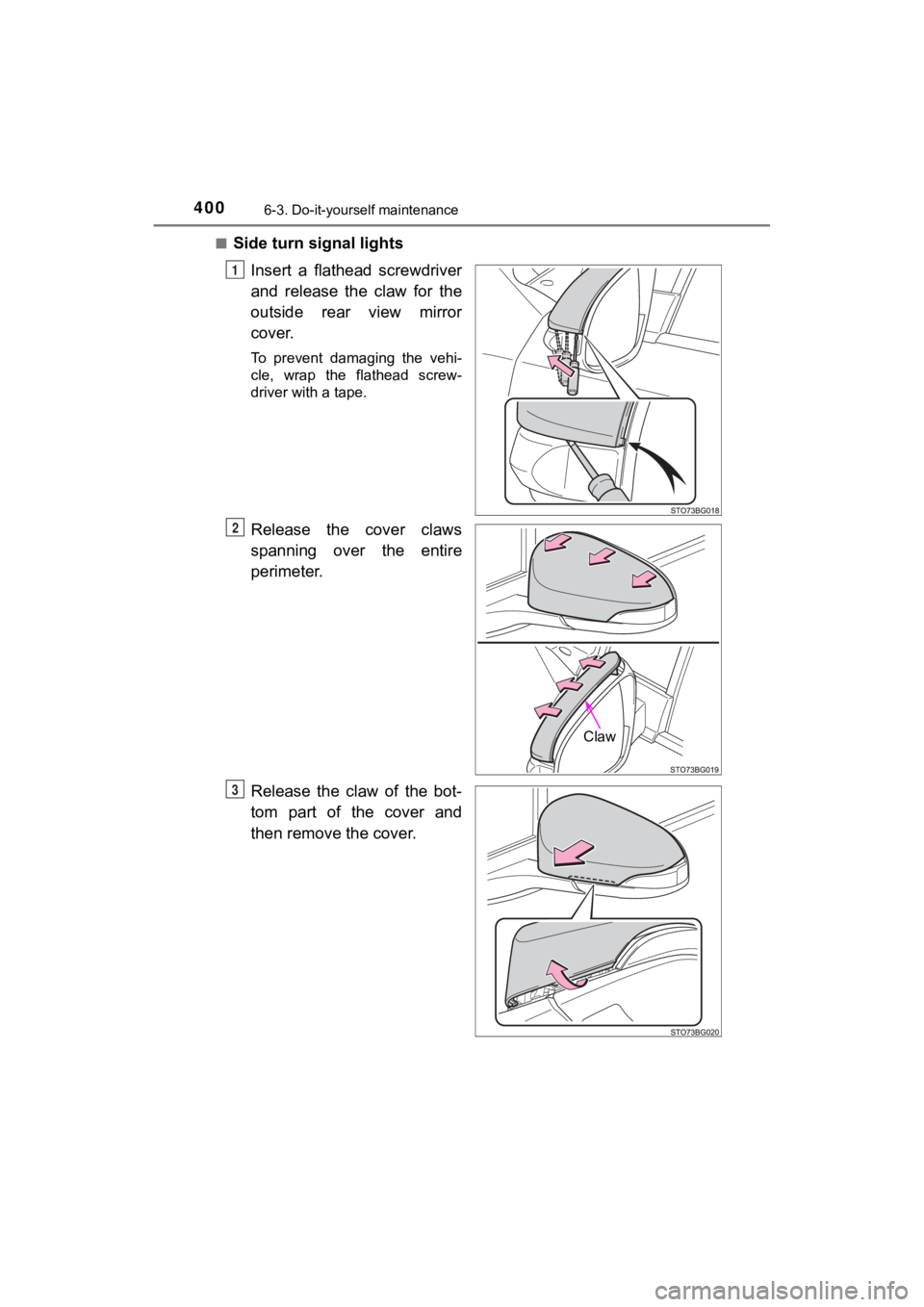
Side turn signal lights
Insert a flathead screwdriver
and release the claw for the
outside rear view mirror
cover.
To prevent damaging the vehi-
cle, wrap the flathead screw-
driver with a tape.
Release the cover claws
spanning over the entire
perimeter.
Release the claw of the bot-
tom part of the cover and
then remove the cover.
1
Claw
O
P
Page 407 of 536
407
7When trouble arises
C-HR_OM_USA_OM10634U7-1. Essential information
Emergency flashers .......... 408
If your vehicle has to be stopped in an
emergency ...................... 409
If the vehicle is trapped in rising water .................. 411 7-2. Steps to take in an
emergency
If your vehicle needs to be towed ......................... 412
If you think something is wrong .............................. 419
Fuel pump shut off system ............................ 420
If a warning light turns on or a warning buzzer
sounds ............................ 421
If a warning message is displayed......................... 431
If you have a flat tire.......... 436
If the engine will not start ................................. 447
If the electronic key does not operate
properly (vehicles with a
smart key system) ........... 449
If the vehicle battery is discharged ...................... 452
If your vehicle overheats ........................ 457
If the vehicle becomes stuck ............................... 460
Page 419 of 536
4197-2. Steps to take in an emergency
C-HR_OM_USA_OM10634U
7
When trouble arises
If you think something is wrong
●Fluid leaks un der the vehicle.
(Water dripping from the air conditioning a fter use is normal.)
● Flat-looking tires or uneven tire wear
● Engine coolant temperature gauge needle continually points high er
than normal.
● Changes in exhaust sound
● Excessive tire squeal when cornering
● Strange noises related to the suspension system
● Pinging or other noises related to the engine
● Engine misses, stumbli ng or running roughly
● Appreciable loss of power
● Vehicle pulls heavily to one side when braking
● Vehicle pulls heavily to one s ide when driving on a level road
● Loss of brake effectiveness, spongy feeling, pedal almost touch es
the floor
If you notice any of the followi ng symptoms, your vehicle proba -
bly needs adjustment or repair. Contact your Toyota dealer as
soon as possible.
Visible symptoms
Audible symptoms
Operational symptoms
Page 424 of 536
4247-2. Steps to take in an emergency
C-HR_OM_USA_OM10634U
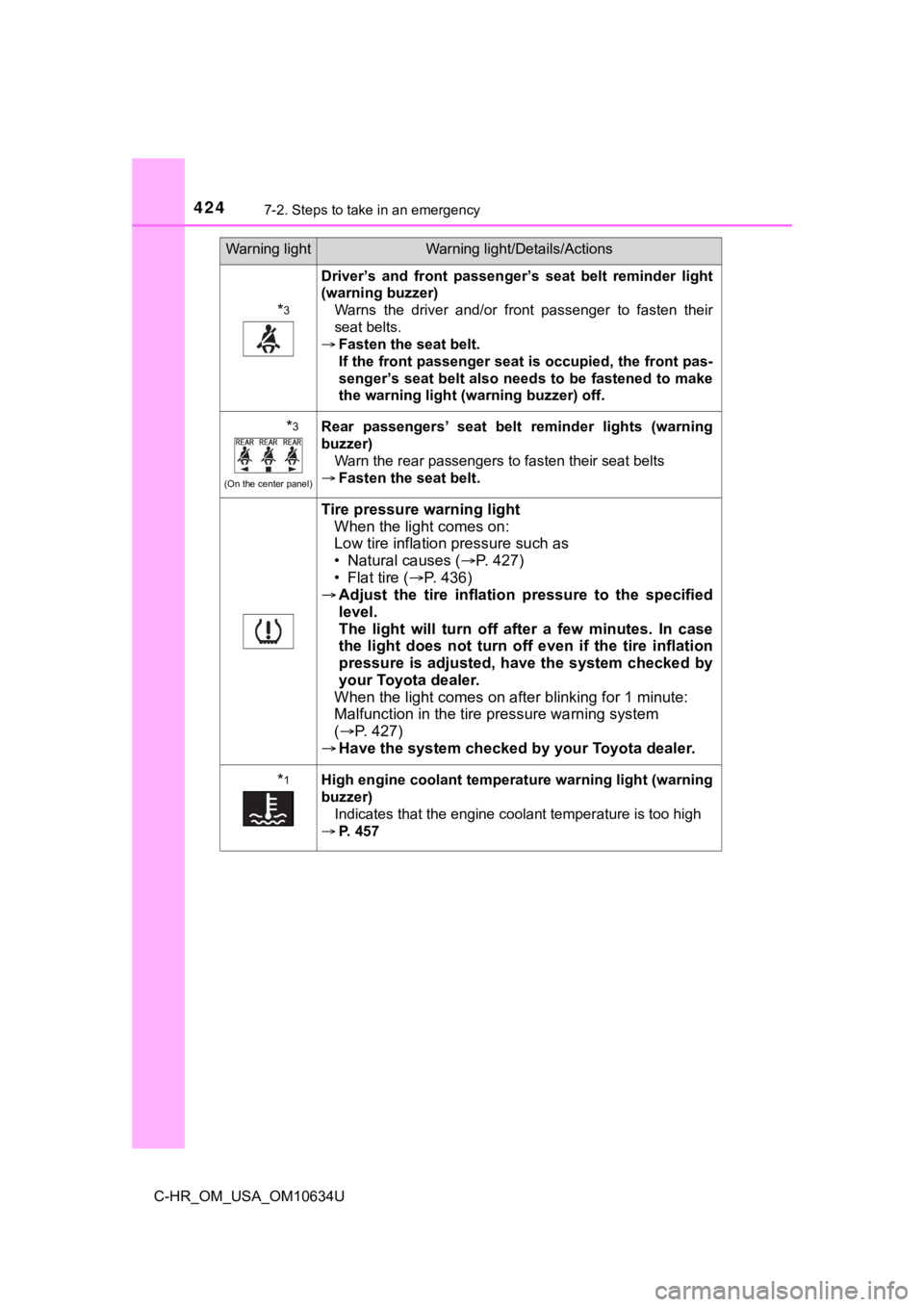
*3
Driver’s and front passenger’s seat belt reminder light
(warning buzzer) Warns the driver and/or front passenger to fasten their
seat belts.
Fasten the seat belt.
If the front passenger seat is occupied, the front pas-
senger’s seat belt also needs to be fastened to make
the warning light (warning buzzer) off.
*3
(On the center panel)
Rear passengers’ seat belt reminder lights (warning
buzzer)
Warn the rear passengers to fasten their seat belts
Fasten the seat belt.
Tire pressure warning light
When the light comes on:
Low tire inflation pressure such as
• Natural causes ( P. 4 2 7 )
• Flat tire ( P. 436)
Adjust the tire inflation pressure to the specified
level.
The light will turn off after a few minutes. In case
the light does not turn off even if the tire inflation
pressure is adjusted, have the system checked by
your Toyota dealer.
When the light comes on after blinking for 1 minute:
Malfunction in t he tire pressure warning system
( P. 4 2 7 )
Have the system checked by your Toyota dealer.
*1High engine coolant temperature warning light (warning
buzzer)
Indicates that the engine coolant temperature is too high
P. 457
Warning lightWarning light/Details/Actions