battery TOYOTA C-HR 2020 (in English) Service Manual
[x] Cancel search | Manufacturer: TOYOTA, Model Year: 2020, Model line: C-HR, Model: TOYOTA C-HR 2020Pages: 536, PDF Size: 11.99 MB
Page 426 of 536
4267-2. Steps to take in an emergency
C-HR_OM_USA_OM10634U
■SRS warning light
This warning light system monitors the airbag sensor assembly, front impact
sensors, side impact sensors (front door), side impact sensors (front), side
impact sensors (rear), driver’s seat position sensor, driver’s seat belt buckle
switch, front passenger occupant classification system, “AIR BA G ON” indica-
tor light, “AIR BAG OFF” indicator light, front passenger’s sea t belt buckle
switch, seat belt pretensioners, airbags, interconnecting wirin g and power
sources. ( P. 32)
■ Electric power steering system wa rning light (warning buzzer)
When the battery charge becomes insufficient or the voltage tem porarily
drops, the electric power steering system warning light may com e on and the
warning buzzer may sound.
■ If the malfunction indicator lamp comes on while driving
For some models, the malfunction indicator lamp will come on if the fuel tank
becomes completely empty. If the fuel tank is empty, refuel the vehicle imme-
diately. The malfunction indicator lamp will go off after several trips.
If the malfunction indicator lamp does not go off, contact your Toyota dealer.
■ Front passenger detection sensor, seat belt reminder and warnin g
buzzer
● If luggage is placed on the front passenger seat, the front pas senger detec-
tion sensor may cause the warning light to flash and the warnin g buzzer to
sound even if a passenger is not sitting in the seat.
● If a cushion is placed on the seat, the sensor may not detect a passenger,
and the warning light may not operate properly.
■ Warning light operat ions for unfastened rear passenger seat bel ts
● When opening and closing the rear door, the warning light comes on for
approximately 34 seconds.
● When any of the rear seat belts are unfastened, the warning lig ht comes on.
When the rear doors are opened and closed while the warning lig ht is on,
the warning light will turn off after approximately 34 seconds.
Page 447 of 536
4477-2. Steps to take in an emergency
C-HR_OM_USA_OM10634U
7
When trouble arises
If the engine will not star t
One of the following may be the cause of the problem:
● There may not be sufficient fuel in the vehicle’s tank.
Refuel the vehicle.
● The engine may be flooded.
Try to restart the engine again following correct starting proc edures.
( P. 178, 181)
● There may be a malf unction in the engine immobilizer system.
( P. 81)
One of the following may be the cause of the problem:
● The battery may be discharged. ( P. 452)
● The battery terminal connecti ons may be loose or corroded.
The engine starting system may be malfunctioning due to an elec trical
problem such as electronic key battery depletion or a blown fus e.
However, an interim measure is a vailable to start the engine.
( P. 448)
If the engine will not start eve n though correct starting proce -
dures are being followed ( P. 178, 181), consider each of the fol-
lowing points:
The engine will not start even t hough the starter motor operates
normally.
The starter motor turns over slowly, the interior lights and he ad-
lights are dim, or the horn does not sound or sounds at a low
volume.
The starter motor does not turn over (vehicles with a smart key
system)
Page 448 of 536
4487-2. Steps to take in an emergency
C-HR_OM_USA_OM10634U
One of the following may be the cause of the problem:
● One or both of the battery t erminals may be disconnected.
● The battery may be discharged. ( P. 452)
● There may be a malfunction in the steering lock system. (vehicl es
with a smart key system)
Contact your Toyota dealer if the problem cannot be repaired, o r if repair
procedures are unknown.
When the engine does not start, the following steps can be used as an
interim measure to start the engine if the engine switch is fun ctioning
normally:
Set the parking brake.
Shift the shift lever to P.
Turn the engine switch to ACCESSORY mode.
Press and hold the engine switch for about 15 seconds while
depressing the brake pedal firmly.
Even if the engine can be started using the above steps, the sy stem
may be malfunctioning. Have the vehicle inspected by your Toyot a
dealer.
The starter motor does not turn over, the interior lights and h ead-
lights do not turn on, o r the horn does not sound.
Emergency start function (vehicles with a smart key system)
1
2
3
4
Page 449 of 536
4497-2. Steps to take in an emergency
C-HR_OM_USA_OM10634U
7
When trouble arises
If the electronic key does not operate
properly (vehicles with a smar t key system)
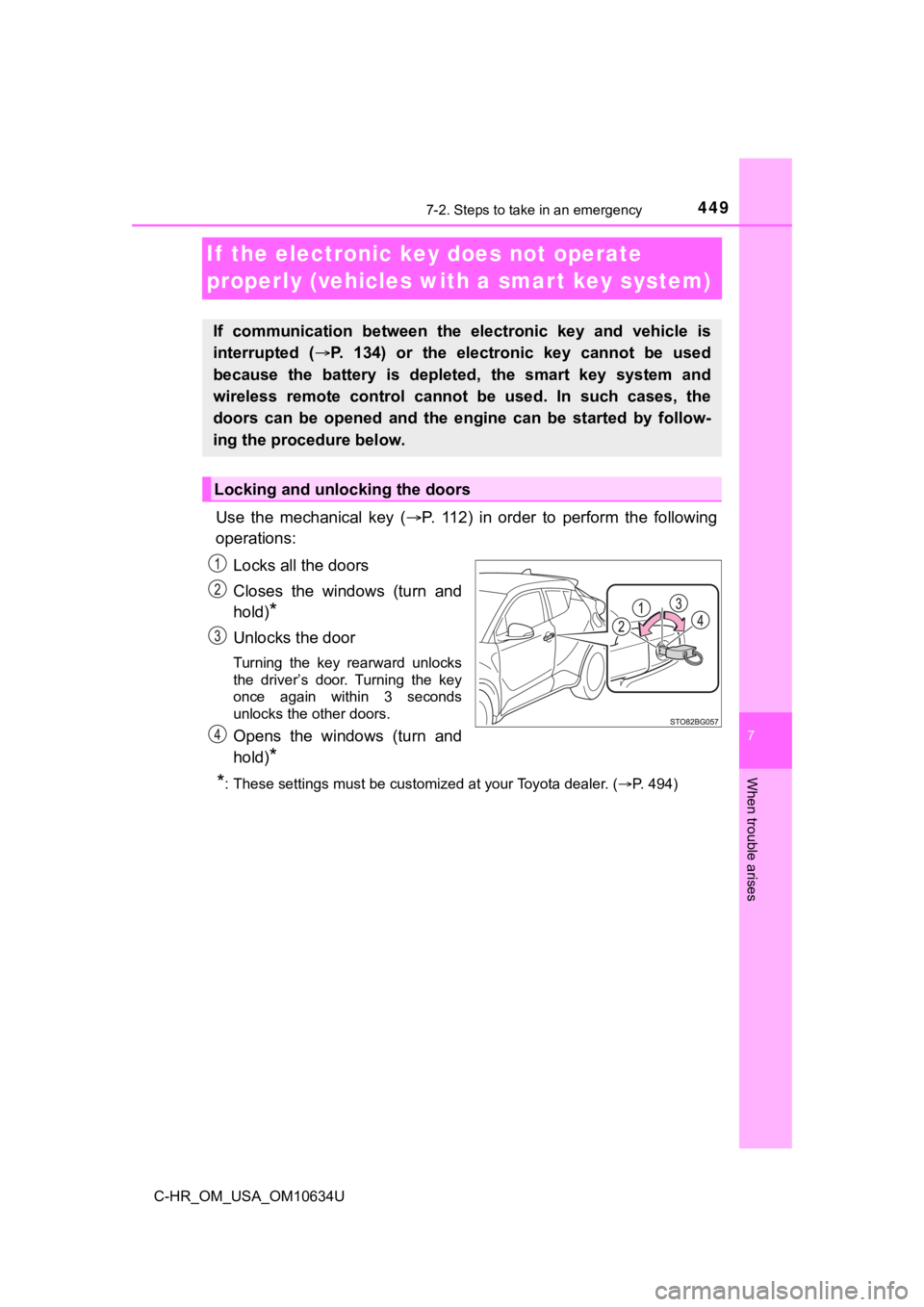
Use the mechanical key (P. 112) in order to perform the following
operations:
Locks all the doors
Closes the windows (turn and
hold)
*
Unlocks the door
Turning the key rearward unlocks
the driver’s door. Turning the key
once again within 3 seconds
unlocks the other doors.
Opens the windows (turn and
hold)
*
*
: These settings must be customized at your Toyota dealer. ( P. 494)
If communication between the electronic key and vehicle is
interrupted ( P. 134) or the electronic key cannot be used
because the battery is depleted, the smart key system and
wireless remote control can not be used. In such cases, the
doors can be opened and the engine can be started by follow-
ing the procedure below.
Locking and unlocking the doors
Page 451 of 536
4517-2. Steps to take in an emergency
7
When trouble arises
C-HR_OM_USA_OM10634U
■Stopping the engine
Set the parking brake, shift the shift lever to P and press the engine switch as
you normally do when stopping the engine.
■ Replacing the key battery
As the above procedure is a temporary measure, it is recommende d that the
electronic key battery be replaced immediately when the battery is depleted.
( P. 383)
■ Changing engine switch modes
Release the brake pedal and press the engine switch in step ab ove. The
engine does not start and modes will be changed each time the s witch is
pressed. ( P. 182)
■ When the electronic key does not work properly
●Make sure that the smart key system and push button start has n ot been
deactivated in the customization setting. If it is off, turn th e function on.
(Customizable features: P. 488)
● Check if battery-saving mode is set. If it is set, cancel the f unction.
( P. 133)
WARNING
■ When using the mechanical key and operating the power windows
Operate the power window after checking to make sure that there is no pos-
sibility of any passenger having any of their body parts caught in the side
window.
Also, do not allow children to operate the mechanical key. It is possible for
children and other passengers to get caught in the power window .
3
Page 452 of 536
4527-2. Steps to take in an emergency
C-HR_OM_USA_OM10634U
If the vehicle batter y is discharged
If you have a set of jumper (or booster) cables and a second ve hicle
with a 12-volt battery, you can jump start your vehicle by foll owing the
steps below.
Open the hood. ( P. 344)
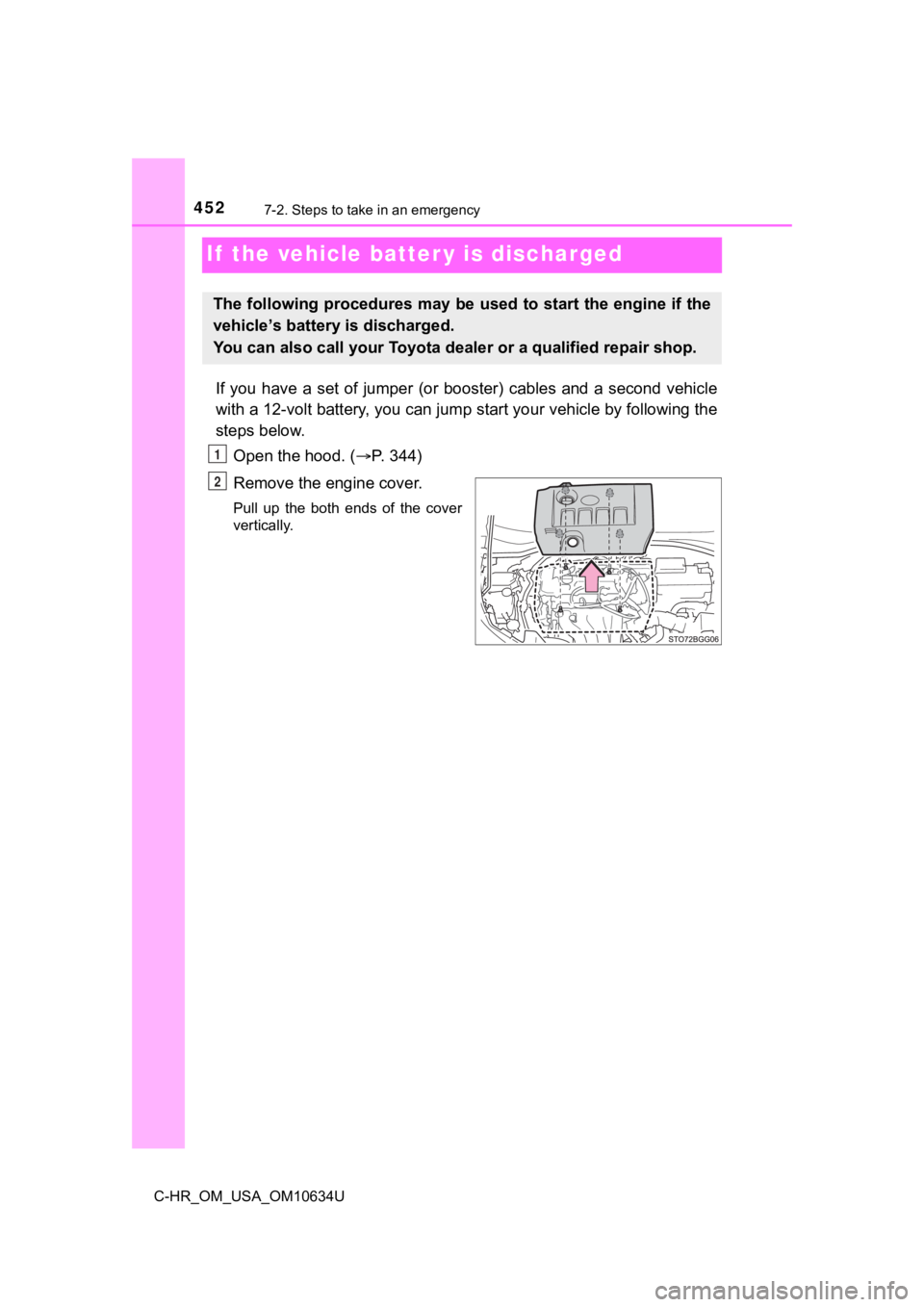
Remove the engine cover.
Pull up the both ends of the cover
vertically.
The following procedures may be used to start the engine if the
vehicle’s battery is discharged.
You can also call your Toyota de aler or a qualified repair shop.
1
2
Page 453 of 536
4537-2. Steps to take in an emergency
7
When trouble arises
C-HR_OM_USA_OM10634U
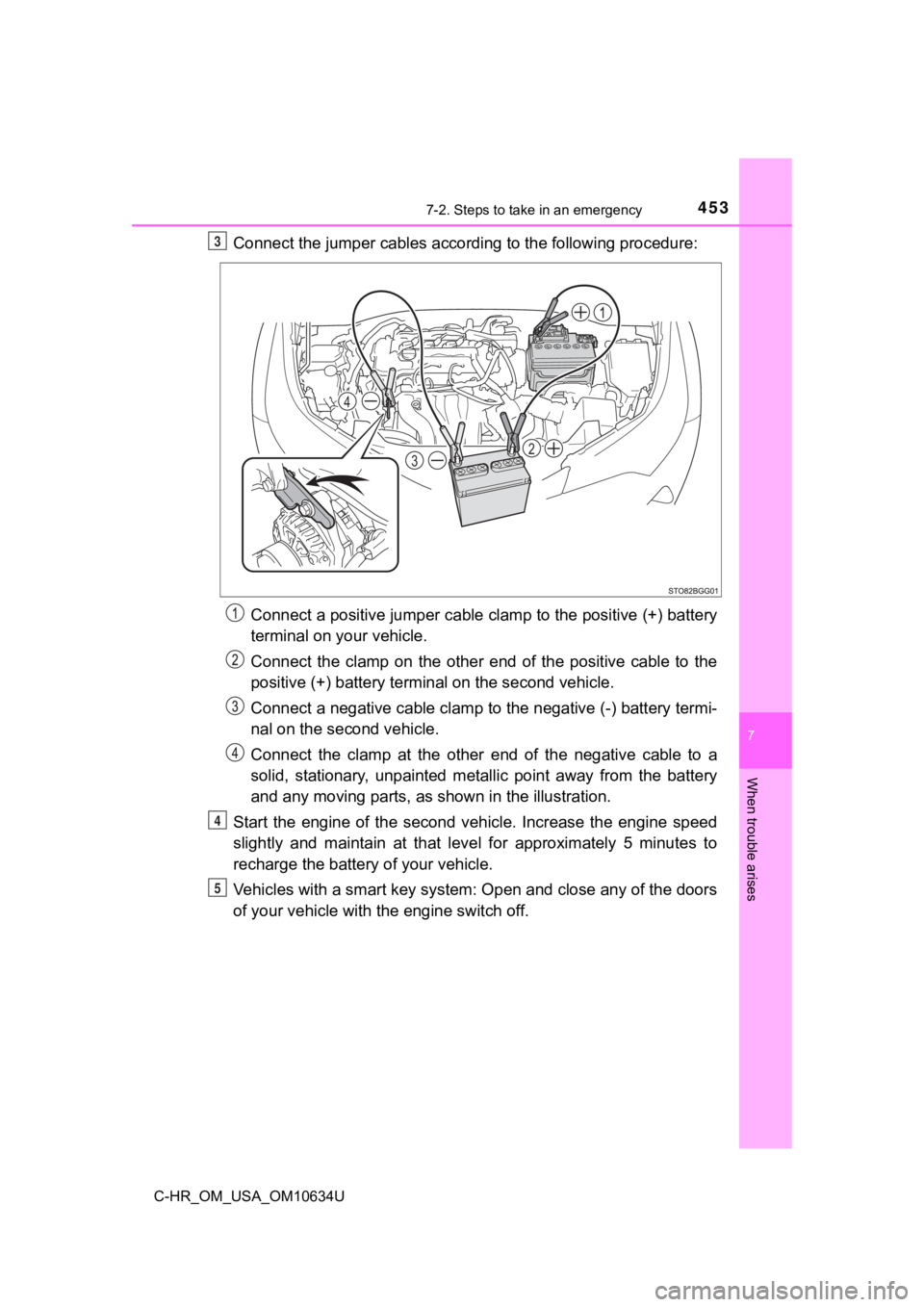
Connect the jumper cables according to the following procedure:Connect a positive jumper cable clamp to the positive (+) batte ry
terminal on your vehicle.
Connect the clamp on the other end of the positive cable to the
positive (+) battery termi nal on the second vehicle.
Connect a negative cable clamp to the negative (-) battery term i-
nal on the s econd vehicle.
Connect the clamp at the other e nd of the negative cable to a
solid, stationary, unpainted meta llic point away from the battery
and any moving parts, as shown in the illustration.
Start the engine of the second v ehicle. Increase the engine speed
slightly and maintain at that lev el for approximately 5 minutes to
recharge the batter y of your vehicle.
Vehicles with a smart key syst em: Open and close any of the doo rs
of your vehicle with the engine switch off.3
32
4
4
5
Page 454 of 536
4547-2. Steps to take in an emergency
C-HR_OM_USA_OM10634U
Vehicles without a smart key system:
Maintain the engine speed of the second vehicle and turn the
engine switch to the “ON” position, then start the vehicle’s engine.
Vehicles with a smart key system:
Maintain the engine speed of the second vehicle and turn the
engine switch to IGNITION ON m ode, then start the vehicle’s
engine.
Once the vehicle’s engine has st arted, remove the jumper cables in
the exact reverse order from which they were connected.
To install the engine cover, conduct the removal procedure in
reverse. After installing, check that the fixed pins are inserted
securely.
Once the engine starts, have the vehicle inspected at your Toyota
dealer as soon as possible.
■ Starting the engine when t he battery is discharged
The engine cannot be started by push-starting.
■ To prevent battery discharge
●Turn off the headlights and the air conditioning system while the engine is
stopped.
● Turn off any unnecessary electrical components when the vehicle is running
at a low speed for an extended period, such as in heavy traffic .
■ Charging the battery
The electricity stored in the battery will discharge gradually even when the
vehicle is not in use, due to natural discharge and the draining effects of cer-
tain electrical appliances. If the vehicle is left for a long t ime, the battery may
discharge, and the engine may be unable to start. (The battery recharges
automatically during driving.)
■ Precautions when the battery is discharged (vehicles with a sma rt key
system)
● In some cases, it may not be possible to unlock the doors using the smart
entry & start system when the battery is discharged. Use the wi reless
remote control or the mechanical key to lock or unlock the door s.
● The engine may not start on the first attempt after the battery has recharged
but will start normally after the second attempt. This is not a malfunction.
● The engine switch mode is memorized by the vehicle. When the ba ttery is
reconnected, the system will return to the mode it was in befor e the battery
was discharged. Before disconnecting the battery, turn the engine switch off.
If you are unsure what mode the engine switch was in before the battery dis-
charged, be especially careful when reconnecting the battery.
6
7
8
Page 455 of 536
4557-2. Steps to take in an emergency
7
When trouble arises
C-HR_OM_USA_OM10634U■
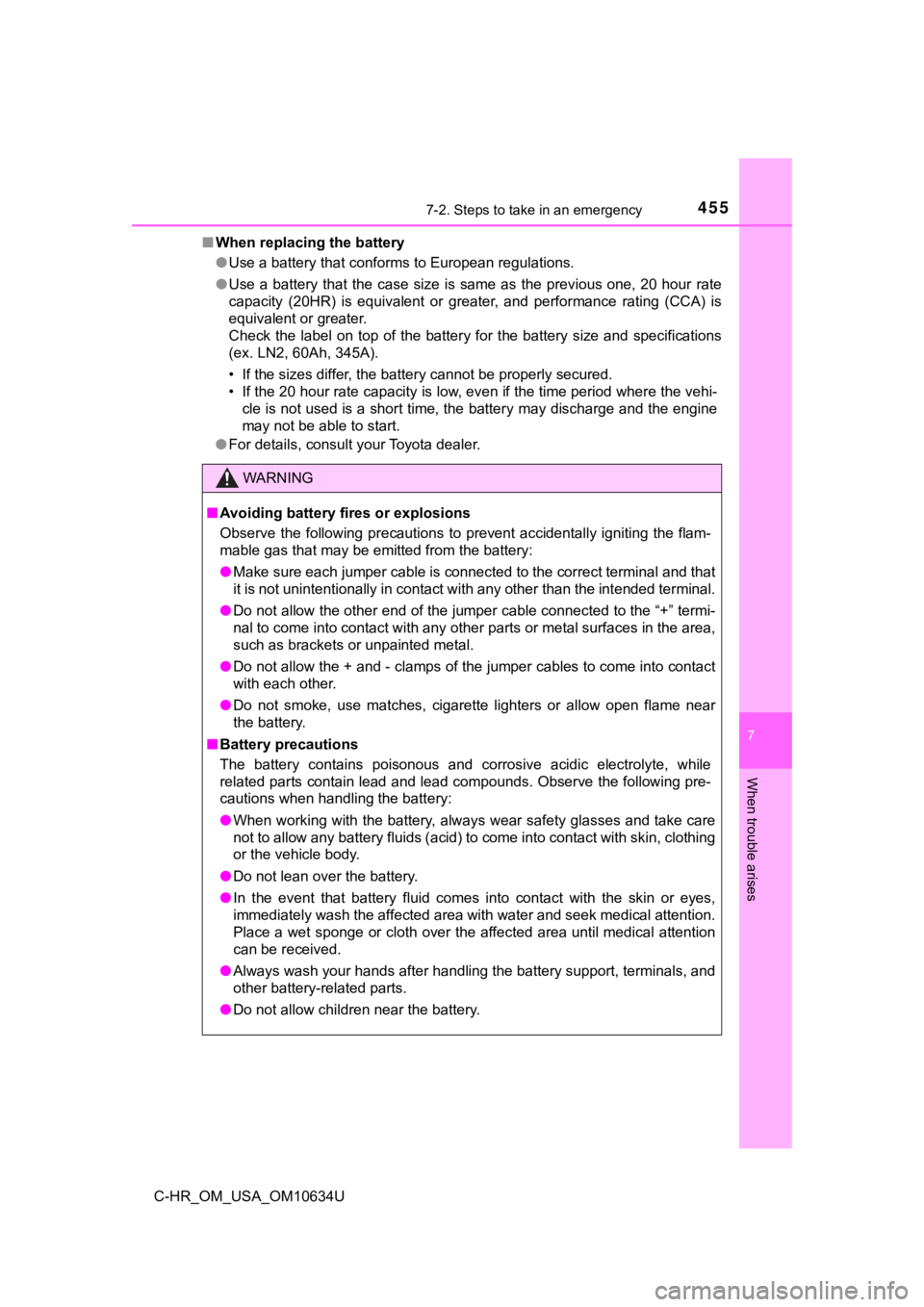
When replacing the battery
●Use a battery that conforms to European regulations.
● Use a battery that the case size is same as the previous one, 20 hour rate
capacity (20HR) is equivalent or greater, and performance rating (CCA) is
equivalent or greater.
Check the label on top of the battery for the battery size and specifications
(ex. LN2, 60Ah, 345A).
• If the sizes differ, the battery cannot be properly secured.
• If the 20 hour rate capacity is low, even if the time period w here the vehi-
cle is not used is a short time, the battery may discharge and the engine
may not be able to start.
● For details, consult your Toyota dealer.
WARNING
■Avoiding battery fires or explosions
Observe the following precautions to prevent accidentally ignit ing the flam-
mable gas that may be emitted from the battery:
● Make sure each jumper cable is connected to the correct terminal and that
it is not unintentionally in contact with any other than the in tended terminal.
● Do not allow the other end of the jumper cable connected to the “+” termi-
nal to come into contact with any other parts or metal surfaces in the area,
such as brackets or unpainted metal.
● Do not allow the + and - clamps of the jumper cables to come in to contact
with each other.
● Do not smoke, use matches, cigarette lighters or allow open fla me near
the battery.
■ Battery precautions
The battery contains poisonous and corrosive acidic electrolyte , while
related parts contain lead and lead compounds. Observe the foll owing pre-
cautions when handling the battery:
● When working with the battery, always wear safety glasses and t ake care
not to allow any battery fluids (acid) to come into contact wit h skin, clothing
or the vehicle body.
● Do not lean over the battery.
● In the event that battery fluid comes into contact with the skin or eyes,
immediately wash the affected area with water and seek medical attention.
Place a wet sponge or cloth over the affected area until medica l attention
can be received.
● Always wash your hands after handling the battery support, term inals, and
other battery-related parts.
● Do not allow children near the battery.
Page 468 of 536
4688-1. Specifications
C-HR_OM_USA_OM10634U
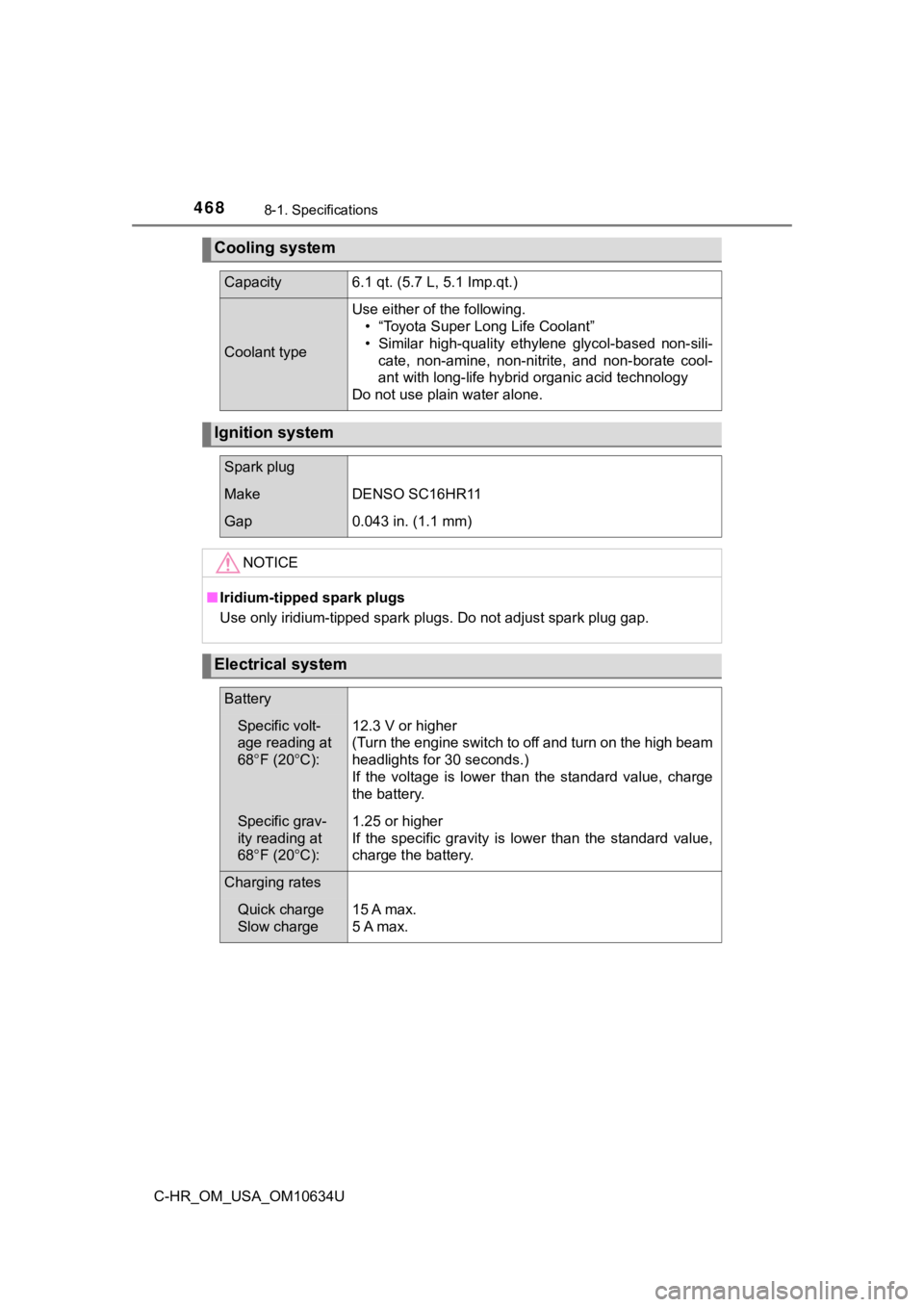
Cooling system
Capacity6.1 qt. (5.7 L, 5.1 Imp.qt.)
Coolant type
Use either of the following.• “Toyota Super Long Life Coolant”
• Similar high-quality ethylene glycol-based non-sili-cate, non-amine, non-nitrite, and non-borate cool-
ant with long-life hybrid organic acid technology
Do not use plain water alone.
Ignition system
Spark plug
MakeDENSO SC16HR11
Gap0.043 in. (1.1 mm)
NOTICE
■ Iridium-tipped spark plugs
Use only iridium-tipped spark plugs. Do not adjust spark plug g ap.
Electrical system
Battery
Specific volt-
age reading at
68F (20 C):12.3 V or higher
(Turn the engine switch to off and turn on the high beam
headlights for 30 seconds.)
If the voltage is lower than the standard value, charge
the battery.
Specific grav-
ity reading at
68 F (20 C):1.25 or higher
If the specific gravity is lower than the standard value,
charge the battery.
Charging rates
Quick charge
Slow charge15 A max.
5 A max.