headlights TOYOTA C-HR 2020 Owners Manual (in English)
[x] Cancel search | Manufacturer: TOYOTA, Model Year: 2020, Model line: C-HR, Model: TOYOTA C-HR 2020Pages: 536, PDF Size: 11.99 MB
Page 13 of 536
13Pictorial index
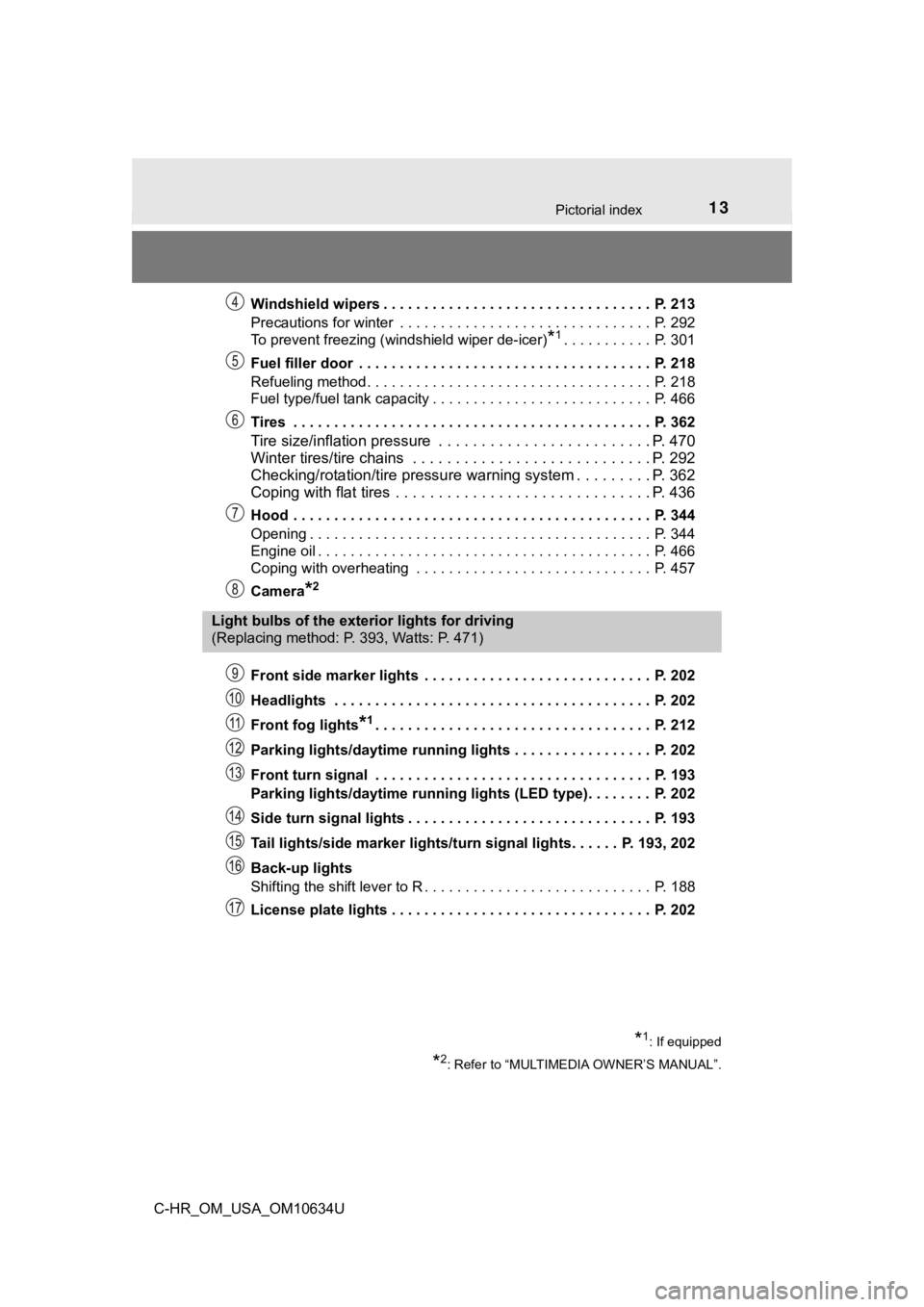
C-HR_OM_USA_OM10634UWindshield wipers . . . . . . . . . . . . . . . . . . . . . . . . . . . . . . . . . P. 213
Precautions for winter . . . . . . . . . . . . . . . . . . . . . . . . . . . . . . . P. 292
To prevent freezing (windshield wiper de-icer)
*1. . . . . . . . . . . P. 301
Fuel filler door . . . . . . . . . . . . . . . . . . . . . . . . . . . . . . . . . . . . P. 218
Refueling method . . . . . . . . . . . . . . . . . . . . . . . . . . . . . . . . . . . P. 218
Fuel type/fuel tank capacity . . . . . . . . . . . . . . . . . . . . . . . . . . . P. 466
Tires . . . . . . . . . . . . . . . . . . . . . . . . . . . . . . . . . . . . . . . . . . . . P. 362
Tire size/inflation pressure . . . . . . . . . . . . . . . . . . . . . . . . . P. 470
Winter tires/tire chains . . . . . . . . . . . . . . . . . . . . . . . . . . . . P. 292
Checking/rotation/tire pressur e warning system . . . . . . . . .P. 362
Coping with flat tires . . . . . . . . . . . . . . . . . . . . . . . . . . . . . . P. 436
Hood . . . . . . . . . . . . . . . . . . . . . . . . . . . . . . . . . . . . . . . . . . . . P. 344
Opening . . . . . . . . . . . . . . . . . . . . . . . . . . . . . . . . . . . . . . . . . . P. 344
Engine oil . . . . . . . . . . . . . . . . . . . . . . . . . . . . . . . . . . . . . . . . . P. 466
Coping with overheating . . . . . . . . . . . . . . . . . . . . . . . . . . . . . P. 457
Camera
*2
Front side marker lights . . . . . . . . . . . . . . . . . . . . . . . . . . . . P. 202
Headlights . . . . . . . . . . . . . . . . . . . . . . . . . . . . . . . . . . . . . . . P. 202
Front fog lights
*1. . . . . . . . . . . . . . . . . . . . . . . . . . . . . . . . . . P. 212
Parking lights/daytime running lights . . . . . . . . . . . . . . . . . P. 202
Front turn signal . . . . . . . . . . . . . . . . . . . . . . . . . . . . . . . . . . P. 193
Parking lights/daytime running lights (LED type). . . . . . . . P. 202
Side turn signal lights . . . . . . . . . . . . . . . . . . . . . . . . . . . . . . P. 193
Tail lights/side marker lights/turn signal lights. . . . . . P. 193, 202
Back-up lights
Shifting the shift lever to R . . . . . . . . . . . . . . . . . . . . . . . . . . . . P. 188
License plate lights . . . . . . . . . . . . . . . . . . . . . . . . . . . . . . . . P. 202
Light bulbs of the exterior lights for driving
(Replacing method: P. 393, Watts: P. 471)
*1: If equipped
*2: Refer to “MULTIMEDIA OWNER’S MANUAL”.
Page 15 of 536
15Pictorial index
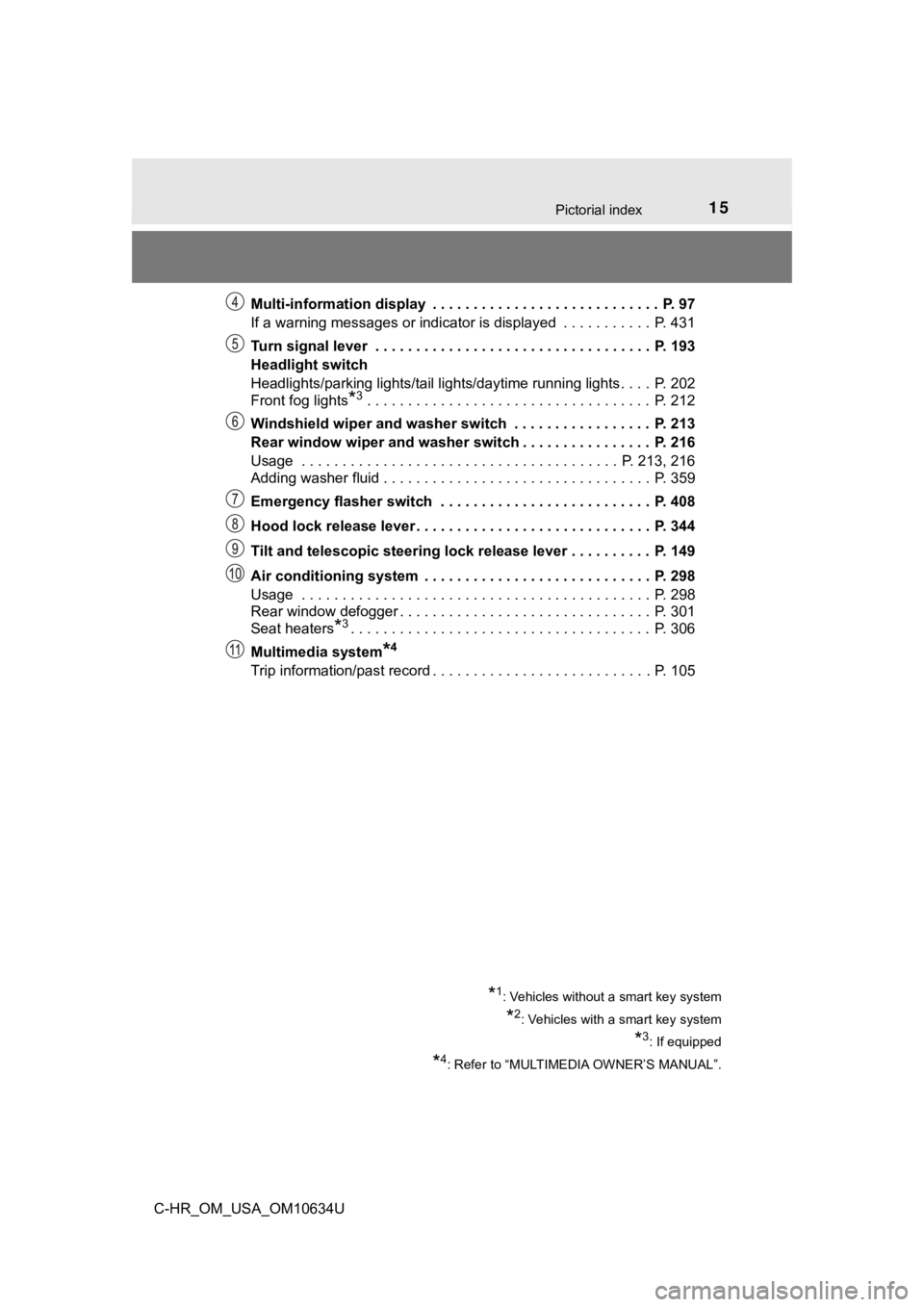
C-HR_OM_USA_OM10634UMulti-information display . . . . . . . . . . . . . . . . . . . . . . . . . . . . P. 97
If a warning messages or indicator is displayed . . . . . . . .
. . . P. 431
Turn signal lever . . . . . . . . . . . . . . . . . . . . . . . . . . . . . . . . . . P. 193
Headlight switch
Headlights/parking lights/tail lights/daytime running lights . . . . P. 202
Front fog lights
*3 . . . . . . . . . . . . . . . . . . . . . . . . . . . . . . . . . . . P. 212
Windshield wiper and washer switch . . . . . . . . . . . . . . . . . P. 213
Rear window wiper and washer switch . . . . . . . . . . . . . . . . P. 216
Usage . . . . . . . . . . . . . . . . . . . . . . . . . . . . . . . . . . . . . . . P. 213, 216
Adding washer fluid . . . . . . . . . . . . . . . . . . . . . . . . . . . . . . . . . P. 359
Emergency flasher switch . . . . . . . . . . . . . . . . . . . . . . . . . . P. 408
Hood lock release lever. . . . . . . . . . . . . . . . . . . . . . . . . . . . . P. 344
Tilt and telescopic steering lock release lever . . . . . . . . . . P. 149
Air conditioning system . . . . . . . . . . . . . . . . . . . . . . . . . . . . P. 298
Usage . . . . . . . . . . . . . . . . . . . . . . . . . . . . . . . . . . . . . . . . . . . P. 298
Rear window defogger . . . . . . . . . . . . . . . . . . . . . . . . . . . . . . . P. 301
Seat heaters
*3. . . . . . . . . . . . . . . . . . . . . . . . . . . . . . . . . . . . . P. 306
Multimedia system
*4
Trip information/past record . . . . . . . . . . . . . . . . . . . . . . . . . . . P. 105
*1: Vehicles without a smart key system
*2: Vehicles with a smart key system
*3: If equipped
*4: Refer to “MULTIMEDIA OWNER’S MANUAL”.
Page 151 of 536
1513-4. Adjusting the steering wheel and mirrors
3
Operation of each component
C-HR_OM_USA_OM10634U
Inside rear view mirror
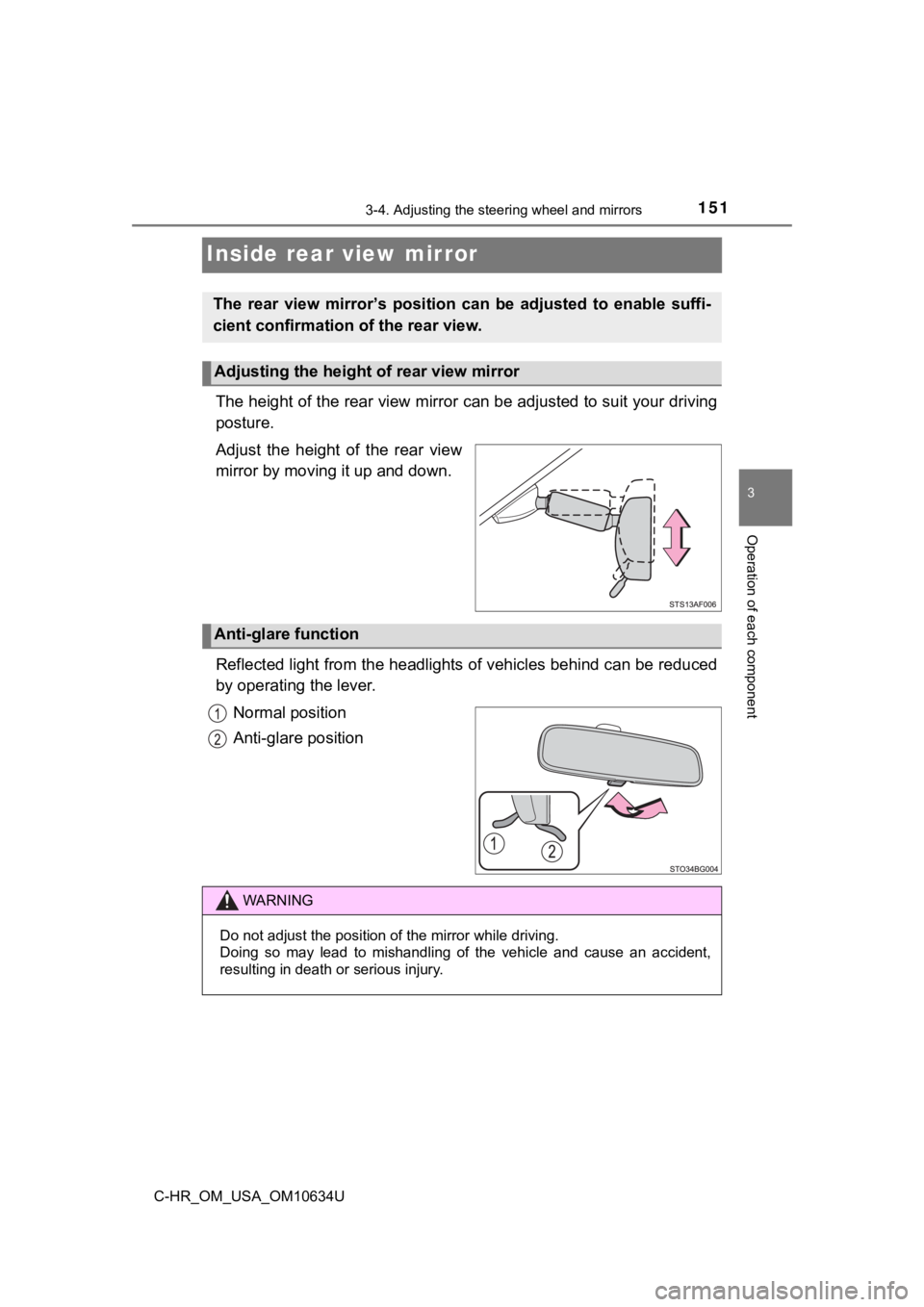
The height of the rear view mirror can be adjusted to suit your driving
posture.
Adjust the height of the rear view
mirror by moving it up and down.
Reflected light from the headlights of vehicles behind can be r educed
by operating the lever.
Normal position
Anti-glare position
The rear view mirror’s position ca n be adjusted to enable suffi-
cient confirmation of the rear view.
Adjusting the height of rear view mirror
Anti-glare function
WARNING
Do not adjust the position of the mirror while driving.
Doing so may lead to mishandling of the vehicle and cause an ac cident,
resulting in death or serious injury.
Page 202 of 536
2024-3. Operating the lights and wipers
C-HR_OM_USA_OM10634U
Headlight switch
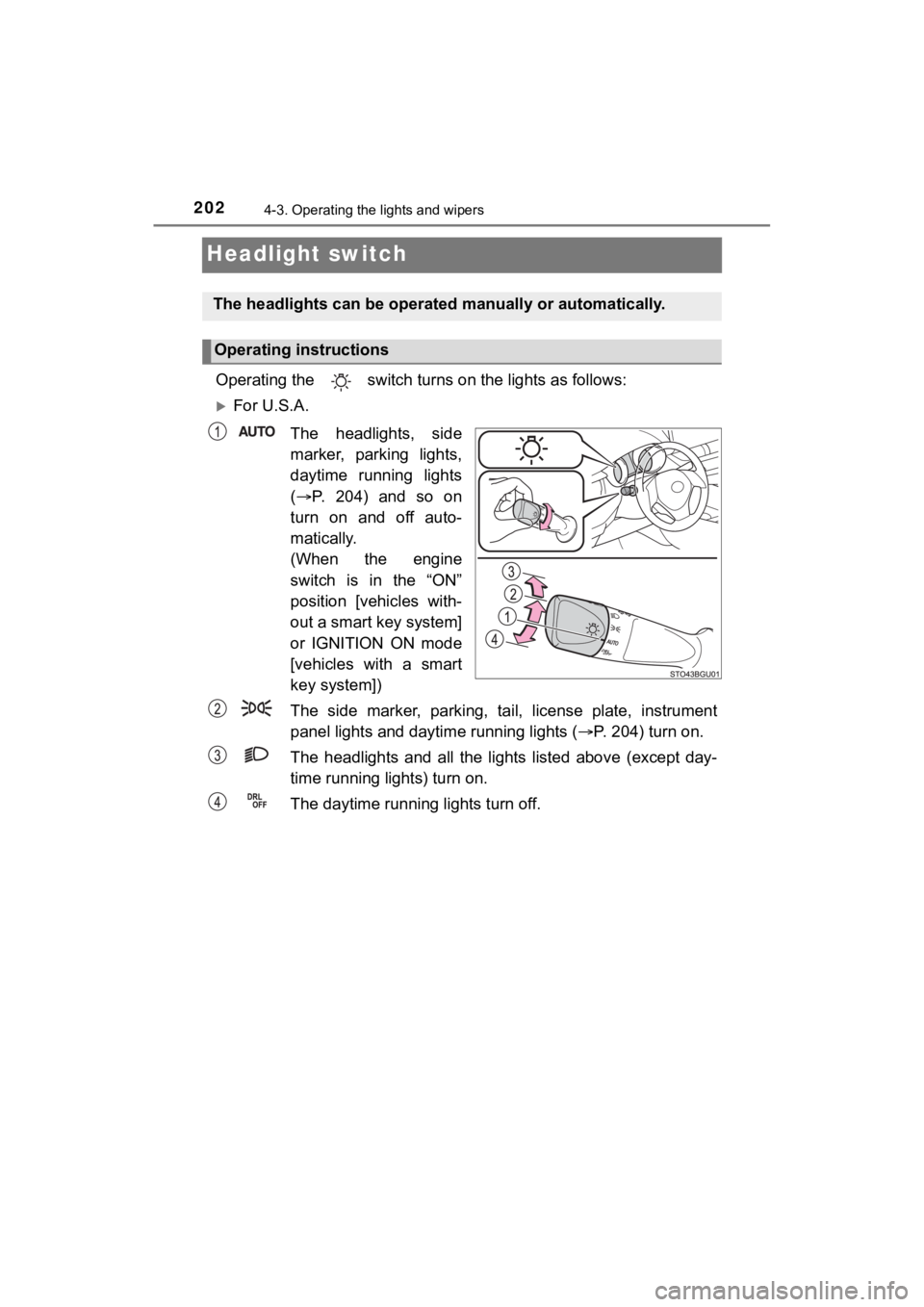
Operating the switch turns on the lights as follows:
For U.S.A.
The headlights, side
marker, parking lights,
daytime running lights
( P. 204) and so on
turn on and off auto-
matically.
(When the engine
switch is in the “ON”
position [vehicles with-
out a smart key system]
or IGNITION ON mode
[vehicles with a smart
key system])
The side marker, parking, tail, license plate, instrument
panel lights and dayti me running lights (P. 204) turn on.
The headlights and all the li ghts listed above (except day-
time running lights) turn on.
The daytime running lights turn off.
The headlights can be operated manually or automatically.
Operating instructions
Page 203 of 536
2034-3. Operating the lights and wipers
4
Driving
C-HR_OM_USA_OM10634U
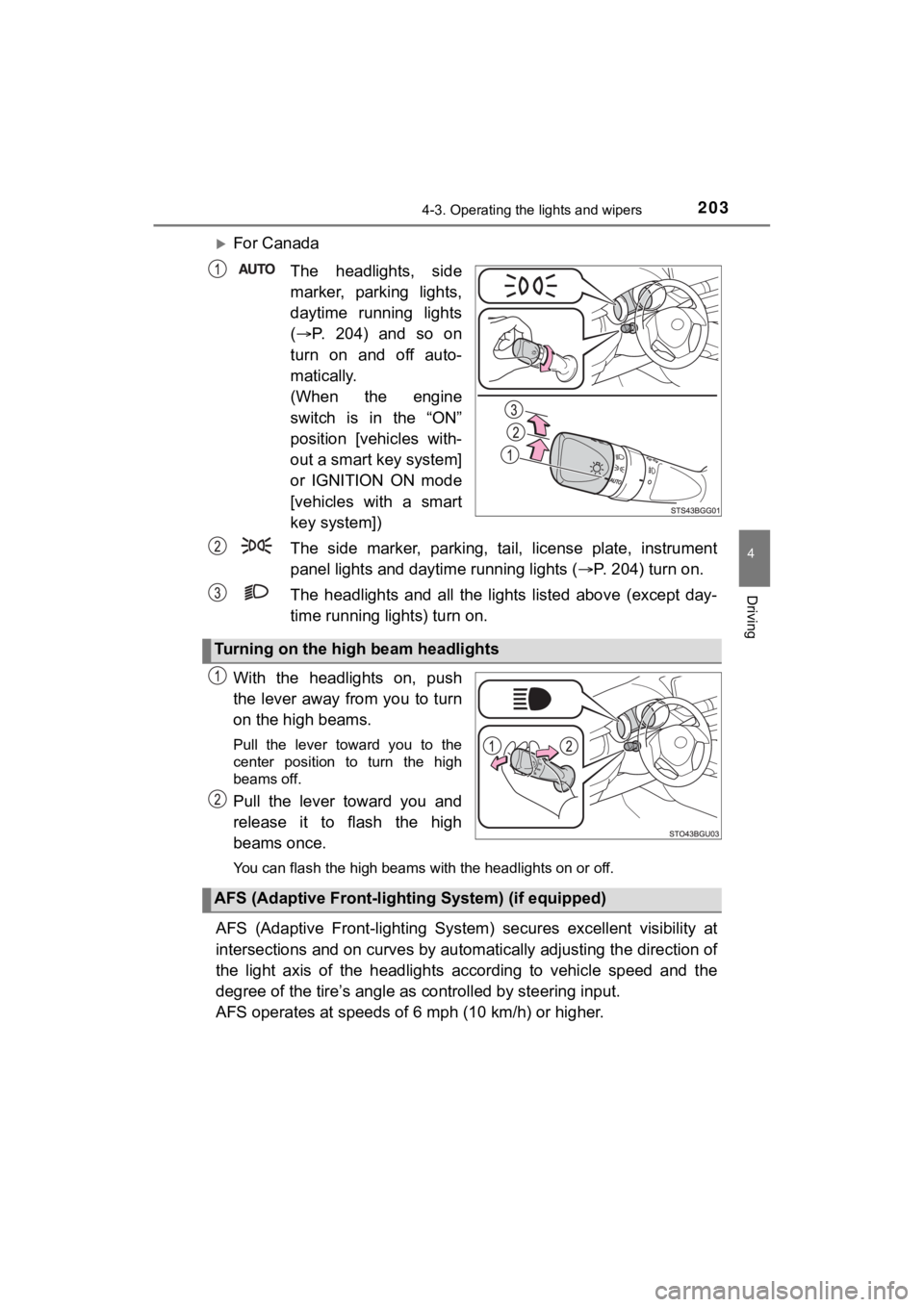
For Canada
The headlights, side
marker, parking lights,
daytime running lights
( P. 204) and so on
turn on and off auto-
matically.
(When the engine
switch is in the “ON”
position [vehicles with-
out a smart key system]
or IGNITION ON mode
[vehicles with a smart
key system])
The side marker, parking, tail, license plate, instrument
panel lights and dayti me running lights (P. 204) turn on.
The headlights and all the li ghts listed above (except day-
time running lights) turn on.
With the headlights on, push
the lever away from you to turn
on the high beams.
Pull the lever toward you to the
center position to turn the high
beams off.
Pull the lever toward you and
release it to flash the high
beams once.
You can flash the high beams with the headlights on or off.
AFS (Adaptive Front-lighting System) secures excellent visibili ty at
intersections and on curves by automatically adjusting the dire ction of
the light axis of the headlights according to vehicle speed and the
degree of the tire’s angle as controlled by steering input.
AFS operates at speeds of 6 mph (10 km/h) or higher.
Turning on the high beam headlights
AFS (Adaptive Front-light ing System) (if equipped)
Page 204 of 536
2044-3. Operating the lights and wipers
C-HR_OM_USA_OM10634U
■Daytime running light system
●The daytime running lights illuminate using the same lights as the parking
lights and illuminate brighter than the parking lights.
● To make your vehicle more visible to other drivers during dayti me driving,
the daytime running lights turn on automatically when all of the following
conditions are met. (The daytime running lights are not designe d for use at
night.)
• The engine is running
• The parking brake is released
• The headlight switch is in the or “AUTO”
* position
*: When the surroundings are bright
The daytime running lights remain on after they illuminate, even if the parking
brake is set again.
● For the U.S.A.: Daytime running lights can be turned off by ope rating the
switch.
● Compared to turning on the headlights, the daytime running ligh t system
offers greater durability and consumes less electricity, so it can help improve
fuel economy.
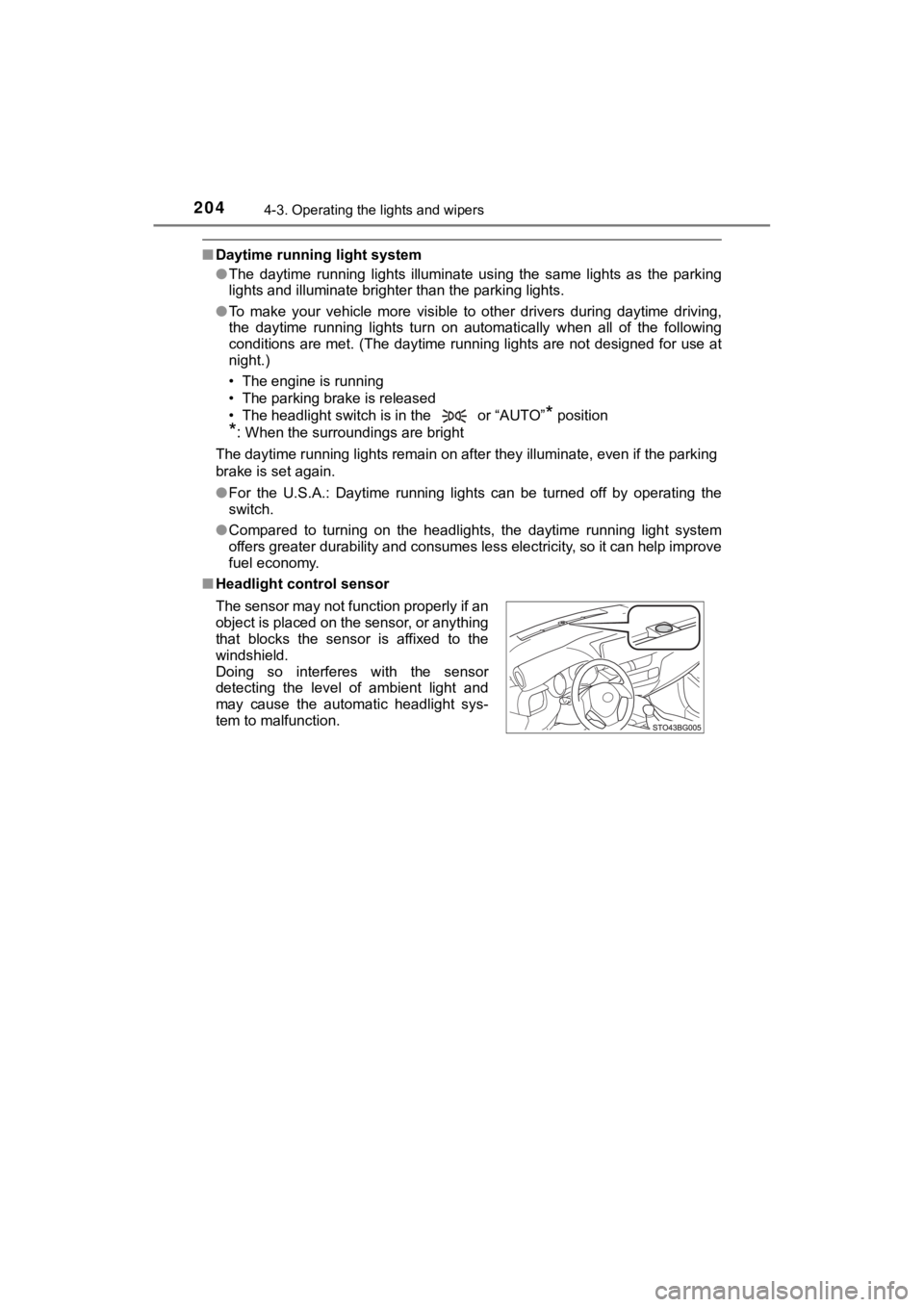
■ Headlight control sensor
The sensor may not function properly if an
object is placed on the sensor, or anything
that blocks the sensor is affixed to the
windshield.
Doing so interferes with the sensor
detecting the level of ambient light and
may cause the automatic headlight sys-
tem to malfunction.
Page 205 of 536
2054-3. Operating the lights and wipers
4
Driving
C-HR_OM_USA_OM10634U■
Automatic light off system
Vehicles without a smart key system
● When the headlights are on: The headlights and tail lights turn off 30 sec-
onds after the engine switch is turned to the “ACC” or “LOCK” p osition and a
door is opened and closed. (The lights turn off immediately if on the
key is pressed after all the doors are locked.)
● When only the tail lights are on: The tail lights turn off automatically if the
engine switch is turned to the “ACC” or “LOCK” position and the driver’s
door is opened.
To turn the lights on again, turn the engine switch to “ON” pos ition, or turn the
light switch to once and then back to or .
If any of the doors is kept open, the lights automatically turn off after 20 min-
utes.
Vehicles with a smart key system
● When the headlights come on: The headlights and tail lights tur n off 30 sec-
onds after a door is opened and closed if the engine switch is turned to
ACCESSORY mode or turned off. (The lights turn off immediately if on
the key is pressed after all the doors are locked.)
● When only the tail lights come on: The tail lights turn off automatically if the
engine switch is turned to ACCESSORY mode or turned off and the driver’s
door is opened.
To turn the lights on again, turn the engine switch to IGNITION ON mode, or
turn the light switch to once and then back to or .
If any of the doors is kept open, the lights automatically turn off after 20 min-
utes.
■ Light reminder buzzer
Vehicles without a smart key system
A buzzer sounds when the engine switch is turned to “LOCK” posi tion and the
driver’s door is opened while the lights are turned on.
Vehicles with a smart key system
A buzzer sounds and a message appears when the engine switch is turned
off or turned to ACCESSORY mode and the driver’s door is opened while the
lights are turned on.
■
Automatic headlight leveling system (vehicles with Adaptive Fro nt-lighting
System)
The level of the headlights is automatically adjusted according to the number
of passengers and the loading condition of the vehicle to ensur e that the
headlights do not interfere with other road users.
Page 206 of 536
2064-3. Operating the lights and wipers
C-HR_OM_USA_OM10634U■
Battery-saving function
In the following conditions, the headlights and the other remai ning lights will
go off automatically after 20 minutes in order to prevent the v ehicle battery
from being discharged:
● The headlights and/or tail lights are on.
● Vehicles without a smart key system: The engine switch is turne d to the
“ACC” position or turned off.
Vehicles with a smart key system: The engine switch is turned t o ACCES-
SORY mode or turned off.
● The light switch is in or .
This function will be canceled in any of the following situatio ns:
● Vehicles without a smart key system: The engine switch is turne d to the
“ON” position.
Vehicles with a smart key system: The engine switch is turned t o IGNITION
ON.
● When the light switch is operated.
● When the door is opened or closed.
■ If “Headlight System Malfunction. Visit Your Dealer.” is displayed on the
multi-information display
The system may be malfunctioning. Have the vehicle inspected by your
Toyota dealer.
■ Customization
Settings (e.g. light sensor sensitivity) can be changed.
(Customizable features: P. 495)
NOTICE
■To prevent battery discharge
Do not leave the lights on longer than necessary when the engin e is not
running.
Page 209 of 536

2094-3. Operating the lights and wipers
4
Driving
C-HR_OM_USA_OM10634U
■High beam automatic turning on or off conditions
●When all of the following conditions are fulfilled, the high be am will be auto-
matically turned on (after approximately 1 second):
• Vehicle speed is above approximately 21 mph (34 km/h).
• The area ahead of the vehicle is dark.
• There are no vehicles ahead with headlights or tail lights turned on.
• There are few streetlights on the road ahead.
● If any of the following conditions are fulfilled, the high beam will be automat-
ically turned off:
• Vehicle speed drops below approximately 17 mph (27 km/h).
• The area ahead of the vehicle is not dark.
• Vehicles ahead have headlights or tail lights turned on.
• There are many streetlights on the road ahead.
■ Camera sensor detection information
●The high beam may not be automatically turned off in the following situa-
tions:
• When oncoming vehicles suddenly appear from a curve
• When the vehicle is cut off in front of by another vehicle
• When vehicles ahead are hidden from sight due to repeated curv es, road
dividers or roadside trees
• When vehicles ahead appear from the faraway lane on wide road
• When vehicles ahead have no lights
● The high beam may be turned off if a vehicle ahead that is usin g fog lights
without using the headlights is detected.
● House lights, street lights, traffic signals, and illuminated billboards or signs
may cause the high beam to switch to the low beams, or the low beams to
remain on.
● The following factors may affect the amount of time taken to tu rn the high
beam on or off:
• The brightness of headlights, fog lights, and tail lights of v ehicles ahead
• The movement and direction of vehicles ahead
• When a vehicle ahead only has operational lights on one side
• When a vehicle ahead is a two-wheeled vehicle
• The condition of the road (gradient, curve, condition of the r oad surface,
etc.)
• The number of passengers and amount of luggage
Page 210 of 536

2104-3. Operating the lights and wipers
C-HR_OM_USA_OM10634U●
The high beam may be turned on or off when the driver does not expect it.
● Bicycles or similar objects may not be detected.
● In the situations shown below, the system may not be able to accurately
detect surrounding brightness levels. This may cause the low be ams to
remain on or the high beams to cause problems for pedestrians, vehicles
ahead or other parties. In these cases, manually switch between the high
and low beams.
• In bad weather (rain, snow, fog, sandstorms, etc.)
• The windshield is obscured by fog, mist, ice, dirt, etc.
• The windshield is cracked or damaged.
• The camera sensor is deformed or dirty.
• The camera sensor temperature is extremely high.
• Surrounding brightness levels are equal to those of headlights , tail lights
or fog lights.
• Vehicles ahead have headlights that are either switched off, d irty, are
changing color, or are not aimed properly.
• When driving through an area of intermittently changing brightness and darkness.
• When frequently and repeatedly driving ascending/descending roads, or
roads with rough, bumpy or uneven surfaces (such as stone-paved
roads, gravel tracks, etc.).
• When frequently and repeatedly taking curves or driving on a w inding
road.
• There is a highly reflective object ahead of the vehicle, such as a sign or a mirror.
• The back of a vehicle ahead is highly reflective, such as a co ntainer on a
truck.
• The vehicle’s headlights are damaged or dirty.
• The vehicle is listing or tilting, due to a flat tire, a trailer being towed etc.
• The high beam and low beam are repeatedly being switched betwe en in
an abnormal manner.
• The driver believes that the high beam may be causing problems or dis-
tress to other drivers or pedestrians nearby.