tires TOYOTA C-HR 2022 Owner's Manual
[x] Cancel search | Manufacturer: TOYOTA, Model Year: 2022, Model line: C-HR, Model: TOYOTA C-HR 2022Pages: 818, PDF Size: 113.75 MB
Page 540 of 818

5384-5. Using the driving support systems
C-HR_HV_OM_Europe_OM10720E
WARNING
■Hill-start assist control does not operate effectively when
● Do not overly rely on hill-start assist control. Hill-start assist control may
not operate effectively on steep inclines and roads covered wit h ice.
● Unlike the parking brake, hill-start assist control is not intended to hold the
vehicle stationary for an extended period of time. Do not attem pt to use
hill-start assist control to hold the vehicle on an incline, as doing so may
lead to an accident.
■ When the TRC/ABS/VSC/Trailer Sway Control is activated
The slip indicator light flashes. Always drive carefully. Reckl ess driving may
cause an accident. Exercise particular care when the indicator light flashes.
■ When the TRC/VSC/Trailer Sway Control systems are turned off
Be especially careful and drive at a speed appropriate to the r oad condi-
tions. As these are the systems to help ensure vehicle stabilit y and driving
force, do not turn the TRC/VSC/Trailer Sway Control systems off unless
necessary.
Trailer Sway Control is part of the VSC system and will not ope rate if VSC is
turned off or experiences a malfunction.
■ Replacing tires
Make sure that all tires are of the specified size, brand, trea d pattern and
total load capacity. In addition, make sure that the tires are inflated to the
recommended tire inflation pressure level.
The ABS, TRC, Trailer Sway Control and VSC systems will not fun ction cor-
rectly if different tires are installed on the vehicle.
Contact any authorized Toyota retailer or Toyota authorized rep airer, or any
reliable repairer for further information when replacing tires or wheels.
Page 541 of 818

5394-5. Using the driving support systems
4
Driving
C-HR_HV_OM_Europe_OM10720E
WARNING
■Handling of tires and the suspension
Using tires with any kind of problem or modifying the suspensio n will affect
the driving assist systems, and may cause a system to malfuncti on.
■ Trailer Sway Control precaution
The Trailer Sway Control system is not able to reduce trailer s way in all situ-
ations.
Depending on many factors such as the conditions of the vehicle , trailer,
road surface and driving environm ent, the Trailer Sway Control system may
not be effective. Refer to your trailer owner’s manual for info rmation on how
to tow your trailer properly.
■ If trailer sway occurs
Observe the following precautions.
Failing to do so may cause death or serious injury.
● Firmly grip the steering wheel. Steer straight ahead.
Do not try to control trailer sway by turning the steering whee l.
● Begin releasing the accelerator pedal immediately but very gradually to
reduce speed.
Do not increase speed. Do not apply vehicle brakes.
If you make no extreme correction with the steering or brakes, your vehicle
and trailer should stabilize. ( P. 301)
Page 544 of 818

5424-6. Driving tips
C-HR_HV_OM_Europe_OM10720E
◆Checking tire inflation pressure
Make sure to check the tire inflation pressure frequently. Impr oper
tire inflation pressure can cause poor fuel economy.
Also, as snow tires can cause large amounts of friction, their use on
dry roads can lead to poor fuel economy. Use tires that are app ro-
priate for the season.
◆Luggage
Carrying heavy luggage will lead to poor fuel economy. Avoid ca rry-
ing unnecessary luggage. Installing a large roof rack will also cause
poor fuel economy.
◆Warming up before driving
Since the gasoline engine starts up and cuts out automatically
when cold, warming up the engine is unnecessary. Moreover, fre-
quently driving short distances will cause the engine to repeat edly
warm up, which can lead to excess fuel consumption.
Page 545 of 818
543
4
4-6. Driving tips
Driving
C-HR_HV_OM_Europe_OM10720E
Winter driving tips
●Use fluids that are appropriate to the prevailing outside tempera-
tures.
• Engine oil
• Engine/power control unit coolant
• Washer fluid
● Have a service technician inspect the condition of the 12-volt bat-
tery.
● Have the vehicle fitted with four snow tires or purchase a set of tire
chains for the front tires*.
Ensure that all tires are the same size and brand, and that cha ins match
the size of the tires.
*: Tire chains cannot be mounted on 18-inch tires or 19-inch tir es.
Perform the following according to the driving conditions:
● Do not try to forcibly open a window or move a wiper that is frozen.
Pour warm water over the frozen area to melt the ice. Wipe away
the water immediately to prevent it from freezing.
● To ensure proper operation of the climate control system fan,
remove any snow that has accumulated on the air inlet vents in
front of the windshield.
● Check for and remove any excess ice or snow that may have accu-
mulated on the exterior lights, vehicle’s roof, chassis, around the
tires or on the brakes.
● Remove any snow or mud from the bottom of your shoes before
getting in the vehicle.
Carry out the necessary preparations and inspections before
driving the vehicle in winter. Always drive the vehicle in a ma n-
ner appropriate to the prevailing weather conditions.
Preparation for winter
Before driving the vehicle
Page 547 of 818
5454-6. Driving tips
4
Driving
C-HR_HV_OM_Europe_OM10720E
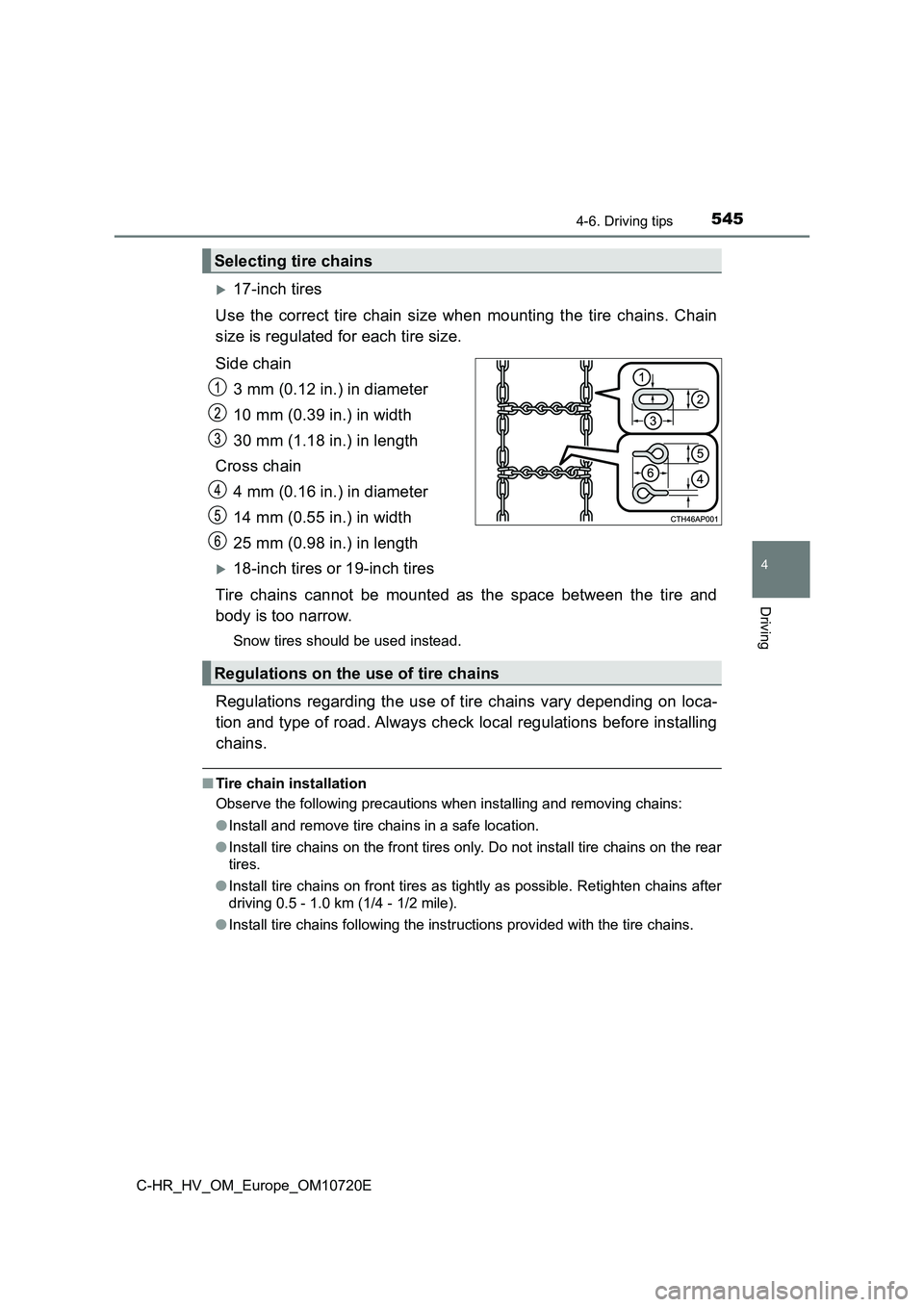
17-inch tires
Use the correct tire chain size when mounting the tire chains. Chain
size is regulated for each tire size.
Side chain
3 mm (0.12 in.) in diameter
10 mm (0.39 in.) in width
30 mm (1.18 in.) in length
Cross chain
4 mm (0.16 in.) in diameter
14 mm (0.55 in.) in width
25 mm (0.98 in.) in length
18-inch tires or 19-inch tires
Tire chains cannot be mounted as the space between the tire and
body is too narrow.
Snow tires should be used instead.
Regulations regarding the use of tire chains vary depending on loca-
tion and type of road. Always check local regulations before in stalling
chains.
■ Tire chain installation
Observe the following precautions when installing and removing chains:
● Install and remove tire chains in a safe location.
● Install tire chains on the front tires only. Do not install tire chains on the rear
tires.
● Install tire chains on front tires as tightly as possible. Retighten chains after
driving 0.5 - 1.0 km (1/4 - 1/2 mile).
● Install tire chains following the instructions provided with the tire chains.
Selecting tire chains
Regulations on the use of tire chains
Page 548 of 818

5464-6. Driving tips
C-HR_HV_OM_Europe_OM10720E
WARNING
■Driving with snow tires
Observe the following precautions to reduce the risk of acciden ts.
Failure to do so may result in a loss of vehicle control and ca use death or
serious injury.
● Use tires of the specified size.
● Maintain the recommended level of air pressure.
● Do not drive at speeds in excess of the speed limit or the speed limit spec-
ified for the snow tires being used.
● Use snow tires on all, not just some wheels.
■ Driving with tire chains
Observe the following precautions to reduce the risk of acciden ts.
Failure to do so may result in the vehicle being unable to be d riven safely,
and may cause death or serious injury.
● Do not drive in excess of the speed limit specified for the tire chains being
used, or 50 km/h (30 mph), whichever is lower.
● Avoid driving on bumpy road surfaces or over potholes.
● Avoid sudden acceleration, abrupt steering, sudden braking and shifting
operations that cause sudden engine braking.
● Slow down sufficiently before entering a curve to ensure that vehicle con-
trol is maintained.
NOTICE
■ Repairing or replacing snow tires
Request repairs or replacement of snow tires from any authorize d Toyota
retailer or Toyota authorized repairer, or any reliable repaire r or legitimate
tire retailers.
This is because the removal and attachment of snow tires affect s the opera-
tion of the tire pressure warning valves and transmitters.
■ Fitting tire chains
The tire pressure warning valves and transmitters may not funct ion correctly
when tire chains are fitted.
Page 581 of 818

579
6Maintenance and care
C-HR_HV_OM_Europe_OM10720E
6-1. Maintenance and care
Cleaning and protecting the
vehicle exterior ................ 580
Cleaning and protecting the
vehicle interior ................. 586
6-2. Maintenance
Maintenance
requirements.................... 590
6-3. Do-it-yourself
maintenance
Do-it-yourself service
precautions ...................... 593
Hood .................................. 596
Positioning a floor jack ....... 598
Engine compartment.......... 599
12-volt battery
(M20A-FXS engine) ......... 612
Tires ................................... 616
Tire inflation pressure ........ 632
Wheels ............................... 634
Air conditioning filter .......... 637
Hybrid battery
(traction battery) air intake
vent and filter ................... 640
Electronic key battery ........ 645
Checking and replacing
fuses ................................ 648
Light bulbs ......................... 653
Page 593 of 818

5916-2. Maintenance
C-HR_HV_OM_Europe_OM10720E
6
Maintenance and care
■Where to go for maintenance service?
In order to maintain your vehicle in the best possible conditio n, Toyota recom-
mends that maintenance service operations as well as other insp ections and
repairs be carried out by authorized Toyota retailers or repair ers or other duly
qualified and equipped professionals. For repairs and services covered by
your warranty, please visit an authorized Toyota retailers or r epairer, who will
use genuine Toyota parts in repairing any difficulties you may encounter.
There can also be advantages in utilizing authorized Toyota ret ailers or
repairers for non-warranty repairs and services, as members of the Toyota
network will be able to expertly assist you with any difficulti es you may
encounter.
Your authorized Toyota retailer or Toyota authorized repairer, or any reliable
repairer will perform all of the scheduled maintenance on your vehicle reliably
and economically due to their experience with Toyota vehicles.
■ Does your vehicle need repairs?
Be on the alert for changes in performance and sounds, and visu al tip-offs
that indicate service is needed. Some important clues are:
● Engine misses, stumbling or pinging
● Appreciable loss of power
● Strange engine noises
● A fluid leak under the vehicle (However, water dripping from the air condi-
tioning system after use is normal.)
● Change in exhaust sound (This may indicate a dangerous carbon monoxide
leak. Drive with the windows open and have the exhaust system c hecked
immediately.)
● Flat-looking tires, excessive tire squeal when cornering, uneven tire wear
● Vehicle pulls to one side when driven straight on a level road
● Strange noises related to suspension movement
● Loss of brake effectiveness, spongy feeling brake pedal, pedal almost
touches the floor, vehicle pulls to one side when braking
● Engine coolant temperature continually higher than normal (P. 686, 757)
If you notice any of these clues, take your vehicle to any auth orized Toyota
retailer or Toyota authorized repairer, or any reliable repaire r as soon as pos-
sible. Your vehicle may need adjustment or repair.
Page 618 of 818

6166-3. Do-it-yourself maintenance
C-HR_HV_OM_Europe_OM10720E
Tires
Check if the treadwear indicators are showing on the tires. Also check
the tires for uneven wear, such as excessive wear on one side o f the
tread.
Check the spare tire condition and pressure if not rotated.
New tread
Worn tread
Treadwear indicator
The location of treadwear indicators is shown by a “TWI” or “ ” mark, etc.,
molded into the sidewall of each tire.
Replace the tires if the treadwear indicators are showing on a tire.
Replace or rotate tires in accordance with maintenance sched-
ules and treadwear.
Checking tires
Page 619 of 818

6176-3. Do-it-yourself maintenance
C-HR_HV_OM_Europe_OM10720E
6
Maintenance and care
Rotate the tires in the order shown.
To equalize tire wear and help extend tire life, Toyota recommends that tire
rotation is carried out approximately every 10000 km (6000 mile s).
Tire rotation
Except for vehicles with full-size
spare tire
Vehicles with full-size spare
tire
FrontFront