tire pressure TOYOTA C-HR 2023 Owners Manual
[x] Cancel search | Manufacturer: TOYOTA, Model Year: 2023, Model line: C-HR, Model: TOYOTA C-HR 2023Pages: 814, PDF Size: 112.62 MB
Page 7 of 814
5
1
5
4
3
2
C-HR_HEV_OM_Europe_OM10764E
8
7
6
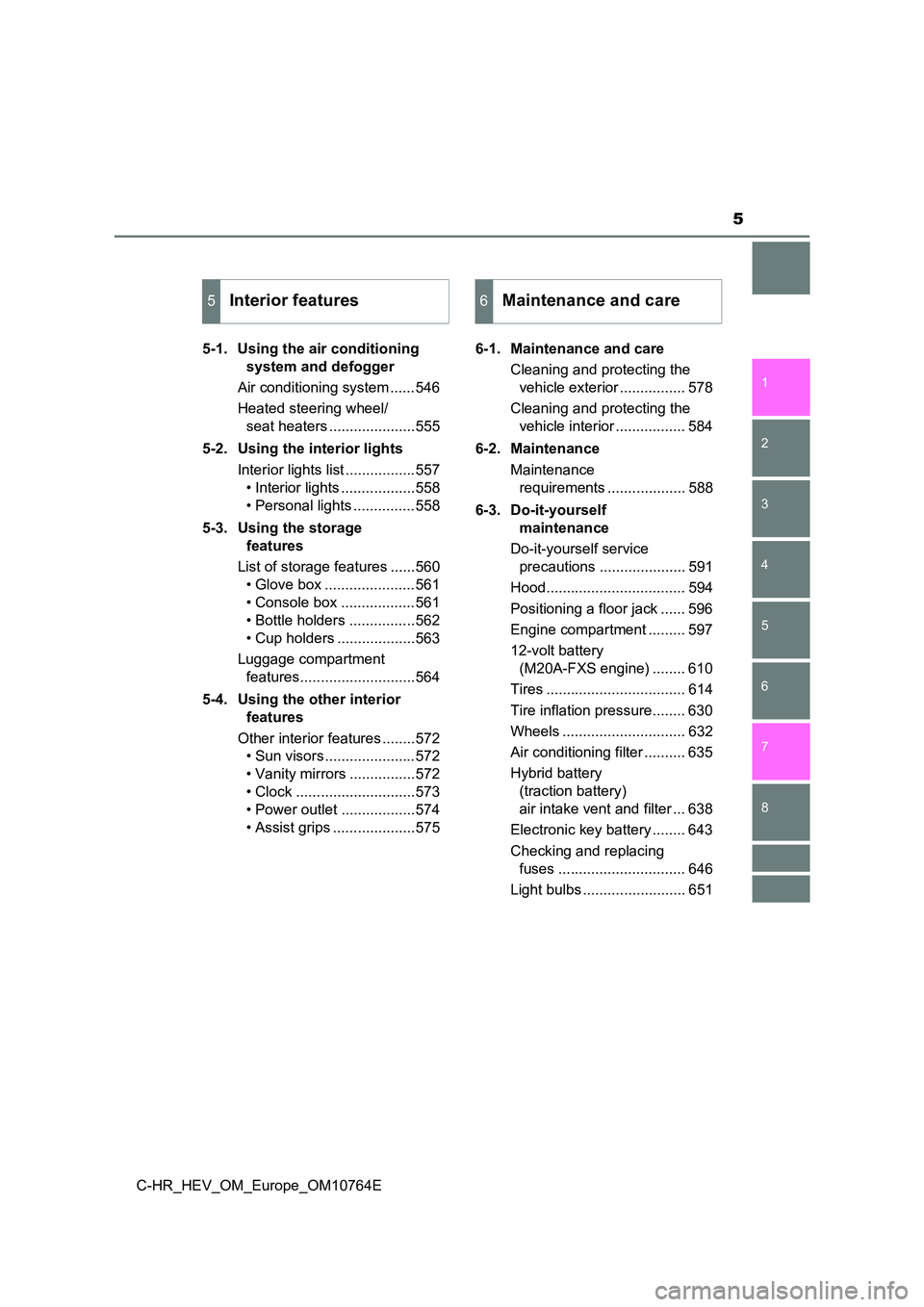
5-1. Using the air conditioning
system and defogger
Air conditioning system ......546
Heated steering wheel/
seat heaters .....................555
5-2. Using the interior lights
Interior lights list .................557
• Interior lights ..................558
• Personal lights ...............558
5-3. Using the storage
features
List of storage features ......560
• Glove box ......................561
• Console box ..................561
• Bottle holders ................562
• Cup holders ...................563
Luggage compartment
features............................564
5-4. Using the other interior
features
Other interior features ........572
• Sun visors ......................572
• Vanity mirrors ................572
• Clock .............................573
• Power outlet ..................574
• Assist grips ....................575
6-1. Maintenance and care
Cleaning and protecting the
vehicle exterior ................ 578
Cleaning and protecting the
vehicle interior ................. 584
6-2. Maintenance
Maintenance
requirements ................... 588
6-3. Do-it-yourself
maintenance
Do-it-yourself service
precautions ..................... 591
Hood.................................. 594
Positioning a floor jack ...... 596
Engine compartment ......... 597
12-volt battery
(M20A-FXS engine) ........ 610
Tires .................................. 614
Tire inflation pressure........ 630
Wheels .............................. 632
Air conditioning filter .......... 635
Hybrid battery
(traction battery)
air intake vent and filter ... 638
Electronic key battery ........ 643
Checking and replacing
fuses ............................... 646
Light bulbs ......................... 651
5Interior features6Maintenance and care
Page 17 of 814
15Pictorial index
C-HR_HEV_OM_Europe_OM10764E
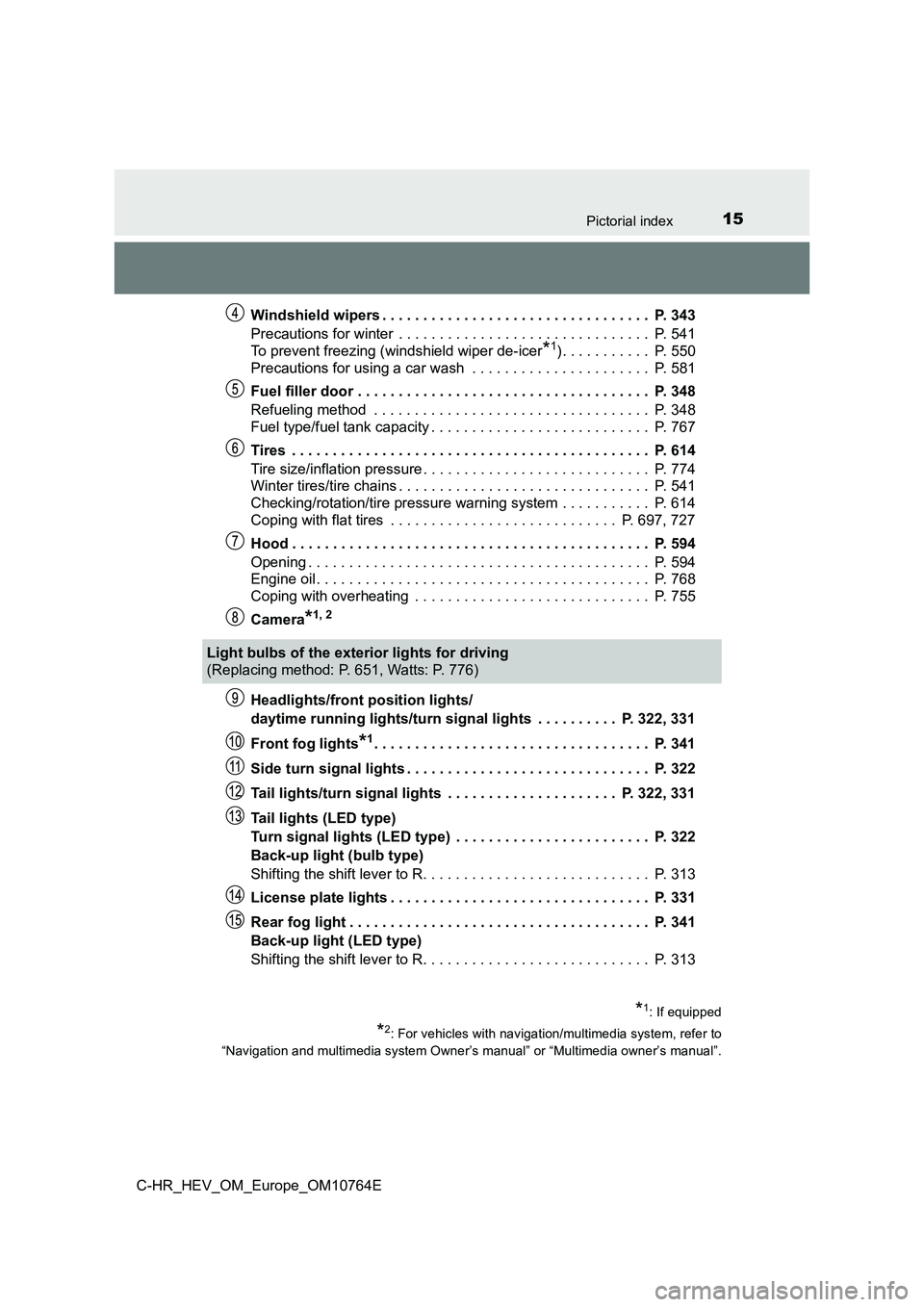
Windshield wipers . . . . . . . . . . . . . . . . . . . . . . . . . . . . . . . . . P. 343
Precautions for winter . . . . . . . . . . . . . . . . . . . . . . . . . . . . . . . P. 541
To prevent freezing (windshield wiper de-icer*1) . . . . . . . . . . . P. 550
Precautions for using a car wash . . . . . . . . . . . . . . . . . . . . . . P. 581
Fuel filler door . . . . . . . . . . . . . . . . . . . . . . . . . . . . . . . . . . . . P. 348
Refueling method . . . . . . . . . . . . . . . . . . . . . . . . . . . . . . . . . . P. 348
Fuel type/fuel tank capacity . . . . . . . . . . . . . . . . . . . . . . . . . . . P. 767
Tires . . . . . . . . . . . . . . . . . . . . . . . . . . . . . . . . . . . . . . . . . . . . P. 614
Tire size/inflation pressure . . . . . . . . . . . . . . . . . . . . . . . . . . . . P. 774
Winter tires/tire chains . . . . . . . . . . . . . . . . . . . . . . . . . . . . . . . P. 541
Checking/rotation/tire pressure warning system . . . . . . . . . . . P. 614
Coping with flat tires . . . . . . . . . . . . . . . . . . . . . . . . . . . . P. 697, 727
Hood . . . . . . . . . . . . . . . . . . . . . . . . . . . . . . . . . . . . . . . . . . . . P. 594
Opening . . . . . . . . . . . . . . . . . . . . . . . . . . . . . . . . . . . . . . . . . . P. 594
Engine oil . . . . . . . . . . . . . . . . . . . . . . . . . . . . . . . . . . . . . . . . . P. 768
Coping with overheating . . . . . . . . . . . . . . . . . . . . . . . . . . . . . P. 755
Camera*1, 2
Headlights/front position lights/
daytime running lights/turn sig nal lights . . . . . . . . . . P. 322, 331
Front fog lights*1. . . . . . . . . . . . . . . . . . . . . . . . . . . . . . . . . . P. 341
Side turn signal lights . . . . . . . . . . . . . . . . . . . . . . . . . . . . . . P. 322
Tail lights/turn signal lights . . . . . . . . . . . . . . . . . . . . . P. 322, 331
Tail lights (LED type)
Turn signal lights (LED type) . . . . . . . . . . . . . . . . . . . . . . . . P. 322
Back-up light (bulb type)
Shifting the shift lever to R. . . . . . . . . . . . . . . . . . . . . . . . . . . . P. 313
License plate lights . . . . . . . . . . . . . . . . . . . . . . . . . . . . . . . . P. 331
Rear fog light . . . . . . . . . . . . . . . . . . . . . . . . . . . . . . . . . . . . . P. 341
Back-up light (LED type)
Shifting the shift lever to R. . . . . . . . . . . . . . . . . . . . . . . . . . . . P. 313
Light bulbs of the exterior lights for driving
(Replacing method: P. 651, Watts: P. 776)
*1: If equipped
*2: For vehicles with navigation/multimedia system, refer to
“Navigation and multimedia system Owner’s manual” or “Multimedi a owner’s manual”.
Page 160 of 814
1582. Instrument cluster
C-HR_HEV_OM_Europe_OM10764E
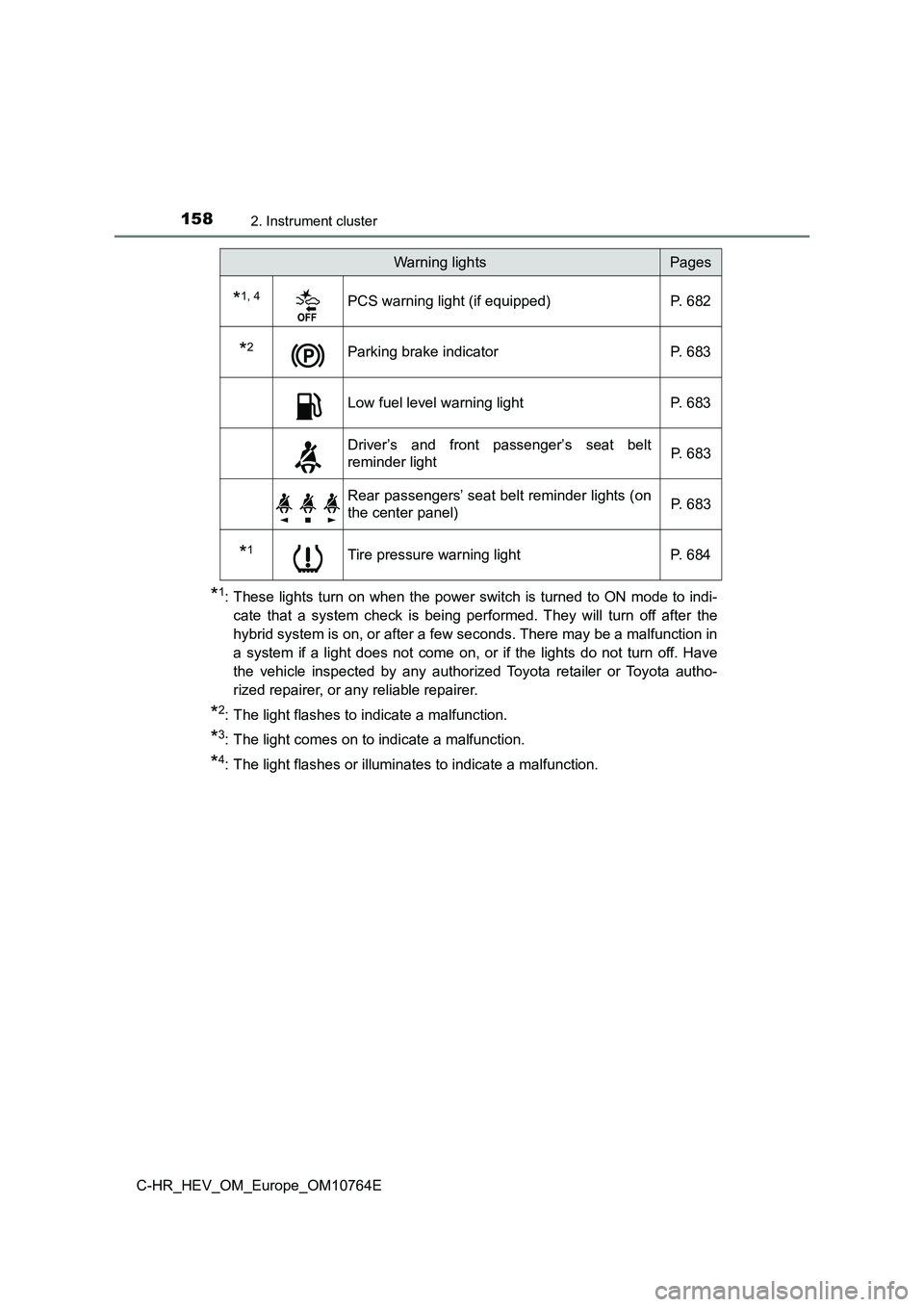
*1: These lights turn on when the power switch is turned to ON mode to indi-
cate that a system check is being performed. They will turn off after the
hybrid system is on, or after a few seconds. There may be a mal function in
a system if a light does not come on, or if the lights do not t urn off. Have
the vehicle inspected by any authorized Toyota retailer or Toyo ta autho-
rized repairer, or any reliable repairer.
*2: The light flashes to indicate a malfunction.
*3: The light comes on to indicate a malfunction.
*4: The light flashes or illuminates to indicate a malfunction.
*1, 4PCS warning light (if equipped) P. 682
*2Parking brake indicator P. 683
Low fuel level warning light P. 683
Driver’s and front passenger’s seat belt
reminder light P. 6 8 3
Rear passengers’ seat belt reminder lights (on
the center panel) P. 6 8 3
*1Tire pressure warning light P. 684
Warning lightsPages
Page 174 of 814
1722. Instrument cluster
C-HR_HEV_OM_Europe_OM10764E
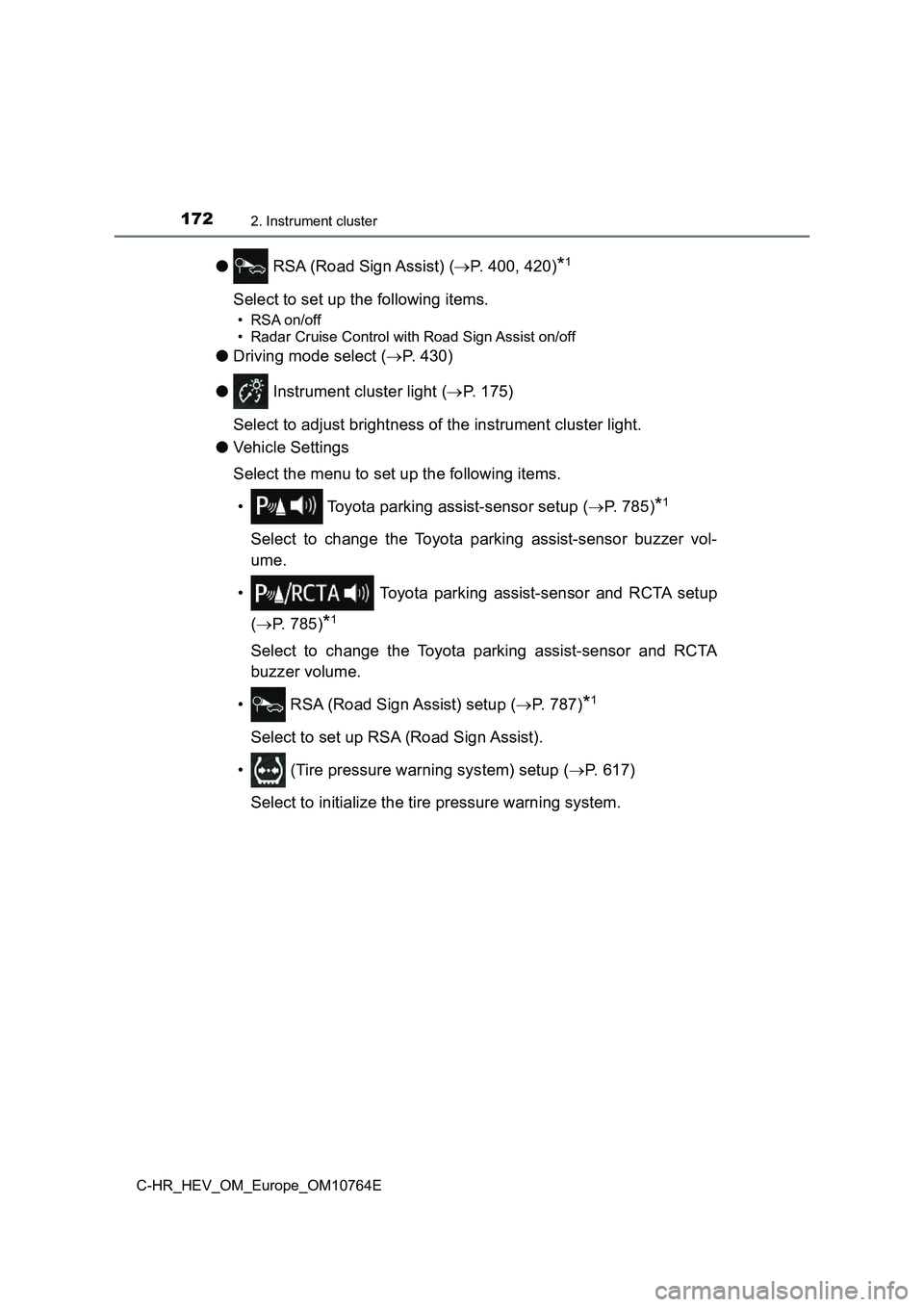
● RSA (Road Sign Assist) (P. 400, 420)*1
Select to set up the following items.
• RSA on/off
• Radar Cruise Control with Road Sign Assist on/off
● Driving mode select (P. 430)
● Instrument cluster light (P. 175)
Select to adjust brightness of the instrument cluster light.
● Vehicle Settings
Select the menu to set up the following items.
• Toyota parking assist-sensor setup ( P. 785)*1
Select to change the Toyota parking assist-sensor buzzer vol-
ume.
• Toyota parking assist-sensor and RCTA setup
( P. 785)*1
Select to change the Toyota parking assist-sensor and RCTA
buzzer volume.
• RSA (Road Sign Assist) setup ( P. 7 8 7 )*1
Select to set up RSA (Road Sign Assist).
• (Tire pressure warning system) setup ( P. 617)
Select to initialize the tire pressure warning system.
Page 298 of 814
2964-1. Before driving
C-HR_HEV_OM_Europe_OM10764E
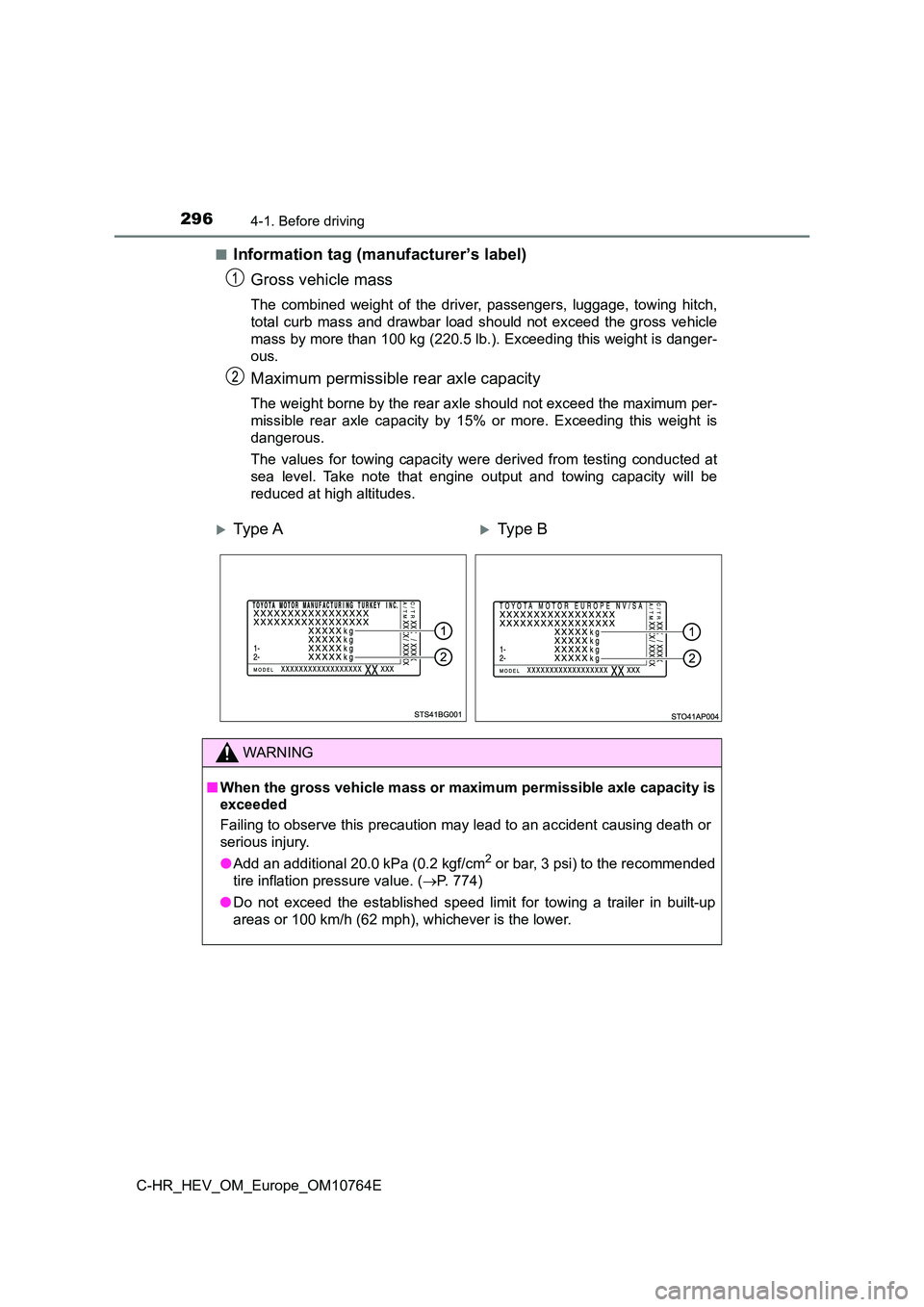
■Information tag (manufacturer’s label)
Gross vehicle mass
The combined weight of the driver, passengers, luggage, towing hitch,
total curb mass and drawbar load should not exceed the gross ve hicle
mass by more than 100 kg (220.5 lb.). Exceeding this weight is danger-
ous.
Maximum permissible rear axle capacity
The weight borne by the rear axle should not exceed the maximum per-
missible rear axle capacity by 15% or more. Exceeding this weig ht is
dangerous.
The values for towing capacity were derived from testing conduc ted at
sea level. Take note that engine output and towing capacity wil l be
reduced at high altitudes.
Ty pe AType B
WARNING
■ When the gross vehicle mass or maximum permissible axle capacity is
exceeded
Failing to observe this precaution may lead to an accident caus ing death or
serious injury.
● Add an additional 20.0 kPa (0.2 kgf/cm2 or bar, 3 psi) to the recommended
tire inflation pressure value. ( P. 774)
● Do not exceed the established speed limit for towing a trailer in built-up
areas or 100 km/h (62 mph), whichever is the lower.
Page 300 of 814
2984-1. Before driving
C-HR_HEV_OM_Europe_OM10764E
■Tire information
● Increase the tire inflation pressure to 20.0 kPa (0.2 kgf/cm2 or bar, 3 psi)
greater than the recommended value when towing. ( P. 774)
● Increase the air pressure of the trailer tires in accordance with the total
trailer weight and according to the values recommended by the m anufac-
turer of your trailer.
■ Trailer lights
Please consult at any authorized retailer or Toyota authorized repairer, or any
reliable repairer when installing trailer lights, as incorrect installation may
cause damage to the vehicle’s lights. Please take care to compl y with your
state’s laws when installing trailer lights.
■ Break-in schedule
Toyota recommends that vehicles fitted with new power train com ponents
should not be used for towing trailers for the first 800 km (50 0 miles).
■ Safety checks before towing
● Check that the maximum load limit for the towing hitch/bracket and hitch ball
is not exceeded. Bear in mind that the coupling weight of the t railer will add
to the load exerted on the vehicle. Also make sure that the tot al load exerted
on the vehicle is within the range of the weight limits. ( P. 295)
● Ensure that the trailer load is secure.
● Supplementary outside rear view mirrors should be added to the vehicle if
the traffic behind cannot be clearly seen with standard mirrors . Adjust the
extending arms of these mirrors on both sides of the vehicle so that they
always provide maximum visibility of the road behind.
■ Maintenance
● Maintenance must be performed more frequently when using the vehicle for
towing due to the greater weight burden placed on the vehicle c ompared to
normal driving.
● Retighten all bolts securing the hitching ball and bracket after towing for
approximately 1000 km (600 miles).
Page 386 of 814
3844-5. Using the driving support systems
C-HR_HEV_OM_Europe_OM10764E
● For region A: In addition to the above, in some situations, such as the fol-
lowing, the emergency steering assist may not operate.
• For region A: When the white (yellow) lane lines are difficult to see, such
as when they are faint, diverging/merging, or a shadow is cast upon them
• For region A: When the lane is wider or narrower than normal
• For region A: When there is a light and dark pattern on the ro ad surface,
such as due to road repairs
• For region A: When a pedestrian is detected near the centerlin e of the
vehicle
• For region A: When the target is too close
• For region A: When there is insufficient safe or unobstructed space for
the vehicle to be steered into
• For region A: If oncoming vehicle is present
• For region A: If VSC function is operating
● In some situations such as the following, sufficient braking force or steering
force (for region A) may not be obtained, preventing the system from per-
forming properly:
• If the braking functions cannot operate to their full extent, such as when
the brake parts are extremely cold, extremely hot, or wet
• If the vehicle is not properly maintained (brakes or tires are excessively
worn, improper tire inflation pressure, etc.)
• When the vehicle is being driven on a gravel road or other sli ppery sur-
face
• When the road surface has deep wheel tracks
• When driving on a hill road
• When driving on a road that has inclines to the left or right
■ If VSC is disabled
● If VSC is disabled (P. 533), the pre-collision brake assist and pre-collision
braking functions are also disabled.
● The PCS warning light will turn on and “VSC Turned Off. Pre-Collision Brake
System Unavailable.” will be displayed on the multi-information display.
Page 391 of 814
3894-5. Using the driving support systems
4
Driving
C-HR_HEV_OM_Europe_OM10764E
WARNING
●The traffic lines are yellow (which may be more difficult to recognize than
lines that are white).
● The white (yellow) lines cross over a curb, etc.
● The vehicle is driven on a bright surface, such as concrete.
● If the edge of the road is not clear or straight.
● The vehicle is driven on a surface that is bright due to reflected light, etc.
● The vehicle is driven in an area where the brightness changes suddenly,
such as at the entrances and exits of tunnels, etc.
● Light from the headlights of an oncoming vehicle, the sun, etc. enters the
camera.
● The vehicle is driven on a slope.
● The vehicle is driven on a road which tilts left or right, or a winding road.
● The vehicle is driven on an unpaved or rough road.
● The traffic lane is excessively narrow or wide.
● The vehicle is extremely tilted due to carrying heavy luggage or having
improper tire pressure.
● The distance to the preceding vehicle is extremely short.
● The vehicle is moving up and down a large amount due to road conditions
during driving (poor roads or road seams).
● When driving in a tunnel or at night with the headlights off or when a head-
light is dim due to its lens being dirty or it being misaligned .
● The vehicle is struck by a crosswind.
● The vehicle is affected by wind from a vehicle driven in a nearby lane.
● The vehicle has just changed lanes or crossed an intersection.
● Tires which differ by structure, manufacturer, brand or tread pattern are
used.
● When tires of a size other than specified are installed.
● Snow tires, etc. are equipped.
● The vehicle is being driven at extremely high speeds.
Page 528 of 814
5264-5. Using the driving support systems
C-HR_HEV_OM_Europe_OM10764E
WARNING
●Do not use the system in the following situations, as the system may be
unable to correctly assist you in reaching the target parking s pot and may
lead to an unexpected accident.
• In an area that is not a parking lot
• A parking lot that is not paved and has no parking space lines , such as
a sand or gravel parking lot
• A parking lot that has a slope or undulations in the road
• A frozen, snow-covered or slippery road
• The asphalt is melting due to hot weather
• There is an obstacle between the vehicle and the target parkin g spot
• Using tire chains or compact spare tire (if equipped)
● Do not use tire other than that provided by the manufacturer. The system
may not operate properly. When replacing tires, contact any aut horized
Toyota retailer or Toyota authorized repairer, or any reliable repairer.
● The system may not be able position the vehicle in the set location in the
following situations.
• The tires are extremely worn or the tire pressure is low
• The vehicle is carrying very heavy load
• The vehicle is tilted due to having luggage, etc., located on one side of
the vehicle
• There are road heaters installed in the parking lot to prevent the road
surface from freezing.
In any other situations when the set position and vehicle posit ion greatly
differ, have the vehicle inspected by any authorized Toyota ret ailer or
Toyota authorized repairer, or any reliable repairer.
Page 538 of 814
5364-5. Using the driving support systems
C-HR_HEV_OM_Europe_OM10764E
WARNING
■Hill-start assist control does not operate effectively when
● Do not overly rely on hill-start assist control. Hill-start assist control may
not operate effectively on steep inclines and roads covered wit h ice.
● Unlike the parking brake, hill-start assist control is not intended to hold the
vehicle stationary for an extended period of time. Do not attem pt to use
hill-start assist control to hold the vehicle on an incline, as doing so may
lead to an accident.
■ When the TRC/ABS/VSC/Trailer Sway Control is activated
The slip indicator light flashes. Always drive carefully. Reckl ess driving may
cause an accident. Exercise particular care when the indicator light flashes.
■ When the TRC/VSC/Trailer Sway Control systems are turned off
Be especially careful and drive at a speed appropriate to the r oad condi-
tions. As these are the systems to help ensure vehicle stabilit y and driving
force, do not turn the TRC/VSC/Trailer Sway Control systems off unless
necessary.
Trailer Sway Control is part of the VSC system and will not ope rate if VSC is
turned off or experiences a malfunction.
■ Replacing tires
Make sure that all tires are of the specified size, brand, trea d pattern and
total load capacity. In addition, make sure that the tires are inflated to the
recommended tire inflation pressure level.
The ABS, TRC, Trailer Sway Control and VSC systems will not fun ction cor-
rectly if different tires are installed on the vehicle.
Contact any authorized Toyota retailer or Toyota authorized rep airer, or any
reliable repairer for further information when replacing tires or wheels.