ECU TOYOTA C-HR 2023 Owners Manual
[x] Cancel search | Manufacturer: TOYOTA, Model Year: 2023, Model line: C-HR, Model: TOYOTA C-HR 2023Pages: 814, PDF Size: 112.62 MB
Page 671 of 814
6697-1. Essential information
C-HR_HEV_OM_Europe_OM10764E
7
When trouble arises
If your vehicle has to be stopped in an
emergency
Steadily step on the brake pedal with both feet and firmly depr ess it.
Do not pump the brake pedal repeatedly as this will increase the effort
required to slow the vehicle.
Shift the shift lever to N.
If the shift lever is shifted to N
After slowing down, stop the vehicle in a safe place by the roa d.
Stop the hybrid system.
If the shift lever cannot be shifted to N
Keep depressing the brake pedal with both feet to reduce vehicl e
speed as much as possible.
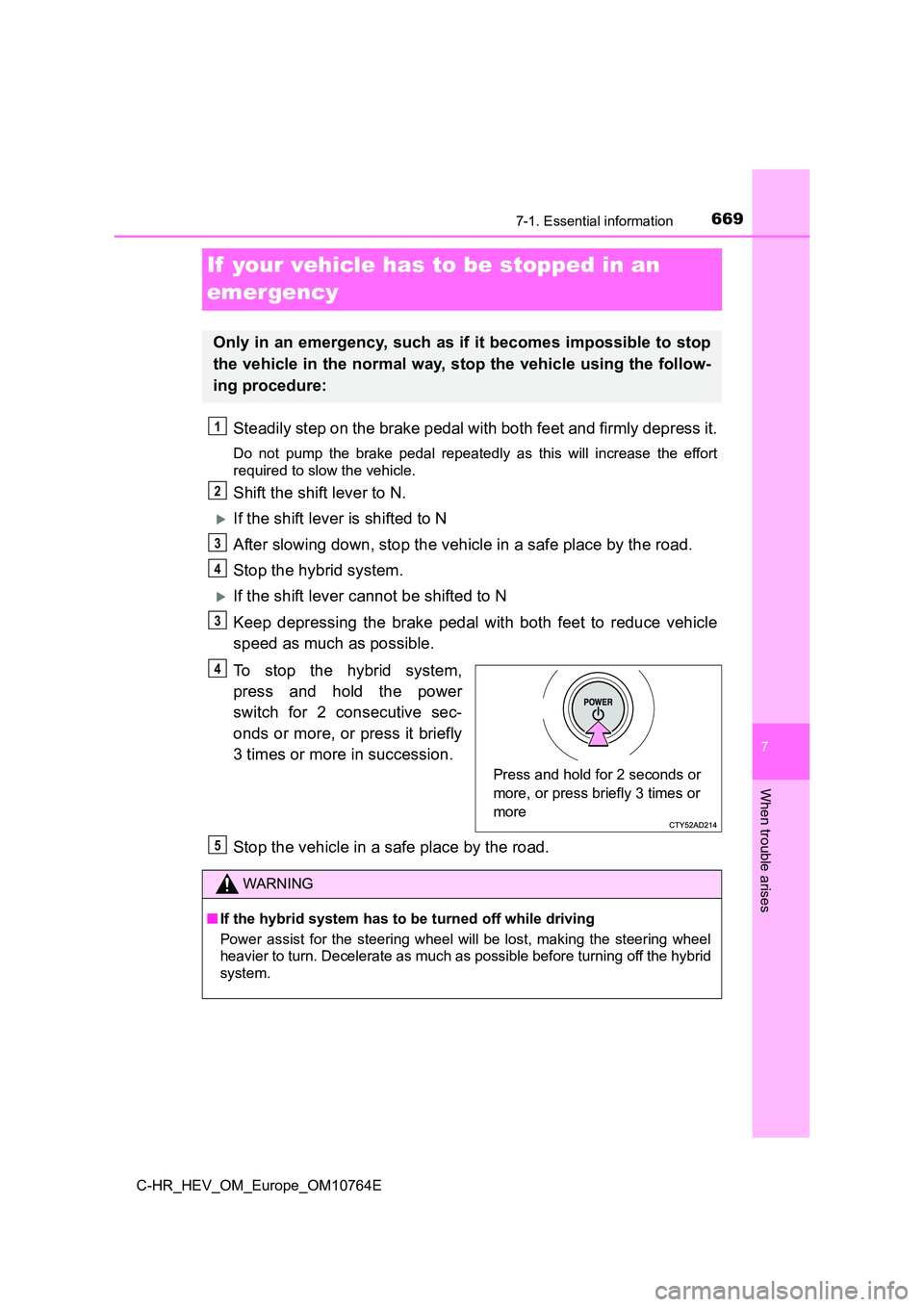
To stop the hybrid system,
press and hold the power
switch for 2 consecutive sec-
onds or more, or press it briefly
3 times or more in succession.
Stop the vehicle in a safe place by the road.
Only in an emergency, such as if it becomes impossible to stop
the vehicle in the normal way, stop the vehicle using the follo w-
ing procedure:
1
2
3
4
3
Press and hold for 2 seconds or
more, or press briefly 3 times or
more
Q
WARNING
■ If the hybrid system has to be turned off while driving
Power assist for the steering wheel will be lost, making the st eering wheel
heavier to turn. Decelerate as much as possible before turning off the hybrid
system.
5
Page 676 of 814
6747-2. Steps to take in an emergency
C-HR_HEV_OM_Europe_OM10764E
If a tow truck is not available in an emergency, your vehicle may be
temporarily towed using cables or chains secured to the emergen cy
towing eyelets. This should only be attempted on hard surfaced roads
for short distances at under 30 km/h (18 mph).
A driver must be in the vehicle to steer and operate the brakes . The
vehicle’s wheels, drivetrain, axles, steering and brakes must b e in
good condition.
To h ave yo urTo hav e y our v ehicle towed by an other v ehicle, the towing ey elet mus t be installed to y our v ehicle. Ins tall the towing ey elet us in g the following proced ure. ve hicle towe d by another vehicle, the towing eyelet must be installed to your vehicle. Install the towing eyelet using the following procedure.
To have your vehicle towed by another vehicle, the towing eyelet must
be installed to your vehicle. Install the towing eyelet using t he follow-
ing procedure.
Take out the wheel nut wrench* and towing eyelet. ( P. 700, 728)
*: If the vehicle is not equipped with a wheel nut wrench, a wheel nut wrench
can be purchased at any authorized Toyota retailer or Toyota au thorized
repairer, or any reliable repairer.
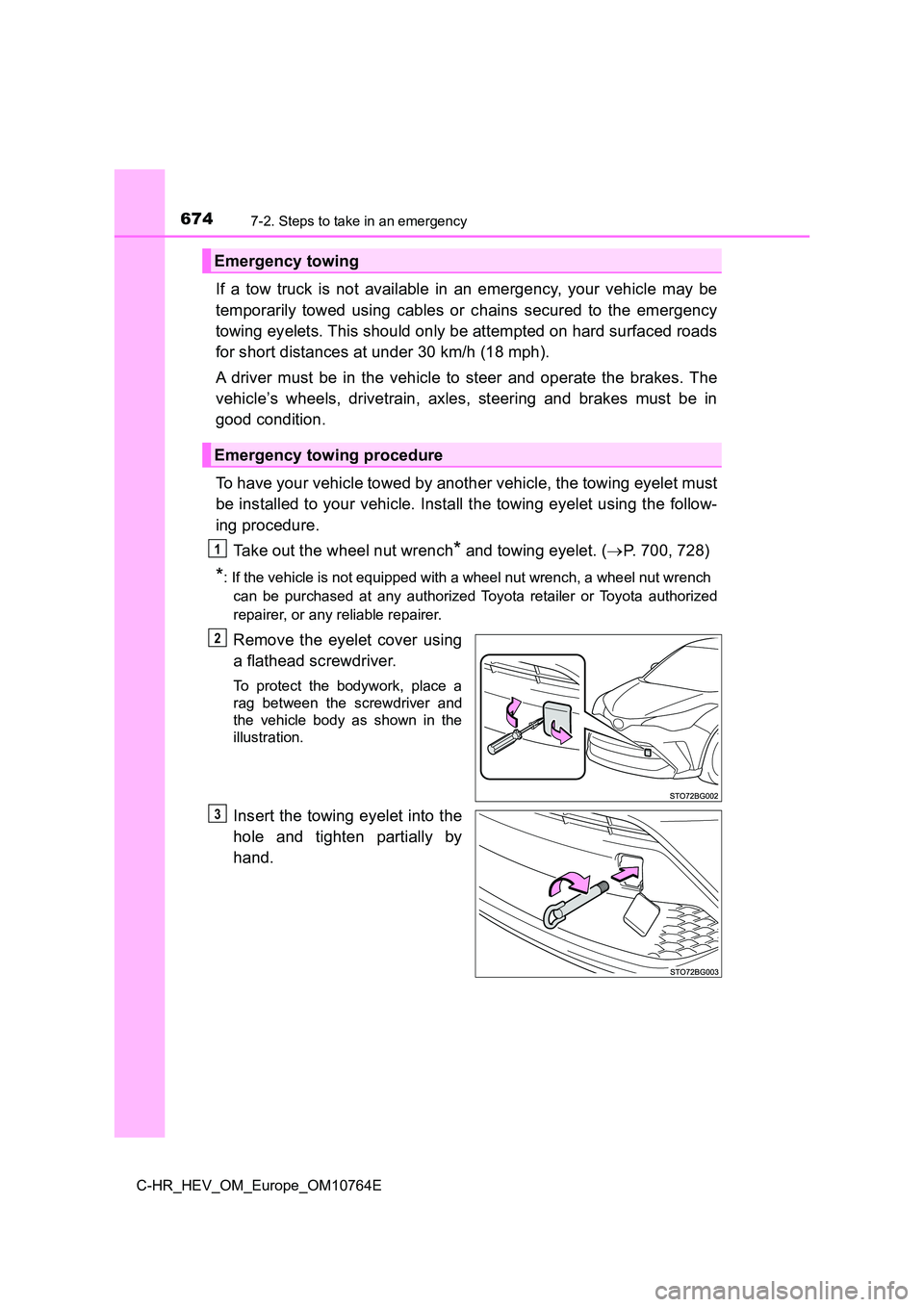
Remove the eyelet cover using
a flathead screwdriver.
To protect the bodywork, place a
rag between the screwdriver and
the vehicle body as shown in the
illustration.
Insert the towing eyelet into the
hole and tighten partially by
hand.
Emergency towing
Emergency towing procedure
1
2
3
Page 677 of 814
6757-2. Steps to take in an emergency
C-HR_HEV_OM_Europe_OM10764E
7
When trouble arises
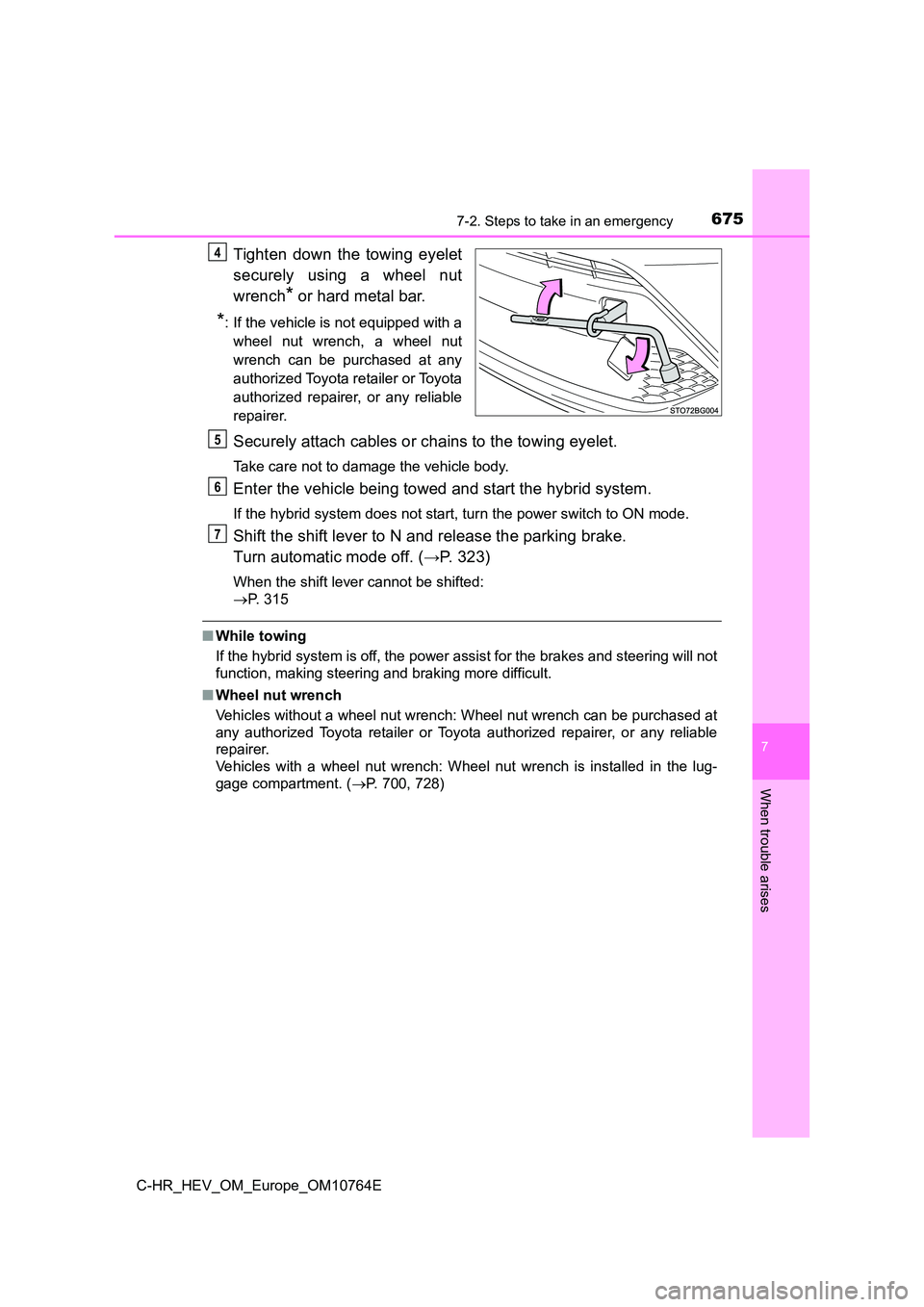
Tighten down the towing eyelet
securely using a wheel nut
wrench* or hard metal bar.
*: If the vehicle is not equipped with a
wheel nut wrench, a wheel nut
wrench can be purchased at any
authorized Toyota retailer or Toyota
authorized repairer, or any reliable
repairer.
Securely attach cables or chains to the towing eyelet.
Take care not to damage the vehicle body.
Enter the vehicle being towed and start the hybrid system.
If the hybrid system does not start, turn the power switch to O N mode.
Shift the shift lever to N and release the parking brake.
Turn automatic mode off. (→P. 323)
When the shift lever cannot be shifted:
P. 315
■While towing
If the hybrid system is off, the power assist for the brakes an d steering will not
function, making steering and braking more difficult.
■ Wheel nut wrench
Vehicles without a wheel nut wrench: Wheel nut wrench can be pu rchased at
any authorized Toyota retailer or Toyota authorized repairer, o r any reliable
repairer.
Vehicles with a wheel nut wrench: Wheel nut wrench is installed in the lug-
gage compartment. ( P. 700, 728)
4
5
6
7
Page 678 of 814
6767-2. Steps to take in an emergency
C-HR_HEV_OM_Europe_OM10764E
WARNING
Observe the following precautions.
Failure to do so may result in death or serious injury.
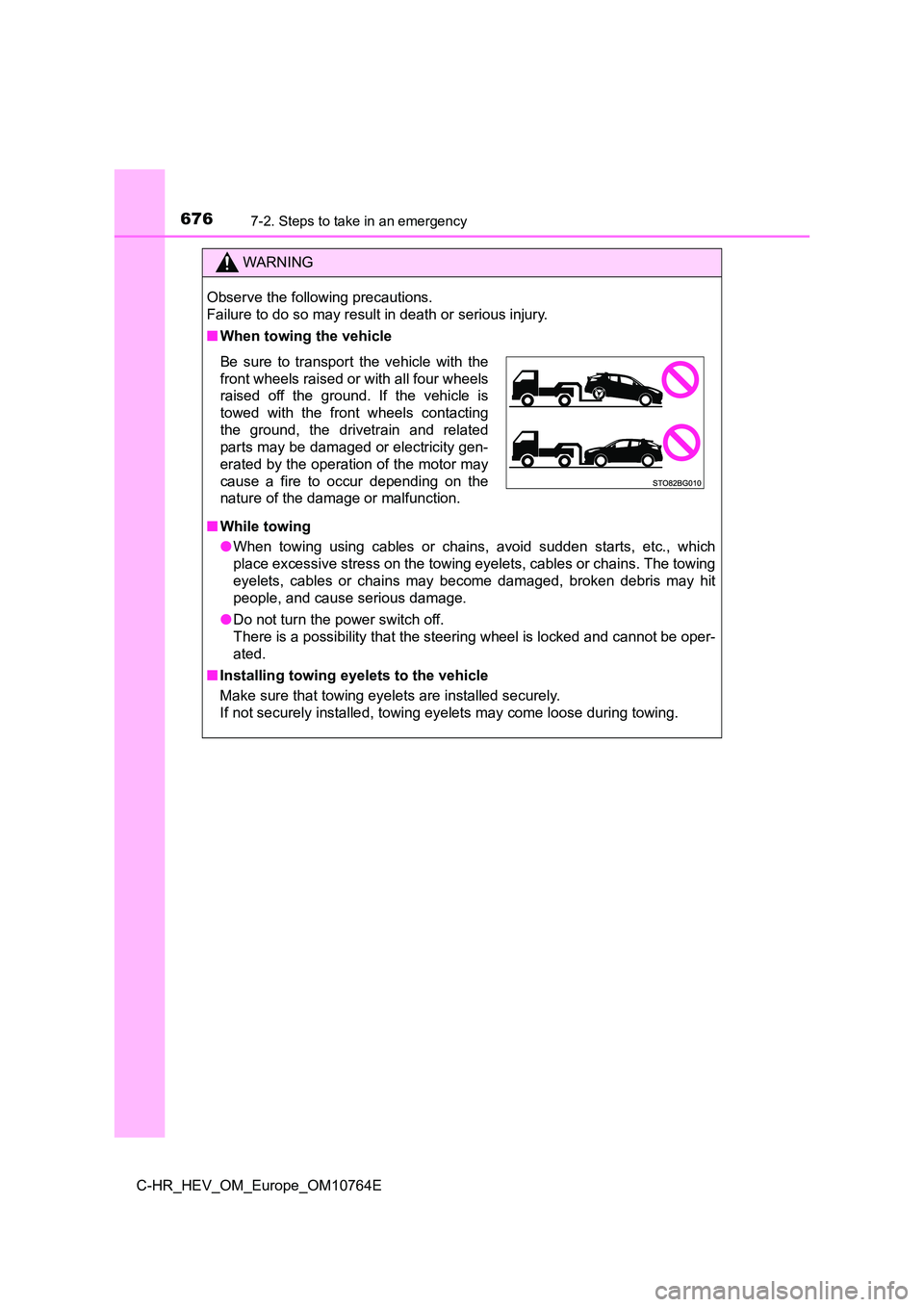
■ When towing the vehicle
■ While towing
● When towing using cables or chains, avoid sudden starts, etc., which
place excessive stress on the towing eyelets, cables or chains. The towing
eyelets, cables or chains may become damaged, broken debris may hit
people, and cause serious damage.
● Do not turn the power switch off.
There is a possibility that the steering wheel is locked and ca nnot be oper-
ated.
■ Installing towing eyelets to the vehicle
Make sure that towing eyelets are installed securely.
If not securely installed, towing eyelets may come loose during towing.
Be sure to transport the vehicle with the
front wheels raised or with all four wheels
raised off the ground. If the vehicle is
towed with the front wheels contacting
the ground, the drivetrain and related
parts may be damaged or electricity gen-
erated by the operation of the motor may
cause a fire to occur depending on the
nature of the damage or malfunction.
Page 679 of 814
6777-2. Steps to take in an emergency
C-HR_HEV_OM_Europe_OM10764E
7
When trouble arises
NOTICE
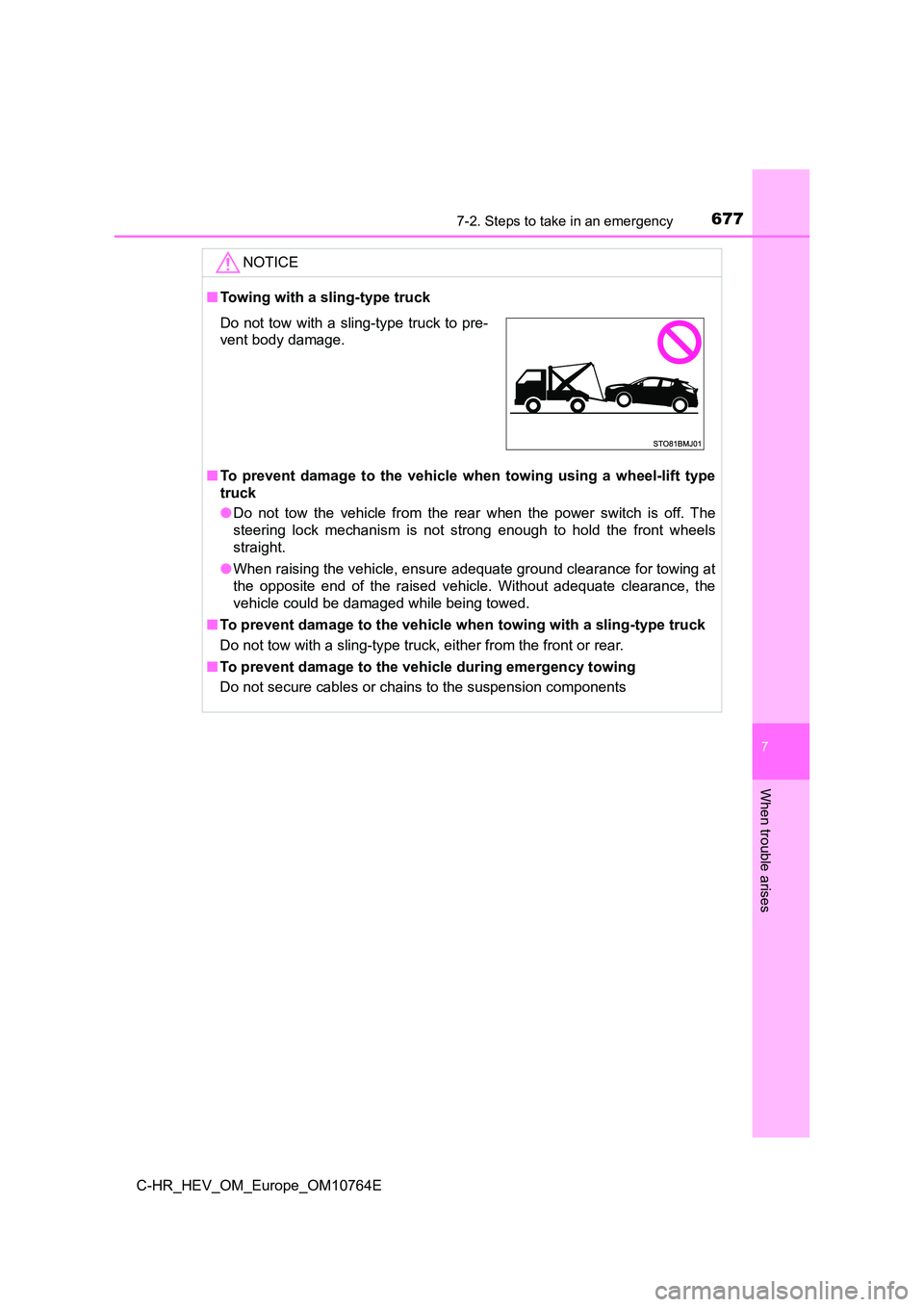
■Towing with a sling-type truck
■ To prevent damage to the vehicle when towing using a wheel-lift type
truck
● Do not tow the vehicle from the rear when the power switch is off. The
steering lock mechanism is not strong enough to hold the front wheels
straight.
● When raising the vehicle, ensure adequate ground clearance for towing at
the opposite end of the raised vehicle. Without adequate cleara nce, the
vehicle could be damaged while being towed.
■ To prevent damage to the vehicle when towing with a sling-type truck
Do not tow with a sling-type tr uck, either from the front or rear.
■ To prevent damage to the vehicle during emergency towing
Do not secure cables or chains to the suspension components
Do not tow with a sling-type truck to pre-
vent body damage.
Page 726 of 814
7247-2. Steps to take in an emergency
C-HR_HEV_OM_Europe_OM10764E
WARNING
■When fixing the flat tire
● Stop your vehicle in a safe and flat area.
● Do not touch the wheels or the area around the brakes immediately after
the vehicle has been driven.
After the vehicle has been driven, the wheels and the area arou nd the
brakes may be extremely hot. Touching these areas with hands, f eet or
other body parts may result in burns.
● To avoid risk of burst or severe leakage, do not drop or damage the bottle.
Visually inspect the bottle before use. Do not use a bottle wit h shock,
crack, scratch, leakage or any other damage. In such case, imme diately
replace.
● Connect the valve and hose securely with the wheel installed to the vehi-
cle. If the hose is not properly connected to the valve, air le akage may
occur and sealant may be sprayed out.
● If the hose comes off the valve while inflating the tire, there is a risk that
the hose will move abruptly due to air pressure.
● After inflation of the tire has completed, the sealant may splatter when the
hose is disconnected or some air is let out of the tire.
● Follow the operation procedure to repair the tire. If the procedures not fol-
lowed, the sealant may spray out.
● Keep back from the tire while it is being repaired, as there is a chance of it
bursting while the repair operation is being performed. If you notice any
cracks or deformation of the tire, turn off (type A) or (off) (type B) the
compressor switch and stop the repair operation immediately.
● The repair kit may overheat if operated for a long period of time. Do not
operate the repair kit continuously for more than 40 minutes.
● Parts of the repair kit become hot during operation. Be careful when han-
dling the repair kit during and after operation. Do not touch t he metal part
around the connecting area between the bottle and the compresso r. I t w il l
be extremely hot.
● Do not attach the vehicle speed warning sticker to an area other than the
one indicated. If the sticker is attached to an area where an S RS airbag is
located, such as the pad of the steering wheel, it may prevent the SRS
airbag from operating properly.
Page 734 of 814
7327-2. Steps to take in an emergency
C-HR_HEV_OM_Europe_OM10764E
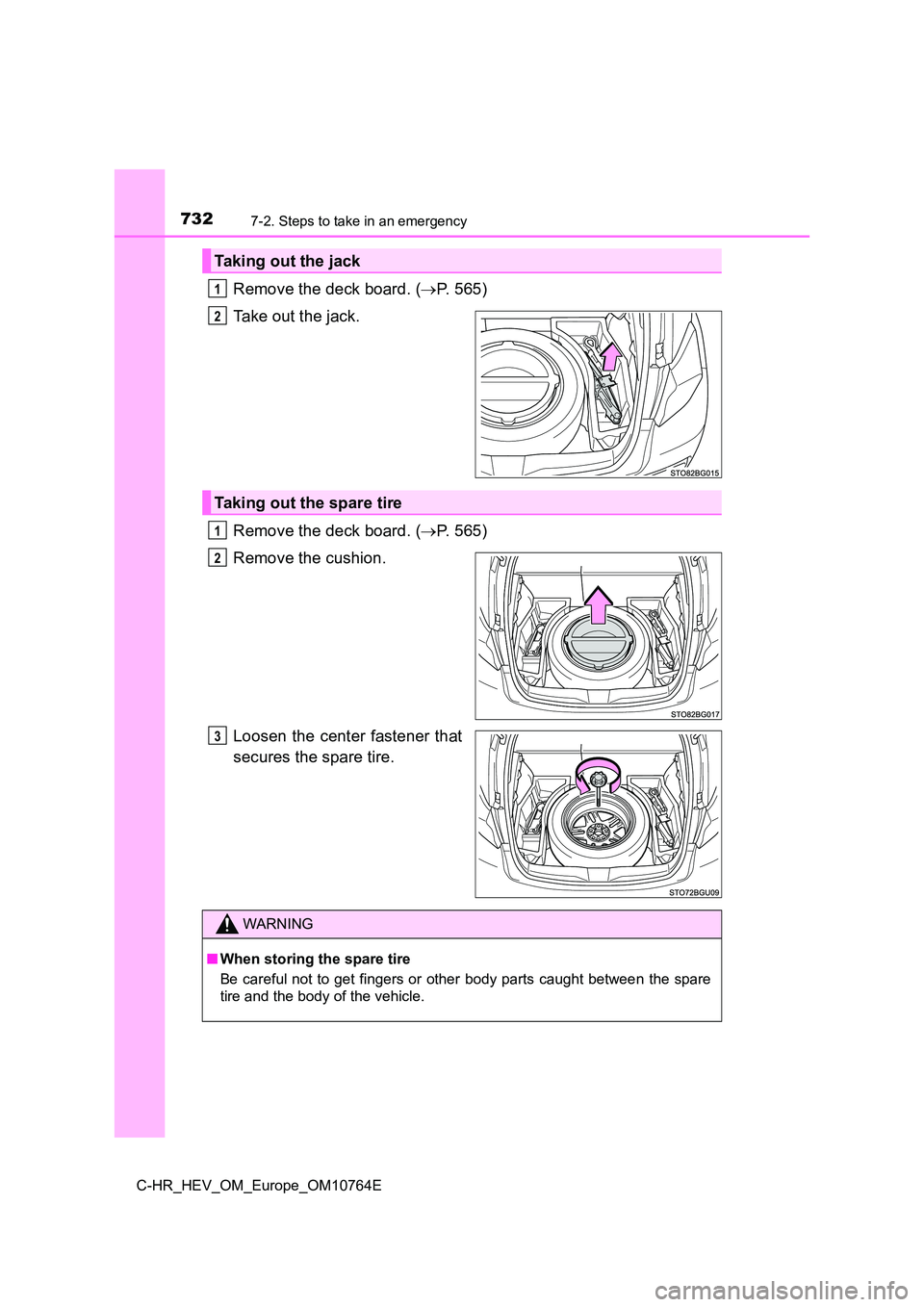
Remove the deck board. (P. 5 6 5 )
Take out the jack.
Remove the deck board. ( P. 5 6 5 )
Remove the cushion.
Loosen the center fastener that
secures the spare tire.
Taking out the jack
1
2
Taking out the spare tire
1
2
3
WARNING
■ When storing the spare tire
Be careful not to get fingers or other body parts caught betwee n the spare
tire and the body of the vehicle.
Page 742 of 814
7407-2. Steps to take in an emergency
C-HR_HEV_OM_Europe_OM10764E
WARNING
■When using the compact spare tire (if equipped)
● Remember that the spare tire provided is specifically designed for use with
your vehicle. Do not use your spare tire on another vehicle.
● Do not use more than one compact spare tire simultaneously.
● Replace the spare tire with a standard tire as soon as possible.
● Avoid sudden acceleration, abrupt steering, sudden braking and shifting
operations that cause sudden engine braking.
■ When the compact spare tire is attached (if equipped)
The vehicle speed may not be correctly detected, and the follow ing systems
may not operate correctly:
*: If equipped
■ Speed limit when using the compact spare tire (if equipped)
Do not drive at speeds in excess of 80 km/h (50 mph) when a com pact
spare tire is installed on the vehicle.
The compact spare tire is not designed for driving at high spee ds. Failure to
observe this precaution may lead to an accident causing death o r serious
injury.
■ After using the tools and jack
Before driving, make sure all the tools and jack are securely i n place in their
storage location to reduce the possibility of personal injury d uring a collision
or sudden braking.
• ABS & Brake assist
• VSC
•TRC
• EPS
• Automatic High Beam*
• PCS (Pre-Collision System)*
• LTA (Lane Tracing Assist)
• Dynamic radar cruise control with
full-speed range*
• Cruise control*
• BSM (Blind Spot Monitor)*
• Toyota parking assist-sensor*
• S-IPA (Simple Intelligent Parking
Assist System)*
• Rear view monitor system*
• Navigation system*
Page 752 of 814
7507-2. Steps to take in an emergency
C-HR_HEV_OM_Europe_OM10764E
Make sure the “READY” indicator comes on. If the indicator light
does not come on, contact any authorized Toyota retailer or Toy ota
authorized repairer, or any reliable repairer.
Once the hybrid system has started, remove the jumper cables in
the exact reverse order from which they were connected.
For M20A-FXS engine: Close the exclusive jump starting terminal
cover, and reinstall the fuse box cover to its original positio n.
Once the hybrid system starts, have the vehicle inspected at an y
authorized Toyota retailer or Toyota authorized repairer, or an y reliable
repairer as soon as possible.
■ Starting the hybrid system when the 12-volt battery is discharged
The hybrid system cannot be started by push-starting.
■ To prevent 12-volt battery discharge
● Turn off the headlights and the audio system while the hybrid system is off.
● Turn off any unnecessary electrical components when the vehicle is running
at a low speed for an extended period, such as in heavy traffic .
■ When the 12-volt battery is removed or discharged
● Information stored in the ECU is cleared. When the 12-volt battery is
depleted, have the vehicle inspected at any authorized Toyota r etailer or
Toyota authorized repairer, or any reliable repairer.
● Some systems may require initialization. (P. 791)
■ When removing the 12-volt battery terminals
When the 12-volt battery terminals are removed, the information stored in the
ECU is cleared. Before removing the 12-volt battery terminals, contact any
authorized Toyota retailer or Toyota authorized repairer, or an y reliable
repairer.
■ Charging the 12-volt battery
The electricity stored in the 12- volt battery will discharge gradually even when
the vehicle is not in use, due to natural discharge and the dra ining effects of
certain electrical appliances. If the vehicle is left for a lon g time, the 12-volt
battery may discharge, and the hybrid system may be unable to s tart. (The
12-volt battery recharges automat ically while the hybrid system is operating.)
8
9
10
Page 756 of 814
7547-2. Steps to take in an emergency
C-HR_HEV_OM_Europe_OM10764E
WARNING
■After recharging the 12-volt battery (M20A-FXS engine)
Have the 12-volt battery inspected at any authorized Toyota ret ailer or
Toyota authorized repairer, or any reliable repairer as soon as possible. If
the 12-volt battery is deteriorating, continued use may cause t he 12-volt
battery to emit a malodorous gas, which may be detrimental to t he health of
passengers.
■ When replacing the 12-volt battery
● When the vent plug and indicator are close to the hold down clamp, the
battery fluid (sulfuric acid) may leak.
● For information regarding 12-volt battery replacement, contact any autho-
rized Toyota retailer or Toyota authorized repairer, or any rel iable repairer.
● M20A-FXS engine: After exchanging, securely attach the exhaust hose
and exhaust hole plug to the exhaust hole of the exchanged 12-v olt bat-
tery. If not properly installed, gases (hydrogen) may leak into the vehicle
interior, and there is the possible danger of the gas igniting and exploding.
NOTICE
■When handling jumper cables
When connecting the jumper cables, ensure that they do not beco me entan-
gled in the cooling fans, etc.
■ To prevent damaging the vehicle (M20A-FXS engine)
The exclusive jump starting terminal is to be used when chargin g the 12-volt
battery from another vehicle in an emergency. It cannot be used to jump
start another vehicle.