engine overheat TOYOTA C_HR HYBRID 2016 Owners Manual
[x] Cancel search | Manufacturer: TOYOTA, Model Year: 2016, Model line: C_HR HYBRID, Model: TOYOTA C_HR HYBRID 2016Pages: 712, PDF Size: 49.31 MB
Page 6 of 712
TABLE OF CONTENTS6
C-HR_HV_OM_Europe_OM10538E
7-1. Maintenance and care
Cleaning and protecting
the vehicle exterior ..........512
Cleaning and protecting
the vehicle interior ...........517
7-2. Maintenance
Maintenance
requirements....................520
7-3. Do-it-yourself maintenance
Do-it-yourself service
precautions ......................523
Hood ..................................526
Positioning a floor jack .......528
Engine compartment..........529
Tires ...................................541
Tire inflation pressure ........553
Wheels ...............................555
Air conditioning filter ..........558
Electronic key battery ........561
Checking and replacing
fuses ................................564
Light bulbs .........................568
8-1. Essential information
Emergency flashers .......... 586
If your vehicle has to
be stopped in an
emergency ...................... 587
8-2. Steps to take in an
emergency
If your vehicle needs
to be towed ..................... 588
If you think something is
wrong .............................. 594
If a warning light turns
on or a warning buzzer
sounds ............................ 595
If a warning message
is displayed ..................... 606
If you have a flat tire
(vehicles with
an emergency tire
puncture repair kit) ......... 612
If you have a flat tire
(vehicles with
a spare tire) ..................... 632
If the hybrid system will
not start ........................... 646
If the electronic key does
not operate properly ........ 648
If the 12-volt battery is
discharged ...................... 651
If your vehicle
overheats ........................ 657
If the vehicle becomes
stuck................................ 662
7Maintenance and care8When trouble arises
Page 15 of 712
15Pictorial index
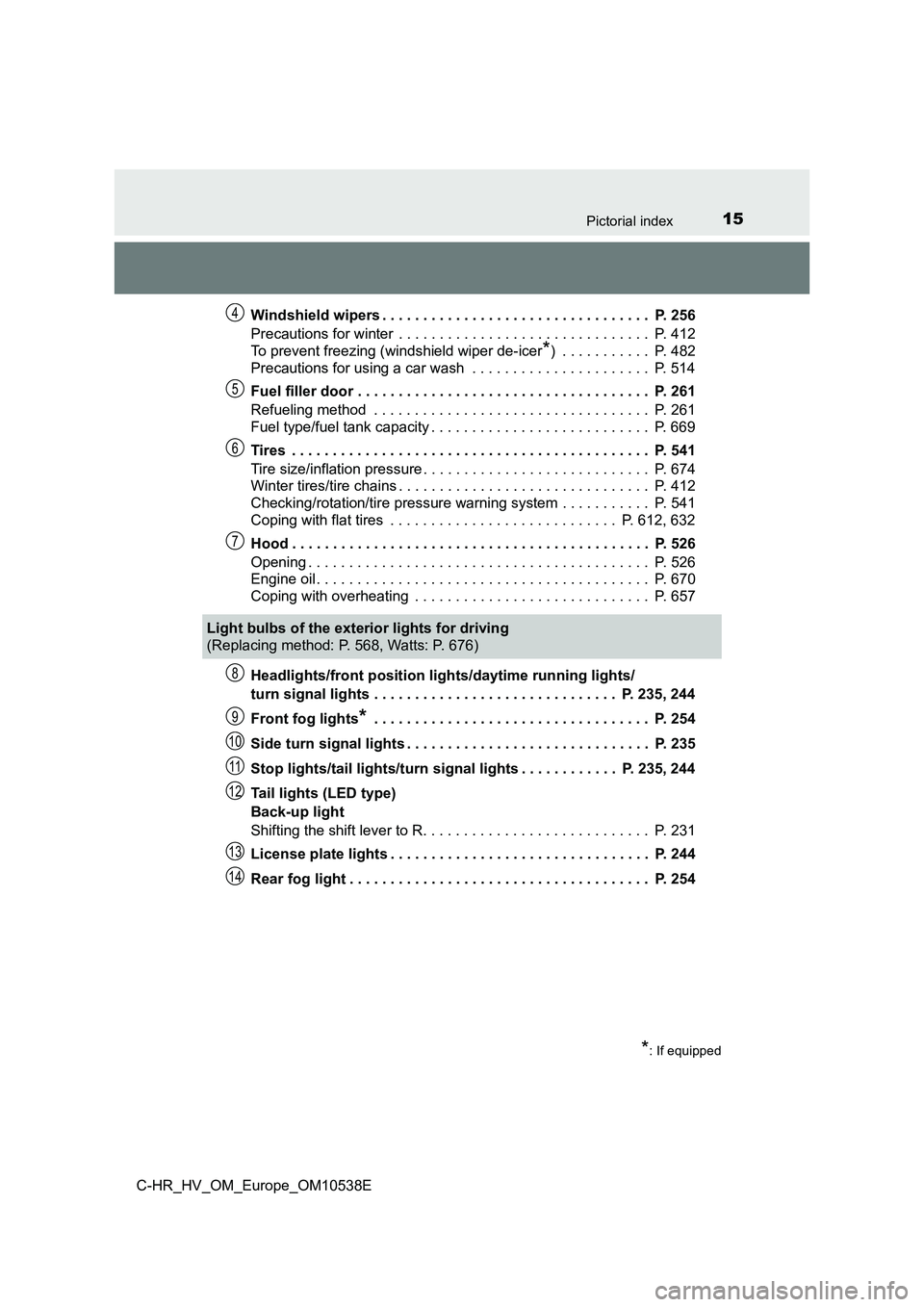
C-HR_HV_OM_Europe_OM10538EWindshield wipers . . . . . . . . . . . . . . . . . . . . . . . . . . . . . . . . . P. 256
Precautions for winter . . . . . . . . . . . . . . . . . . . . . . . . . . . . . . . P. 412
To prevent freezing (windshield wiper de-icer
*) . . . . . . . . . . . P. 482
Precautions for using a car wash . . . . . . . . . . . . . . . . . . . . . . P. 514
Fuel filler door . . . . . . . . . . . . . . . . . . . . . . . . . . . . . . . . . . . . P. 261
Refueling method . . . . . . . . . . . . . . . . . . . . . . . . . . . . . . . . . . P. 261
Fuel type/fuel tank capacity . . . . . . . . . . . . . . . . . . . . . . . . . . . P. 669
Tires . . . . . . . . . . . . . . . . . . . . . . . . . . . . . . . . . . . . . . . . . . . . P. 541
Tire size/inflation pressure . . . . . . . . . . . . . . . . . . . . . . . . . . . . P. 674
Winter tires/tire chains . . . . . . . . . . . . . . . . . . . . . . . . . . . . . . . P. 412
Checking/rotation/tire pressure warning system . . . . . . . . . . . P. 541
Coping with flat tires . . . . . . . . . . . . . . . . . . . . . . . . . . . . P. 612, 632
Hood . . . . . . . . . . . . . . . . . . . . . . . . . . . . . . . . . . . . . . . . . . . . P. 526
Opening . . . . . . . . . . . . . . . . . . . . . . . . . . . . . . . . . . . . . . . . . . P. 526
Engine oil . . . . . . . . . . . . . . . . . . . . . . . . . . . . . . . . . . . . . . . . . P. 670
Coping with overheating . . . . . . . . . . . . . . . . . . . . . . . . . . . . . P. 657
Headlights/front position lights/daytime running lights/
turn signal lights . . . . . . . . . . . . . . . . . . . . . . . . . . . . . . P. 235, 244
Front fog lights
* . . . . . . . . . . . . . . . . . . . . . . . . . . . . . . . . . . P. 254
Side turn signal lights . . . . . . . . . . . . . . . . . . . . . . . . . . . . . . P. 235
Stop lights/tail lights/turn signal lights . . . . . . . . . . . . P. 235, 244
Tail lights (LED type)
Back-up light
Shifting the shift lever to R. . . . . . . . . . . . . . . . . . . . . . . . . . . . P. 231
License plate lights . . . . . . . . . . . . . . . . . . . . . . . . . . . . . . . . P. 244
Rear fog light . . . . . . . . . . . . . . . . . . . . . . . . . . . . . . . . . . . . . P. 254
4
5
6
7
Light bulbs of the exterior lights for driving
(Replacing method: P. 568, Watts: P. 676)
*: If equipped
8
9
10
11
12
13
14
Page 128 of 712
1282. Instrument cluster
C-HR_HV_OM_Europe_OM10538E
■ Engine speed
On hybrid vehicles, engine speed is precisely controlled in order to help
improve fuel efficiency and reduce exhaust emissions, etc.
There are times when the engine speed that is displayed may differ even
when vehicle operation and driving conditions are the same.
■ Outside temperature display
● In the following situations, the correct outside temperature may not be dis-
played, or the display may take longer than normal to change.
• When stopped, or driving at low speeds (less than 25 km/h [16 mph])
• When the outside temperature has changed suddenly (at the entrance/
exit of a garage, tunnel, etc.)
● When “--” is displayed, the system may be malfunctioning.
Take your vehicle to any authorized Toyota retailer or Toyota authorized
repairer, or any reliable repairer.
NOTICE
■ To prevent damage to the engine and its components
The engine may be overheating if the engine coolant temperature gauge is
in the red zone (“H”). In this case, immediately stop the vehicle in a safe
place, and check the engine after it has cooled completely. ( P. 657)
Page 204 of 712
2044-1. Before driving
C-HR_HV_OM_Europe_OM10538E
WARNING
Observe the following precautions.
Failure to do so may result in death or serious injury.
■ When driving the vehicle
● Do not drive if you are unfamiliar with the location of the brake and accel-
erator pedals to avoid depressing the wrong pedal.
• Accidentally depressing the accelerator pedal instead of the brake
pedal will result in sudden acceleration that may lead to an accident.
• When backing up, you may twist your body around, leading to a diffi-
culty in operating the pedals. Make sure to operate the pedals properly.
• Make sure to keep a correct driving posture even when moving the
vehicle only slightly. This allows you to depress the brake and accelera-
tor pedals properly.
• Depress the brake pedal using your right foot. Depressing the brake
pedal using your left foot may delay response in an emergency, result-
ing in an accident.
● The driver should pay extra attention to pedestrians when the vehicle is
powered only by the electric motor (traction motor). As there is no engine
noise, the pedestrians may misjudge the vehicle’s movement.
● Do not drive the vehicle over or stop the vehicle near flammable materials.
The exhaust system and exhaust gases can be extremely hot. These hot
parts may cause a fire if there is any flammable material nearby.
● During normal driving, do not turn off the hybrid system. Turning the hybrid
system off while driving will not cause loss of steering or braking control,
however, power assist to the steering will be lost. This will make it more
difficult to steer smoothly, so you should pull over and stop the vehicle as
soon as it is safe to do so.
In the event of an emergency, such as if it becomes impossible to stop the
vehicle in the normal way: P. 587
● Use engine braking (shift lever to B) to maintain a safe speed when driving
down a steep hill.
Using the brakes continuously may cause the brakes to overheat and lose
effectiveness. ( P. 2 3 2 )
● Do not adjust the positions of the steering wheel, the seat, or the inside or
outside rear view mirrors while driving.
Doing so may result in a loss of vehicle control.
● Always check that all passengers’ arms, heads or other parts of their body
are not outside the vehicle.
Page 206 of 712
2064-1. Before driving
C-HR_HV_OM_Europe_OM10538E
WARNING
Observe the following precautions.
Failure to do so may result in death or serious injury.
■ If you hear a squealing or scraping noise (brake pad wear indicators)
Have the brake pads checked and replaced by any authorized Toyota
retailer or Toyota authorized repairer, or any reliable repairer as soon as
possible.
Rotor damage may result if the pads are not replaced when needed.
It is dangerous to drive the vehicle w hen the wear limits of the brake pads
and/or those of the brake discs are exceeded.
■ When the vehicle is stopped
● Do not depress the accelerator pedal unnecessarily.
If the shift lever is in any position other than P or N, the vehicle may accel-
erate suddenly and unexpectedly, causing an accident.
● In order to prevent accidents due to the vehicle rolling away, always keep
depressing the brake pedal while stopped with the “READY” indicator is
illuminated, and apply the parking brake as necessary.
● If the vehicle is stopped on an incline, in order to prevent accidents caused
by the vehicle rolling forward or backward, always depress the brake pedal
and securely apply the parking brake as needed.
● Avoid revving or racing the engine.
Running the engine at high speed while the vehicle is stopped may cause
the exhaust system to overheat, which could result in a fire if combustible
material is nearby.
Page 219 of 712
2194-1. Before driving
4
Driving
C-HR_HV_OM_Europe_OM10538E
■Important points regarding stability
Vehicle movement resulting from uneven road surfaces and strong
crosswinds will affect handling. The vehicle may also be rocked by
passing buses or large trucks. Frequently check behind when mov-
ing alongside such vehicles. As soon as such vehicle movement
occurs, immediately start to decelerate smoothly by slowly applying
the brakes. Always steer the vehicle straight ahead while braking.
■Passing other vehicles
Consider the total combined length of your vehicle and trailer and
ensure that the vehicle-to-vehicle distance is sufficient before exe-
cuting lane changes.
■Transmission information
To maintain engine braking efficiency and charging system perfor-
mance when using engine braking, do not use the transmission in
D. Shift the shift lever to B.
■If the engine overheats
Towing a loaded trailer up a long, steep incline in temperatures
exceeding 30 C (85F) may result in the engine overheating. If the
engine coolant temperature gauge indicates that the engine is over-
heating, turn the air conditioning off immediately, leave the road and
stop the vehicle in a safe place. ( P. 657)
■When parking the vehicle
Always place wheel chocks under the wheels of both the vehicle
and trailer. Firmly set the parking brake and shift the shift lever to P.
Page 609 of 712
6098-2. Steps to take in an emergency
C-HR_HV_OM_Europe_OM10538E
8
When trouble arises
■If “See Owner’s Manual” is shown
● If “Braking Power Low Stop in a Safe Place See Owner’s Manual” is shown,
this may be a malfunction. Immediately stop the vehicle in a safe place and
contact any authorized Toyota retailer or Toyota authorized repairer, or any
reliable repairer. Continuing to drive the vehicle may be dangerous.
● If the following messages are shown, there may be a malfunction. Immedi-
ately have the vehicle inspected by any authorized Toyota retailer or Toyota
authorized repairer, or any reliable repairer.
• “Hybrid System Malfunction”
• “Check Engine”
• “Hybrid Battery System Malfunction”
• “Accelerator Malfunction”
• “Entry & Start System Malfunction See Owner’s Manual”
● If “Low 12-Volt Battery See Owner’s Manual” is shown, the hybrid system
may not start normally. (Coping method: P. 651)
■ If “Charging System Malfunction” is shown
Indicates a malfunction in the vehicle’s charging system. Immediately stop
the vehicle in a safe place and contact any authorized Toyota retailer or
Toyota authorized repairer, or any reli able repairer. Continuing to drive the
vehicle may be dangerous.
■ If “Engine Coolant Temperature high” is shown
Indicates that the engine coolant temperature is too high. Immediately stop
the vehicle in a safe place. ( P. 657)
■ If “Engine Oil Pressure Low” is shown
Indicates that the engine oil pressure is too low. Immediately stop the vehicle
in a safe place and contact any authorized Toyota retailer or Toyota autho-
rized repairer, or any reliable repairer.
■ If “Hybrid System Overheated. Reduced Output Power.” is shown
This message may be shown when driving under severe operating condi-
tions. (For example, when driving up a long steep hill.)
Handling method: P. 657
Page 657 of 712

6578-2. Steps to take in an emergency
C-HR_HV_OM_Europe_OM10538E
8
When trouble arises
If your vehicle overheats
●The needle of the engine coolant temperature gauge (P. 125)
enters the red zone or a loss of hybrid system power is experi-
enced. (For example, the vehicle speed does not increase.)
● “Hybrid System Overheated Reduced Output Power.” is shown on
the multi-information display.
● Steam comes out from under the hood.
■If the high coolant temperature warning light comes on
Stop the vehicle in a safe place and turn off the air conditioning
system, and then stop the hybrid system.
If you see steam:
Carefully lift the hood after the steam subsides.
If you do not see steam:
Carefully lift the hood.
After the hybrid system has cooled down sufficiently, inspect the
hoses and radiator core (radiator) for any leaks.
Radiator
Cooling fans
If a large amount of coolant
leaks, immediately contact
any authorized Toyota retailer
or Toyota authorized repairer,
or any reliable repairer.
The following may indicate that your vehicle is overheating.
Correction procedures
1
2
3
1
2
Page 660 of 712
6608-2. Steps to take in an emergency
C-HR_HV_OM_Europe_OM10538E
After stopping the hybrid system and waiting for 5 minutes or
more, start the hybrid system again and check if “Hybrid System
Overheated” is shown on the multi-information display.
If the message does not disappear:
Stop the hybrid system and contact any authorized Toyota
retailer or Toyota authorized repairer, or any reliable repairer.
If the message is not displayed:
The hybrid system temperature has dropped and the vehicle may
be driven normally.
However, if the message appears again frequently, contact any autho-
rized Toyota retailer or Toyota authorized repairer, or any reliable
repairer.
WARNING
■ To prevent an accident or injury when inspecting under the hood of
your vehicle
Observe the following precautions.
Failure to do so may result in serious injury such as burns.
● If steam is seen coming from under the hood, do not open the hood until
the steam has subsided. The engine compartment may be very hot.
● After the hybrid system has been turned off, check that the indicator on the
power switch and the “READY” indicator are off.
When the hybrid system is operating, the gasoline engine may automati-
cally start, or the cooling fans may suddenly operate even if the gasoline
engine stops. Do not touch or approach rotating parts such as the fan,
which may lead to fingers or clothing (especially a tie, a scarf or a muffler)
getting caught, resulting in serious injury.
● Do not loosen the coolant reservoir caps while the hybrid system and radi-
ator are hot.
High temperature steam or coolant could spray out.
6
Page 700 of 712
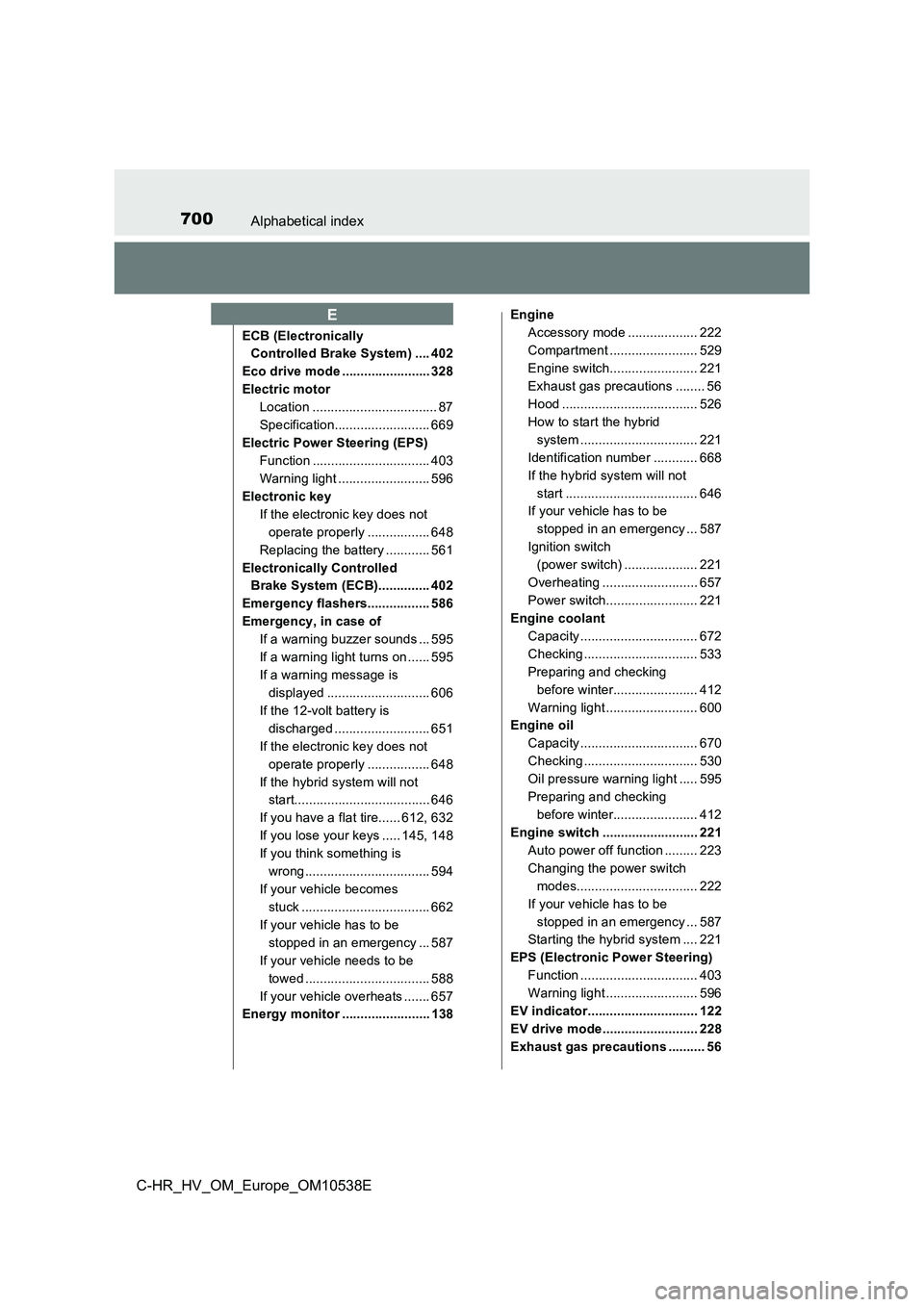
700Alphabetical index
C-HR_HV_OM_Europe_OM10538E
ECB (Electronically
Controlled Brake System) .... 402
Eco drive mode ........................ 328
Electric motor
Location .................................. 87
Specification.......................... 669
Electric Power Steering (EPS)
Function ................................ 403
Warning light ......................... 596
Electronic key
If the electronic key does not
operate properly ................. 648
Replacing the battery ............ 561
Electronically Controlled
Brake System (ECB).............. 402
Emergency flashers................. 586
Emergency, in case of
If a warning buzzer sounds ... 595
If a warning light turns on ...... 595
If a warning message is
displayed ............................ 606
If the 12-volt battery is
discharged .......................... 651
If the electronic key does not
operate properly ................. 648
If the hybrid system will not
start..................................... 646
If you have a flat tire...... 612, 632
If you lose your keys ..... 145, 148
If you think something is
wrong .................................. 594
If your vehicle becomes
stuck ................................... 662
If your vehicle has to be
stopped in an emergency ... 587
If your vehicle needs to be
towed .................................. 588
If your vehicle overheats ....... 657
Energy monitor ........................ 138
Engine
Accessory mode ................... 222
Compartment ........................ 529
Engine switch........................ 221
Exhaust gas precautions ........ 56
Hood ..................................... 526
How to start the hybrid
system ................................ 221
Identification number ............ 668
If the hybrid system will not
start .................................... 646
If your vehicle has to be
stopped in an emergency ... 587
Ignition switch
(power switch) .................... 221
Overheating .......................... 657
Power switch......................... 221
Engine coolant
Capacity ................................ 672
Checking ............................... 533
Preparing and checking
before winter....................... 412
Warning light ......................... 600
Engine oil
Capacity ................................ 670
Checking ............................... 530
Oil pressure warning light ..... 595
Preparing and checking
before winter....................... 412
Engine switch .......................... 221
Auto power off function ......... 223
Changing the power switch
modes................................. 222
If your vehicle has to be
stopped in an emergency ... 587
Starting the hybrid system .... 221
EPS (Electronic Power Steering)
Function ................................ 403
Warning light ......................... 596
EV indicator.............................. 122
EV drive mode.......................... 228
Exhaust gas precautions .......... 56
E