airbag off TOYOTA CAMRY 2012 XV50 / 9.G User Guide
[x] Cancel search | Manufacturer: TOYOTA, Model Year: 2012, Model line: CAMRY, Model: TOYOTA CAMRY 2012 XV50 / 9.GPages: 532, PDF Size: 6.44 MB
Page 181 of 532
181
2-2. Instrument cluster
2
When driving
■
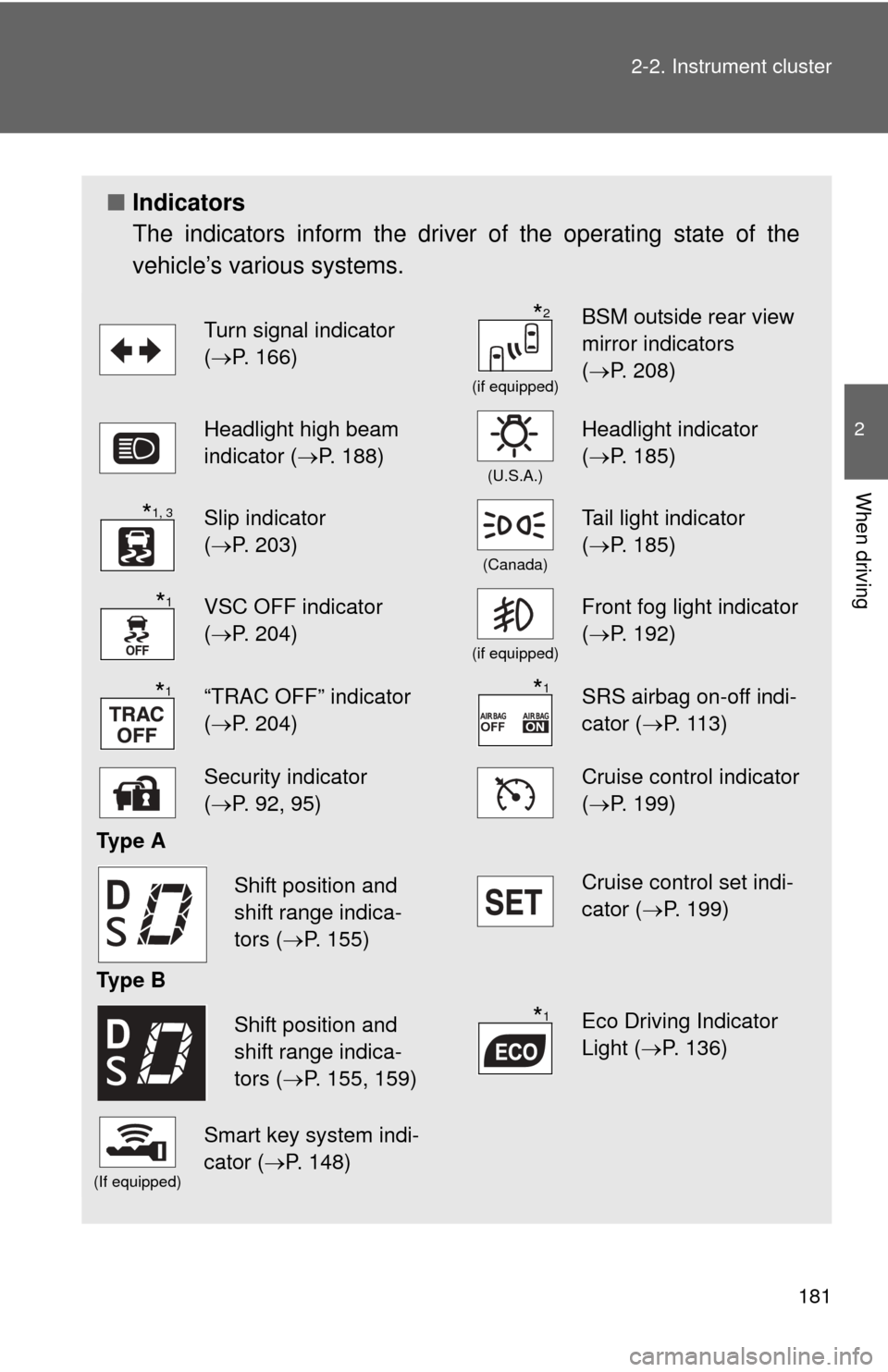
Indicators
The indicators inform the driver of the operating state of the
vehicle’s various systems.
Turn signal indicator
(P. 166)
(if equipped)
BSM outside rear view
mirror indicators
( P. 208)
Headlight high beam
indicator ( P. 188)
(U.S.A.)
Headlight indicator
(P. 185)
Slip indicator
(P. 203)
(Canada)
Tail light indicator
( P. 185)
VSC OFF indicator
(P. 204)
(if equipped)
Front fog light indicator
( P. 192)
“TRAC OFF” indicator
(P. 204)SRS airbag on-off indi-
cator (P. 113)
Security indicator
(P. 92, 95)Cruise control indicator
( P. 199)
Ty p e A
Cruise control set indi-
cator (P. 199)
Ty p e B
Eco Driving Indicator
Light ( P. 136)
(If equipped)
Smart key system indi-
cator ( P. 148)
*2
*1, 3
*1
*1*1
Shift position and
shift range indica-
tors (P. 155)
Shift position and
shift range indica-
tors (P. 155, 159)*1
Page 329 of 532

329
3-5. Other interior features
3
Interior features
Safety Connect LE
D light Indicators
When the “ENGINE START STOP” switch is turned to IGNITION ON
mode (vehicles with a smart key system) or the engine switch is
turned to the “ON” position (vehicle s without a smart key system), the
red indicator light comes on for 2 seconds then turns off. Afterward,
the green indicator light comes on, indicating that the service is
active.
The following indicator light patter ns indicate specific system usage
conditions:
● Green indicator light on = Active service
● Green indicator light flashing = Safety Connect call in process
● Red indicator light (except at v ehicle start-up) = System malfunc-
tion (contact your Toyota dealer)
● No indicator light (off) = Safety Connect service not active
Safety Connect services
■ Automatic Collision Notification
In case of either airbag deployment or severe rear-end collision,
the system is design ed to automatically call the response center.
The responding agent receives th e vehicle’s location and attempts
to speak with the vehicle occupant s to assess the level of emer-
gency. If the occupants are unable to communicate, the agent
automatically treats the call as an emergency, contacts the nearest
emergency services provider to describe the situation, and
requests that assistance be sent to the location.
Page 338 of 532
338 4-1. Maintenance and care
■Caring for leather areas
Toyota recommends cleaning the interior of the vehicle at least twice a year
to maintain the quality of the vehicle's interior.
■ Shampooing the carpets
There are several commercial foaming-type cleaners available. Use a
sponge or brush to apply the foam. Rub in overlapping circles. Do not use
water. Wipe dirty surfaces and let them dry. Excellent results are obtained by
keeping the carpet as dry as possible.
■ Seat belts
Clean with mild soap and lukewarm water using a cloth or sponge. Also
check the belts periodically for excessive wear, fraying or cuts.
CAUTION
■Water in the vehicle
●Do not splash or spill liquid in the vehicle.
Doing so may cause electrical components etc. to malfunction or catch
fire.
● Do not get any of the SRS components or wiring in the vehicle interior wet.
( P. 101)
An electrical malfunction may cause the airbags to deploy or not function
properly, resulting in death or serious injury.
■ Cleaning the interior (esp ecially instrument panel)
Do not use polish wax or polish cleaner. The instrument panel may reflect off
the windshield, obstructing the driver 's view and leading to an accident,
resulting in death or serious injury.
Page 419 of 532
5
When trouble arises
419
5-1. Essential information
Fuel pump shut off system
Follow the procedure below to restart the engine after the system is
activated.Vehicles without a smart key system Turn the engine switch to the “ACC” or “LOCK” position.
Restart the engine.
Vehicles with a smart key system Turn the “ENGINE START STOP” switch off.
Restart the engine.
NOTICE
■Before starting the engine
Inspect the ground under the vehicle.
If you find that fuel has leaked on to the ground, the fuel system has been
damaged and is in need of repair. Do not restart the engine.
To minimize the risk of fuel leakage when the engine stalls or when
an airbag inflates upon collision , the fuel pump shut off system
stops the supply of fuel to the engine.
STEP1
STEP2
STEP1
STEP2
Page 429 of 532
5
When trouble arises
429
5-2. Steps to take in an emergency
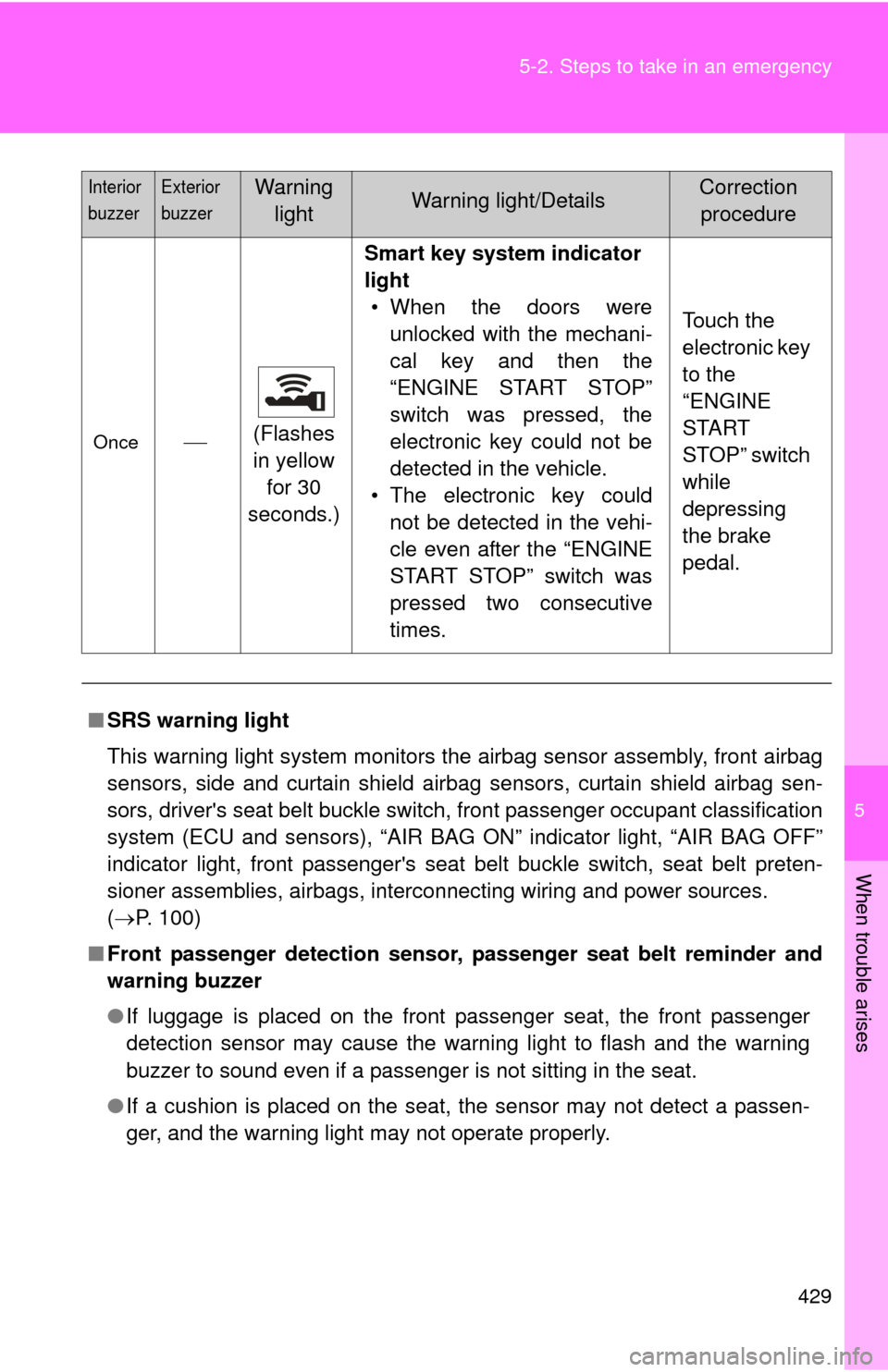
Once
(Flashes
in yellow
for 30
seconds.) Smart key system indicator
light
• When the doors were unlocked with the mechani-
cal key and then the
“ENGINE START STOP”
switch was pressed, the
electronic key could not be
detected in the vehicle.
• The electronic key could not be detected in the vehi-
cle even after the “ENGINE
START STOP” switch was
pressed two consecutive
times. Touch the
electronic key
to the
“ENGINE
START
STOP” switch
while
depressing
the brake
pedal.
■ SRS warning light
This warning light system monitors the airbag sensor assembly, front airbag
sensors, side and curtain shield airbag sensors, curtain shield airbag sen-
sors, driver's seat belt buckle switch, front passenger occupant classification
system (ECU and sensors), “AIR BAG ON” indicator light, “AIR BAG OFF”
indicator light, front passenger's seat belt buckle switch, seat belt preten-
sioner assemblies, airbags, interc onnecting wiring and power sources.
( P. 100)
■ Front passenger detection sensor, passenger seat belt reminder and
warning buzzer
● If luggage is placed on the front passenger seat, the front passenger
detection sensor may cause the warning light to flash and the warning
buzzer to sound even if a passenger is not sitting in the seat.
● If a cushion is placed on the seat, the sensor may not detect a passen-
ger, and the warning light may not operate properly.
Interior
buzzerExterior
buzzerWarning
lightWarning light/DetailsCorrection procedure
Page 508 of 532
508
Votre véhicule est équipé de SACS DE SECURITE GONFLABLES
INTELLIGENTS (ADVANCED AIRBAGS) conçus selon les normes
de sécurité américaines applicables aux véhicules à moteur
(FMVSS208). Le boîtier électronique (ECU) des sacs de sécurité
gonflables régule le déploiement de ces derniers sur la base des
informations qu'il reçoit des capteurs, etc., indiqués ci-dessus dans le
schéma illustrant la composition du système. Parmi ces informations
figurent la gravité du choc et l'occupation du véhicule par les
passagers. Le déploiement rapide des sacs de sécurité gonflables
est obtenu au moyen d'une réaction chimique dans les dispositifs
pyrotechniques, qui produit un gaz inoffensif permettant d'amortir le
mouvement des occupants.