spare wheel TOYOTA CAMRY 2012 XV50 / 9.G Owners Manual
[x] Cancel search | Manufacturer: TOYOTA, Model Year: 2012, Model line: CAMRY, Model: TOYOTA CAMRY 2012 XV50 / 9.GPages: 532, PDF Size: 6.44 MB
Page 431 of 532

5
When trouble arises
431
5-2. Steps to take in an emergency
■When a tire is replaced with a spare tire (vehicles with a tire pres-
sure warning system)
The compact spare tire is not equipped with a tire pressure warning
valve and transmitter. If a
tire goes flat, the tire pressure warning light will
not turn off even though the flat tire has been replaced with the spare
tire. Replace the spare tire with the re paired tire and adjust the tire infla-
tion pressure. The tire pressure wa rning light will go off after a few min-
utes.
■If the tire pressure warning system is not functioning (vehicles with
a tire pressure warning system)
The tire pressure warning system will be disabled in the following condi-
tions:
(When the condition be comes normal, the system will work properly.)
●If tires not equipped with tire pressure warning valves and transmit-
ters are used
●If the ID code on the tire pressure warning valves and transmitters is
not registered in the tire pressure warning computer.
●If the tire inflation pressure is 73 psi (500 kPa, 5.1 kgf/cm2 or bar) or
higher
The tire pressure warning system may be disabled in the following condi-
tions:
(When the condition be comes normal, the system will work properly.)
●If electronic devices or facilities using similar radio wave frequencies
are nearby.
●If a radio set at a similar frequencies is in use in the vehicle
●If a window tint that affects the radio wave signals is installed
●If there is a lot of snow or ice on the vehicle, particularly around the
wheels or wheel housings
●If non-genuine Toyota wheels are used. (Even if you use Toyota
wheels, the tire pressure warning system may not work properly with
some types of tires.)
●If tire chains are used
Page 432 of 532
432 5-2. Steps to take in an emergency
■If the tire pressure warning light frequently comes on after blinking
for 1 minute (vehicles with a tire pressure warning system)
If the tire pressure warning light frequently comes on after blinking for 1
minute when the engine switch (vehicles without a smart key system) or
the “ENGINE START STOP” switch (vehicles with a smart key system) is
turned on, have it checked by your Toyota dealer.
■Electric power steering system warning light (warning buzzer)
The electric power steering system warning light may come on and the
warning buzzer may sound when the voltage is low or the voltage drops.
■ Customization that can be co nfigured at Toyota dealer
The vehicle speed linked seat belt reminder buzzer can be disabled.
(Customizable features P. 493) However, Toyota recommends that the
seat belt reminder buzzer be operational to alert the driver and front passen-
ger that the seat belts are not fastened.
CAUTION
■ When the electric power steerin g system warning light comes on
The steering wheel may become extremely heavy.
If the steering wheel becomes heavier than usual when operating, hold
firmly and operate using more force than usual.
■
If the tire pressure warning light comes on (vehicles with a tire
pressure warning system)
Be sure to observe the following precautions. Failure to do so could
cause loss of vehicle control and re sult in death or serious injury.
●Stop your vehicle in a safe place as soon as possible. Adjust the tire
inflation pressure immediately.
●If the tire pressure warning light comes on even after tire inflation pres-
sure adjustment, it is pr obable that you have a flat tire. Check the tires.
If a tire is flat, change it with th e spare tire and have the flat tire
repaired by the nearest Toyota dealer.
●Avoid abrupt maneuvering and braking. If the vehicle tires deteriorate,
you could lose control of the steering wheel or the brakes.
Page 435 of 532
5
When trouble arises
435
5-2. Steps to take in an emergency
If you have a flat tire
Remove the flat tire and replace it with the spare provided.
■Before jacking up the vehicle
●Stop the vehicle on a hard, flat surface.
● Set the parking brake.
● Shift the shift lever to P.
● Stop the engine.
● Turn on the emergency flashers.
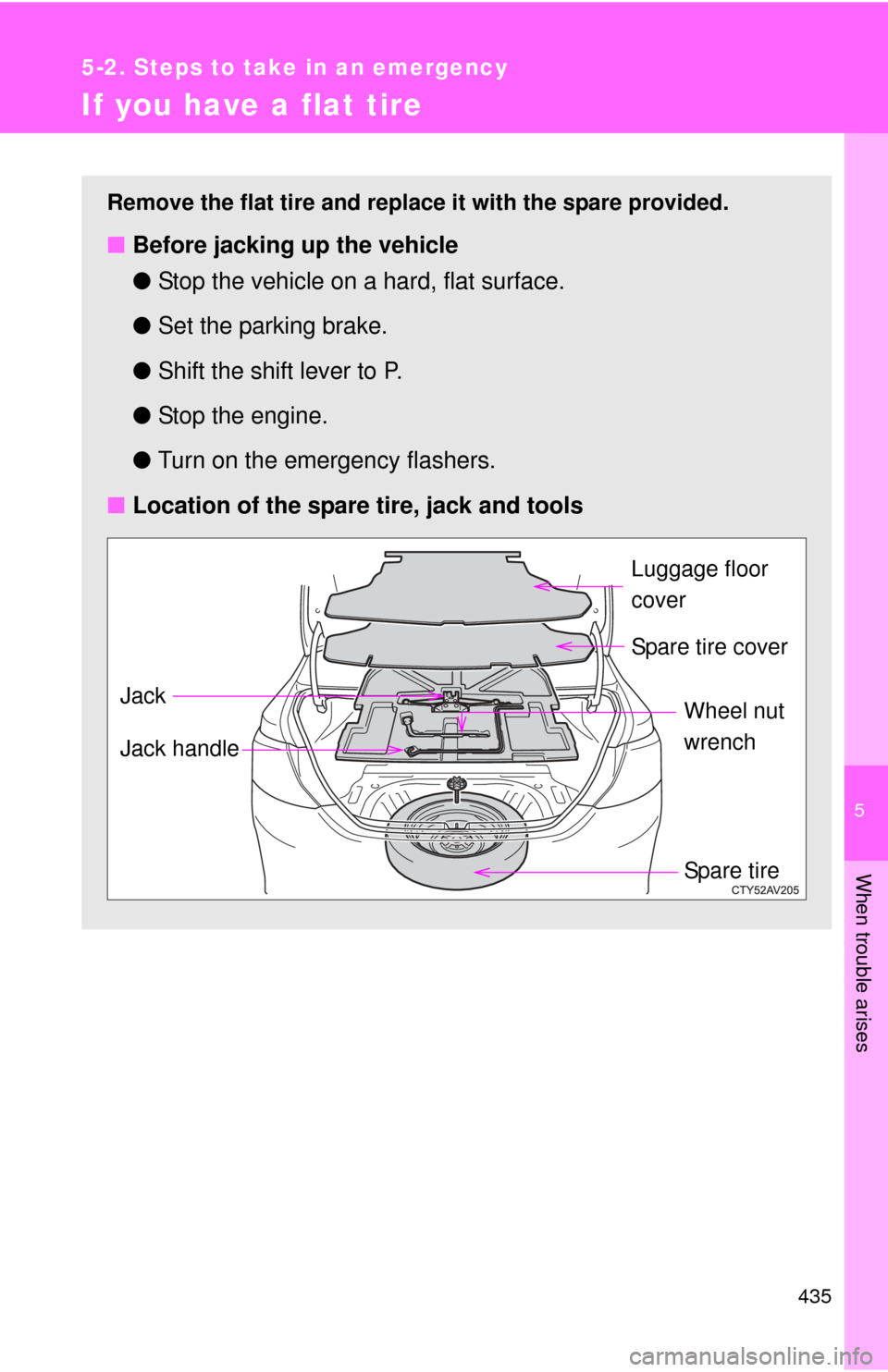
■ Location of the spare tire, jack and tools
Spare tire
Luggage floor
cover
Wheel nut
wrench
Jack
Jack handle Spare tire cover
Page 440 of 532
440 5-2. Steps to take in an emergency
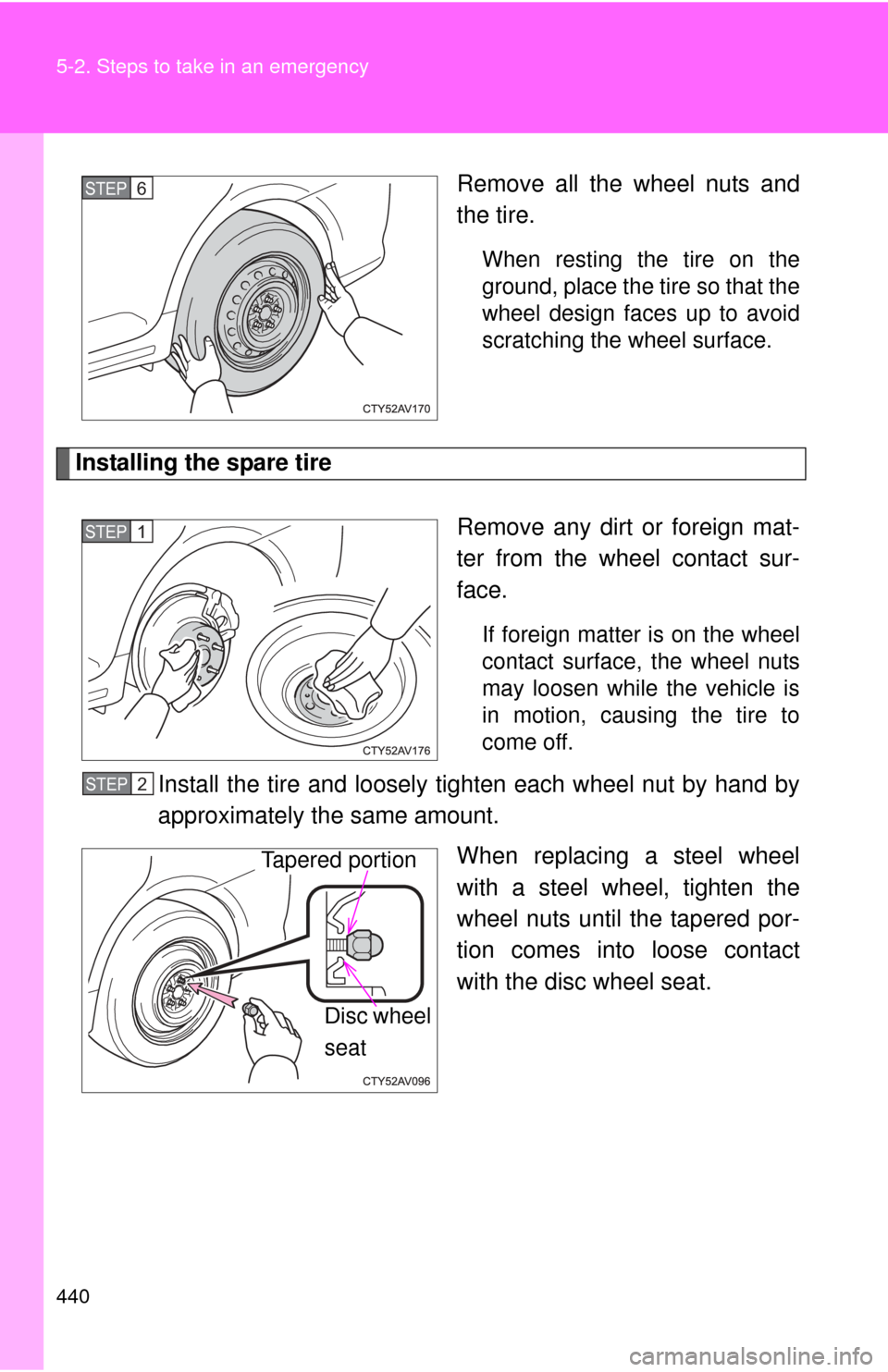
Remove all the wheel nuts and
the tire.
When resting the tire on the
ground, place the tire so that the
wheel design faces up to avoid
scratching the wheel surface.
Installing the spare tireRemove any dirt or foreign mat-
ter from the wheel contact sur-
face.
If foreign matter is on the wheel
contact surface, the wheel nuts
may loosen while the vehicle is
in motion, causing the tire to
come off.
Install the tire and loosely tighten each wheel nut by hand by
approximately the same amount.
When replacing a steel wheel
with a steel wheel, tighten the
wheel nuts until the tapered por-
tion comes into loose contact
with the disc wheel seat.
STEP6
STEP1
STEP2
Disc wheel
seat
Tapered portion
Page 442 of 532
442 5-2. Steps to take in an emergency
■The compact spare tire
●The compact spare tire is identified by the label “TEMPORARY USE
ONLY” on the tire sidewall.
Use the compact spare tire temporarily, and only in an emergency.
●Make sure to check the tire inflation pressu re of the compact spare
tire. ( P. 474)
■After completing the tire change (vehicles with a tire pressure
warning system)
The tire pressure warnin g system must be reset. ( P. 368)
■When using the compact spare tire
As the compact spare tire is not equipped with a tire pressure warning
valve and transmitter, low inflation pressure of the spare tire will not be
indicated by the tire pressure warn ing system. Also, if you replace the
compact spare tire after the tire pressure warning light comes on, the
light remains on.
■If you have a flat front tire on a road covered with snow or ice
Install the compact spare tire on one of the rear wheels of the vehicle.
Perform the following steps and fit tire chains to the front tires:
Replace a rear tire with the compact spare tire.
Replace the flat front tire with the tire removed from the rear of
the vehicle.
Fit tire chains to the front tires.
STEP1
STEP2
STEP3
Page 446 of 532

446 5-2. Steps to take in an emergency
NOTICE
■Do not drive the vehicle with a flat tire.
Do not continue driving with a flat tire.
Driving even a short distance with a flat tire can damage the tire and the
wheel beyond repair.
■Be careful when driving over bumps with the compact spare tire
installed on the vehicle.
The vehicle becomes lower when driving with the compact spare tire
compared to when driving with standard tires. Be careful when driving
over uneven road surfaces.
■Driving with tire chains and the compact spare tire
Do not fit tire chains to the compact spare tire.
Tire chains may damage the vehicle body and adversely affect driving
performance.
■When replacing the tires (vehicles with a tire pressure warning sys-
tem)
When removing or fitting the wheels, tires or the tire pressure warning
valve and transmitter, contact your Toyota dealer as the tire pressure
warning valve and transmitter may be damaged if not handled correctly.
■To avoid damage to the tire pressure warning valves and transmit-
ters (if equipped)
When a tire is repaired with liquid se alants, the tire pressure warning
valve and transmitter may not operate properly. If a liquid sealant is
used, contact your Toyota dealer or other qualified service shop as soon
as possible. Make sure to replace the tire pressure warning valve and
transmitter when replacing the tire. ( P. 368)
Page 474 of 532
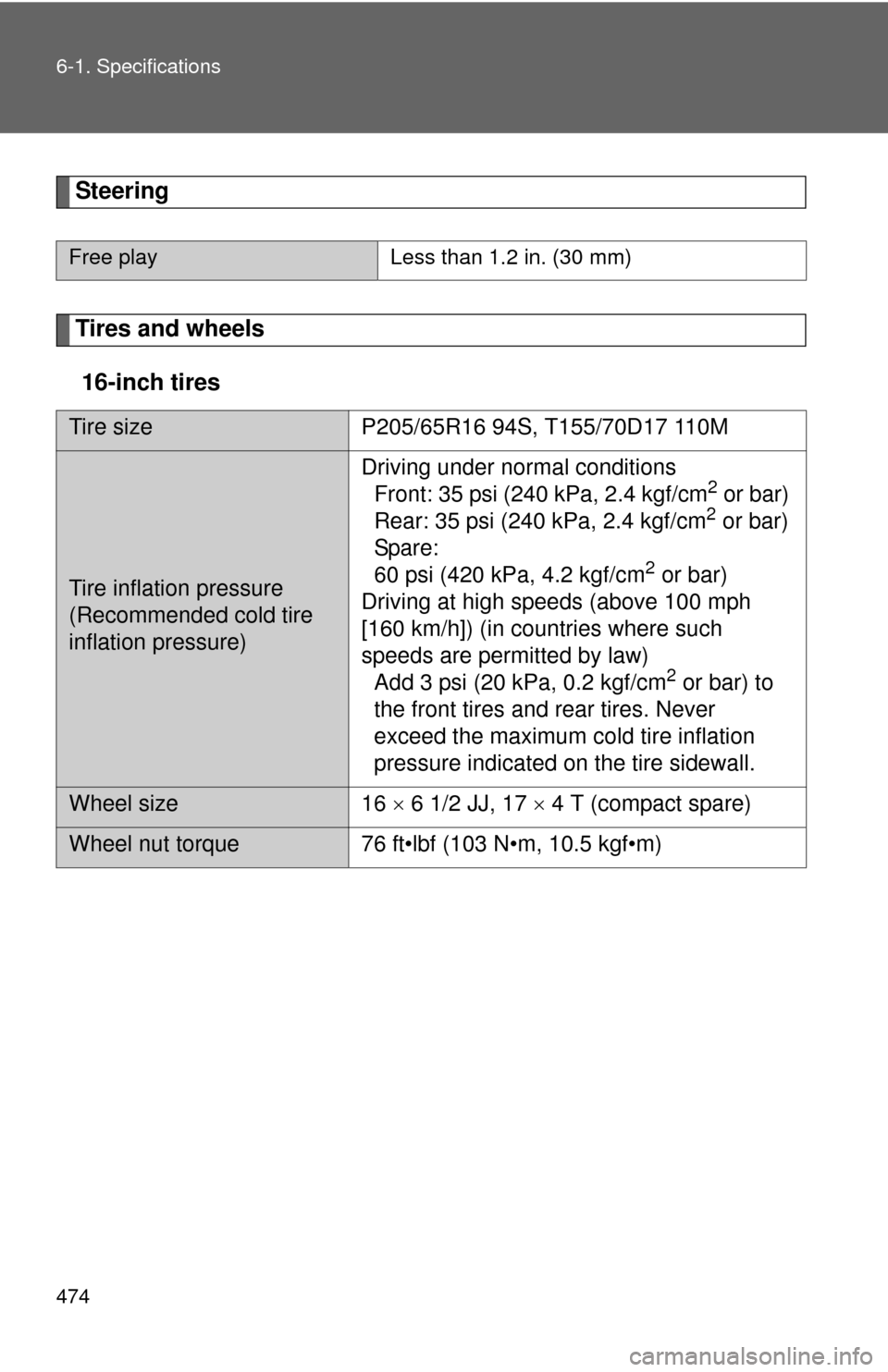
474 6-1. Specifications
Steering
Tires and wheels16-inch tires
Free play Less than 1.2 in. (30 mm)
Tire sizeP205/65R16 94S, T155/70D17 110M
Tire inflation pressure
(Recommended cold tire
inflation pressure)Driving under normal conditions
Front: 35 psi (240 kPa, 2.4 kgf/cm
2 or bar)
Rear: 35 psi (240 kPa, 2.4 kgf/cm2 or bar)
Spare:
60 psi (420 kPa, 4.2 kgf/cm
2 or bar)
Driving at high speeds (above 100 mph
[160 km/h]) (in countries where such
speeds are permitted by law) Add 3 psi (20 kPa, 0.2 kgf/cm
2 or bar) to
the front tires and rear tires. Never
exceed the maximum co ld tire inflation
pressure indicated on the tire sidewall.
Wheel size 16 6 1/2 JJ, 17 4 T (compact spare)
Wheel nut torque 76 ft•lbf (103 N•m, 10.5 kgf•m)
Page 475 of 532
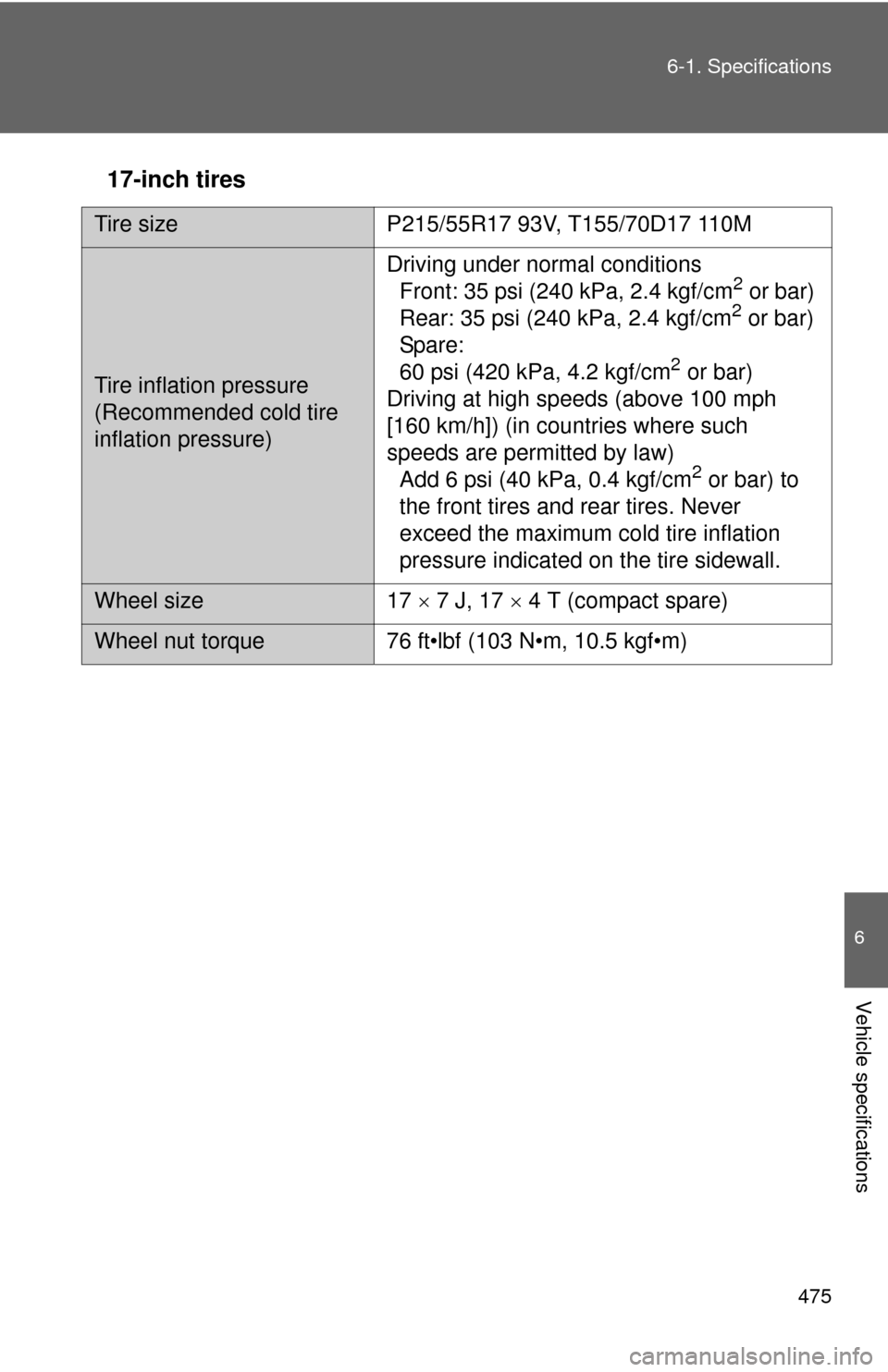
475
6-1. Specifications
6
Vehicle specifications
17-inch tires
Tire size
P215/55R17 93V, T155/70D17 110M
Tire inflation pressure
(Recommended cold tire
inflation pressure)Driving under normal conditions
Front: 35 psi (240 kPa, 2.4 kgf/cm
2 or bar)
Rear: 35 psi (240 kPa, 2.4 kgf/cm2 or bar)
Spare:
60 psi (420 kPa, 4.2 kgf/cm
2 or bar)
Driving at high speeds (above 100 mph
[160 km/h]) (in countries where such
speeds are permitted by law) Add 6 psi (40 kPa, 0.4 kgf/cm
2 or bar) to
the front tires and rear tires. Never
exceed the maximum co ld tire inflation
pressure indicated on the tire sidewall.
Wheel size 17 7 J, 17 4 T (compact spare)
Wheel nut torque 76 ft•lbf (103 N•m, 10.5 kgf•m)
Page 476 of 532
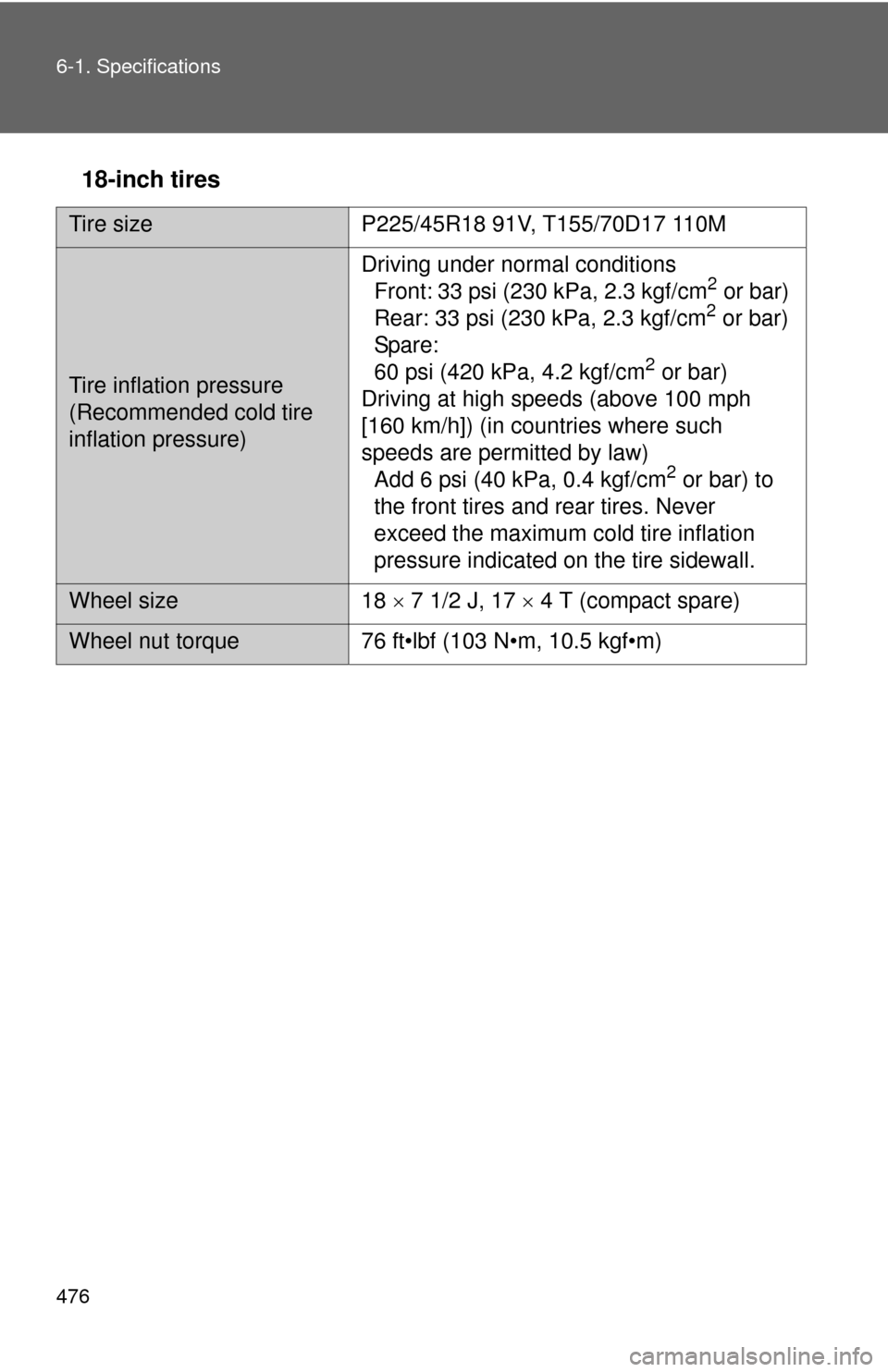
476 6-1. Specifications
18-inch tires
Tire sizeP225/45R18 91V, T155/70D17 110M
Tire inflation pressure
(Recommended cold tire
inflation pressure)Driving under normal conditions
Front: 33 psi (230 kPa, 2.3 kgf/cm
2 or bar)
Rear: 33 psi (230 kPa, 2.3 kgf/cm2 or bar)
Spare:
60 psi (420 kPa, 4.2 kgf/cm
2 or bar)
Driving at high speeds (above 100 mph
[160 km/h]) (in countries where such
speeds are permitted by law) Add 6 psi (40 kPa, 0.4 kgf/cm
2 or bar) to
the front tires and rear tires. Never
exceed the maximum co ld tire inflation
pressure indicated on the tire sidewall.
Wheel size 18 7 1/2 J, 17 4 T (compact spare)
Wheel nut torque 76 ft•lbf (103 N•m, 10.5 kgf•m)
Page 525 of 532

525
Alphabetical index
Seats
Adjustment ............................. 62
Adjustment precautions .......... 64
Child seats/child restraint system installation.............. 122
Cleaning ............................... 337
Head restraint ......................... 67
Properly sitting in the seat ...... 98
Rear seat folding down........... 65
Seat heaters ......................... 307
Service reminder
indicators .............................. 179
Shift lever Automatic
transmission ............... 155, 159
If the shift lever cannot be shifted from P ................ 449
Shift lock system..................... 449
Side airbags ............................. 100
Side marker lights Replacing light bulbs ............ 401
Switch ................................... 185
Wattage ................................ 477
Side mirror Adjusting and folding .............. 79
Defogger............................... 240
Smart key system Entry function ......................... 32
Starting the engine ............... 148
Spare tire Inflation pressure .................. 375
Storage location ................... 435
Spark plug................................ 471
Specifications .......................... 466
Speedometer ........................... 169 Steering
Column lock release......146, 152
Steering wheel Adjustment ..............................76
Stop lights
Replacing light bulbs .............401
Wattage .................................477
Storage feature.........................289
Storage precautions ................213
Stuck If your vehicle becomes
stuck ...................................462
Sun visors.................................298
Sunshade Roof.........................................85
Switch Emergency flasher switch .....414
Engine switch ................145, 148
Fog light switch .....................192
Hazard light switch ................414
Ignition switch................145, 148
Light switches........................185
Power door lock switch ...........52
Power window switch ..............81
Window lock switch .................81
Wiper and washer switch ......194