API SN TOYOTA CAMRY 2022 Owner's Manual
[x] Cancel search | Manufacturer: TOYOTA, Model Year: 2022, Model line: CAMRY, Model: TOYOTA CAMRY 2022Pages: 664, PDF Size: 11.3 MB
Page 479 of 664
4796-3. Do-it-yourself maintenance
CAMRY_U
6
Maintenance and care
■When to replace your vehicle’s tires
Tires should be replaced if:
●The treadwear indicators are showing on a tire.
●You have tire damage such as cuts, splits, cracks deep enough t o
expose the fabric, and bulges indicating internal damage
●A tire goes flat repeatedly or c annot be properly repaired due to the size
or location of a cut or other damage
If you are not sure, consult with your Toyota dealer.
■Replacing tires and wheels
If the ID codes of the tire pressure warning valve and transmit ters are not
registered, the tire pressure warning system will not work properly. In this
case, after driving for about 20 minutes, the tire pressure warning light will
blink for approximately 1 minute and then illuminate to indicat e a system
malfunction.
■Tire life
Any tire over 6 years old must be checked by a qualified techni cian even
if it has seldom or never been u sed or damage is not obvious.
■Routine tire inflation pressure checks
The tire pressure warning system does not replace routine tire inflation
pressure checks. Make sure to chec k tire inflation pressure as part of
your routine of daily vehicle checks.
■Low profile tires (vehicles with 18 or 19-inch wheels)
Generally, low profile tires will wear more rapidly and tire gr ip perfor-
mance will be reduced on snowy and /or icy roads when compared to
standard tires. Be sure to use snow tires on snowy and/or icy r oads and
drive carefully at a speed approp riate for road and weather conditions.
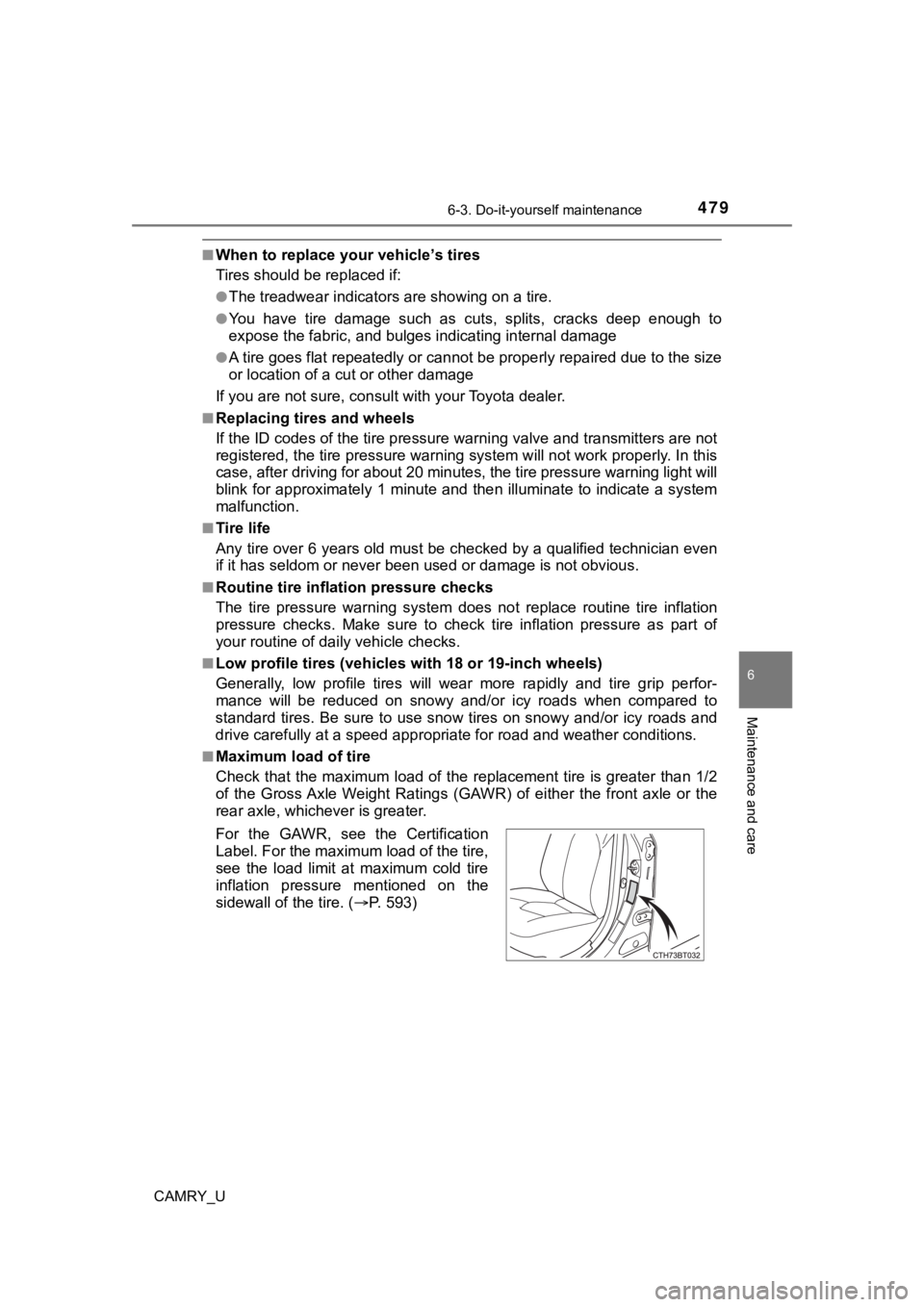
■Maximum load of tire
Check that the maximum load of t he replacement tire is greater than 1/2
of the Gross Axle Weight Ratings (GAWR) of either the front axl e or the
rear axle, whichever is greater.
For the GAWR, see the Certification
Label. For the maximum load of the tire,
see the load limit at maximum cold tire
inflation pressure mentioned on the
sidewall of the tire. ( P. 5 9 3 )
Page 481 of 664

4816-3. Do-it-yourself maintenance
CAMRY_U
6
Maintenance and care
●Performance may be affected in the following situations.
• When driving near a TV tower, electric power plant, gas station, radio
station, large display, airport or other facilit y that generates strong
radio waves or electrical noise
• When carrying a portable radio, cellular phone, cordless phone or
other wireless communication device
Vehicles with a tire inflation pressure display function: If ti re position
information is not correctly displayed due to the radio wave co nditions,
the display may be corrected by changing the location of the ve hicle as
the radio wave conditions may change.
●When the vehicle is stopped, the time taken for the warning to start or
turn off may be longer.
●When the inflation pressure of a tire drops rapidly, for exampl e when a
tire has burst, the warning may not operate.
■Initialization procedure
●Make sure to perform the initialization procedure after adjusti ng the tire
inflation pressure.
Also, make sure the tires are cold before performing the initia lization
procedure or adjusting the tire inflation pressure.
●If the engine switch is turned t o the “LOCK” position (vehicles without a
smart key system) or off (vehicles with a smart key system) dur ing ini-
tialization, it is not necessary to restart the initialization procedure from
the beginning as it will begin aut omatically when the engine switch is
turned back to the “ON” position (vehicles without a smart key system)
or IGNITION ON mode (vehicles with a smart key system).
●If initialization has accidentally been started when it is not necessary,
adjust the tire inflation pressu re to the specified level when the tires are
cold and then perform the ini tialization procedure again.
●Vehicles with a tire inflation p ressure display function: While the position
of each tire is being determined and the inflation pressures are not being
displayed on the multi-information display, if the inflation pr essure of a
tire drops, the tire pressure warning light will come on.
■Warning performance of the tire pressure warning system
The warning of the tire pressu re warning system will change in accor-
dance with the conditions under which it was initialized. For t his reason,
the system may give a warning even if the tire pressure does no t reach a
low enough level, or if the pressure is higher than the pressur e that was
adjusted to when the sys tem was initialized.
Page 571 of 664

5717-2. Steps to take in an emergency
CAMRY_U
7
When trouble arises
■When it is difficult to free the vehicle
Press to turn off TRAC.
WARNING
■When attempting to f ree a stuck vehicle
If you choose to push the vehicle back and forth to free it, make sure the
surrounding area is clear to avoid striking other vehicles, obj ects or people.
The vehicle may also lunge forward or lunge back suddenly as it becomes
free. Use extreme caution.
■ When shifting the shift lever
Be careful not to shift the shift lever with the accelerator pedal depressed.
This may lead to unexpected rapid acceleration of the vehicle t hat may
cause an accident resulting in death or serious injury.
NOTICE
■ To avoid damaging the transmission and other components
● Avoid spinning the front wheels and depressing the accelerator pedal
more than necessary.
● If the vehicle remains stuck even after these procedures are pe rformed,
the vehicle may require towing to be freed.
Page 579 of 664

5798-1. Specifications
8
Vehicle specifications
CAMRY_U
How to read oil container label:
API registered mark is added to
some oil containers to help you
select the oil you should use.
3.5 L V6 (2GR-FKS) engine
“Toyota Genuine Motor Oil” is used in your Toyota vehicle. Use
Toyota approved “Toyota Genuine Motor Oil” or equivalent to sat -
isfy the following grade and viscosity.
Oil grade: ILSAC GF-6A multigrade engine oil
Recommended viscosity: SAE 0W-20
SAE 0W-20 is the best choice for
good fuel economy and good start-
ing in cold weather.
If SAE 0W-20 is not available, SAE
5W-20 oil may be used. However,
it must be replaced with SAE 0W-
20 at the next oil change.
Oil viscosity (0W-20 is explained here as an example):
• The 0W in 0W-20 indicates the characteristic of the oil which allows cold
startability. Oils with a lower value before the W allow for ea sier starting of
the engine in cold weather.
• The 20 in 0W-20 indicates the viscosity characteristic of the oil when the
oil is at high temperature. An oil with a higher viscosity (one with a higher
value) may be better suited if the vehicle is operated at high speeds, or
under extreme load conditions.
Outside temperature
Page 622 of 664

622
CAMRY_U
Votre véhicule est équipé de COUSSINS GONFLABLES INTELLI-
GENTS conçus selon les normes de sécurité américaines applicables
aux véhicules à moteur (FMVSS208). L'ensemble de capteurs de
coussins gonflables (E CU) régule le déploiement des coussins gon-
flables sur la base des informa tions qu'il reçoit des capteurs, etc., indi-
qués ci-dessus dans le schéma illu strant les composants du système.
Parmi ces informations figurent la gravité du choc et l'occupat ion du
véhicule par les passagers. Le d éploiement rapide des coussins gon-
flables est obtenu au moyen d'une réaction chimique dans les di sposi-
tifs pyrotechniques, qui produit un gaz inoffensif permettant d'amortir
le mouvement des occupants.
Page 624 of 664

624
CAMRY_U
AVERTISSEMENT
■Précautions relatives aux coussins gonflables SRS
● Le coussin gonflable passager avant SRS se déploie également avec une
force considérable, pouvant occasionner des blessures graves, v oire mor-
telles, si le passager avant se trouve très près du coussin gon flable. Le
siège du passager avant doit être éloigné le plus possible du c oussin gon-
flable en réglant le dossier de siège de façon à ce que le pass ager avant
soit assis bien droit dans le siège.
● Les nourrissons et les enfants qui ne sont pas correctement ass is et/ou
attachés peuvent être grièvement blessés ou tués par le déploie ment d'un
coussin gonflable. Un nourrisson ou un enfant trop petit pour utiliser une
ceinture de sécurité doit être correctement attaché au moyen d' un siège
de sécurité enfant. Toyota recommande vivement d'installer tous les nour-
rissons et enfants sur les sièges arrière du véhicule et de prévoir pour eux
des systèmes de retenue adaptés. Les sièges arrière sont plus s ûrs pour
les nourrissons et les enfants que le siège du passager avant.
● N'installez jamais un siège de sécurité enfant type dos à la ro ute sur le
siège passager avant, même si le témoin indicateur “AIRBAG OFF” est
allumé. En cas d'accident, la force engendrée par le déploiement rapide
du coussin gonflable du passager avant peut blesser grièvement, voire
tuer l'enfant si le siège de sécurité enfant type dos à la route est installé
sur le siège du passager avant.
● Si vous attachez une rallonge de cein-
ture de sécurité aux boucles de ceinture
de sécurité avant, sans l'attacher au
pêne de la ceinture de sécurité, les
coussins gonflables frontaux SRS
déterminent que le conducteur et le
passager avant ont attaché leur cein-
ture de sécurité, bien que la ceinture de
sécurité ne soit pas attachée. Dans ce
cas, les coussins gonflables frontaux
SRS peuvent ne pas se déployer cor-
rectement en cas de collision, pouvant
occasionner des blessures graves,
voire mortelles. Veillez à porter la cein-
ture de sécurité avec la rallonge de
ceinture de sécurité.