ECU TOYOTA CAMRY HYBRID 2022 Owner's Guide
[x] Cancel search | Manufacturer: TOYOTA, Model Year: 2022, Model line: CAMRY HYBRID, Model: TOYOTA CAMRY HYBRID 2022Pages: 624, PDF Size: 13.76 MB
Page 67 of 624
671-2. Child safety
1
For safety and security
■Child restraint LATCH anchors
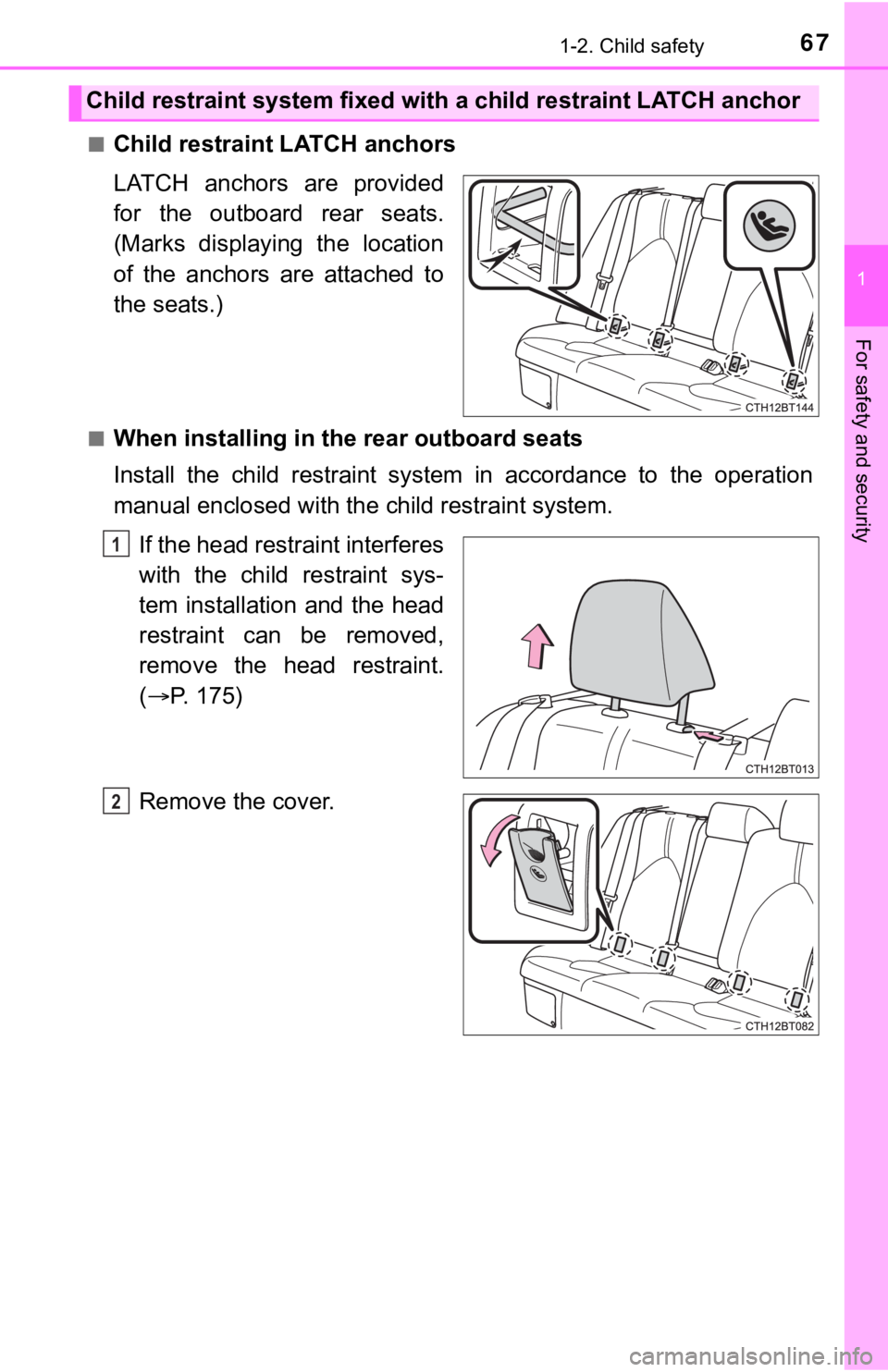
LATCH anchors are provided
for the outboard rear seats.
(Marks displaying the location
of the anchors are attached to
the seats.)
■When installing in the rear outboard seats
Install the child restraint system in accordance to the operation
manual enclosed with the child restraint system.
If the head restraint interferes
with the child restraint sys-
tem installation and the head
restraint can be removed,
remove the head restraint.
(P. 175)
Remove the cover.
Child restraint system fixed with a child restraint LATCH anchor
1
2
Page 69 of 624
691-2. Child safety
1
For safety and security
After installing the child restraint system, rock it back and forth to
ensure that it is installed securely. (P. 66)
■When installing in the rear center seat
There are no LATCH anchors behind the rear center seat. How-
ever, the inboard LATCH anchors of the outboard seats, which are
16.1 in. (410 mm) apart, can be used if the child restraint system
manufacturer’s instructions permit use of those anchors with the
anchor spacing stated.
Child restraint systems with rigid lower attachments cannot be
installed in the center seat. This type of child restraint system can
only be installed in the outboard seat.
■Laws and regulations pertaining to anchors
The LATCH system conforms to FMVSS225 or CMVSS210.2.
Child restraint systems conforming to FMVSS213 or CMVSS213 specifica-
tions can be used.
This vehicle is designed to conform to SAE J1819.
WARNING
■When installing a child restraint system
Observe the following precautions.
Failure to do so may result in death or serious injury.
●When using the LATCH anchors, be sure that there are no foreign objects
around the anchors and that the seat belt is not caught behind the child
restraint system.
●Follow all installation instructions provided by the child restraint system
manufacturer.
●Never attach two child restraint system attachments to the same anchor. In
a collision, one anchor may not be strong enough to hold two child
restraint system attachments and may break.
If the LATCH anchors are already in use, use the seat belt to install a child
restraint system in the center seat.
●When securing some types of child restraint systems in rear seats, it may
not be possible to properly use the seat belts in positions next to the child
restraint without interfering with it or affecting seat belt effectiveness. Be
sure your seat belt fits snugly across your shoulder and low on your hips. If
it does not, or if it interferes with the child restraint, move to a different
position. Failure to do so may result in death or serious injury.
●<002c004900030057004b0048000300560048004400570003004c0056000300440047004d00580056005700480047000f0003005500480046005200510049004c0055005000030057004b0048000300560048004600580055004c0057005c00030052004900
030057004b004800030046004b004c004f0047000300550048[straint system.
5
Page 71 of 624
711-2. Child safety
1
For safety and security
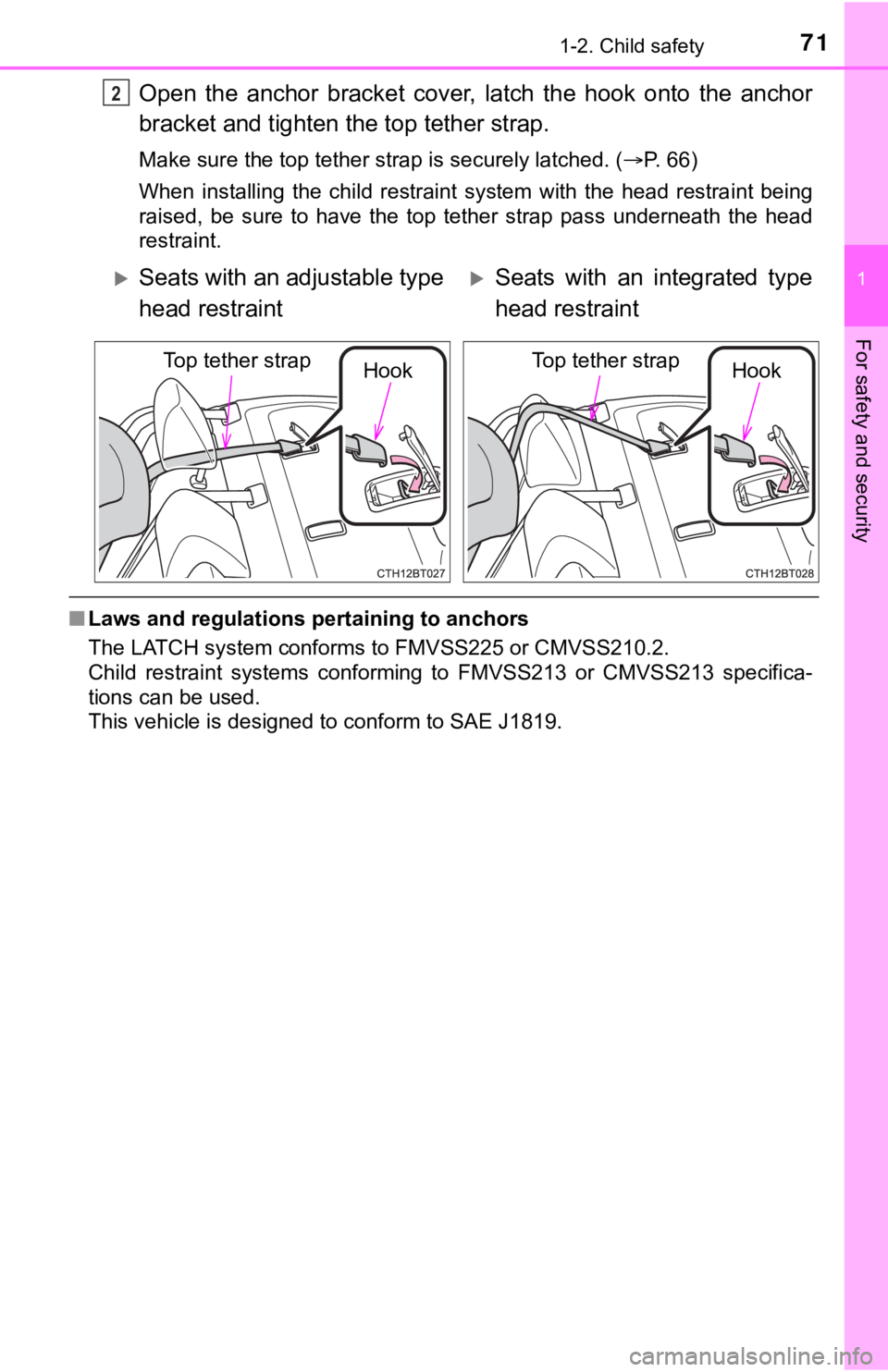
Open the anchor bracket cover, latch the hook onto the anchor
bracket and tighten the top tether strap.
Make sure the top tether strap is securely latched. (P. 66)
When installing the child restraint system with the head restraint being
raised, be sure to have the top tether strap pass underneath the head
restraint.
■Laws and regulations pertaining to anchors
The LATCH system conforms to FMVSS225 or CMVSS210.2.
Child restraint systems conforming to FMVSS213 or CMVSS213 specifica-
tions can be used.
This vehicle is designed to conform to SAE J1819.
2
Seats with an adjustable type
head restraintSeats with an integrated type
head restraint
HookTop tether strapHookTop tether strap
Page 72 of 624
721-2. Child safety
WARNING
■When installing a child restraint system
Observe the following precautions.
Failure to do so may result in death or serious injury.
●Firmly attach the top tether strap and make sure that the belt is not twisted.
●Do not attach the top tether strap to anything other than the anchor
bracket.
●After securing a child restraint system, never adjust the seat.
●Follow all installation instructions provided by the child restraint system
manufacturer.
●When installing the child restraint system with the head restraint being
raised, after the head restraint has been raised and then the anchor
bracket has been fixed, do not lower the head restraint.
NOTICE
■Anchor brackets (for top tether strap)
When not in use, make certain to close the lid. If it remains open, the lid
may be damaged.
Page 73 of 624
73
1
For safety and security
1-3. Emergency assistance
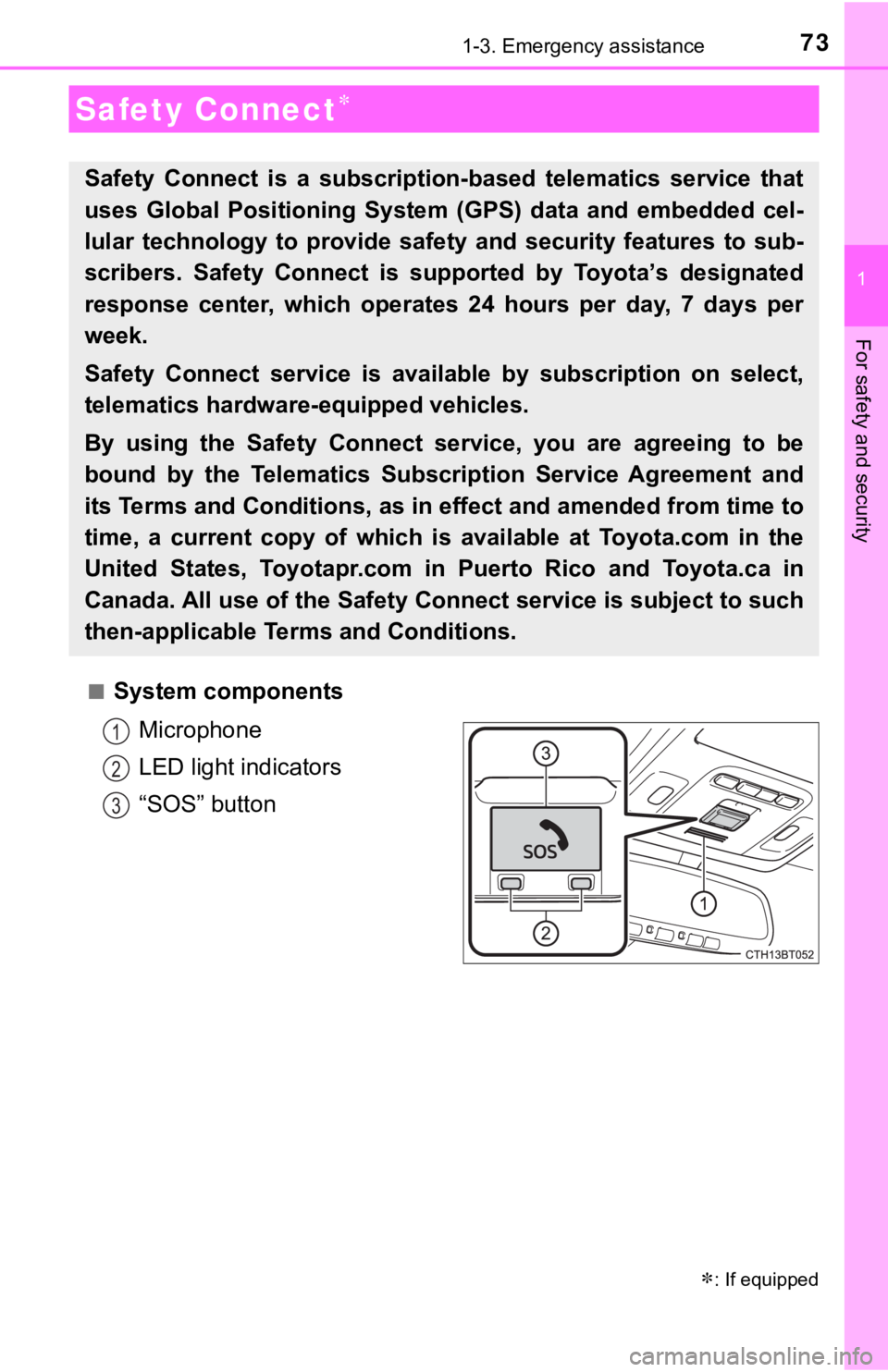
■System components
Microphone
LED light indicators
“SOS” button
Safety Connect
: If equipped
Safety Connect is a subscription-based telematics service that
uses Global Positioning System (GPS) data and embedded cel-
lular technology to provide safety and security features to sub-
scribers. Safety Connect is supported by Toyota’s designated
response center, which operates 24 hours per day, 7 days per
week.
Safety Connect service is available by subscription on select,
telematics hardware-equipped vehicles.
By using the Safety Connect service, you are agreeing to be
bound by the Telematics Subscription Service Agreement and
its Terms and Conditions, as in effect and amended from time to
time, a current copy of which is available at Toyota.com in the
United States, Toyotapr.com in Puerto Rico and Toyota.ca in
Canada. All use of the Safety Connect service is subject to such
then-applicable Terms and Conditions.
1
2
3
Page 75 of 624
751-3. Emergency assistance
1
For safety and security
■Safety Connect Services Information
●Phone calls using the vehicle’s Bluetooth® technology will not be possible
when Safety Connect is active and in use.
●Safety Connect is available beginning Fall 2009 on select Toyota models (in
the contiguous United States only). Contact with the Safety Connect
response center is dependent upon the telematics device being in operative
condition, cellular connection availability, and GPS satellite signal reception,
which can limit the ability to reach the response center or receive emer-
gency service support. Enrollment and Telematics Subscription Service
Agreement are required. A variety of subscription terms are available;
charges vary by subscription term selected and location.
●Automatic Collision Notification, Emergency Assistance and Stolen Vehicle
Location are available in the United States, including Hawaii and Alaska,
Puerto Rico and Canada, and Enhanced Roadside Assistance are available
in the United States, Puerto Rico and Canada.
●Automatic Collision Notification, Emergency Assistance, Stolen Vehicle and
Enhanced Road Assistance are not available in the U.S. Virgin Islands.
For vehicles first sold in the U.S. Virgin Islands, no Safety Connect services
will function in or outside the U.S. Virgin Islands.
●Safety Connect services are not subject to section 255 of the Telecommuni-
cations Act and the device is not TTY compatible.
■Languages
The Safety Connect response center will offer support in multiple languages.
The Safety Connect system will offer voice prompts in English, Spanish, and
French. Please indicate your language of choice when enrolling.
■When contacting the response center
You may be unable to contact the response center if the network is busy.
When the power switch is turned to ON mode, the red indicator light
comes on for 2 seconds then turns off. Afterward, the green indicator
light comes on, indicating that the service is active.
The following indicator light patterns indicate specific system usage
conditions:
●Green indicator light on = Active service
●Green indicator light flashing = Safety Connect call in process
●Red indicator light (except at vehicle start-up) = System malfunction
(contact your Toyota dealer)
●No indicator light (off) = Safety Connect service not active
Safety Connect LED light Indicators
Page 77 of 624
771-3. Emergency assistance
1
For safety and security
■Enhanced Roadside Assistance
Enhanced Roadside Assistance adds GPS data to the already
included warranty-based Toyota roadside service.
Subscribers can press the “SOS” button to reach a Safety Connect
response-center agent, who can help with a wide range of needs,
such as: towing, flat tire, fuel delivery, etc. For a description of the
Enhanced Roadside Assistance services and their limitations,
please see the Safety Connect Terms and Conditions, which are
available at Toyota.com in the United States, Toyotapr.com in
Puerto Rico and Toyota.ca in Canada.
Important! Read this information before using Safety Connect.
■Exposure to radio frequency signals
The Safety Connect system installed in your vehicle is a low-power
radio transmitter and receiver. It receives and also sends out radio
frequency (RF) signals.
In August 1996, the Federal Communications Commission (FCC)
adopted RF exposure guidelines with safety levels for mobile wire-
less phones. Those guidelines are consistent with the safety stan-
dards previously set by the following U.S. and international
standards bodies.
●ANSI (American National Standards Institute) C95.1 [1992]
●NCRP (National Council on Radiation Protection and Measure-
ment) Report 86 [1986]
●ICNIRP (International Commission on Non-Ionizing Radiation
Protection) [1996]
Those standards were based on comprehensive and periodic eval-
uations of the relevant scientific literature. Over 120 scientists, engi-
neers, and physicians from universities, and government health
agencies and industries reviewed the available body of research to
develop the ANSI Standard (C95.1).
The design of Safety Connect complies with the FCC guidelines in
addition to those standards.
Safety information for Safety Connect
Page 79 of 624
791-4. Hybrid system
1
For safety and security
◆When stopped/during start off
The gasoline engine stops
* when the vehicle is stopped. During
start off, the electric motor (traction motor) drives the vehicle. At
slow speeds or when traveling down a gentle slope, the engine is
stopped
* and the electric motor (traction motor) is used.
When the shift lever is in N, the hybrid battery (traction battery) is
not being charged.
*: When the hybrid battery (traction battery) requires charging or the
engine is warming up, etc., the gasoline engine will not automatically
stop. (P. 80)
◆During normal driving
The gasoline engine is predominantly used. The electric motor
(traction motor) charges the hybrid battery (traction battery) as nec-
essary.
◆When accelerating sharply
When the accelerator pedal is depressed heavily, the power of the
hybrid battery (traction battery) is added to that of the gasoline
engine via the electric motor (traction motor).
◆When braking (regenerative braking)
The wheels operate the electric motor (traction motor) as a power
generator, and the hybrid battery (traction battery) is charged.
When driving with the gasoline engine stopped, a sound, which
changes in accordance with the driving speed, will be played in order
to warn people nearby of the vehicle’s approach. The sound will stop
when the vehicle speed exceeds approximately 22 mph (35 km/h).
Acoustic Vehicle Alerting System
Page 81 of 624
811-4. Hybrid system
1
For safety and security
■Sounds and vibrations specific to a hybrid vehicle
There may be no engine sound or vibration even though the vehicle is able to
move with the “READY” indicator is illuminated. For safety, apply the parking
brake and make sure to shift the shift lever to P when parked.
The following sounds or vibrations may occur when the hybrid system is
operating and are not a malfunction:
●Motor sounds may be heard from the engine compartment.
●Sounds may be heard from the hybrid battery (traction battery) under the
rear seats when the hybrid system starts or stops.
●Relay operating sounds such as a snap or soft clank will be emitted from the
hybrid battery (traction battery), under the rear seats, when the hybrid sys-
tem is started or stopped.
●Sounds from the hybrid system may be heard when the trunk lid is open.
●Sounds may be heard from the transmission when the gasoline engine
starts or stops, when driving at low speeds, or during idling.
●Engine sounds may be heard when accelerating sharply.
●Sounds may be heard due to regenerative braking when the brake pedal is
depressed or as the accelerator pedal is released.
●Vibration may be felt when the gasoline engine starts or stops.
●Cooling fan sounds may be heard from the air intake vent. (P. 83)
■Acoustic Vehicle Alerting System
In the following cases, the Acoustic Vehicle Alerting System may be difficult
for surrounding people to hear.
●In very noisy areas
●In the wind or the rain
■Maintenance, repair, recycling, and disposal
Contact your Toyota dealer regarding maintenance, repair, recycling and dis-
posal. Do not dispose of the vehicle yourself.
■Customization
Some functions can be customized. (P. 569)
Page 83 of 624
831-4. Hybrid system
1
For safety and security
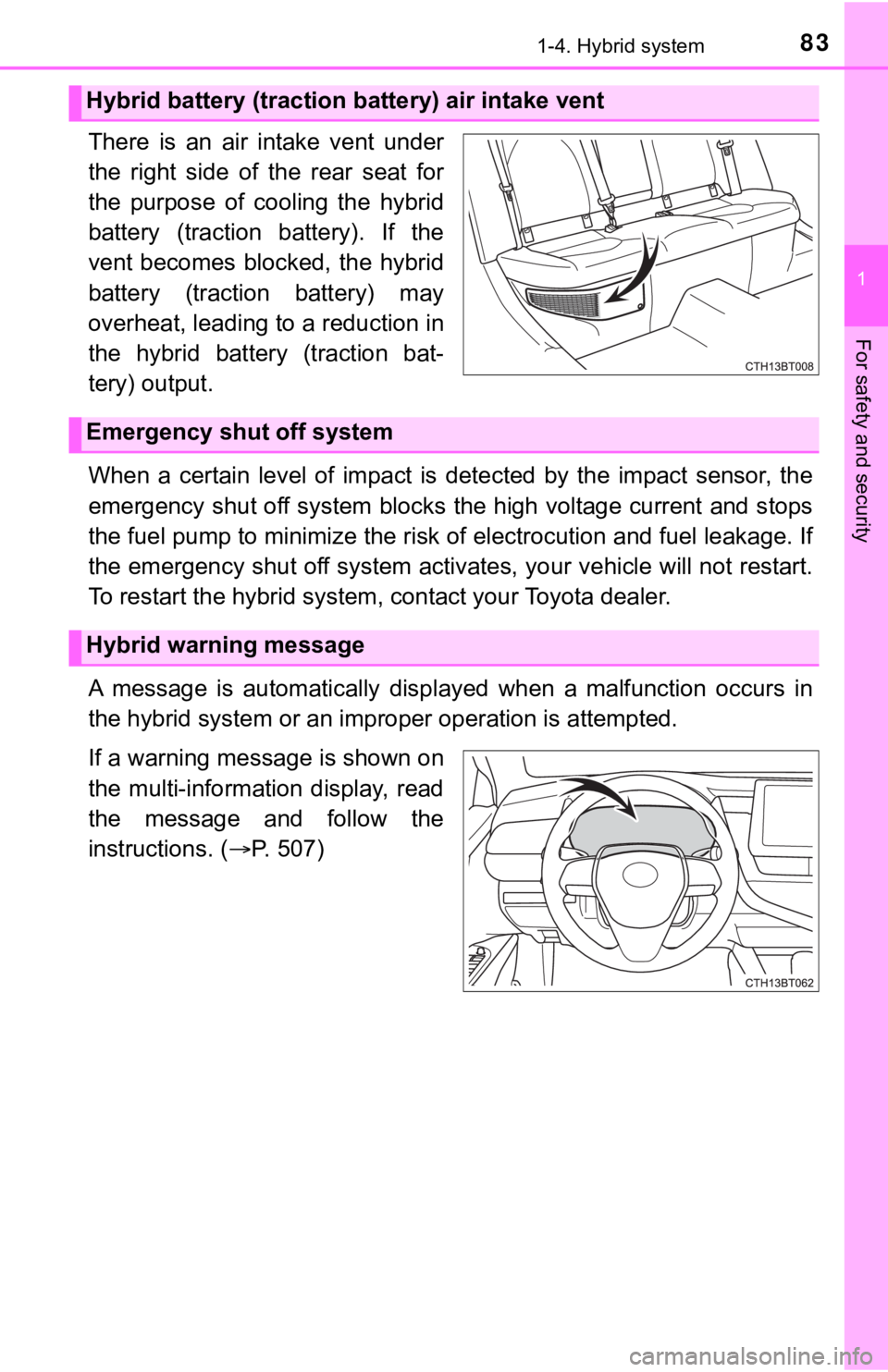
There is an air intake vent under
the right side of the rear seat for
the purpose of cooling the hybrid
battery (traction battery). If the
vent becomes blocked, the hybrid
battery (traction battery) may
overheat, leading to a reduction in
the hybrid battery (traction bat-
tery) output.
When a certain level of impact is detected by the impact sensor, the
emergency shut off system blocks the high voltage current and stops
the fuel pump to minimize the risk of electrocution and fuel leakage. If
the emergency shut off system activates, your vehicle will not restart.
To restart the hybrid system, contact your Toyota dealer.
A message is automatically displayed when a malfunction occurs in
the hybrid system or an improper operation is attempted.
If a warning message is shown on
the multi-information display, read
the message and follow the
instructions. (P. 507)
Hybrid battery (traction battery) air intake vent
Emergency shut off system
Hybrid warning message