engine TOYOTA COROLLA 2010 10.G Owners Manual
[x] Cancel search | Manufacturer: TOYOTA, Model Year: 2010, Model line: COROLLA, Model: TOYOTA COROLLA 2010 10.GPages: 476, PDF Size: 9.5 MB
Page 328 of 476
328 4-3. Do-it-yourself maintenance
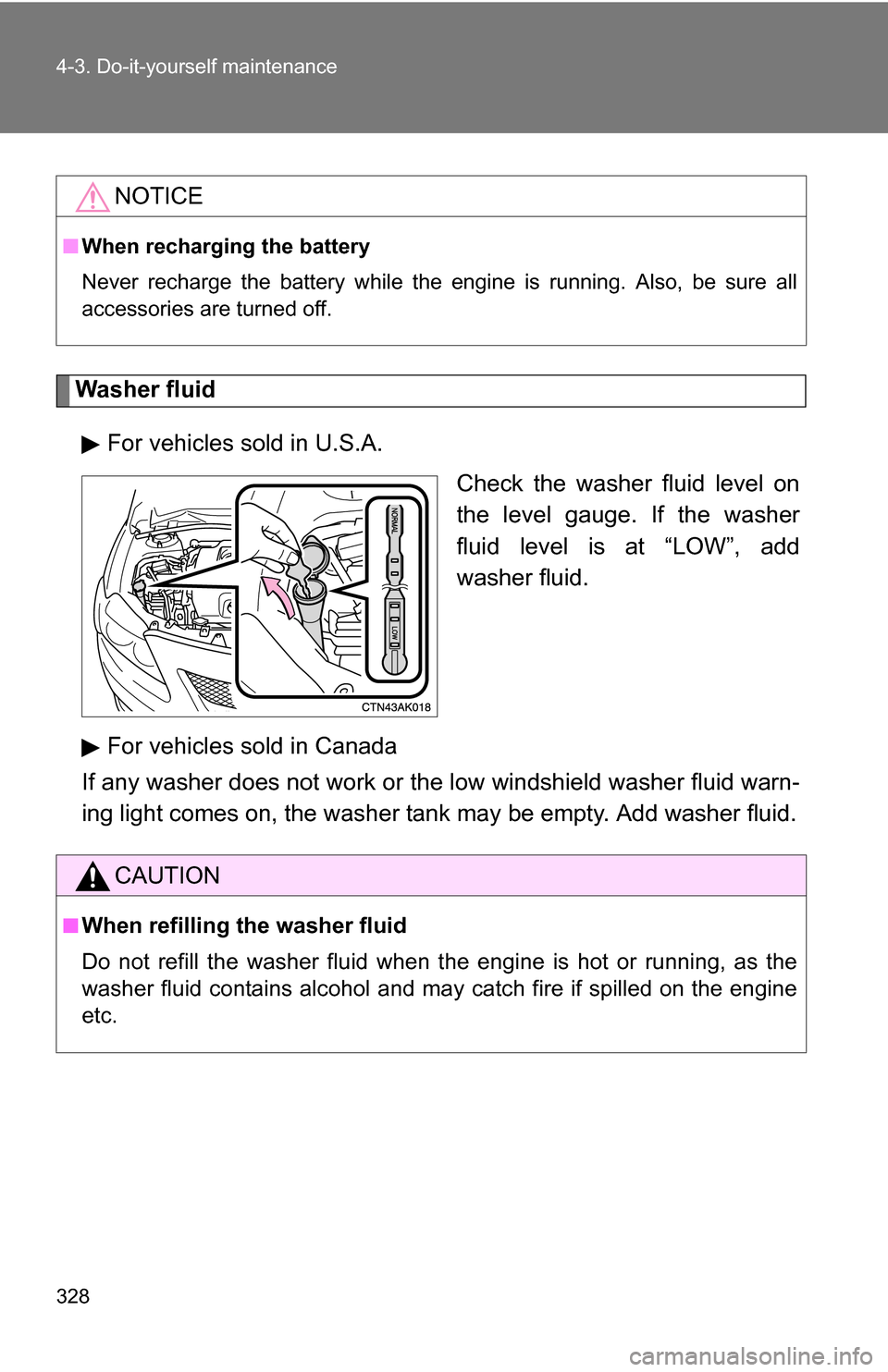
Washer fluidFor vehicles sold in U.S.A. Check the washer fluid level on
the level gauge. If the washer
fluid level is at “LOW”, add
washer fluid.
For vehicles sold in Canada
If any washer does not work or the low windshield washer fluid warn-
ing light comes on, the washer tank may be empty. Add washer fluid.
NOTICE
■ When recharging the battery
Never recharge the battery while the engine is running. Also, be sure all
accessories are turned off.
CAUTION
■When refilling the washer fluid
Do not refill the washer fluid when t he engine is hot or running, as the
washer fluid contains alcohol and may catch fire if spilled on the engine
etc.
Page 329 of 476
329
4-3. Do-it-yourself maintenance
4
Maintenance and care
NOTICE
■
Do not use any fluid other than washer fluid
Do not use soapy water or engine antifreeze instead of washer fluid.
Doing so may cause streaking on the vehicle’s painted surfaces.
■ Diluting washer fluid
Dilute washer fluid with water as necessary.
Refer to the freezing temperatures listed on the washer fluid tank.
Page 331 of 476
331
4-3. Do-it-yourself maintenance
4
Maintenance and care
Installing tire pressure warning valves and transmitters
When replacing tires or wheels, tire pressure warning valves and
transmitters must also be installed.
When new tire pressure warning valves and transmitters are
installed, new tire pressure warning valve and transmitter ID codes
must be registered in the tire pre ssure warning computer and the tire
pressure warning system must be initialized. Have tire pressure
warning valve and transmitter ID codes registered by your Toyota
dealer. ( P. 332)
Initializing the tire pressure warning system
The tire pressure warning system must be initialized when changing
the tire size.
When the tire pressure warning syst em is initialized, the current tire
inflation pressure is set as the pressure benchmark.
■ How to initialize the tire pressure warning system
Park the vehicle in a safe place and turn the “ENGINE START
STOP” switch or the engine switch OFF.
While the vehicle is moving, in itialization is not performed.
Adjust the tire inflation pressure to the specified cold tire infla-
tion pressure level. ( P. 431)
Make sure to adjust the tire pressure to the specified cold tire
inflation pressure level. The ti re pressure warning system will
operate based on this pressure level.
Turn the “ENGINE START STOP” switch to IGNITION ON
mode (vehicles with smart key sy stem) or the engine switch to
the “ON” position (vehicles without smart key system).
STEP 1
STEP 2
STEP 3
Page 332 of 476
332 4-3. Do-it-yourself maintenance
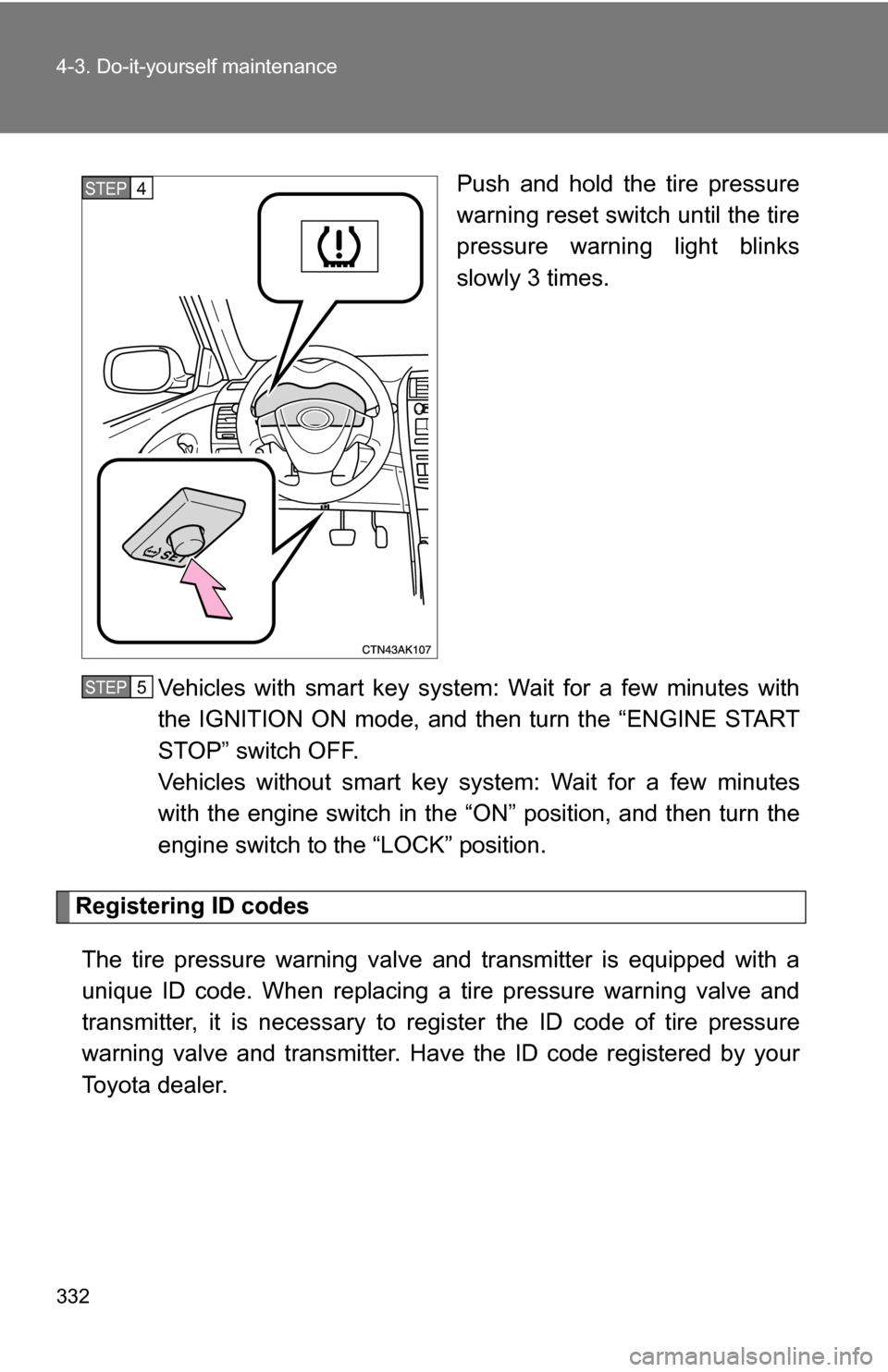
Push and hold the tire pressure
warning reset switch until the tire
pressure warning light blinks
slowly 3 times.
Vehicles with smart key system: Wait for a few minutes with
the IGNITION ON mode, and then turn the “ENGINE START
STOP” switch OFF.
Vehicles without smart key system: Wait for a few minutes
with the engine switch in the “O N” position, and then turn the
engine switch to the “LOCK” position.
Registering ID codes
The tire pressure warning valve and transmitter is equipped with a
unique ID code. When replacing a tire pressure warning valve and
transmitter, it is necessary to regi ster the ID code of tire pressure
warning valve and transmitter. Have the ID code registered by your
Toyota dealer.
STEP 4
STEP 5
Page 344 of 476
344
4-3. Do-it-yourself maintenance
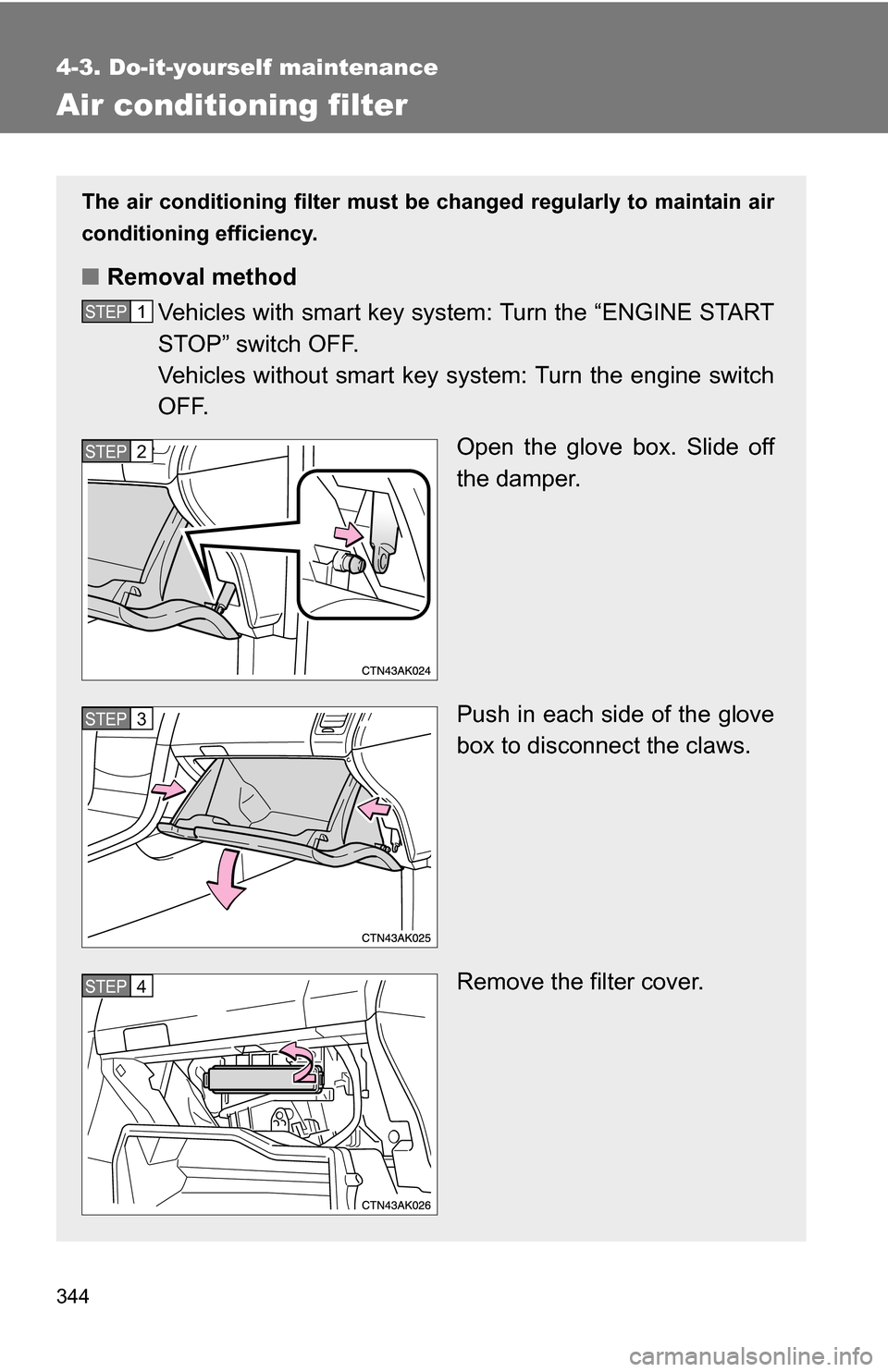
Air conditioning filter
The air conditioning filter must be changed regularly to maintain air
conditioning efficiency.
■ Removal method
Vehicles with smart key system: Turn the “ENGINE START
STOP” switch OFF.
Vehicles without smart key system: Turn the engine switch
OFF.
Open the glove box. Slide off
the damper.
Push in each side of the glove
box to disconnect the claws.
Remove the filter cover.
STEP 1
STEP 2
STEP 3
STEP 4
Page 350 of 476
350
4-3. Do-it-yourself maintenance
Checking and replacing fuses
If any of the electrical components do not operate, a fuse may have
blown. If this happens, check and replace the fuses as necessary.
Vehicles with smart key system: Turn the “ENGINE START
STOP” switch OFF.
Vehicles without smart key system: Turn the engine switch
OFF.
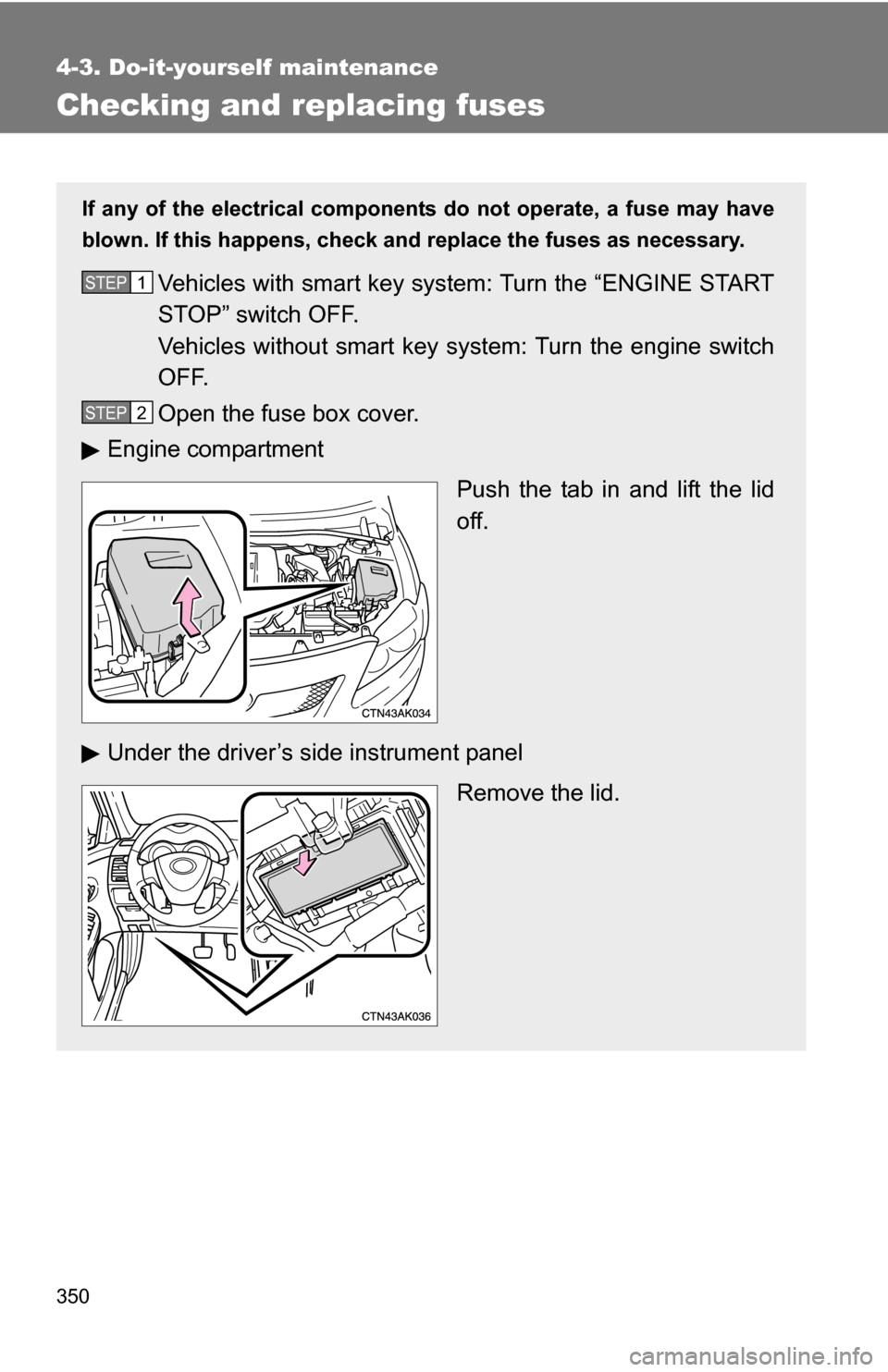
Open the fuse box cover.
Engine compartment
Push the tab in and lift the lid
off.
Under the driver’s side instrument panel Remove the lid.STEP 1
STEP 2
Page 354 of 476
354 4-3. Do-it-yourself maintenance
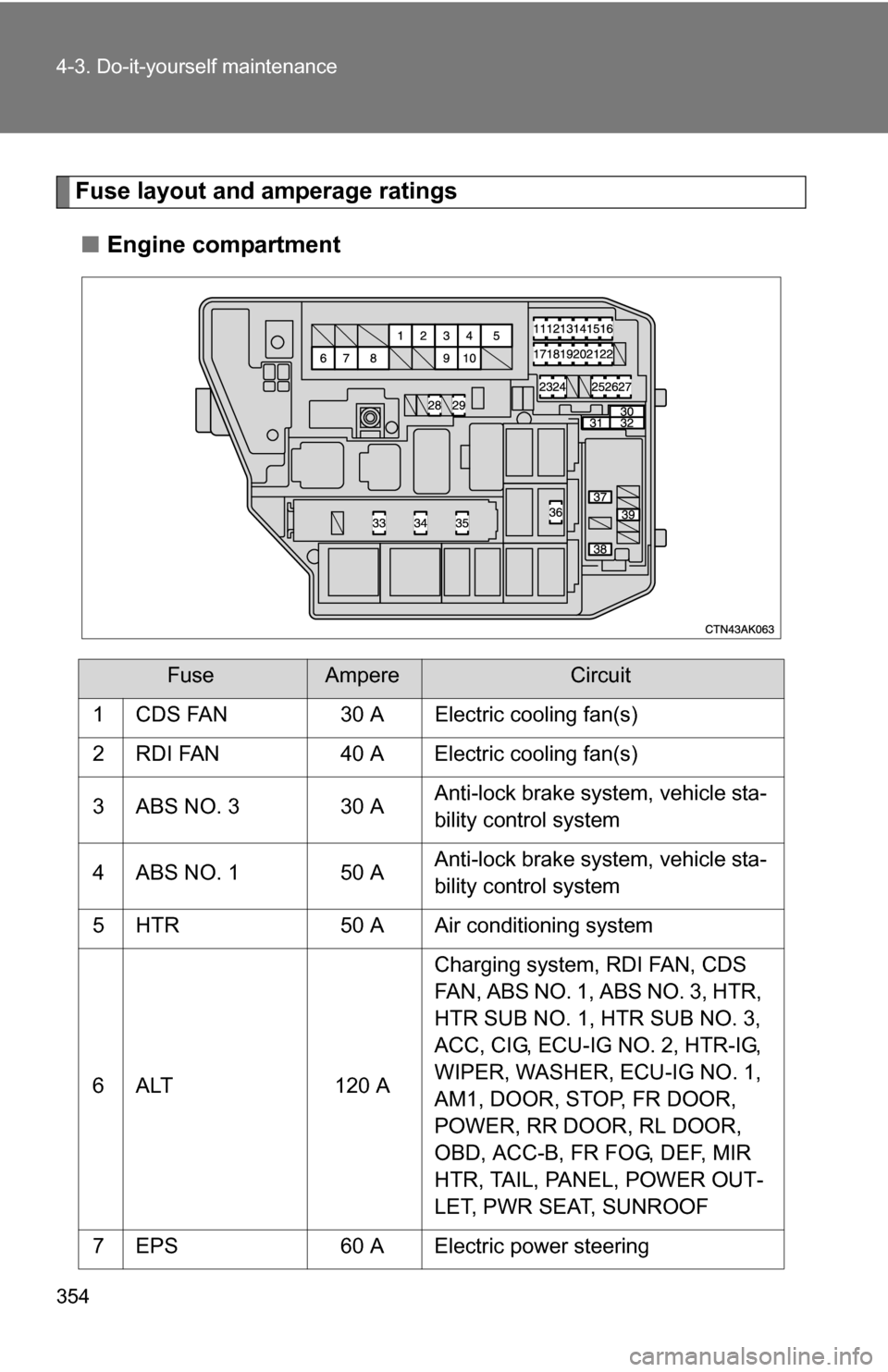
Fuse layout and amperage ratings■ Engine compartment
FuseAmpereCircuit
1 CDS FAN 30 A Electric cooling fan(s)
2 RDI FAN 40 A Electric cooling fan(s)
3 ABS NO. 3 30 A Anti-lock brake system, vehicle sta-
bility control system
4 ABS NO. 1 50 A Anti-lock brake system, vehicle sta-
bility control system
5 HTR 50 A Air conditioning system
6 ALT 120 A Charging system, RDI FAN, CDS
FAN, ABS NO. 1, ABS NO. 3, HTR,
HTR SUB NO. 1, HTR SUB NO. 3,
ACC, CIG, ECU-IG NO. 2, HTR-IG,
WIPER, WASHER, ECU-IG NO. 1,
AM1, DOOR, STOP, FR DOOR,
POWER, RR DOOR, RL DOOR,
OBD, ACC-B, FR FOG, DEF, MIR
HTR, TAIL, PANEL, POWER OUT-
LET, PWR SEAT, SUNROOF
7 EPS 60 A Electric power steering
Page 371 of 476
When trouble arises5
371
5-1. Essential informationEmergency flashers ......... 372
If your vehicle needs to be towed ........................ 373
If you think something is wrong ......................... 378
Fuel pump shut off system ........................... 379
Event data recorder ......... 380 5-2. Steps to take in an
emergency
If a warning light turns on or a warning buzzer
sounds... ....................... 382
If you have a flat tire......... 393
If the engine will not start ................................ 404
If the shift lever cannot be shifted from P
(automatic
transmission) ................. 406
If you lose your keys ........ 407
If the electronic key does not operate properly
(vehicles with smart
key system).................... 408
If the battery is discharged ..................... 410
If your vehicle overheats ....................... 416
If the vehicle becomes stuck .............................. 419
Page 372 of 476
372
5-1. Essential information
Emergency flashers
NOTICE
■To prevent battery discharge
Do not leave the emergency flashers on longer than necessary when the
engine is not running.
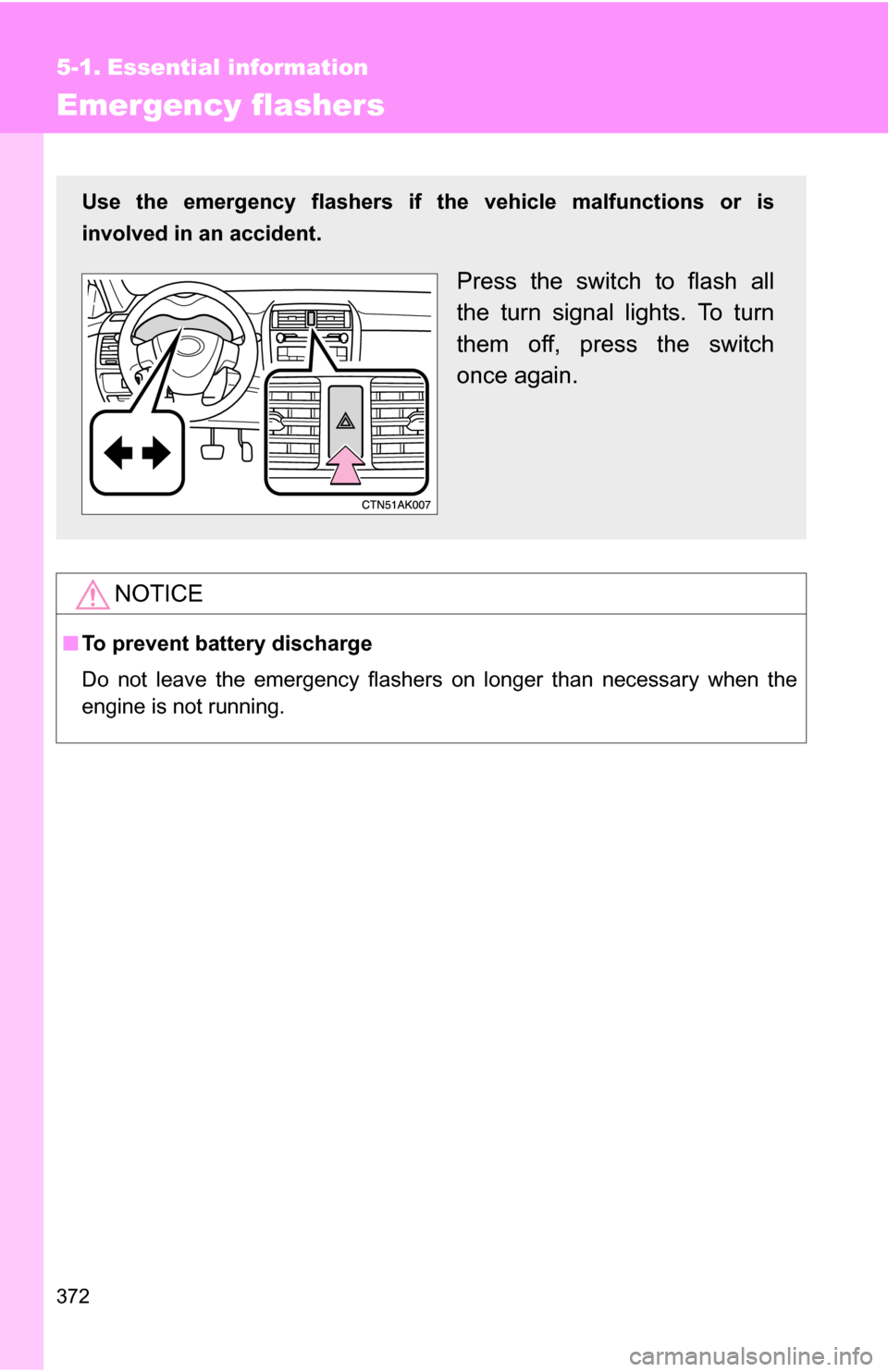
Use the emergency flashers if th e vehicle malfunctions or is
involved in an accident.
Press the switch to flash all
the turn signal lights. To turn
them off, press the switch
once again.
Page 373 of 476
5
When trouble arises
373
5-1. Essential information
If your vehicle needs to be towed
Before towingThe following may indicate a problem with your transmission. Contact
your Toyota dealer before towing.
● The engine is running, but the vehicle will not move.
● The vehicle makes an abnormal sound.
If towing is necessary, we recommend having your vehicle towed by
your Toyota dealer or a commerci al towing service, using a lift-type
truck or a flat bed truck.
Use a safety chain system for all to wing, and abide by all state/pro-
vincial and local laws.
If towing from the front, the vehic le's rear wheels and axles must be
in good condition. (P. 376)
If they are damaged, use a towing dolly or flat bed truck.