engine TOYOTA COROLLA 2010 10.G Manual Online
[x] Cancel search | Manufacturer: TOYOTA, Model Year: 2010, Model line: COROLLA, Model: TOYOTA COROLLA 2010 10.GPages: 476, PDF Size: 9.5 MB
Page 314 of 476
314
4-3. Do-it-yourself maintenance
Engine compar tment
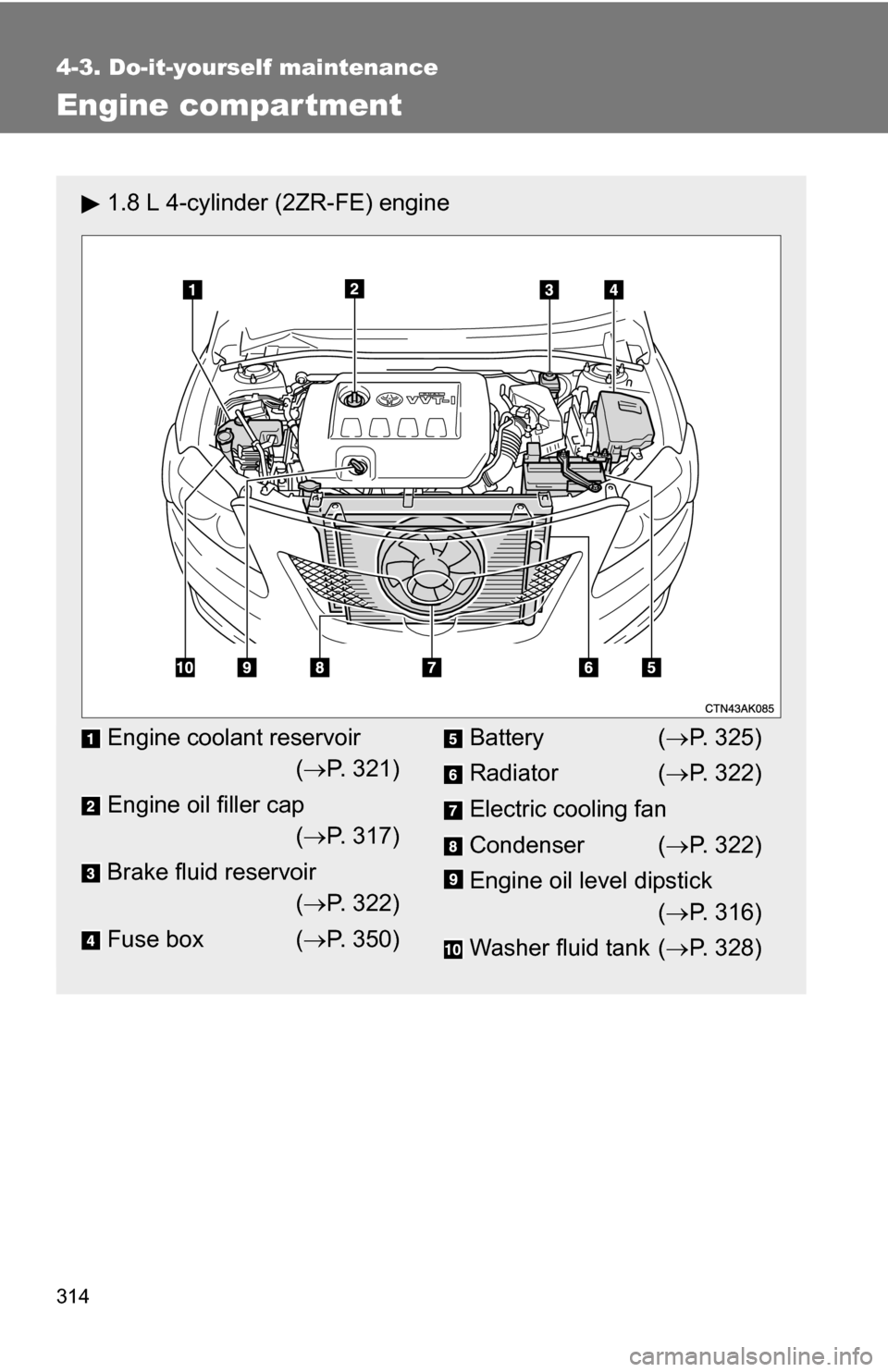
1.8 L 4-cylinder (2ZR-FE) engine
Engine coolant reservoir( P. 321)
Engine oil filler cap ( P. 317)
Brake fluid reservoir ( P. 322)
Fuse box ( P. 350)Battery ( P. 325)
Radiator ( P. 322)
Electric cooling fan
Condenser ( P. 322)
Engine oil level dipstick ( P. 316)
Washer fluid tank ( P. 328)
Page 315 of 476
315
4-3. Do-it-yourself maintenance
4
Maintenance and care
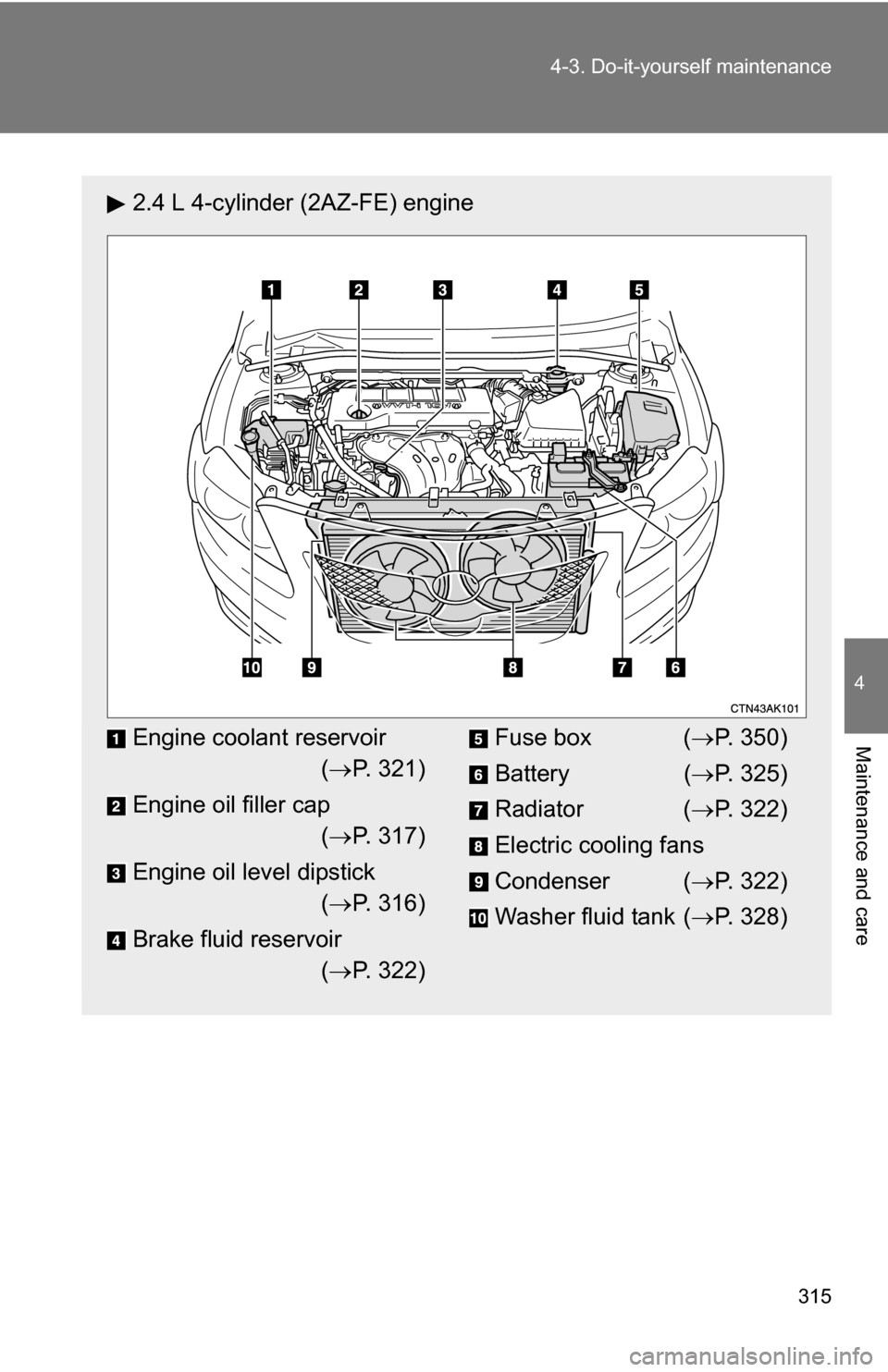
2.4 L 4-cylinder (2AZ-FE) engine
Engine coolant reservoir
( P. 321)
Engine oil filler cap ( P. 317)
Engine oil level dipstick ( P. 316)
Brake fluid reservoir ( P. 322)Fuse box ( P. 350)
Battery ( P. 325)
Radiator ( P. 322)
Electric cooling fans
Condenser ( P. 322)
Washer fluid tank ( P. 328)
Page 316 of 476
316 4-3. Do-it-yourself maintenance
Engine oilWith the engine at operating temperature and turned off, check the oil
level on the dipstick.
■ Checking the engine oil
Park the vehicle on level gro und. After turning off the engine,
wait more than five minutes for the oil to drain back into the
bottom of the engine.
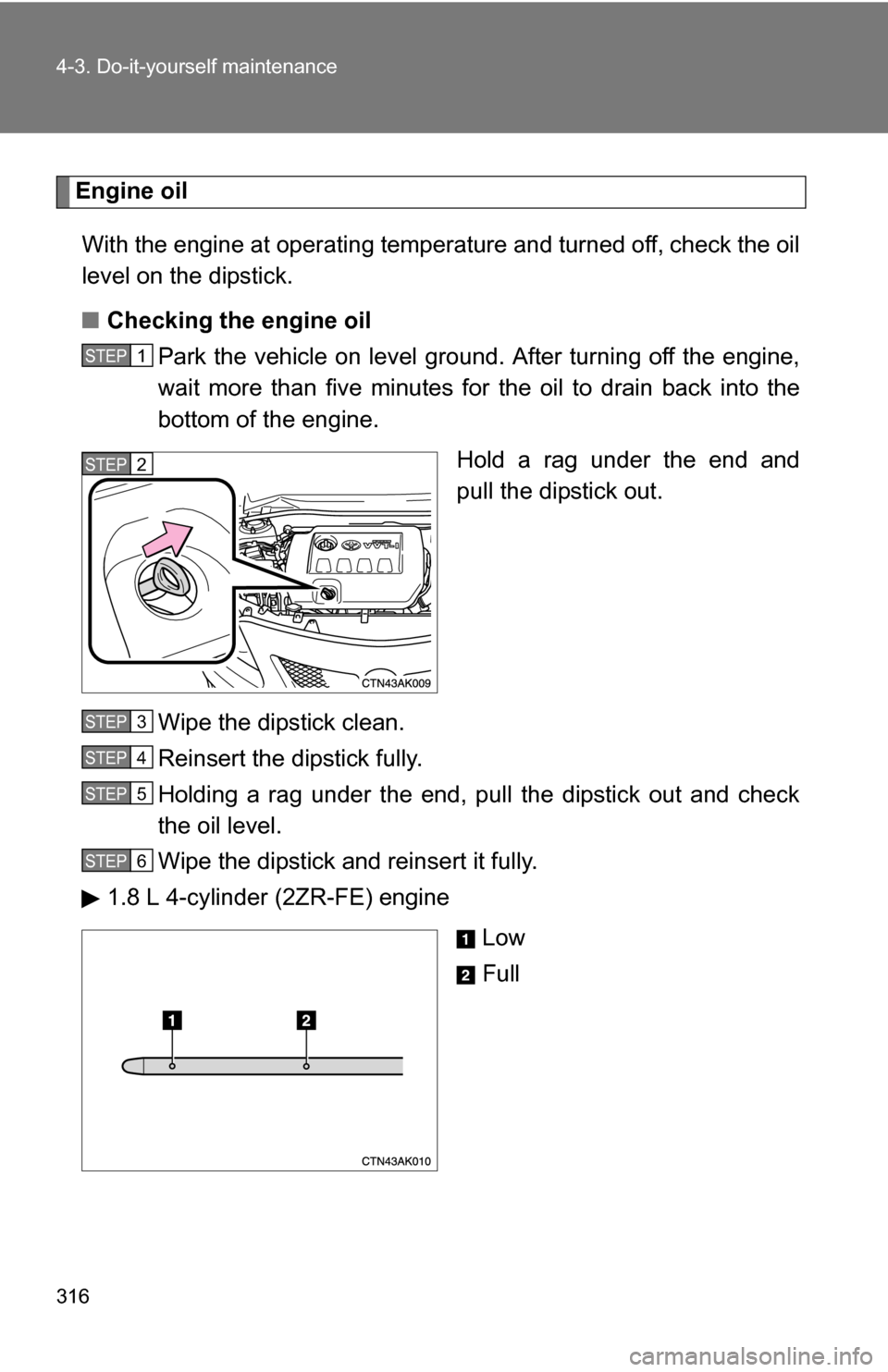
Hold a rag under the end and
pull the dipstick out.
Wipe the dipstick clean.
Reinsert the dipstick fully.
Holding a rag under the end, pull the dipstick out and check
the oil level.
Wipe the dipstick and reinsert it fully.
1.8 L 4-cylinder (2ZR-FE) engine
Low
Full
STEP 1
STEP 2
STEP 3
STEP 4
STEP 5
STEP 6
Page 317 of 476
317
4-3. Do-it-yourself maintenance
4
Maintenance and care
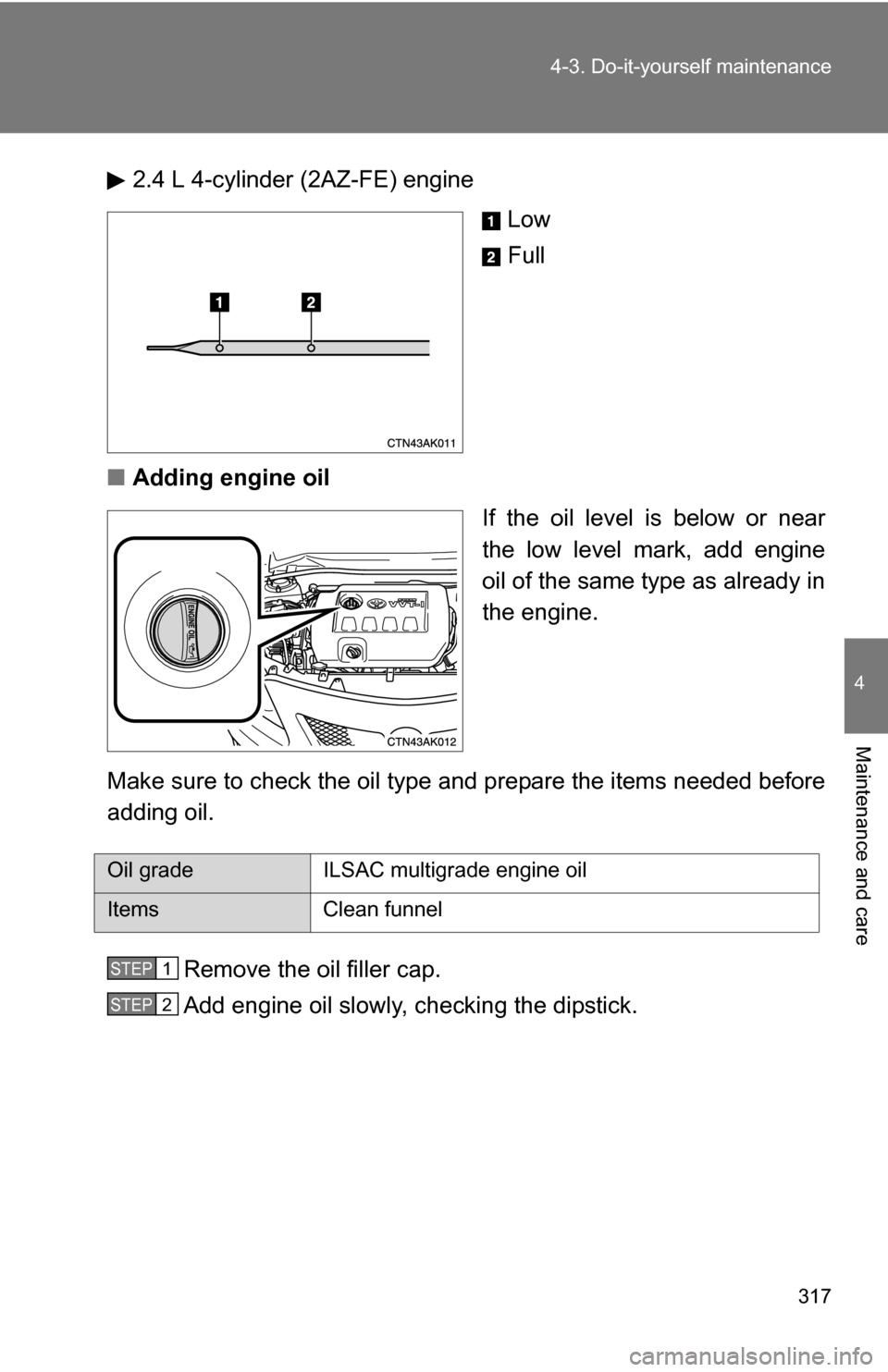
2.4 L 4-cylinder (2AZ-FE) engine
Low
Full
■ Adding engine oil
If the oil level is below or near
the low level mark, add engine
oil of the same type as already in
the engine.
Make sure to check the oil type and prepare the items needed before
adding oil. Remove the oil filler cap.
Add engine oil slowly, checking the dipstick.
Oil grade ILSAC multigrade engine oil
Items Clean funnel
STEP 1
STEP 2
Page 318 of 476
318 4-3. Do-it-yourself maintenance
Install the filler cap, turning it clockwise.
The approximate quantity of oil needed to raise the level between low and
full on the dipstick is indicated as follows:
1.8 L 4-cylinder (2ZR-FE) engine
1.6 qt. (1.5 L, 1.3 lmp. qt.)
2.4 L 4-cylinder (2AZ-FE) engine
1.1 qt. (1.0 L, 0.9 lmp. qt.)
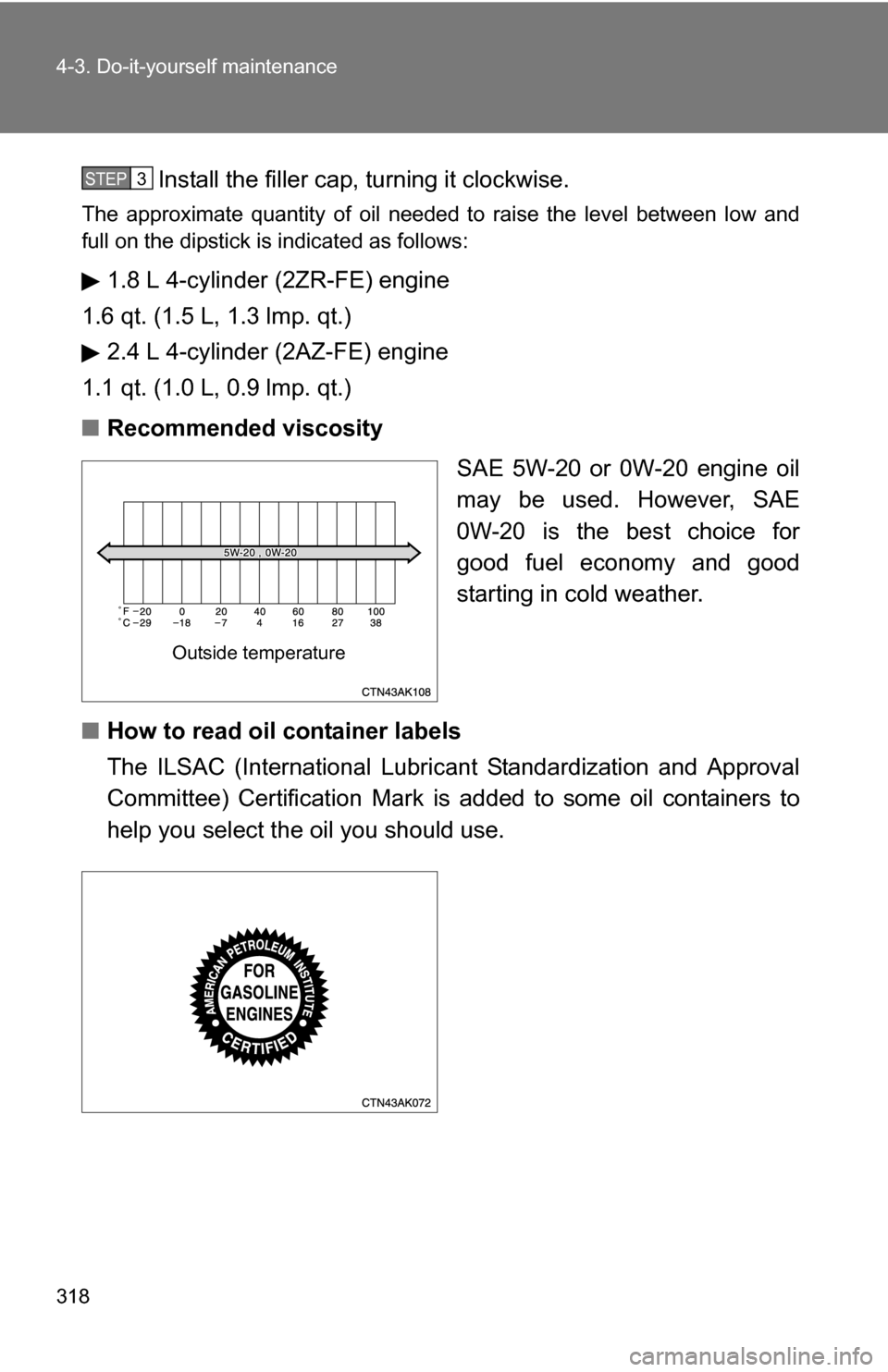
■ Recommended viscosity
SAE 5W-20 or 0W-20 engine oil
may be used. However, SAE
0W-20 is the best choice for
good fuel economy and good
starting in cold weather.
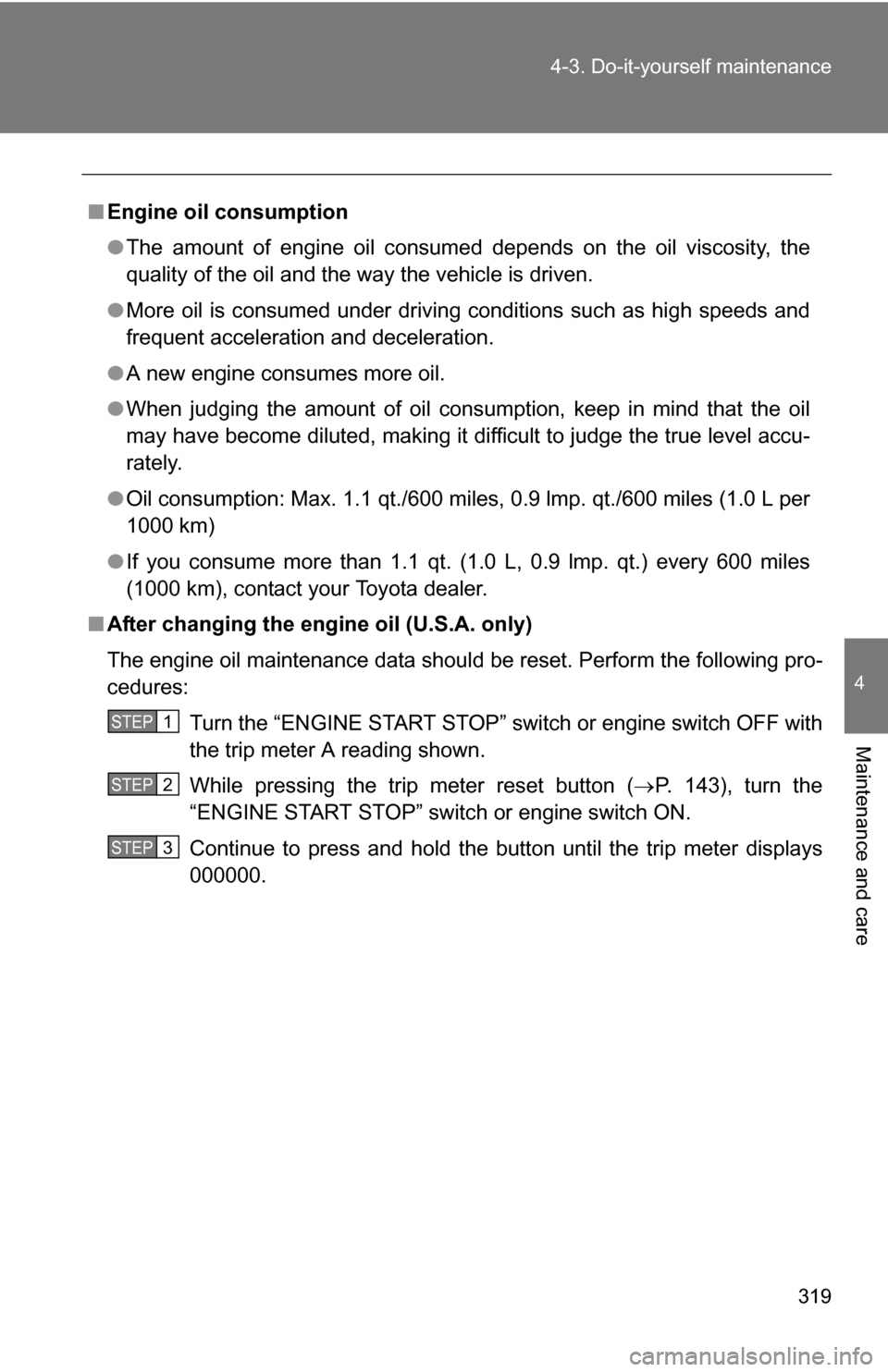
■ How to read oil container labels
The ILSAC (International Lubricant Standardization and Approval
Committee) Certification Mark is added to some oil containers to
help you select th e oil you should use.
STEP 3
Outside temperature
Page 319 of 476
319
4-3. Do-it-yourself maintenance
4
Maintenance and care
■
Engine oil consumption
●The amount of engine oil consumed depends on the oil viscosity, the
quality of the oil and the way the vehicle is driven.
● More oil is consumed under driving conditions such as high speeds and
frequent acceleration and deceleration.
● A new engine consumes more oil.
● When judging the amount of oil consumption, keep in mind that the oil
may have become diluted, making it difficult to judge the true level accu-
rately.
● Oil consumption: Max. 1.1 qt./600 miles, 0.9 lmp. qt./600 miles (1.0 L per
1000 km)
● If you consume more than 1.1 qt. (1.0 L, 0.9 lmp. qt.) every 600 miles
(1000 km), contact your Toyota dealer.
■ After changing the engine oil (U.S.A. only)
The engine oil maintenance data should be reset. Perform the following pro-
cedures:
Turn the “ENGINE START STOP” switch or engine switch OFF with
the trip meter A reading shown.
While pressing the trip meter reset button ( P. 143), turn the
“ENGINE START STOP” switch or engine switch ON.
Continue to press and hold the button until the trip meter displays
000000.
STEP 1
STEP 2
STEP 3
Page 320 of 476
320 4-3. Do-it-yourself maintenance
CAUTION
■Used engine oil
●Used engine oil contains potentially harmful contaminants which may
cause skin disorders such as inflammation or skin cancer, so care should
be taken to avoid prolonged and repeated contact. To remove used engine
oil from your skin, wash thoroughly with soap and water.
● Dispose of used oil and filters only in a safe and acceptable manner. Do
not dispose of used oil and filters in household trash, in sewers or onto the
ground. Call your Toyota dealer, service station or auto parts store for
information concerning recycling or disposal.
● Do not leave used engine oil within the reach of children.
NOTICE
■To prevent serious engine damage
Check the oil level on a regular basis.
■ When replacing the engine oil
●Be careful not to spill engine oil on the vehicle components.
● Avoid overfilling, as the engine could be damaged.
● Check the oil level on the dipstick every time you refill the vehicle.
● Be sure the engine oil filler cap is properly tightened.
Page 321 of 476
321
4-3. Do-it-yourself maintenance
4
Maintenance and care
Engine coolant
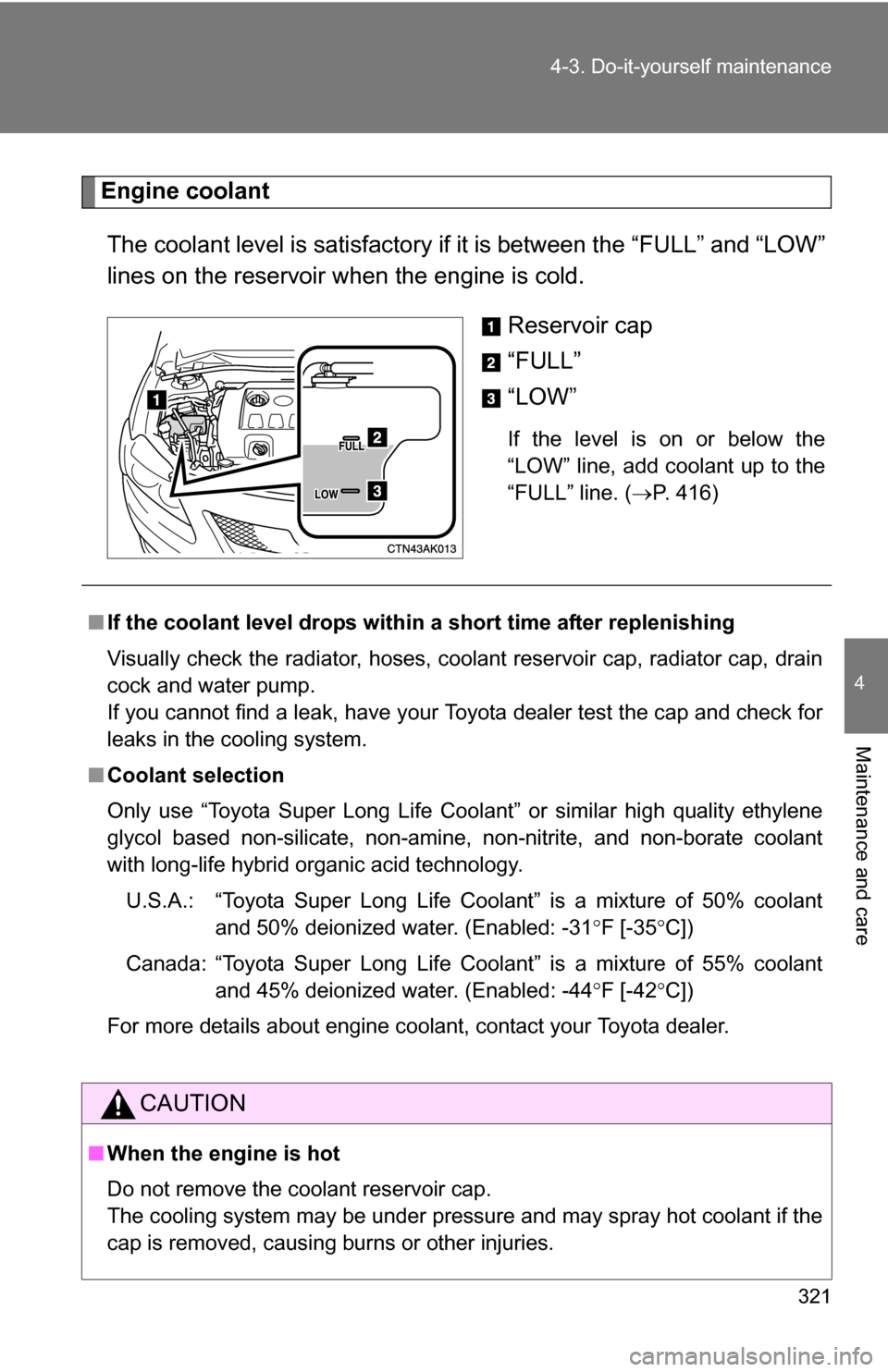
The coolant level is satisfactory if it is between the “FULL” and “LOW”
lines on the reservoir when the engine is cold.
Reservoir cap
“FULL”
“LOW”
If the level is on or below the
“LOW” line, add coolant up to the
“FULL” line. (P. 416)
■If the coolant level drops within a short time after replenishing
Visually check the radiator, hoses, coolant reservoir cap, radiator cap, drain
cock and water pump.
If you cannot find a leak, have your Toyota dealer test the cap and check for
leaks in the cooling system.
■ Coolant selection
Only use “Toyota Super Long Life Coolant” or similar high quality ethylene
glycol based non-silicate, non-amine, non-nitrite, and non-borate coolant
with long-life hybrid organic acid technology.
U.S.A.: “Toyota Super Long Life Coolant” is a mixture of 50% coolant and 50% deionized water. (Enabled: -31 F [-35 C])
Canada: “Toyota Super Long Life Coolant” is a mixture of 55% coolant and 45% deionized water. (Enabled: -44 F [-42 C])
For more details about engine coolant, contact your Toyota dealer.
CAUTION
■ When the engine is hot
Do not remove the coolant reservoir cap.
The cooling system may be under pressure and may spray hot coolant if the
cap is removed, causing burns or other injuries.
Page 322 of 476
322 4-3. Do-it-yourself maintenance
Radiator and condenserCheck the radiator and condenser and remove any foreign objects.
If any of the above parts are extr emely dirty or you are not sure of
their condition, have your vehicl e checked by your Toyota dealer.
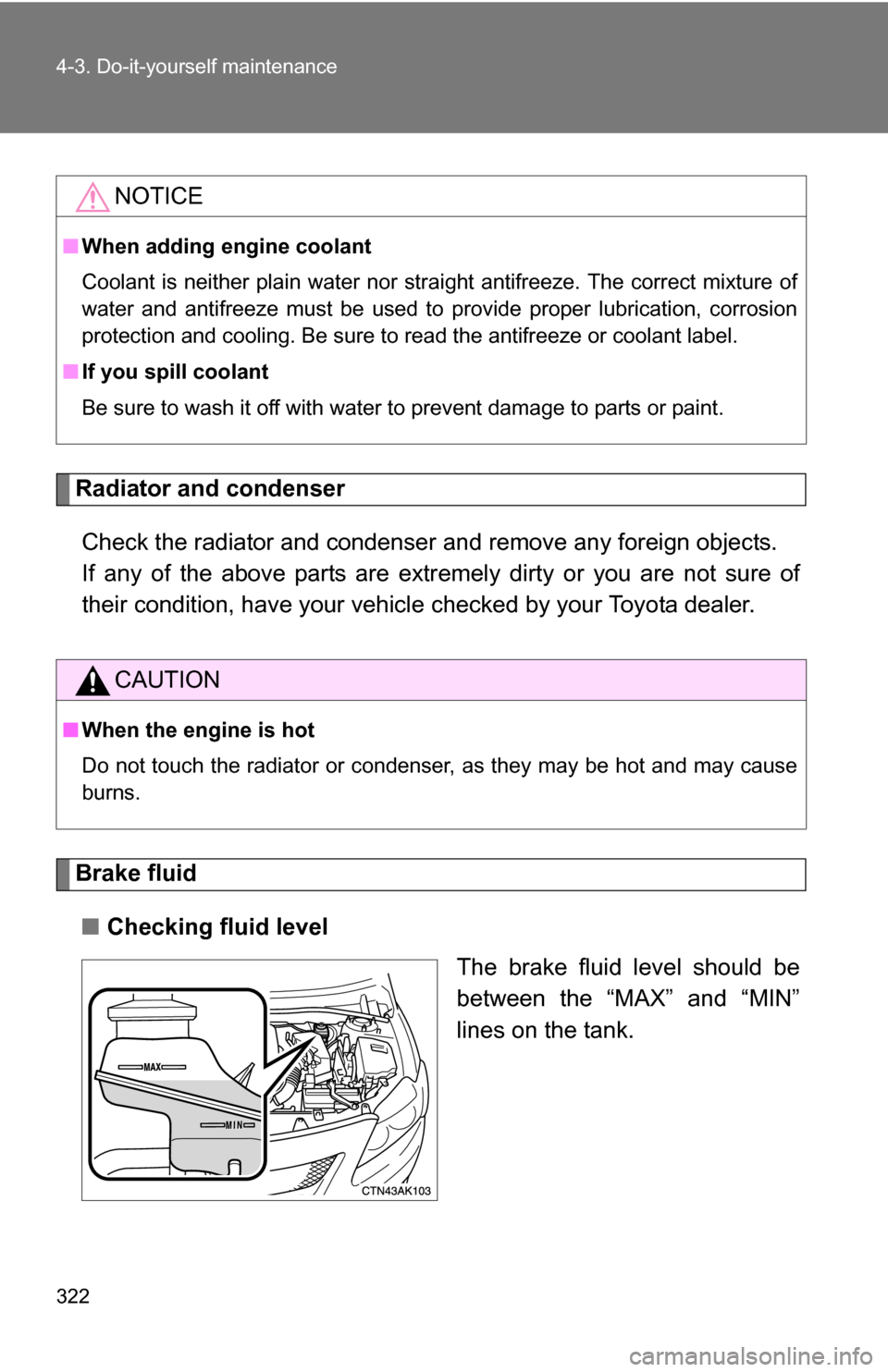
Brake fluid
■ Checking fluid level
The brake fluid level should be
between the “MAX” and “MIN”
lines on the tank.
NOTICE
■When adding engine coolant
Coolant is neither plain water nor stra ight antifreeze. The correct mixture of
water and antifreeze must be used to provide proper lubrication, corrosion
protection and cooling. Be sure to read the antifreeze or coolant label.
■ If you spill coolant
Be sure to wash it off with water to prevent damage to parts or paint.
CAUTION
■When the engine is hot
Do not touch the radiator or condenser, as they may be hot and may cause
burns.
Page 326 of 476
326 4-3. Do-it-yourself maintenance
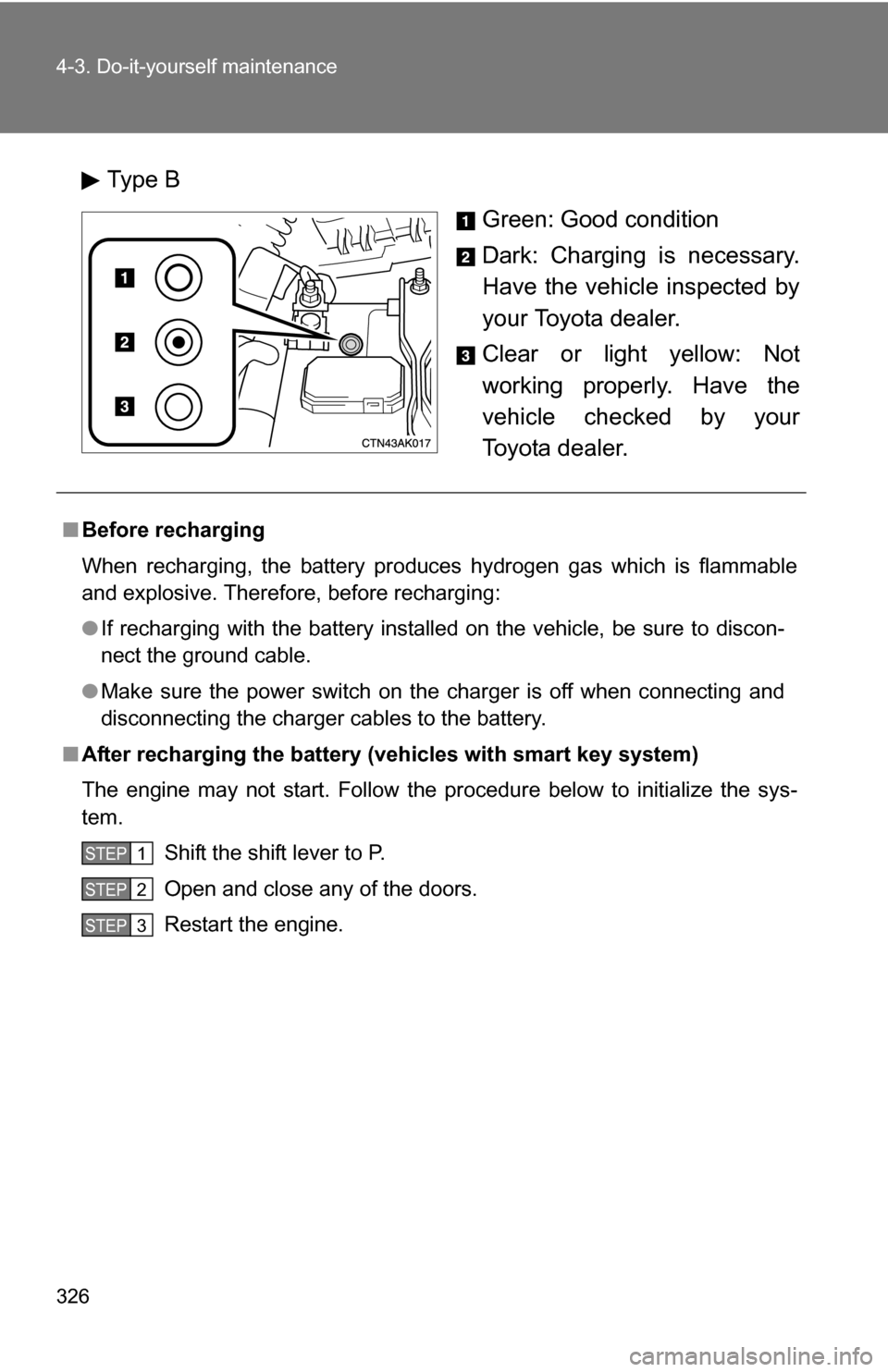
Type BGreen: Good condition
Dark: Charging is necessary.
Have the vehicle inspected by
your Toyota dealer.
Clear or light yellow: Not
working properly. Have the
vehicle checked by your
Toyota dealer.
■Before recharging
When recharging, the battery produces hydrogen gas which is flammable
and explosive. Therefore, before recharging:
●If recharging with the battery installed on the vehicle, be sure to discon-
nect the ground cable.
● Make sure the power switch on the charger is off when connecting and
disconnecting the charger cables to the battery.
■ After recharging the battery (vehicles with smart key system)
The engine may not start. Follow the procedure below to initialize the sys-
tem.
Shift the shift lever to P.
Open and close any of the doors.
Restart the engine.
STEP 1
STEP 2
STEP 3