cap TOYOTA COROLLA 2010 10.G User Guide
[x] Cancel search | Manufacturer: TOYOTA, Model Year: 2010, Model line: COROLLA, Model: TOYOTA COROLLA 2010 10.GPages: 476, PDF Size: 9.5 MB
Page 170 of 476
170
2-5. Driving information
Vehicle load limits
■Total load capacity and seating capacity
These details are also described on the tire and loading information
label. (P. 338)
CAUTION
■Overloading the vehicle
Do not overload the vehicle.
It may not only cause damage to the ti res, but also degrade steering and
braking ability, resulting in an accident.
Vehicle load limits include total load capacity, seating capacity,
towing capacity and cargo capacity.
■ Total load capacity: 825 lb. (370 kg)
Total load capacity means the combined weight of occupants, cargo
and luggage.
■Seating capacity: 5 occupants (Front 2, Rear 3)
Seating capacity means the maxi mum number of occupants whose
estimated average weight is 150 lb. (68 kg) per person.
■ Towing capacity: 1500 lb. (680 kg)
■ Cargo capacity
Cargo capacity may increase or decrease depending on the weight
and the number of occupants.
Page 176 of 476
176 2-5. Driving information
Towing a trailerContact your Toyota dealer for further information about additional
requirements such as a towing kit, etc.
HitchTrailer hitch assemblies have different weight capacities established
by the hitch manufacturer. Even th ough the vehicle may be rated for
towing a higher weight, the operat or must never exceed the maxi-
mum weight rating specified for the trailer hitch.
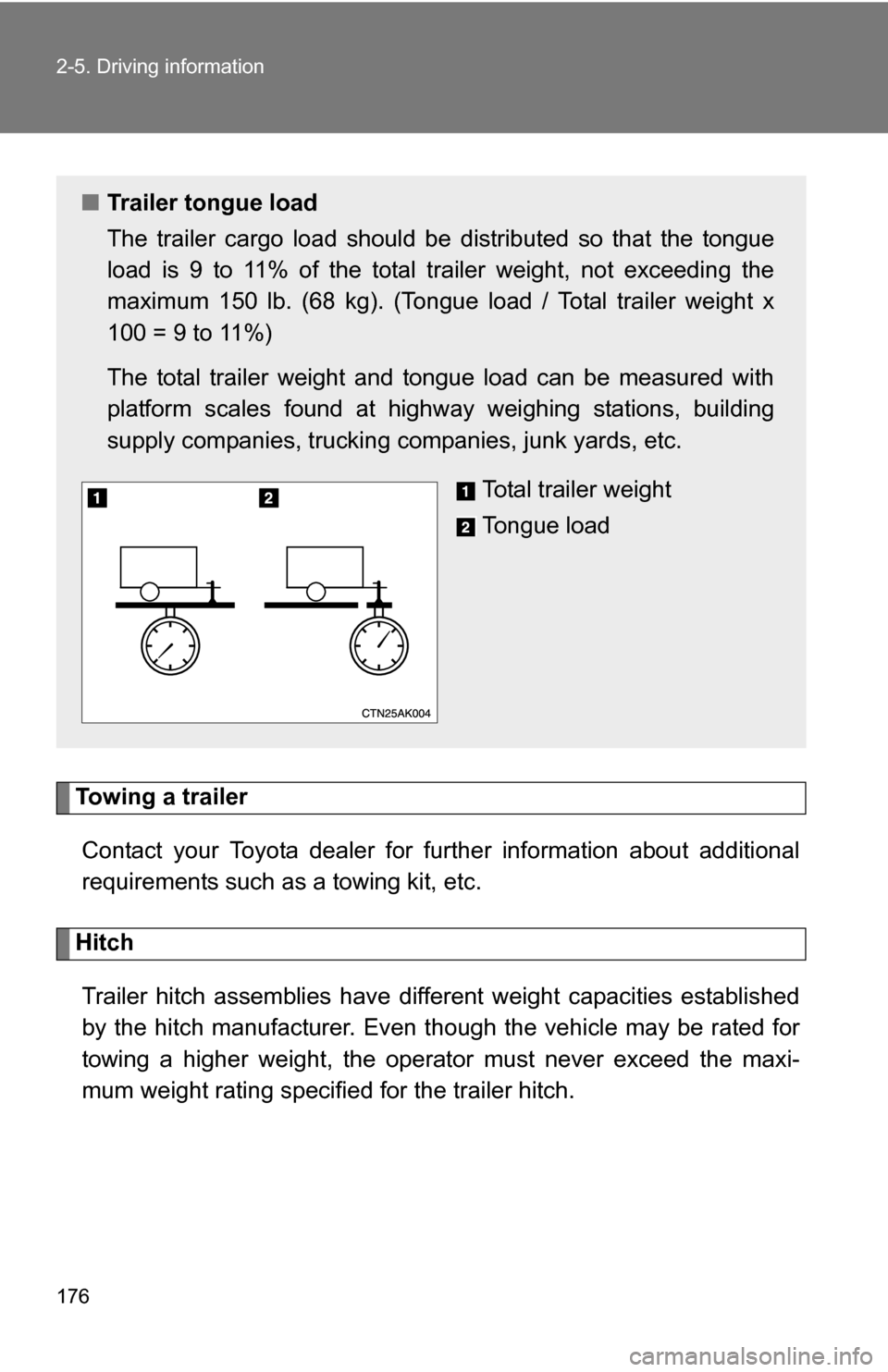
■ Trailer tongue load
The trailer cargo load should be distributed so that the tongue
load is 9 to 11% of the total trailer weight, not exceeding the
maximum 150 lb. (68 kg). (Tongue load / Total trailer weight x
100 = 9 to 11%)
The total trailer weight and tongue load can be measured with
platform scales found at high way weighing stations, building
supply companies, trucking co mpanies, junk yards, etc.
Total trailer weight
Tongue load
Page 178 of 476
178 2-5. Driving information
CAUTION
■To avoid accident or injury
●Do not exceed the trailer hitch assembly weight, gross vehicle weight,
gross axle weight and trailer tongue load capacities.
● Never load more weight in the back than in the front of the trailer. About
60% of the load should be in the front half of the trailer, and the remaining
40% in the rear.
■ Hitches
●Use only a hitch that conforms to the total trailer weight requirement.
● Follow the directions supplied by the hitch manufacturer.
● Lubricate the hitch ball with a light coat of grease.
● Remove the trailer hitch whenever you are not towing a trailer. After
removing the hitch, seal any mounting hole in the vehicle body to prevent
entry of any substances into the vehicle.
■ When towing a trailer
●If the gross trailer weight exceeds 1000 lb. (453 kg), trailer brakes are
required. Toyota recommends trailers with brakes that conform to all appli-
cable federal and state/provincial regulations.
● Never tap into your vehicle's hydraulic system, as this will lower the vehi-
cle's braking effectiveness.
● Never tow a trailer without using a safety chain securely attached to both
the trailer and the vehicle. If damage occurs to the coupling unit or hitch
ball, there is danger of the trailer wandering into another lane.
Page 278 of 476
278
3-6. Other interior features
Grocer y bag hook
NOTICE
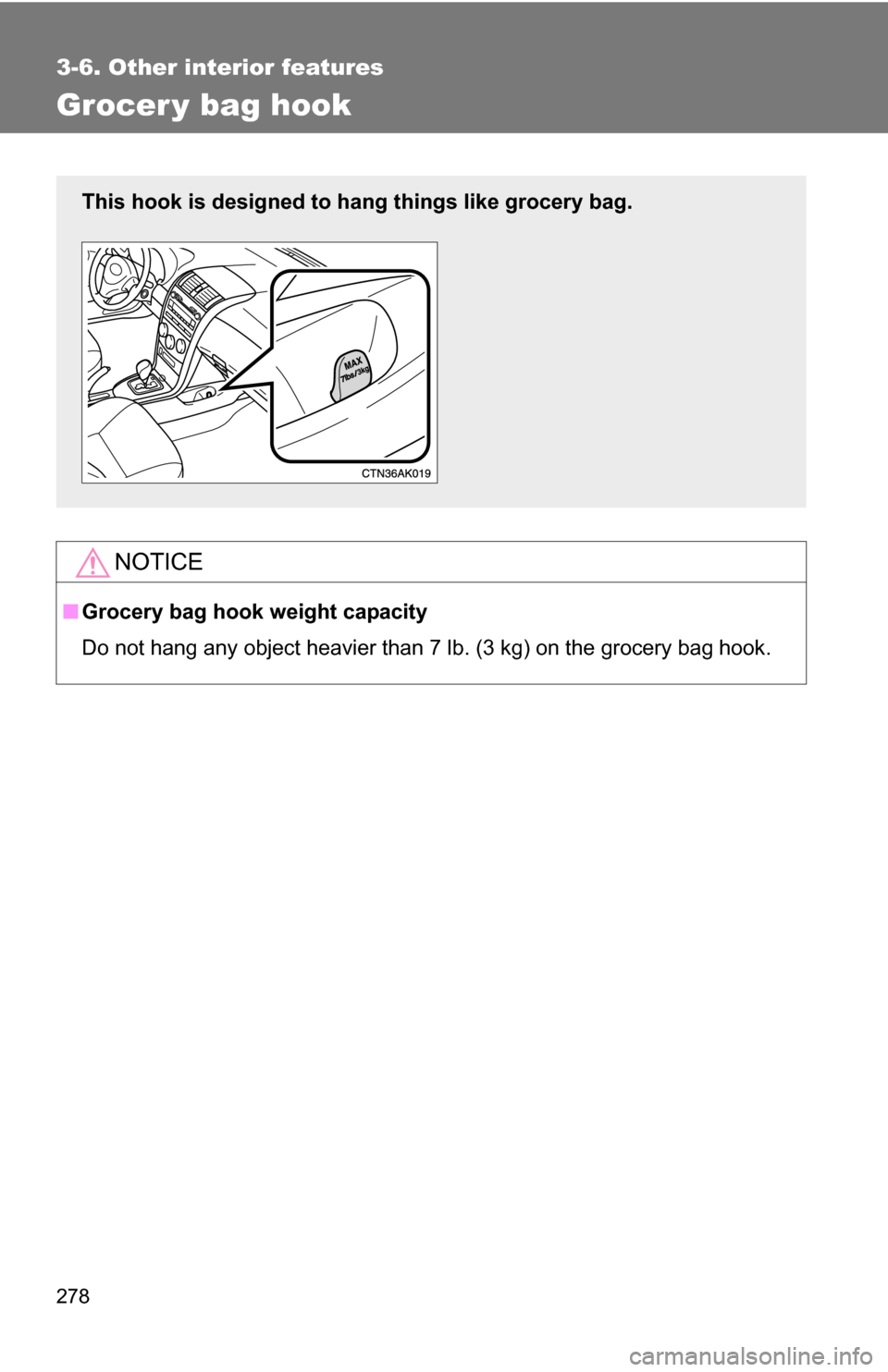
■Grocery bag hook weight capacity
Do not hang any object heavier than 7 lb. (3 kg) on the grocery bag hook.
This hook is designed to hang things like grocery bag.
Page 304 of 476
304
4-2. Maintenance
Emission inspection and maintenance (I/M) programs
Some states have vehicle emission inspection programs which
include OBD (On Board Diagnostics) checks. The OBD system moni-
tors the operation of th e emission control system.
■If the malfunction indicator lamp comes on
The OBD system determines that a problem exists somewhere
in the emission control system. Your vehicle may not pass the I/
M test and may need to be repaired. Contact your Toyota dealer
to service the vehicle.
■ Your vehicle may not pass the I/M test:
●When the battery is disconnected or discharged
Readiness codes that are se t during ordinary driving are
erased.
Also, depending on your driving habits, the readiness codes
may not be completely set.
● When the fuel tank cap is loose
The malfunction indicator lamp comes on as a temporary mal-
function and your vehicle may not pass the I/M test.
■ When the malfunction indicator lamp goes off after several
driving trips
The error code in the OBD system will not be cleared unless the
vehicle is driven 40 or more times.
■ If your vehicle does not pass the I/M test
Contact your Toyota dealer to prepare the vehicle for re-testing.
Page 314 of 476
314
4-3. Do-it-yourself maintenance
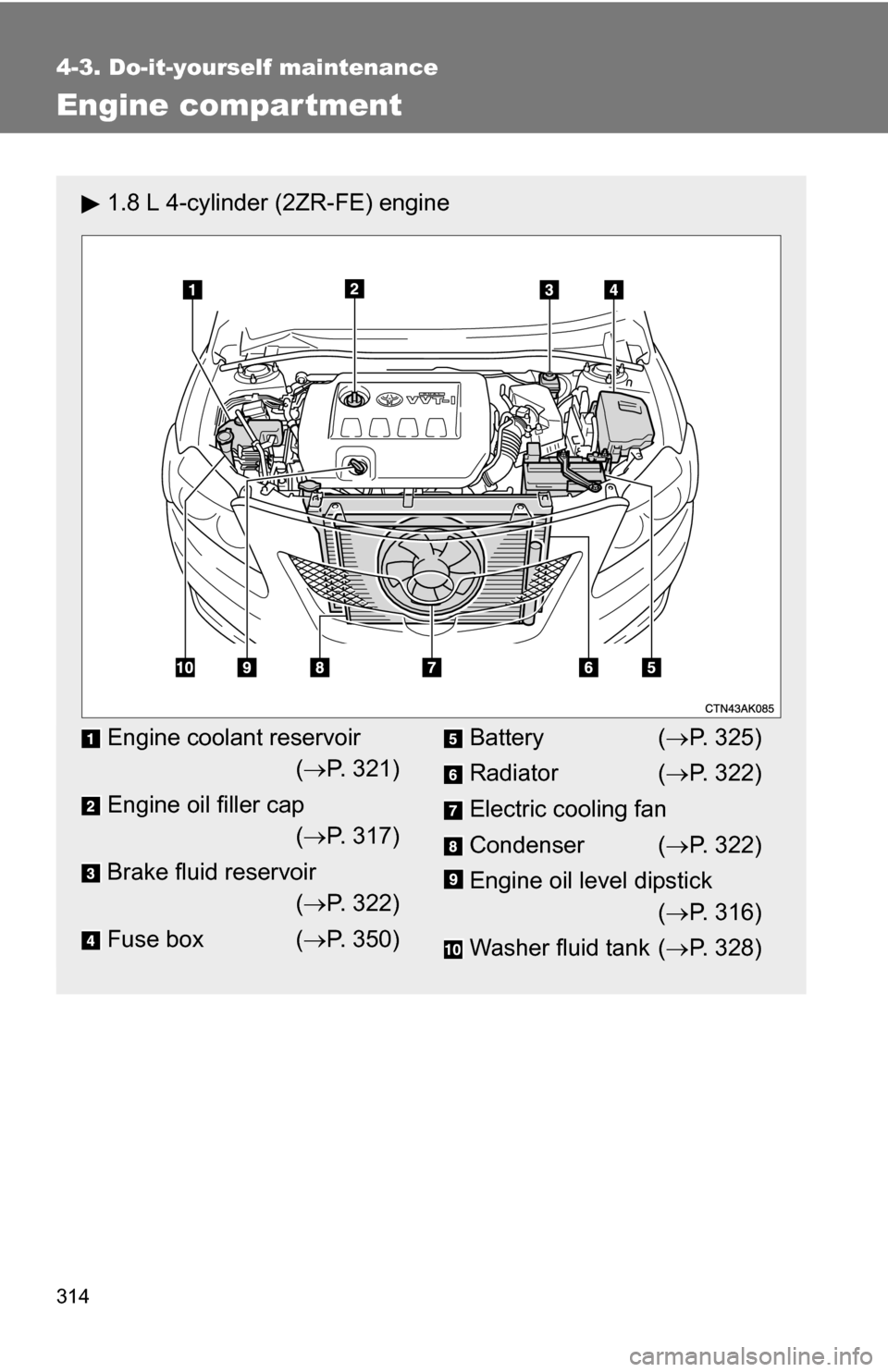
Engine compar tment
1.8 L 4-cylinder (2ZR-FE) engine
Engine coolant reservoir( P. 321)
Engine oil filler cap ( P. 317)
Brake fluid reservoir ( P. 322)
Fuse box ( P. 350)Battery ( P. 325)
Radiator ( P. 322)
Electric cooling fan
Condenser ( P. 322)
Engine oil level dipstick ( P. 316)
Washer fluid tank ( P. 328)
Page 315 of 476
315
4-3. Do-it-yourself maintenance
4
Maintenance and care
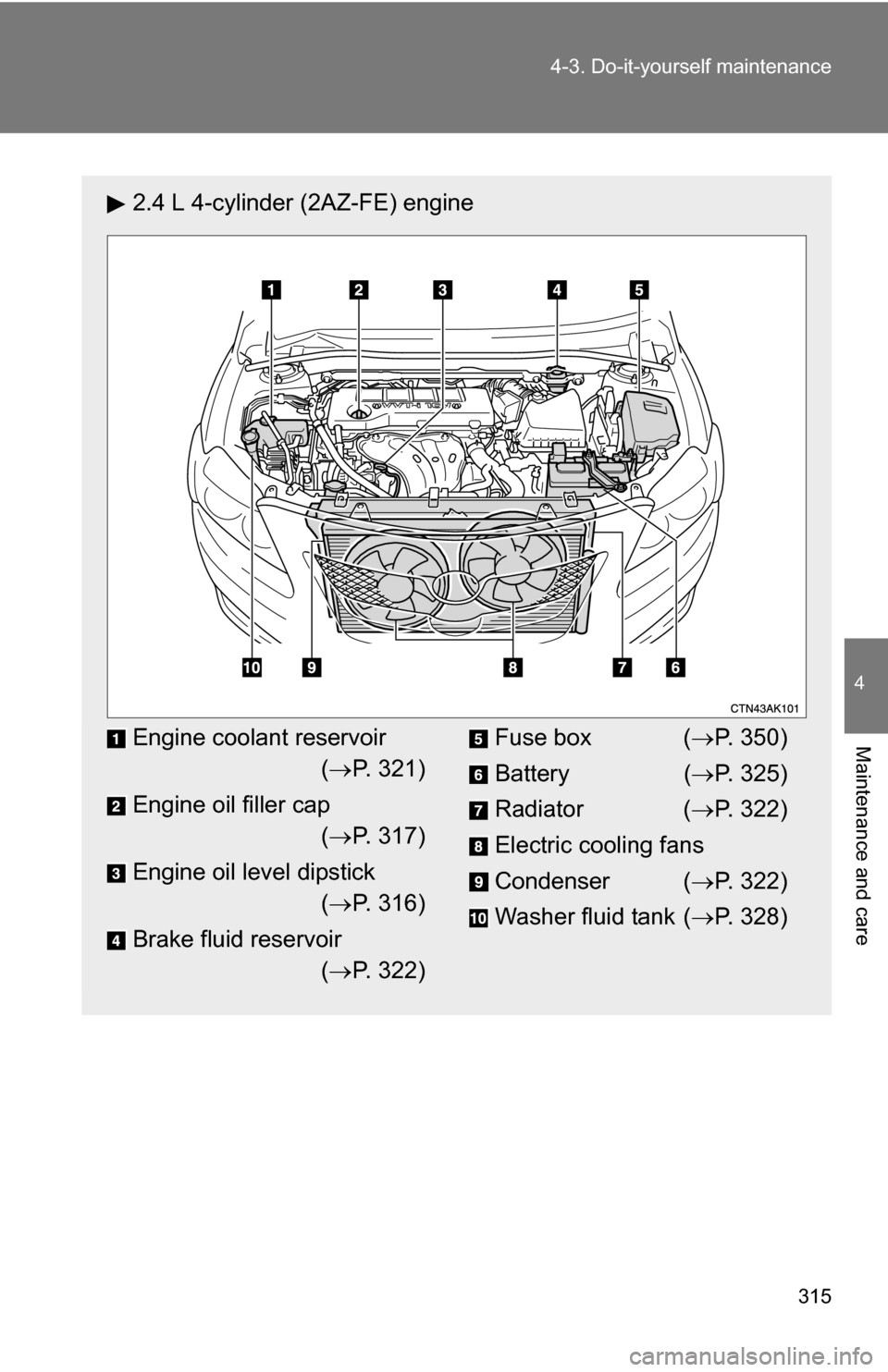
2.4 L 4-cylinder (2AZ-FE) engine
Engine coolant reservoir
( P. 321)
Engine oil filler cap ( P. 317)
Engine oil level dipstick ( P. 316)
Brake fluid reservoir ( P. 322)Fuse box ( P. 350)
Battery ( P. 325)
Radiator ( P. 322)
Electric cooling fans
Condenser ( P. 322)
Washer fluid tank ( P. 328)
Page 317 of 476
317
4-3. Do-it-yourself maintenance
4
Maintenance and care
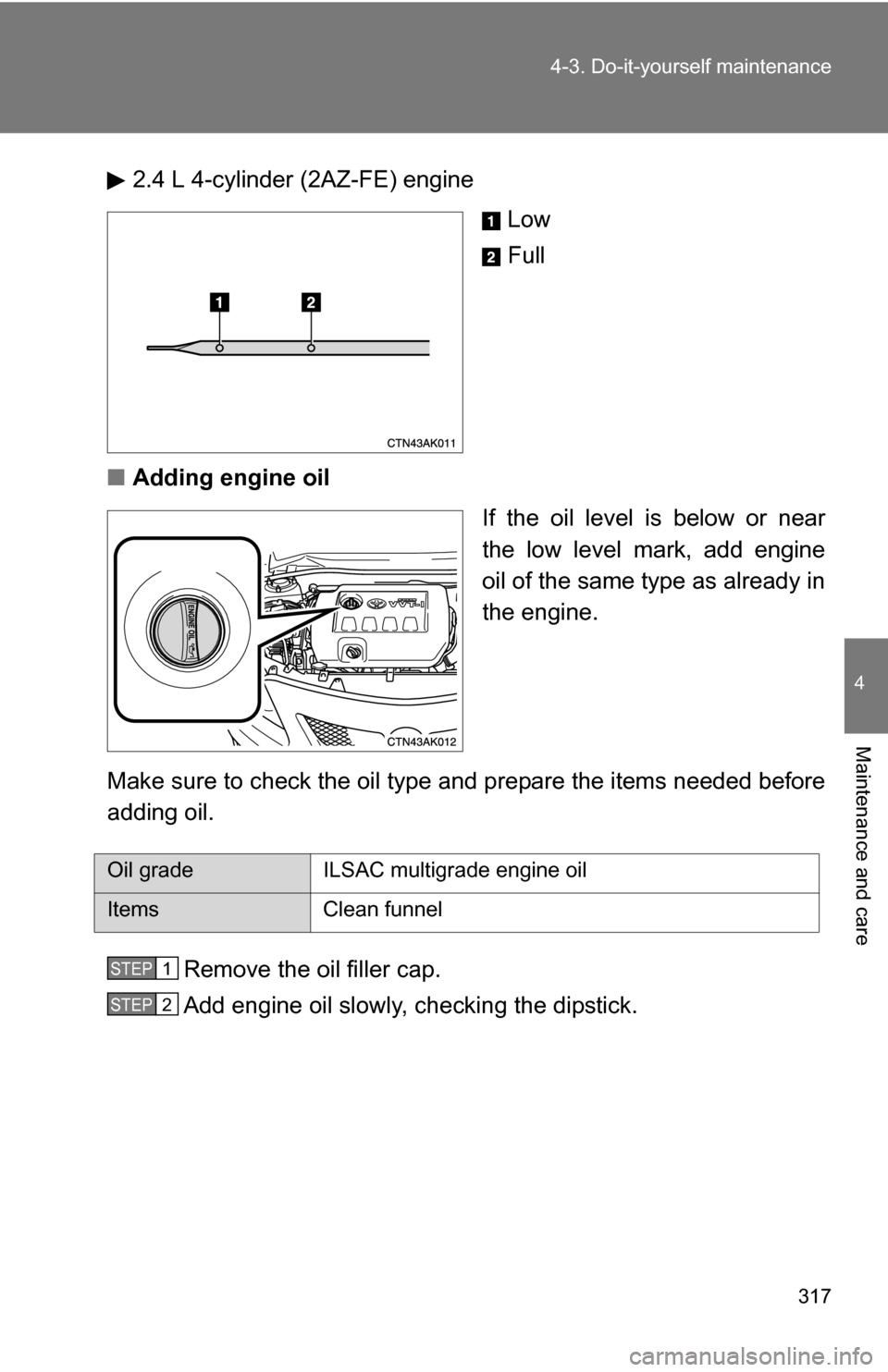
2.4 L 4-cylinder (2AZ-FE) engine
Low
Full
■ Adding engine oil
If the oil level is below or near
the low level mark, add engine
oil of the same type as already in
the engine.
Make sure to check the oil type and prepare the items needed before
adding oil. Remove the oil filler cap.
Add engine oil slowly, checking the dipstick.
Oil grade ILSAC multigrade engine oil
Items Clean funnel
STEP 1
STEP 2
Page 318 of 476
318 4-3. Do-it-yourself maintenance
Install the filler cap, turning it clockwise.
The approximate quantity of oil needed to raise the level between low and
full on the dipstick is indicated as follows:
1.8 L 4-cylinder (2ZR-FE) engine
1.6 qt. (1.5 L, 1.3 lmp. qt.)
2.4 L 4-cylinder (2AZ-FE) engine
1.1 qt. (1.0 L, 0.9 lmp. qt.)
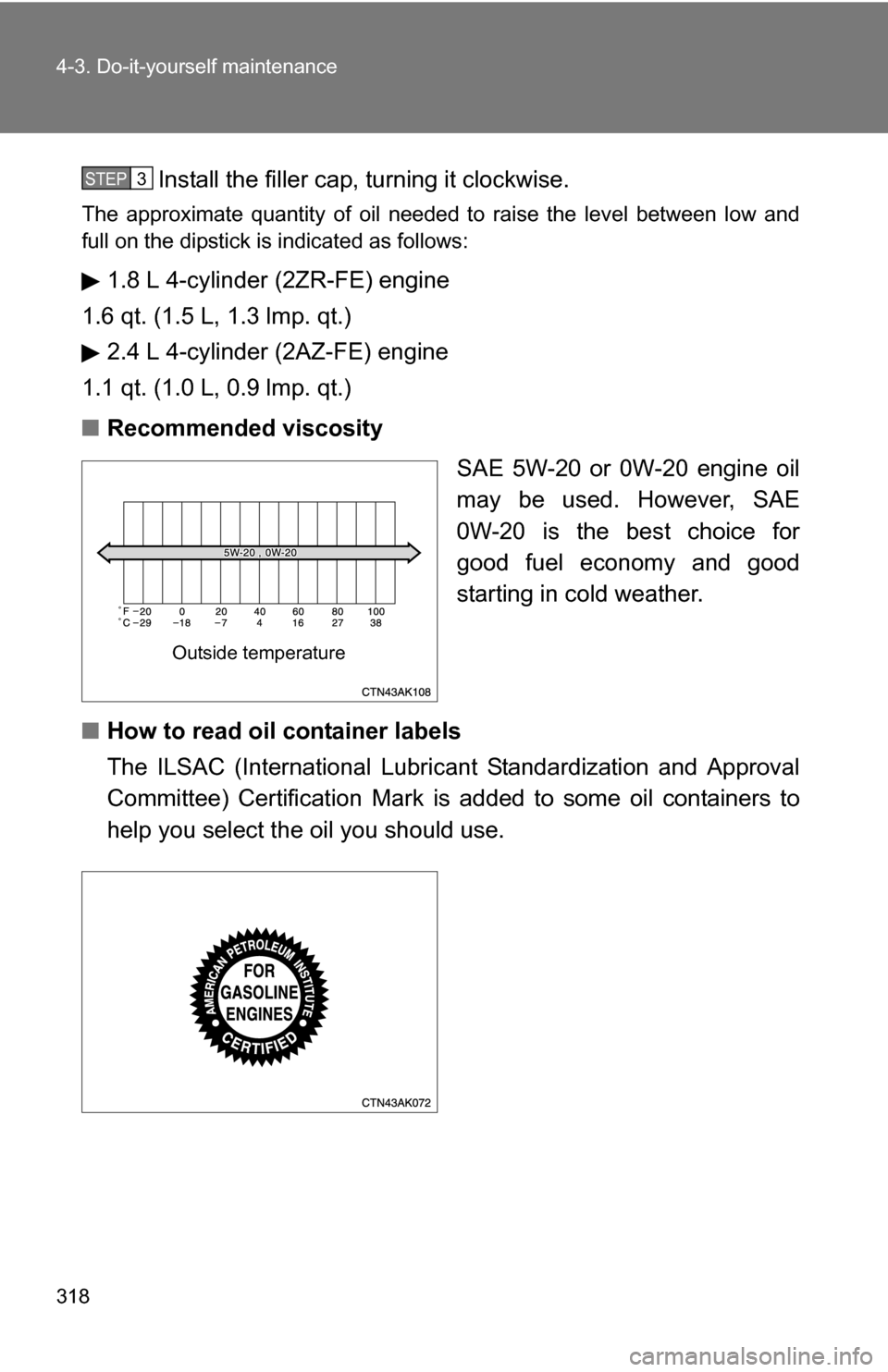
■ Recommended viscosity
SAE 5W-20 or 0W-20 engine oil
may be used. However, SAE
0W-20 is the best choice for
good fuel economy and good
starting in cold weather.
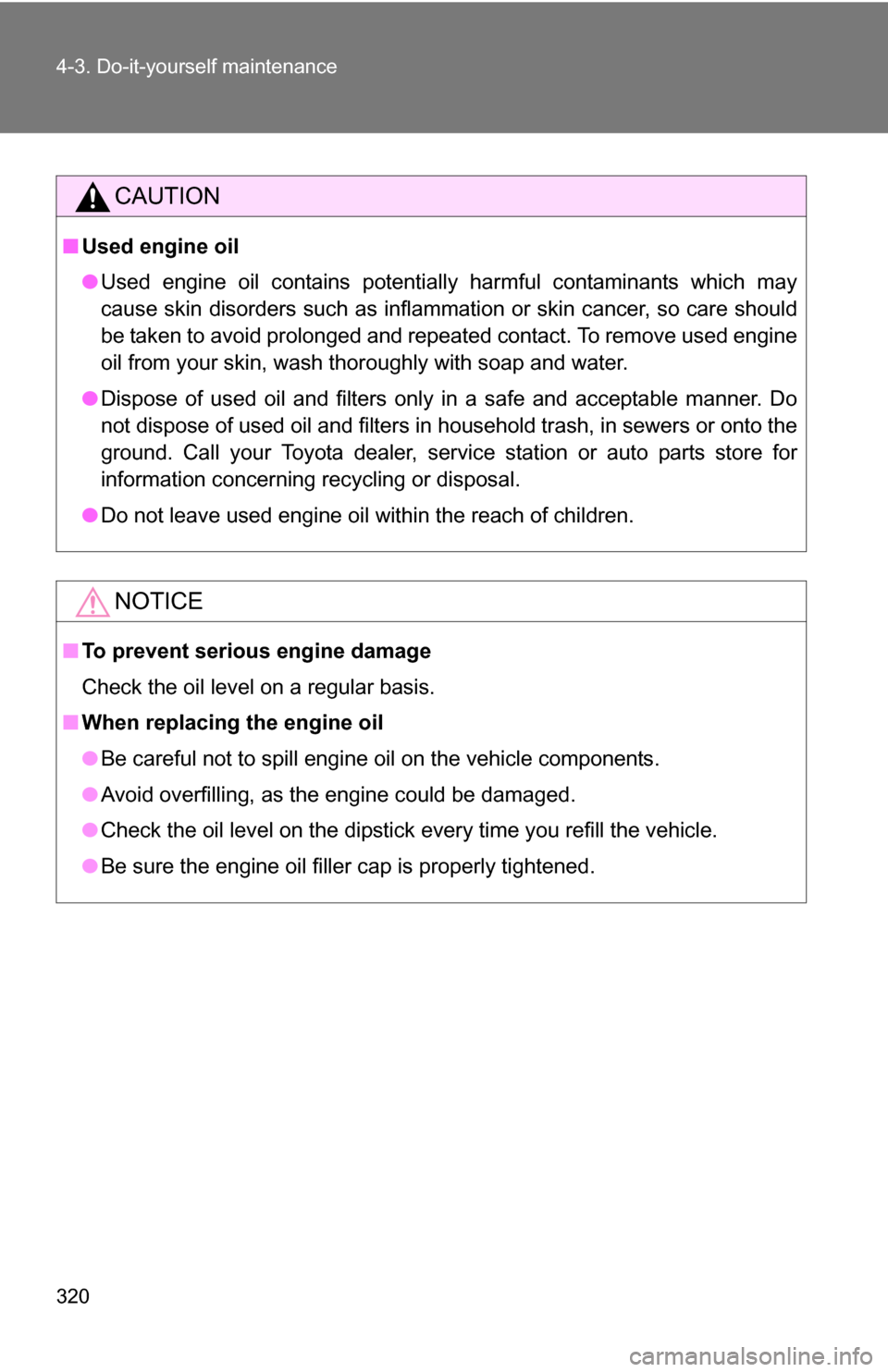
■ How to read oil container labels
The ILSAC (International Lubricant Standardization and Approval
Committee) Certification Mark is added to some oil containers to
help you select th e oil you should use.
STEP 3
Outside temperature
Page 320 of 476
320 4-3. Do-it-yourself maintenance
CAUTION
■Used engine oil
●Used engine oil contains potentially harmful contaminants which may
cause skin disorders such as inflammation or skin cancer, so care should
be taken to avoid prolonged and repeated contact. To remove used engine
oil from your skin, wash thoroughly with soap and water.
● Dispose of used oil and filters only in a safe and acceptable manner. Do
not dispose of used oil and filters in household trash, in sewers or onto the
ground. Call your Toyota dealer, service station or auto parts store for
information concerning recycling or disposal.
● Do not leave used engine oil within the reach of children.
NOTICE
■To prevent serious engine damage
Check the oil level on a regular basis.
■ When replacing the engine oil
●Be careful not to spill engine oil on the vehicle components.
● Avoid overfilling, as the engine could be damaged.
● Check the oil level on the dipstick every time you refill the vehicle.
● Be sure the engine oil filler cap is properly tightened.