Speed TOYOTA COROLLA 2016 11.G Workshop Manual
[x] Cancel search | Manufacturer: TOYOTA, Model Year: 2016, Model line: COROLLA, Model: TOYOTA COROLLA 2016 11.GPages: 620, PDF Size: 9.12 MB
Page 393 of 620

3936-1. Using the air conditioning system and defogger
6
Interior features
COROLLA_TMMMS_TMMC_U (OM12J84U)n
Fan speed setting
Press “
” on to increase the fan speed.
Press “ ” on to decrease the fan speed.
nChange the airflow mode
To change the airflow, press “ ” or “” on .
The air outlets used are switched each time either side of the button is
pressed.
n
Other functions
l Switching between outside air and recirculated air modes
( P. 387)
l Defogging the windshield ( P. 387)
l Defogging the rear window and outside rear view mirrors
( P. 387)
Page 394 of 620
3946-1. Using the air conditioning system and defogger
COROLLA_TMMMS_TMMC_U (OM12J84U)
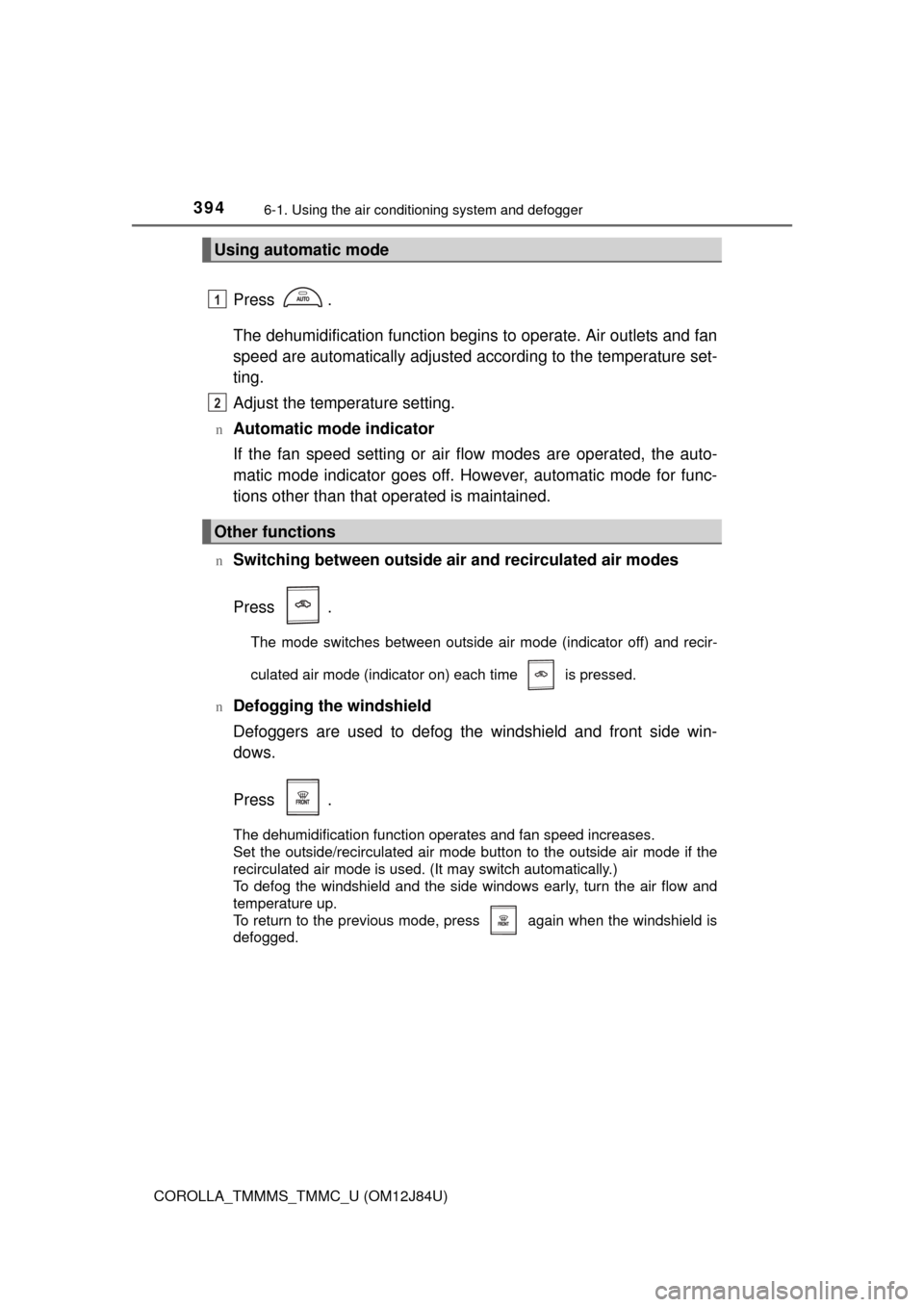
Press .
The dehumidification function begins to operate. Air outlets and fan
speed are automatically adjusted according to the temperature set-
ting.
Adjust the temperature setting.
nAutomatic mode indicator
If the fan speed setting or air fl ow modes are operated, the auto-
matic mode indicator goes off. However, automatic mode for func-
tions other than that operated is maintained.
nSwitching between outside air and recirculated air modes
Press .
The mode switches between outside air mode (indicator off) and recir-
culated air mode (indicator on) each time is pressed.
n
Defogging the windshield
Defoggers are used to defog the windshield and front side win-
dows.
Press .
The dehumidification function operates and fan speed increases.
Set the outside/recirculated air mode button to the outside air mode if the
recirculated air mode is used. (It may switch automatically.)
To defog the windshield and the side windows early, turn the air flow and
temperature up.
To return to the previous mode, press again when the windshield is
defogged.
Using automatic mode
Other functions
1
2
Page 397 of 620
3976-1. Using the air conditioning system and defogger
6
Interior features
COROLLA_TMMMS_TMMC_U (OM12J84U)
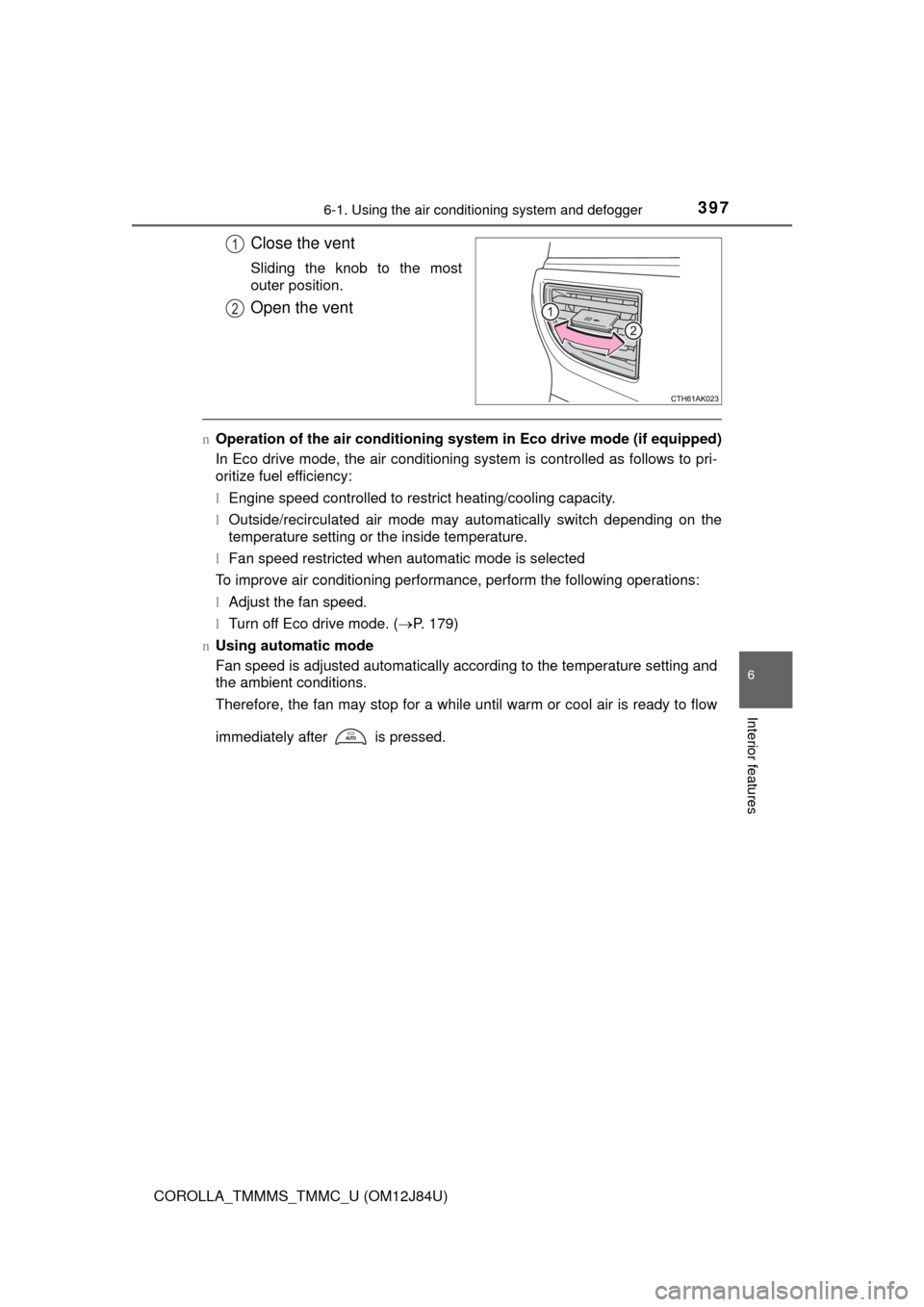
Close the vent
Sliding the knob to the most
outer position.
Open the vent
nOperation of the air conditioning system in Eco drive mode (if equipped)
In Eco drive mode, the air conditioning system is controlled as follows to pri-
oritize fuel efficiency:
l Engine speed controlled to restrict heating/cooling capacity.
l Outside/recirculated air mode may automatically switch depending on the
temperature setting or the inside temperature.
l Fan speed restricted when automatic mode is selected
To improve air conditioning performance, perform the following operations:
l Adjust the fan speed.
l Turn off Eco drive mode. ( P. 179)
n Using automatic mode
Fan speed is adjusted automatically according to the temperature setting and
the ambient conditions.
Therefore, the fan may stop for a while until warm or cool air is ready to flow
immediately after is pressed.
1
2
Page 410 of 620
4106-4. Other interior features
COROLLA_TMMMS_TMMC_U (OM12J84U)
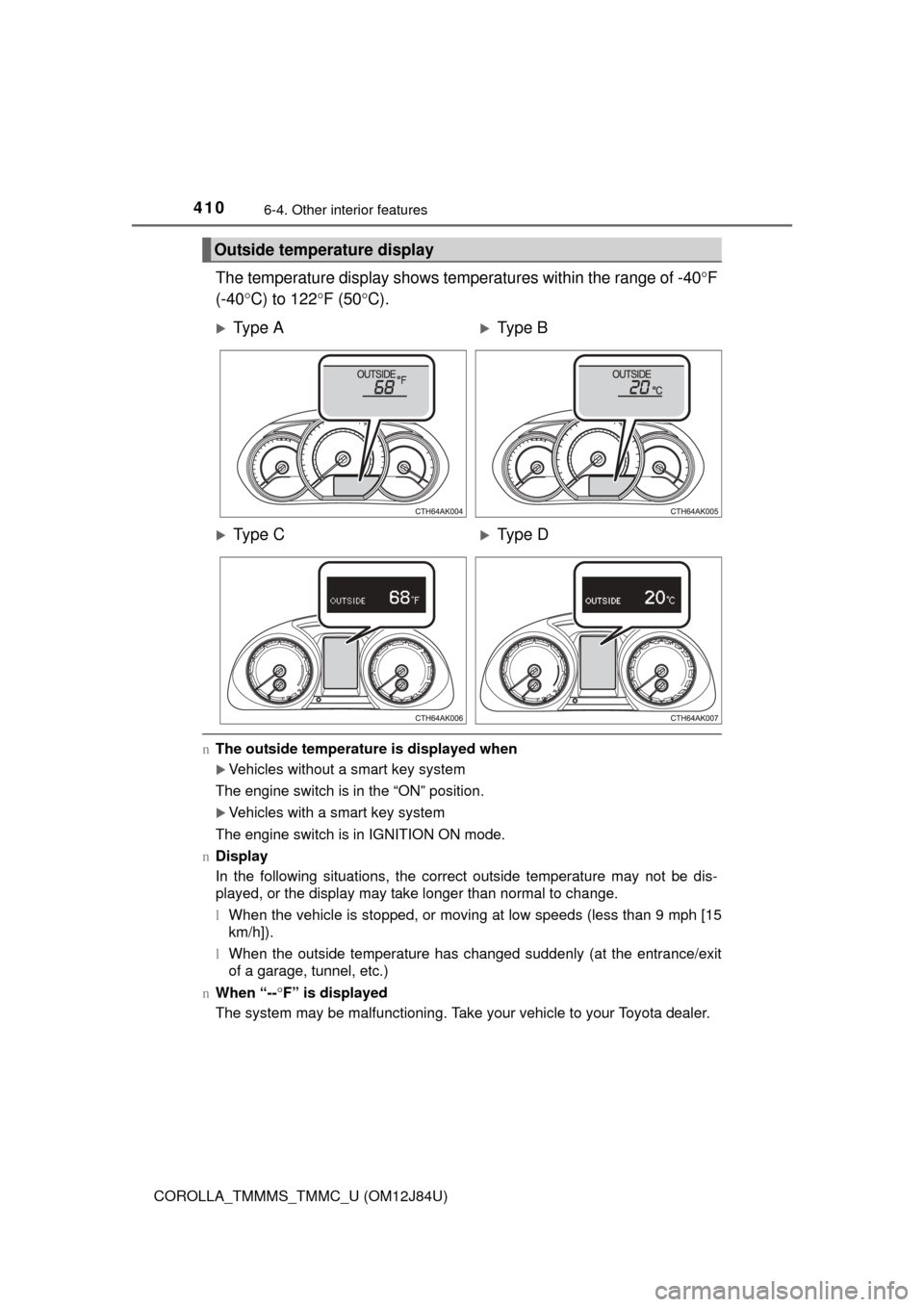
The temperature display shows temperatures within the range of -40F
(-40 C) to 122 F (50C).
n The outside temperature is displayed when
Vehicles without a smart key system
The engine switch is in the “ON” position.
Vehicles with a smart key system
The engine switch is in IGNITION ON mode.
n Display
In the following situations, the correct outside temperature may not be dis-
played, or the display may take longer than normal to change.
lWhen the vehicle is stopped, or moving at low speeds (less than 9 mph [15
km/h]).
l When the outside temperature has changed suddenly (at the entrance/exit
of a garage, tunnel, etc.)
n When “-- F” is displayed
The system may be malfunctioning. Take your vehicle to your Toyota dealer.
Outside temperature display
Ty p e AType B
Ty p e CType D
Page 445 of 620

4457-3. Do-it-yourself maintenance
7
Maintenance and care
COROLLA_TMMMS_TMMC_U (OM12J84U)
nEngine oil consumption
A certain amount of engine oil will be consumed while driving. In the following
situations, oil consumption may increase, and engine oil may need to be
refilled in between oil maintenance intervals.
lWhen the engine is new, for example directly after purchasing the vehicle or
after replacing the engine
l If low quality oil or oil of an inappropriate viscosity is used
l When driving at high engine speeds or with a heavy load, or when driving
while accelerating or decelerating frequently
l When leaving the engine idling for a long time, or when driving frequently
through heavy traffic
CAUTION
n Used engine oil
lUsed engine oil contains potentially harmful contaminants which may
cause skin disorders such as inflammation and skin cancer, so care
should be taken to avoid prolonged and repeated contact. To remove used
engine oil from your skin, wash thoroughly with soap and water.
l Dispose of used oil and filters only in a safe and acceptable manner. Do
not dispose of used oil and filters in household trash, in sewers or onto the
ground.
Call your Toyota dealer, service station or auto parts store for information
concerning recycling or disposal.
l Do not leave used engine oil within the reach of children.
NOTICE
nTo prevent serious engine damage
Check the oil level on a regular basis.
n When replacing the engine oil
lBe careful not to spill engine oil on the vehicle components.
l Avoid overfilling, or the engine could be damaged.
l Check the oil level on the dipstick every time you refill the vehicle.
l Be sure the engine oil filler cap is properly tightened.
Page 455 of 620

4557-3. Do-it-yourself maintenance
7
Maintenance and care
COROLLA_TMMMS_TMMC_U (OM12J84U)
Your vehicle is equipped with a tire pressure warning system that uses
tire pressure warning valves and tr ansmitters to detect low tire infla-
tion pressure before serious problems arise. ( P. 498)
uInstalling tire pressure warning valves and transmitters
When replacing tires or wheels, tire pressure warning valves and
transmitters must also be installed.
When new tire pressure warning valves and transmitters are
installed, new ID codes must be registered in the tire pressure
warning computer and the tire pr essure warning system must be
initialized. Have tire pressure warning valves and transmitter ID
codes registered by your Toyota dealer. ( P. 457)
uInitializing the tire pressure warning system
nThe tire pressure warning system must be initialized in the fol-
lowing circumstances:
l When changing the tire size.
l When the tire inflation pressure is changed such as when chang-
ing traveling speed or load weight.
When the tire pressure warning system is initialized, the current tire
inflation pressure is set as the benchmark pressure.
Tire pressure warning system (if equipped)
Page 457 of 620

4577-3. Do-it-yourself maintenance
7
Maintenance and care
COROLLA_TMMMS_TMMC_U (OM12J84U)
uRegistering ID codes
The tire pressure warning valve and transmitter is equipped with a
unique ID code. When replacing a tire pressure warning valve and
transmitter, it is necessary to register the ID code. Have the ID code
registered by your Toyota dealer.
nWhen to replace your vehicle’s tires
Tires should be replaced if:
lThe treadwear indicators are showing on a tire.
lYou have tire damage such as cuts, splits, cracks deep enough to
expose the fabric, and bulges indicating internal damage
lA tire goes flat repeatedly or cannot be properly repaired due to the size
or location of a cut or other damage
If you are not sure, consult with your Toyota dealer.
nReplacing tires and wheels (vehicles with a tire pressure warning
system)
If the ID code of the tire pressure warning valve and transmitter is not reg-
istered, the tire pressure warning system will not work properly. After driv-
ing for about 20 minutes, the tire pressure warning light blinks for 1
minute and stays on to indicate a system malfunction.
nTire life
Any tire over 6 years old must be checked by a qualified technician even
if it has seldom or never been used or damage is not obvious.
nRoutine tire inflation pressure checks (vehicles with a tire pressure
warning system)
The tire pressure warning system does not replace routine tire inflation
pressure checks. Make sure to check tire inflation pressure as part of
your routine of daily vehicle checks.
nLow profile tires (17-inch tires)
Generally, low profile tires will wear mo re rapidly and tire grip perfor-
mance will be reduced on snowy and /or icy roads when compared to
standard tires. Be sure to use snow tires or tire chains on snowy and/or
icy roads and drive carefully at a speed appropriate for road and weather
conditions.
Page 458 of 620
4587-3. Do-it-yourself maintenance
COROLLA_TMMMS_TMMC_U (OM12J84U)n
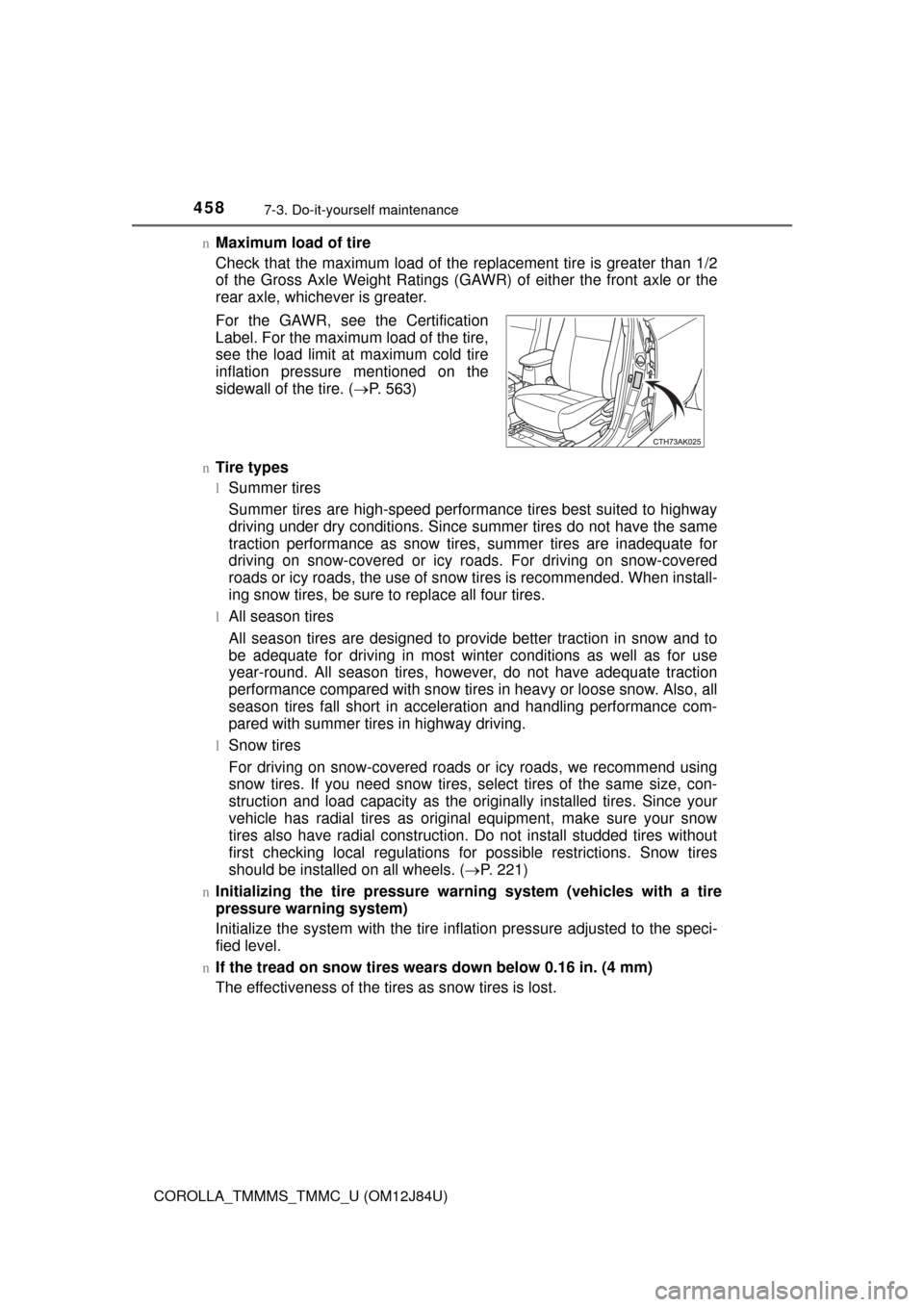
Maximum load of tire
Check that the maximum load of the re
placement tire is greater than 1/2
of the Gross Axle Weight Ratings (GAWR) of either the front axle or the
rear axle, whichever is greater.
nTire types
lSummer tires
Summer tires are high-speed performance tires best suited to highway
driving under dry conditions. Since summer tires do not have the same
traction performance as snow tires, summer tires are inadequate for
driving on snow-covered or icy ro ads. For driving on snow-covered
roads or icy roads, the use of snow tires is recommended. When install-
ing snow tires, be sure to replace all four tires.
lAll season tires
All season tires are designed to provide better traction in snow and to
be adequate for driving in most winter conditions as well as for use
year-round. All season tires, however, do not have adequate traction
performance compared with snow tires in heavy or loose snow. Also, all
season tires fall short in acceleration and handling performance com-
pared with summer tires in highway driving.
lSnow tires
For driving on snow-covered roads or icy roads, we recommend using
snow tires. If you need snow tires, select tires of the same size, con-
struction and load capacity as the or iginally installed tires. Since your
vehicle has radial tires as original equipment, make sure your snow
tires also have radial construction. Do not install studded tires without
first checking local regulations fo r possible restrictions. Snow tires
should be installed on all wheels. ( P. 221)
nInitializing the tire pressure warn ing system (vehicles with a tire
pressure warning system)
Initialize the system with the tire infl ation pressure adjusted to the speci-
fied level.
nIf the tread on snow tires wears down below 0.16 in. (4 mm)
The effectiveness of the tire s as snow tires is lost.
For the GAWR, see the Certification
Label. For the maximum load of the tire,
see the load limit at maximum cold tire
inflation pressure mentioned on the
sidewall of the tire. (
P. 563)
Page 489 of 620
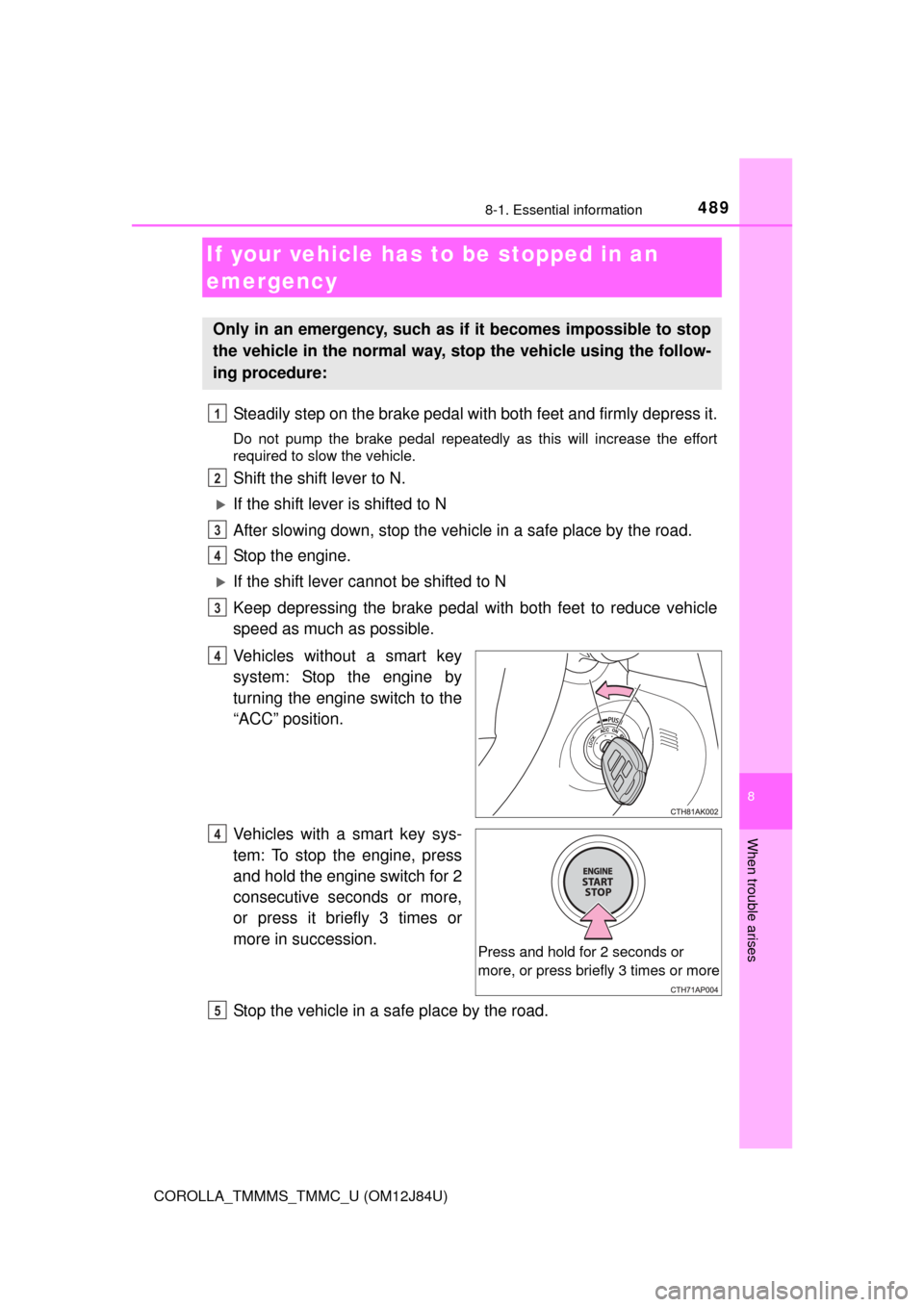
4898-1. Essential information
8
When trouble arises
COROLLA_TMMMS_TMMC_U (OM12J84U)
Steadily step on the brake pedal with both feet and firmly depress it.
Do not pump the brake pedal repeatedly as this will increase the effort
required to slow the vehicle.
Shift the shift lever to N.
If the shift lever is shifted to N
After slowing down, stop the vehicle in a safe place by the road.
Stop the engine.
If the shift lever cannot be shifted to N
Keep depressing the brake pedal with both feet to reduce vehicle
speed as much as possible.
Vehicles without a smart key
system: Stop the engine by
turning the engine switch to the
“ACC” position.
Vehicles with a smart key sys-
tem: To stop the engine, press
and hold the engine switch for 2
consecutive seconds or more,
or press it briefly 3 times or
more in succession.
Stop the vehicle in a safe place by the road.
If your vehicle has to be stopped in an
emergency
Only in an emergency, such as if it becomes impossible to stop
the vehicle in the normal way, st op the vehicle using the follow-
ing procedure:
1
2
3
4
3
4
Press and hold for 2 seconds or
more, or press briefly 3 times or more
4
5
Page 502 of 620

5028-2. Steps to take in an emergency
COROLLA_TMMMS_TMMC_U (OM12J84U)
*5: Driver’s seat belt buzzer:Vehicles without a smart key system: The driver’s seat belt buzzer sounds
to alert the driver that his or her seat belt is not fastened. Once the engine
switch is turned to the “ON” position, the buzzer sounds for 6 seconds. If
the vehicle reaches a speed of 12 mph (20 km/h), the buzzer sounds once.
If the seat belt is still unfastened after 30 seconds, the buzzer will sound
intermittently for 10 seconds. Then, if the seat belt is still unfastened, the
buzzer will sound in a different tone for 20 more seconds.
Vehicles with a smart key system: The driver’s seat belt buzzer sounds to
alert the driver that his or her seat belt is not fastened. Once the engine
switch is turned to IGNITION ON mode, the buzzer sounds for 6 seconds.
If the vehicle reaches a speed of 12 mph (20 km/h), the buzzer sounds
once. If the seat belt is still unfastened after 30 seconds, the buzzer will
sound intermittently for 10 seconds. Then, if the seat belt is still unfas-
tened, the buzzer will sound in a different tone for 20 more seconds.
Front passenger’s seat belt buzzer:
The front passenger’s seat belt buzzer sounds to alert the front passenger
that his or her seat belt is not fastened. The buzzer sounds once if the\
vehicle reaches a speed of 12 mph (20 km/h). If the seat belt is still unfas-
tened after 30 seconds, the buzzer will sound intermittently for 10 seconds.
Then, if the seat belt is still unfastened, the buzzer will sound in a different
tone for 20 more seconds.
*6: If equipped
*7: Refer to the separate “Scheduled Maintenance Guide” or “Owner’s Manual
Supplement” for the maintenance interval applicable to your vehicle.