ignition TOYOTA COROLLA 2021 Owners Manual (in English)
[x] Cancel search | Manufacturer: TOYOTA, Model Year: 2021, Model line: COROLLA, Model: TOYOTA COROLLA 2021Pages: 624, PDF Size: 20.3 MB
Page 2 of 624
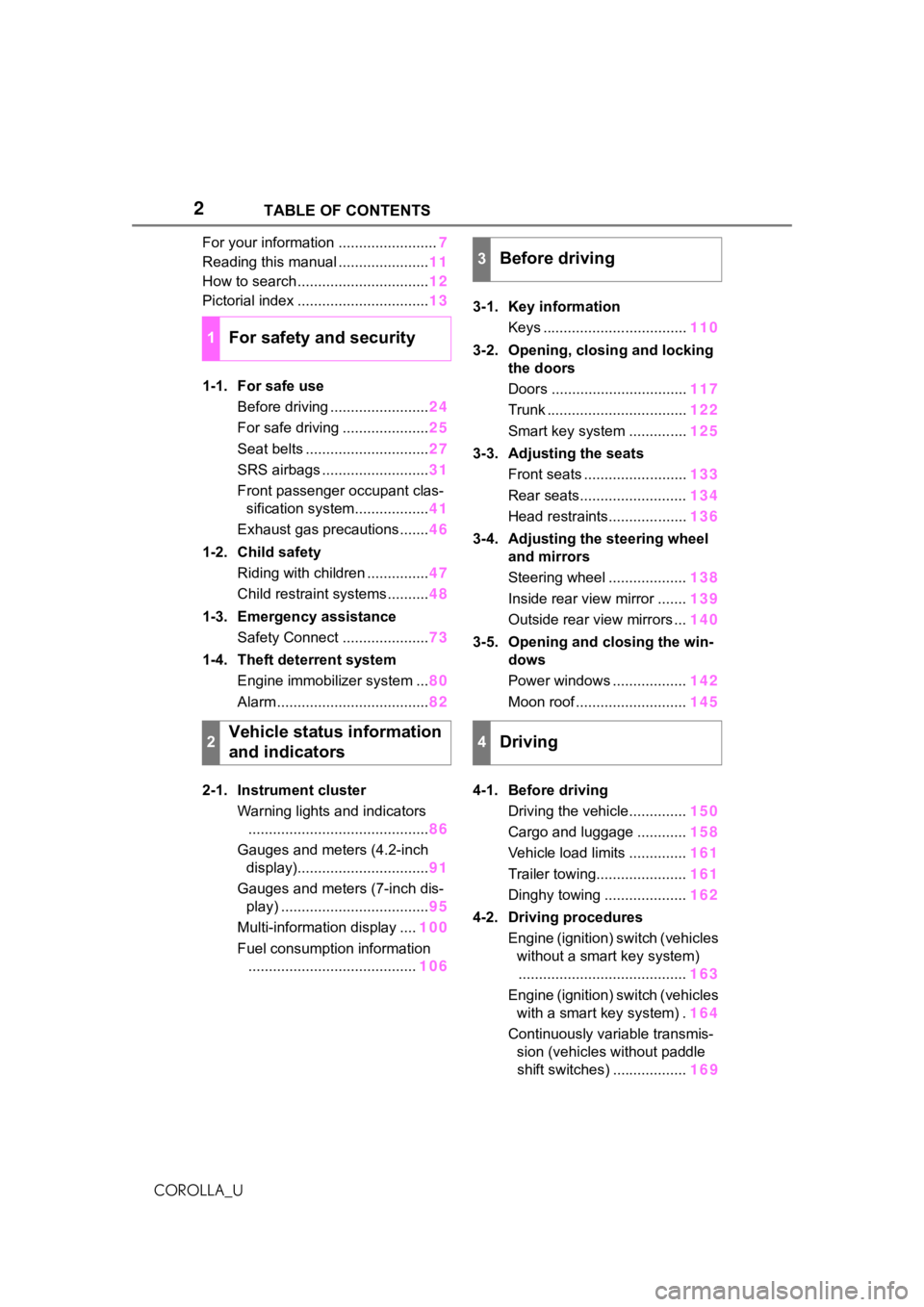
2
COROLLA_UTABLE OF CONTENTS
For your information ........................
7
Reading this manual ...................... 11
How to search ................................ 12
Pictorial index ................................ 13
1-1. For safe use Before driving ........................ 24
For safe driving ..................... 25
Seat belts .............................. 27
SRS airbags .......................... 31
Front passenger occupant clas- sification system.................. 41
Exhaust gas precautions....... 46
1-2. Child safety Riding with children ............... 47
Child restraint systems .......... 48
1-3. Emergency assistance Safety Connect ..................... 73
1-4. Theft deterrent system Engine immobilizer system ... 80
Alarm ..................................... 82
2-1. Instrument cluster Warning lights and indicators............................................ 86
Gauges and meters (4.2-inch display)................................ 91
Gauges and meters (7-inch dis- play) .................................... 95
Multi-information display .... 100
Fuel consumption information ......................................... 1063-1. Key information
Keys ................................... 110
3-2. Opening, closing and locking the doors
Doors ................................. 117
Trunk .................................. 122
Smart key system .............. 125
3-3. Adjusting the seats Front seats ......................... 133
Rear seats.......................... 134
Head restraints................... 136
3-4. Adjusting the steering wheel and mirrors
Steering wheel ................... 138
Inside rear view mirror ....... 139
Outside rear view mirrors ... 140
3-5. Opening and closing the win- dows
Power windows .................. 142
Moon roof ........................... 145
4-1. Before driving Driving the vehicle.............. 150
Cargo and luggage ............ 158
Vehicle load limits .............. 161
Trailer towing...................... 161
Dinghy towing .................... 162
4-2. Driving procedures Engine (ignition) switch (vehicles without a smart key system)......................................... 163
Engine (ignition) switch (vehicles with a smart key system) . 164
Continuously variable transmis- sion (vehic l
es without paddle
shift switches) .................. 169
1For safety and security
2Vehicle status information
and indicators
3Before driving
4Driving
Page 149 of 624
149
4
4
Driving
COROLLA_U
Driving
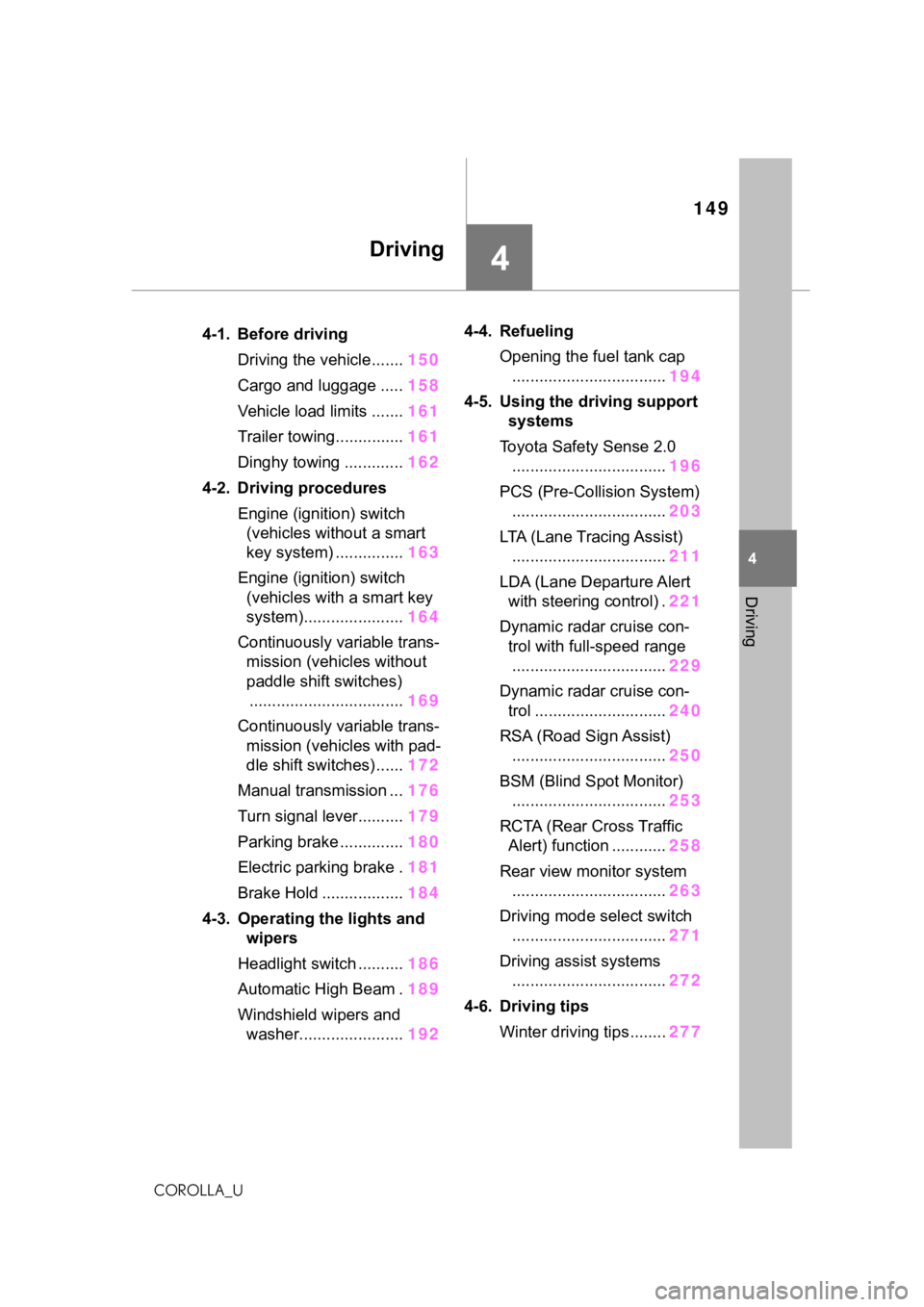
.4-1. Before drivingDriving the vehicle....... 150
Cargo and luggage ..... 158
Vehicle load limits ....... 161
Trailer towing............... 161
Dinghy towing ............. 162
4-2. Driving procedures Engine (ignition) switch (vehicles without a smart
key system) ............... 163
Engine (ignition) switch (vehicles with a smart key
system)...................... 164
Continuously variable trans- mission (vehicles without
paddle shift switches).................................. 169
Continuously variable trans- mission (vehicles with pad-
dle shift switches) ...... 172
Manual transmission ... 176
Turn signal lever.......... 179
Parking brake .............. 180
Electric parking brake . 181
Brake Hold .................. 184
4-3. Operating the lights and wipers
Headlight switch .......... 186
Automatic High Beam . 189
Windshield wipers and washer....................... 1924-4. Refueling
Opening the fuel tank cap.................................. 194
4-5. Using the dr iving support
systems
Toyota Safety Sense 2.0 .................................. 196
PCS (Pre-Collision System) .................................. 203
LTA (Lane Tracing Assist) .................................. 211
LDA (Lane Departure Alert with steering control) . 221
Dynamic radar cruise con- trol with full-speed range.................................. 229
Dynamic radar cruise con- trol ............................. 240
RSA (Road Sign Assist) .................................. 250
BSM (Blind Spot Monitor) .................................. 253
RCTA (Rear Cross Traffic Alert) function ............ 258
Rear view monitor system .................................. 263
Driving mode select switch .................................. 271
Driving assist systems .................................. 272
4-6. Driving tips Winter driving tips........ 277
Page 163 of 624
1634-2. Driving procedures
4
Driving
COROLLA_U
4-2.Driving procedures
1Check that the parking brake
is set. ( P.180, 181)
2 Check that the shift lever is in
P (continuously variable
transmission) or N (manual
transmission).
3 Firmly depress the brake
pedal (continuously variable
transmission) or clutch pedal
(manual transmission).
4 Turn the engine switch to
START to start the engine.
■If the engine does not start
The engine immobilizer system may
not have been deactivated. ( P. 8 0 )
Contact your Toyota dealer.
■When the steering lock cannot
be released
When starting the engine, the
engine switch may seem stuck in
OFF. To free it, turn the key while
turning the steerin g wheel slightly
left and right.
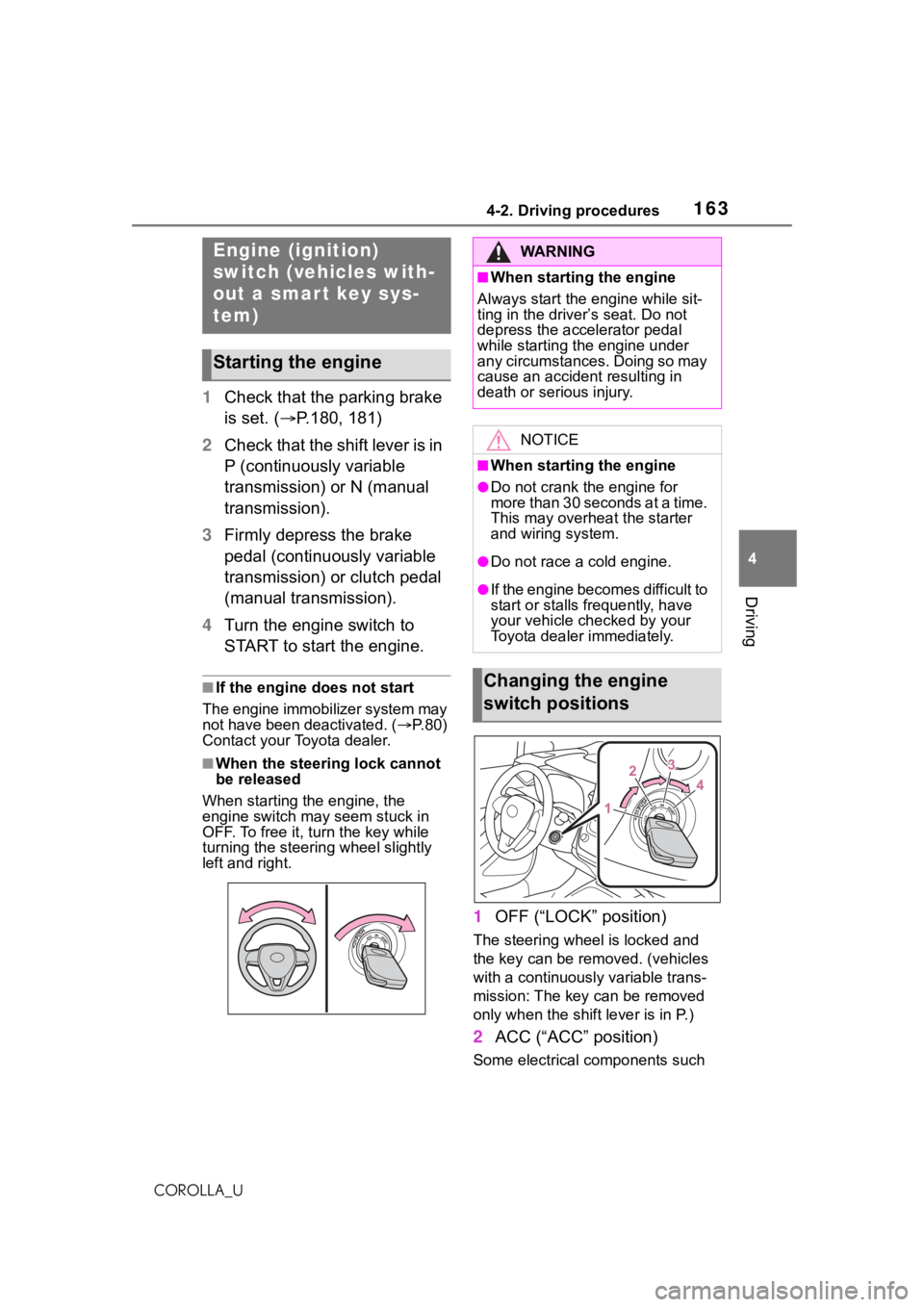
1 OFF (“LOCK” position)
The steering wheel is locked and
the key can be removed. (vehicles
with a continuously variable trans-
mission: The key can be removed
only when the shift lever is in P.)
2ACC (“ACC” position)
Some electrical components such
Engine (ignition)
switch (vehicles with-
out a smart key sys-
tem)
Starting the engine
WA R N I N G
■When starting the engine
Always start the engine while sit-
ting in the driver’s seat. Do not
depress the accelerator pedal
while starting the engine under
any circumstances. Doing so may
cause an accident resulting in
death or serious injury.
NOTICE
■When starting the engine
●Do not crank the engine for
more than 30 seconds at a time.
This may overhea t the starter
and wiring system.
●Do not race a cold engine.
●If the engine becomes difficult to
start or stalls frequently, have
your vehicle checked by your
Toyota dealer immediately.
Changing the engine
switch positions
Page 164 of 624
1644-2. Driving procedures
COROLLA_Uas the audio system can be used.
3
ON ( “ON” position)
All electrical com ponents can be
used.
4 START ( “START” position)
For starting the engine.
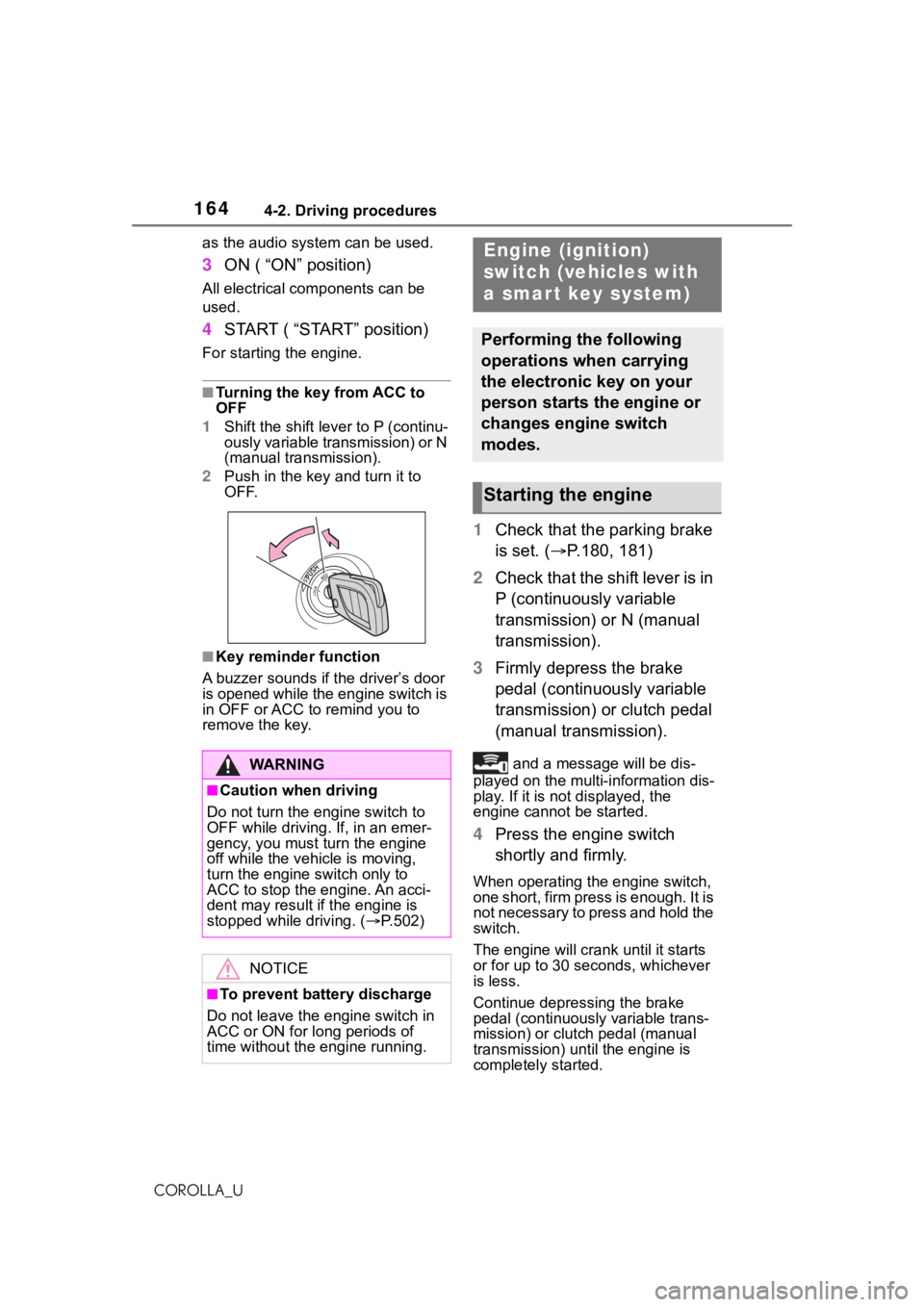
■Turning the key from ACC to
OFF
1 Shift the shift lever to P (continu-
ously variable transmission) or N
(manual transmission).
2 Push in the key and turn it to
OFF.
■Key reminder function
A buzzer sounds if the driver’s door
is opened while the engine switch is
in OFF or ACC to r emind you to
remove the key.
1 Check that the parking brake
is set. ( P.180, 181)
2 Check that the shift lever is in
P (continuously variable
transmission) or N (manual
transmission).
3 Firmly depress the brake
pedal (continuously variable
transmission) or clutch pedal
(manual transmission).
and a message will be dis-
played on the multi-information dis-
play. If it is not displayed, the
engine cannot be started.
4 Press the engine switch
shortly and firmly.
When operating the engine switch,
one short, firm press is enough. It is
not necessary to press and hold the
switch.
The engine will crank until it starts
or for up to 30 seconds, whichever
is less.
Continue depressing the brake
pedal (continuously variable trans-
mission) or clutch pedal (manual
transmission) unt il the engine is
completely started.
WA R N I N G
■Caution when driving
Do not turn the engine switch to
OFF while driving. If, in an emer-
gency, you must turn the engine
off while the vehicle is moving,
turn the engine switch only to
ACC to stop the engine. An acci-
dent may result i f the engine is
stopped while driving. ( P.502)
NOTICE
■To prevent battery discharge
Do not leave the engine switch in
ACC or ON for long periods of
time without the engine running.
Engine (ignition)
switch (vehicles with
a smar t key system)
Performing the following
operations when carrying
the electronic key on your
person starts the engine or
changes engine switch
modes.
Starting the engine
Page 166 of 624
1664-2. Driving procedures
COROLLA_U
Continuously variable trans-
mission
1 Stop the vehicle completely.
2 Set the parking brake
( P.180, 181), and shift the
shift lever to P.
Check the parking brake indicator
is illuminated.
3 Press the engine switch.
The engine will stop, and the meter
display will be extinguished.
4Release the brake pedal and
check that “ACCESSORY” or
“IGNITION ON” is not shown
on the multi-information dis-
play.
Manual transmission
1 Stop the vehicle completely.
2 Set the parking brake.
( P.180, 181)
Check the parking brake indicator
is illuminated.
3Shift the shift lever to N.
( P.176)
4 Press the engine switch.
The engine will stop, and the meter
display will be extinguished.
5Release the brake pedal and
check that “ACCESSORY” or
“IGNITION ON” is not shown
on the multi-information dis-
play.
■Automatic engine shut off fea-
ture
●The vehicle is equipped with a
feature that automatically shuts off
the engine when the shift lever is
in P (continuously variable trans-
mission) or the parking brake is
set (manual transmission) with the
engine running for an extended
period.
●The engine will automatically shut
off after approxima tely 1 hour if it
has been left running while the
shift lever is in P (continuously
variable transmission) or the park-
ing brake is set (manual transmis-
sion).
●The timer for the automatic engine
shut off feature will reset if the
brake pedal (continuously variable
transmission) or th e clutch pedal
WA R N I N G
■Caution while driving
If engine failure o ccurs while the
vehicle is moving, do not lock or
open the doors until the vehicle
reaches a safe and complete
stop. Activation of the steering
lock in this circumstance may lead
to an accident, resulting in death
or serious injury.
NOTICE
■When starting the engine
●Do not race a cold engine.
●If the engine becomes difficult to
start or stalls frequently, have
your vehicle checked by your
Toyota dealer immediately.
■Symptoms indicating a mal-
function with the engine
switch
If the engine switch seems to be
operating somewh at differently
than usual, such as the switch
sticking slightly, there may be a
malfunction. Contact your Toyota
dealer immediately.
Stopping the engine
Page 168 of 624
1684-2. Driving procedures
COROLLA_U
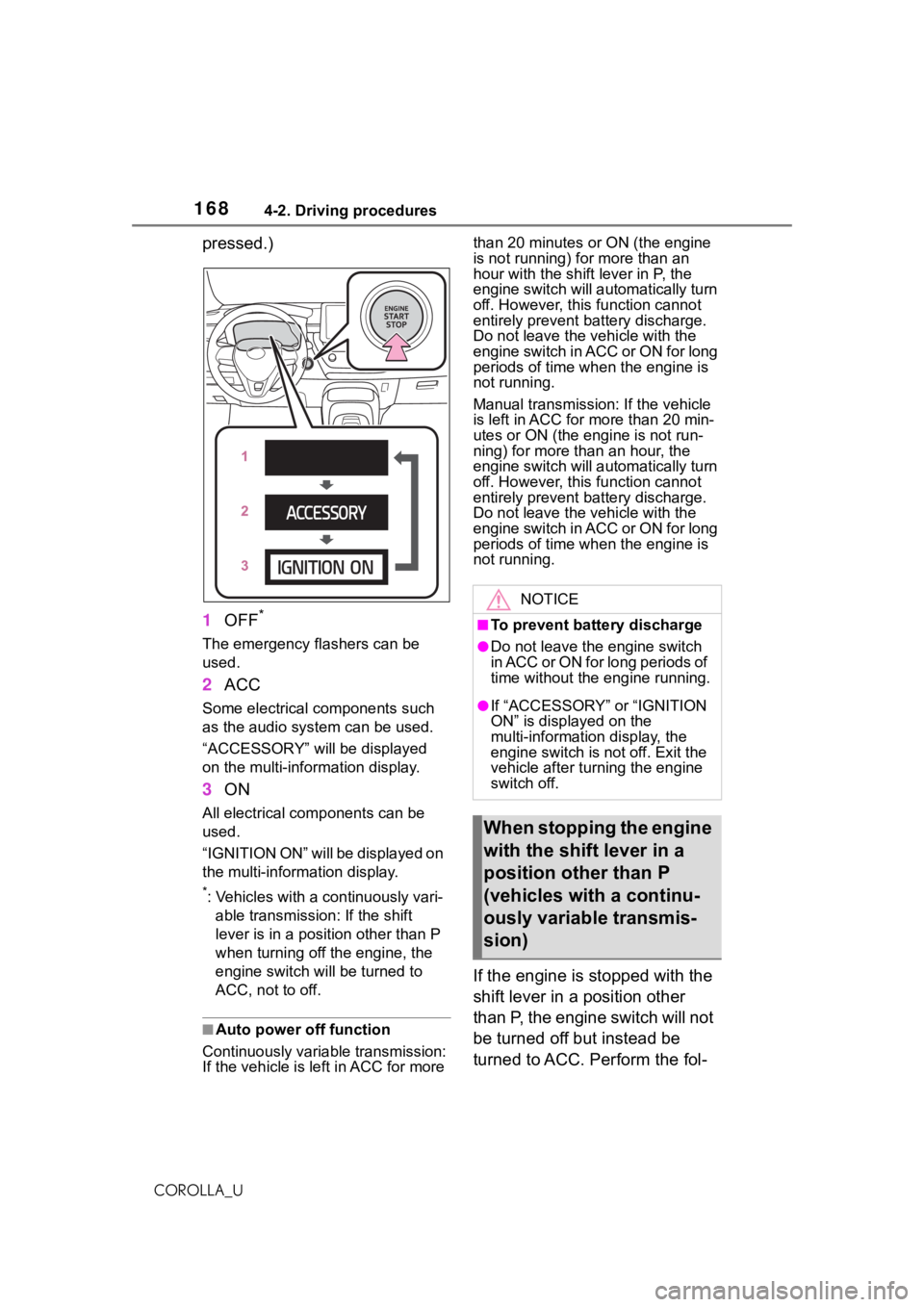
pressed.)
1OFF
*
The emergency flashers can be
used.
2ACC
Some electrical components such
as the audio system can be used.
“ACCESSORY” will be displayed
on the multi-information display.
3ON
All electrical com ponents can be
used.
“IGNITION ON” will be displayed on
the multi-information display.
*: Vehicles with a continuously vari- able transmissio n: If the shift
lever is in a position other than P
when turning off the engine, the
engine switch will be turned to
ACC, not to off.
■Auto power off function
Continuously variable transmission:
If the vehicle is le ft in ACC for more than 20 minutes or ON (the engine
is not running) for more than an
hour with the shif
t lever in P, the
engine switch will automatically turn
off. However, this function cannot
entirely prevent b attery discharge.
Do not leave the vehicle with the
engine switch in ACC or ON for long
periods of time when the engine is
not running.
Manual transmission: If the vehicle
is left in ACC for more than 20 min-
utes or ON (the engine is not run-
ning) for more than an hour, the
engine switch will automatically turn
off. However, this function cannot
entirely prevent b attery discharge.
Do not leave the vehicle with the
engine switch in ACC or ON for long
periods of time when the engine is
not running.
If the engine is stopped with the
shift lever in a position other
than P, the engine switch will not
be turned off but instead be
turned to ACC. Perform the fol-
NOTICE
■To prevent battery discharge
●Do not leave the engine switch
in ACC or ON for long periods of
time without the engine running.
●If “ACCESSORY” or “IGNITION
ON” is displayed on the
multi-information display, the
engine switch is not off. Exit the
vehicle after turning the engine
switch off.
When stopping the engine
with the shift lever in a
position other than P
(vehicles with a continu-
ously variable transmis-
sion)
Page 169 of 624
1694-2. Driving procedures
4
Driving
COROLLA_U
lowing procedure to turn the
switch off:
1Check that the parking brake
is set.
2 Shift the shift lever to P.
3 Check that “ACCESSORY” is
displayed on the multi-infor-
mation display and press the
engine switch shortly and
firmly.
4 Check that “ACCESSORY”
or “IGNITION ON” on the
multi-information display are
off.
*: If equipped
*: To improve fuel efficiency and
reduce noise, shift the shift lever
to D for normal driving.
■When driving with the dynamic
radar cruise control or dynamic
radar cruise control with
full-speed range activated
Even when switching the driving
mode to sport mode with the intent
of enabling engine braking, engine
braking will not occur because
dynamic radar cruise control or
dynamic radar cruise control with
NOTICE
■To prevent battery discharge
Do not stop the engine when the
shift lever is in a position other
than P. If the engin e is stopped in
another shift lever position, the
engine switch will not be turned
off but instead be turned to ACC
mode. If the vehicle is left in ACC,
battery discharge may occur.
Continuously variable
transmission (vehi-
cles without paddle
shift switches)
*
Select the shift position
depending on your purpose
and situation.
Shift position purpose
and functions
Shift posi-
tionObjective or function
PParking the vehi-
cle/starting the engine
RReversing
N
Neutral
(Condition in which the power is not transmit- ted)
DNormal driving*
B
Applying moderate
engine braking driving down hills
Page 194 of 624
1944-4. Refueling
COROLLA_U
4-4.Refueling
Turn the engine switch off and
ensure that all the doors and
windows are closed.
Confirm the type of fuel.
■Fuel types
P. 5 6 8
■Fuel tank opening for unleaded
gasoline
To help prevent incorrect fueling,
your vehicle has a fuel tank opening
that only acco mmodates the spe-
cial nozzle on unleaded fuel pumps.
■If the malfunction indicator
lamp illuminates
The malfunction indicator lamp may
illuminate erroneous ly if refueling is
performed repeatedly when the fuel
tank is nearly full.
Opening the fuel tank
cap
Perform the following steps
to open the fuel tank cap:
Before refueling the vehi-
cle
WA R N I N G
■When refueling the vehicle
Observe the following precautions
while refueling the vehicle. Failure
to do so may result in death or
serious injury.
●After exiting the vehicle and
before opening the fuel door,
touch an unpainted metal sur-
face to discharge any static
electricity. It is important to dis-
charge static electricity before
refueling because sparks result-
ing from static electricity can
cause fuel vapors to ignite while
refueling.
●Always hold the grips on the
fuel tank cap and turn it slowly
to remove it.
A whooshing sound may be
heard when the f uel tank cap is
loosened. Wait until the sound
cannot be heard before fully
removing the cap. In hot
weather, pressurized fuel may
spray out the filler neck and
cause injury.
●Do not allow anyone that has
not discharged static electricity
from their body to come close to
an open fuel tank.
●Do not inhale vaporized fuel.
Fuel contains substances that
are harmful if inhaled.
●Do not smoke while refueling
the vehicle.
Doing so may cause the fuel to
ignite and cause a fire.
●Do not return to the vehicle or
touch any person or object that
is statically charged.
This may cause static electricity
to build up, resulting in a possi-
ble ignition hazard.
■When refueling
Observe the following precautions
to prevent fuel overflowing from
the fuel tank:
●Securely insert the fuel nozzle
into the fuel filler neck.
●Stop filling the tank after the fuel
nozzle automatically clicks off.
Page 561 of 624
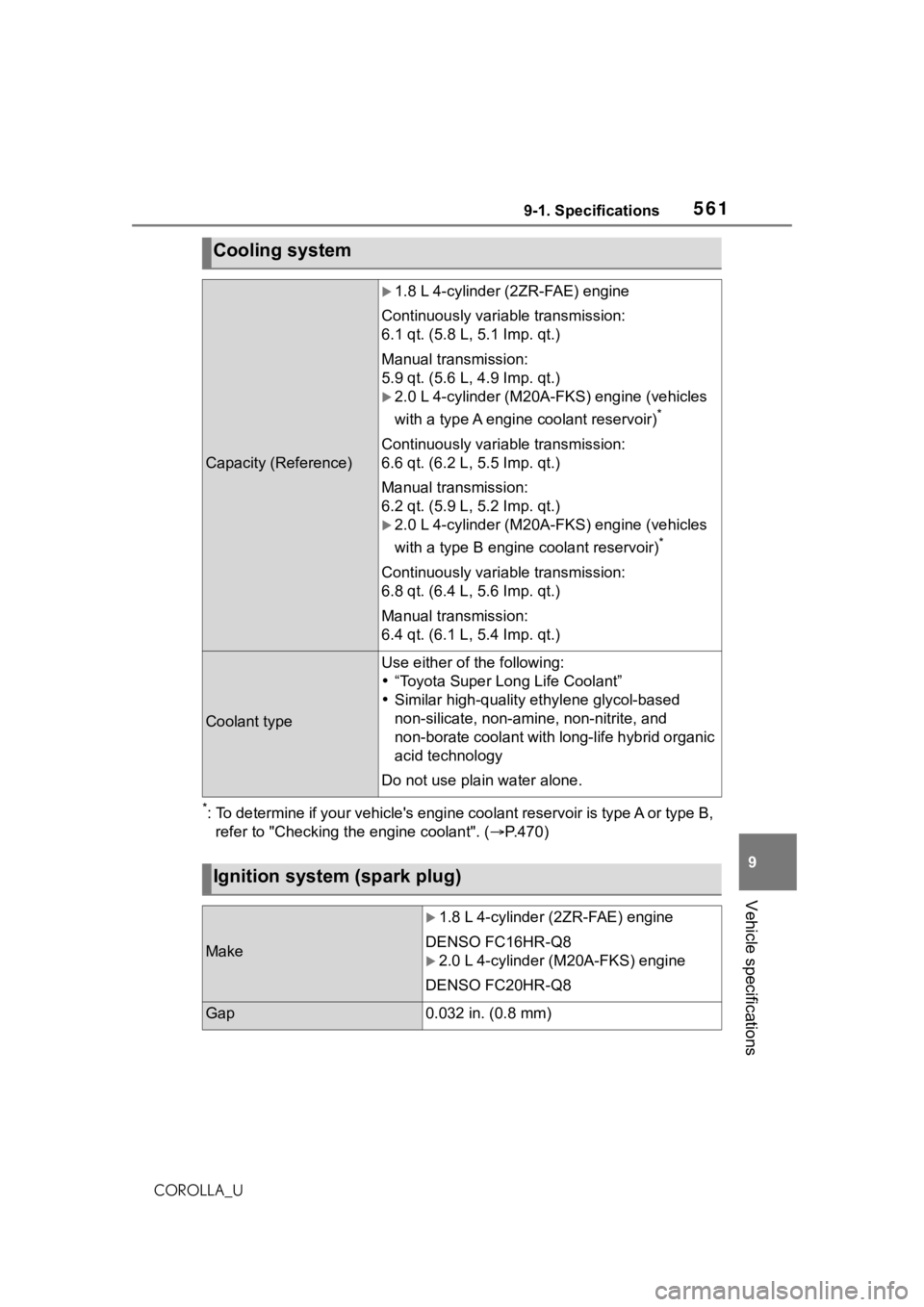
5619-1. Specifications
9
Vehicle specifications
COROLLA_U
*: To determine if your vehicle's engine coolant reservoir is type A or type B,
refer to "Checking the engine coolant". ( P.470)
Cooling system
Capacity (Reference)
1.8 L 4-cylinder (2ZR-FAE) engine
Continuously variable transmission:
6.1 qt. (5.8 L, 5.1 Imp. qt.)
Manual transmission:
5.9 qt. (5.6 L, 4.9 Imp. qt.)
2.0 L 4-cylinder (M20A-FKS) engine (vehicles
with a type A engine coolant reservoir)
*
Continuously variable transmission:
6.6 qt. (6.2 L, 5.5 Imp. qt.)
Manual transmission:
6.2 qt. (5.9 L, 5.2 Imp. qt.)
2.0 L 4-cylinder (M20A-FKS) engine (vehicles
with a type B engine coolant reservoir)
*
Continuously variable transmission:
6.8 qt. (6.4 L, 5.6 Imp. qt.)
Manual transmission:
6.4 qt. (6.1 L, 5.4 Imp. qt.)
Coolant type
Use either o f the following:
“Toyota Super Long Life Coolant”
Similar high-quality et hylene glycol-based
non-silicate, non -amine, non-nitrite, and
non-borate coolant with long-life hybrid organic
acid technology
Do not use pla in water alone.
Ignition system (spark plug)
Make
1.8 L 4-cylinder (2ZR-FAE) engine
DENSO FC16HR-Q8
2.0 L 4-cylinder (M20A-FKS) engine
DENSO FC20HR-Q8
Gap0.032 in. (0.8 mm)
Page 610 of 624

610Alphabetical Index
COROLLA_UDoor lock .............................. 117
Open door warning buzzer . 119,
121
Outside rear view mirrors ..... 140
Rear door child-protectors.... 121
Side doors ............................ 117
Drive distance ......................... 104
Drive information ................... 104
Drive-start control .................. 152
Driving Break-in tips ......................... 152
Correct driving posture ........... 25
Driving mode select switch... 271
Procedures ........................... 150
Winter drive tips ................... 277
Driving information display ... 101
Driving range .......................... 102
Driving support system informa- tion display ........................... 103
Dynamic radar cruise control 240 Warning message ................ 248
Dynamic radar cruise control with full-speed range ........... 229Warning message ................ 238
E
Eco Driving Indicator ............. 102
Eco Driving Indicator Light ... 102
EDR (Event data recorder)......... 9
Elapsed time ........................... 104
Electric Power Steering (EPS) ............................................... 272Warning light ........................ 514
Electronic key ......................... 110 Battery-saving function......... 126
If the electronic key does not operate properly ................. 544
Replacing the battery ........... 489
Emergency flashers ............... 502
Emergency tire puncture repair kit ........................................... 523 Emergency, in case of
If a warning buzzer sounds .. 511
If a warning light turns on ..... 511
If a warning message is dis-played .................................521
If the battery is d ischarged ...546
If the electronic key does not operate properly .................544
If the engine will not start......542
If the vehicle is trapped in rising water...................................504
If you have a flat tire .....523, 534
If you lose your keys.............544
If you think something is wrong ...........................................509
If your vehicle becomes stuck ...........................................553
If your vehicle has to be stopped in an emergency .................502
If your vehicle needs to be towed ...........................................505
If your vehicle ove rheats ......550
Engine ACCESSORY mode . ............167
Compartment........................466
Engine switch ...............163, 164
Fuel pump shut off system ...510
Hood .....................................464
How to start the engine 163, 164
Identification number ............557
If the engine will not start......542
If your vehicle has to be stopped in an emergency .................502
Ignition switch (engine switch) ...................................163, 164
Overheating ..........................550
Tachometer.......................91, 95
Engine coolant Capacity ...............................561
Checking ..............................470
Preparing and checking before winter ..................................277