fuel type TOYOTA COROLLA 2022 Owners Manual (in English)
[x] Cancel search | Manufacturer: TOYOTA, Model Year: 2022, Model line: COROLLA, Model: TOYOTA COROLLA 2022Pages: 678, PDF Size: 147.24 MB
Page 5 of 678
3TABLE OF CONTENTS
1
6
5
4
3
2
9
8
7
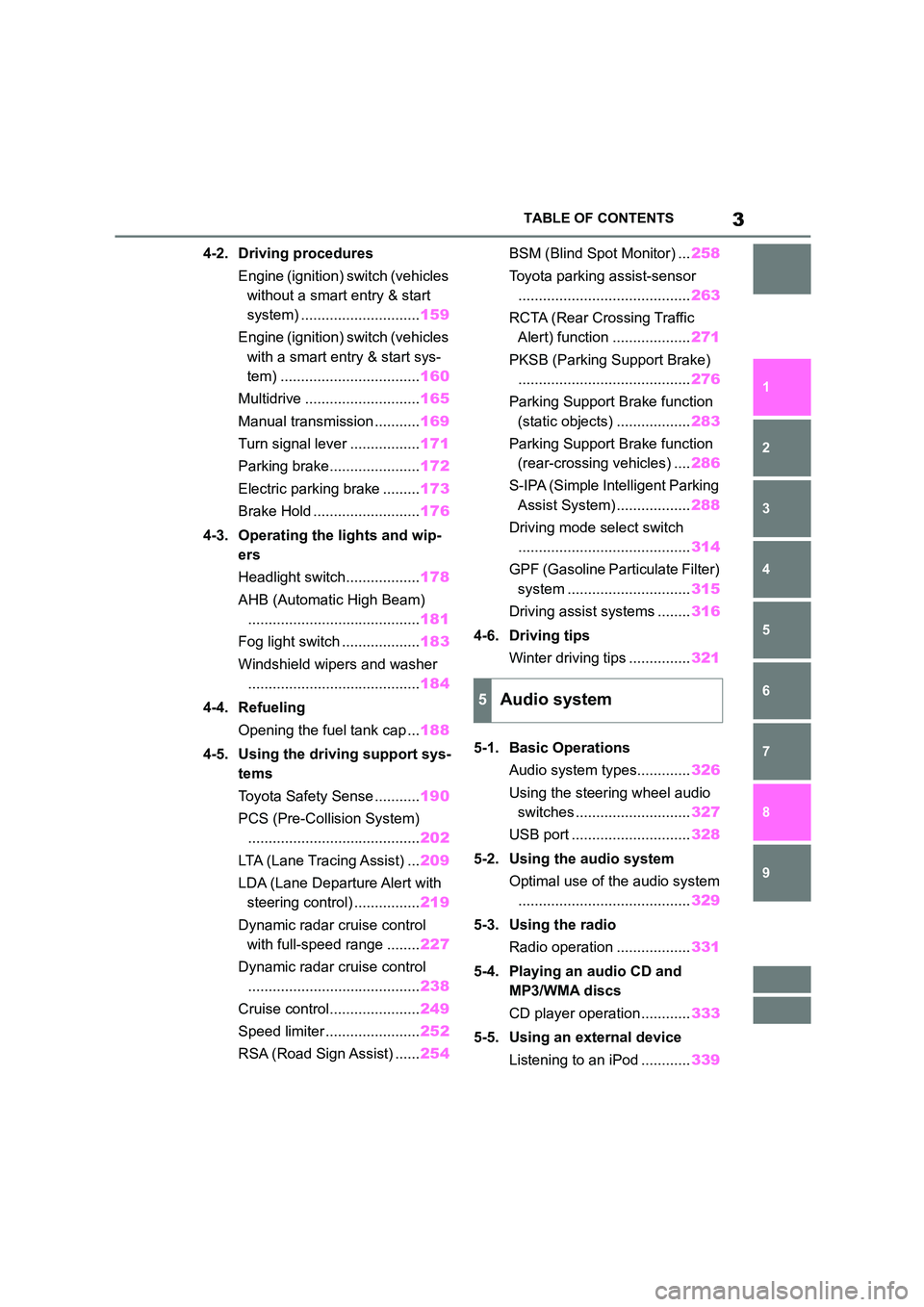
4-2. Driving procedures
Engine (ignition) switch (vehicles
without a smart entry & start
system) ............................. 159
Engine (ignition) switch (vehicles
with a smart entry & start sys-
tem) .................................. 160
Multidrive ............................ 165
Manual transmission ........... 169
Turn signal lever ................. 171
Parking brake...................... 172
Electric parking brake ......... 173
Brake Hold .......................... 176
4-3. Operating the lights and wip-
ers
Headlight switch.................. 178
AHB (Automatic High Beam)
.......................................... 181
Fog light switch ................... 183
Windshield wipers and washer
.......................................... 184
4-4. Refueling
Opening the fuel tank cap ... 188
4-5. Using the driving support sys-
tems
Toyota Safety Sense ........... 190
PCS (Pre-Collision System)
.......................................... 202
LTA (Lane Tracing Assist) ... 209
LDA (Lane Departure Alert with
steering control) ................ 219
Dynamic radar cruise control
with full-speed range ........ 227
Dynamic radar cruise control
.......................................... 238
Cruise control...................... 249
Speed limiter ....................... 252
RSA (Road Sign Assist) ...... 254
BSM (Blind Spot Monitor) ... 258
Toyota parking assist-sensor
.......................................... 263
RCTA (Rear Crossing Traffic
Alert) function ................... 271
PKSB (Parking Support Brake)
.......................................... 276
Parking Support Brake function
(static objects) .................. 283
Parking Support Brake function
(rear-crossing vehicles) .... 286
S-IPA (Simple Intelligent Parking
Assist System) .................. 288
Driving mode select switch
.......................................... 314
GPF (Gasoline Particulate Filter)
system .............................. 315
Driving assist systems ........ 316
4-6. Driving tips
Winter driving tips ............... 321
5-1. Basic Operations
Audio system types............. 326
Using the steering wheel audio
switches ............................ 327
USB port ............................. 328
5-2. Using the audio system
Optimal use of the audio system
.......................................... 329
5-3. Using the radio
Radio operation .................. 331
5-4. Playing an audio CD and
MP3/WMA discs
CD player operation ............ 333
5-5. Using an external device
Listening to an iPod ............ 339
5Audio system
Page 14 of 678
12Pictorial index
To prevent freezing (windshield wiper de-icer)*2......................P.383, 390
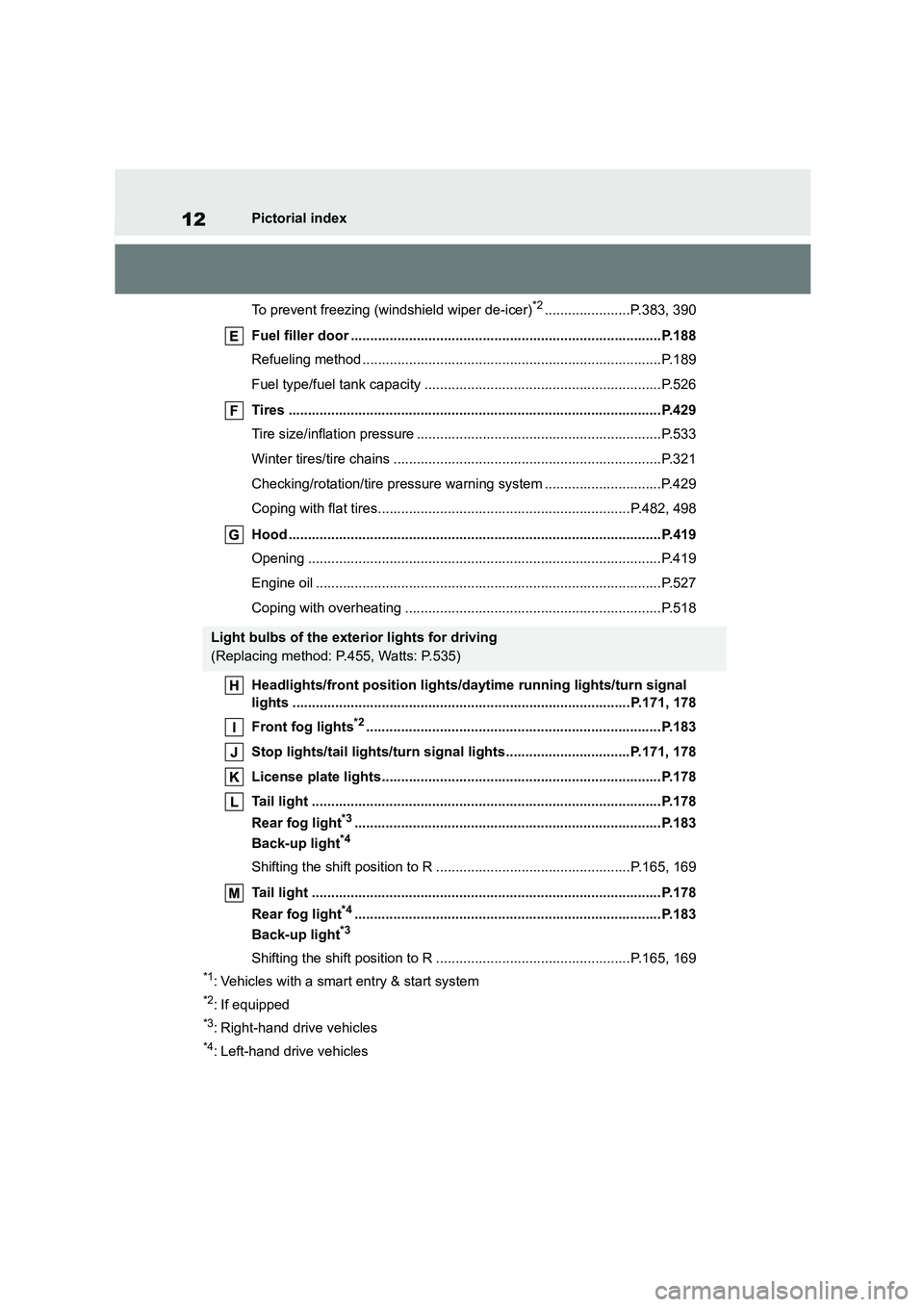
Fuel filler door ................................................................................P.188
Refueling method .............................................................................P.189
Fuel type/fuel tank capacity .............................................................P.526
Tires ................................................................................................P.429
Tire size/inflation pressure ...............................................................P.533
Winter tires/tire chains .....................................................................P.321
Checking/rotation/tire pressure warn ing system ..............................P.429
Coping with flat tires.................................................................P.482, 498
Hood ................................................................................................P.419
Opening ...........................................................................................P.419
Engine oil .........................................................................................P.527
Coping with overheating ..................................................................P.518
Headlights/front position lights/daytime running lights/turn signal
lights .......................................................................................P.171, 178
Front fog lights*2............................................................................P.183
Stop lights/tail lights/turn signal lights................................P.171, 178
License plate lights........................................................................P.178
Tail light ..........................................................................................P.178
Rear fog light*3...............................................................................P.183
Back-up light*4
Shifting the shift position to R ..................................................P.165, 169
Tail light ..........................................................................................P.178
Rear fog light*4...............................................................................P.183
Back-up light*3
Shifting the shift position to R ..................................................P.165, 169
*1: Vehicles with a smart entry & start system
*2: If equipped
*3: Right-hand drive vehicles
*4: Left-hand drive vehicles
Light bulbs of the exterior lights for driving
(Replacing method: P.455, Watts: P.535)
Page 39 of 678
37
1
1-1. For safe use
For safety and security
may be sustained from SRS airbags,
due to the extremely high speed deployment (inflation) by hot gases.
●A loud noise and white powder will be emitted.
●Parts of the airbag module (steering wheel hub, airbag cover and inflator)
as well as the front seats, parts of the
front and rear pillars, and roof side rails, may be hot for several minutes.
The airbag itself may also be hot.
●The windshield may crack.
●The brakes and stop lights will be con- trolled automatically. ( P.316)
●The interior lights will turn on automat- ically. ( P.395)
●The emergency flashers will turned on automatically. ( P.462)
●Fuel supply to the engine will be stopped. ( P.470)
●Vehicles with eCall: If any of the fol-
lowing situations occur, the system is
designed to send an emergency call*
to the eCall control center, notifying
them of the vehicle’s location (without needing to push the “SOS” button)
and an agent will attempt to speak
with the occupants to ascertain the level of emergency and assistance
required. If the occupants are unable
to communicate, the agent automati- cally treats the call as an emergency
and helps to dispatch the necessary
emergency services. ( P. 6 4 ) • An SRS airbag is deployed.
• A seat belt pretensioner is activated.
• The vehicle is involved in a severe rear-end collision.*: In some cases, the call cannot be
made. ( P. 6 5 )
■SRS airbag deployment conditions (SRS front airbags)
●The SRS front airbags will deploy in the event of an impact that exceeds
the set threshold le vel (the level of
force corresponding to an approxi- mately 20 - 30 km/h [12 - 18 mph]
frontal collision with a fixed wall that
does not move or deform).
However, this threshold velocity will be
considerably higher in the following situ-
ations: • If the vehicle strikes an object, such
as a parked vehicle or sign pole,
which can move or deform on impact • If the vehicle is involved in an
underride collision, such as a collision
in which the front of the vehicle “underrides”, or goes under, the bed
of a truck
●Depending on the type of collision, it is
possible that only the seat belt
pretensioners will activate.
■SRS airbag deployment conditions (SRS side and curtain shield
airbags [if equipped])
●The SRS side and curtain shield
airbags will deploy in the event of an
impact that exceeds the set threshold level (the level of force corresponding
to the impact force produced by an
approximately 1500 kg [3300 lb.] vehi- cle colliding with the vehicle cabin
from a direction perpendicular to the
vehicle orientation at an approximate speed of 20 - 30 km/h [12 - 18 mph]).
●Vehicles with an SRS driver’s knee airbag: Both SRS curtain shield
airbags may deploy in the event of a
severe side collision.
●Both SRS curtain shield airbags may
also deploy in the event of a severe frontal collision.
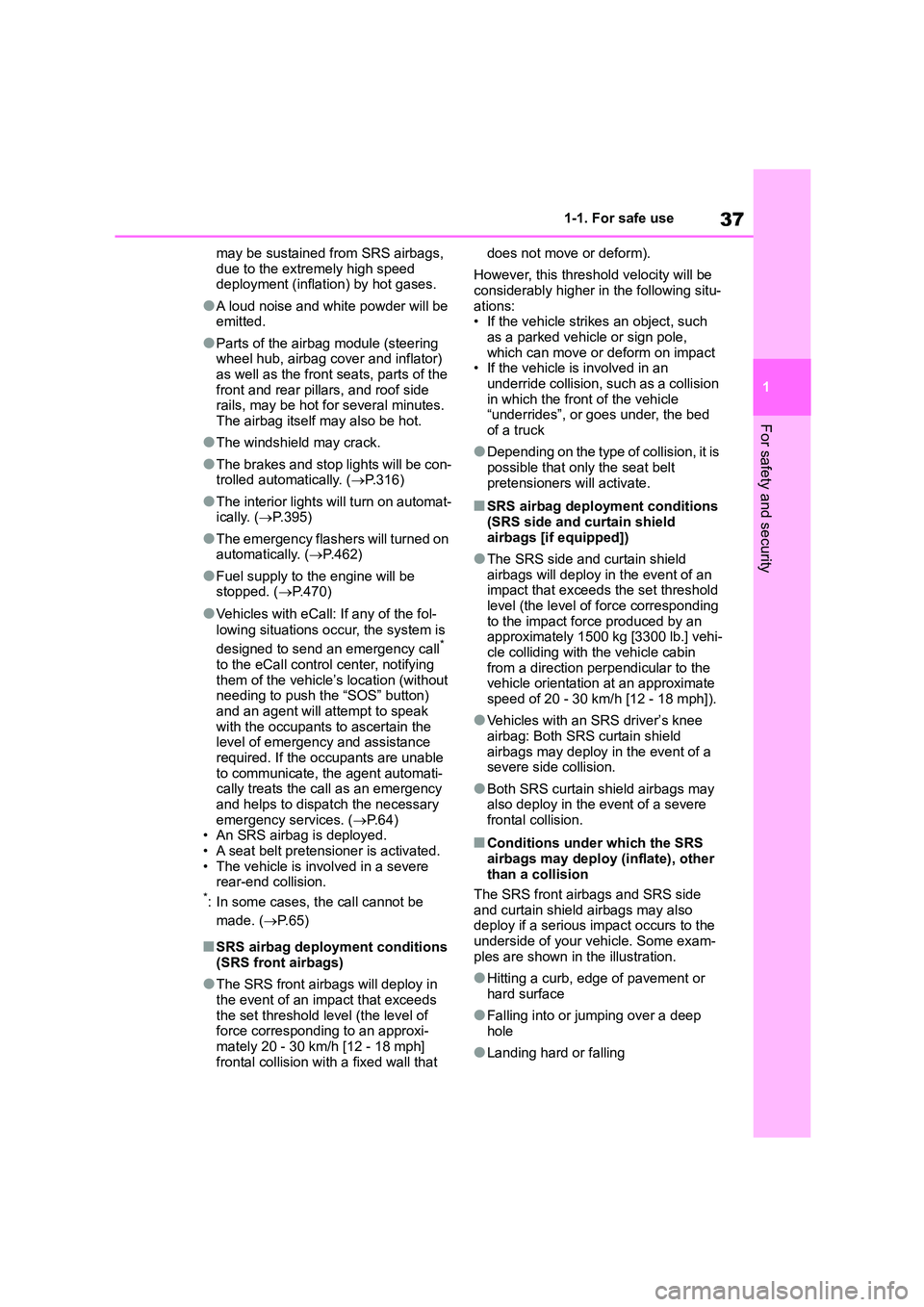
■Conditions under which the SRS
airbags may deploy (inflate), other
than a collision
The SRS front airbags and SRS side
and curtain shield airbags may also
deploy if a serious impact occurs to the
underside of your vehicle. Some exam- ples are shown in the illustration.
●Hitting a curb, edge of pavement or hard surface
●Falling into or jumping over a deep hole
●Landing hard or falling
Page 100 of 678
982-1. Instrument cluster
• Average vehicle speed: Displays the
average vehicle speed since the dis-
play was reset*
*: To reset, display the desired item and
press and hold the meter control
switch.
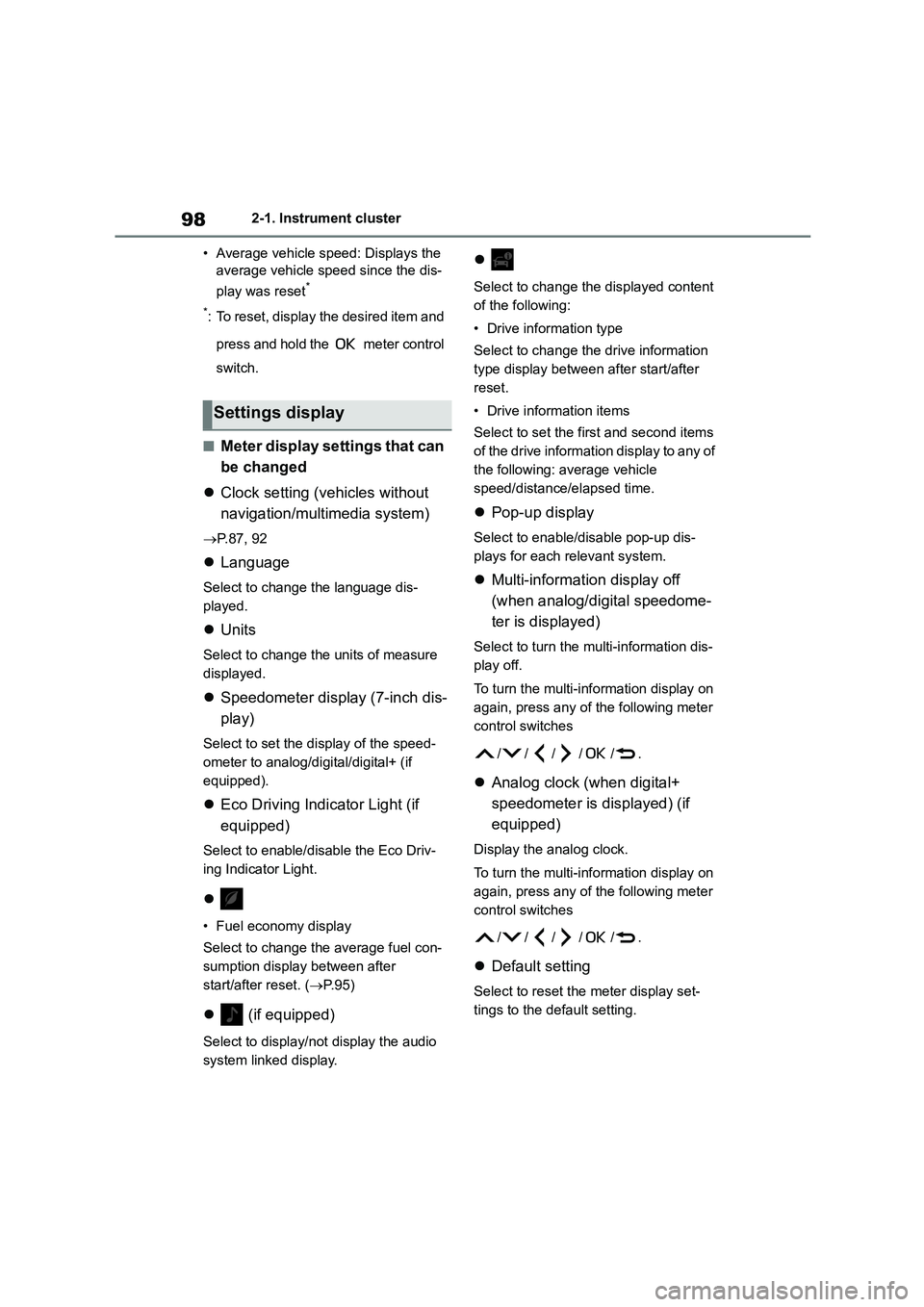
■Meter display settings that can
be changed
Clock setting (vehicles without
navigation/multimedia system)
P.87, 92
Language
Select to change the language dis-
played.
Units
Select to change the units of measure
displayed.
Speedometer display (7-inch dis-
play)
Select to set the display of the speed-
ometer to analog/digital/digital+ (if
equipped).
Eco Driving Indicator Light (if
equipped)
Select to enable/disable the Eco Driv-
ing Indicator Light.
• Fuel economy display
Select to change the average fuel con-
sumption display between after
start/after reset. ( P. 9 5 )
(if equipped)
Select to display/not display the audio
system linked display.
Select to change the displayed content
of the following:
• Drive information type
Select to change the drive information
type display between after start/after
reset.
• Drive information items
Select to set the first and second items
of the drive information display to any of
the following: average vehicle
speed/distance/elapsed time.
Pop-up display
Select to enable/disable pop-up dis-
plays for each relevant system.
Multi-information display off
(when analog/digital speedome-
ter is displayed)
Select to turn the multi-information dis-
play off.
To turn the multi-information display on
again, press any of the following meter
control sw itches
//// /.
Analog clock (when digital+
speedometer is displayed) (if
equipped)
Display the analog clock.
To turn the multi-information display on
again, press any of the following meter
control sw itches
//// /.
Default setting
Select to reset the meter display set-
tings to the default setting.
Settings display
Page 107 of 678
105
2
2-1. Instrument cluster
Vehicle status information and indicators
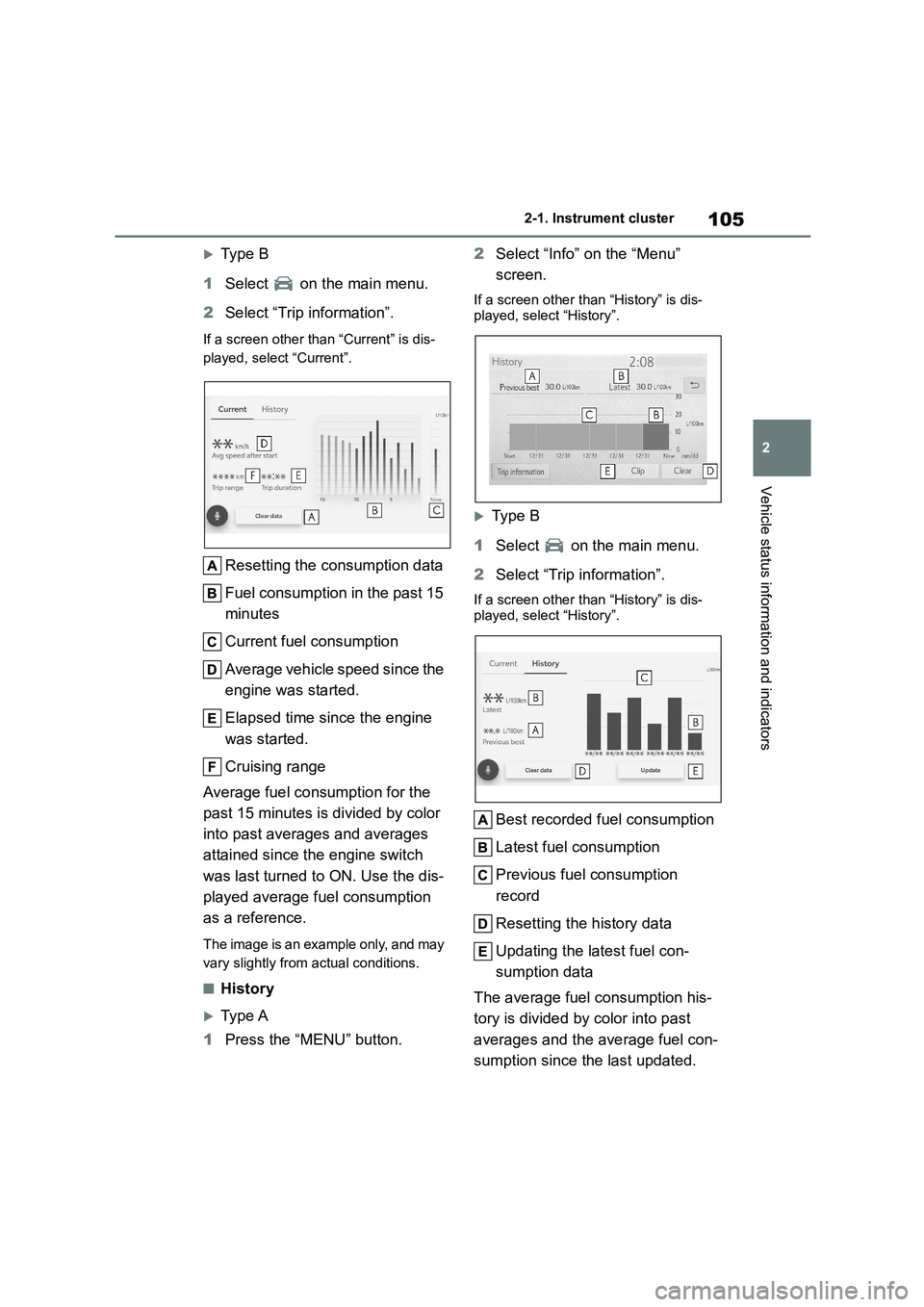
Type B
1 Select on the main menu.
2 Select “Trip information”.
If a screen other than “Current” is dis-
played, select “Current”.
Resetting the consumption data
Fuel consumption in the past 15
minutes
Current fuel consumption
Average vehicle speed since the
engine was started.
Elapsed time since the engine
was started.
Cruising range
Average fuel consumption for the
past 15 minutes is divided by color
into past averages and averages
attained since the engine switch
was last turned to ON. Use the dis-
played average fuel consumption
as a reference.
The image is an example only, and may
vary slightly from actual conditions.
■History
Type A
1 Press the “MENU” button.
2 Select “Info” on the “Menu”
screen.
If a screen other than “History” is dis-
played, select “History”.
Ty p e B
1 Select on the main menu.
2 Select “Trip information”.
If a screen other than “History” is dis-
played, select “History”.
Best recorded fuel consumption
Latest fuel consumption
Previous fuel consumption
record
Resetting the history data
Updating the latest fuel con-
sumption data
The average fuel consumption his-
tory is divided by color into past
averages and the average fuel con-
sumption since the last updated.
Page 190 of 678
1884-4. Refueling
4-4.Refueling
Turn the engine switch off and
ensure that all the doors and
windows are closed.
Confirm the type of fuel.
■Fuel types
P.537
■Fuel tank opening for unleaded
gasoline
To help prevent incorrect fueling, your vehicle has a fuel tank opening that only
accommodates the special nozzle on
unleaded fuel pumps.
Opening the fuel tank
cap
Perform the following steps to
open the fuel tank cap:
Before refueling the vehicle
WA R N I N G
■When refueling the vehicle
Observe the following precautions
while refueling the vehicle. Failure to
do so may result in death or serious injury.
●After exiting the vehicle and before opening the fuel door, touch an
unpainted metal surface to dis-
charge any static electricity. It is important to discharge static elec-
tricity before refueling because
sparks resulting from static electric- ity can cause fuel vapors to ignite
while refueling.
●Always hold the grips on the fuel tank cap and turn it slowly to
remove it.
A whooshing sound may be heard when the fuel tank cap is loosened.
Wait until the sound cannot be
heard before fully removing the cap. In hot weather, pressurized
fuel may spray out the filler neck
and cause injury.
●Do not allow anyone that has not
discharged static electricity from their body to come close to an open
fuel tank.
●Do not inhale vaporized fuel.
Fuel contains substances that are
harmful if inhaled.
●Do not smoke while refueling the
vehicle. Doing so may cause the fuel to
ignite and cause a fire.
●Do not return to the vehicle or touch
any person or object that is stati-
cally charged. This may cause static electricity to
build up, resulting in a possible igni-
tion hazard.
■When refueling
Observe the following precautions to prevent fuel overflowing from the fuel
tank:
●Securely insert the fuel nozzle into
the fuel filler neck.
●Stop filling the tank after the fuel
nozzle automatically clicks off.
●Do not top off the fuel tank.
Page 317 of 678
315
4
4-5. Using the driving support systems
Driving
*: If equipped
■If “Exhaust Filter Full See Owner's
Manual” is shown on the
multi-information display
●The message may be displayed while
high load driving with particulate mat- ter accumulating.
●Engine output (engine speed) is restricted when a certain amount of
particulate matter accumulates, how-
ever, it is possible to drive the vehicle unless the malfunction indicator lamp
comes on.
●Particulate matter can accumulate
more quickly if the vehicle is fre-
quently driven short trips or at low
speeds, or if the engine is regularly started in an extremely cold environ-
ment. Excessive accumulation of par-
ticulate matter can be prevented by periodically driving long distances
continuously with intermittent releas-
ing of the accelerator pedal, such as when driving on highways and free-
ways.
■If the malfunction indicator lamp
comes on or “Engine Maintenance required Visit Your Dealer” is
shown on the multi-information
display
The amount of accumulated particulate
matter has exceeded a certain level.
Have the vehicle inspected by any
authorized Toyota retailer or Toyota
authorized repairer, or any reliable repairer immediately.
GPF (Gasoline Particu-
late Filter) system*
The GPF system collects par-
ticulate matter in the exhaust
gas by using an exhaust gas
filter.
The system will operate to
regenerate the filter automati-
cally, depending on the vehicle
conditions.
NOTICE
■To prevent the GPF system from
not operating properly
●Do not use fuel other than the spec-
ified type
●Do not modify the exhaust pipes
Page 528 of 678
5269-1. Specifications
*: Drive belt deflection with 98 N (10 kgf, 22 lbf) thumb force (used belt)
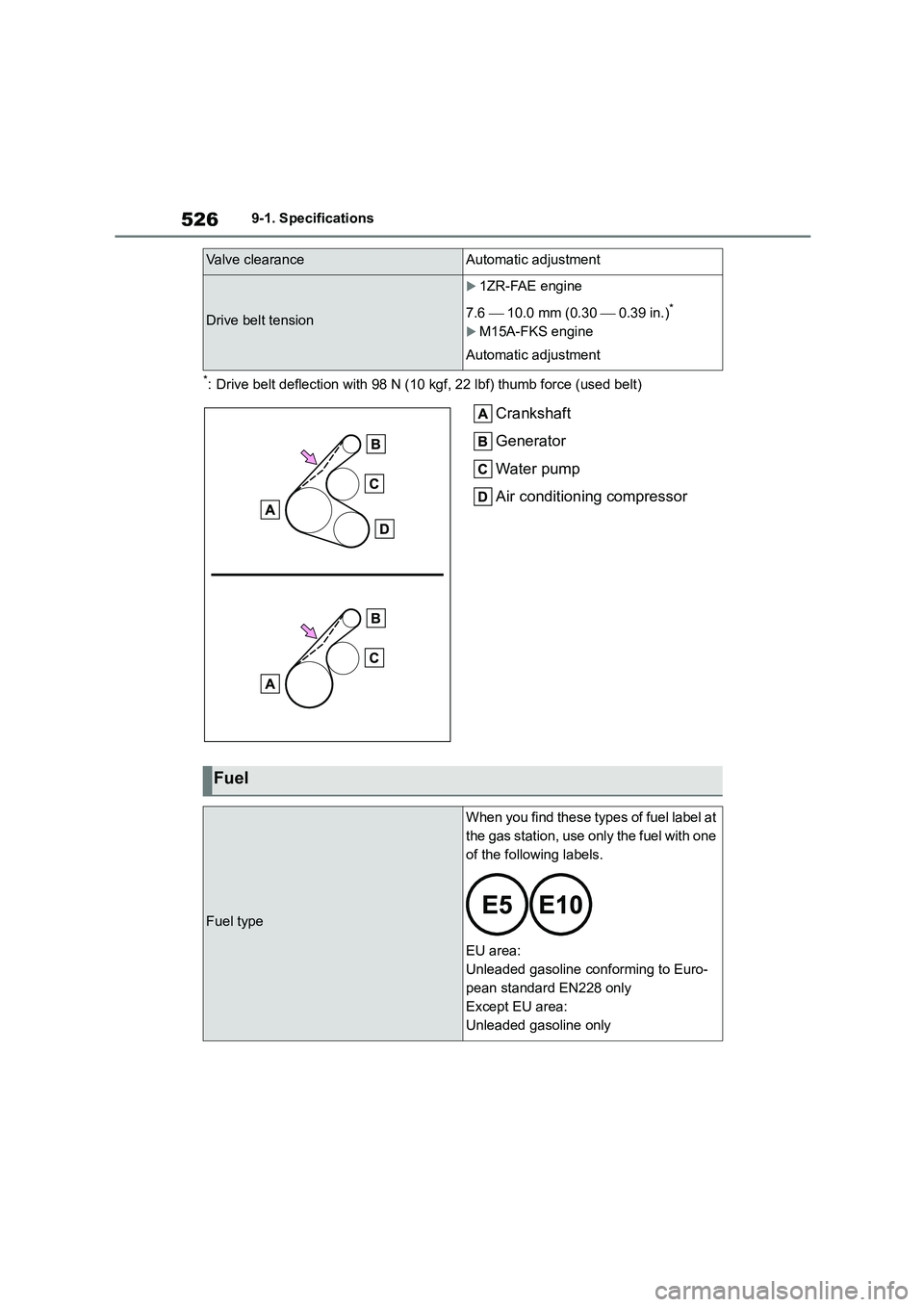
Crankshaft
Generator
Water pump
Air conditioning compressor
Valve clearanceAutomatic adjustment
Drive belt tension
1ZR-FAE engine
7.6 10.0 mm (0.30 0.39 in.)*
M15A-FKS engine
Automatic adjustment
Fuel
Fuel type
When you find these types of fuel label at
the gas station, use only the fuel with one
of the following labels.
EU area:
Unleaded gasoline conforming to Euro-
pean standard EN228 only
Except EU area:
Unleaded gasoline only
Page 534 of 678
5329-1. Specifications
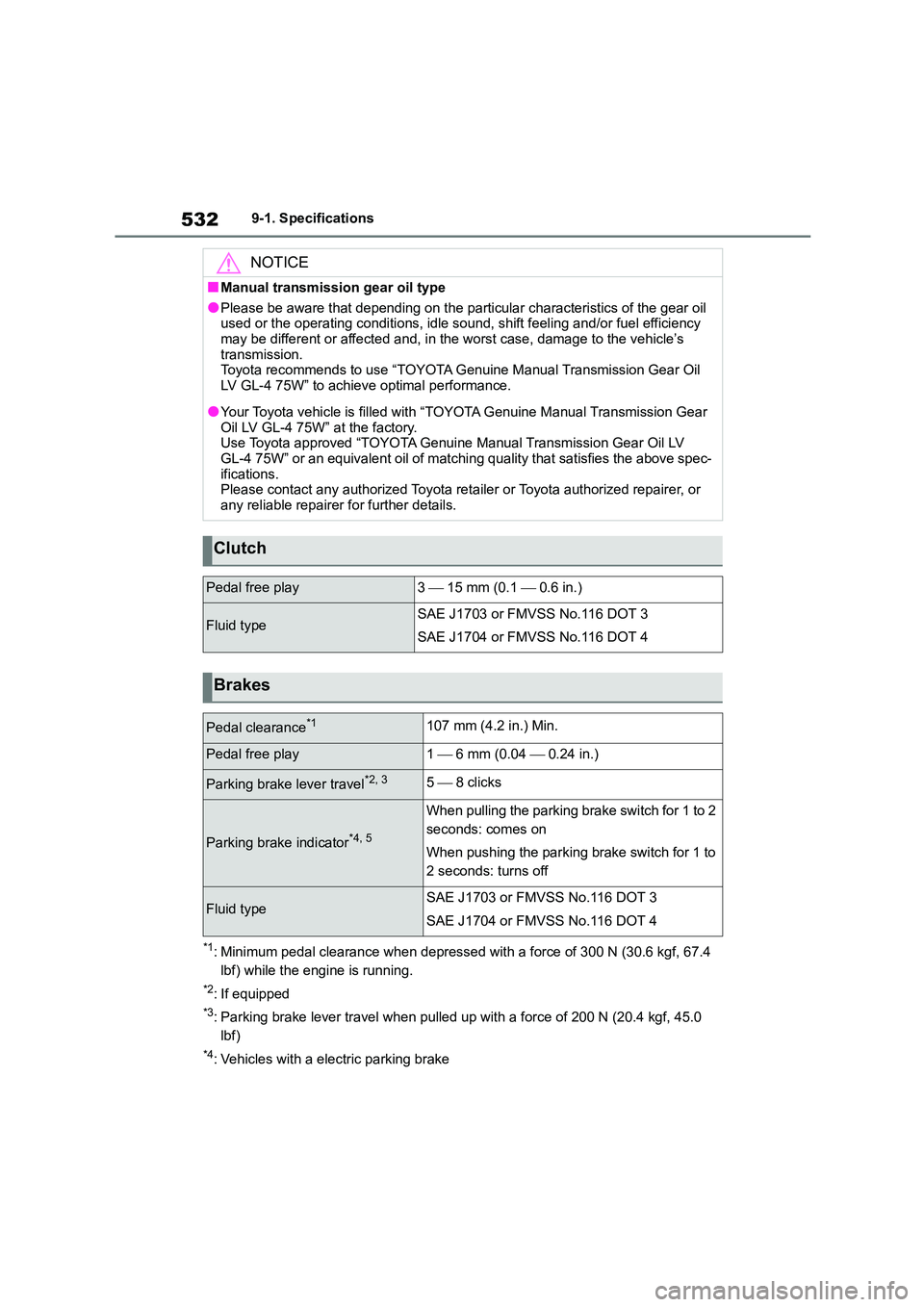
*1: Minimum pedal clearance when depressed with a force of 300 N (30.6 kgf, 67.4
lbf) while the engine is running.
*2: If equipped
*3: Parking brake lever travel when pulled up with a force of 200 N (20.4 kgf, 45.0
lbf)
*4: Vehicles with a electric parking brake
NOTICE
■Manual transmission gear oil type
●Please be aware that depending on the particular characteristics of the gear oil
used or the operating conditions, idle sound, shift feeling and/or fuel efficiency may be different or affected and, in the worst case, damage to the vehicle’s
transmission.
Toyota recommends to use “TOYOTA Genuine Manual Transmission Gear Oil LV GL-4 75W” to achieve optimal performance.
●Your Toyota vehicle is filled with “TOYOTA Genuine Manual Transmission Gear
Oil LV GL-4 75W” at the factory. Use Toyota approved “TOYOTA Genuine Manual Transmission Gear Oil LV
GL-4 75W” or an equivalent oil of matching quality that satisfies the above spec-
ifications. Please contact any authorized Toyota retailer or Toyota authorized repairer, or
any reliable repairer for further details.
Clutch
Pedal free play3 15 mm (0.1 0.6 in.)
Fluid typeSAE J1703 or FMVSS No.116 DOT 3
SAE J1704 or FMVSS No.116 DOT 4
Brakes
Pedal clearance*1107 mm (4.2 in.) Min.
Pedal free play1 6 mm (0.04 0.24 in.)
Parking brake lever travel*2, 35 8 clicks
Parking brake indicator*4, 5
When pulling the parking brake switch for 1 to 2
seconds: comes on
When pushing the parking brake switch for 1 to
2 seconds: turns off
Fluid typeSAE J1703 or FMVSS No.116 DOT 3
SAE J1704 or FMVSS No.116 DOT 4
Page 539 of 678
537
9
9-1. Specifications
Vehicle specifications
■Use of ethanol blended gasoline in
a gasoline engine
Toyota allows the use of ethanol
blended gasoline where the ethanol
content is up to 10%. Make sure that the ethanol blended gasoline to be used has
a Research Octane Number that follows
the above.
■If your engine knocks
●Consult any authorized Toyota retailer
or Toyota authorized repairer, or any reliable repairer.
●You may occasionally notice light knocking for a short time while accel-
erating or driving uphill. This is normal
and there is no need for concern.Fuel infor mation
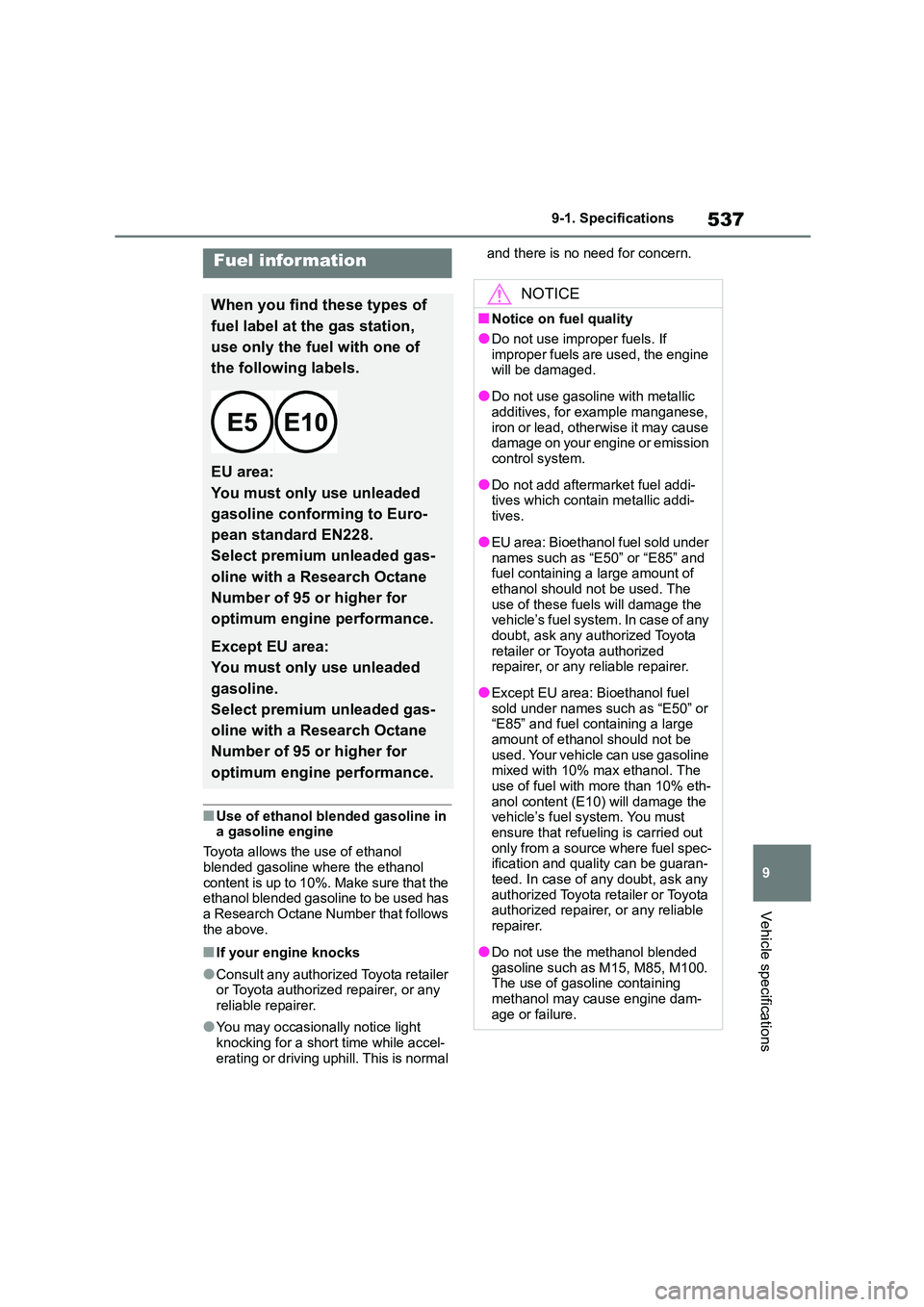
When you find these types of
fuel label at the gas station,
use only the fuel with one of
the following labels.
EU area:
You must only use unleaded
gasoline conforming to Euro-
pean standard EN228.
Select premium unleaded gas-
oline with a Research Octane
Number of 95 or higher for
optimum engine performance.
Except EU area:
You must only use unleaded
gasoline.
Select premium unleaded gas-
oline with a Research Octane
Number of 95 or higher for
optimum engine performance.
NOTICE
■Notice on fuel quality
●Do not use improper fuels. If
improper fuels are used, the engine
will be damaged.
●Do not use gasoline with metallic
additives, for example manganese,
iron or lead, otherwise it may cause damage on your engine or emission
control system.
●Do not add aftermarket fuel addi-
tives which contain metallic addi-
tives.
●EU area: Bioethanol fuel sold under
names such as “E50” or “E85” and fuel containing a large amount of
ethanol should not be used. The
use of these fuels will damage the vehicle’s fuel system. In case of any
doubt, ask any authorized Toyota
retailer or Toyota authorized repairer, or any reliable repairer.
●Except EU area: Bioethanol fuel sold under names such as “E50” or
“E85” and fuel containing a large
amount of ethanol should not be used. Your vehicle can use gasoline
mixed with 10% max ethanol. The
use of fuel with more than 10% eth- anol content (E10) will damage the
vehicle’s fuel system. You must
ensure that refue ling is carried out only from a source where fuel spec-
ification and quality can be guaran-
teed. In case of any doubt, ask any authorized Toyota retailer or Toyota
authorized repairer, or any reliable
repairer.
●Do not use the methanol blended
gasoline such as M15, M85, M100. The use of gasoline containing
methanol may cause engine dam-
age or failure.