lights TOYOTA COROLLA CROSS 2023 Owners Manual
[x] Cancel search | Manufacturer: TOYOTA, Model Year: 2023, Model line: COROLLA CROSS, Model: TOYOTA COROLLA CROSS 2023Pages: 500, PDF Size: 15.11 MB
Page 2 of 500
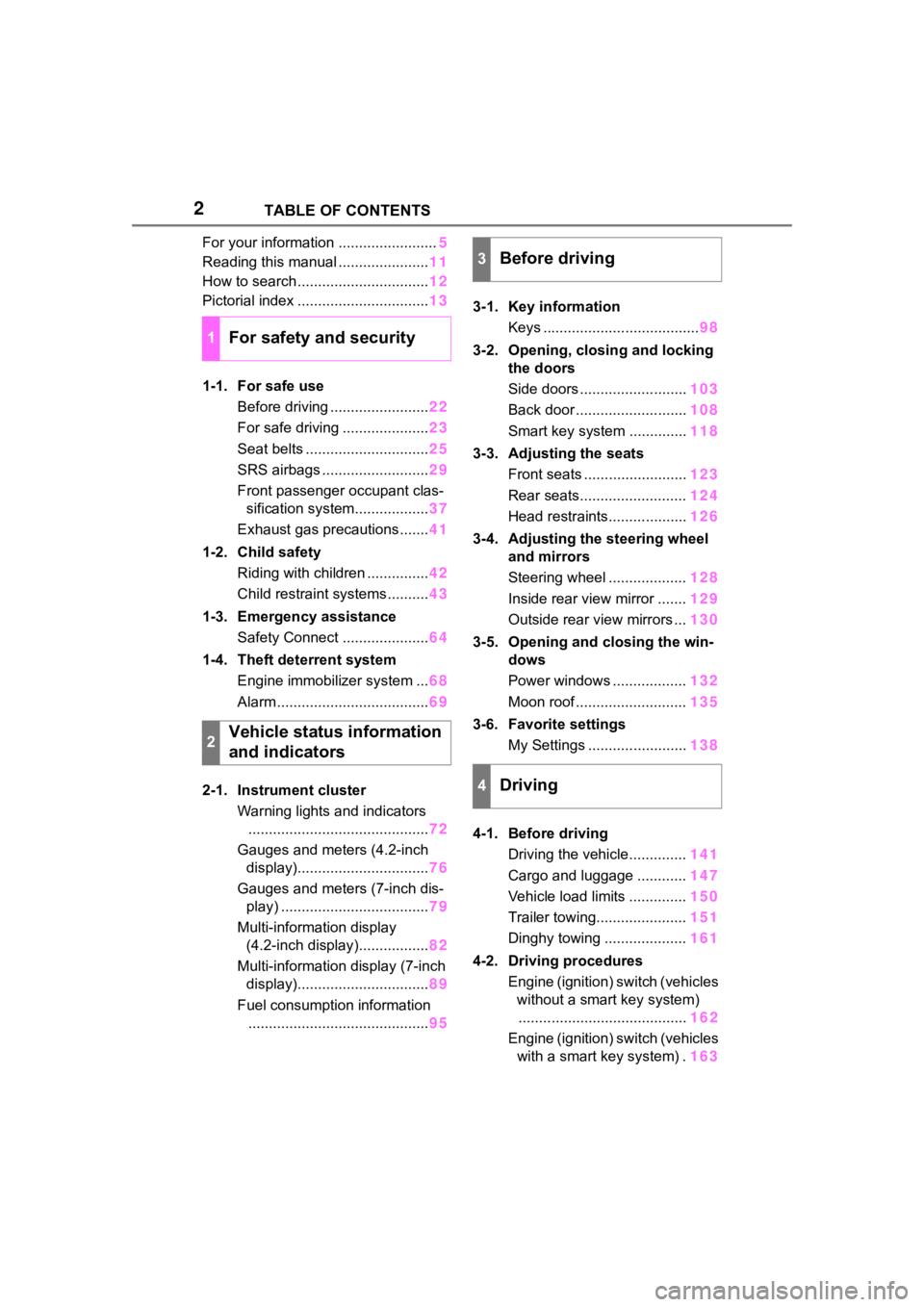
2TABLE OF CONTENTS
For your information ........................5
Reading this manual ...................... 11
How to search ................................ 12
Pictorial index ................................ 13
1-1. For safe use Before driving ........................ 22
For safe driving ..................... 23
Seat belts .............................. 25
SRS airbags .......................... 29
Front passenger occupant clas- sification system.................. 37
Exhaust gas precautions....... 41
1-2. Child safety Riding with children ............... 42
Child restraint systems .......... 43
1-3. Emergency assistance Safety Connect ..................... 64
1-4. Theft deterrent system Engine immobilizer system ... 68
Alarm ..................................... 69
2-1. Instrument cluster Warning lights and indicators............................................ 72
Gauges and meters (4.2-inch display)................................ 76
Gauges and meters (7-inch dis- play) .................................... 79
Multi-information display (4.2-inch display)................. 82
Multi-information display (7-inch display)................................ 89
Fuel consumption information ............................................ 953-1. Key information
Keys ...................................... 98
3-2. Opening, closing and locking the doors
Side doors .......................... 103
Back door ........................... 108
Smart key system .............. 118
3-3. Adjusting the seats Front seats ......................... 123
Rear seats.......................... 124
Head restraints................... 126
3-4. Adjusting the steering wheel and mirrors
Steering wheel ................... 128
Inside rear view mirror ....... 129
Outside rear view mirrors ... 130
3-5. Opening and closing the win- dows
Power windows .................. 132
Moon roof ........................... 135
3-6. Favorite settings My Settings ........................ 138
4-1. Before driving Driving the vehicle.............. 141
Cargo and luggage ............ 147
Vehicle load limits .............. 150
Trailer towing...................... 151
Dinghy towing .................... 161
4-2. Driving procedures Engine (ignition) switch (vehicles without a smart key system)........ ................................. 162
Eng
ine (ignition) switch (vehicles
with a smart key system) . 163
1For safety and security
2Vehicle status information
and indicators
3Before driving
4Driving
Page 3 of 500
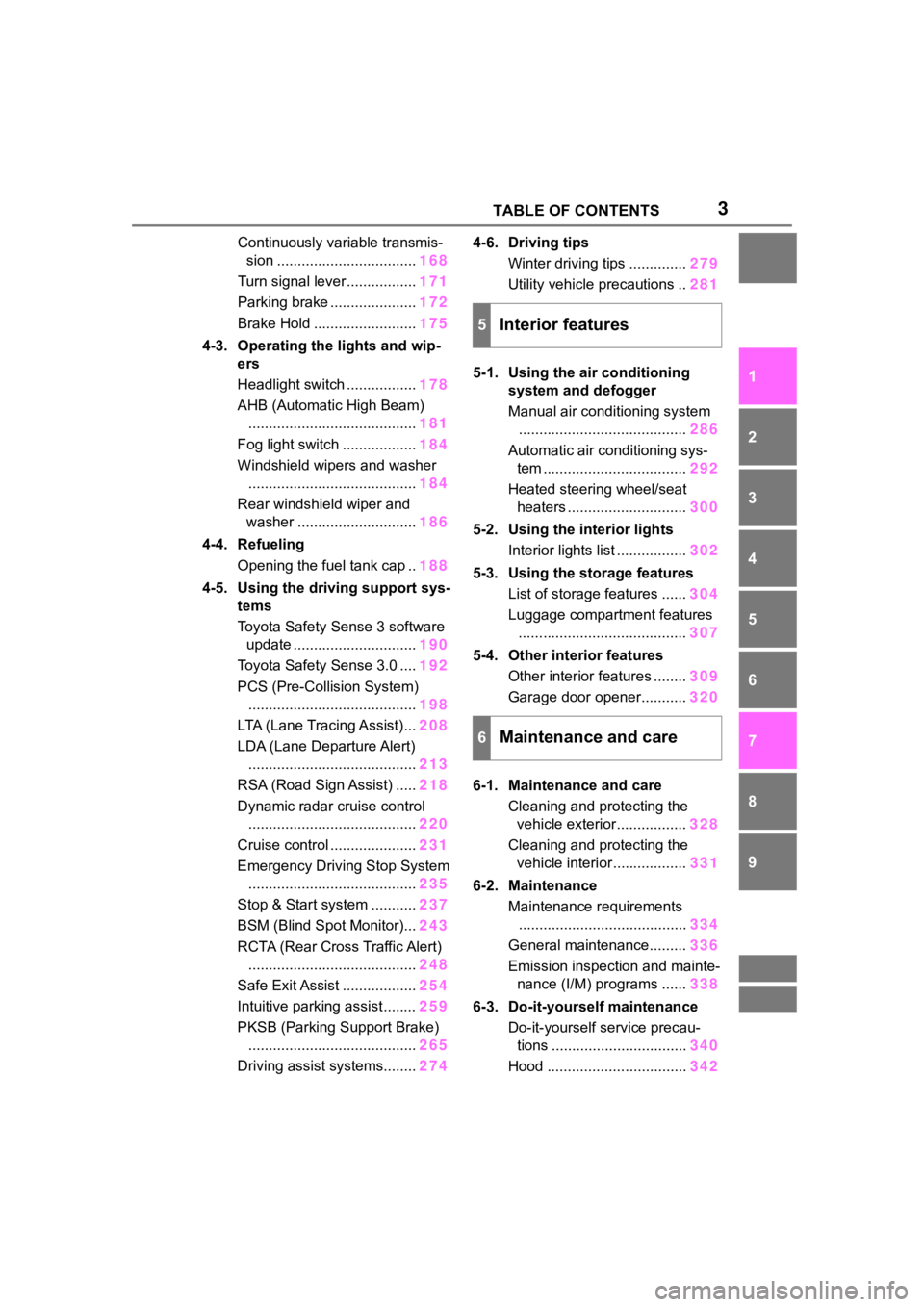
3TABLE OF CONTENTS
1
2
3
4
5
6
7
8
9
10
Continuously variable transmis-sion .................................. 168
Turn signal lever................. 171
Parking brake ..................... 172
Brake Hold ......................... 175
4-3. Operating the lights and wip- ers
Headlight switch ................. 178
AHB (Automatic High Beam) ......................................... 181
Fog light switch .................. 184
Windshield wipers and washer ......................................... 184
Rear windshield wiper and washer ............................. 186
4-4. Refueling Opening the fuel tank cap .. 188
4-5. Using the driving support sys- tems
Toyota Safety Sense 3 software
update .............................. 190
Toyota Safety Sense 3.0 .... 192
PCS (Pre-Collision System) ......................................... 198
LTA (Lane Tracing Assist)... 208
LDA (Lane Departure Alert) ......................................... 213
RSA (Road Sign Assist) ..... 218
Dynamic radar cruise control ......................................... 220
Cruise control ..................... 231
Emergency Driving Stop System ......................................... 235
Stop & Start system ........... 237
BSM (Blind Spot Monitor)... 243
RCTA (Rear Cross Traffic Alert) ......................................... 248
Safe Exit Assist .................. 254
Intuitive parking assist ........ 259
PKSB (Parking Support Brake) ......................................... 265
Driving assist systems........ 2744-6. Driving tips
Winter driving tips .............. 279
Utility vehicle precautions .. 281
5-1. Using the air conditioning system and defogger
Manual air conditioning system
......................................... 286
Automatic air conditioning sys- tem ................................... 292
Heated steering wheel/seat heaters ............................. 300
5-2. Using the interior lights Interior lights list ................. 302
5-3. Using the storage features List of storage features ...... 304
Luggage compartment features ......................................... 307
5-4. Other interior features Other interior features ........ 309
Garage door opener........... 320
6-1. Maintenance and care Cleaning and protecting the vehicle exterior................. 328
Cleaning and protecting the vehicle interi or.................. 33
1
6-2. Maintenance Maintenance requirements......................................... 334
General maintenance......... 336
Emission inspection and mainte- nance (I/M) programs ...... 338
6-3. Do-it-yourself maintenance Do-it-yourself service precau-tions ................................. 340
Hood .................................. 342
5Interior features
6Maintenance and care
Page 14 of 500
14Pictorial index
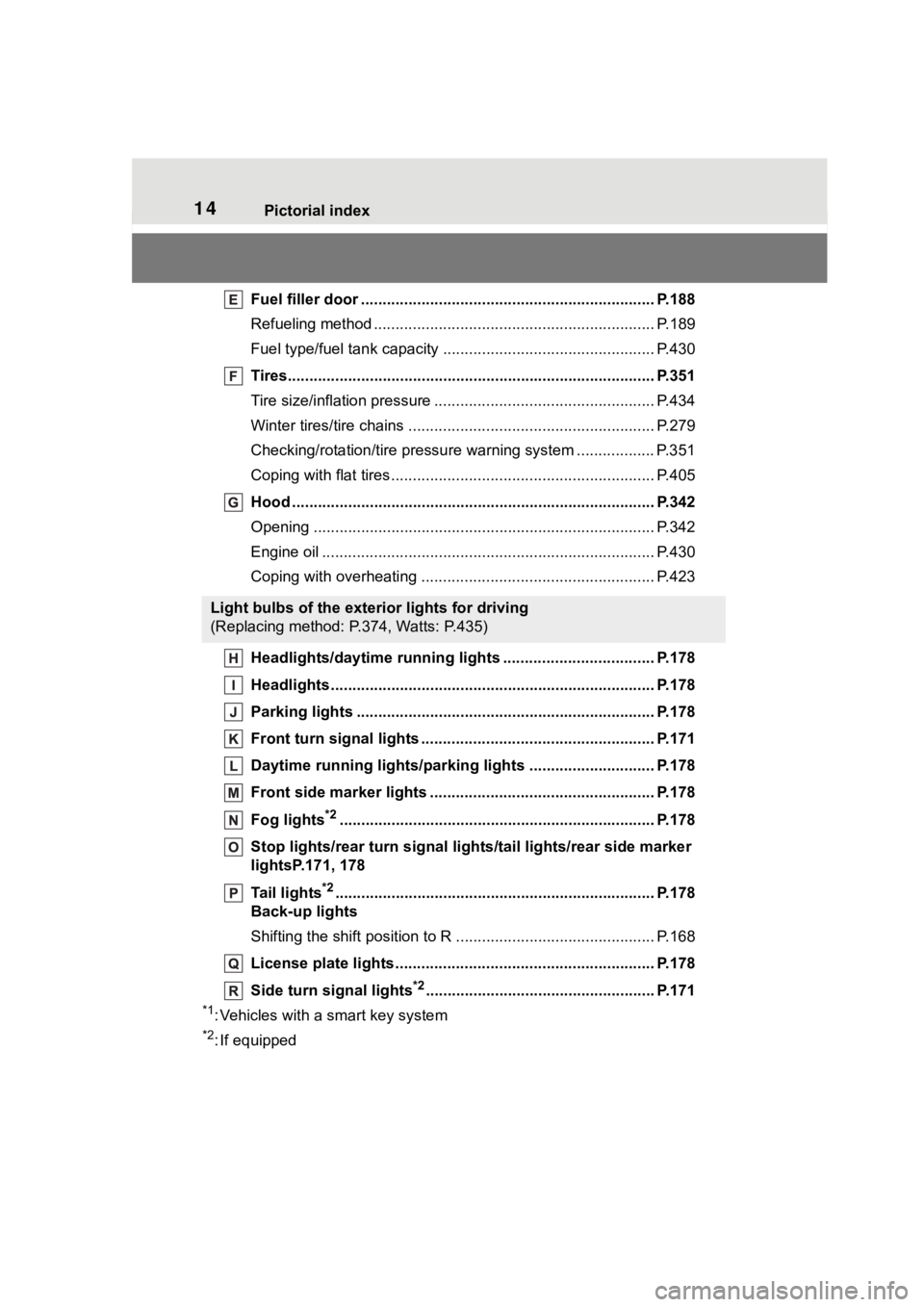
Fuel filler door .................................................................... P.188
Refueling method ............................................... .................. P.189
Fuel type/fuel tan k capacity ................................... .............. P.430
Tires.......................................................... ........................... P.351
Tire size/inflation pressure ................................... ................ P.434
Winter tires/tire chains ....................................... .................. P.279
Checking/rotation/tire pressur e warning system ..................P.351
Coping with flat tires......................................... .................... P.405
Hood ........................................................... ......................... P.342
Opening ............................................................................... P.342
Engine oil ..................................................... ........................ P.430
Coping with overheating ...................................................... P.423
Headlights/daytime running lights .............................. ..... P.178
Headlights..................................................... ...................... P.178
Parking lights ................................................. .................... P.178
Front turn signal lights ....................................... ............... P.171
Daytime running lights/parking lights ............................. P.178
Front side marker lights ....................................... ............. P.178
Fog lights
*2............................................................... .......... P.178
Stop lights/rear turn signal lig hts/tail lights/rear side marker
lightsP.171, 178
Tail lights
*2............................................................... ........... P.178
Back-up lights
Shifting the shift position to R ............................... ............... P.168
License plate lights........................................... ................. P.178
Side turn signal lights
*2..................................................... P.171
*1: Vehicles with a smart key system
*2: If equipped
Light bulbs of the exterior lights for driving
(Replacing method: P.374, Watts: P.435)
Page 15 of 500
15Pictorial index
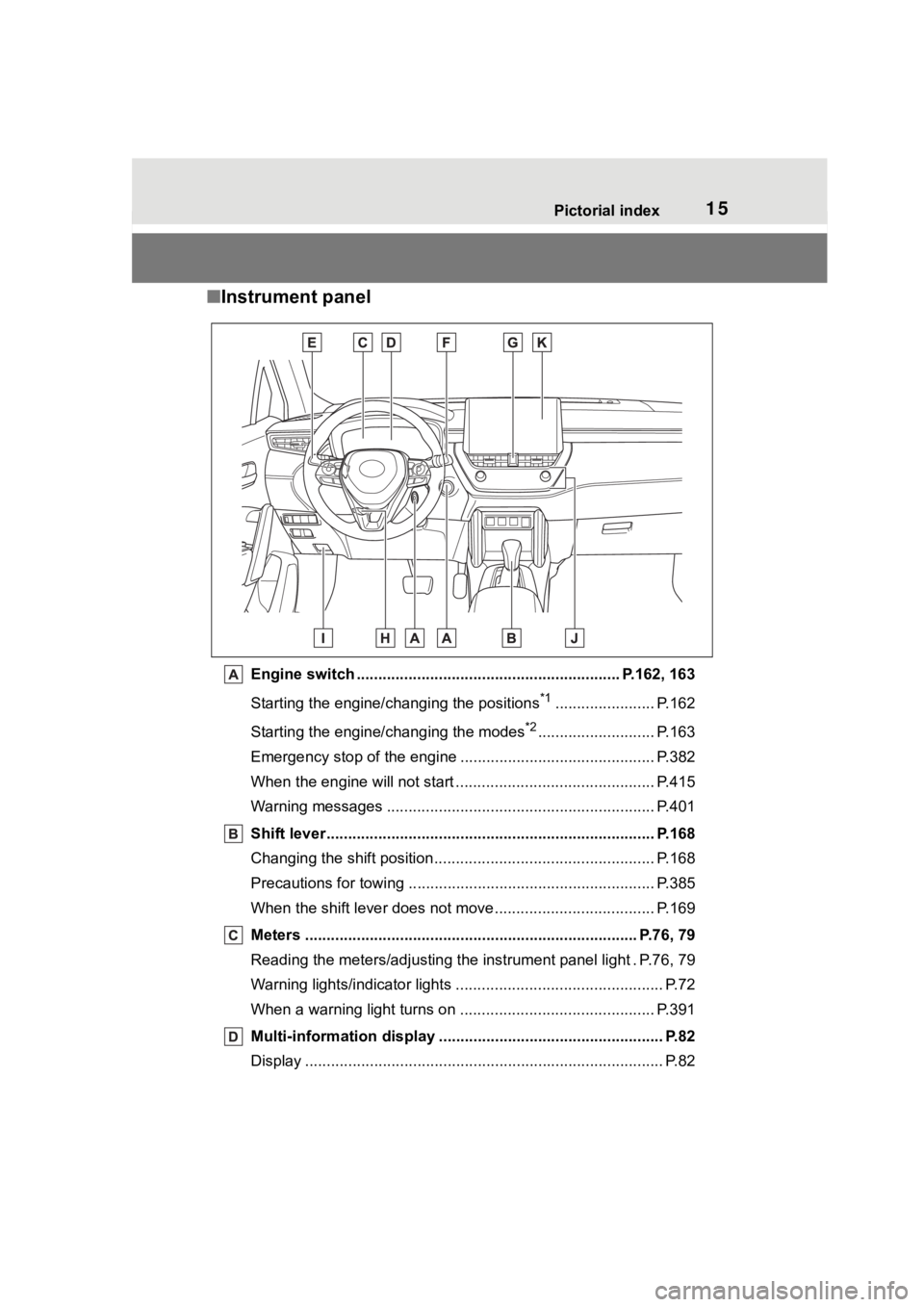
■Instrument panel
Engine switch ............................................................. P.162, 163
Starting the engine/changing the positions
*1....................... P.162
Starting the engine/changing the modes
*2........................... P.163
Emergency stop of the engin e ............................................. P.382
When the engine will not start ................................. ............. P.415
Warning messages ............................................... ............... P.401
Shift lever.................................................... ........................ P.168
Changing the shift position.................................... ............... P.168
Precautions for towing .. ....................................... ................ P.385
When the shift lever does not move............................. ........ P.169
Meters ............................................................................. P.76, 79
Reading the meters/adjusting the instrument panel light . P.76, 7 9
Warning lights/indicator lights ................................ ................ P.72
When a warning light turns on .................................. ........... P.391
Multi-information display . ................................................... P.82
Display ........................................................ ........................... P.82
Page 16 of 500

16Pictorial index
When a warning message is displayed ................................ P.401
Turn signal lever.............................................. ................... P.171
Headlight switch ............................................... ................. P.178
Headlights/parking lights/tail lig hts/side marker lights/license plate
lights/daytime running lights .................................. ............... P.178
Fog lights
*3P. 1 8 4
Windshield wiper and washer sw itch....................... P.184, 186
Usage.......................................................... ................. P.184, 186
Adding washer fluid .............................................................. P.350
Emergency flasher switch ....................................... .......... P.382
Tilt and telescopic steering lock release lever ................P. 1 2 8
Hood lock release lever ........................................ ............. P.342
Air conditioning system ............................. ............... P.286, 292
Usage.......................................................... ................. P.286, 292
Rear window defogger ........................................... ...... P.288, 295
Audio system
*4
*1
: Vehicles without a smart key system
*2: Vehicles with a smart key system
*3: If equipped
*4: Refer to “MULTIMEDIA OWNER’S MANUAL”.
Page 20 of 500
20Pictorial index
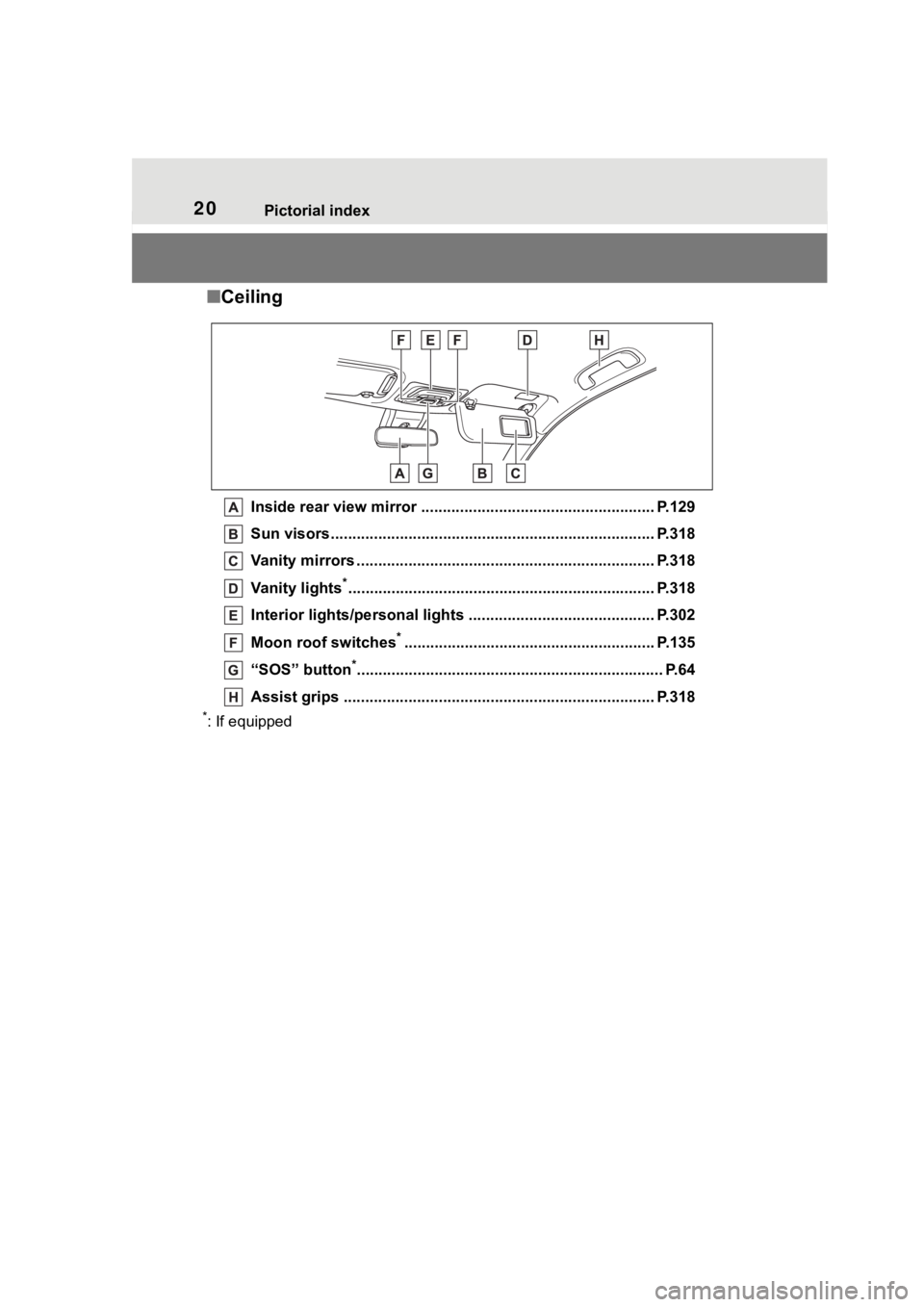
■Ceiling
Inside rear view mirror ........................................ .............. P.129
Sun visors..................................................... ...................... P.318
Vanity mirrors ................................................. .................... P.318
Vanity lights
*............................................................... ........ P.318
Interior lights/personal lights ................................ ........... P.302
Moon roof switches
*.......................................................... P.135
“SOS” button
*............................................................... ........ P.64
Assist grips ................................................... ..................... P.318
*: If equipped
Page 30 of 500

301-1. For safe use
based on US motor vehicle safety standards (FMVSS208). The air-
bag sensor assembly (ECU) controls airbag deployment based on
information obtained from the sensors, etc., shown in the system
components diagram above. This in formation includes crash sever-
ity and occupant information. As the airbags deploy, a chemical
reaction in the inflators quickly fills the airbags with non-toxic gas to
help restrain the motion of the occupants.
■If the SRS airbags deploy
(inflate)
●Slight abrasions, burns, bruising,
etc., may be sustained from SRS
airbags, due to the extremely high
speed of deployment (inflation) by
hot gases.
●A loud noise and white powder will
be emitted.
●Parts of the airbag module (steer-
ing wheel hub, airbag cover and
inflator) as well as the parts
around the airbags may be hot for
several minutes. T he airbag itself
may also be hot.
●The windshield may crack.
●All of the doors will be unlocked.
( P.105)
●The brakes and st op lights will be
controlled automatically. ( P.275)
●The interior lights will turn on auto-
matically. ( P.303)
●The emergency flashers will turn
on automatically. ( P.382)
●Fuel supply to the engine will be
stopped. (P.390)
●For Safety Connect subscribers, if
any of the followin g situations
occur, the system is designed to
send an emergency call to the
response center, notifying them of
the vehicle’s location (without
needing to push the “SOS” button)
and an agent will attempt to speak
with the occupants to ascertain
the level of emergency and assis-
tance required. If the occupants
are unable to communicate, the
agent automatically treats the call as an emergency and helps to dis-
patch the necessary emergency
services. (
P. 6 4 )
• When an SRS airbag has been
deployed
• When a seat belt pretensioner has operated
• When the vehicle has been involved in a severe rear-end colli-
sion
■The SRS airbags deploy in a
frontal impact when
●The following SRS airbags will
deploy in the event of an impact
that exceeds a th reshold level
(level of force corresponding to an
approximately 12 - 18 mph [20 -
30 km/h] frontal collision with a
fixed wall that does not move or
deform):
• SRS front airbags
• SRS knee airbag
●The threshold level at which the
SRS airbags will deploy will be
higher than normal in the in the
following situations:
• When the vehicle collides with an
object, such as a parked vehicle
or sign pole, which moves or
deforms on impact
• If the vehicle is involved in an underride collision, such as a colli-
sion in which the front of the vehi-
cle “underrides”, or goes under,
the bed of a truck
●Depending on the type of collision,
only the following may deploy:
• Seat belt pretensioners
●The SRS airbags for the front pas-
senger’s seat will not deploy if
there is no passe nger in the front
passenger seat. However, the
Page 38 of 500
381-1. For safe use
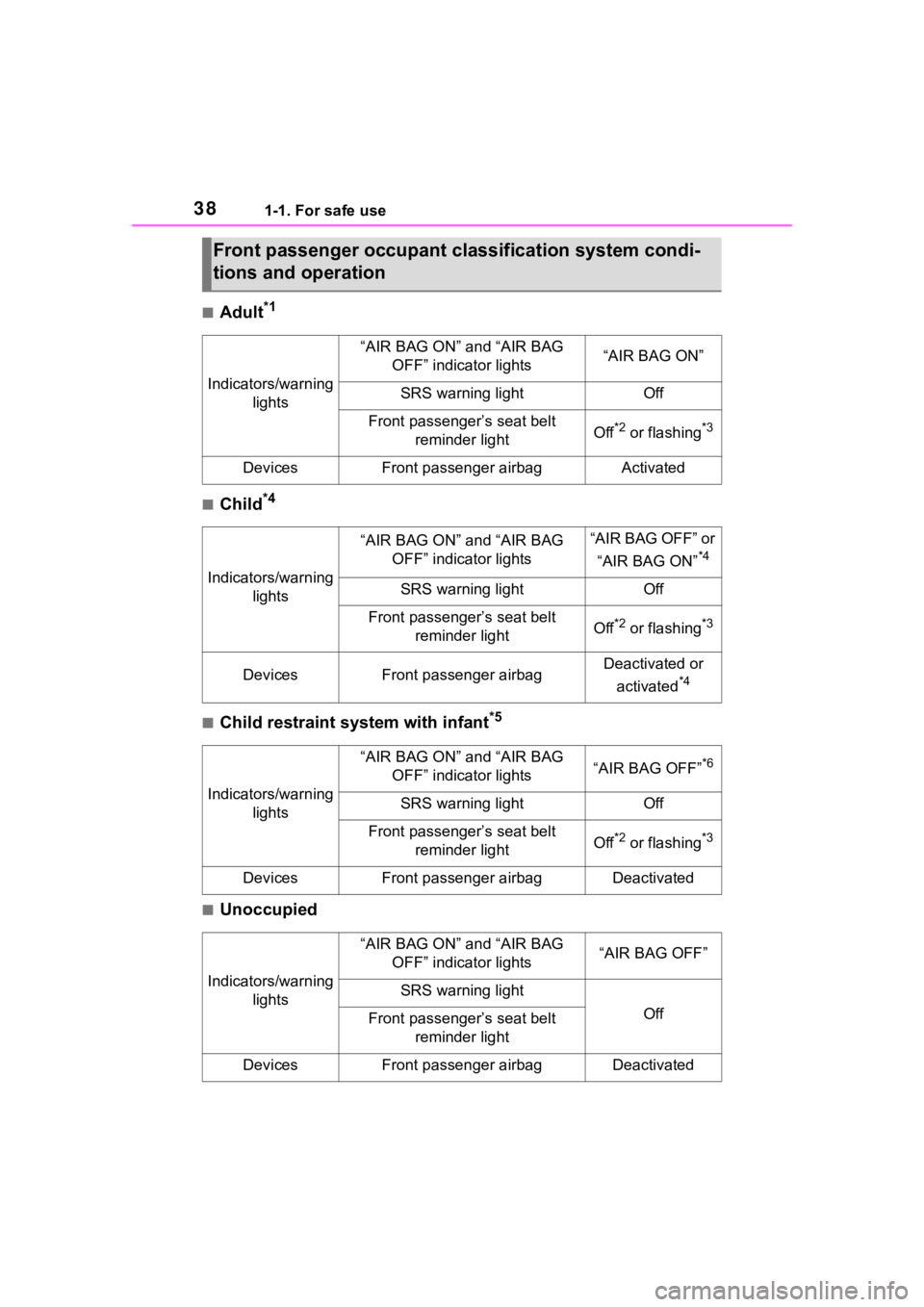
■Adult*1
■Child*4
■Child restraint system with infant*5
■Unoccupied
Front passenger occupant classification system condi-
tions and operation
Indicators/warning lights
“AIR BAG ON” and “AIR BAG OFF” indicator lights“AIR BAG ON”
SRS warning lightOff
Front passenger’s seat belt reminder lightOff*2 or flashing*3
DevicesFront passenger airbagActivated
Indicators/warning lights
“AIR BAG ON” and “AIR BAG OFF” indicator lights“AIR BAG OFF” or
“AIR BAG ON”
*4
SRS warning lightOff
Front passenger’s seat belt reminder lightOff*2 or flashing*3
DevicesFront passenger airbagDeactivated or
activated
*4
Indicators/warning lights
“AIR BAG ON” and “AIR BAG OFF” indicator lights“AIR BAG OFF”*6
SRS warning lightOff
Front passenger’s seat belt reminder lightOff*2 or flashing*3
DevicesFront passenger airbagDeactivated
Indicators/warning lights
“AIR BAG ON” and “AIR BAG OFF” indicator lights“AIR BAG OFF”
SRS warning light
OffFront passenger’s seat belt reminder light
DevicesFront passenger airbagDeactivated
Page 39 of 500

391-1. For safe use
1
For safety and security
■System malfunction
*1: The system judges a person of adult size as an adult. When a smaller
adult sits in the front passenger seat, the system may not recognize them
as an adult depending on their physique and posture.
*2: In the event the front passenger is wearing a seat belt.
*3: In the event the front passenge r does not wear a seat belt.
*4: For some children, child in seat, child in booster seat or chi ld in convert-
ible seat, the system may not recognize them as a child. Factors which
may affect this can be the physique or posture.
*5: Never install a rear-facing ch ild restraint system on the fron t passenger
seat. A forward-facing child restraint system should only be in stalled on
the front passenger sea t when it is unavoidable. ( P.43)
*6: In case the indicator light is not illuminated, consult this m anual on how
to install the child restr aint system properly. (P. 4 3 )
Indicators/warning
lights
“AIR BAG ON” and “AIR BAG OFF” indicator lights“AIR BAG OFF”
SRS warning light
OnFront passenger’s seat belt reminder light
DevicesFront passenger airbagDeactivated
WARNING
■Front passenger occupant
classification system precau-
tions
Observe the following precautions
regarding the front passenger
occupant classification system.
Failure to do so may cause death
or serious injury.
●Wear the seat belt properly.
●Make sure the front passenger’s
seat belt latch plate has not
been left inserted into the
buckle before someone sits in
the front passenger seat.
●Make sure the “AIR BAG OFF”
indicator light is not illuminated
when using the seat belt
extender for the front passenger
seat. If the “AIR BAG OFF” indi-
cator light is illuminated, discon-
nect the extender tongue from
the seat belt buckle, and recon-
nect the seat belt. Reconnect
the seat belt extender after
making sure the “AIR BAG ON”
indicator light i s illuminated. If
you use the seat belt extender
while the “AIR BAG OFF” indi-
cator light is illuminated, the
SRS airbags for the front pas-
senger will not activate, which
could cause death or serious
injury in the even t of a collision.
●Do not apply a heavy load to the
front passenger seat or equip-
ment (e.g. seatback pocket).
Page 71 of 500
71
2
2
Vehicle status information and indicators
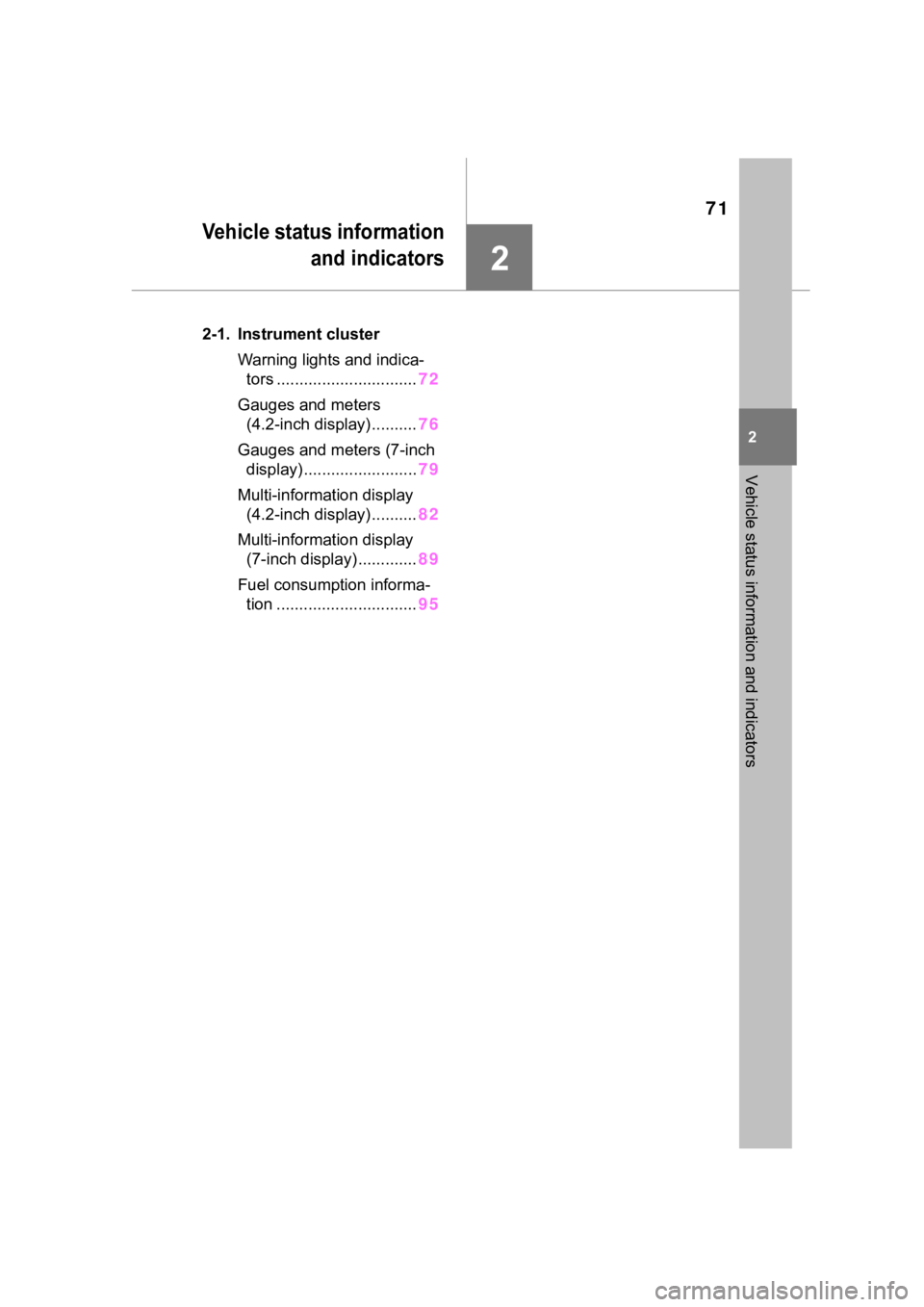
Vehicle status informationand indicators
.2-1. Instrument cluster
Warning lights and indica-tors ............................... 72
Gauges and meters (4.2-inch display) .......... 76
Gauges and meters (7-inch display) ......................... 79
Multi-information display (4.2-inch display) .......... 82
Multi-information display (7-inch display) ............. 89
Fuel consumption informa- tion ............................... 95