transmission TOYOTA COROLLA HATCHBACK 2022 (in English) Owner's Manual
[x] Cancel search | Manufacturer: TOYOTA, Model Year: 2022, Model line: COROLLA HATCHBACK, Model: TOYOTA COROLLA HATCHBACK 2022Pages: 758, PDF Size: 155.26 MB
Page 274 of 758
2724-5. Using the driving support systems
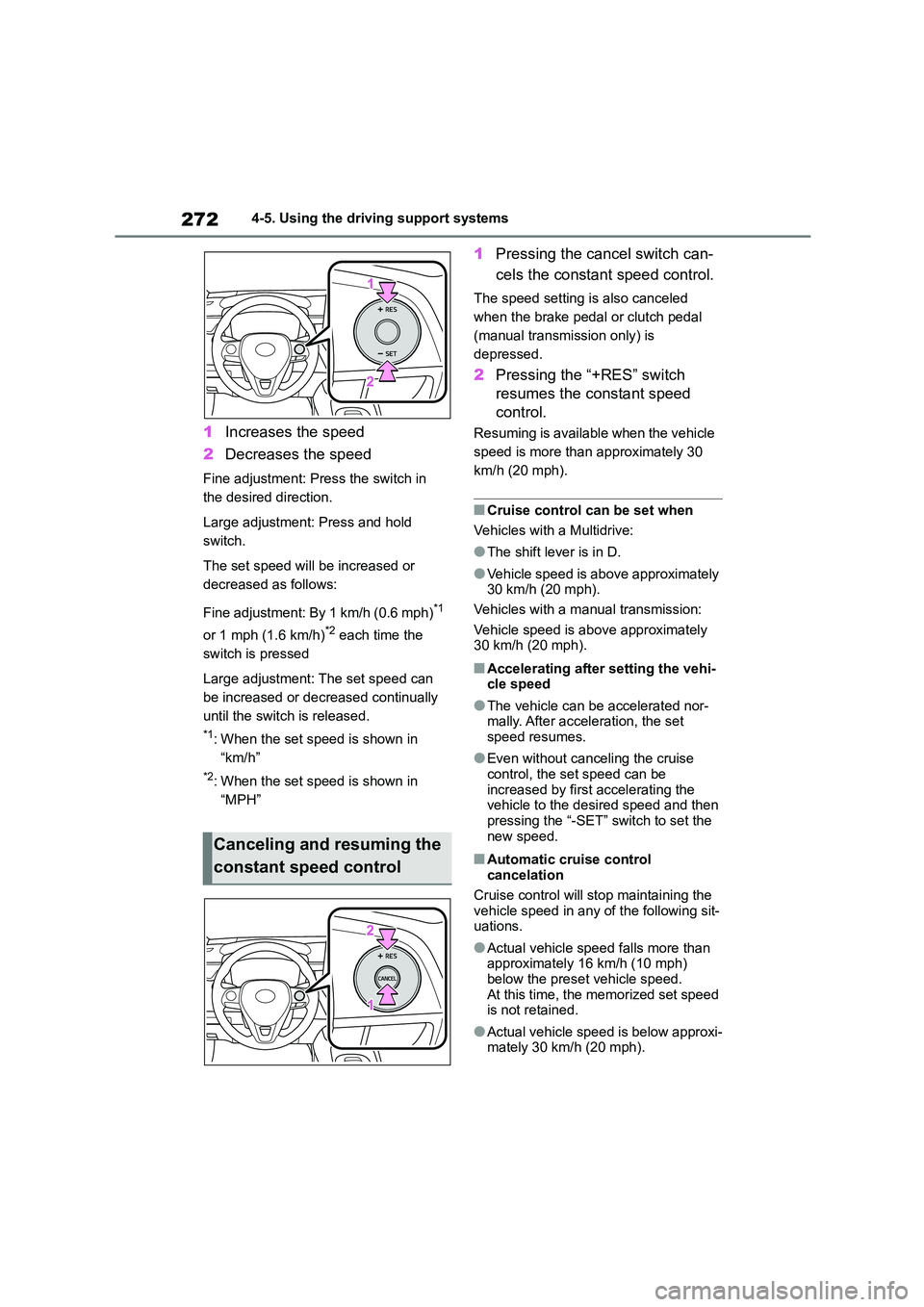
1Increases the speed
2 Decreases the speed
Fine adjustment: Press the switch in
the desired direction.
Large adjustment: Press and hold
switch.
The set speed will be increased or
decreased as follows:
Fine adjustment: By 1 km/h (0.6 mph)*1
or 1 mph (1.6 km/h)*2 each time the
switch is pressed
Large adjustment: The set speed can
be increased or decreased continually
until the switch is released.
*1: When the set speed is shown in
“km/h”
*2: When the set speed is shown in
“MPH”
1 Pressing the cancel switch can-
cels the constant speed control.
The speed setting is also canceled
when the brake pedal or clutch pedal
(manual transmission only) is
depressed.
2 Pressing the “+RES” switch
resumes the constant speed
control.
Resuming is available when the vehicle
speed is more than approximately 30
km/h (20 mph).
■Cruise control can be set when
Vehicles with a Multidrive:
●The shift lever is in D.
●Vehicle speed is above approximately 30 km/h (20 mph).
Vehicles with a manual transmission:
Vehicle speed is above approximately 30 km/h (20 mph).
■Accelerating after setting the vehi-
cle speed
●The vehicle can be accelerated nor-
mally. After acceleration, the set
speed resumes.
●Even without canceling the cruise
control, the set speed can be
increased by first accelerating the vehicle to the desired speed and then
pressing the “-SET” switch to set the
new speed.
■Automatic cruise control cancelation
Cruise control will stop maintaining the
vehicle speed in any of the following sit- uations.
●Actual vehicle speed falls more than approximately 16 km/h (10 mph)
below the preset vehicle speed.
At this time, the memorized set speed is not retained.
●Actual vehicle speed is below approxi-mately 30 km/h (20 mph).
Canceling and resuming the
constant speed control
Page 282 of 758
2804-5. Using the driving support systems
*: If equipped
■When the brake hold system is
not operating with the shift
lever is in D
Stopping the engine
While driving with the shift lever is
in D, depress the brake pedal and
stop the vehicle.
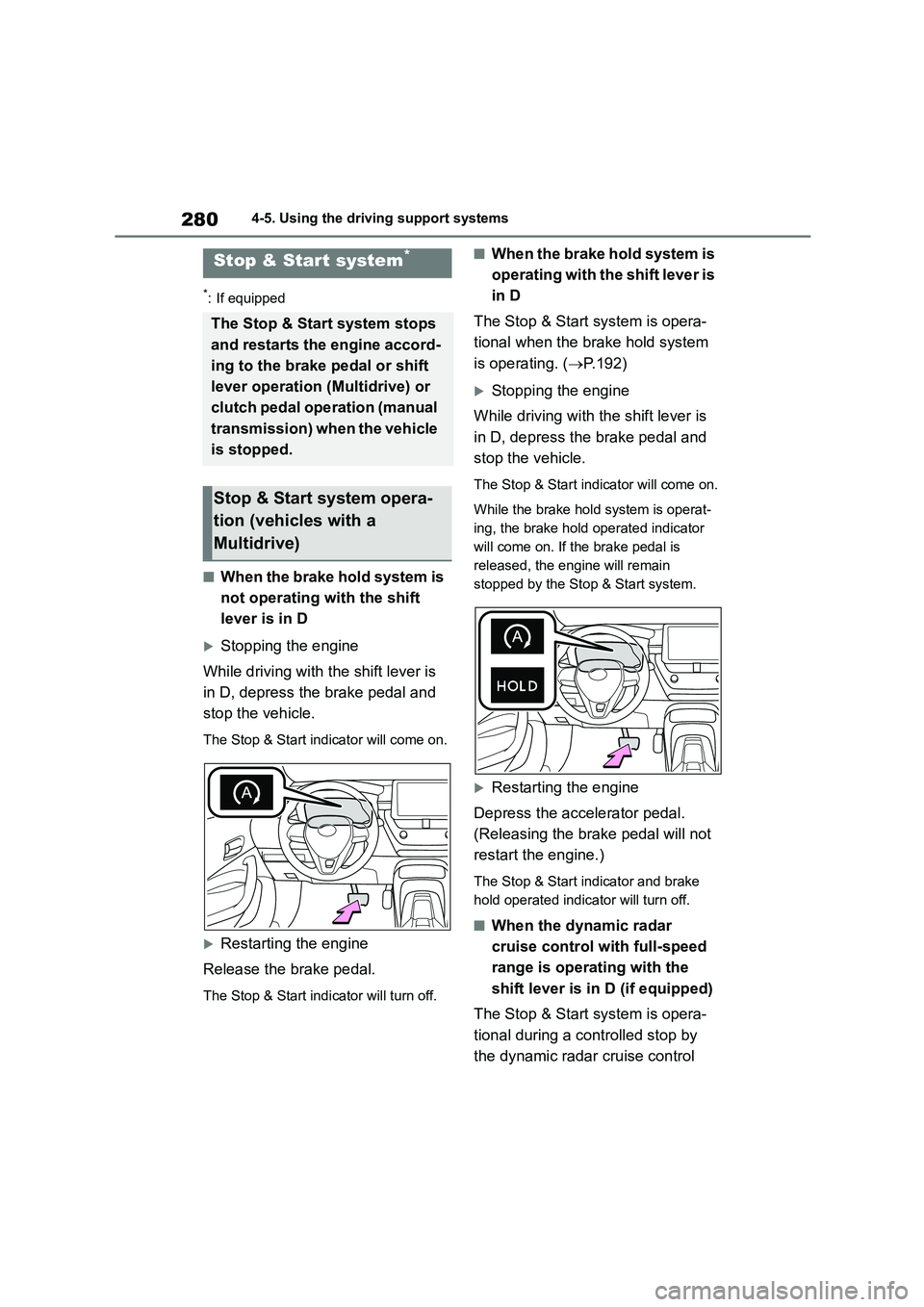
The Stop & Start indicator will come on.
Restarting the engine
Release the brake pedal.
The Stop & Start indicator will turn off.
■When the brake hold system is
operating with the shift lever is
in D
The Stop & Start system is opera-
tional when the brake hold system
is operating. ( P.192)
Stopping the engine
While driving with the shift lever is
in D, depress the brake pedal and
stop the vehicle.
The Stop & Start indicator will come on.
While the brake hold system is operat-
ing, the brake hold operated indicator
will come on. If the brake pedal is
released, the engine will remain
stopped by the Stop & Start system.
Restarting the engine
Depress the accelerator pedal.
(Releasing the brake pedal will not
restart the engine.)
The Stop & Start indicator and brake
hold operated indicator will turn off.
■When the dynamic radar
cruise control with full-speed
range is operating with the
shift lever is in D (if equipped)
The Stop & Start system is opera-
tional during a controlled stop by
the dynamic radar cruise control
Stop & Start system*
The Stop & Start system stops
and restarts the engine accord-
ing to the brake pedal or shift
lever operation (Multidrive) or
clutch pedal operation (manual
transmission) when the vehicle
is stopped.
Stop & Start system opera-
tion (vehicles with a
Multidrive)
Page 284 of 758
2824-5. Using the driving support systems
■Stopping the engine
1 With the clutch pedal fully
depressed, depress the brake
pedal, and stop the vehicle.
2 Shift the shift lever to N
( P.186), and release the
clutch pedal.
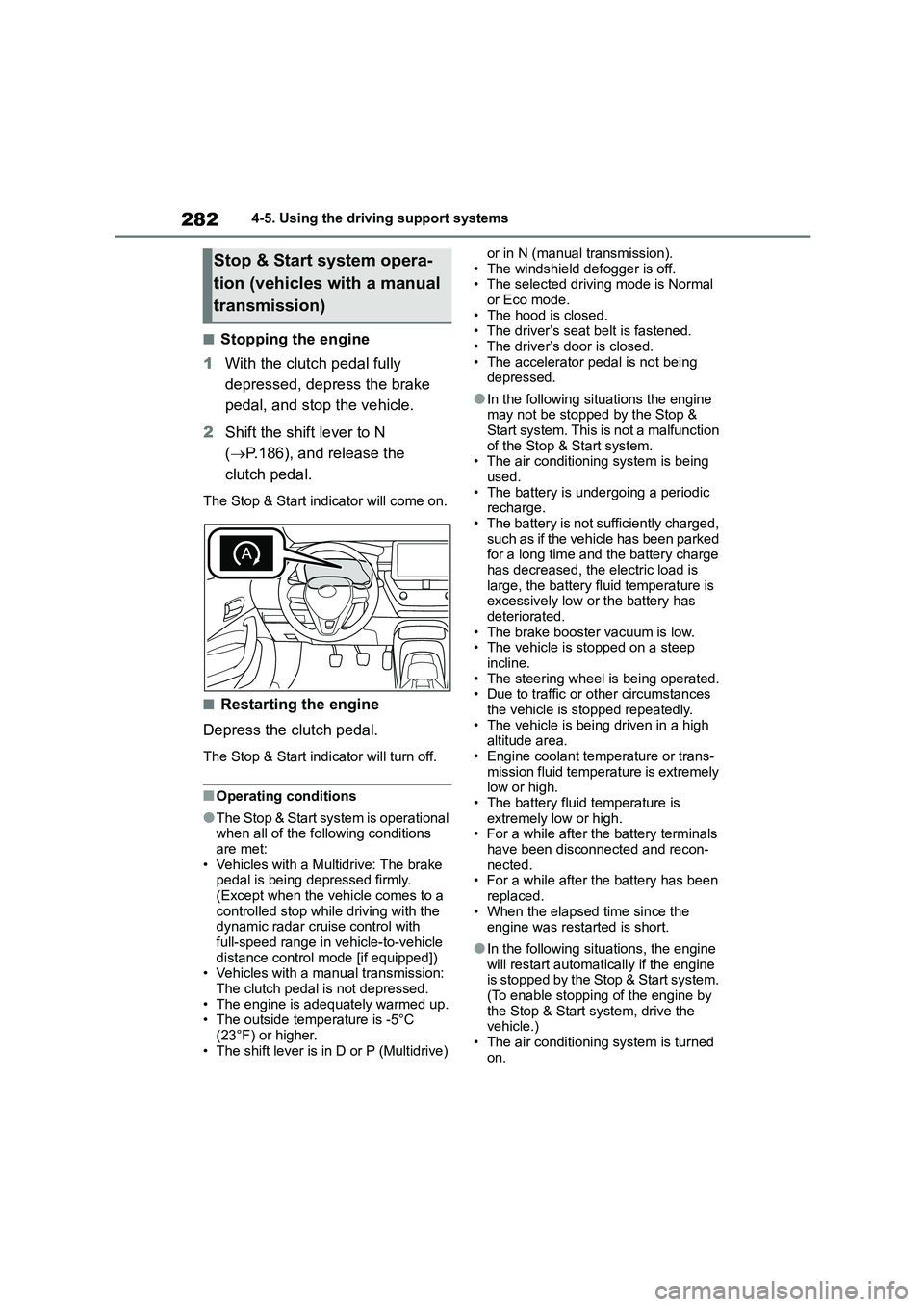
The Stop & Start indicator will come on.
■Restarting the engine
Depress the clutch pedal.
The Stop & Start indicator will turn off.
■Operating conditions
●The Stop & Start system is operational
when all of the following conditions are met:
• Vehicles with a Multidrive: The brake
pedal is being depressed firmly. (Except when the vehicle comes to a
controlled stop while driving with the
dynamic radar cruise control with
full-speed range in vehicle-to-vehicle distance control mode [if equipped])
• Vehicles with a manual transmission:
The clutch pedal is not depressed. • The engine is adequately warmed up.
• The outside temperature is -5°C
(23°F) or higher. • The shift lever is in D or P (Multidrive)
or in N (manual transmission).
• The windshield defogger is off. • The selected driving mode is Normal
or Eco mode.
• The hood is closed. • The driver’s seat belt is fastened.
• The driver’s door is closed.
• The accelerator pedal is not being depressed.
●In the following situations the engine may not be stopped by the Stop &
Start system. This is not a malfunction
of the Stop & Start system. • The air conditioning system is being
used.
• The battery is undergoing a periodic recharge.
• The battery is not sufficiently charged,
such as if the vehicle has been parked for a long time and the battery charge
has decreased, the electric load is
large, the battery fluid temperature is excessively low or the battery has
deteriorated.
• The brake booster vacuum is low. • The vehicle is stopped on a steep
incline.
• The steering wheel is being operated. • Due to traffic or other circumstances
the vehicle is stopped repeatedly.
• The vehicle is being driven in a high altitude area.
• Engine coolant temperature or trans-
mission fluid temperature is extremely low or high.
• The battery fluid temperature is
extremely low or high. • For a while after the battery terminals
have been disconnected and recon-
nected. • For a while after the battery has been
replaced.
• When the elapsed time since the
engine was restarted is short.
●In the following situations, the engine
will restart automatically if the engine is stopped by the Stop & Start system.
(To enable stopping of the engine by
the Stop & Start system, drive the vehicle.)
• The air conditioning system is turned
on.
Stop & Start system opera-
tion (vehicles with a manual
transmission)
Page 288 of 758
2864-5. Using the driving support systems
• The battery charge amount may be
low.
The engine is restarted to prioritize
battery charging. Operating the engine
for a short while allows the system to
recover.
●When the engine cannot be restarted
by the Stop & Start system
“Shift to N and Press Clutch” (vehi-
cles with a manual transmission)
When the engine is stopped by the
Stop & Start system, the shift lever was
moved to a position other than N without
depressing the clutch pedal.
■Stop & Start system warning mes- sages
If a system malfuncti on occurs, a warn-
ing message will be displayed on the multi-information display to inform the
driver of the need for caution. ( P.520)
■If the Stop & Start cancel indicator
continues to flash
The system may be malfunctioning.
Have the vehicle inspected by any
authorized Toyota retailer or Toyota authorized repairer, or any reliable
repairer.
WA R N I N G
■When the Stop & Start system is
operating
●Depress the brake pedal and apply
the parking brake when necessary
while the engine is stopped by the
Stop & Start system (while the Stop & Start indicator is on). (Except
when the brake hold system is
operating or when the vehicle comes to a controlled stop while
driving with the dynamic radar
cruise control with full-speed range in vehicle-to-vehicle distance con-
trol mode*)
●Do not leave the vehicle while the engine is stopped by the Stop &
Start system (while the Stop & Start
indicator is on). An accident may occur due to the
automatic engine start function.
●Ensure that the engine is not
stopped by the Stop & Start system
while the vehicle is in a poorly venti- lated area. The engine may restart
due to the automatic engine start
function, causing exhaust gases to collect and enter the vehicle, possi-
bly resulting in death or a serious
health hazard.
*: Vehicles with a dynamic radar
cruise control with full-speed range
NOTICE
■To ensure the system operates
correctly
If any of the following situations occur,
the Stop & Start syst em may not oper-
ate correctly. Have your vehicle checked by any authorized Toyota
retailer or Toyota authorized repairer,
or any reliable repairer.
●While the driver’s seat belt is fas-
tened, the driver’s and front pas- senger’s seat belt reminder light
flashes.
●Even though the driver’s seat belt is
not fastened, the driver’s and front
passenger’s seat belt reminder light does not illuminate.
●Even though the driver’s door is closed, the open door warning light
is illuminated or the interior light is
illuminated when the interior light switch is in the door position.
Page 289 of 758
287
4
4-5. Using the driving support systems
Driving
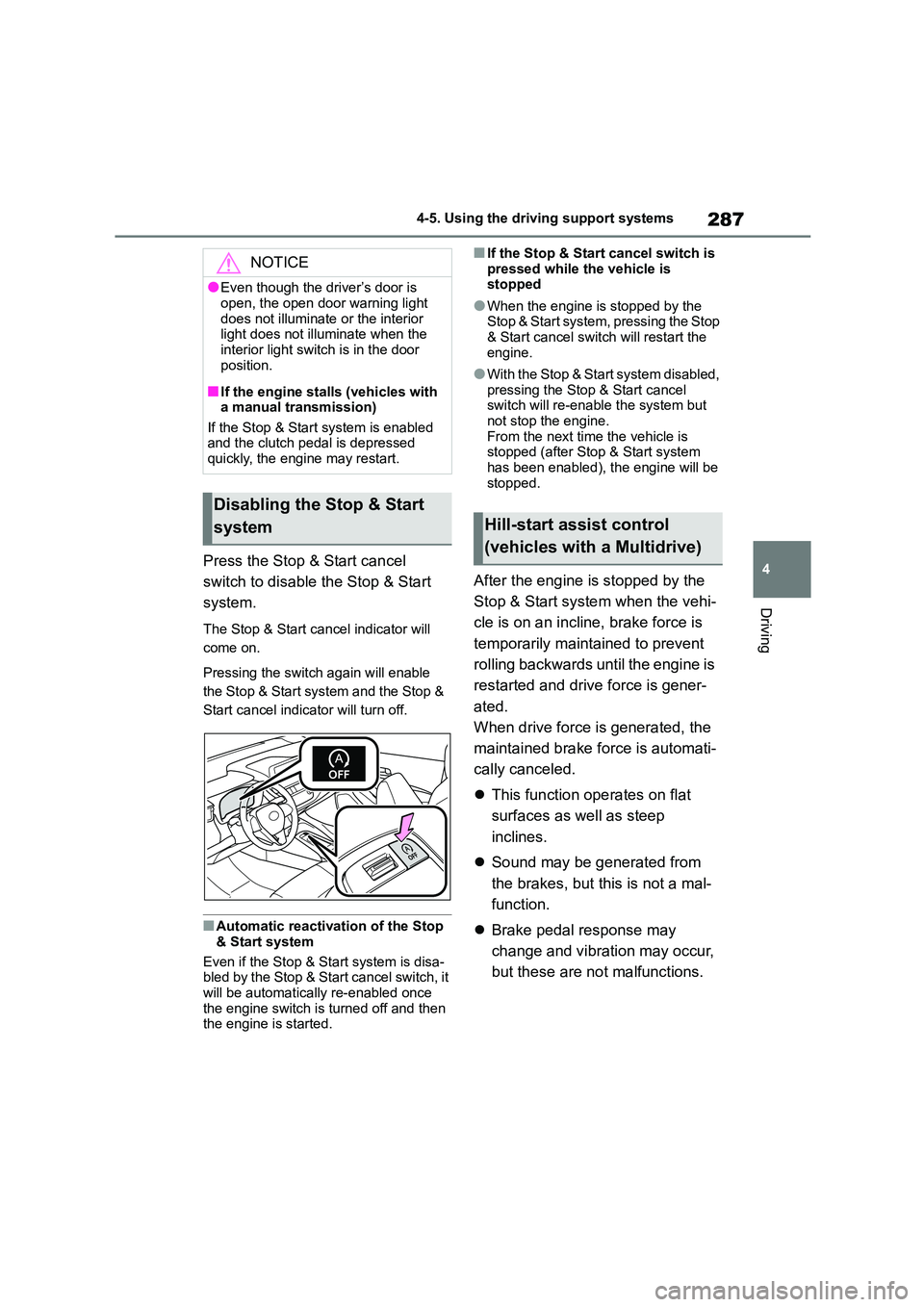
Press the Stop & Start cancel
switch to disable the Stop & Start
system.
The Stop & Start cancel indicator will
come on.
Pressing the switch again will enable
the Stop & Start syst em and the Stop &
Start cancel indicator will turn off.
■Automatic reactivation of the Stop
& Start system
Even if the Stop & Start system is disa- bled by the Stop & Start cancel switch, it
will be automatically re-enabled once
the engine switch is turned off and then the engine is started.
■If the Stop & Start cancel switch is
pressed while the vehicle is stopped
●When the engine is stopped by the Stop & Start system, pressing the Stop
& Start cancel switch will restart the
engine.
●With the Stop & Start system disabled,
pressing the Stop & Start cancel switch will re-enable the system but
not stop the engine.
From the next time the vehicle is stopped (after Stop & Start system
has been enabled), the engine will be
stopped.
After the engine is stopped by the
Stop & Start system when the vehi-
cle is on an incline, brake force is
temporarily maintained to prevent
rolling backwards unt il the engine is
restarted and drive force is gener-
ated.
When drive force is generated, the
maintained brake force is automati-
cally canceled.
This function operates on flat
surfaces as well as steep
inclines.
Sound may be generated from
the brakes, but this is not a mal-
function.
Brake pedal response may
change and vibration may occur,
but these are not malfunctions.
NOTICE
●Even though the driver’s door is
open, the open door warning light
does not illuminate or the interior light does not illuminate when the
interior light switch is in the door
position.
■If the engine stalls (vehicles with
a manual transmission)
If the Stop & Star t system is enabled and the clutch pedal is depressed
quickly, the engine may restart.
Disabling the Stop & Start
systemHill-start assist control
(vehicles with a Multidrive)
Page 357 of 758
355
4
4-5. Using the driving support systems
Driving
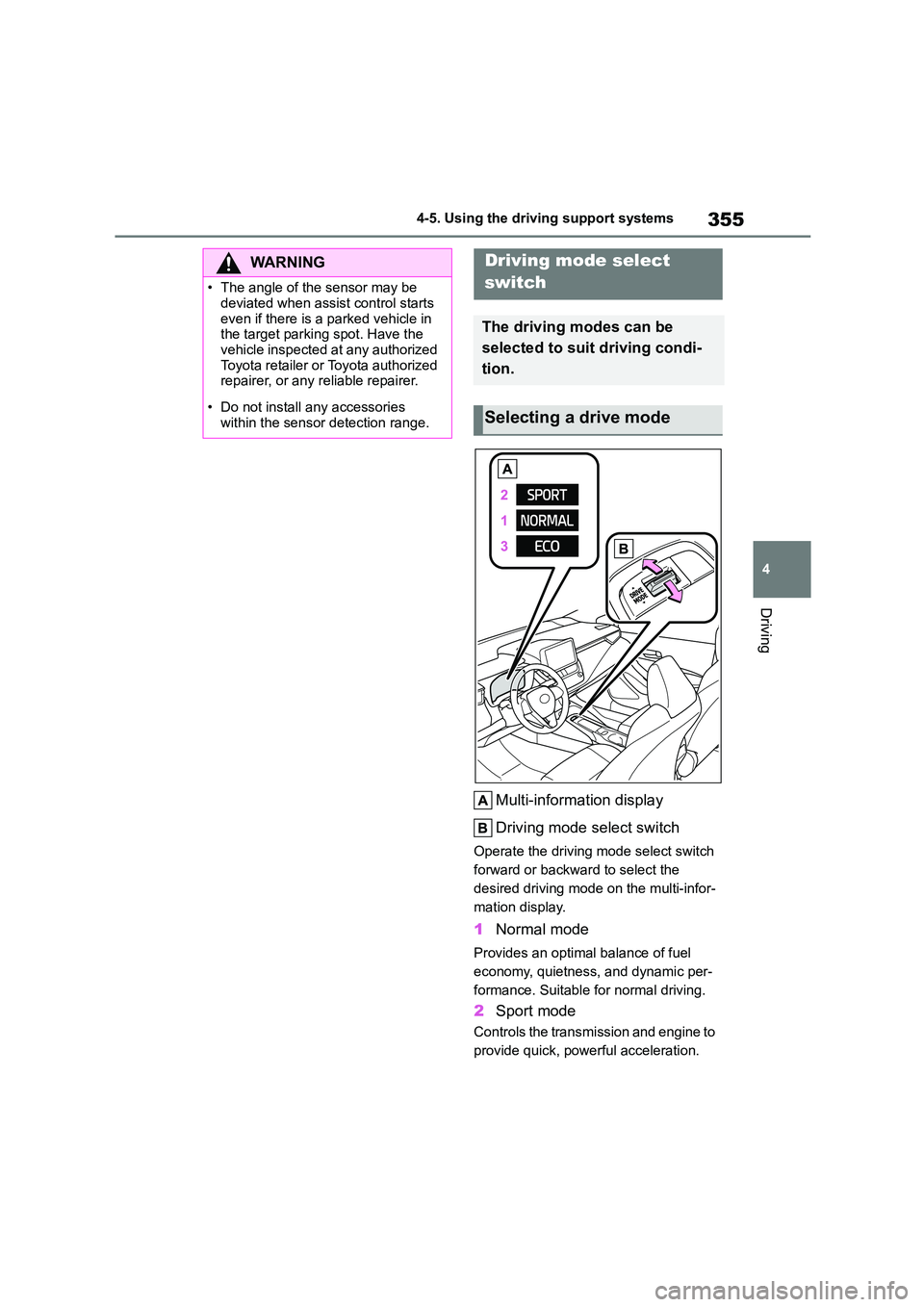
Multi-information display
Driving mode select switch
Operate the driving mode select switch
forward or backward to select the
desired driving mode on the multi-infor-
mation display.
1 Normal mode
Provides an optimal balance of fuel
economy, quietness, and dynamic per-
formance. Suitable for normal driving.
2 Sport mode
Controls the transmission and engine to
provide quick, powerful acceleration.
WA R N I N G
• The angle of the sensor may be
deviated when assist control starts
even if there is a parked vehicle in the target parking spot. Have the
vehicle inspected at any authorized
Toyota retailer or Toyota authorized repairer, or any reliable repairer.
• Do not install any accessories
within the sensor detection range.
Driving mode select
switch
The driving modes can be
selected to suit driving condi-
tion.
Selecting a drive mode
Page 358 of 758
3564-5. Using the driving support systems
This mode also changes the steering
feel, making it suitable for when agile
driving response is desired, such as
when driving on roads with many
curves.
When Sport mode is selected, Sport
mode indicator comes on.
Vehicles with a manual transmission:
When Sport mode is selected, the iMT
will be enabled. ( P.187)
3Eco drive mode
Helps the driver accelerate in an
eco-friendly manner and improve fuel
economy through moderate throttle
characteristics and by controlling the
operation of the air conditioning system
(heating/cooling).
When Eco drive mode is selected, Eco
drive mode indicator comes on.
■Operation of the air conditioning
system in Eco drive mode
Eco drive mode controls the heat-
ing/cooling operations and fan speed of
the air conditioning system to enhance fuel efficiency. To improve air condition-
ing performance, perform the following
operations:
●Turn off air conditioning eco mode
(vehicles with an automatic air condi-
tioning system) ( P.430)
●Adjust the fan speed (P.423, 428)
●Turn off Eco drive mode
■Automatic deactivation of Sport
mode
If the engine switch is turned off after driving in Sport mode, the drive mode
will be changed to normal mode.
*: If equipped
Exhaust Gas Filter sys-
tem*
The Exhaust Gas Filter system
is designed to collect particu-
late matter in the exhaust
gases using an exhaust gas fil-
ter installed to the exhaust
pipes.
NOTICE
■To prevent the Exhaust Gas Filter
system from failing
●Do not use fuel other than the spec- ified type
●Do not modify the exhaust pipe
Page 360 of 758
3584-5. Using the driving support systems
to reduce the vehicle speed and
help reduce the poss ibility of further
damage due to a secondary colli-
sion.
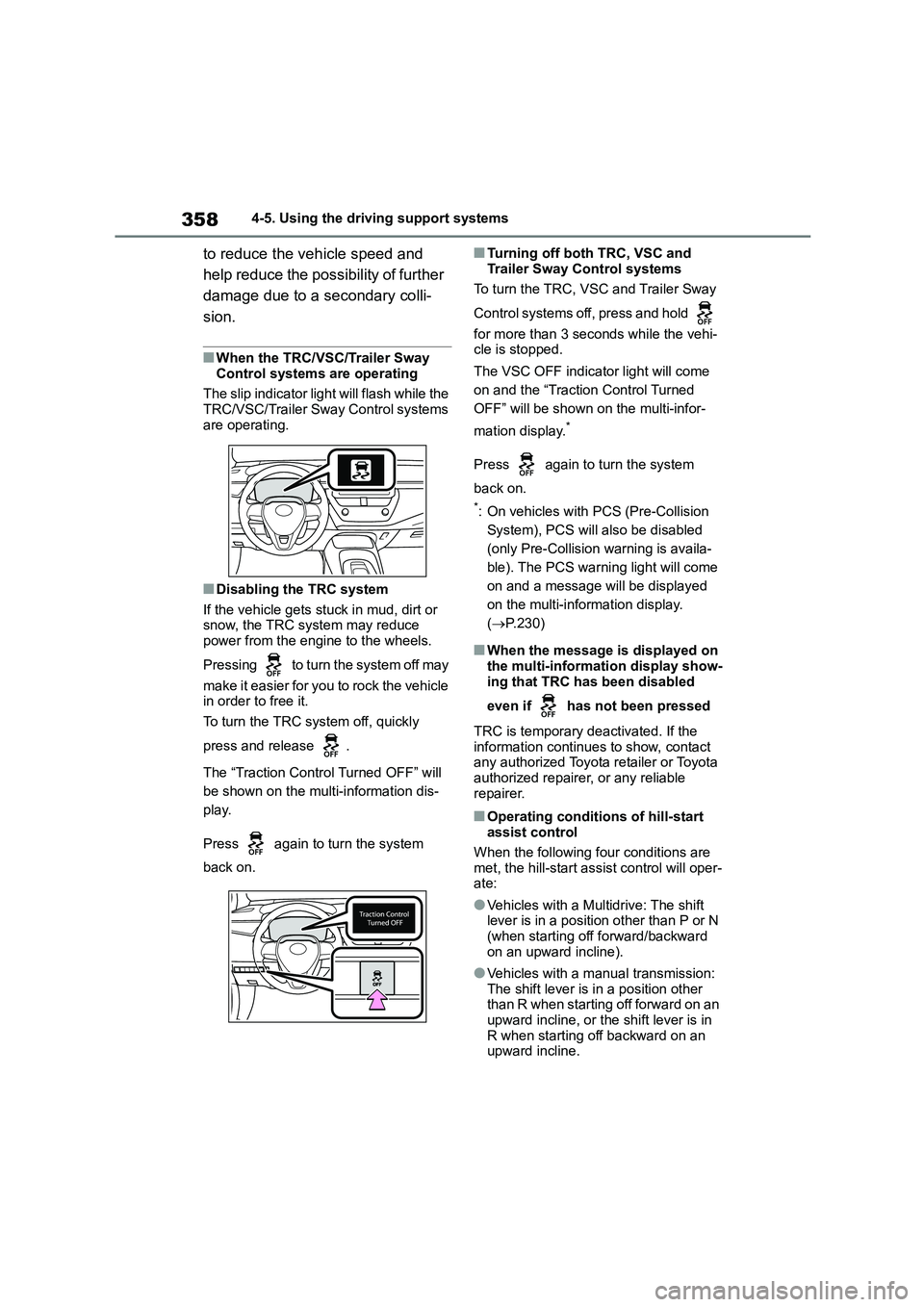
■When the TRC/VSC/Trailer Sway
Control systems are operating
The slip indicator light will flash while the
TRC/VSC/Trailer Sway Control systems
are operating.
■Disabling the TRC system
If the vehicle gets stuck in mud, dirt or snow, the TRC system may reduce
power from the engine to the wheels.
Pressing to turn the system off may
make it easier for you to rock the vehicle
in order to free it.
To turn the TRC system off, quickly
press and release .
The “Traction Control Turned OFF” will
be shown on the multi-information dis-
play.
Press again to turn the system
back on.
■Turning off both TRC, VSC and
Trailer Sway Control systems
To turn the TRC, VSC and Trailer Sway
Control systems off, press and hold
for more than 3 seconds while the vehi- cle is stopped.
The VSC OFF indicator light will come
on and the “Traction Control Turned
OFF” will be shown on the multi-infor-
mation display.*
Press again to turn the system
back on.
*: On vehicles with PCS (Pre-Collision
System), PCS will also be disabled
(only Pre-Collision warning is availa-
ble). The PCS warning light will come
on and a message will be displayed
on the multi-information display.
( P.230)
■When the message is displayed on
the multi-information display show- ing that TRC has been disabled
even if has not been pressed
TRC is temporary deactivated. If the information continues to show, contact
any authorized Toyota retailer or Toyota
authorized repairer, or any reliable repairer.
■Operating conditions of hill-start
assist control
When the following four conditions are met, the hill-start assist control will oper-
ate:
●Vehicles with a Multidrive: The shift
lever is in a position other than P or N
(when starting off forward/backward
on an upward incline).
●Vehicles with a manual transmission:
The shift lever is in a position other than R when starting off forward on an
upward incline, or the shift lever is in
R when starting off backward on an upward incline.
Page 361 of 758
359
4
4-5. Using the driving support systems
Driving
●The vehicle is stopped
●The accelerator pedal is not
depressed
●The parking brake is not engaged
■Automatic system cancelation of
hill-start assist control
The hill-start assist control will turn off in any of the following situations:
●Vehicles with a Multidrive: The shift lever is shifted to P or N.
●Vehicles with a manual transmission: The shift lever is shifted to R when
starting off forward on an upward
incline, or the shift lever is shifted to other than R when starting off back-
ward on an upward incline.
●The accelerator pedal is depressed
●The parking brake is engaged
●2 seconds at maximum elapsed after
the brake pedal is released
■Sounds and vibrations caused by the ABS, brake assist, VSC, Trailer
Sway Control, TRC and hill-start
assist control systems
●A sound may be heard from the
engine compartment when the brake pedal is depressed repeatedly, when
the engine is started or just after the
vehicle begins to move. This sound does not indicate that a malfunction
has occurred in any of these systems.
●Any of the following conditions may
occur when the above systems are
operating. None of these indicates that a malfunction has occurred.
• Vibrations may be felt through the
vehicle body and steering. • A motor sound may be heard also
after the vehicle comes to a stop.
• The brake pedal may pulsate slightly
after the ABS is activated. • The brake pedal may move down
slightly after the ABS is activated.
■Active Cornering Assist operation
sounds and vibrations
When the Active Cornering Assist is
operated, operation sounds and vibra-
tions may be generated from the brake
system, but this is not a malfunction.
■EPS operation sound
When the steering wheel is operated, a
motor sound (whirring sound) may be
heard. This does not indicate a malfunc- tion.
■Automatic reactivation of TRC,
Trailer Sway Control and VSC sys-
tems
After turning the TRC, Trailer Sway Con-
trol and VSC systems off, the systems
will be automatically re-enabled in the following situations:
●When the engine switch is turned off
●If only the TRC system is turned off,
the TRC will turn on when vehicle speed increases.
If both the TRC and VSC systems are
turned off, automatic re-enabling will not occur when vehicle speed
increases.
■Operating conditions of Active Cor-
nering Assist
The system operates when the following
occurs.
●TRC/VSC can operate
●The driver is attempting to accelerate while turning
●The system detects that the vehicle is drifting to the outer side
●The brake pedal is released
■Reduced effectiv eness of the EPS system
The effectiveness of the EPS system is
reduced to prevent the system from overheating when there is frequent
steering input over an extended period
of time. The steering wheel may feel
heavy as a result. Should this occur, refrain from excessive steering input or
stop the vehicle and turn the engine off.
The EPS system should return to nor- mal within 10 minutes.
Page 366 of 758
3644-6. Driving tips
Perform the following according to
the driving conditions:
Do not try to forcibly open a win-
dow or move a wiper that is fro-
zen. Pour warm water over the
frozen area to melt the ice. Wipe
away the water immediately to
prevent it from freezing.
To ensure proper operation of
the climate control system fan,
remove any snow that has accu-
mulated on the air inlet vents in
front of the windshield.
Check for and remove any
excess ice or snow that may
have accumulated on the exte-
rior lights, vehicle’s roof, chassis,
around the tires or on the brakes.
Remove any snow or mud from
the bottom of your shoes before
getting in the vehicle.
Accelerate the vehicle slowly, keep
a safe distance between you and
the vehicle ahead, and drive at a
reduced speed suitable to road
conditions.
Park the vehicle and shift the
shift lever to P (Multidrive), or 1
or R (manual transmission) with-
out setting the parking brake.
The parking brake may freeze
up, preventing it from being
released. If the vehicle is parked
without setting the parking brake,
make sure to block the wheels.
Failure to do so may be danger-
ous because it may cause the
vehicle to move unexpectedly,
possibly leading to an accident.
Vehicles with a Multidrive: If the
vehicle is parked without setting
the parking brake, confirm that
the shift lever cannot be moved
out of P*.
*: The shift lever will be locked if it is
attempted to be shifted from P to any
other position without depressing the
brake pedal. If the shift lever can be
shifted from P, there may be a prob-
lem with the shift lock system. Have
the vehicle inspected by any author-
ized Toyota retailer or Toyota author-
ized repairer, or any reliable repairer
or legitimate tire retailers immedi-
ately.
Use the correct tire chain size when
NOTICE
■Repairing or replacing snow tires
(vehicles with a tire pressure
warning system)
Request repairs or replacement of
snow tires from any authorized Toyota
retailer or Toyota authorized repairer, or any reliable repairer or legitimate
tire retailers.
This is because the removal and
attachment of snow tires affects the operation of the tire pressure warning
valves and transmitters.
Before driving the vehicle
When driving the vehicle
When parking the vehicle
Selecting tire chains