height TOYOTA COROLLA HATCHBACK 2022 Owners Manual (in English)
[x] Cancel search | Manufacturer: TOYOTA, Model Year: 2022, Model line: COROLLA HATCHBACK, Model: TOYOTA COROLLA HATCHBACK 2022Pages: 758, PDF Size: 155.26 MB
Page 37 of 758
35
1
1-1. For safe use
For safety and security
the release button .
■Emergency locking retractor (ELR)
The retractor will lock the belt during a sudden stop or on impact. It may also
lock if you lean forward too quickly. A
slow, easy motion will allow the belt to extend so that you can move around
fully.
■After using the rear center seat belt
Stow seat belt buckle in the pocket.
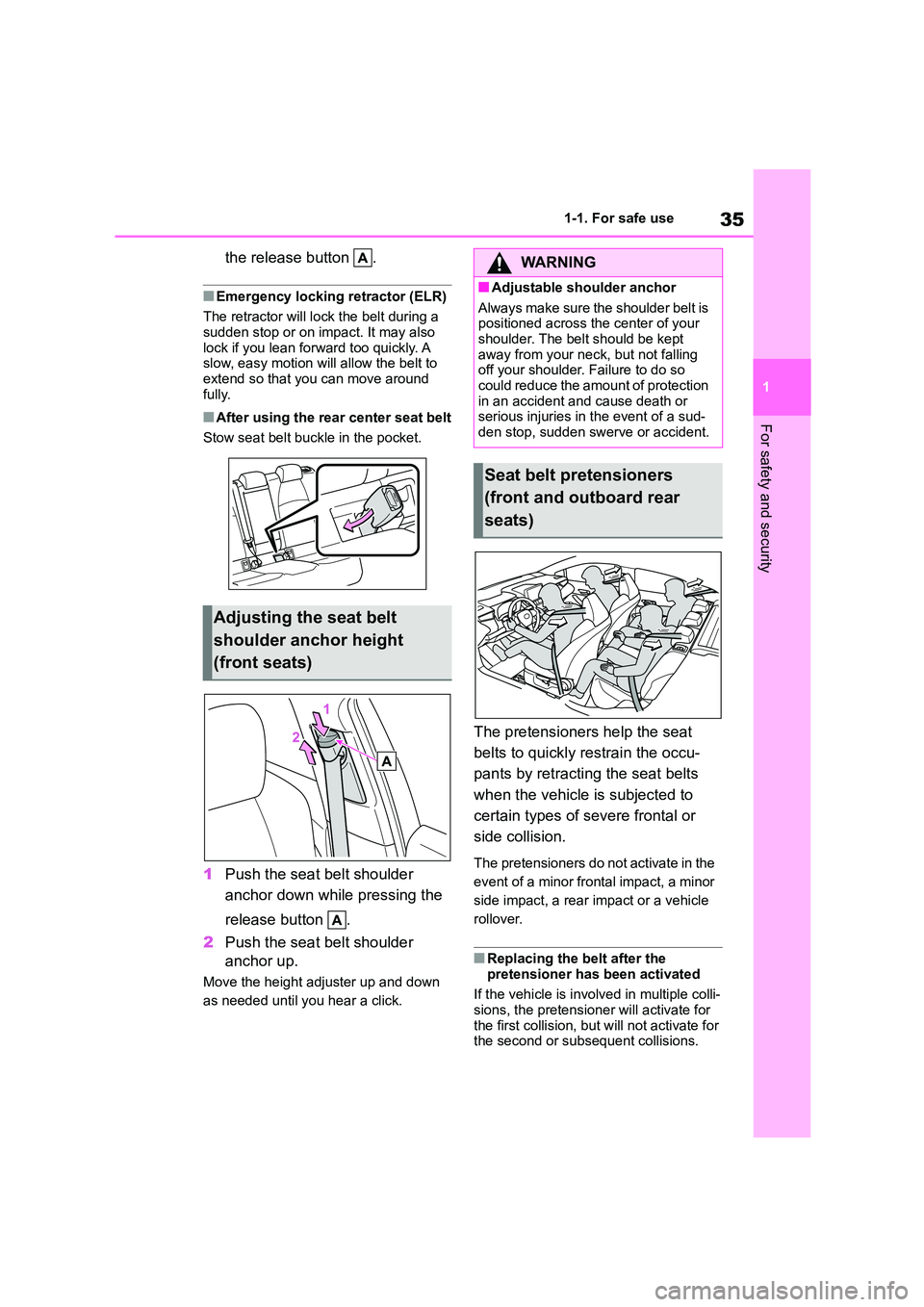
1 Push the seat belt shoulder
anchor down while pressing the
release button .
2 Push the seat belt shoulder
anchor up.
Move the height adjuster up and down
as needed until you hear a click.
The pretensioners help the seat
belts to quickly restrain the occu-
pants by retracting the seat belts
when the vehicle is subjected to
certain types of severe frontal or
side collision.
The pretensioners do not activate in the
event of a minor frontal impact, a minor
side impact, a rear impact or a vehicle
rollover.
■Replacing the belt after the
pretensioner has been activated
If the vehicle is involved in multiple colli- sions, the pretensioner will activate for
the first collision, but will not activate for
the second or subsequent collisions.
Adjusting the seat belt
shoulder anchor height
(front seats)
WA R N I N G
■Adjustable shoulder anchor
Always make sure the shoulder belt is
positioned across the center of your shoulder. The belt should be kept
away from your neck, but not falling
off your shoulder. Failure to do so could reduce the amount of protection
in an accident and cause death or
serious injuries in the event of a sud-
den stop, sudden sw erve or accident.
Seat belt pretensioners
(front and outboard rear
seats)
Page 52 of 758
501-2. Child safety
■When installing a child
restraint system to a front pas-
senger seat
For the safety of a child, install a
child restraint system to a rear seat.
When installing a child restraint
system to a front passenger seat is
unavoidable, adjust the seat as fol-
lows and install t he child restraint
system:
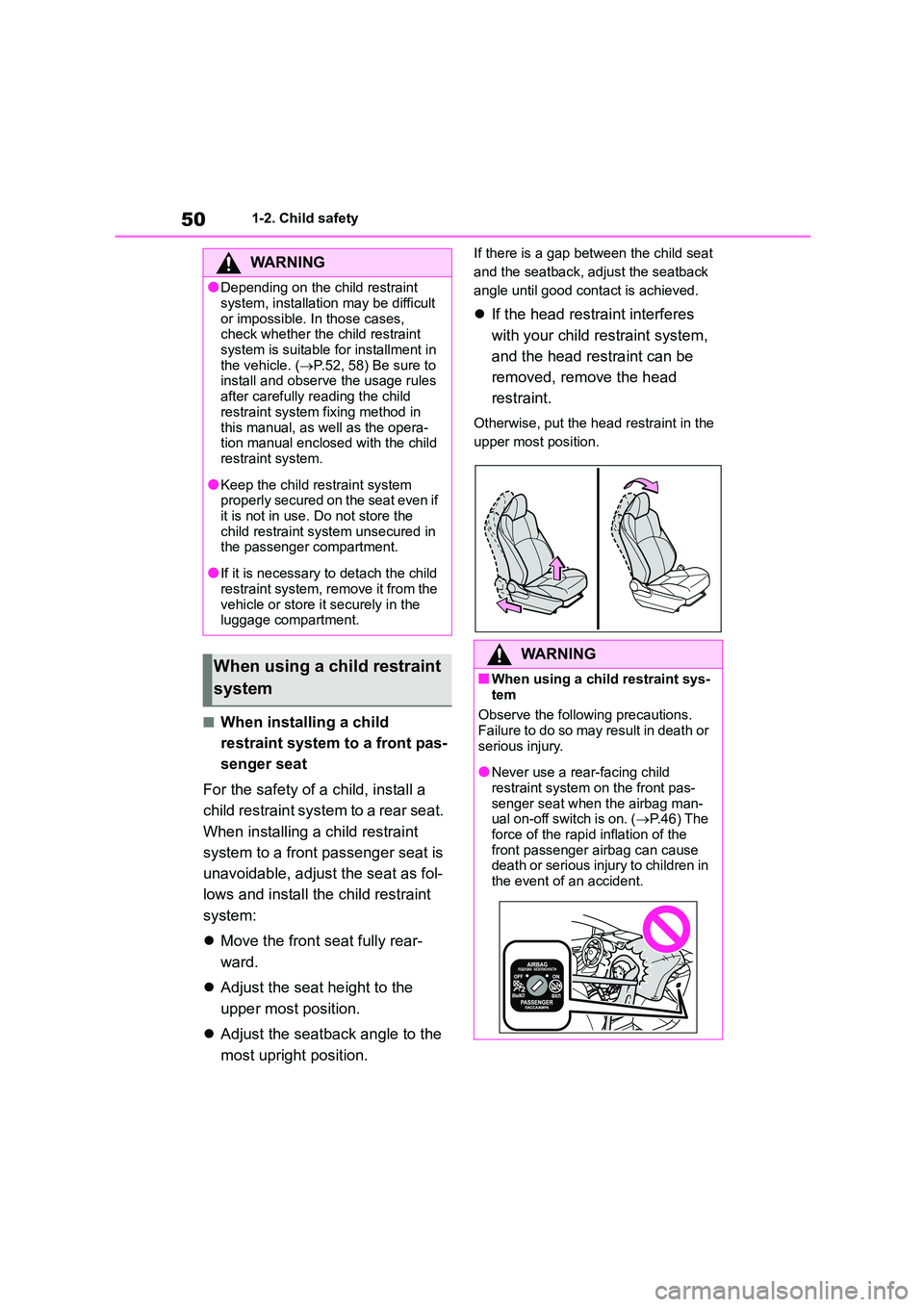
Move the front seat fully rear-
ward.
Adjust the seat height to the
upper most position.
Adjust the seatback angle to the
most upright position.
If there is a gap between the child seat
and the seatback, adjust the seatback
angle until good contact is achieved.
If the head restraint interferes
with your child restraint system,
and the head restraint can be
removed, remove the head
restraint.
Otherwise, put the head restraint in the
upper most position.
WA R N I N G
●Depending on the child restraint
system, installation may be difficult
or impossible. In those cases, check whether the child restraint
system is suitable for installment in
the vehicle. ( P.52, 58) Be sure to install and observe the usage rules
after carefully reading the child
restraint system fixing method in
this manual, as well as the opera- tion manual enclosed with the child
restraint system.
●Keep the child re straint system
properly secured on the seat even if
it is not in use. Do not store the child restraint system unsecured in
the passenger compartment.
●If it is necessary to detach the child
restraint system, remove it from the
vehicle or store it securely in the luggage compartment.
When using a child restraint
system
WA R N I N G
■When using a child restraint sys-
tem
Observe the following precautions. Failure to do so may result in death or
serious injury.
●Never use a rear-facing child
restraint system on the front pas-
senger seat when the airbag man- ual on-off switch is on. ( P.46) The
force of the rapid inflation of the
front passenger airbag can cause death or serious injury to children in
the event of an accident.
Page 55 of 758
53
1
1-2. Child safety
For safety and security
child restraint systems. ( P. 5 6 )
Check the selected child restraint
system together with the following
[Before confirming the compatibility
of each seating position with child
restraint systems].
■Before confirming the compat-
ibility of each seating position
with child restraint systems
1 Checking the child restraint sys-
tem standards.
Use a child restraint system that
conforms to UN(ECE) R44*1 or
UN(ECE) R129*1, 2.
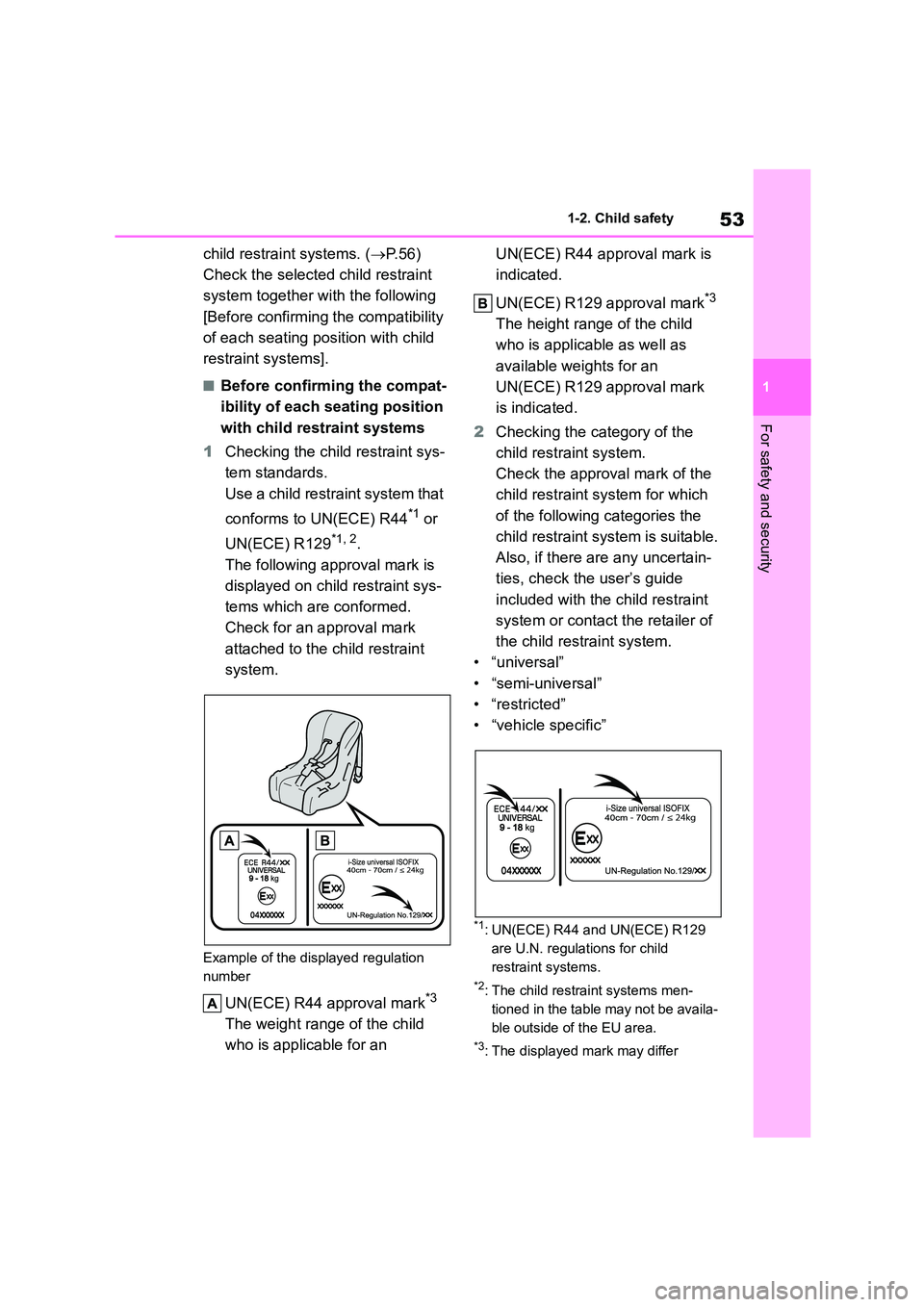
The following approval mark is
displayed on child restraint sys-
tems which are conformed.
Check for an approval mark
attached to the child restraint
system.
Example of the displayed regulation
number
UN(ECE) R44 approval mark*3
The weight range of the child
who is applicable for an
UN(ECE) R44 approval mark is
indicated.
UN(ECE) R129 approval mark*3
The height range of the child
who is applicable as well as
available weights for an
UN(ECE) R129 approval mark
is indicated.
2 Checking the category of the
child restraint system.
Check the approval mark of the
child restraint system for which
of the following categories the
child restraint system is suitable.
Also, if there are any uncertain-
ties, check the user’s guide
included with the child restraint
system or contact the retailer of
the child restraint system.
• “universal”
• “semi-universal”
• “restricted”
• “vehicle specific”
*1: UN(ECE) R44 and UN(ECE) R129
are U.N. regulations for child
restraint systems.
*2: The child restraint systems men-
tioned in the table may not be availa-
ble outside of the EU area.
*3: The displayed mark may differ
Page 56 of 758
541-2. Child safety
depending on the product.
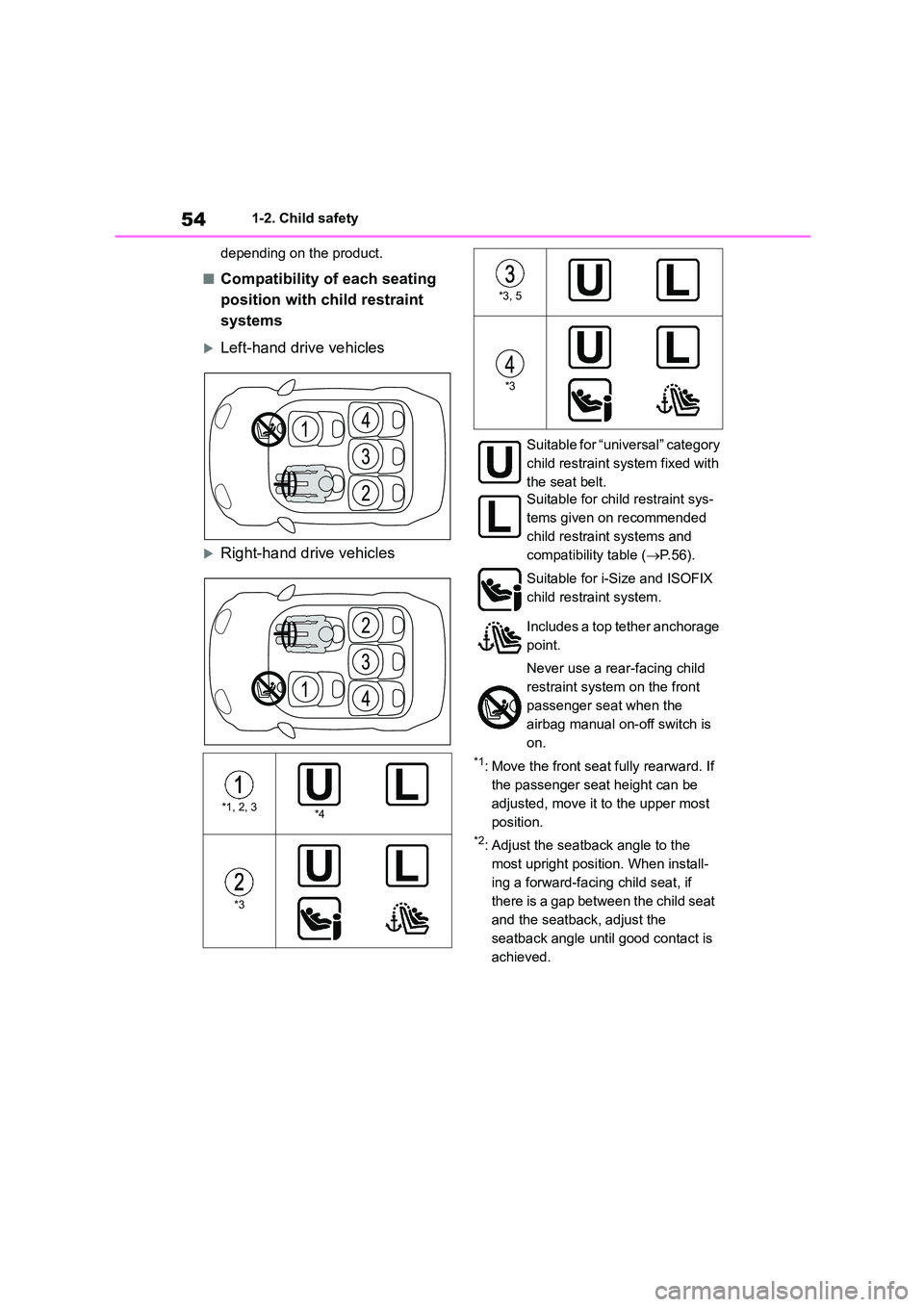
■Compatibility of each seating
position with child restraint
systems
Left-hand drive vehicles
Right-hand drive vehicles
*1: Move the front seat fully rearward. If
the passenger seat height can be
adjusted, move it to the upper most
position.
*2: Adjust the seatback angle to the
most upright position. When install-
ing a forward-facing child seat, if
there is a gap between the child seat
and the seatback, adjust the
seatback angle until good contact is
achieved.
*1, 2, 3*4
*3
*3, 5
*3
Suitable for “universal” category
child restraint system fixed with
the seat belt.
Suitable for child restraint sys-
tems given on recommended
child restraint systems and
compatibility table ( P. 5 6 ) .
Suitable for i-Size and ISOFIX
child restraint system.
Includes a top tether anchorage
point.
Never use a rear-facing child
restraint system on the front
passenger seat when the
airbag manual on-off switch is
on.
Page 58 of 758
561-2. Child safety
seat.
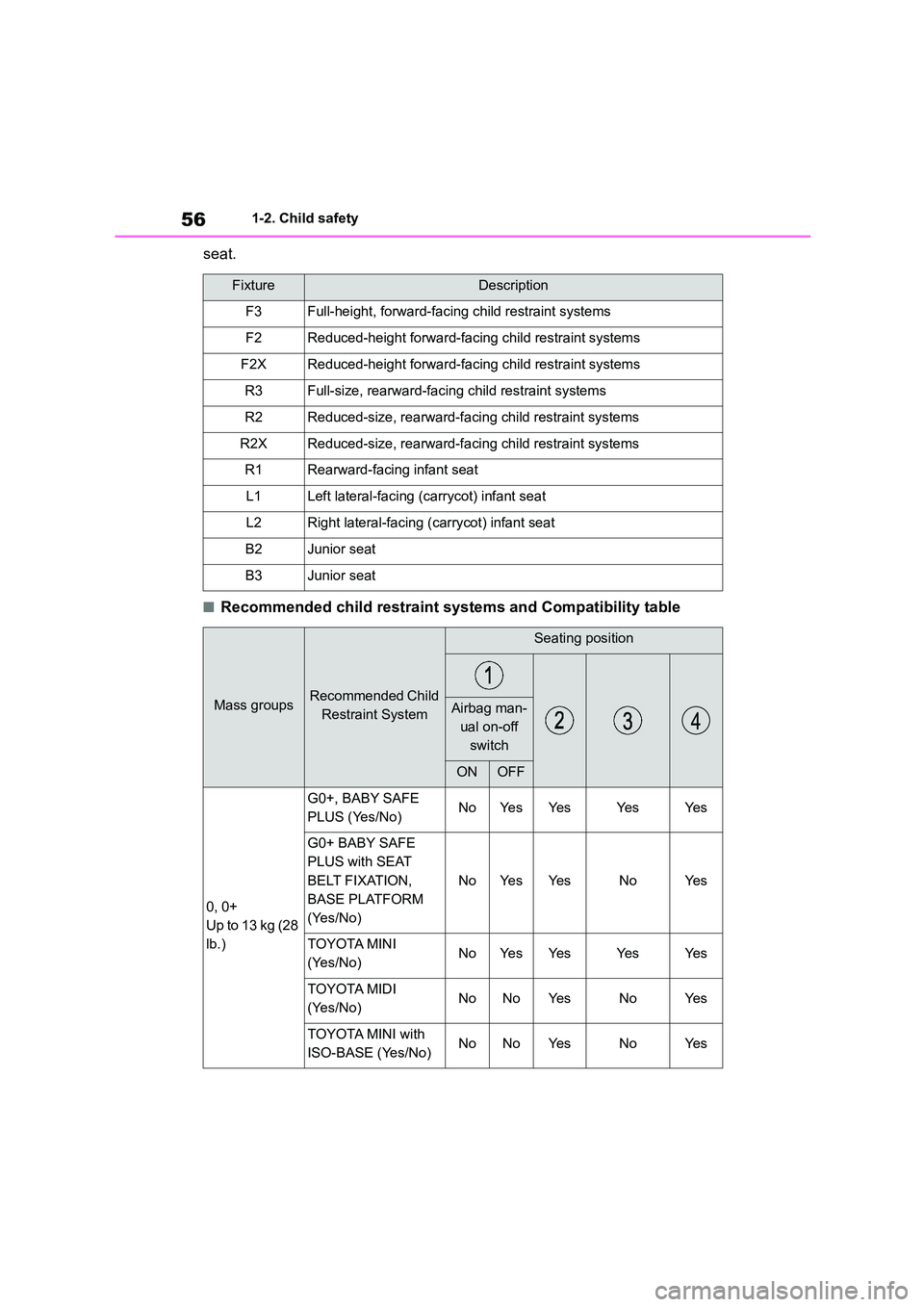
■Recommended child restraint systems and Compatibility table
FixtureDescription
F3Full-height, forward-facing child restraint systems
F2Reduced-height forward-facing child restraint systems
F2XReduced-height forward-facing child restraint systems
R3Full-size, rearward-facing child restraint systems
R2Reduced-size, rearward-facing child restraint systems
R2XReduced-size, rearward-facing child restraint systems
R1Rearward-facing infant seat
L1Left lateral-facing (carrycot) infant seat
L2Right lateral-facing (carrycot) infant seat
B2Junior seat
B3Junior seat
Mass groupsRecommended Child
Restraint System
Seating position
Airbag man-
ual on-off
switch
ONOFF
0, 0+
Up to 13 kg (28
lb.)
G0+, BABY SAFE
PLUS (Yes/No)NoYe sYe sYe sYe s
G0+ BABY SAFE
PLUS with SEAT
BELT FIXATION,
BASE PLATFORM
(Yes/No)
NoYe sYe sNoYe s
TOYOTA MINI
(Yes/No)NoYe sYe sYe sYe s
TOYOTA MIDI
(Yes/No)NoNoYe sNoYe s
TOYOTA MINI with
ISO-BASE (Yes/No)NoNoYe sNoYe s
Page 61 of 758
59
1
1-2. Child safety
For safety and security
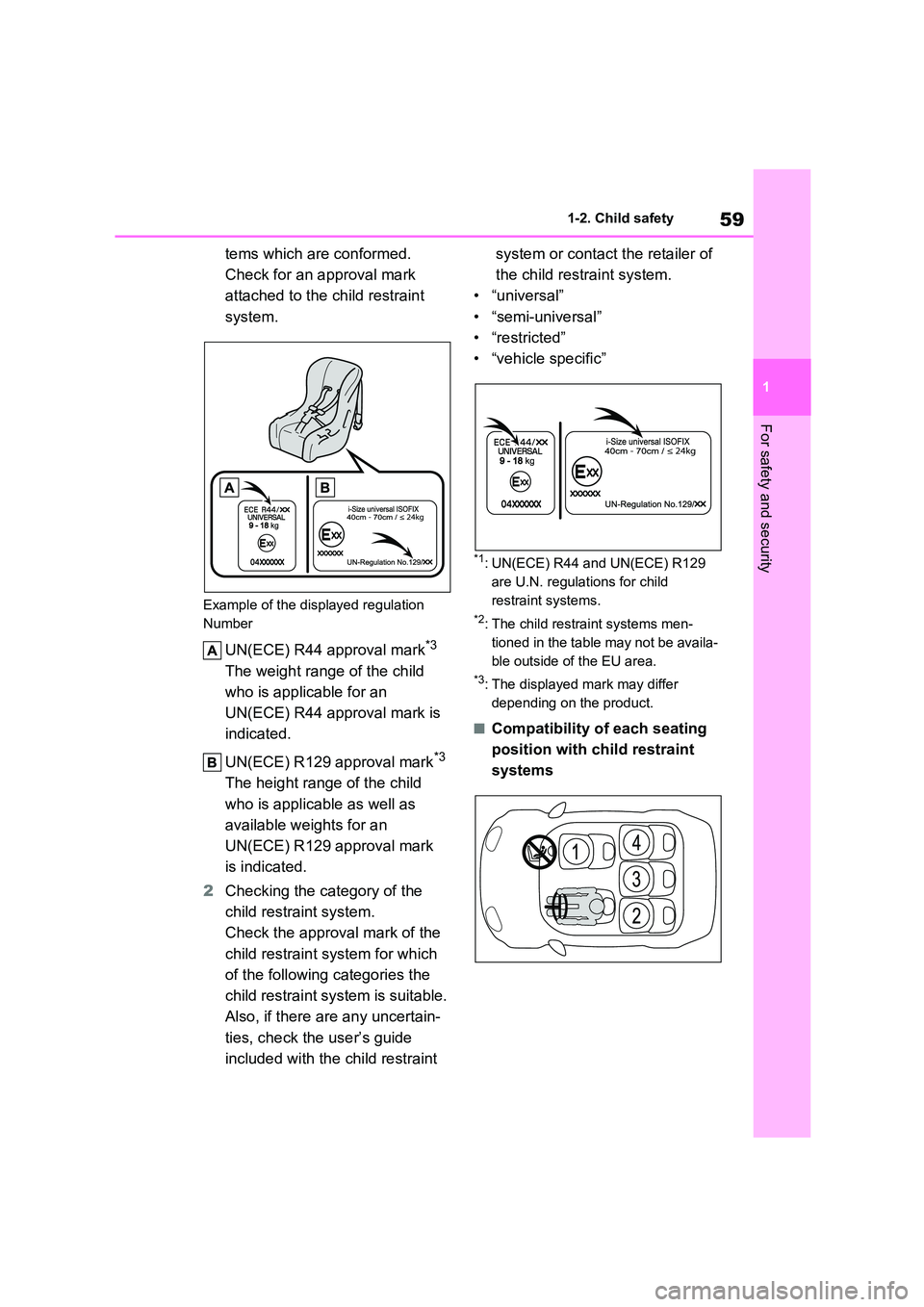
tems which are conformed.
Check for an approval mark
attached to the child restraint
system.
Example of the displayed regulation
Number
UN(ECE) R44 approval mark*3
The weight range of the child
who is applicable for an
UN(ECE) R44 approval mark is
indicated.
UN(ECE) R129 approval mark*3
The height range of the child
who is applicable as well as
available weights for an
UN(ECE) R129 approval mark
is indicated.
2 Checking the category of the
child restraint system.
Check the approval mark of the
child restraint system for which
of the following categories the
child restraint system is suitable.
Also, if there are any uncertain-
ties, check the user’s guide
included with th e child restraint
system or contact the retailer of
the child restraint system.
• “universal”
• “semi-universal”
• “restricted”
• “vehicle specific”
*1: UN(ECE) R44 and UN(ECE) R129
are U.N. regulations for child
restraint systems.
*2: The child restraint systems men-
tioned in the table may not be availa-
ble outside of the EU area.
*3: The displayed mark may differ
depending on the product.
■Compatibility of each seating
position with child restraint
systems
Page 62 of 758
601-2. Child safety
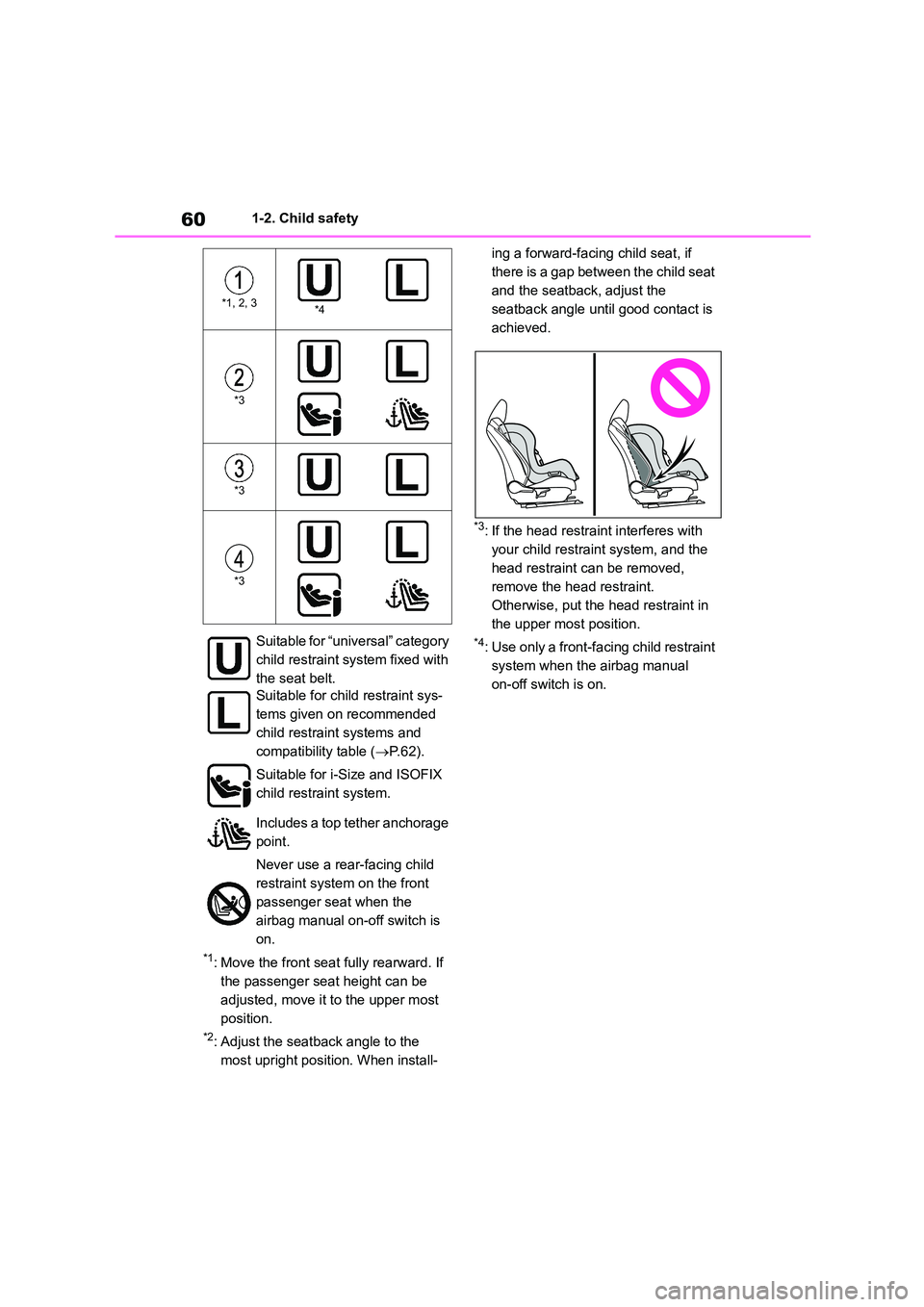
*1: Move the front seat fully rearward. If
the passenger seat height can be
adjusted, move it to the upper most
position.
*2: Adjust the seatback angle to the
most upright position. When install-
ing a forward-facing child seat, if
there is a gap between the child seat
and the seatback, adjust the
seatback angle until good contact is
achieved.
*3: If the head restraint interferes with
your child restra int system, and the
head restraint can be removed,
remove the head restraint.
Otherwise, put the head restraint in
the upper most position.
*4: Use only a front-fa cing child restraint
system when the airbag manual
on-off switch is on.
*1, 2, 3*4
*3
*3
*3
Suitable for “universal” category
child restraint syst em fixed with
the seat belt.
Suitable for child restraint sys-
tems given on recommended
child restraint systems and
compatibility table ( P. 6 2 ) .
Suitable for i-Size and ISOFIX
child restraint system.
Includes a top tether anchorage
point.
Never use a rear-facing child
restraint system on the front
passenger seat when the
airbag manual on-off switch is
on.
Page 63 of 758
61
1
1-2. Child safety
For safety and security
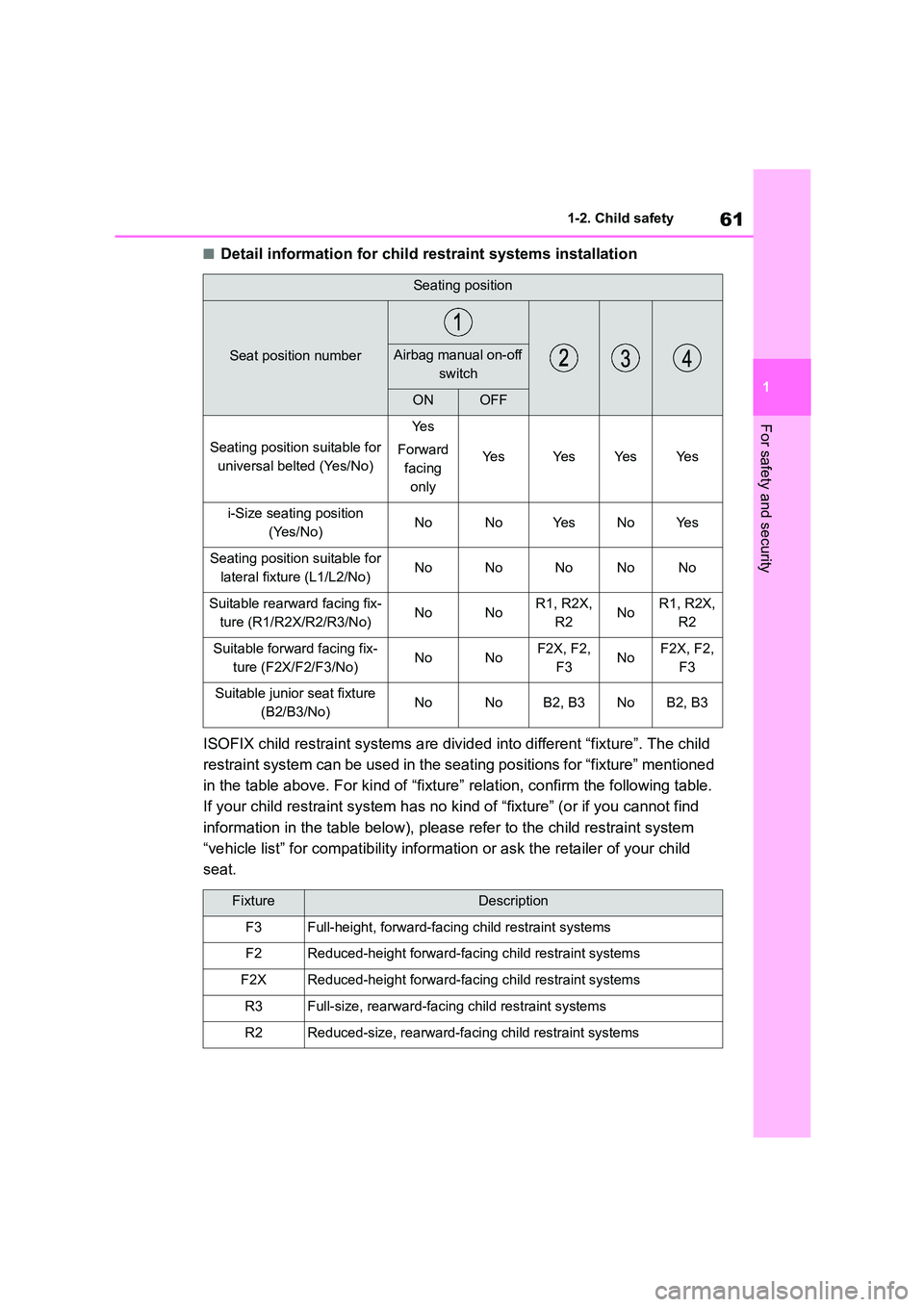
■Detail information for child restraint systems installation
ISOFIX child restraint systems are divid ed into different “fixture”. The child
restraint system can be used in the se ating positions for “fixture” mentioned
in the table above. For kind of “fixtu re” relation, confirm the following table.
If your child restraint system has no ki nd of “fixture” (or if you cannot find
information in the table below), please refer to the child restraint system
“vehicle list” for compatib ility information or ask the retailer of your child
seat.
Seating position
Seat position numberAirbag manual on-off
switch
ONOFF
Seating position suitable for
universal belted (Yes/No)
Ye s
Forward
facing
only
Ye sYe sYe sYe s
i-Size seating position
(Yes/No)NoNoYe sNoYe s
Seating position suitable for
lateral fixture (L1/L2/No)NoNoNoNoNo
Suitable rearward facing fix-
ture (R1/R2X/R2/R3/No)NoNoR1, R2X,
R2NoR1, R2X,
R2
Suitable forward facing fix-
ture (F2X/F2/F3/No)NoNoF2X, F2,
F3NoF2X, F2,
F3
Suitable junior seat fixture
(B2/B3/No)NoNoB2, B3NoB2, B3
FixtureDescription
F3Full-height, forward-faci ng child restraint systems
F2Reduced-height forward-facing child restraint systems
F2XReduced-height forward-facing child restraint systems
R3Full-size, rearward-facing child restraint systems
R2Reduced-size, rearward-facing child restraint systems
Page 143 of 758
141
3
3-3. Adjusting the seats
Before driving
3-3.Adjusting the seats
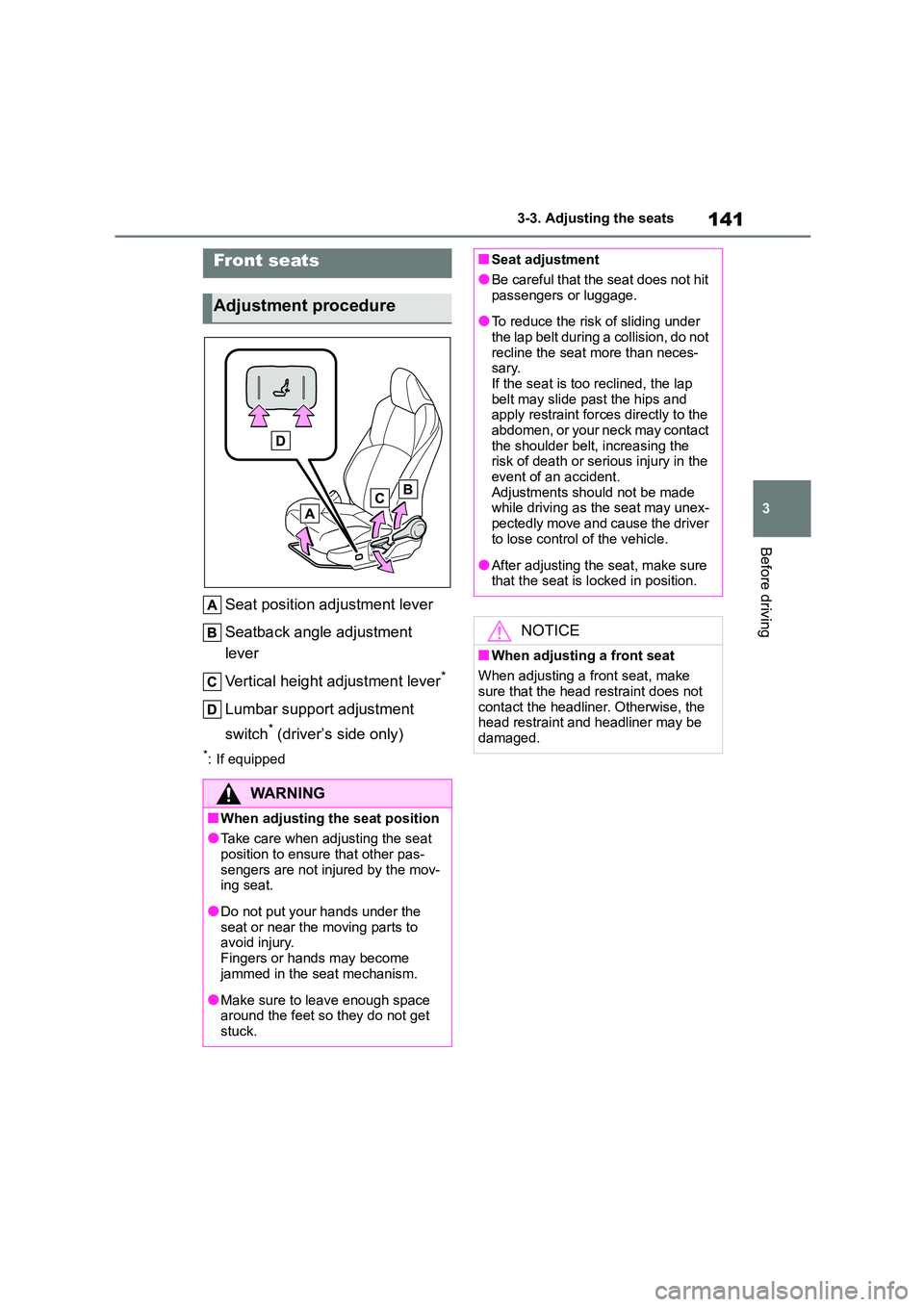
Seat position adjustment lever
Seatback angle adjustment
lever
Vertical height adjustment lever*
Lumbar support adjustment
switch* (driver’s side only)
*: If equipped
Front seats
Adjustment procedure
WA R N I N G
■When adjusting the seat position
●Take care when adjusting the seat position to ensure that other pas-
sengers are not injured by the mov-
ing seat.
●Do not put your hands under the
seat or near the moving parts to avoid injury.
Fingers or hands may become
jammed in the seat mechanism.
●Make sure to leave enough space
around the feet so they do not get
stuck.
■Seat adjustment
●Be careful that the seat does not hit
passengers or luggage.
●To reduce the risk of sliding under
the lap belt during a collision, do not
recline the seat more than neces- sary.
If the seat is too reclined, the lap
belt may slide past the hips and apply restraint forces directly to the
abdomen, or your neck may contact
the shoulder belt, increasing the risk of death or serious injury in the
event of an accident.
Adjustments should not be made while driving as the seat may unex-
pectedly move and cause the driver
to lose control of the vehicle.
●After adjusting the seat, make sure
that the seat is locked in position.
NOTICE
■When adjusting a front seat
When adjusting a front seat, make
sure that the head restraint does not
contact the headliner. Otherwise, the head restraint and headliner may be
damaged.
Page 146 of 758
1443-3. Adjusting the seats
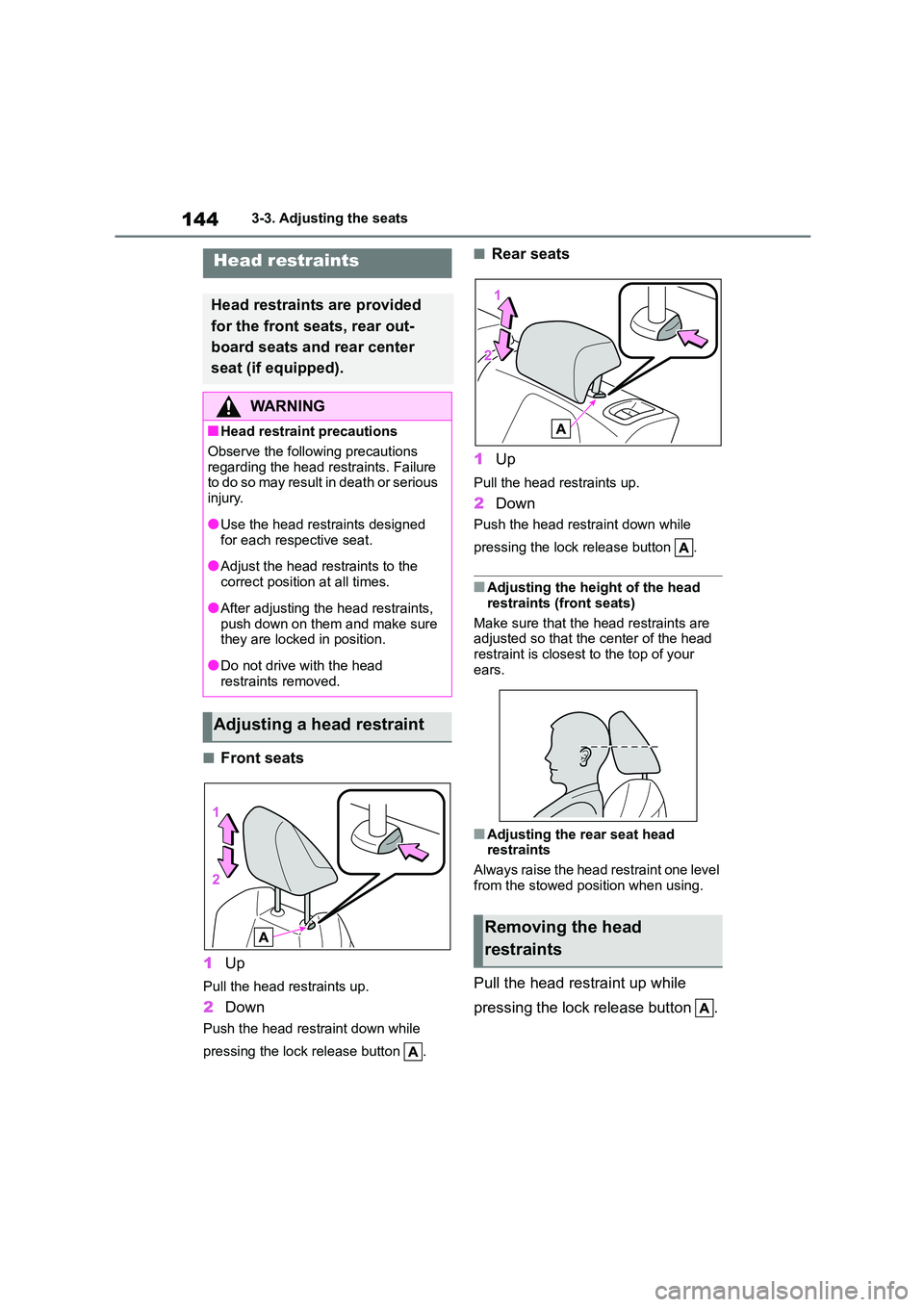
■Front seats
1 Up
Pull the head restraints up.
2Down
Push the head restraint down while
pressing the lock release button .
■Rear seats
1 Up
Pull the head restraints up.
2Down
Push the head restraint down while
pressing the lock release button .
■Adjusting the height of the head
restraints (front seats)
Make sure that the head restraints are
adjusted so that the center of the head
restraint is closest to the top of your ears.
■Adjusting the rear seat head restraints
Always raise the head restraint one level
from the stowed position when using.
Pull the head restraint up while
pressing the lock release button .
Head restraints
Head restraints are provided
for the front seats, rear out-
board seats and rear center
seat (if equipped).
WA R N I N G
■Head restraint precautions
Observe the following precautions
regarding the head restraints. Failure to do so may result in death or serious
injury.
●Use the head restraints designed
for each respective seat.
●Adjust the head restraints to the
correct position at all times.
●After adjusting the head restraints,
push down on them and make sure
they are locked in position.
●Do not drive with the head
restraints removed.
Adjusting a head restraint
Removing the head
restraints