belt TOYOTA COROLLA HATCHBACK 2023 Workshop Manual
[x] Cancel search | Manufacturer: TOYOTA, Model Year: 2023, Model line: COROLLA HATCHBACK, Model: TOYOTA COROLLA HATCHBACK 2023Pages: 436, PDF Size: 8.72 MB
Page 327 of 436
3277-2. Steps to take in an emergency
7
When trouble arises
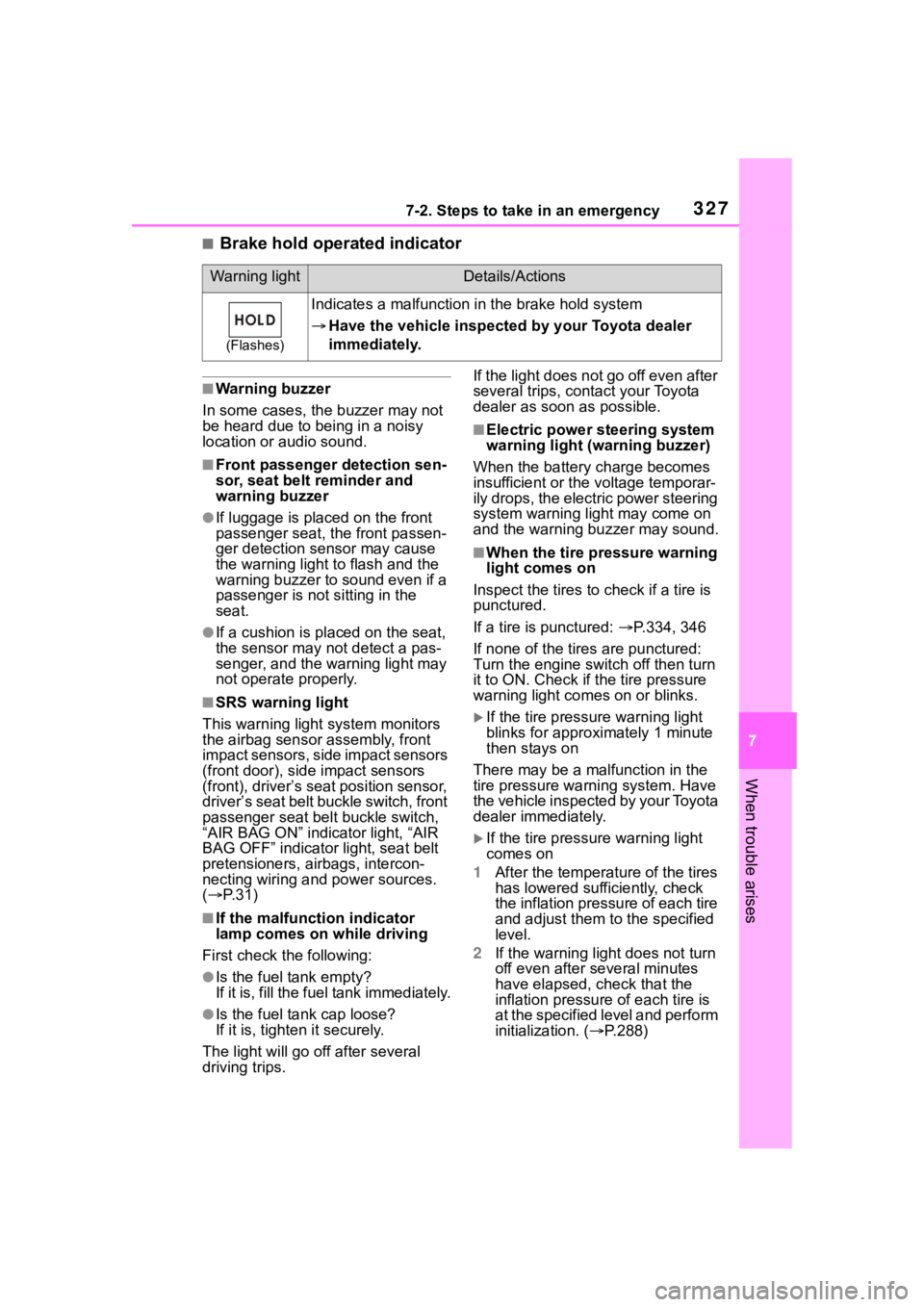
■Brake hold operated indicator
■Warning buzzer
In some cases, the buzzer may not
be heard due to being in a noisy
location or audio sound.
■Front passenger detection sen-
sor, seat belt reminder and
warning buzzer
●If luggage is placed on the front
passenger seat, the front passen-
ger detection sensor may cause
the warning light to flash and the
warning buzzer to sound even if a
passenger is not sitting in the
seat.
●If a cushion is placed on the seat,
the sensor may n ot detect a pas-
senger, and the warning light may
not operate properly.
■SRS warning light
This warning light system monitors
the airbag sensor assembly, front
impact sensors, side impact sensors
(front door), side impact sensors
(front), driver’s se at position sensor,
driver’s seat belt buckle switch, front
passenger seat belt buckle switch,
“AIR BAG ON” indicator light, “AIR
BAG OFF” indicator light, seat belt
pretensioners, airbags, intercon-
necting wiring and power sources.
( P.31)
■If the malfunction indicator
lamp comes on while driving
First check the following:
●Is the fuel t ank empty?
If it is, fill the f uel tank immediately.
●Is the fuel tank cap loose?
If it is, tighten it securely.
The light will go o ff after several
driving trips. If the light does not go off even after
several trips, con
tact your Toyota
dealer as soon as possible.
■Electric power steering system
warning light (warning buzzer)
When the battery charge becomes
insufficient or the voltage temporar-
ily drops, the electric power steering
system warning light may come on
and the warning buzzer may sound.
■When the tire pressure warning
light comes on
Inspect the tires to check if a tire is
punctured.
If a tire is punctured: P.334, 346
If none of the tires are punctured:
Turn the engine switch off then turn
it to ON. Check if the tire pressure
warning light com es on or blinks.
If the tire pressure warning light
blinks for approximately 1 minute
then stays on
There may be a malfunction in the
tire pressure warning system. Have
the vehicle inspected by your Toyota
dealer immediately.
If the tire pressur e warning light
comes on
1 After the temperature of the tires
has lowered sufficiently, check
the inflation pressure of each tire
and adjust them to the specified
level.
2 If the warning light does not turn
off even after several minutes
have elapsed, check that the
inflation pressure of each tire is
at the specified level and perform
initialization. ( P.288)
Warning lightDetails/Actions
(Flashes)
Indicates a malfunction in the brake hold system
Have the vehicle inspected by your Toyota dealer
immediately.
Page 361 of 436
3617-2. Steps to take in an emergency
7
When trouble arises
equivalent (45Ah) or greater, and
performance rating (CCA) is
equivalent (307A) or greater.
• If the sizes differ, the battery can- not be properly secured.
• If the 20 hour rate capacity is low,
even if the time period where the
vehicle is not used is a short time,
the battery may discharge and the
engine may not be able to start.
●For details, consu lt your Toyota
dealer.
WARNING
■When removing the battery
terminals
Always remove the negative (-)
terminal first. If the positive (+) ter-
minal contacts any metal in the
surrounding area when the posi-
tive (+) terminal is removed, a
spark may occur, l eading to a fire
in addition to electrical shocks
and death or serious injury.
■Avoiding battery fires or
explosions
Observe the following precautions
to prevent accidentally igniting the
flammable gas that may be emit-
ted from the battery:
●Make sure each jumper cable is
connected to the correct termi-
nal and that it is not unintention-
ally in contact with any other
than the intended terminal.
●Do not allow the other end of
the jumper cable connected to
the “+” terminal to come into
contact with any other parts or
metal surfaces in the area, such
as brackets or unpainted metal.
●Do not allow the + and - clamps
of the jumper cables to come
into contact with each other.
●Do not smoke, use matches,
cigarette lighters or allow open
flame near the battery.
■Battery precautions
The battery contains poisonous
and corrosive acidic electrolyte,
while related parts contain lead
and lead compounds. Observe
the following precautions when
handling the battery:
●When working with the battery,
always wear safety glasses and
take care not to allow any bat-
tery fluids (acid) to come into
contact with skin, clothing or the
vehicle body.
●Do not lean over the battery.
●In the event that battery fluid
comes into contact with the skin
or eyes, immediately wash the
affected area with water and
seek medical attention. Place a
wet sponge or cloth over the
affected area until medical
attention can be received.
●Always wash your hands after
handling the battery support,
terminals, and other bat-
tery-related parts.
●Do not allow children near the
battery.
NOTICE
■When handling jumper cables
When connecting the jumper
cables, ensure that they do not
become entangled in the cooling
fan or engine drive belt.
Page 363 of 436
3637-2. Steps to take in an emergency
7
When trouble arises
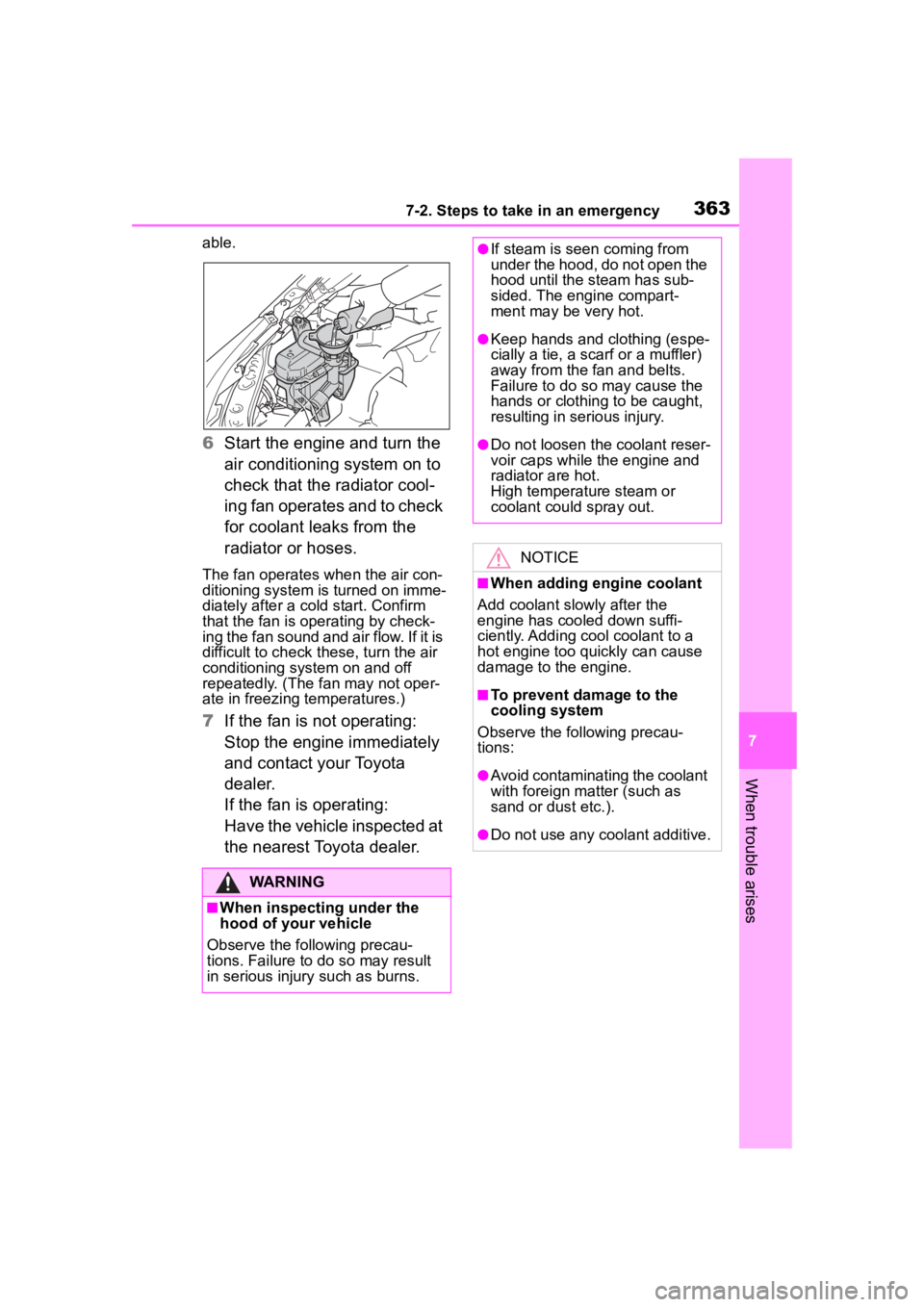
able.
6Start the engine and turn the
air conditioning system on to
check that the radiator cool-
ing fan operates and to check
for coolant leaks from the
radiator or hoses.
The fan operates when the air con-
ditioning system is turned on imme-
diately after a cold start. Confirm
that the fan is op erating by check-
ing the fan sound and air flow. If it is
difficult to check these, turn the air
conditioning system on and off
repeatedly. (The fan may not oper-
ate in freezing temperatures.)
7 If the fan is not operating:
Stop the engine immediately
and contact your Toyota
dealer.
If the fan is operating:
Have the vehicle inspected at
the nearest Toyota dealer.
WARNING
■When inspecting under the
hood of your vehicle
Observe the following precau-
tions. Failure to do so may result
in serious injury such as burns.
●If steam is seen coming from
under the hood, do not open the
hood until the steam has sub-
sided. The engine compart-
ment may be very hot.
●Keep hands and clothing (espe-
cially a tie, a sca rf or a muffler)
away from the fan and belts.
Failure to do so may cause the
hands or clothing to be caught,
resulting in serious injury.
●Do not loosen the coolant reser-
voir caps while the engine and
radiator are hot.
High temperature steam or
coolant could spray out.
NOTICE
■When adding engine coolant
Add coolant slowly after the
engine has cooled down suffi-
ciently. Adding cool coolant to a
hot engine too quickly can cause
damage to the engine.
■To prevent damage to the
cooling system
Observe the following precau-
tions:
●Avoid contaminating the coolant
with foreign matter (such as
sand or dust etc.).
●Do not use any coolant additive.
Page 367 of 436
3678-1. Specifications
8
Vehicle specifications
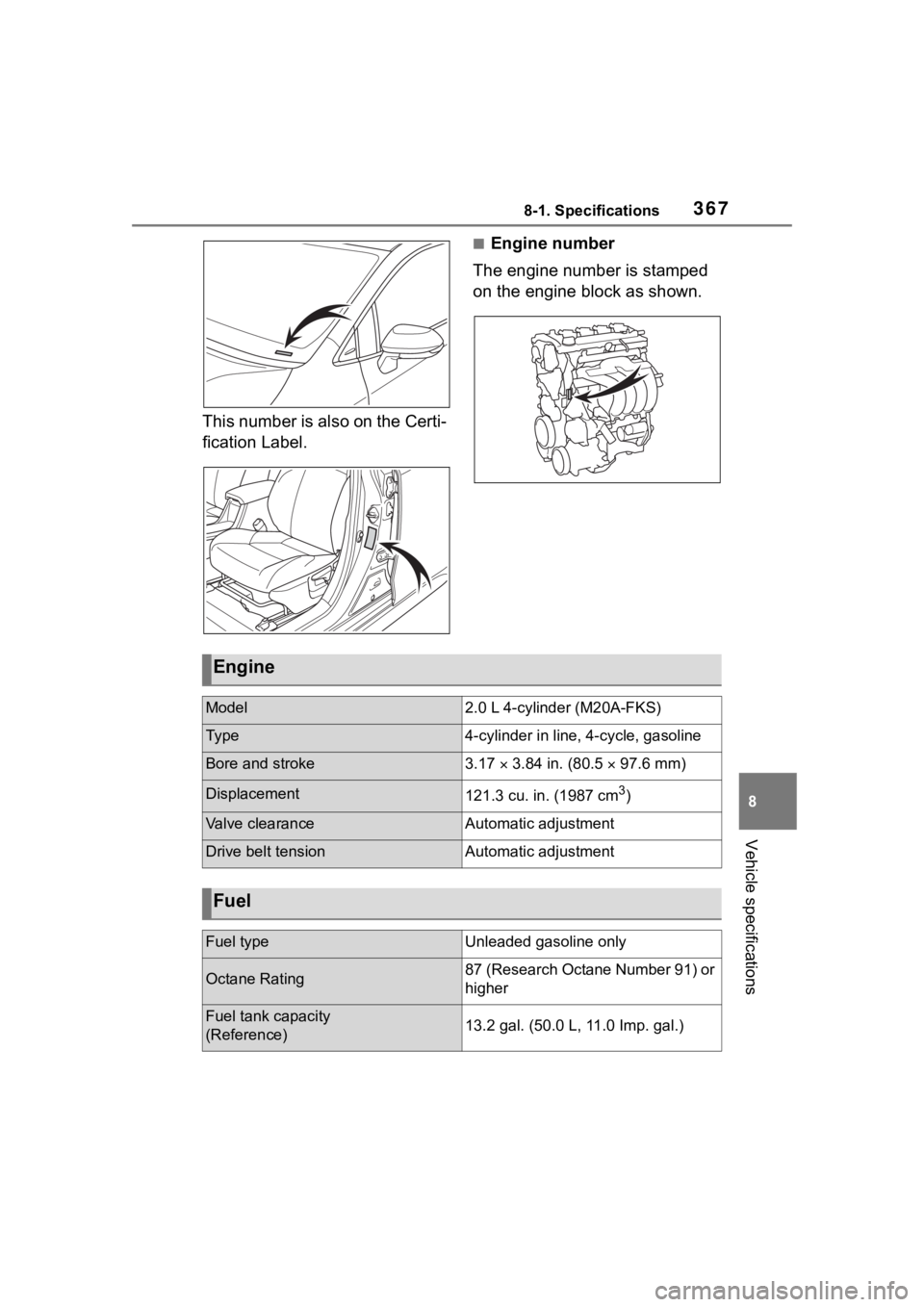
This number is also on the Certi-
fication Label.
■Engine number
The engine number is stamped
on the engine block as shown.
Engine
Model2.0 L 4-cylinder (M20A-FKS)
Ty p e4-cylinder in line , 4-cycle, gasoline
Bore and stroke3.17 3.84 in. (80.5 97.6 mm)
Displacement121.3 cu. in. (1987 cm3)
Valve clearanceAutomatic adjustment
Drive belt tensionAutomatic adjustment
Fuel
Fuel typeUnleaded gasoline only
Octane Rating87 (Research Octane Number 91) or
higher
Fuel tank capacity
(Reference)13.2 gal. (50.0 L, 11.0 Imp. gal.)
Page 378 of 436
3788-1. Specifications
Speed symbol (alphabet with
one letter)
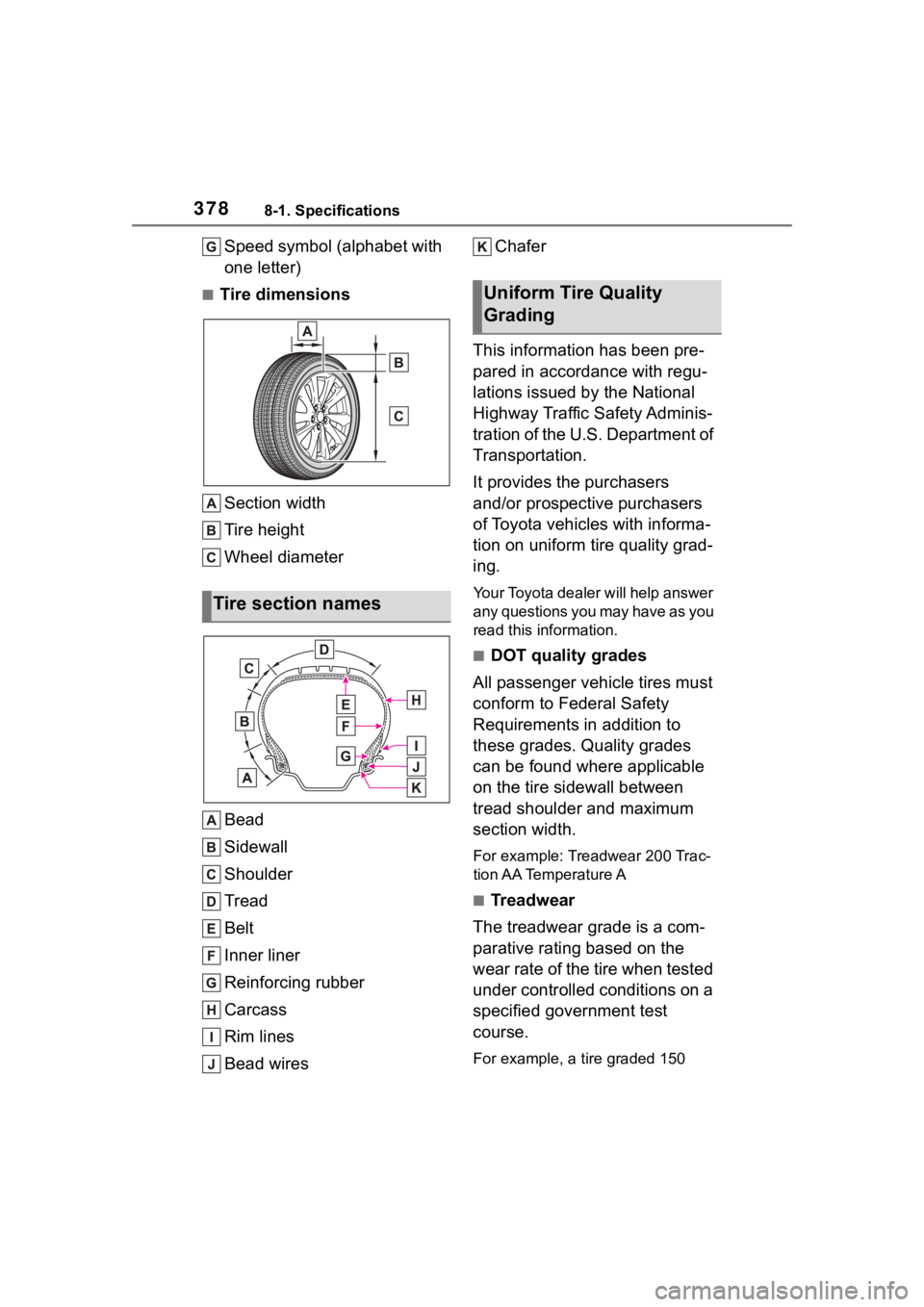
■Tire dimensionsSection width
Tire height
Wheel diameter
Bead
Sidewall
Shoulder
Tread
Belt
Inner liner
Reinforcing rubber
Carcass
Rim lines
Bead wires Chafer
This information has been pre-
pared in accordance with regu-
lations issued by the National
Highway Traffic Safety Adminis-
tration of the U.S. Department of
Transportation.
It provides the purchasers
and/or prospective purchasers
of Toyota vehicles with informa-
tion on uniform tire quality grad-
ing.
Your Toyota dealer will help answer
any questions you may have as you
read this information.
■DOT quality grades
All passenger vehicle tires must
conform to Federal Safety
Requirements in addition to
these grades. Quality grades
can be found where applicable
on the tire sidewall between
tread shoulder and maximum
section width.
For example: Treadwear 200 Trac-
tion AA Temperature A
■Treadwear
The treadwear grade is a com-
parative rating based on the
wear rate of the tire when tested
under controlled conditions on a
specified government test
course.
For example, a tire graded 150
Tire section names
Uniform Tire Quality
Grading
Page 397 of 436
397
9
9
For owners
For owners
.9-1. For ownersReporting safety defects for U.S. owners............... 398
Reporting safety defects for Canadian owners ...... 398
Seat belt instructions for Canadian owners (in
French) ...................... 399
SRS airbag instructions for Canadian owners (in
French) ...................... 400
Page 399 of 436
3999-1. For owners
9
For owners
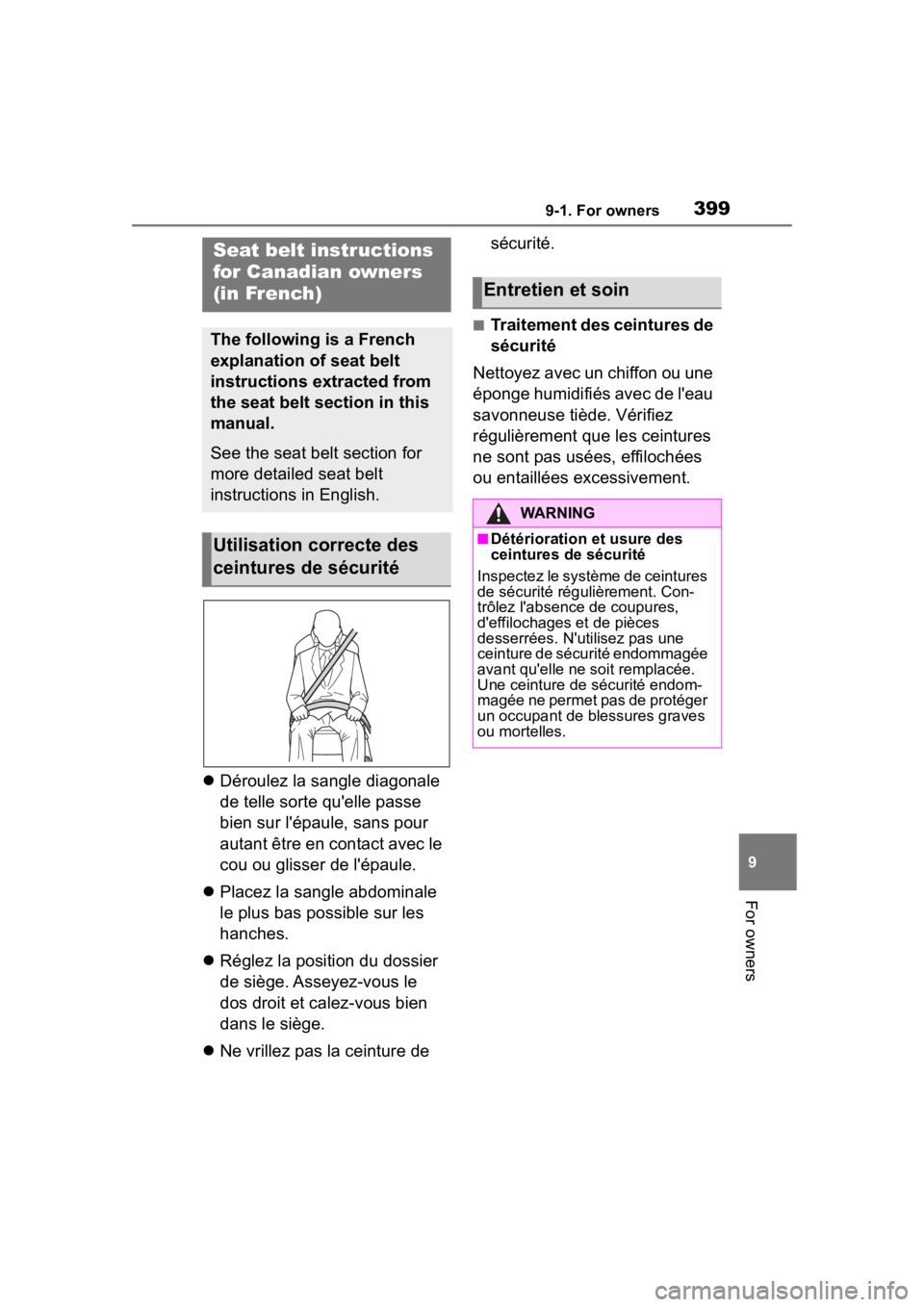
Déroulez la sangle diagonale
de telle sorte qu'elle passe
bien sur l'épaule, sans pour
autant être en contact avec le
cou ou glisser de l'épaule.
Placez la sangle abdominale
le plus bas possible sur les
hanches.
Réglez la position du dossier
de siège. Asseyez-vous le
dos droit et calez-vous bien
dans le siège.
Ne vrillez pas la ceinture de sécurité.
■Traitement des ceintures de
sécurité
Nettoyez avec un chiffon ou une
éponge humidifiés avec de l'eau
savonneuse tiède. Vérifiez
régulièrement que les ceintures
ne sont pas usées, effilochées
ou entaillées excessivement.
Seat belt instructions
for Canadian owners
(in French)
The following is a French
explanation of seat belt
instructions extracted from
the seat belt section in this
manual.
See the seat belt section for
more detailed seat belt
instructions in English.
Utilisation correcte des
ceintures de sécurité
Entretien et soin
WARNING
■Détérioration et usure des
ceintures de sécurité
Inspectez le système de ceintures
de sécurité régulièrement. Con-
trôlez l'absence de coupures,
d'effilochages et de pièces
desserrées. N'ut ilisez pas une
ceinture de sécurité endommagée
avant qu'elle ne soit remplacée.
Une ceinture de sécurité endom-
magée ne permet pas de protéger
un occupant de blessures graves
ou mortelles.
Page 409 of 436
409What to do if... (Troubleshooting)
Is the engine switch in ON?
If you cannot release the shift lever
by depressing the brake pedal with
the engine switch in ON. ( P.139)
Is the window lock switch
pressed?
The power window except for the
one at the driver’s seat cannot be
operated if the win dow lock switch
is pressed. ( P.119)
The auto power off function
will be operated if the vehicle
is left in ACC or ON mode
(the engine is not running) for
a period of time. ( P.136)
The seat belt reminder light is
flashing
Are the driver and the front passen-
ger wearing the seat belts?
( P.323)
The parking brake indicator is
on
Is the parking br ake released?
( P.142)
Depending on the situation,
other types of warning buzzer
may also sound. ( P.320, 330)
Did anyone inside the vehicle
open a door during setting the
alarm?
The sensor detects it and the alarm
sounds. ( P. 6 5 )
Do one of the following to deac-
tivate or stop the alarms:
Unlock the doors.
Turn the engine switch to
ACC or ON, or start the
engine. (The alarm will be
deactivated or stopped after a
few seconds.)
Is the electronic key left inside
the vehicle?
Check the message on the
multi-informat ion display. (P.330)
When a warning light turns on
or a warning message is dis-
played, refer to P.320, 330.
The shift lever cannot be
shifted from P even if you
depress the brake pedal
The windows do not open
or close by operating the
power window switches
The engine switch is
turned off automatically
A warning buzzer sounds
during driving
An alarm is activated and
the horn sounds (vehicles
with an alarm)
A warning buzzer sounds
when leaving the vehicle
A warning light turns on
or a warning message is
displayed
Page 412 of 436
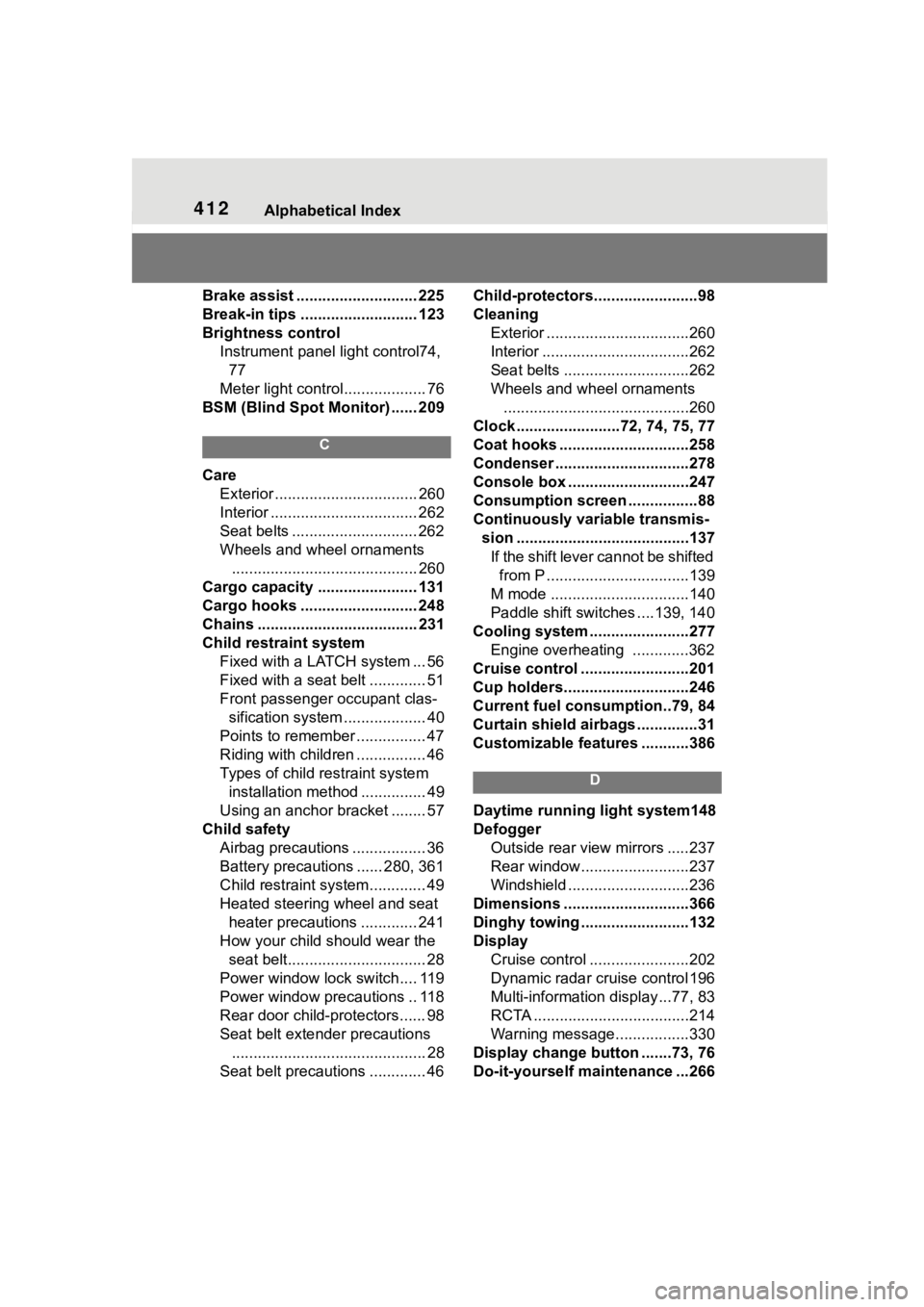
412Alphabetical Index
Brake assist ............................ 225
Break-in tips ........................... 123
Brightness control Instrument panel light control74, 77
Meter light control ................... 76
BSM (Blind Spot Monitor) ...... 209
C
Care Exterior ................................. 260
Interior .................................. 262
Seat belts ............................. 262
Wheels and wheel ornaments........................................... 260
Cargo capacity ....................... 131
Cargo hooks ........................... 248
Chains ..................................... 231
Child restraint system Fixed with a LATCH system ... 56
Fixed with a seat belt ............. 51
Front passenger occupant clas-sification system ................... 40
Points to remember ................ 47
Riding with children ................ 46
Types of child restraint system installation met hod ............... 49
Using an anchor bracket ........ 57
Child safety Airbag precautions ................. 36
Battery precautions ...... 280, 361
Child restraint system............. 49
Heated steering wheel and seat
heater precautions ............. 241
How your child should wear the seat belt................................ 28
Power window lock switch.... 119
Power window precautions .. 118
Rear door child-protectors...... 98
Seat belt extender precautions ............................................. 28
Seat belt precautions ............. 46 Child-protectors........................98
Cleaning
Exterior .................................260
Interior ..................................262
Seat belts .............................262
Wheels and wheel ornaments...........................................260
Clock ................... .....72, 74, 75, 77
Coat hooks ..............................258
Condenser ............. ..................278
Console box ............................247
Consumption screen ................88
Continuously variable transmis- sion ........................................137If th e s hif t le ver ca n no t b e s hif te d from P .................................139
M mode ................................140
Paddle shift switches ....139, 140
Cooling system .......................277 Engine overheating .............362
Cruise control .........................201
Cup holders.............................246
Current fuel consumption..79, 84
Curtain shield airbags ..............31
Customizable featu res ...........386
D
Daytime running light system148
Defogger
Outside rear view mirrors .....237
Rear window.........................237
Windshield ............................236
Dimensions .............................366
Dinghy towing .........................132
Display Cruise control .......................202
Dynamic radar cruise control 196
Multi-information display...77, 83
RCTA ....................................214
Warning message.................330
Display change button .......73, 76
Do-it-yourself maintenance ...266
Page 418 of 436
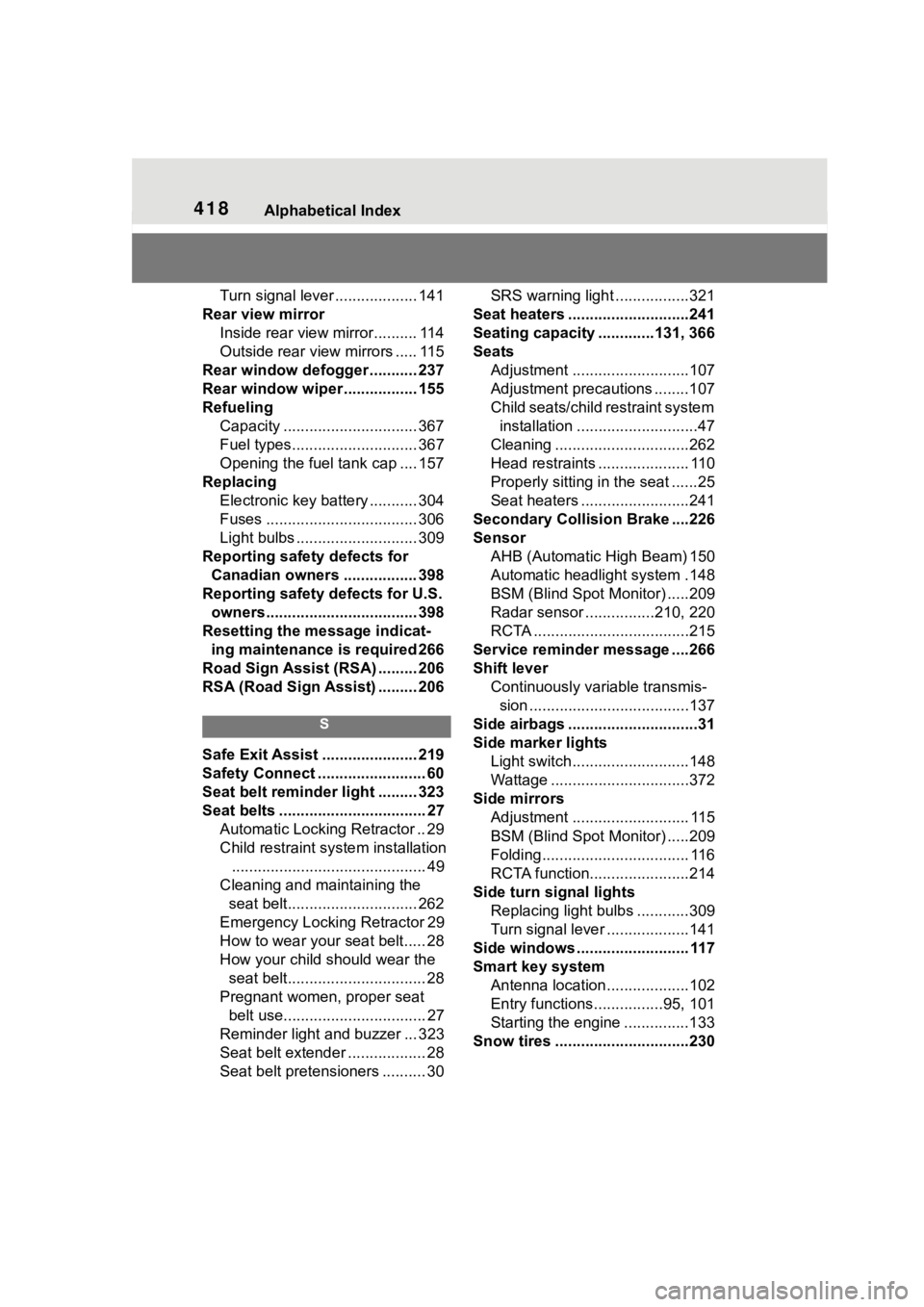
418Alphabetical Index
Turn signal lever ................... 141
Rear view mirror Inside rear view mirror.......... 114
Outside rear view mirrors ..... 115
Rear window defogger ........... 237
Rear window wiper ................. 155
Refueling Capacity ............................... 367
Fuel types............................. 367
Opening the fuel tank cap .... 157
Replacing Electronic key battery ........... 304
Fuses ................................... 306
Light bulbs ............................ 309
Reporting safety defects for Canadian owners ................. 398
Reporting safety defects for U.S. owners................................... 398
Resetting the message indicat- ing maintenance is required 266
Road Sign Assist (RSA) ......... 206
RSA (Road Sign Assist) ......... 206
S
Safe Exit Assist ...................... 219
Safety Connect ......................... 60
Seat belt reminder light ......... 323
Seat belts .................................. 27 Automatic Locking Retractor .. 29
Child restraint system installation............................................. 49
Cleaning and maintaining the seat belt.............................. 262
Emergency Locking Retractor 29
How to wear your seat belt..... 28
How your child should wear the seat belt................................ 28
Pregnant women, proper seat belt use................................. 27
Reminder light and buzzer ... 323
Seat belt extender .................. 28
Seat belt pretensioners .......... 30 SRS warning light .................321
Seat heaters ............................241
Seating capacity .............131, 366
Seats Adjustment ...........................107
Adjustment precautions ........107
Child seats/child restraint system installation ............................47
Cleaning ...............................262
Head restraints ..................... 110
Properly sitting in the seat ......25
Seat heaters ....... ..................241
Secondary Collision Brake ....226
Sensor AHB (Automatic High Beam) 150
Automatic headlight system .148
BSM (Blind Spot M onitor) .....209
Radar sensor ................210, 220
RCTA ....................................215
Service reminder message ....266
Shift lever Continuously variable transmis-sion .....................................137
Side airbags ..............................31
Side marker lights Light switch...........................148
Wattage ................................372
Side mirrors Adjustment ........................... 115
BSM (Blind Spot M onitor) .....209
Folding.................................. 116
RCTA function.......................214
Side turn signal lights Replacing light bulbs ............309
Turn signal lever ...................141
Side windows .......................... 117
Smart key system Antenna location...................102
Entry functions................95, 101
Starting the engine ...............133
Snow tires ...............................230