engine TOYOTA FR-S 2015 Owners Manual (in English)
[x] Cancel search | Manufacturer: TOYOTA, Model Year: 2015, Model line: FR-S, Model: TOYOTA FR-S 2015Pages: 452, PDF Size: 9.97 MB
Page 2 of 452

TABLE OF CONTENTSIndex
2
1-1. Key information
Keys ..................................... 20
1-2. Opening, closing and
locking the doors and
trunk
Smart key system................. 23
Wireless remote control ....... 37
Doors.................................... 40
Trunk .................................... 42
1-3. Adjustable components
(seats, mirrors,
steering wheel)
Front seats ........................... 47
Rear seats ............................ 50
Head restraints ..................... 52
Seat belts ............................. 54
Steering wheel ..................... 61
Anti-glare inside rear view
mirror .................................. 62
Outside rear view mirrors ..... 63
1-4. Opening and closing
the windows
Power windows .................... 66
1-5. Refueling
Opening the fuel tank
cap ..................................... 691-6. Theft deterrent system
Engine immobilizer
system ................................ 73
Alarm .................................... 75
Theft prevention labels
(U.S.A.)............................... 79
1-7. Safety information
Correct driving posture ......... 80
SRS airbag (Supplemental
Restraint System
airbag) ................................ 82
Front passenger occupant
classification system ......... 117
Child restraint systems ....... 125
Installing child restraints ..... 129
2-1. Driving procedures
Driving the vehicle .............. 140
Engine (ignition) switch....... 153
Automatic transmission ...... 162
Manual Transmission ......... 169
Turn signal lever ................. 172
Parking brake ..................... 173
Horn .................................... 174
2-2. Instrument cluster
Gauges and meters ............ 175
Indicators and warning
lights ................................. 179
Multi-information display ..... 183
1Before driving
2When driving
Page 4 of 452

TABLE OF CONTENTSIndex
4
4-3. Do-it-yourself
maintenance
Do-it-yourself service
precautions ...................... 264
Hood................................... 267
Positioning a floor jack ....... 269
Engine compartment .......... 271
Tires ................................... 284
Tire inflation pressure......... 291
Wheels ............................... 295
Air conditioning filter ........... 298
Electronic key battery ......... 301
Checking and replacing
fuses ................................ 303
Light bulbs .......................... 311
5-1. Essential information
Emergency flashers ........... 322
If your vehicle needs to be
towed ............................... 323
If you think something is
wrong ............................... 331
Fuel pump shut off
system .............................. 3325-2. Steps to take in an
emergency
If a warning light turns
on or a warning buzzer
sounds... .......................... 333
If you have a flat tire ........... 346
If the engine will not
start .................................. 357
If the shift lever cannot be
shifted from P ................... 360
If you lose your keys ........... 361
If the electronic key does
not operate properly ......... 362
If the battery is
discharged ........................ 366
If your vehicle
overheats .......................... 370
If the vehicle becomes
stuck ................................. 373
If your vehicle has to
be stopped in an
emergency........................ 375
6-1. Specifications
Maintenance data
(fuel, oil level, etc.) ........... 378
Fuel information .................. 390
Tire information................... 394
6-2. Customization
Customizable features ........ 407
5When trouble arises
6Vehicle specifications
Page 11 of 452
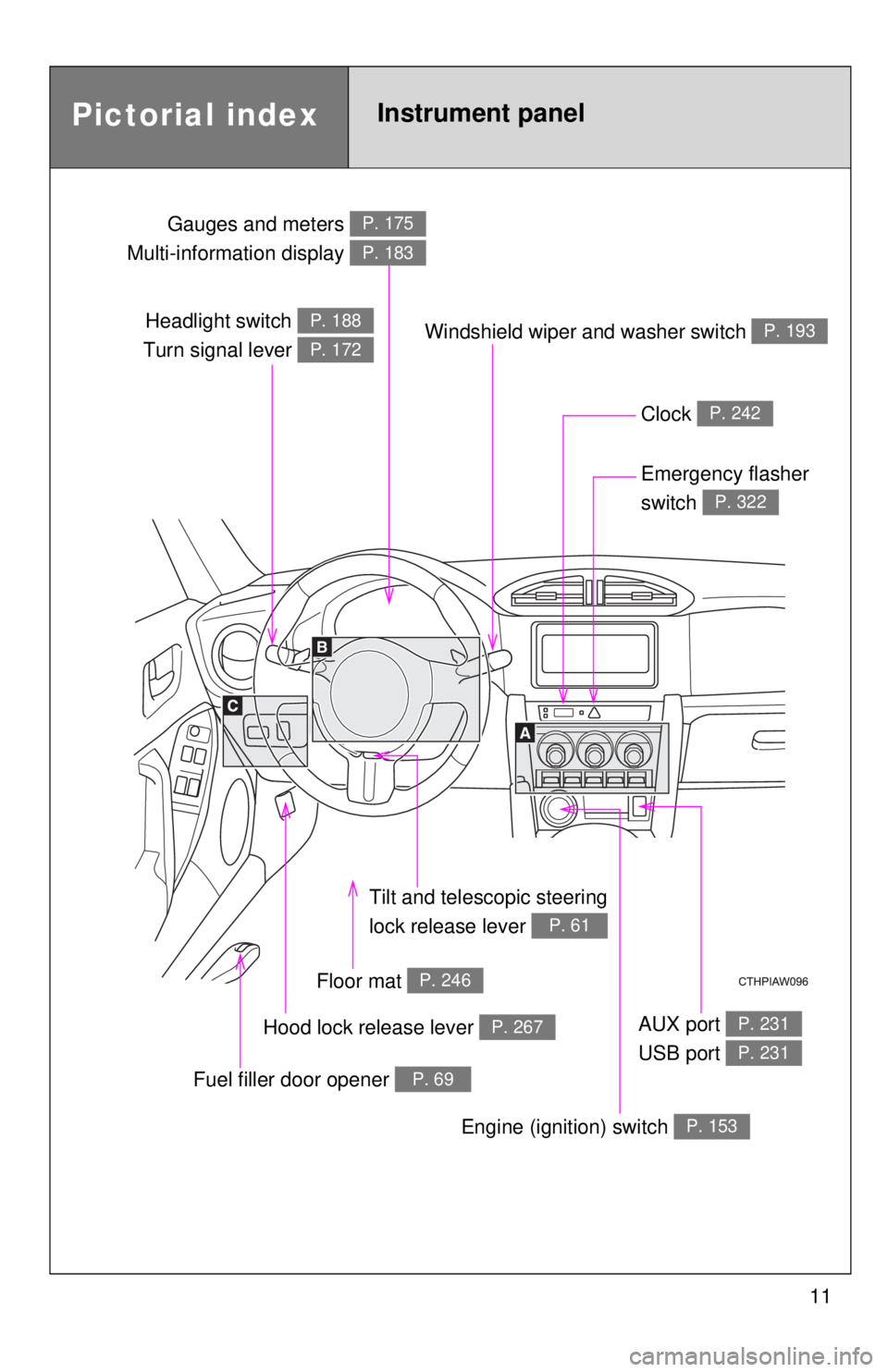
11
Headlight switch
Turn signal lever P. 188
P. 172
Gauges and meters
Multi-information display P. 175
P. 183
Clock P. 242
Windshield wiper and washer switch P. 193
Emergency flasher
switch
P. 322
Tilt and telescopic steering
lock release lever
P. 61
Floor mat P. 246
Hood lock release lever P. 267
Fuel filler door opener P. 69
AUX port
USB port P. 231
P. 231
Pictorial indexInstrument panel
Engine (ignition) switch P. 153
Page 14 of 452

14
For your information
Main Owner’s Manual
Please note that this manual applies to all models and explains all equip-
ment, including options. Therefore, you may find some explanations for
equipment not installed on your vehicle.
All specifications provided in this manual are current at the time of printing.
However, because of the Scion policy of continual product improvement, we
reserve the right to make changes at any time without notice.
Depending on specifications, the vehicle shown in the illustration may differ
from your vehicle in terms of color and equipment.
Noise from under vehicle after turning off the engine
Approximately five hours after the engine is turned off, you may hear sound
coming from under the vehicle for several minutes. This is the sound of a fuel
evaporation leakage check and, it does not indicate a malfunction.
Accessories, spare parts and modification of your Scion
A wide variety of non-genuine spare parts and accessories for Scion vehicles
are currently available in the market. You should know that Scion does not
warrant these products and is not responsible for their performance, repair,
or replacement, or for any damage they may cause to, or adverse effect they
may have on, your Scion vehicle.
This vehicle should not be modified with non-genuine Scion products. Modifi-
cation with non-genuine Scion products could affect its performance, safety
or durability, and may even violate governmental regulations. In addition,
damage or performance problems resulting from the modification may not be
covered under warranty.
Page 19 of 452
Before driving1
19
1-1. Key information
Keys ................................... 20
1-2. Opening, closing and
locking the doors and
trunk
Smart key system .............. 23
Wireless remote
control .............................. 37
Doors ................................. 40
Trunk .................................. 42
1-3. Adjustable components
(seats, mirrors,
steering wheel)
Front seats ......................... 47
Rear seats.......................... 50
Head restraints................... 52
Seat belts ........................... 54
Steering wheel ................... 61
Anti-glare inside rear
view mirror ....................... 62
Outside rear view
mirrors.............................. 631-4. Opening and closing
the windows
Power windows .................. 66
1-5. Refueling
Opening the fuel tank
cap ................................... 69
1-6. Theft deterrent system
Engine immobilizer
system ............................. 73
Alarm.................................. 75
Theft prevention labels
(U.S.A.) ............................ 79
1-7. Safety information
Correct driving posture....... 80
SRS airbag
(Supplemental Restraint
System airbag)................. 82
Front passenger
occupant classification
system ........................... 117
Child restraint systems..... 125
Installing child
restraints ........................ 129
Page 23 of 452
23
1
Before driving
1-2. Opening, closing and locking the doors and trunk
Smart key system
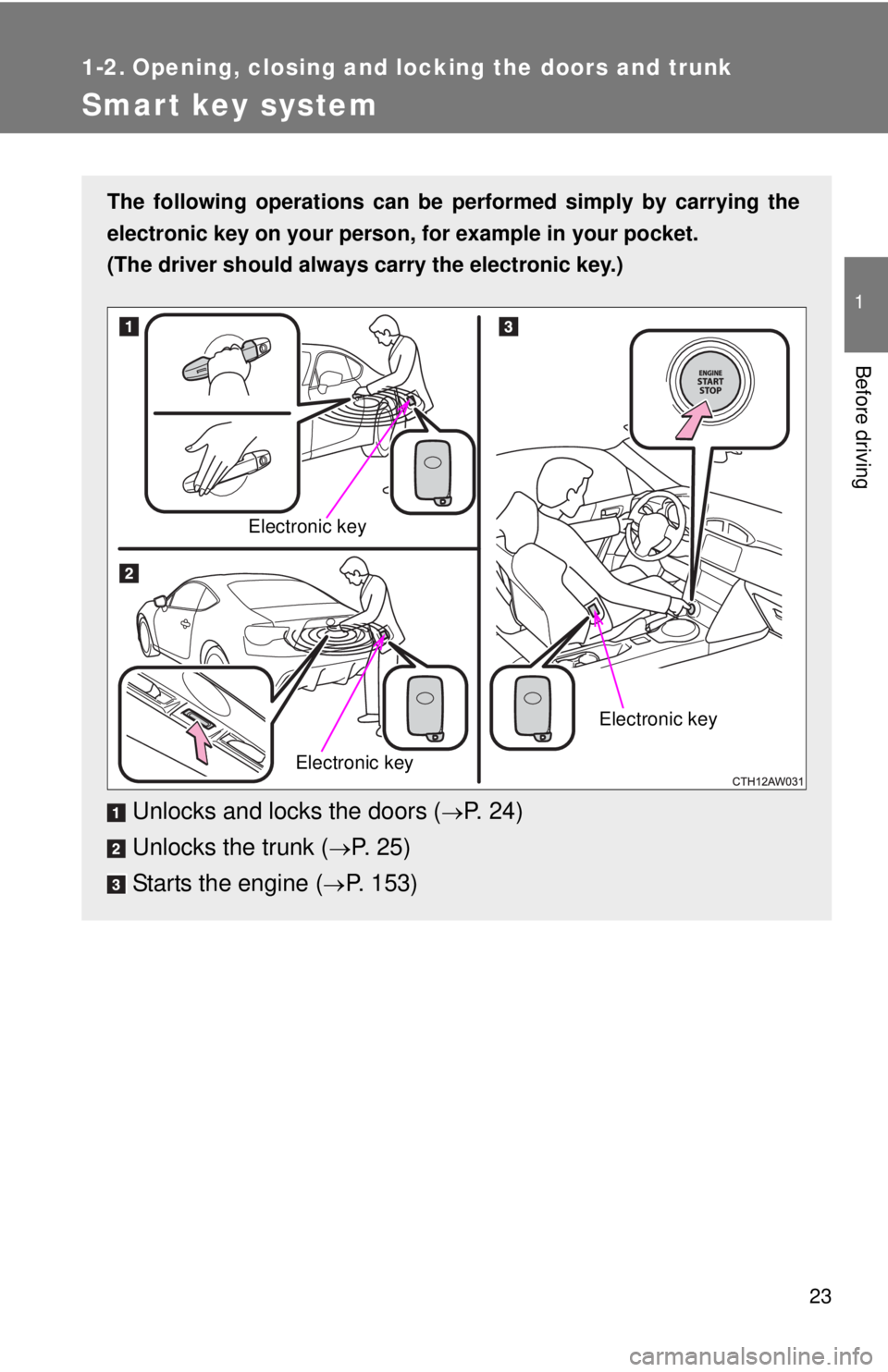
The following operations can be performed simply by carrying the
electronic key on your person, for example in your pocket.
(The driver should always carry the electronic key.)
Unlocks and locks the doors (P. 24)
Unlocks the trunk (
P. 2 5 )
Starts the engine (
P. 153)
Electronic key
Electronic key
Electronic key
Page 26 of 452
26 1-2. Opening, closing and locking the doors and trunk
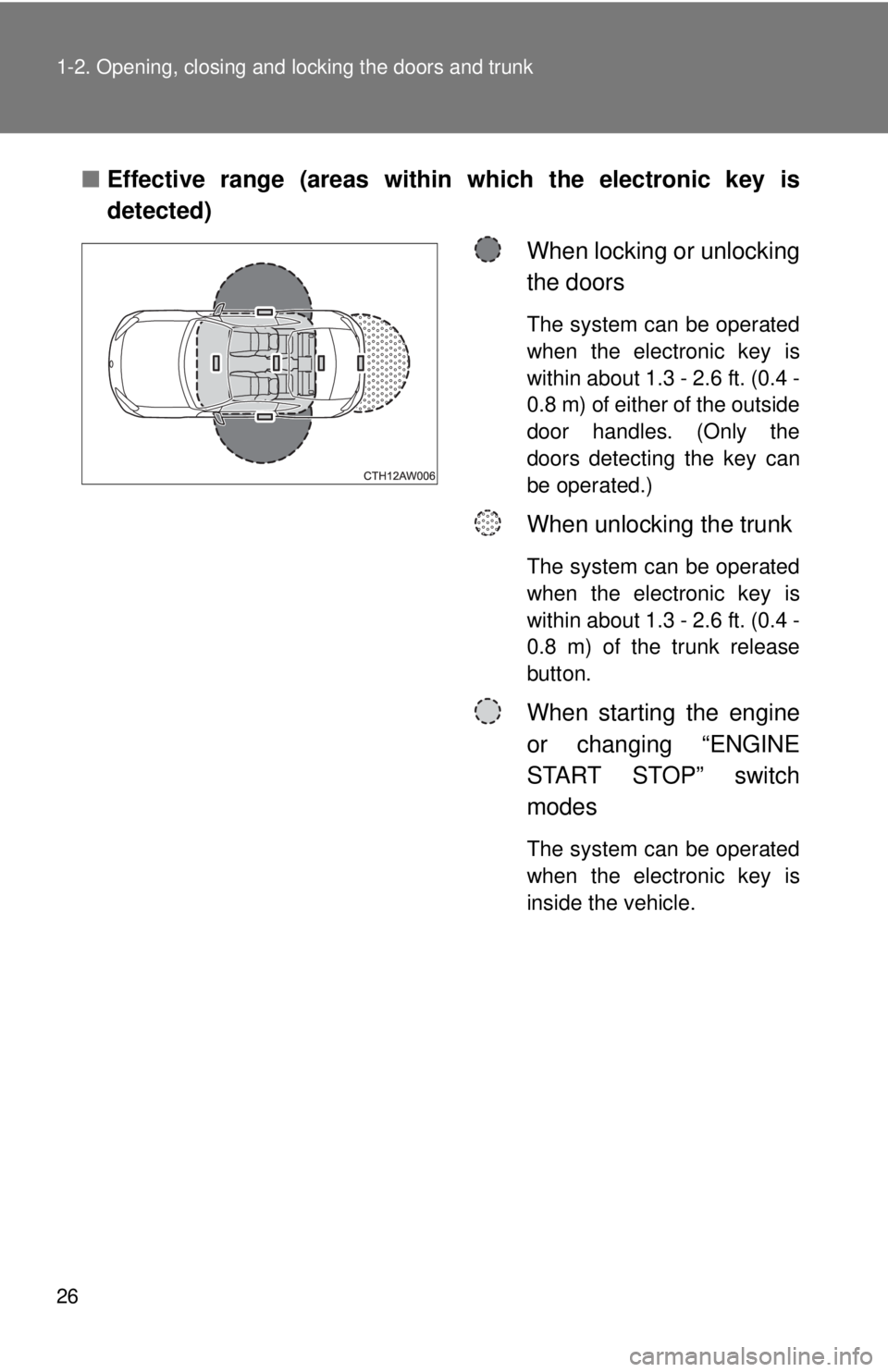
■Effective range (areas within which the electronic key is
detected)
When locking or unlocking
the doors
The system can be operated
when the electronic key is
within about 1.3 - 2.6 ft. (0.4 -
0.8 m) of either of the outside
door handles. (Only the
doors detecting the key can
be operated.)
When unlocking the trunk
The system can be operated
when the electronic key is
within about 1.3 - 2.6 ft. (0.4 -
0.8 m) of the trunk release
button.
When starting the engine
or changing “ENGINE
START STOP” switch
modes
The system can be operated
when the electronic key is
inside the vehicle.
Page 28 of 452

28 1-2. Opening, closing and locking the doors and trunk
*: Vehicles with an automatic transmission only
AlarmSituationCorrection procedure
Interior alarm
pings once and
exterior alarm
sounds once for
5 secondsAn attempt was made to
lock either door by opening
a door and putting the
inside lock button into the
lock position, then closing
the door by pulling on the
outside door handle with
the electronic key still
inside the vehicle.Retrieve the elec-
tronic key from the
vehicle and lock the
doors again.
Exterior alarm
sounds once for
5 secondsAn attempt was made to
lock the doors using the
smart key system while the
electronic key was still
inside the vehicle.Retrieve the elec-
tronic key from the
vehicle and lock the
doors again.
An attempt was made to
lock the vehicle while a
door was open.Close all of the doors
and lock the doors
again.
Interior alarm
sounds continu-
ouslyThe “ENGINE START
STOP” switch was turned
to ACCESSORY mode
while the driver’s door was
open (or the driver’s door
was opened while the
“ENGINE START STOP”
switch was in ACCES-
SORY mode).Turn the “ENGINE
START STOP” switch
off and close the
driver’s door.
Interior alarm
sounds continu-
ously*The driver’s door was
opened while any shift
position other than P was
selected without turning off
the “ENGINE START
STOP” switch.Shift the shift lever to
P.
Page 30 of 452

30 1-2. Opening, closing and locking the doors and trunk
■Conditions affecting operation
The smart key system uses weak radio waves. In the following situations,
the communication between the electronic key and the vehicle may be
affected, preventing the smart key system, wireless remote control and
engine immobilizer system from operating properly.
(Way of coping P. 362)
●When the electronic key battery is depleted
●Near a TV tower, electric power plant, gas station, radio station, large dis-
play, airport or other facility that generates strong radio waves or electri-
cal noise
●When the electronic key is in contact with, or is covered by the following
metallic objects
• Cards to which aluminum foil is attached
• Cigarette boxes that have aluminum foil inside
• Metallic wallets or bags
• Coins
• Hand warmers made of metal
• Media such as CDs and DVDs
●When other wireless keys (that emit radio waves) are being used nearby
●When carrying the electronic key together with the following devices that
emit radio waves
• A portable radio, cellular phone, cordless phone or other wireless com-
munication device
• Another vehicle's electronic key or a wireless key that emits radio
waves
• Personal computers or personal digital assistants (PDAs)
• Digital audio players
• Portable game systems
●If window tint with a metallic content or metallic objects are attached to
the rear window
●When the electronic key is placed near a battery charger or electronic
devices
Page 31 of 452

31 1-2. Opening, closing and locking the doors and trunk
1
Before driving
■Notes for the entry function
●Even when the electronic key is within the effective range (detection
areas), the system may not operate properly in the following cases:
• The electronic key is too close to the window or outside door handle,
near the ground, or in a high place when the doors are locked or
unlocked.
• The electronic key is near the ground or in a high place, or too close to
the rear bumper center when the trunk is unlocked.
• The electronic key is on the instrument panel, rear shelf or floor, in the
door pockets or glove box, auxiliary box when the engine is started or
“ENGINE START STOP” switch modes are changed.
●Do not leave the electronic key on top of the instrument panel or near the
door pockets when exiting the vehicle. Depending on the radio wave
reception conditions, it may be detected by the antenna outside the cabin
and the door will become lockable from the outside, possibly trapping the
electronic key inside the vehicle.
●As long as the electronic key is within the effective range, the doors may
be locked or unlocked by anyone.
●Even if the electronic key is not inside the vehicle, it may be possible to
start the engine if the electronic key is near the window.
●The doors may unlock if a large amount of water splashes on the door
handle, such as in the rain or in a car wash when the electronic key is
within the effective range. (The door will automatically be locked after
approximately 60 seconds if the doors are not opened and closed.)
●Gripping the door handle when wearing a glove may not unlock the door.
●If the wireless remote control is used to lock the doors when the elec-
tronic key is near the vehicle, there is a possibility that the door may not
be unlocked by the entry function. (Use the wireless remote control to
unlock the doors.)
●A sudden approach to the effective range or door handle may prevent the
doors from being unlocked. In this case, return the door handle to the
original position and check that the doors unlock before pulling the door
handle again.