transmission TOYOTA GR YARIS 2020 Owners Manual
[x] Cancel search | Manufacturer: TOYOTA, Model Year: 2020, Model line: GR YARIS, Model: TOYOTA GR YARIS 2020Pages: 458, PDF Size: 105.69 MB
Page 4 of 458
2
YARIS(GR) Owner's Manual_Europe_M52L09_en
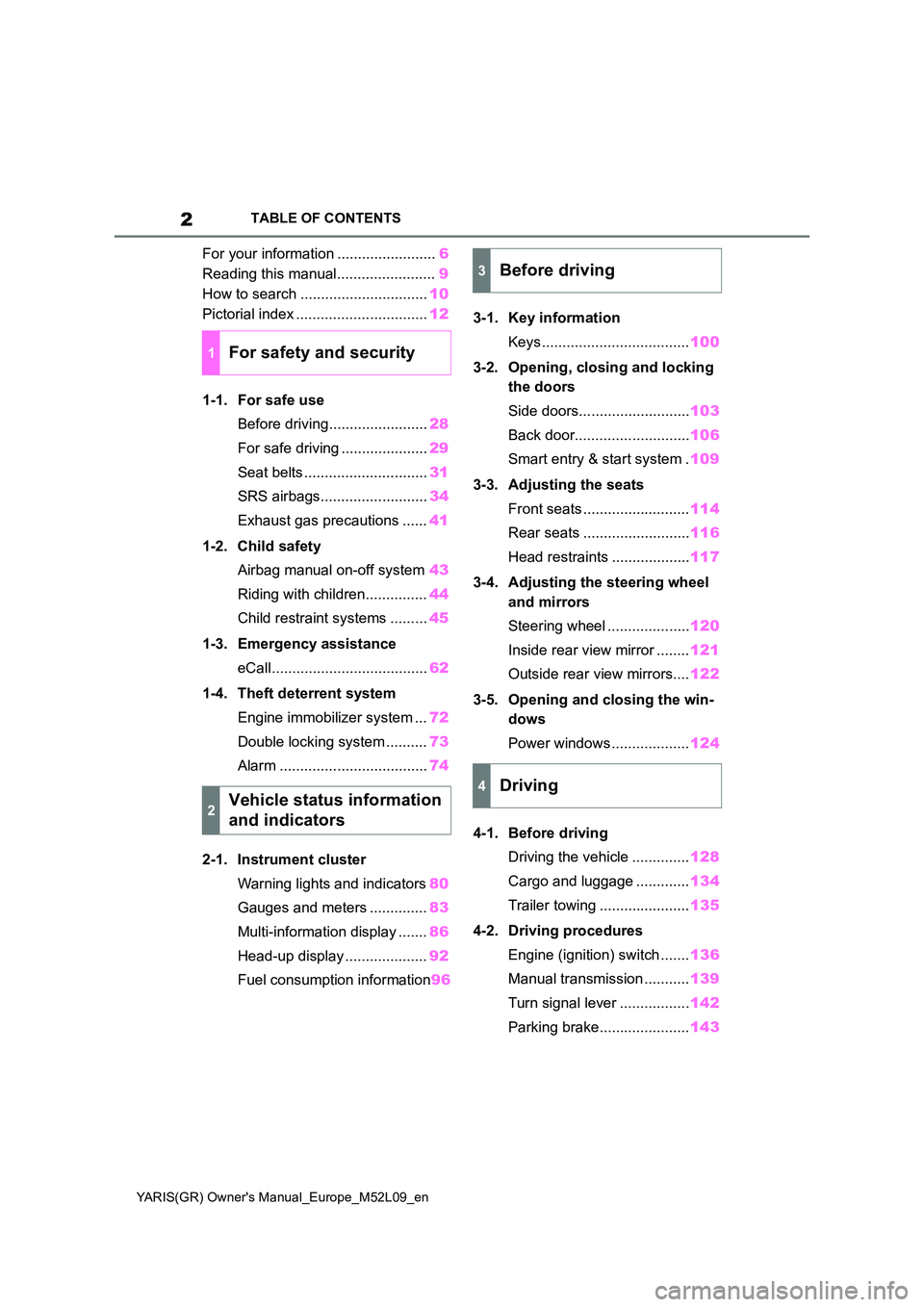
TABLE OF CONTENTS
For your information ........................6
Reading this manual........................ 9
How to search ............................... 10
Pictorial index ................................ 12
1-1. For safe use
Before driving........................ 28
For safe driving ..................... 29
Seat belts .............................. 31
SRS airbags.......................... 34
Exhaust gas precautions ...... 41
1-2. Child safety
Airbag manual on-off system 43
Riding with children............... 44
Child restraint systems ......... 45
1-3. Emergency assistance
eCall...................................... 62
1-4. Theft deterrent system
Engine immobilizer system ... 72
Double locking system .......... 73
Alarm .................................... 74
2-1. Instrument cluster
Warning lights and indicators 80
Gauges and meters .............. 83
Multi-information display ....... 86
Head-up display .................... 92
Fuel consumption information 96
3-1. Key information
Keys .................................... 100
3-2. Opening, closing and locking
the doors
Side doors........................... 103
Back door............................ 106
Smart entry & start system . 109
3-3. Adjusting the seats
Front seats .......................... 114
Rear seats .......................... 116
Head restraints ................... 117
3-4. Adjusting the steering wheel
and mirrors
Steering wheel .................... 120
Inside rear view mirror ........ 121
Outside rear view mirrors.... 122
3-5. Opening and closing the win-
dows
Power windows ................... 124
4-1. Before driving
Driving the vehicle .............. 128
Cargo and luggage ............. 134
Trailer towing ...................... 135
4-2. Driving procedures
Engine (ignition) switch ....... 136
Manual transmission ........... 139
Turn signal lever ................. 142
Parking brake...................... 143
1For safety and security
2Vehicle status information
and indicators
3Before driving
4Driving
Page 18 of 458
16
YARIS(GR) Owner's Manual_Europe_M52L09_en
Pictorial index
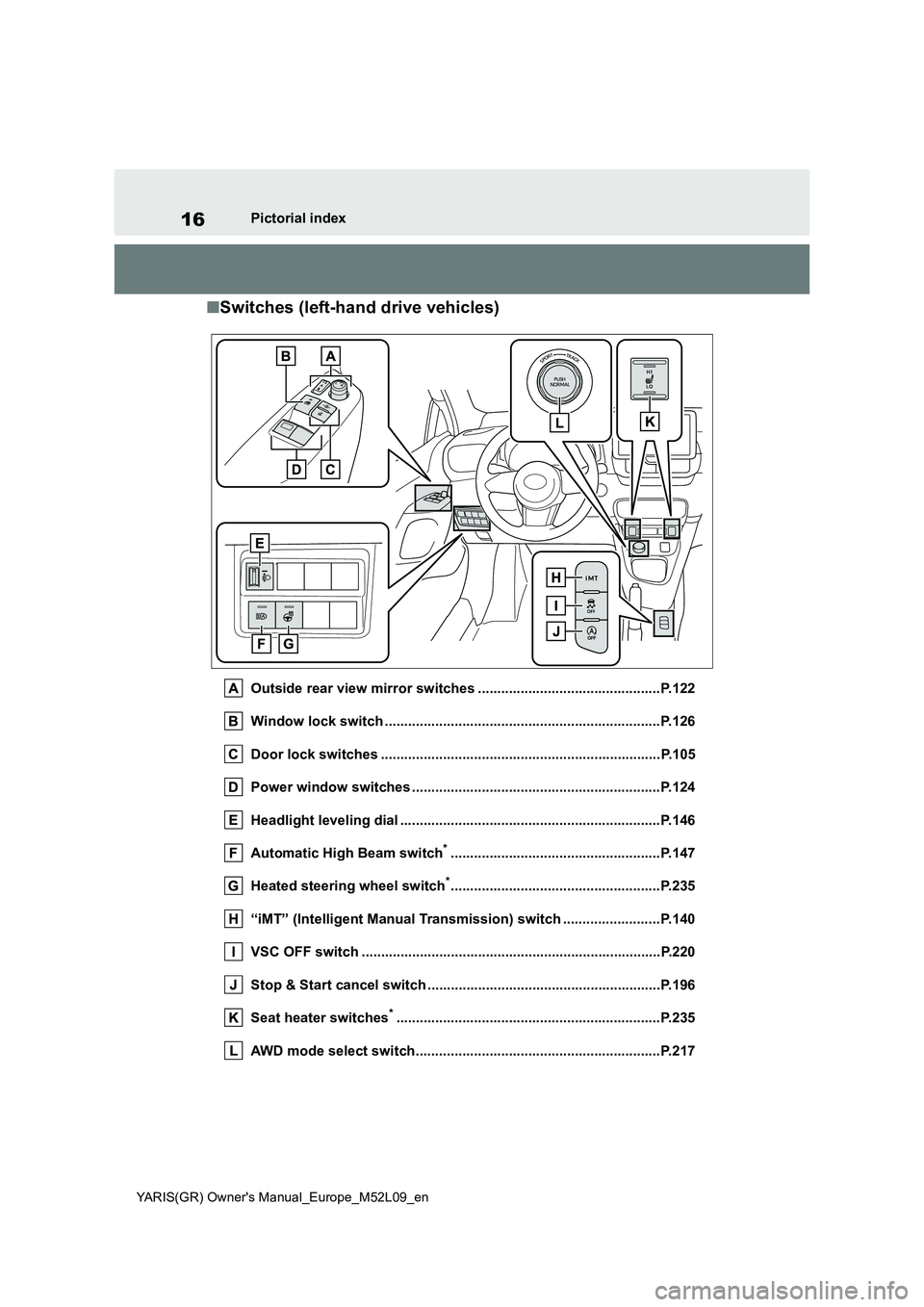
■Switches (left-hand drive vehicles)
Outside rear view mirror switches ...............................................P.122
Window lock switch .......................................................................P.126
Door lock switches ........................................................................P.105
Power window switches ................................................................P.124
Headlight leveling dial ...................................................................P.146
Automatic High Beam switch*......................................................P.147
Heated steering wheel switch*......................................................P.235
“iMT” (Intelligent Manual Transmission) switch .........................P.140
VSC OFF switch .............................................................................P.220
Stop & Start cancel switch ............................................................P.196
Seat heater switches*....................................................................P.235
AWD mode select switch...............................................................P.217
Page 24 of 458
22
YARIS(GR) Owner's Manual_Europe_M52L09_en
Pictorial index
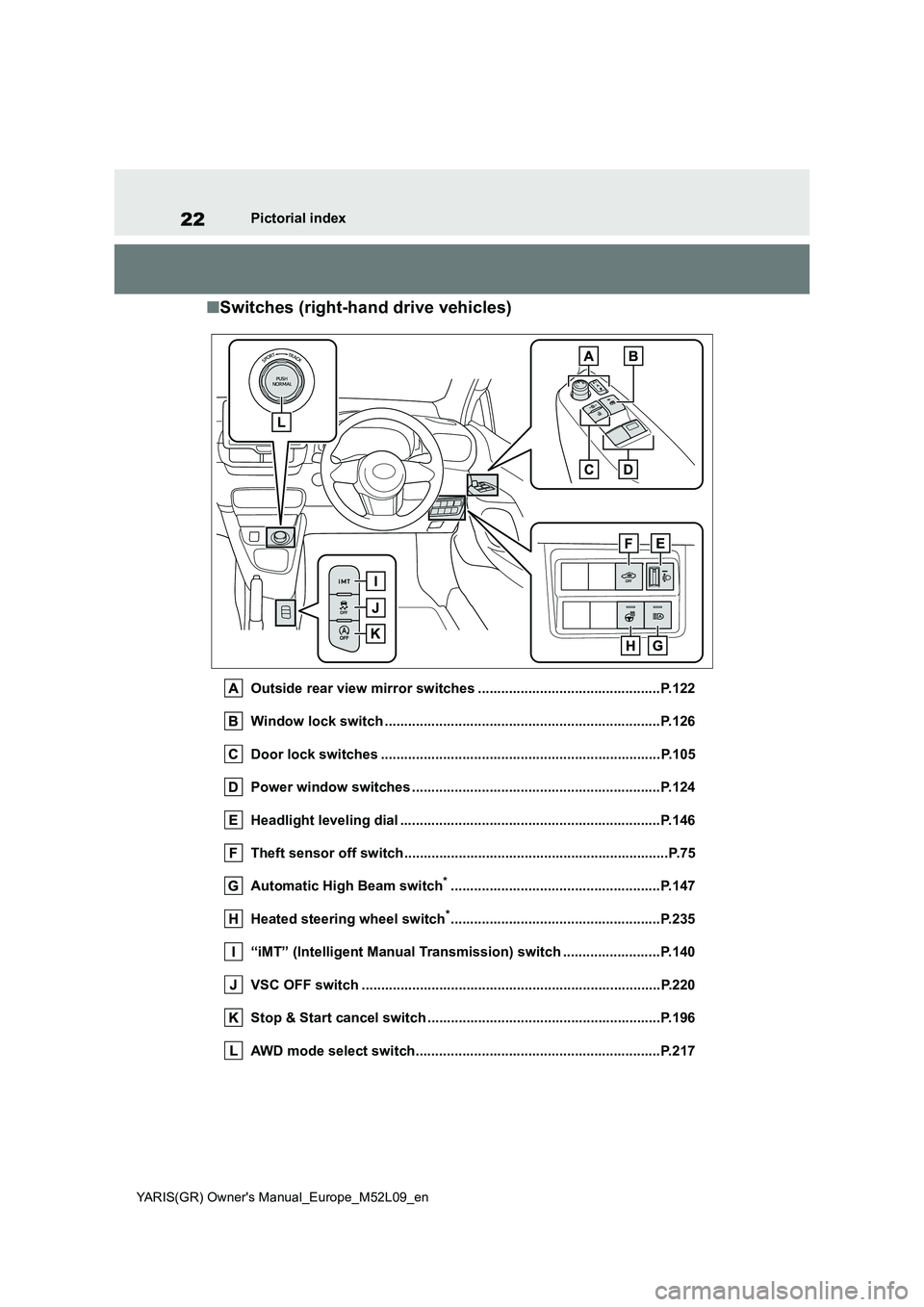
■Switches (right-hand drive vehicles)
Outside rear view mirror switches ...............................................P.122
Window lock switch .......................................................................P.126
Door lock switches ........................................................................P.105
Power window switches ................................................................P.124
Headlight leveling dial ...................................................................P.146
Theft sensor off switch....................................................................P.75
Automatic High Beam switch
*......................................................P.147
Heated steering wheel switch
*......................................................P.235
“iMT” (Intelligent Manual Transmission) switch .........................P.140
VSC OFF switch .............................................................................P.220
Stop & Start cancel switch ............................................................P.196
AWD mode select switch...............................................................P.217
Page 129 of 458
4
127
YARIS(GR) Owner's Manual_Europe_M52L09_en
4
Driving
Driving
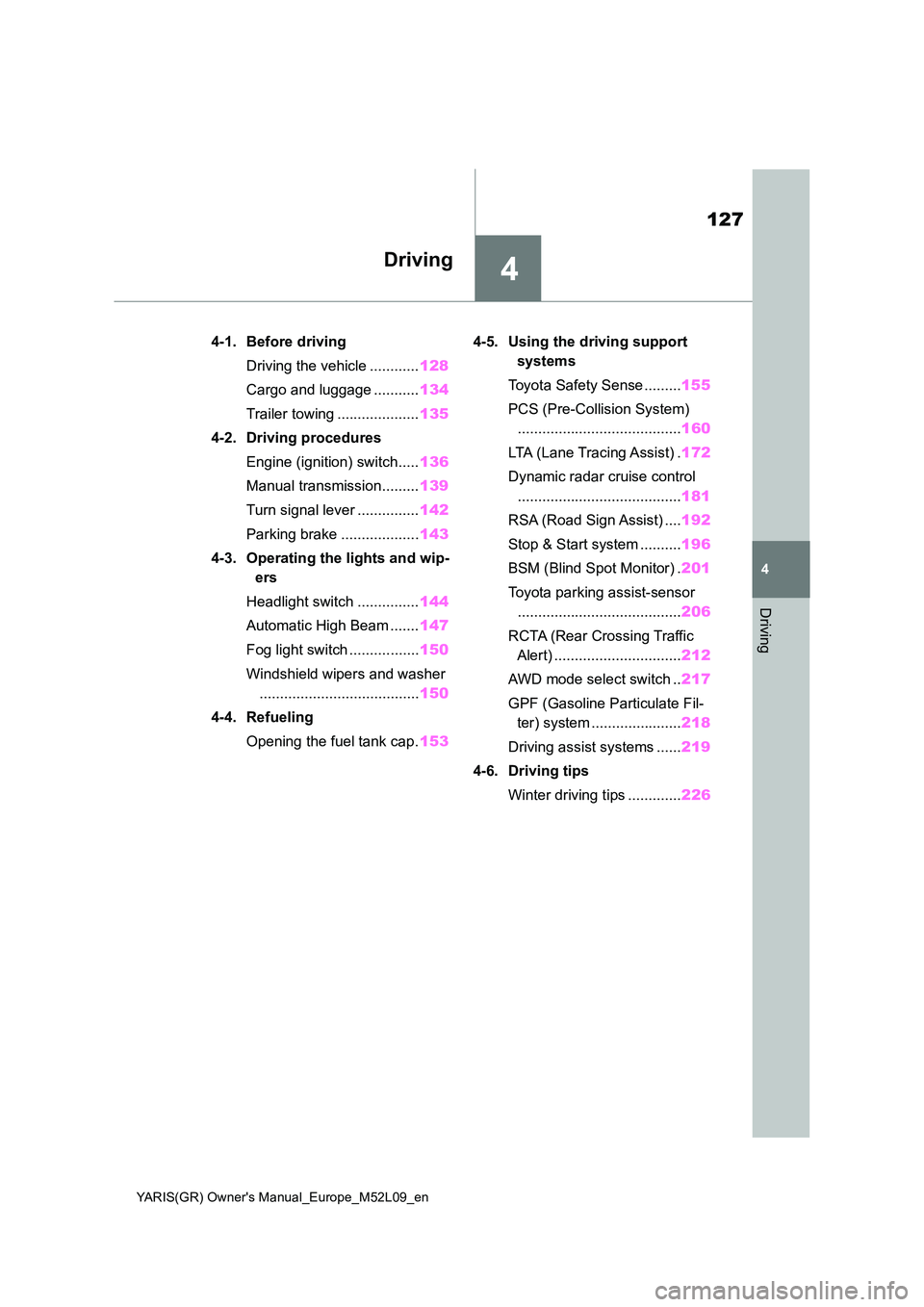
4-1. Before driving
Driving the vehicle ............ 128
Cargo and luggage ........... 134
Trailer towing .................... 135
4-2. Driving procedures
Engine (ignition) switch..... 136
Manual transmission......... 139
Turn signal lever ............... 142
Parking brake ................... 143
4-3. Operating the lights and wip-
ers
Headlight switch ............... 144
Automatic High Beam ....... 147
Fog light switch ................. 150
Windshield wipers and washer
....................................... 150
4-4. Refueling
Opening the fuel tank cap. 153
4-5. Using the driving support
systems
Toyota Safety Sense ......... 155
PCS (Pre-Collision System)
........................................ 160
LTA (Lane Tracing Assist) . 172
Dynamic radar cruise control
........................................ 181
RSA (Road Sign Assist) .... 192
Stop & Start system .......... 196
BSM (Blind Spot Monitor) . 201
Toyota parking assist-sensor
........................................ 206
RCTA (Rear Crossing Traffic
Alert) ............................... 212
AWD mode select switch .. 217
GPF (Gasoline Particulate Fil-
ter) system ...................... 218
Driving assist systems ...... 219
4-6. Driving tips
Winter driving tips ............. 226
Page 132 of 458
130
YARIS(GR) Owner's Manual_Europe_M52L09_en
4-1. Before driving
WARNING
●Do not drive the vehicle over or stop the vehicle near flammable
materials. The exhaust system and exhaust gases can be extremely hot. These
hot parts may cause a fire if there is any flammable material nearby.
●During normal driving, do not turn off the engine. Turning the engine off while driving will not cause loss
of steering or braking control, but the power assist to these systems will be lost. This will make it more
difficult to steer and brake, so you should pull over and stop the vehi-cle as soon as it is safe to do so.
However, in the event of an emer- gency, such as if it becomes impos-sible to stop the vehicle in the
normal way: →P. 3 0 6
●Use engine braking (downshift) to
maintain a safe speed when driving down a steep hill.Using the brakes continuously may
cause the brakes to overheat and lose effectiveness. ( →P.139)
●Do not adjust the positions of the steering wheel, the seat, or the inside or outside rear view mirrors
while driving. Doing so may result in a loss of vehicle control.
●Always check that all passengers’ arms, heads or other parts of their
body are not outside the vehicle.
●Do not drive the vehicle off-road.
This is not an AWD vehicle designed for off-road driving. Pro-ceed with all due caution if it
becomes unavoidable to drive off- road.
●Do not drive across a river or through other bodies of water.This may cause electric/electronic
components to short circuit, dam- age the engine or cause other seri-ous damage to the vehicle.
■When driving on slippery road surfaces
●Sudden braking, acceleration and steering may cause tire slippage and reduce your ability to control
the vehicle.
●Sudden acceleration, engine brak-
ing due to shifting, or changes in engine speed could cause the vehi-cle to skid.
●After driving through a puddle, lightly depress the brake pedal to
make sure that the brakes are func- tioning properly. Wet brake pads may prevent the brakes from func-
tioning properly. If the brakes on only one side are wet and not func-tioning properly, steering control
may be affected.
■When shifting the shift lever
●Do not shift the shift lever to R while the vehicle is moving forward.Doing so can damage the transmis-
sion and may result in a loss of vehicle control.
●Do not shift the shift lever to a driv-ing position while the vehicle is moving backward.
Doing so can damage the transmis- sion and may result in a loss of vehicle control.
●Moving the shift lever to N while the vehicle is moving will disengage the
engine from the transmission. Engine braking is not available when N is selected.
Page 134 of 458
132
YARIS(GR) Owner's Manual_Europe_M52L09_en
4-1. Before driving
WARNING
●Do not touch the exhaust pipes while the engine is running or
immediately after turning the engine off.Doing so may cause burns.
■When taking a nap in the vehicle
Always turn the engine off. Otherwise,
if you accidentally move the shift lever or depress the accelerator pedal, this could cause an accident or fire due to
engine overheating. Additionally, if the vehicle is parked in a poorly ventilated area, exhaust gases may collect and
enter the vehicle, leading to death or a serious health hazard.
■When braking
●When the brakes are wet, drive more cautiously.
Braking distance increases when the brakes are wet, and this may cause one side of the vehicle to
brake differently than the other side. Also, the parking brake may not securely hold the vehicle.
●If the brake booster device does not operate, do not follow other vehi-
cles closely and avoid hills or sharp turns that require braking.In this case, braking is still possible,
but the brake pedal should be depressed more firmly than usual. Also, the braking distance will
increase. Have your brakes fixed immediately.
●Do not pump the brake pedal if the engine stalls.Each push on the brake pedal uses
up the reserve for the power- assisted brakes.
●The brake system consists of 2 indi-vidual hydraulic systems; if one of the systems fails, the other will still
operate. In this case, the brake pedal should be depressed more firmly than usual and the braking
distance will increase. Have your brakes fixed immediately.
■If the vehicle becomes stuck
Do not spin the wheels excessively when a driven wheel is up in the air,
or the vehicle is stuck in sand, mud, etc. This may damage the driveline components or propel the vehicle for-
ward or backward, causing an acci- dent.
NOTICE
■When driving the vehicle
●Do not depress the accelerator and brake pedals at the same time during driving, as this may restrain
the engine output.
●Do not shift gears unless the clutch
pedal is fully depressed. After shift- ing, do not release the clutch pedal abruptly. Doing so may damage the
clutch, transmission and gears.
●Observe the following precautions.
Failure to do so may cause exces- sive premature wear or damage to the clutch, eventually making it diffi-
cult to accelerate and start off from a stop. Have the vehicle inspected by any authorized Toyota retailer or
Toyota authorized repairer, or any reliable repairer.
• Do not rest your foot on the clutch pedal or depress it any time other than when shifting.
Doing so may cause clutch trouble.
• Do not use any gear other than the
1st gear when starting off and mov- ing forward.Doing so may damage the clutch.
Page 135 of 458
133
4
YARIS(GR) Owner's Manual_Europe_M52L09_en
4-1. Before driving
Driving
NOTICE
• Do not use the clutch pedal to adjust vehicle speed. When stop-
ping the vehicle with the shift lever in a position other then N, make sure to fully depress the clutch
pedal and stop the vehicle using the brake.Doing so may damage the clutch.
• When stopping the vehicle with the shift lever in a position other than N,
make sure to fully depress the clutch pedal and stop the vehicle using the brakes.
●Do not shift the shift lever to R with-out the vehicle completely stopped.
Doing so may damage the clutch, transmission and gears.
■Avoiding damage to vehicle parts
●Do not turn the steering wheel fully in either direction and hold it there
for an extended period of time. Doing so may damage the power steering motor.
●When driving over bumps in the road, drive as slowly as possible to
avoid damaging the wheels, under- side of the vehicle, etc.
●Make sure to idle the engine imme-diately after high-load driving. Stop the engine only after the turbo-
charger has cooled down. Failure to do so may cause damage to the turbocharger.
■If you get a flat tire while driving
A flat or damaged tire may cause the
following situations. Hold the steering wheel firmly and gradually depress the brake pedal to slow down the
vehicle.
●It may be difficult to control your vehicle.
●The vehicle will make abnormal sounds or vibrations.
●The vehicle will lean abnormally.
Information on what to do in case of a
flat tire ( →P.325)
■When encountering flooded
roads
Do not drive on a road that has flooded after heavy rain, etc. Doing so
may cause the following serious dam- age to the vehicle:
●Engine stalling
●Short in electrical components
●Engine damage caused by water immersion
In the event that you drive on a flooded road and the vehicle becomes flooded or stuck in mud or
sand, be sure to have any authorized Toyota retailer or Toyota authorized repairer, or any reliable repairer check
the following:
●Brake function
●Changes in quantity and quality of oil and fluid used for the engine,
transmission, transfer, differential, etc.
●Lubricant condition for the propel-ler shaft, bearings and suspension joints (where possible), and the
function of all joints, bearings, etc.
Page 141 of 458
139
4
YARIS(GR) Owner's Manual_Europe_M52L09_en
4-2. Driving procedures
Driving
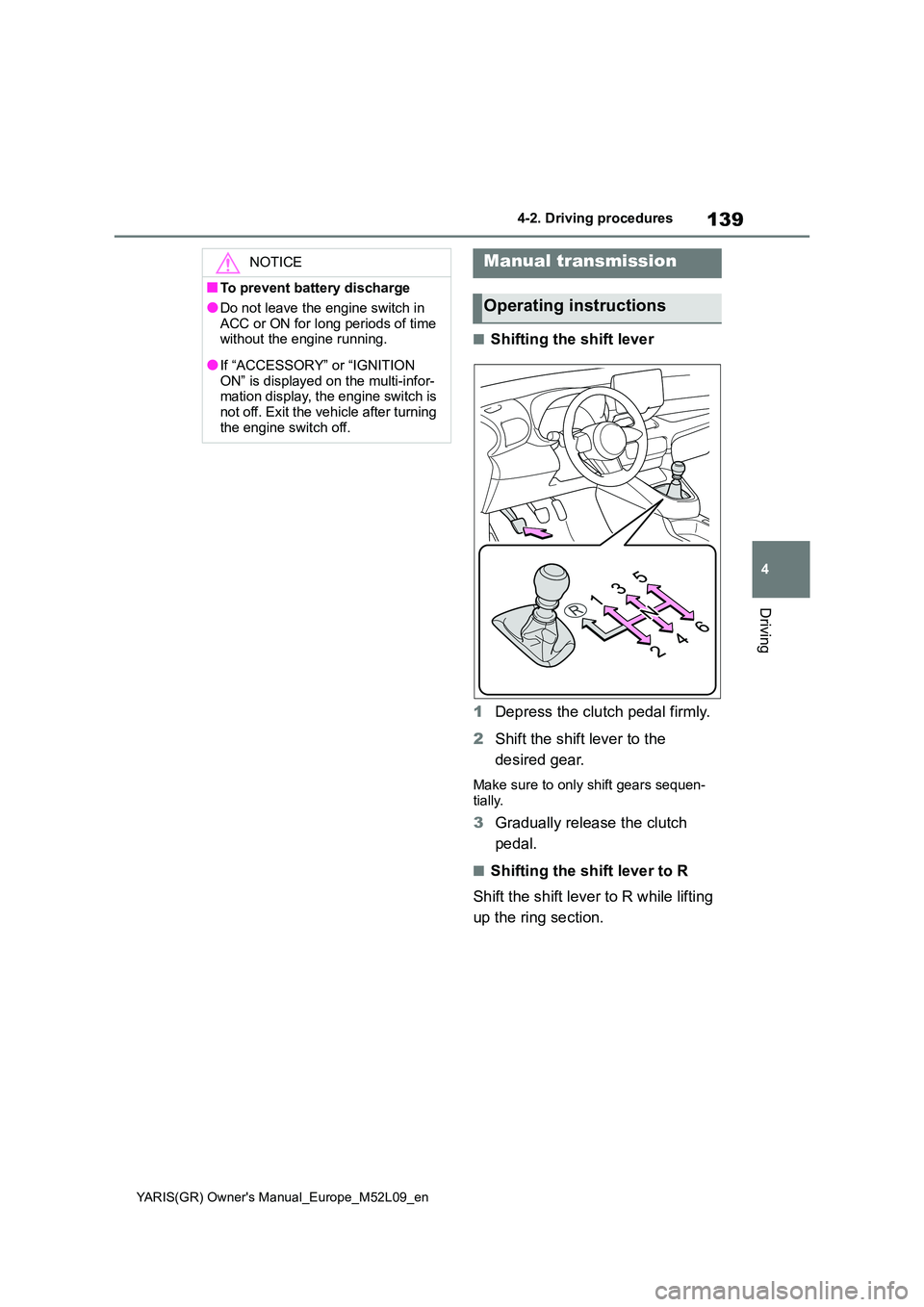
■Shifting the shift lever
1 Depress the clutch pedal firmly.
2 Shift the shift lever to the
desired gear.
Make sure to only shift gears sequen- tially.
3 Gradually release the clutch
pedal.
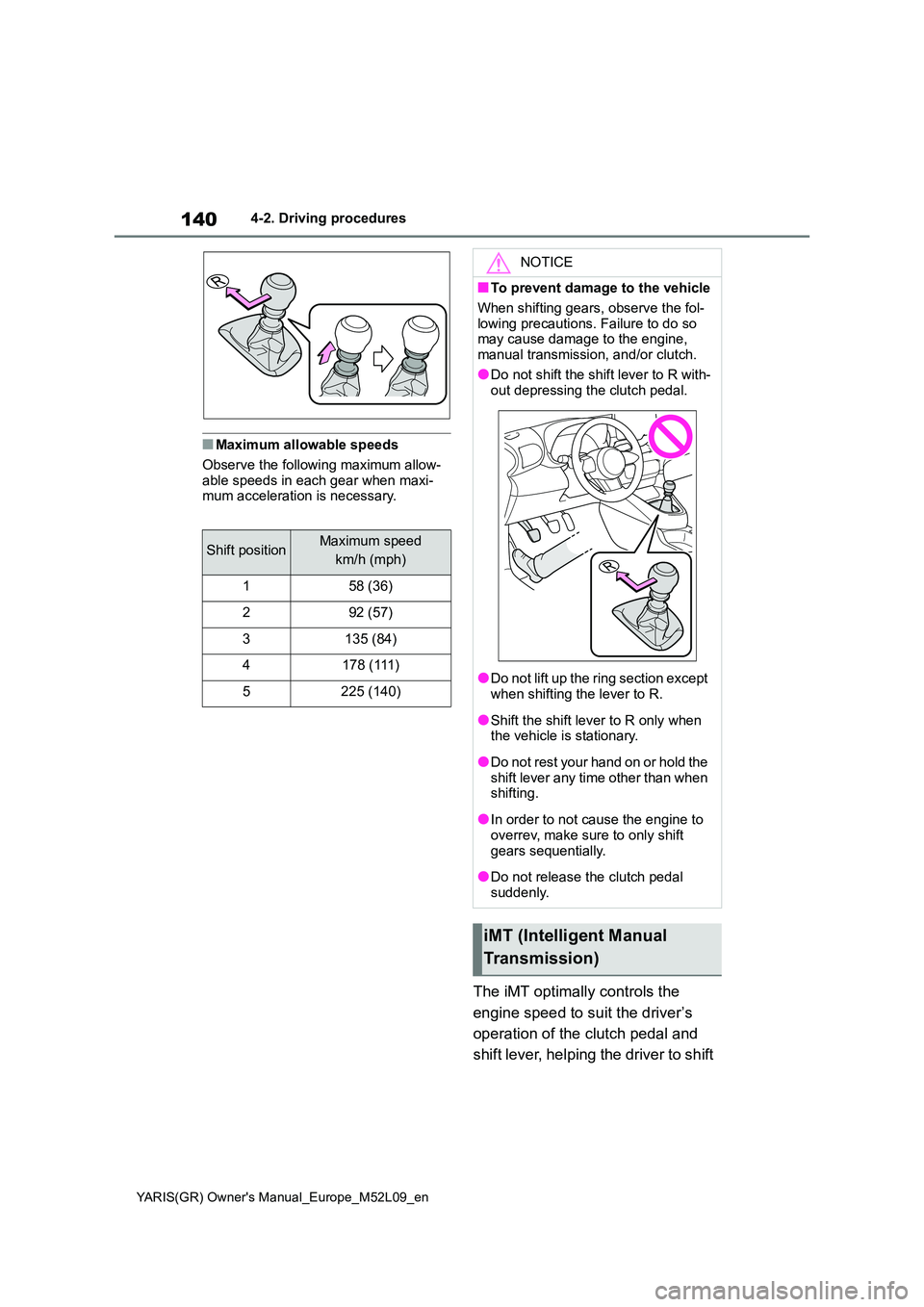
■Shifting the shift lever to R
Shift the shift lever to R while lifting
up the ring section.
NOTICE
■To prevent battery discharge
●Do not leave the engine switch in
ACC or ON for long periods of time without the engine running.
●If “ACCESSORY” or “IGNITION ON” is displayed on the multi-infor-mation display, the engine switch is
not off. Exit the vehicle after turning the engine switch off.
Manual transmission
Operating instructions
Page 142 of 458
140
YARIS(GR) Owner's Manual_Europe_M52L09_en
4-2. Driving procedures
■Maximum allowable speeds
Observe the following maximum allow-
able speeds in each gear when maxi- mum acceleration is necessary.
The iMT optimally controls the
engine speed to suit the driver’s
operation of the clutch pedal and
shift lever, helping the driver to shift
Shift positionMaximum speed
km/h (mph)
158 (36)
292 (57)
3135 (84)
4178 (111)
5225 (140)
NOTICE
■To prevent damage to the vehicle
When shifting gears, observe the fol-
lowing precautions. Failure to do so may cause damage to the engine, manual transmission, and/or clutch.
●Do not shift the shift lever to R with-out depressing the clutch pedal.
●Do not lift up the ring section except when shifting the lever to R.
●Shift the shift lever to R only when the vehicle is stationary.
●Do not rest your hand on or hold the shift lever any time other than when shifting.
●In order to not cause the engine to overrev, make sure to only shift
gears sequentially.
●Do not release the clutch pedal
suddenly.
iMT (Intelligent Manual
Transmission)
Page 199 of 458
197
4
YARIS(GR) Owner's Manual_Europe_M52L09_en
4-5. Using the driving support systems
Driving
●Installation and removal of electrical
components and wireless devices
may affect the Stop & Start system.
Contact any authorized Toyota retailer
or Toyota authorized repairer, or any
reliable repairer for details.
●When stopping the vehicle for a lon-
ger period of time, turn the engine
switch off to stop the engine com-
pletely.
●When the engine is restarted by the
Stop & Start system, the steering
wheel may temporarily feel heavy.
■Operating conditions
●The Stop & Start system is operational
when all of the following conditions
are met:
• The vehicle has been driven a certain
amount of time.
• The clutch pedal is not depressed.
• The shift lever is in N.
• The driver’s seat belt is fastened.
• The driver’s door is closed.
• The selected driving modes are nor-
mal mode and track mode.
• The windshield defogger is off.
• The engine is adequately warmed up.
• The outside temperature is -5°C
(23°F) or higher.
• The hood and back door are closed.
(P.197)
●In the following situations the engine
may not be stopped by the Stop &
Start system. This is not a malfunction
of the Stop & Start system.
• When the air conditioning system is
being used.
• When the battery is undergoing a peri-
odic recharge.
• When the battery is not sufficiently
charged, such as if the vehicle has
been parked for a long time and the
battery charge has decreased, the
electric load is large, the battery fluid
temperature is excessively low or the
battery has deteriorated.
• When the brake booster vacuum is
low.
• When the elapsed time since the
engine was restarted is short.
• When the vehicle is stopped fre-quently, such as when in a traffic jam.
• When the engine coolant temperature
or transmission fluid temperature is
extremely low or high.
• When the steering wheel is being
operated.
• When the vehicle is being driven in a
high altitude area.
• When the battery fluid temperature is
extremely low or high.
• For a while after the battery terminals
have been disconnected and recon-
nected.
●When the engine is stopped by the
S t o p & S t a r t s y s t e m , t h e e n g i n e w i l l b e
restarted automatically if any of the
following conditions are met:
(To enable the engine to be stopped by
the Stop & Start system again, drive the
vehicle.)
• The air conditioning system is turned
on.
• The windshield defogger is turned on.
• The driver’s seat belt is unfastened.
• The driver’s door is opened.
• The driving mode is changed from
normal mode and track mode to
another mode.
• The Stop & Start cancel switch is
pressed.
• The steering wheel is operated.
• The vehicle starts to roll on an incline.
●When the engine is stopped by the
Stop & Start system, the engine may
restart automatically in the following
situations: (To enable the engine to be
stopped by the Stop & Start system
again, drive the vehicle.)
• When the brake pedal is pumped or
strongly depressed.
• When the air conditioning system is
being used.
• When a switch of the air conditioning
system is operated (windshield defog-
ger switch, etc.).
• If the battery charge becomes low.
■When the hood is opened
If the hood is opened while the engine is
stopped by the Stop & Start system, the
engine will stall and will not be able to be