instrument panel TOYOTA GT86 2015 Owners Manual (in English)
[x] Cancel search | Manufacturer: TOYOTA, Model Year: 2015, Model line: GT86, Model: TOYOTA GT86 2015Pages: 464, PDF Size: 10.65 MB
Page 12 of 464
12
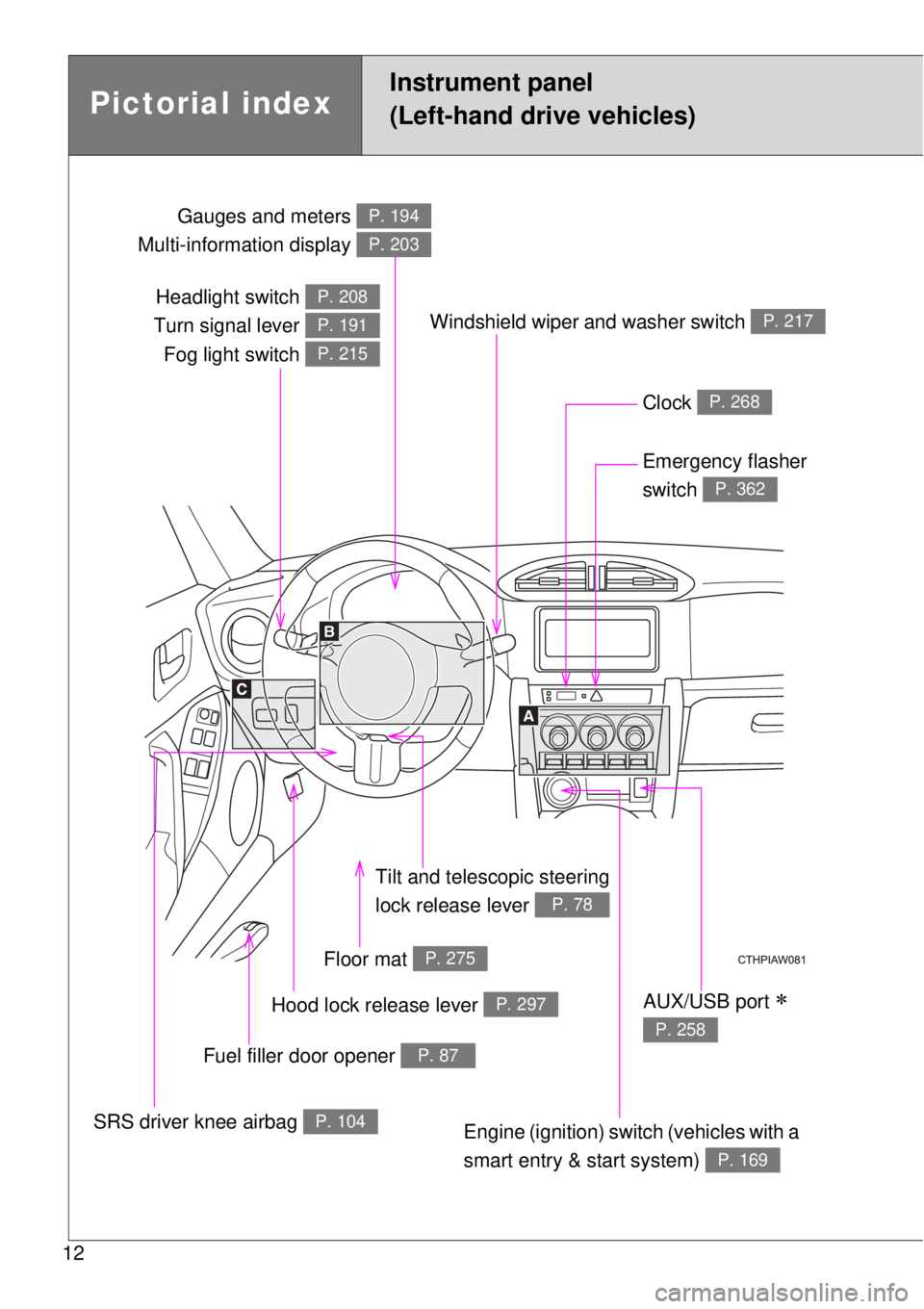
Headlight switch
Turn signal lever
Fog light switch P. 208
P. 191
P. 215
Gauges and meters
Multi-information display P. 194
P. 203
Clock P. 268
Windshield wiper and washer switch P. 217
Emergency flasher
switch
P. 362
Tilt and telescopic steering
lock release lever
P. 78
Floor mat P. 275
Hood lock release lever P. 297
Fuel filler door opener P. 87
SRS driver knee airbag P. 104Engine (ignition) switch (vehicles with a
smart entry & start system)
P. 169
AUX/USB port
P. 258
Pictorial index
Instrument panel
(Left-hand drive vehicles)
Page 14 of 464
14
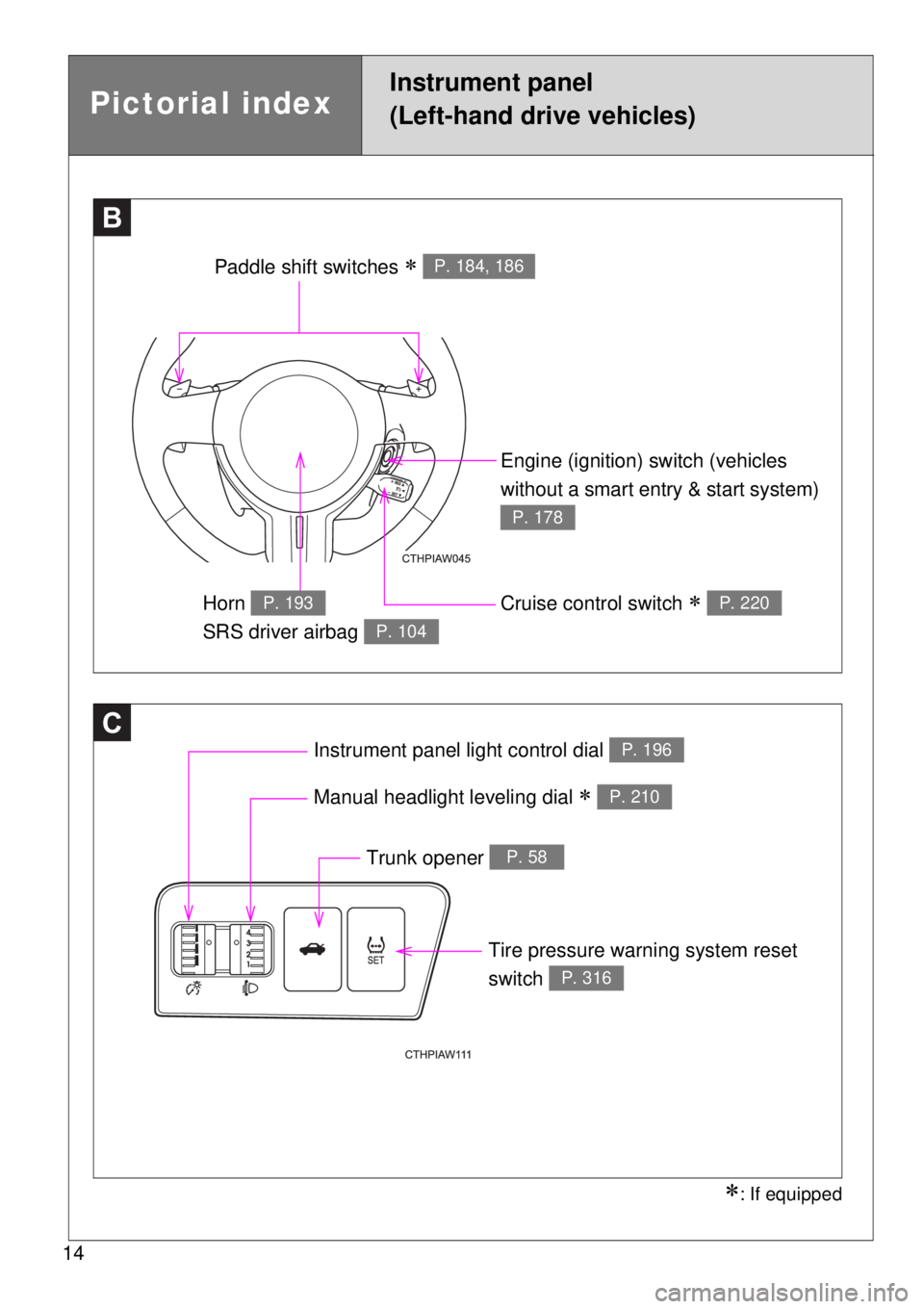
C
BB
Paddle shift switches P. 184, 186
Engine (ignition) switch (vehicles
without a smart entry & start system)
P. 178
Cruise control switch P. 220Horn
SRS driver airbag P. 193
P. 104
Instrument panel light control dial P. 196
Manual headlight leveling dial P. 210
Trunk opener P. 58
: If equipped
Pictorial index
Instrument panel
(Left-hand drive vehicles)
Tire pressure warning system reset
switch
P. 316
Page 19 of 464
19
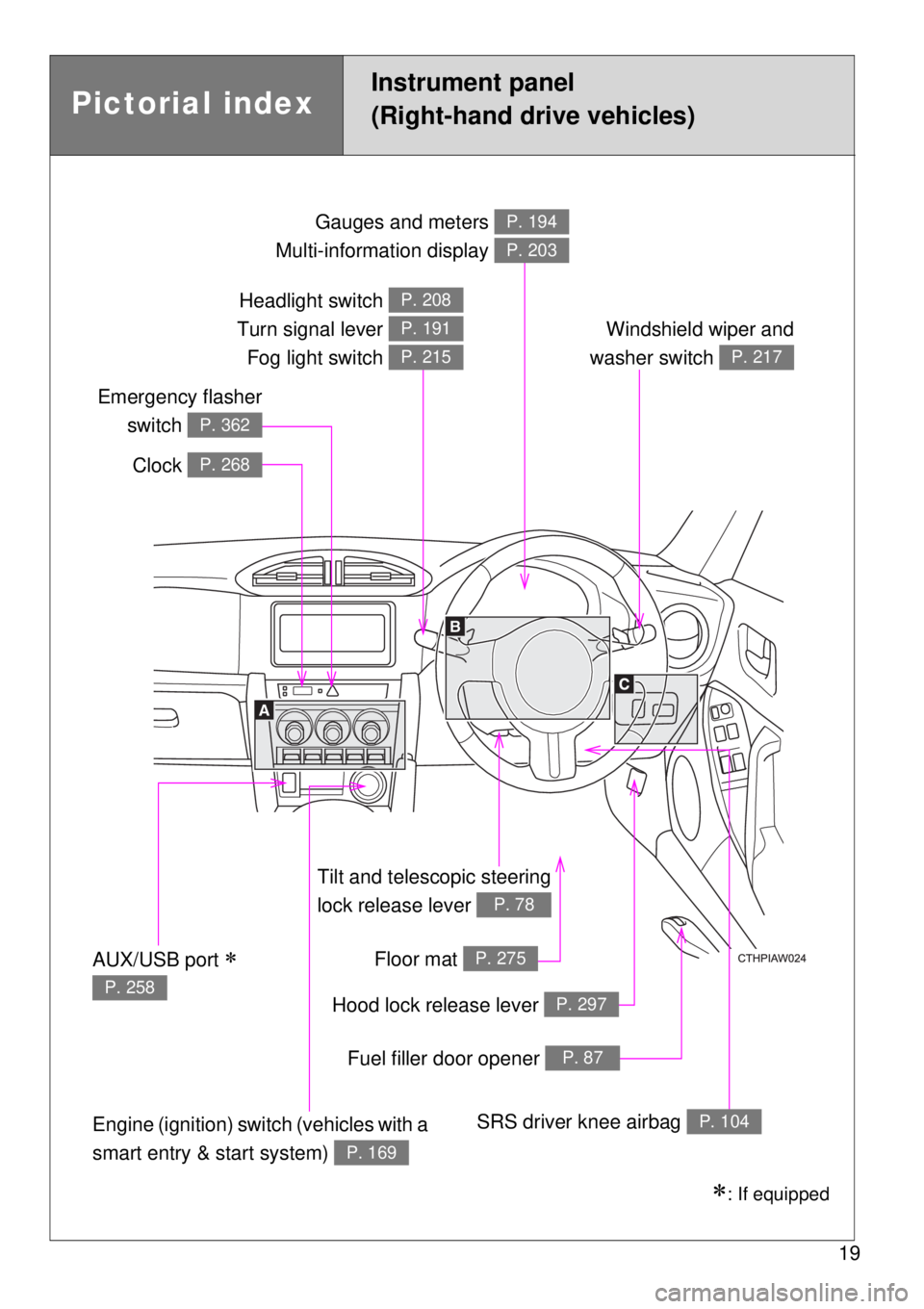
Tilt and telescopic steering
lock release lever
P. 78
Gauges and meters
Multi-information display P. 194
P. 203
Clock P. 268
Windshield wiper and
washer switch
P. 217
Emergency flasher
switch
P. 362
Floor mat P. 275
Hood lock release lever P. 297
Fuel filler door opener P. 87
Engine (ignition) switch (vehicles with a
smart entry & start system)
P. 169
SRS driver knee airbag P. 104
Headlight switch
Turn signal lever
Fog light switch P. 208
P. 191
P. 215
AUX/USB port
P. 258
: If equipped
Pictorial index
Instrument panel
(Right-hand drive vehicles)
Page 20 of 464
20
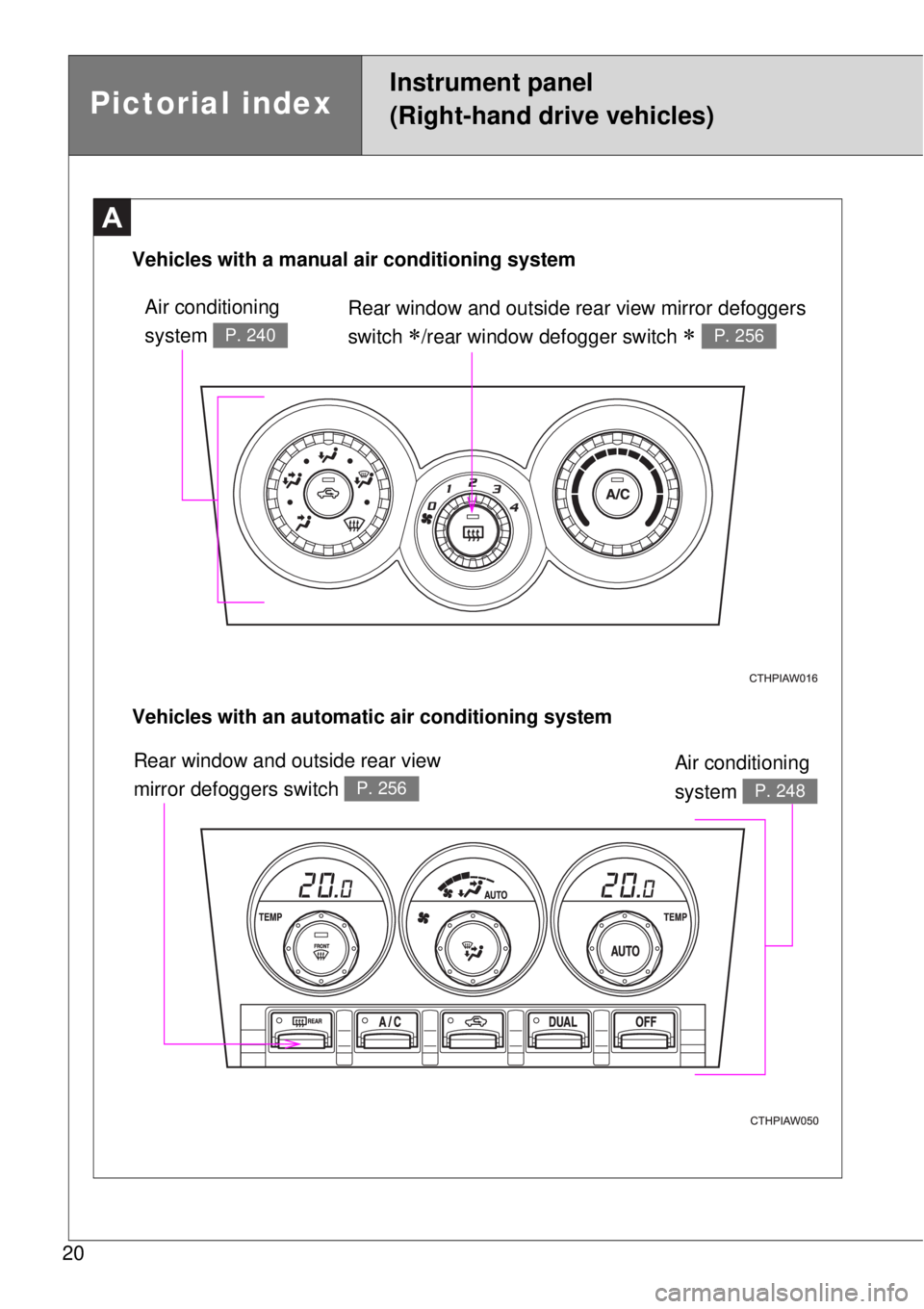
A
Rear window and outside rear view mirror defoggers
switch
/rear window defogger switch P. 256
Vehicles with an automatic air conditioning system Vehicles with a manual air conditioning system
Air conditioning
system
P. 240
Air conditioning
system
P. 248
Rear window and outside rear view
mirror defoggers switch
P. 256
Pictorial index
Instrument panel
(Right-hand drive vehicles)
Page 21 of 464
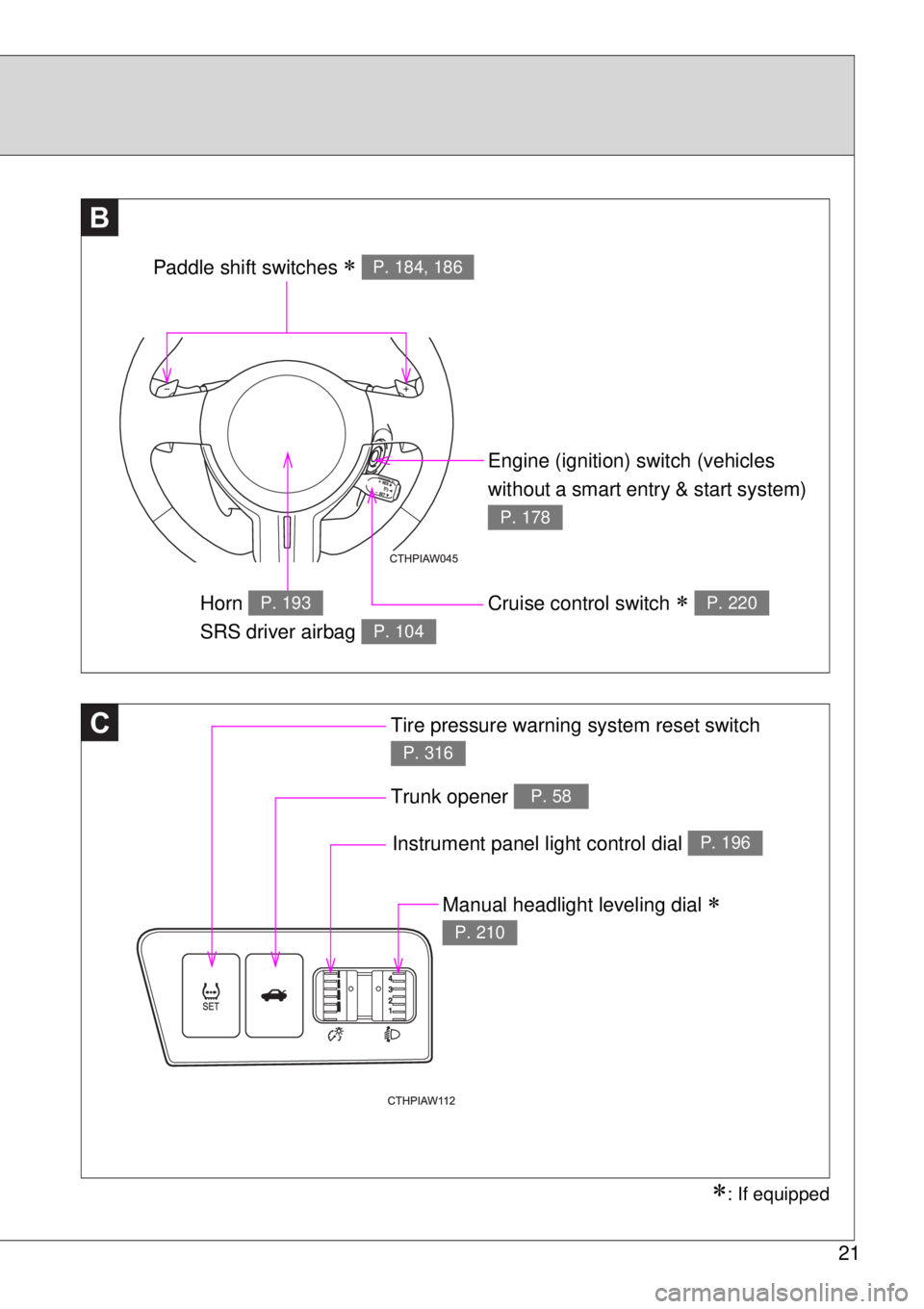
21
C
B
Engine (ignition) switch (vehicles
without a smart entry & start system)
P. 178
Cruise control switch P. 220Horn
SRS driver airbag P. 193
P. 104
Instrument panel light control dial P. 196
Manual headlight leveling dial
P. 210
Trunk opener P. 58
: If equipped
Paddle shift switches P. 184, 186
Tire pressure warning system reset switch
P. 316
Page 41 of 464

41 1-2. Opening, closing and locking the doors and trunk
1
Before driving
Notes for the entry function
Even when the electronic key is within the effective range (detection
areas), the system may not operate properly in the following cases:
• The electronic key is too close to the window or outside door handle,
near the ground, or in a high place when the doors are locked or
unlocked.
• The electronic key is near the ground or in a high place, or too close to
the rear bumper center when the trunk is unlocked.
• The electronic key is on the instrument panel, rear package tray or
floor, in the door pockets or glove box or auxiliary box when the engine
is started or “ENGINE START STOP” switch modes are changed.
Do not leave the electronic key on top of the instrument panel or near the
door pockets when exiting the vehicle. Depending on the radio wave
reception conditions, it may be detected by the antenna outside the cabin
and the door will become lockable from the outside, possibly trapping the
electronic key inside the vehicle.
As long as the electronic key is within the effective range, the doors may
be locked or unlocked by anyone.
Even if the electronic key is not inside the vehicle, it may be possible to
start the engine if the electronic key is near the window.
The doors may unlock if a large amount of water splashes on the door
handle, such as in the rain or in a car wash when the electronic key is
within the effective range. (The door will automatically be locked after
approximately 30 seconds if the doors are not opened and closed.)
Gripping the door handle when wearing a glove may not unlock the door.
If the wireless remote control is used to lock the doors when the elec-
tronic key is near the vehicle, there is a possibility that the door may not
be unlocked by the entry function. (Use the wireless remote control to
unlock the doors.)
A sudden approach to the effective range or door handle may prevent the
doors from being unlocked. In this case, return the door handle to the
original position and check that the doors unlock before pulling the door
handle again.
Page 109 of 464
109 1-7. Safety information
1
Before driving
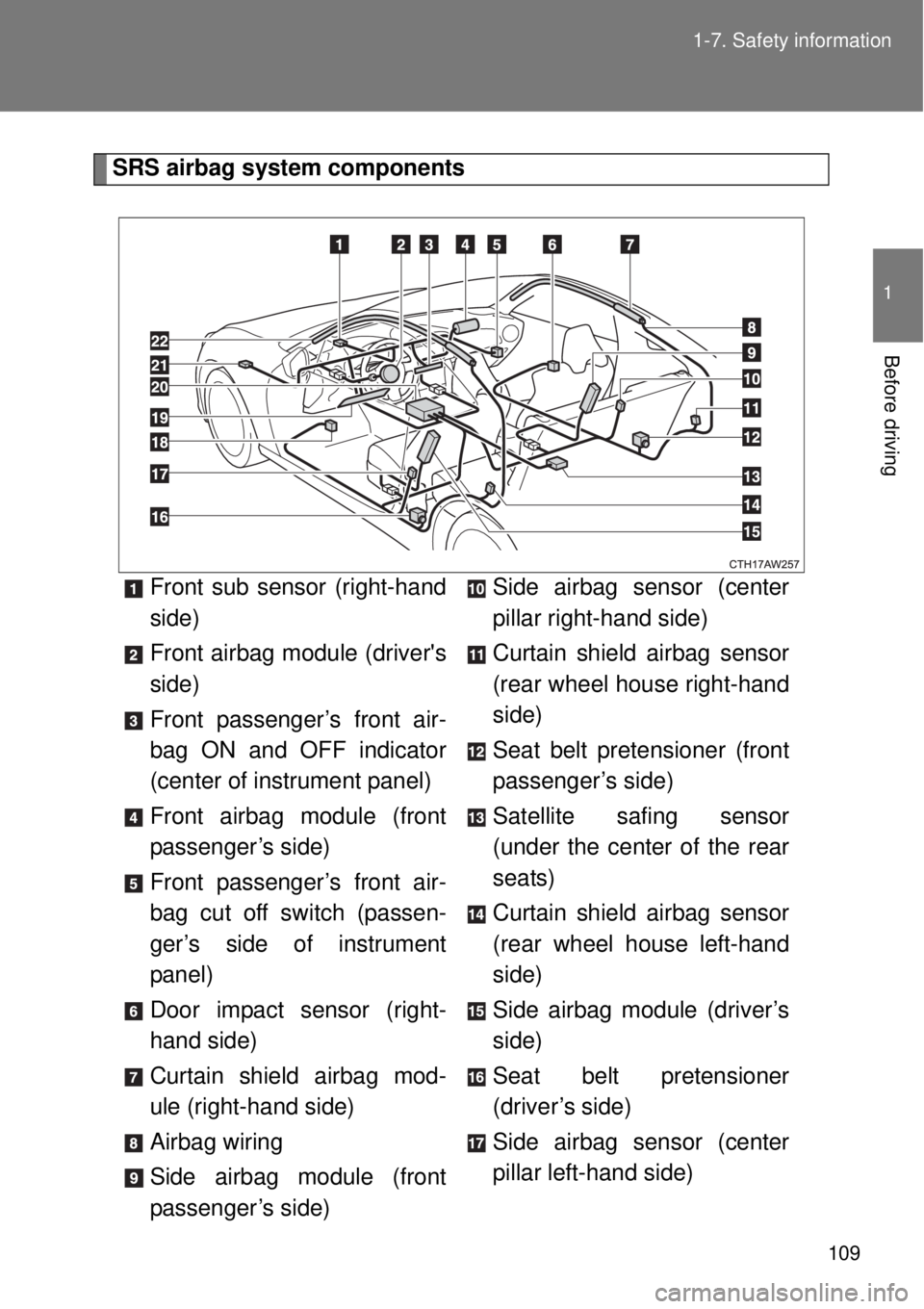
SRS airbag system components
Front sub sensor (right-hand
side)
Front airbag module (driver's
side)
Front passenger’s front air-
bag ON and OFF indicator
(center of instrument panel)
Front airbag module (front
passenger’s side)
Front passenger’s front air-
bag cut off switch (passen-
ger’s side of instrument
panel)
Door impact sensor (right-
hand side)
Curtain shield airbag mod-
ule (right-hand side)
Airbag wiring
Side airbag module (front
passenger’s side)Side airbag sensor (center
pillar right-hand side)
Curtain shield airbag sensor
(rear wheel house right-hand
side)
Seat belt pretensioner (front
passenger’s side)
Satellite safing sensor
(under the center of the rear
seats)
Curtain shield airbag sensor
(rear wheel house left-hand
side)
Side airbag module (driver’s
side)
Seat belt pretensioner
(driver’s side)
Side airbag sensor (center
pillar left-hand side)
Page 111 of 464

111 1-7. Safety information
1
Before driving
SRS front airbag
The driver’s SRS front airbag is stowed in the center portion of the steering
wheel. The driver’s knee airbag is stowed under the steering column. The
passenger’s SRS front airbag is stowed near the top of the dashboard under
an “SRS AIRBAG” mark.
In a moderate to severe front collision, the following components deploy.
SRS front airbag for driver
SRS front airbag for front passenger
Knee airbag for driver
These components supplement the seat belts by reducing the impact to the
occupant’s head, chest and knees.
If the SRS airbags deploy (inflate)
Bruising and slight abrasions may result from contact with a deploying
(inflating) SRS airbag.
A loud noise and white powder will be emitted.
Parts of the airbag module (steering wheel hub, airbag cover and inflator)
as well as the front seats, parts of the front and rear pillars, and roof side
rails, may be hot for several minutes. The airbag itself may also be hot.
The windshield may crack.
Front-seat passenger airbag manual cut off switch
The passenger-side front airbag can be deactivated by the cut off switch
located in the instrumental panel side. When the cut off switch is turned to
the deactivation mode the passenger-side front airbag becomes deacti-
vated. When the cutoff switch is turned to the activation mode the passen-
ger-side front airbag becomes active to deploy. While the passenger-side
front airbag is active the A/B ON indicator is illuminated.
Page 120 of 464

120 1-7. Safety information
The driver’s and front passenger’s SRS side airbags and SRS curtain shield
airbags deploy independently of each other since each has its own impact
sensor. Therefore, they may not both deploy in the same accident. Also, the
SRS side airbag and SRS curtain shield airbag deploy independently of the
driver’s and front passenger’s SRS front airbags in the steering wheel and
instrument panel.
An impact sensor, which senses impact force, is located in each of the left
and right center pillars, doors and rear wheel houses. Another impact sen-
sor, which also senses impact force, is located under the rear center seat.
If one of the center pillar impact sensors and the impact sensor that is
located under the rear center seat together sense an impact force above a
predetermined level in a side collision, the control module causes both the
SRS side airbag and SRS curtain shield airbag on the impacted side to
inflate regardless of whether the rear wheel house impact sensor on the
same side senses an impact.
If one of the rear wheel house impact sensors and the impact sensor that is
located under the rear center seat together sense an impact force above a
predetermined level in a side collision, the control module causes only the
SRS curtain shield airbag on the impacted side to inflate.
After the deployment, the SRS side airbag immediately starts to deflate. The
time required from detection of an impact to deflation of an SRS side airbag
after deployment is shorter than the blink of an eye. The SRS curtain shield
airbag remains inflated for a while following deployment then slowly deflates.
The SRS side airbag and SRS curtain shield airbag deploy even when no
one occupies the seat on the side on which an impact is applied.
Page 124 of 464
124 1-7. Safety information
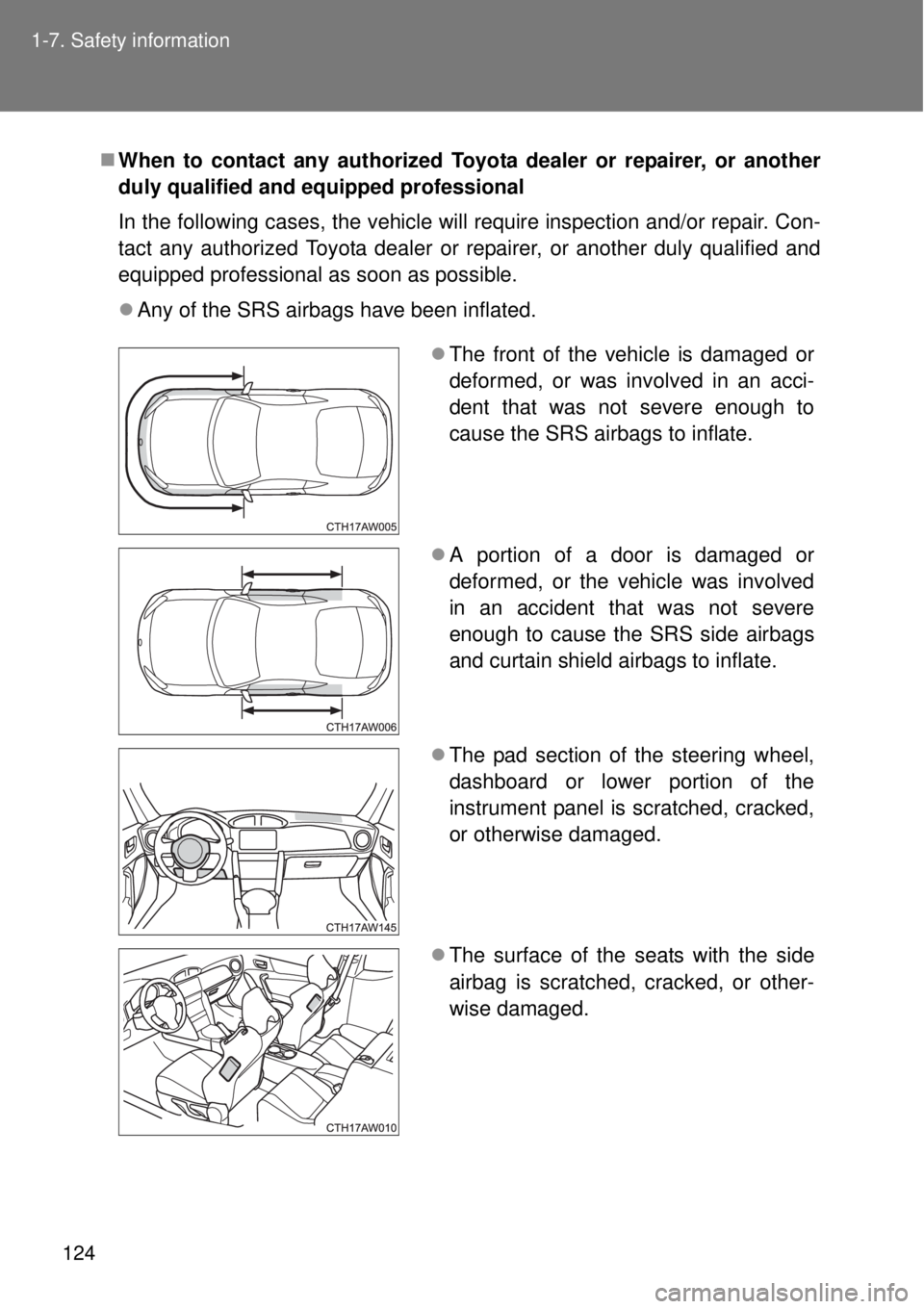
When to contact any authorized Toyota dealer or repairer, or another
duly qualified and equipped professional
In the following cases, the vehicle will require inspection and/or repair. Con-
tact any authorized Toyota dealer or repairer, or another duly qualified and
equipped professional as soon as possible.
Any of the SRS airbags have been inflated.
The front of the vehicle is damaged or
deformed, or was involved in an acci-
dent that was not severe enough to
cause the SRS airbags to inflate.
A portion of a door is damaged or
deformed, or the vehicle was involved
in an accident that was not severe
enough to cause the SRS side airbags
and curtain shield airbags to inflate.
The pad section of the steering wheel,
dashboard or lower portion of the
instrument panel is scratched, cracked,
or otherwise damaged.
The surface of the seats with the side
airbag is scratched, cracked, or other-
wise damaged.